Wagner RichardBiblio.com
21 933 résultats
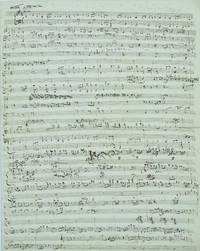
184541<p>Richard Wagner – Autograph draft of the overture to Tannhäuser<br /><br />2 folio pages in black ink on a single leaf. Recto: 29 lines; verso: 30 lines.<br /><br />These two pages constitute a draft of the overture to <em>Tannhäuser</em>. An inscription at the top reads "Ouverture" and "Andante maestuoso" the latter added later. The manuscript contains up to bar 166 an almost definitive version dating from 1845. The following 129 bars are crossed out in pencil and were not used in the final version.<br /><br />The beginning of Wolfram's section slightly modified has been removed "Dir hohe Liebe töne begeistert mein Gesang" up to "ewig strahlt dein Stern" from the singers' contest in Act II here in G major followed by a combination of its initial motif with Tannhäuser's hymn of praise.<br /><br />The complete overture comprises 442 bars in its final version.</p>
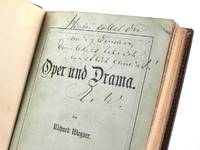
186983415Leipzig: Verlagsbuchhandlung von J.J. Weber 1869. Fine. Verlagsbuchhandlung von J.J. Weber Leipzig 1869 14.50 x 23 cm relié Inscribed copy concealing the secret truth of Wagner's thwarted love story Second edition with parts previously unpublished with a new preface ""An Constantin Frantz"" dated April 28 1868 Tribschen bei Luzern. The first edition was published by the same publisher in 1852. Full burgundy morocco binding spine with five raised bands gilt date at foot marbled endpapers and pastedowns gilt turn-ins original first softcover preserved top edge gilt gilt leading edges. Some foxing more pronounced on some leaves a small restoration to the upper right-hand corner on pages IX-XIV not affecting the text pencil annotation on pages 116 and 139 skillful restorations to head and foot of the upper joint. Exceptionally and intimately signed and inscribed by Richard Wagner to a mysterious dedicatee:« Hierbei sollst du meiner gedenken denn alles habe ich ernstlich gemeint. R. W. » At this you shall remember me for I have meant everything seriously. This moving autograph confession with its highly personal tone written on the most important of his theoretical writings radically differs from the hasty ""Zur Erinnerung"" written by the composer on his opera scores or the little notes he used to hand out to patrons after concerts. We did not find any other inscribed copies of Oper und Drama' on the market or in public institutions. However the composer's autobiography and correspondence reveal the existence of two dedications on this major work. The first was addressed to Theodor Uhlig on the original manuscript with an autograph inscription inspired by Goethe. The second and only other inscription mentioned in a letter from Wagner is said to have been made for Malwida von Meysenbug on the same edition as our copy. Although it is not impossible this could be the very same inscription written on the ""book of all books on music"" according to Richard Strauss the style and content of the inscribed words allow for an even more prestigious attribution. A ""VERY SOLID"" MANIFESTO In February 1851 Wagner completed Oper und Drama. This ""very solid book"" - as described in a letter to Franz Liszt - sets out the revolutionary principles of Leitmotiv and Gesamtkunstwerk political and aesthetic utopia of a musical drama acting as a synthesis of the Arts. The text is part of his Zürcher Kunstschriften three seminal essays written during his Swiss exile along with Kunstwerk der Zukunft' and Die Kunst und die Revolution'. He outlines in his treatises the shape of his future scenic festival"" - the celebrated Ring and includes his reflections on the relationship between art and society as well as his theories on the future of opera. In 1868 he decided to complete the composition of this monumental tetralogy and simultaneously worked on the second edition of Oper und Drama' published at the end of 1868 - mistakenly stated on the cover as 1869. In the end it differed from the previous edition only in its new preface the very few changes proving once more the permanence of his musical and artistic vision almost twenty years after it was first written. Wagner will tirelessly defend and promote his ideas which found their ultimate achievement during the 1876 Bayreuth festival. This second corrected edition with a revised preface is an integral part of the artist's creative process giving his reflections the status of a political and musical manifesto as evidenced by the intimate and enigmatic dedication on our copy. The importance of this work in the eyes of the composer the absence of any explicit attribution to the inscription's recipient the use of the familiar form of address and the content of the message confirm the importance of the dedicatee and his place within the author's inner circle. Among the personalities around the master at the time of this inscription several may have inspired these words: FRIEDRICH Friedrich Nietzsch Verlagsbuchhandlung von J.J. Weber paperback
186983415Verlagsbuchhandlung von J.J. Weber | Leipzig 1869 | 14.50 x 23 cm | relié
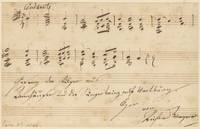
39462Oblong octavo 101 x 160 mm. . The first 8 measures. Notated in black ink on four staves the four vocal parts incorporated into one stave. Inscribed below the quote: "Gesang der Pilger aus Tannhäuser und der Sängerkrieg auf Wartburg . von Richard Wagner." With the date "Janu. 3d 1846" in the hand of the British concert manager and critic John Ella 1802-1888 at lower left presumably the day on which Wagner both penned the quotation and presented it to Ella.<br /> <br /> Together with:<br /> An original 19th century photograph of Wagner 82 x 53 mm. The composer is depicted half-length turned left with his right hand extending into jacket pocket. <br /> <br /> Together with:<br /> A 1-page 167 x 245 mm. autograph statement in Ella's hand relating how he acquired the present autograph: "The property of Prof. Ella 9 Victoria Square S.W XI/113. Written in my Album and presented to me in Dresden as a memento of my visit & a token of friendship. This Autograph was exhibited in the 'Loan Collection' at South Kensington 1885 Jno Ella. Entered in collection list by John Belcher." <br /> <br /> The three items laid down onto a triple-windowed mat 360 x 278 mm. Minor foxing to Wagner autograph; photograph slightly faded. The ensemble in very good condition overall. Tannhäuser a grand opera in three acts to a libretto by the composer was first performed in Dresden at the Hoftheater on 19 October 1845.<br /> <br /> "Wagner's text is a conflation of two separate medieval legends: those concerning Tannhäuser believed originally to have been a crusading knight from Franconia and the song contest on the Wartburg - drawing on a number of 19th-century versions notably those of Ludwig Tieck E. T. A. Hoffmann Heinrich Heine Friedrich de la Motte Fouqué and Joseph Eichendorff. The anachronistic linking of the two legends was originally made by Ludwig Bechstein in Der Sagenschatz und die Sagenkreise des Thüringerlandes of 1835-8 see Spencer 1976 and reinforced by a contemporary scholar C. T. L. Lucas. .<br /> <br /> The uncomprehending response of the audience at the first performance on 19 October 1845 was largely due to the inability of Joseph Tichatschek the singer of the leading role to grasp the principle of melos towards which Wagner was progressing. His abnormal vocal demands also took their toll on Wilhelmine Schröder-Devrient Venus his niece Johanna Wagner Elisabeth and Anton Mitterwuizer Wolfram. However by the mid-1850s the work had established itself in the repertory of more than 40 German opera houses. An invitation from Emperor Napoleon III to stage Tannhäuser in Paris led to one of the most celebrated débâcles in the annals of operatic history .<br /> <br /> Tannhäuser with its frequently abrupt contrasts and rudimentary motivic integration falls well short of the mature Wagnerian music drama. Yet it marks a considerable advance over Der fliegende Holländer in the deployment of the orchestra continues Wagner's preoccupation with the dramatic conception or 'poetic intent' and shows some awareness of what he later referred to as 'the beautiful convincing necessity of transition'." Barry Millington in Grove Music Online<br /> <br /> "Tannhäuser is based on two German legends: 'Tannhäuser' the mythologized medieval German Minnesänger and poet and the tale of the 'Wartburg Song Contest'. The story centers on the struggle between sacred and profane love and redemption through love a theme running through much of Wagner's mature work. One of the most famous parts from the opera is the 'Pilgrim's Chorus'. The theme of this chorus is already present in the overture of the opera and concludes this mighty stage work with the same music in the form of a majestic hymn which glorifies the victory of pure love over sinful passion." Baton Music Online<br /> <br /> "Throughout his career Ella made regular trips to Europe where he forged important contacts with foreign musicians. Thalberg Meyerbeer and Berlioz were among his friends. . John Ella contributed meaningfully to musical life in London during the 19th century and promoted many musicians and singers who are still regarded today as preeminent among their contemporaries. His published writings include Musical Sketches Abroad and at Home London 1869 3/1878 and Lectures on Dramatic Music and Musical Education London 1872." Christina Bashford in Grove Music Online. unknown
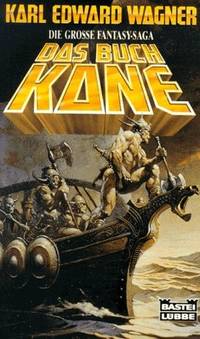
19892529BASTEI-LÜBBE 04-06/1989. 1. softcover. Sage von Kane Die Kane 2012120124 BASTEI-LÜBBE paperback
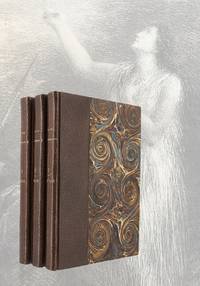
188584667Paris: Imprimeries MorelletBoyer & Cie 1885. Fine. Wagner's influence on literary and artistic avant-garde Imprimeries Morellet Boyer & Cie Paris 1885-1888 16.80 x 24.60 cm 3 volumes reliés Complete collection in 36 issues including three double issues bound in three volumes - First year: 12 issues from 8 February 1885 to 6 January 1886 - Second year: 12 issues from 8 February 1886 to 15 January 1887 - Third year: 12 issues from February 1887 to January 1888. Illustrated with 4 full-page lithographs by Fantin-Latour: L'Évocation d'Erda - Odilon Redon : Brünnhilde - Jacques-Emile Blanche : Tristan et Isolde and Le pur-simple. Three quarter brown morocco binding smooth spine titled in gilt marbled paper boards marbled paper endpapers and pastedowns orignal wrappers preserved binding signed by Dupré. Numerous contributions from some of the most prominent writers critics poets and musicians of the late 19th-century including Wagner himself: Charles and Pierre Bonnier Jules de Brayer Alfred Ernst Joris-Karl Huysmans Fourcaud René Ghil Stuart Merrill Stéphane Mallarmé Catulle Mendès Éphraïm Mikhael Pierre Quillard Jean Richepin Émile Hennequin Charles Vignier Charles Morice Paul Verlaine Villiers de l'Ilse Adam Teodor de Wyzewa Stewart Chamberlain Gerard de Nerval Souvenirs sur Lohengrin Jean Ajalbert Gabriel Mourey Adolphe Jullien Tola Dorian Swinburne Evenepoel Franz Liszt. A very valuable complete collection of this avant-garde journal both literary and aimed at presenting Wagner's works through a new aesthetic. Imprimeries MorelletBoyer & Cie hardcover
19911633BASTEI-LÜBBE 09/1991-03/93. 4. softcover. Sage von Kane Die Kane 2012120124 BASTEI-LÜBBE paperback
188584667Imprimeries Morellet Boyer & Cie | Paris 1885-1888 | 16.80 x 24.60 cm | 3 volumes reliés
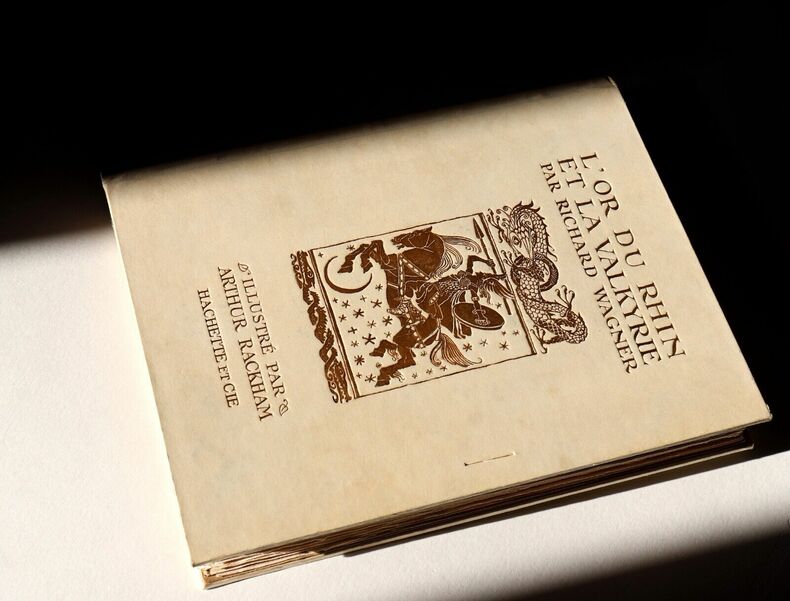
1910AMO-4504L'ANNEAU DU NIBELUNG | Tetralogie par Richard Wagner. L'Or du Rhin | La Walkyrie | Siegfried | Le Crépuscule des Dieux. Premier volume : L'Or du Rhin et la Valkyrie, par Richard Wagner, avec illustrations par Arthur Rackham. Traduits en prose rythmée par Alfred Ernst. Paris, Hachette et Cie (imprimerie Ballantyne and Company Ltd, Londres), sans date (1910) X-158-(2) pages et 34 compositions en couleurs contrecollées sur papier marron. 4 hors-textes contrecollés présentes de petites traces de pli (sans gravité). Quelques feuillets avec légère décharge (acidité du papier marron sur lequel sont montés les hors-texte). Beau papier vélin de cuve. Tirage numéroté à 330 exemplaires dont 30 exemplaires sur Japon signés par l'artiste et 300 exemplaires sur papier vélin à la forme. Celui-ci, un des 300 exemplaires sur papier vélin à la forme et numéroté au composteur (n°245). Reliure éditeur plein vélin décoré doré. Reliure très fraîche. Rubans absents. Deuxième volume : Siegfried et Le Crépuscule des Dieux, par Richard Wagner, avec illustrations par Arthur Rackham. Traduits en prose rythmée par Alfred Ernst. Paris, Hachette et Cie (imprimerie Ballantyne and Co Limited, Londres), sans date (1911) (8)-185-(2) pages et 30 compositions en couleurs contrecollées sur papier marron. Parfait état intérieur. Tirage numéroté à 390 exemplaires dont 40 exemplaires sur Japon signés par l'artiste et 350 exemplaires sur papier vélin à la forme. Celui-ci, un des 40 exemplaires sur Japon signés et numéroté (n°24) à la plume par Arthur Rackham.
253812 pages of a bifolium; second leaf blank. Small folio 208 x 270 mm. Dated Paris May 7 1841. On stationery with Wagner's monogrammatic blindstamp to upper left corner. In German with translation.<br/><br/>A long densely-written letter regarding Wagner's proposed biography of Beethoven and mentioning his opera Rienzi.<br/><br/>Wagner who was trying to eke out a living in Paris at the time attempts to interest Winkler in his two-volume monograph on Beethoven based on the research of Wagner's friend Gottfried Engelbert Anders 1795-1866 a German-born librarian in Paris. Wagner declares his intention to supersede Anton Schindler's biography of Beethoven published in the previous year which he considers inadequate. He asks Winkler to recommend him to the publisher Christoph Arnold 1763-1847 and names his and Anders's requested fees to be paid in part as advances: <br/><br/>"Herr Anders found Schindler's book to be very poor compared to his own collection of communications on Beethoven . also every thoughtful and sensitive reader has expressed his opinion on Schindler's book that it falls short of meeting the demands of a true biography as it had been expected. Herr Anders was prompted to realize his long-cherished dream. As his position. leaves him hardly any time and he also confesses that an easy fluent realization will not come to him he has offered to leave me all his rich material and to discuss everything with me but to have the book itself written by me. Avoiding any fussy pedantic scholarly philistinism of citation our book shall be more like a great novel on an artist than like a dry enumeration of chronologically ordered dates and anecdotes."<br/><br/>In the final paragraph Wagner expresses his frustration about the long silence of the Dresden court opera regarding a possible production of his opera Rienzi:<br/><br/>"I have to confess to you that my opera Rienzi still means more to me than anything else. I am almost dying of my unruly lack of patience concerning the decision of the general direction. A negative decision.will cost me half a year during which I could have entered negotiations with a different theater."<br/><br/>Provenance<br/>From the noted autograph collection of Louis Koch.<br/><br/>Slightly creased; small professional repairs to edges; professionally guarded at inner edge of final leaf. WBV 169. Richard Wagner: Sämtliche Briefe I no. 149 pp. 481-86. Kinsky: Manuskripte Briefe Dokumente von Scarlatti bis Stravinsky: Katalog der Musikautographensammlung Louis Koch pp. 250-51 with facsimile of first page.<br/><br/>Theodor Winkler 1775-1856 better known under his pseudonym Theodor Hell was the editor-in-chief of the daily Dresdner Abend-Zeitung for which Wagner worked as a Paris correspondent. Enclosed with the present letter was Wagner's third "Pariser Bericht" dated May 5 1841. Winkler was active in many fields; trained as a lawyer he achieved fame as a poet editor arts administrator and stage director.<br/><br/>Wagner's biography of Beethoven did not in fact materialize. After Arnold declined the publishers Brockhaus and Cotta did the same. <br/><br/>Rienzi was first performed at the Dresden court opera on October 20 1842. unknown books
alb78a07c1366618221Wagner N.P. Tales, Tales and Stories of Kota-Murlyka. In 6 Vol. In Russian /Vagner N.P. Povesti, skazki i rasskazy Kota-Murlyki. V 6 t. Nikolai Petrovich Wagner (1829-1907), a Russian zoologist, professor, and one of the most distinguished writers of his time, published his popular Tales of the Kota-Murlyki in 1872, which were republished nine times before the revolution. We have thousands of titles and often several copies of each title may be available. Please feel free to contact us for a detailed description of the copies available. SKUalb78a07c1366618221.
17258364Paris, C. Labottière, 1725. Petit in-8 (166 x 105 mm), XXI pp., 5 pp. n. ch., 244 pp. Maroquin rouge, triple filet doré encadrant les plats avec les armoiries dorées au centre, dos à nerfs orné avec fleurs de lis dorées, coupes et coiffes décorées, roulette intérieure dorée, tranches dorées, infime accroc sur un mors, petit trou supprimant une lettre du titre (reliure de l’époque).
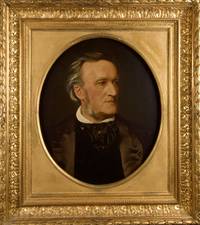
39768On re-lined canvas within contemporary decorative wooden frame gilt. Original oval wooden stretcher. Image 64.5 x 54 cm 25.25 x 21.3 inches frame 82 x 72.5 cm 32.25 x 28.5 inches.<br /> <br /> The composer is depicted quarter-length turned slightly left. He wears a white shirt dark olive brown jacket with satin lapels black waistcoat and dark brown silk cravat with decorative gold pin with a jeweled center.<br /> <br /> Some minor cracking to the subject's left shoulder otherwise in very good condition. Frame slightly worn. The painting closely resembles a number of contemporary photographic images of Wagner dating from the 1870s. unknown
16-3657Berne: Haller - J. Fr. Wagner 1838-1839. Folio. 53 x 38 cm. Later 1/2 morocco with marbled boards and endpapers created by J. Ardouin. Lithographed title and 30 plates in 2 tones drawn and lithographed by Adolphe Otth etpritned by Wagner. Lacks the explications of plates 21-25. Pages have been washed to total freshnessBrunet IV-254 / Graesse V-62; Playfair 773; Gay 830. OCLC Number: 465452437Adolphe Otth 1803-1839 curieusement référencé Otten par Brunet et Graesseétudia la médecine ainsi que les sciences naturelles sous la direction de Seringeet Candolle. Il entreprit en 1837 un premier voyage en Provence aux Baléares eten Algérie d’où il revint avec les matériaux pour la suite de planches que nousprésentons ici. Il entreprit ensuite en 1839 un second voyage en Italie en Grèceen Egypte en Syrie qui le mena jusqu’à Jérusalem où il mourut de la peste peuaprès son arrivée.Ces très belles planches nous montrent des vues des monuments et jardinsd’Alger le golfe les mosquées l’aqueduc de Bab-el-Oued la Casbah le four àchaux le port les rues le café des platanes le fort… Elles sont accompagnéesd’un avant-propos et des explications des planches.Exemplaire lavé parfaitement établi.Manque un ou 2 feuillets d’explications pour les planches XXI à XXV petitesréparations marginales.Édition originale publiée en livraisons.Ravissant album complet des 30 grandes lithographies représentant Alger et ses environs en 1839 : le faubourg de Bab-El-Oued les jardins du Dey le golfe une mosquée le port le fort de l'Empereur intérieur de maison.etc.Paysagiste et lithographe le bernois Adolph Otth voyage en Algérie après la Conquête du pays par les armées françaises :«J'ai rapporté de mes courses un nombre considérable d'esquisses dont je ne destine qu'une trentaine des plus intéressantes à composer ce recueil. Ce qui ajoutera peut-être quelque chose au mérite et à l' intérêt de cet ouvrage c'est que ces vues ont été esquissées sur les lieux et lithographiées par le voyageur lui-même sur ses dessins originaux ce qui se rencontre assez rarement.» Avant-ProposCarl Adolf Adolphe Otth April 2 1803 Bern - May 16 1839 was a Swiss physician and . In 1838 he published a book with thirty lithographs based on a trip to Algiers titled Esquisses africaines dessinées pendant un voyage a Alger et lithographiées par Adolphe Otth. In 1839 during a journey to the Middle East he died .Dans un autre ouvrage très intéressant les " Esquisses Africaines " dessinées pendant un voyage à Alger et lithographiées par Adolphe Otth docteur en médecine et naturaliste suisse - 1803-1839 et imprimées par J.F. Wagner lithographe à Berne quatre des trente planches représentant des vues étonnamment précises de notre ville vers 1837. L'ouvrage a été édité en 1840 à Berne.L'auteur dit dans son introduction : " Je fis d'Alger des excursions dans toutes les directions et aussi loin qu'un voyageur isolé et sans protection le pouvait sans trop éminemment risquer sa vie. Je parcourus en tout sens le littoral accidenté d'Alger la fameuse Plaine de Metidjah jusque près de Bélida j'allais par mer à Bougia ville presque entièrement dévastée par les Français mais admirablement située au pied des rochers escarpés du Cap Carbon et entourée de la chaîne majestueuse de l'Atlas qui avance jusqu'au bord du vaste golfe. Une course sur la cime du Gourayah m'a montré l'Atlas dans toute son imposante grandeur et m'a dédommagé en quelques sorte de l'impossibilité de la traverser jusqu'à Constantine ".Expertise by :Emmanuel LHERMITTEAssesseur de la Commission de conciliation et d’expertise douanièreMembre de la Compagnie Nationale des ExpertsAssisté de Stéphanie MARTIN Berne: Haller - J. Fr. Wagner, 1838-1839 hardcover
19781354BASTEI-LÜBBE 1978-80. 1. softcover. Sage von Kane Die Kane 200042000920011200152002320026 BASTEI-LÜBBE paperback
884629One page in German with an integral blank leaf; Lucerne 1872 April 13 to the noted bass-baritione Karl Hill. Hill was an eccentric and difficult artist with a rather unsavory reputation . Nevertheless Wagner was seriously thinking of engaging him having heard from friends that his artistry was of the highest caliber. This letter concerns Wagner's desire to engage him for the upcoming premier of 'The Ring of the Niebelung" in Bayreuth. Wagner writes: "I know you well enough by reputation to have thought seriously about using you in my projected performance. I am planning next fall and winter to review all the availble musical and mimetic resources for which I have had no time in recent years.If I did not know you I should have had to go to my old friend Betz in Berlin who has already agreed to sing the baritone solo at Beethoven's 9th Symphony.". Wagner's reference to the Beethoven 9th concerns the special performance held on May 22 1872 when the foundation stone of the Bayreuth Festspielhaus was laid. Wagner was indeed able to engage the elusive Hill who premiered the roles of Alberich and Klingsor in Parsifal some years later. Hill's career lasted until the early 90s when he was institutionalized after suffering a nervous breakdown. He died soon thereafter. Some age toning otherwise a wonderful Wagner letter strong and clean with excellent content. Excellent. unknown
1989370BASTEI-LÜBBE 07/1989-02/90. 2. softcover. Sage von Kane Die Kane 2012120124 BASTEI-LÜBBE paperback
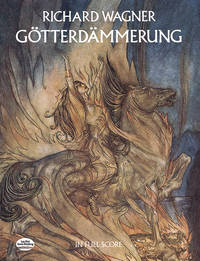
198251508DOVER PUBLICATIONS 1982. 1. hardcover. Ring der Nibelungen Sirmkovrilo! Partitur in deutscher Sprache! DOVER PUBLICATIONS hardcover
1910001353London: Heinemann 1910. Two volumes complete - Volume I - Rhinegold ix 1 159pp 1 thirty-four colour illustrations tipped on to brown paper and Volume II - Siegfried published in 1911 ix 1 181pp 3 thirty colour illustrations tipped on to brown paper. Original full vellum gilt to spines and upper covers t.e.g. Spine of Rhinegold slightly rubbed and faded Siegfried lacks tie some light spotting to covers some off setting from brown paper to next text leaf but generally quite bright and clean. Each illustration with titled tissue guard. Rhinegold is number two hundred and fifty-one of eleven hundred copies Siegfried is number five hundred and eighty-eight both signed by Rackham to limitation leaf. Both housed in a leather entry cloth slipcase . Riall page 103. Signed by Illustrator. First Edition. Full Vellum. Good/No Jacket. Illus. by Rackham Arthur. 4to. Limited Edition. Heinemann Hardcover
129019aaf1) Zürich, Joh. Heinrich Lindinner / 2) Zürich : Getrukt, bey Joh. Rudolf Simmler, 1701, 1704, in-12° (13,5:9 cm)., 5 Bll. + 258 S. + 1 gefalt. gest. Karte + 39 Kupfertafeln / Mit gest. Titel + 23 Ansichten auf 11 Kupfertafeln + 3 Bll. (statt 4: = ohne Drucktitel) + 408 S., Pergament d. Zeit / Cont. vellum.
1889272886Berlin: Berlin Kunstdruck - und Verlags-Anstalt 1889. First. unbound. near fine. Carl Emil Doepler. Group of 39 of 40 total large plates showing costume designs for all the characters in Wagner's Ring by Carl Emil Doepler. Beautifully printed chromolithograph plates with excellent details 13-1/2" x 18" loose as issued and protected in a new gray cloth portfolio box with red leather spine label and the original title text mounted on front. Berlin: Berlin Kunstdruck- und Verlags-Anstalt Vormals A. & C. Kaufmann 1889. First edition. The 10 text pages are quite tattered at edges but the plates printed on heavier stock are all in excellent clean condition with only very minor wear at marginal edges or corners of 4 plates. Lacking plate 26: "Wotan als Wanderer" but otherwise a near fine copy of this very scarce and beautifully produced work - OCLC lists only 1 copy in the Netherlands and there is only 1 auction sale record from 1993.<br/><br/> Part I Das Rheingold: 1 Rheintochter. 2 Wotan. 3 Fricka und Freia. 4 Fasolt. 5 Fafner. 6 Donner. 7 Froh. 8 Loge. 9 Alberich. 10 & 11 Die Nibelungen. 12 Erda. Part II Die Walkure: 13 Siegmund. 14 Sieglinde. 15 Hunding. 16 Wotan. 17 Brunnhilde. 18 Waltraute. 19 Die Walkuren Grimgerde & Gerhilde & Siegrune. 20 Ortlinde. 21 Rossweisse. 22 Schwertleite. 23 Helmwige. Part III Siegfried: 24 Mime. 25 Siegfried. 26 Wotan LACKING. 27 Alberich. Part IV Gotterdammerung: 28 Die Nornen. 29 Brunhilde. 30 Siegfried. 31 Gunther. 32-35 Mannen Gunthers. 36 Barde und Kinder. 37 Knechte mit Jagdbeute. 38 Gutrune. 39 Frauen im Gefolge Gutrunes. 40 Hagen.<br/><br/> Berlin Kunstdruck - und Verlags-Anstalt unknown books
1889272886Berlin: Berlin Kunstdruck - und Verlags-Anstalt 1889. First. unbound. near fine. Carl Emil Doepler. Group of 39 of 40 total large plates showing costume designs for all the characters in Wagner's Ring by Carl Emil Doepler. Beautifully printed chromolithograph plates with excellent details 13-1/2" x 18" loose as issued and protected in a new gray cloth portfolio box with red leather spine label and the original title text mounted on front. Berlin: Berlin Kunstdruck- und Verlags-Anstalt Vormals A. & C. Kaufmann 1889. First edition. The 10 text pages are quite tattered at edges but the plates printed on heavier stock are all in excellent clean condition with only very minor wear at marginal edges or corners of 4 plates. Lacking plate 26: "Wotan als Wanderer" but otherwise a near fine copy of this very scarce and beautifully produced work - OCLC lists only 1 copy in the Netherlands and there is only 1 auction sale record from 1993.<br/> <br/> Part I Das Rheingold: 1 Rheintochter. 2 Wotan. 3 Fricka und Freia. 4 Fasolt. 5 Fafner. 6 Donner. 7 Froh. 8 Loge. 9 Alberich. 10 & 11 Die Nibelungen. 12 Erda. Part II Die Walkure: 13 Siegmund. 14 Sieglinde. 15 Hunding. 16 Wotan. 17 Brunnhilde. 18 Waltraute. 19 Die Walkuren Grimgerde & Gerhilde & Siegrune. 20 Ortlinde. 21 Rossweisse. 22 Schwertleite. 23 Helmwige. Part III Siegfried: 24 Mime. 25 Siegfried. 26 Wotan LACKING. 27 Alberich. Part IV Gotterdammerung: 28 Die Nornen. 29 Brunhilde. 30 Siegfried. 31 Gunther. 32-35 Mannen Gunthers. 36 Barde und Kinder. 37 Knechte mit Jagdbeute. 38 Gutrune. 39 Frauen im Gefolge Gutrunes. 40 Hagen.<br/> <br/> Berlin Kunstdruck - und Verlags-Anstalt unknown
19104403<p>Two Folios 42 x 31.8 cm stiff card covers holding publisher's orange wrappers with descriptive index on rear flap; containing 44 sheets Blätter which include numbered fascicules and plates. These are all loose as issued and are complete. This fourth volume of Wagner's works "Some Sketches Projects and Completed Buildings" which the architect issued was published in three sections. The first in 1910 the second in 1915 and the third in 1922. The two segments here include the Competition Projects for the Reichsministerium and the Technical Museum an apartment house the Palace of Peace in den Haag extensive elevations and plans with gardens for the Karlsplatz and Kaiser Franz-Josef-Stadt Museum Wagner's Opus=IV the reconstruction of the Vienna University Library the Villa Wagner the reconstruction of the Royal Art Academy of Vienna the House of Glory the Hotel Wien. All these are accompanied by fine full-size plates of photographs and drawings of elevations details interiors of public buildings monuments and residences. Many of the plates are original engravings and incorporate metallic inks. These engravings the book design and the magnitude of architectural thinking make this publication a Secessionist masterpiece. Outer covers with minor wear interior orange wrappers and all contents near fine. There is one library holding in North America Columbia for the fourth collection in the original edition. A splendid document of the era and a summit in the history of architectural publishing with some of the architect's greatest works rarely encountered in the market. More photos available on request.</p> Anton Schroll hardcover
04916London: G.G. Harrap 1913. A Superb Early Bayntun Inlaid Binding<br/>On One of Willy Pogany's Masterpieces<br/><br/>BAYNTUN binder. POGANY Willy illustrator. WAGNER Richard. ROLLESTON T.W. The Tale of Lohengrin Knight of the Swan after the Drama of Richard Wagner by T.W. Rolleston. Presented by Willy Pogany. London: G.G. Harrap n .d. 1913. <br/><br/>First trade edition. Quarto 10 x 7 1/4 inches; 254 x 184 mm. 192 unnumbered pages. Eight tipped-in color plates including frontispiece with original tissue guard numerous full page color illustrations calligraphic text head- tailpieces; an image on every page. Printed on heavy gray stock. Some minor discoloration to first three and last three leaves otherwise fine.<br/><br/>Bound ca. 1930 by Bayntun of Bath stamp-signed in gilt on front turn-in. Full black morocco covers with single gilt rule front cover with multi color morocco inlays reproducing the illustration on page 53. Spine with five raised bands decoratively tooled and lettered in gilt in compartments. Decorative gilt board edges gilt ruled turn-ins blue cockerel endpapers all edges gilt. Housed in the original blue cloth over boards clamshell case.<br/><br/>The design on the front cover is taken from the illustration on p. 53.<br/><br/>"And then aloud spake she-<br/>"O King a champion waits<br/>the hoar<br/>To take my part with godlike power<br/>And my Deliverer be.<br/><br/>"In dreams I saw him; silver-bright<br/>His jewell'd armour shone.<br/>His sword was as a beam of light<br/>His crest a silver swan.<br/><br/>"He is my Lord he is my King.<br/>And his till death am I.<br/>Come Victor Lord the hoar is near-<br/>Oh hear thy poor maid's cry!"<br/><br/>William Andrew "Willy" Pogany born Vilmos Andreas Pogány August 1882 - 30 July 1955 was a prolific Hungarian illustrator of children's and other books. Pogany's best known works consist of illustrations of classic myths and legends done in the Art Nouveau style. He also worked as an art director on several Hollywood films including Fashions of 1934 and Dames.<br/><br/>The publication of Pogány's Lohengrin was the final act in his trilogy of masterworks focused on Wagner's Germanic tales and one of the quintet that is considered his finest work. Pogány clearly approached the commission to illustrate Lohengrin as an opportunity to improve and extend techniques that he had developed through his preceding work particularly The Rubáiyat of Omar Khayyám The Rime of the Ancient Mariner Tannhäuser and Parsifal the other four books that immortalized his career as an illustrator. That commitment to ongoing innovation resulted in an incredible suite of illustrations including color lithographs monotone and marginal illustrations and the delightful tipped-in color plates produced with a four-color process included in Lohengrin. Themes of medieval chivalry erotic love and moral tests are illustrated in a lavish fashion by Pogány with an outstanding use of iconography form and color.'. London: G.G. Harrap, 1913 unknown books
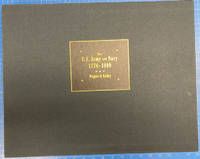
189949472Akron: The Warner Company 1899. 1899. MILITARY. First edition. Oblong folio 14" x 17" decorated cloth titles and color design on the front cover brown front and rear endpapers all edges gilt 241 pp. 43 folio sized color lithographs with accompanying text. Color plates depict the uniforms of officers and non-commissioned officers and the changes to the uniform through time for both Army and Navy 1776-1899. Appendices enumerating the principal ships of the United States Navy their batteries and armor and official reports of the Battle of Manila and the action off Santiago De Cuba. Much on the Indian Wars including four full-color lithographs depicting the U.S. Army either attacking or being attacked by Indians. One full color lithograph entitled "U.S. Army - Custer Massacre At Big Horn Montana - June 25 1876" was prepared especially for this publication and does not appear elsewhere. Also much on the Spanish-American War including full reports of activities. At the back is a complete list of ships of the U.S. Navy including specifications on batteries armor engines and date of launching. We do not feel that many copies of this book have survived intact over the years largely due to its size and the overwhelming temptation to break up the book to gain the colorful plates each image size measuring 9" x 13" which are suitable for framing. Expertly rebacked and some light cosmetic touch-up to the spine ends and corners else very good tight bright copy. housed in a cloth slipcase with leather labels on front cover and spine with titles stamped in gilt. An exceptional copy of a rare and informative book. The Warner Company, 1899. hardcover