1 837 résultats
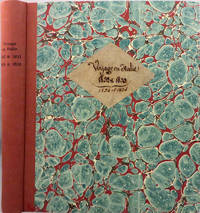
183227396n.p.: Original Manuscript 1832 1833 1834 1835. Original Manuscript in French of the travels by General Despans-CubiÄres to Italy over the course of four years. The text includes significant considerations of military affairs the mention and discussion of famous personages as well as historical observations and political affairs . 4to the manuscripts now bound into a binding of terra-cotta paper over marbled boards with a hand-calligraphed label to the upper cover and the titles in black to the spine panel. 534 pp. A fine and beautifully preserved collection of manuscripts written over four years. A UNIQUE AND INTERESTING MANUSCRIPT BY ONE OF THE MOST FAMOUS GENERALS IN ALL OF FRENCH HISTORY. 'Amédée Louis de CubiÄres was the illegitimate son of the Marquis Louis Pierre de CubiÄres page to Louis XV and squire to Louis XVI then in 1815 of Louis XVIII by Madame Guesnon de Bonneuil née Michelle Sentuary.<br> He served in the Austerlitz Prussian and Polish campaigns being mentioned in dispatches at Austerlitz and wounded at Jena 1806. Promoted to lieutenant on 30 November 1806 he received the cross of the Légion d'honneur at Eylau 1807. Aide-de-camp to general Morand from 12 January 1808 he followed him in the Austrian campaign of 1809 the French invasion of Russia in 1812 and the 1813 German campaign. He fought with distinction at Eckmühl and rose to captain at Essling 7 June 1809. He assisted at the battle of Wagram 6 July 1809 and had three horses shot from under him at the battle of Borodino. Napoleon I of France made him an officer of the Légion d’honneur in reward for his good conduct in the 1813 campaign in which he had become chef de bataillon promoted 3 October 1813.<br> On Napoleon's return from Elba in 1815 colonel de CubiÄres was made colonel Å• la suite to the 1st Light Infantry Regiment of which the titular colonel was Beurnonville. According to Jolyet Napoleon reviewed this regiment on the day after his arrival back in Paris on 21 March and asked who was its commander. CubiÄres replied "Sir it is colonel de Beurnonville ; but he is ill." Napoleon replied "Beurnonville is not sick - it is you colonel CubiÄres who shall nevertheless take command of the 1st Light Infantry". In 1815 Despans-CubiÄres fought with his regiment at Waterloo and was wounded at Quatre-Bras and at Mont-Saint-Jean.<br> According to Jolyet CubiÄres was "the most valiant soldier and the best man-of-war that I have known. With this he brought a remarkable beauty a brilliant spirit and a generous and independent love".<br> Promoted to commander of the Légion d’honneur 21 March 1831 he was made commander-in-chief of the French troops which landed at Ancona in the Papal States 9 February 1832 to occupy the town in reprisal for Austrian intervention at Bologna. Returning to France in 1837 with the rank of lieutenant-general he next became Minister for War in the 1839 transitional government 31 March-13 May 1839 then in Adolphe Thiers's second cabinet 1 March-29 October 1840. He attached his name to Paris's fortifications to the decision to write a history of all France's regiments since Francis I and to the organisation of the chasseurs of Vincennes. Made a peer of France on 7 November 1839 he took part in the discussions of the Chambre des pairs on taxes and roads before being raised to grand officer of the Légion d’honneur on 27 April 1840.<br> When the 1844 novel The Count of Monte Cristo was published - according to Librairie Générale Française 1995 its character of Fernand Mondego was inspired by general Despans-CubiÄres. On 17 August 1852 he won a decree of rehabilitation at the Court of Appeal at Rouen after an earlier trial on charges of corruption and was allowed to retire as a général de division on 1 January 1853 Original Manuscript hardcover
0939179962.Glibrary. Good. Access codes and supplements are not guaranteed with used items. May be an ex-library book. unknown
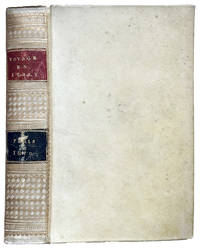
1810TK0329Paris :: Arthus-Bertrand 1810. 1810. 2 volumes in 1. 12mo. xl 176; iv 184 pp. Original full vellum spine highly decorated with gilt-stamping dual red & black morocco spine labels title & imprint; spine rubbed. Very good. Third edition. The text is written in the form of the author's 49 letters written to the Count of Caylus August 19 1755-April 6 1757. "During his tenure he virtually doubles the collection. For three years he traveled through Italy and visited the ruins of Pompeii Paestum and Herculaneum in the company of the future Duke of Choiseul then Ambassador of France. At that time he also corresponded with the Count of Caylus in the cabinet of medals." / Father Jean-Jacques Barthelemy was a French clergyman archaeologist numismatist and man of letters. Arthus-Bertrand, 1810. hardcover
1927783141927. Pp. 18 14 tavole A-P 240 di tavole 2 n.n. Edito in 500 esemplari numerati unknown
1927783131927. Pp 28 227 con tavole 2 n.n. esemplare edito in cinquecento esemplari numerati unknown
1923783091923. Pp. 30 112 tavole con 328 figure in nero e colore. Volume edito in 850 esemplari numerati Edizione normale unknown
2008ABE-1730675663196Vogue Italia 2008 Periodical oversize special 1st ED. Vogue N. 695. Liya Kebede cover. 346pp. 1st Edition. Soft cover. Near Fine. Vogue Italia paperback
2002008276Köln ; London : Taschen 2002 2002. Hardcover. Fine/Fine. 201 p. : color illustrations. ; 31 cm ; large Folio ; ISBN: 3822818348; 9783822818343 ; LC: NK2051 ; OCLC: 52880812 ; español italiano y portugués ; powder-blue cloth with white lettering in color photographic dustjacket ; Contents: Letham / Jean-Claude Chalmet Aegina - The Pink House / Henri-Paul Coulon Theodora Chorafas Aegina - Oikia Kardamatis / Timothy Hennessy Hydra - the Paouris Palace / Maria Matzini Hydra - Maxie Leoussis Hydra - The House of the Shooting Star / George Petrides Hydra - An Architect's Refuge / The Tsghis Family Hydra - Kourmada / Audrey and Robert Browning Hydra - The Schneider Family Hydra - Dina Nikolaou Hydra - Tilly and Basile Touloumtzoglou Hydra - The Governor's Palace Argo-Saronic Islands - Vassily Tsighis Serifos - Miriam Frank Serifos - Panos Alexopoulos Serifos - Langada / Dolly Contoyanni Patmos - A hidden House for friends Dodecanese - A Parisienne's Retreat. Patmos - A family home Dodecanese - A Secret House Patmos - Spiti Marilenas / Marilena Liakopoulos Patmos ; FINE/FINE <br/> <br/> Köln ; London : Taschen, 2002 hardcover
200817640Institute of Classical Studies. 2008. Softcover. Near Fine. Very light shelfwear else fine.; Institute of Classical Studies Bulletin Supplement 97; 193 pages; The new millennium sees both Pliny the Elder and his massive encyclopaedic Natural History being studied more seriously and holistically than at any time in the preceding century. The essays in this volume which honour the seminal work of Barbara Levick on the politics and society of imperial Rome above all in the period of Pliny’s life and literary activity further this re-assessment. They consider aspects of Pliny’s life and output which have not so far received serious attention. These include his value as a source for the kings of Rome and their achievements; his attitude to astronomy and natural wonders to gentilician commemoration philosophical sects Roman dress and coinage; and his moral judgements on the fall of the Republic. The essays consider the ideological climate of the Flavian period as reflected not only in Pliny’s attitude to the past but in his construction of Rome and Italy and his relationship to contemporary writers like Licinius Mucianus. Pliny emerges clearly as a major literary and cultural figure of the early Empire. . 1905670141 . Institute of Classical Studies paperback
200810508Institute of Classical Studies. 2008. Softcover. Fine. Institute of Classical Studies Bulletin Supplement 97; 193 pages; The new millennium sees both Pliny the Elder and his massive encyclopaedic Natural History being studied more seriously and holistically than at any time in the preceding century. The essays in this volume which honour the seminal work of Barbara Levick on the politics and society of imperial Rome above all in the period of Pliny’s life and literary activity further this re-assessment. They consider aspects of Pliny’s life and output which have not so far received serious attention. These include his value as a source for the kings of Rome and their achievements; his attitude to astronomy and natural wonders to gentilician commemoration philosophical sects Roman dress and coinage; and his moral judgements on the fall of the Republic. The essays consider the ideological climate of the Flavian period as reflected not only in Pliny’s attitude to the past but in his construction of Rome and Italy and his relationship to contemporary writers like Licinius Mucianus. Pliny emerges clearly as a major literary and cultural figure of the early Empire. . 1905670141 . Institute of Classical Studies paperback
200811564Institute of Classical Studies. 2008. Softcover. Very Good. Inscribed to scholar R. E. Fantham from one of the contributors Geraldine Herbert-Brown on ffep. Light creasing to corners of wraps. Minor shelfwear.; Institute of Classical Studies Bulletin Supplement 97; 193 pages; The new millennium sees both Pliny the Elder and his massive encyclopaedic Natural History being studied more seriously and holistically than at any time in the preceding century. The essays in this volume which honour the seminal work of Barbara Levick on the politics and society of imperial Rome above all in the period of Pliny’s life and literary activity further this re-assessment. They consider aspects of Pliny’s life and output which have not so far received serious attention. These include his value as a source for the kings of Rome and their achievements; his attitude to astronomy and natural wonders to gentilician commemoration philosophical sects Roman dress and coinage; and his moral judgements on the fall of the Republic. The essays consider the ideological climate of the Flavian period as reflected not only in Pliny’s attitude to the past but in his construction of Rome and Italy and his relationship to contemporary writers like Licinius Mucianus. Pliny emerges clearly as a major literary and cultural figure of the early Empire.; Signed by Contributor . 1905670141 . Institute of Classical Studies paperback
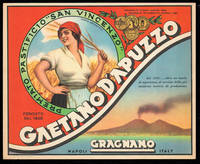
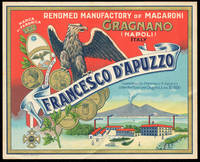
34002Gragnano. Ephemera. Label for the Pastificio Francesco D'Apuzzo. Measures 19.5 x 15.5 cm. Condition is near fine with negligible wear. unknown
33999Gragnano. Ephemera. Printed by I. R. E. S. Palermo. Label for the Pastificio Francesco D'Apuzzo. Measures 19.5 x 15.5 cm. Condition is fine with negligible wear. unknown
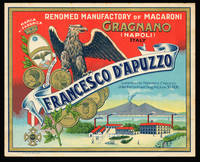
34000Gragnano. Ephemera. Printed by I. R. E. S. Palermo. Label for the Pastificio Francesco D'Apuzzo. Measures 19.5 x 15.5 cm. Condition is fine with negligible wear. unknown
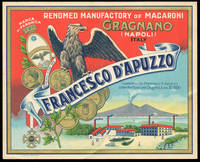
34001Gragnano. Ephemera. Printed by I. R. E. S. Palermo. Label for the Pastificio Francesco D'Apuzzo. Measures 19.5 x 15.5 cm. Condition is fine with negligible wear. unknown
1390328333.Gpaperback. Good. Access codes and supplements are not guaranteed with used items. May be an ex-library book. paperback
2005BOOKS073425ITorino: Umberto Allemandi & C. 2005. HC. very good w/very good dustjacket hardcover. B&W and color illustrations. ISBN 8842211532 Text in Italian. 675pp. Umberto Allemandi & C. unknown
20016628British Archaeological Reports. 2001. Softcover. Very Good. British Archaeological Reports BAR International Series 933; 269 pages; Monica Rorison's thesis identifies and examines the vici of Aquitania Lugdunensus and Belgia dating from Caesar's victory at Alesia in 52 BC through to the Roman withdrawal in the early 5th century. The study combines a catologue of sites arranged geographically with an overview of the definition origins development structure and function of the settlements. . 1841712272 . British Archaeological Reports paperback
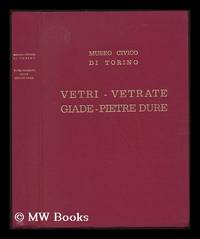
1971229143Torino : Museo Civico 1971. First Edition. Hardcover. Fine copy in the original gilt-blocked cloth. Corners sharp with an overall tight bright and clean impression. Uncommon in such positive condition. Physical description: 384 p. : illus. plates. ; 23 cm. Notes: At head of title: Museo civico di Torino. Bibliography: p.21-23 255-257 319 369-370. Subject: Glassware - Turin - Catalogs. Glass painting and staining - Italy - Turin - Catalogs. Glassware - Catalogs. Glassware Italian. Glass painting and staining - Italy. Jade art objects. Other names: Mallé Luigi 1920-1979. Genre: Catalogue Illustrated. Torino : Museo Civico hardcover
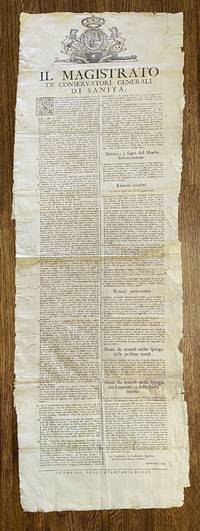
17444109Turin Italy: Stamperia Reale 1744. Very good. Huge letterpress broadside 1070 x 360 mm printed on 2 1/2 folio sheets edges untrimmed. A few sections underlined and annotated in a contemporary hand in the left blank margin worn; paper extensions mainly in the right margin; prominent horizontal central fold other folds reinforced on verso with occasional lost of one or two letters. A remarkable survival preserved in mylar L-sleeve backed with lig-free board. GIGANTIC APPARENTLY UNRECORDED BROADSIDE ISSUED BY THE STATE MAGISTRATE WARNING AGAINST THE 1744 "CATTLE PLAGUE" EPIDEMIC IN NORTHERN ITALY A FLIMSY ATTEMPT AT GOVERNMENTAL MANAGEMENT AND DISEASE CONTROL. <br /> <br /> The disease described herein was almost certainly RIDERPEST a highly contagious viral infection which can produce a 100% death rate among herds the colloquial term "cattle plague" is a misnomer because sheep and goats can also be afflicted by it. <br /> <br /> The 1744 outbreak had been observed in The Netherlands in the months before our broadside was printed but the Magistrate mentions only the reports from Franche Comté. While the devating consequences of cattle plague in The Netherlands are well researched its effects in Italy at this same time are not well-known probably due to the comparatively low survival rate of contemporary documentation. <br /> <br /> Indeed no other copy of our broadside can be found. Here the Magistrate of the Conservatory General of Health gives warning signs of the infection and preventative measures against its spread including mandatory "lazarettos" quarantine areas for livestock. The "nature and the signs" of the disease is addressed along with a dubious and ineffectual attempt at a remedy which involved cold water salt vinegar pepper and camphor; "Rimedi preservativi" prophylactic measures are recommended and steps for "fumigating" i.e. disinfecting livestock and their owners are given. <br /> <br /> The urgency of Magistrate's is justified: less than 30 years earlier through circuitous trade routes cattle plague had spread like wildfire even the most remote regions of Eastern and Western Europe and Britain. Such trade networks had become larger and more sophisticated in order to supply food to growing urban centers.<br /> <br /> Throughout history outbreaks of cattle plague led to severe economic crisis: the resulting famine inflation civil unrest and overall moral decay destabilized societies with crippling effect as had been seen in The Netherlands in the first outbreak of 1713-1720. Wherever and whenever cattle plague emerged religious figures government officials technocrats and the public wrested with the meaning and consequences of these disasters.<br /> <br /> Students and scholars of socio-economics in the Early Modern era would do well do incorporate primary sources of veterinary history in their research.<br /> <br /> NB: Interested parties are advised that this huge broadside will be shipped folded. Stamperia Reale unknown
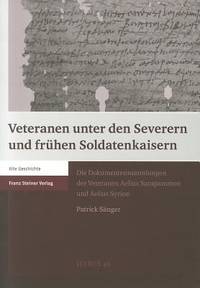
201212010Franz Steiner Verlag. 2012. Softcover. Near Fine. Very very light shelfwear else fine.; English summary: How did the Roman veterans make their lives after the end of the term of service and discharge from the army What positions did they take in the social and economic structures of their chosen residences There is scarcely other source material that offers more answers to these questions than that which remains in the surviving papyri from Egypt. Patrick Sanger uses the document collections of the veterans Aelius Sarapammon and Aelius Syrion to make possible a thorough analysis of the socio-economic position of the two protagonists who made their home in Ankyronpolis a village of mid-Egyptian region of Herakleopolis. The pertinent 19 archival texts P. Vet. Aelii span the time from the end of the 2nd to the middle of the 3rd century CR and are presented here some for the first time and some as a new edition. These documents which will not only garner interest by reason of their time period but also their contents serve as the point of departure for a presentation of the socio-economic situation of veterans in Egypt and other provinces of the Roman Empire as well as for the detailed study of the legal and administrative history. German description: Wie gestaltete sich das Leben romischer Veteranen nach der Beendigung der Dienstzeit und der Entlassung aus der Armee Welche Position nahmen sie im sozialen und okonomischen Gefuge des von ihnen gewahlten Wohnortes ein Kaum ein anderes Quellenmaterial als die in Agypten erhalten gebliebenen Papyri halt mehr Antworten auf diese Fragen bereit. Die von Patrick Sanger erschlossenen Dokumentensammlungen bzw. Archive der Veteranen Aelius Sarapammon und Aelius Syrion ermoglichen eine eingehende Analyse der sozio-okonomischen Verhaltnisse der beiden Protagonisten die in Ankyronon einem Dorf des mittelagyptischen Gaues Herakleopolites beheimatet waren. Die zugehorigen 19 Archivtexte P. Vet. Aelii erstrecken sich uber den Zeitraum vom Ende des 2. Bis zur Mitte des 3. Jahrhunderts n. Chr. Und werden teils in Erst- teils in Neuedition vorgelegt. Diese Dokumente die nicht nur aufgrund ihrer Zeitstellung sondern auch ihrer Herkunft besonderes Interesse beanspruchen dienen als Ausgangspunkt fur eine Darstellung der sozio-okonomischen Situation von Veteranen in Agypten und anderen Provinzen des Imperium Romanum sowie fur verwaltungs- und rechtshistorische Detailstudien; Heidelberger Althistorische Beitrage Und Epigraphische Studien Band 48; 429 pages . 3515099042 . Franz Steiner Verlag paperback
197116792Roma: Partito Comunista Italiano / Editoriali Fratelli Spada 1971. First Edition. Lithographed poster offset in three colors; 100cm x 70cm ca 40" x 28"; on heavy paper. Minor toning; light creases at margins; Near Fine - Grade A/A-.<br /> <br /> A bit of a puzzle: the poster appears to celebrate the twentieth anniversary of the formation of the Associazione Bandiera Rossa an Italian Trotskyist group; but the poster bears the imprint of the PCI the main-line Marxist-Leninist party in Italy - an ideological implausibility even within the chaotic confines of Italian Marxism. Adding further to the confusion is a quotation from Antonio Gramsci founder of the PCI in upper right. In any case a terrific graphic attributed here to Luciano Prati whose name we encounter on a few late-70s Italian film posters but nowhere else. Duke University appears to be the only North American institution to hold a catalogued copy of this work. Partito Comunista Italiano / Editoriali Fratelli Spada unknown
1893058392London Uk: Rivington Percival & Co. 1893. 1st Edition . Hardcover. Very Good. Maps And Plan. Xxiii 434 Pp 29 Pp Catalogue Dated Iii/93. Green Cloth Gilt Green Endpapers 1893 Date On Title Page. First Edition. Light Wear.Tiny Bookseller's Ticket Of The Royal Library Tunbridge Wells. Venice The Longest-Lived European Republic Remains Of Undue Fascination From Those Who Look For Something Special In The People Or Their Art Or Architecture When It Was The Republican Structure Itself Which Was The Sole Basis Of Its Strength And When It Decayed Of Venice's Slow Collapse And Sudden Fall. Per Wikipedia Horatio Robert Forbes Brown 16 February 1854 - 19 August 1926 Was A Scottish Historian Who Specialized In The History Of Venice And Italy. Born In Nice He Grew Up In Midlothian Scotland Was Educated In England At Clifton College And Oxford. In 1877 The Brown Family Found Itself In A Bad Financial Position. Allan Brown Emigrated To New South Wales And A Tenant Was Found For The Family Home In Midlothian Newhall House. In 1879 Brown And His Mother Decided To Live In Italy. They Went First To Florence Where Gulielmina Brown's Forbes Aunts Lived And Then Settled At Venice Taking An Apartment In The Palazzo Balbi Valier On The Grand Canal. He Spent Most Of His Life In Venice Publishing Several Books About The City. Brown's Name As An Historian Was Made By The Five Volumes Of Calendar Of State Papers Venetian Which He Published Between 1895 And 1905. He Also Wrote For The Cambridge Modern History Was The Biographer Of John Addington Symonds And Was A Poet And Alpinist. <br/> <br/> Rivington, Percival & Co. hardcover
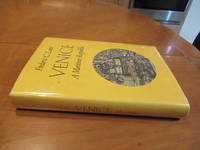
1973057420Baltimore Maryland U.S.A.: Johns Hopkins Univ Pr 1973. 1st Edition 1st Printing. Hardcover. Fine/Fine. 505 Pp. Gold Cloth. First Printing. Fine In Fine Dust Jacket Priced $27.50. Excellent Fascinating History Focusing On How Venice Worked For 1000 Years As An Independent Coalition Of Merchant Adventurers Businessmen And Workers With A Government Organized In Layers Each Accountable To Those Higher Or Lower In Power With No Politicians And No Political Parties And Intense Loyalty From Its Citizens While Being Open To Immigration And Eventual Citizenship For All Workers. The Book Makes Clear Also How Venice Had A Foreign Relations Policy Of Absolute Self-Interest And Was Almost Unbelievably Exploitive Of Its Conquered Territories. Food For Thought Without Strong Similarity To Any Other Long-Lived Government System In The Second Millennium Prior To The American And French Revolutions Genoa Was Similar But Less Successful And Completely Independent For A Much Shorter Period Of Time. <br/> <br/> Johns Hopkins Univ Pr hardcover
191264262Boston: L.C. Page & Co. 1912. 8vo. xiii 7 11-502 pp. Photogravure frntsp. 64 photo plates. Elaborately decorated & illustrated blue pictorial publisher’s cloth blue green & gilt Arts & Crafts design front cover t.e.g. slight uniform interior toning slight bumping to a couple corners rear hinge just starting still a VG bright copy from the library of former California State Librarian Gary Kurutz w/ former ownership markings on ffep. New edition of this sumptuous travelogue to the famed city re-published with new pictorial binding for Page’s “Travel Lovers’ Library†and uniform with the other volumes. L.C. Page & Co., hardcover