(Italy), VeniceBiblio.com

287 résultats
1019738987.Ghardcover. Good. Access codes and supplements are not guaranteed with used items. May be an ex-library book. hardcover
dola292Venice: 1967. Exhibition Catalogue. square 8vo. ff. 37. profusely illus. some colour. cloth 2 small library stamps. illus. plastic dw Venice: 1967 hardcover
1276322828.Gpaperback. Good. Access codes and supplements are not guaranteed with used items. May be an ex-library book. paperback
1275243339.Gpaperback. Good. Access codes and supplements are not guaranteed with used items. May be an ex-library book. paperback
1276041659.Gpaperback. Good. Access codes and supplements are not guaranteed with used items. May be an ex-library book. paperback
1277694532.Gpaperback. Good. Access codes and supplements are not guaranteed with used items. May be an ex-library book. paperback
1275582028.Gpaperback. Good. Access codes and supplements are not guaranteed with used items. May be an ex-library book. paperback
1275622771.Gpaperback. Good. Access codes and supplements are not guaranteed with used items. May be an ex-library book. paperback
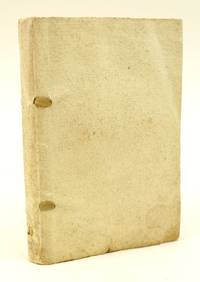
1729ST16379-042Venezia Venice: Appresso Carlo Buonarrigo 1729. FIRST EDITION. 155 x 105 mm. 6 1/8 x 4 1/8. 1 p.l. extra engraved title 122 pp. <br/> Original cream-colored wrapper of heavy paper silk ribbon stitching remnants of old shelf label at foot of spine. Extra engraved title page depicting the Bucinotoro in all its glory surmounted by the Lion of St. Mark emblem of Venice. Front pastedown with bookplate of the duke of Arenberg Castle Nordkirchen. Cicognara 4369. Binding lightly soiled front pastedown lifting occasional faint yellowing to margins other trivial imperfections but still A VERY FINE COPY--clean bright and especially fresh in its remarkably well-preserved fragile binding.<br/> <br/> This is a detailed account of the magnificent Bucintoro—a ceremonial ship used in the annual ritual in which the Doge of Venice was symbolically wedded to the sea— unveiled in 1729. The city known as La Serenissima had long been a major port for trade between Europe and points East and the people honored the role played by the Mediterranean Sea in the Republic's prosperity. Beginning in 1311 the head of state sailed forth each year on Ascension Day to be "married" to the sea aboard a boat called the Bucintoro. The wooden ship was restored or rebuilt from time to time through the centuries and in 1719 the Venetian Senate commissioned a brand new vessel to be richly ornamented and even bedecked with gold. <br /> <br /> Our volume describes the process by which the finest artists and artisans of the day--from shipbuilders to sculptors and painters--created the largest and most lavish Bucintoro in history. The engraved title page shows the stately craft in full rig banners flying as Doge Alvise Mocenigo is rowed out to meet his marine bride. Cicognara notes the volume's value in preserving for posteriority these memories of Italian greatness--and that greatness lasted only a relatively short time because after the fall of the Venetian Republic in 1797 Napoleon had the Bucintoro stripped of its finery. The denuded and humiliated ship was then used by the Austrian navy until 1824 sailing under the name "Hydra."<br /> <br /> The presence of a binding identical to ours on several copies in sales records suggests that these may have been the publisher's original wrappers which have weathered the years surprisingly well. The text here is deeply impressed on thick paper upholding the fine tradition of Venetian printing. Appresso Carlo Buonarrigo unknown
184336123Venice: F. Andreola 1843. hardcover. Fascicolo XVIII. 64pp. Folio full red morocco fine gilt floral borders back gilt green moire endpapers a.e.g. Venezia: F. Andreola 1843.<br/> <br/> F. Andreola unknown
a64606Firenze 1800 1st. In Italian. Hardcover. 4to. 275pp. double column text black marbled cloth with green cloth spine. Good Plus very light water stain on text throughout with light wrinkling throughout as well. Volume 2 of 2 only. Pictures available on request. . hardcover
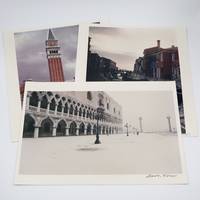
1970232456Venice 1970. Printed circa 1984. Each SIGNED in ink below the image. 1 vols. Each approximately 13 x 9 inches. Fine. Printed circa 1984. Each SIGNED in ink below the image. 1 vols. Each approximately 13 x 9 inches. Lovely luminous group of Venetian views lovingly shot and printed by the Russian-born photographer Kessel 1902 - 1995 whose work for LIFE magazine won international acclaim. As he wrote in his book ON ASSIGNMENT: DMITRI KESSEL LIFE PHOTOGRAPHER New York Abrams 1985: "In sun rain fog snow photographing Venice was for me a labor of love "<br /> <br /> The photos include several views of St. Mark's Square including the Basilica a snowy view of the Doge's palace the Campanile vaporettos parked in a canal gondolas floating in the lagoon one of the famous bronze horses undergoing restoration and others. unknown
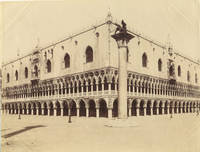
11774Three 19th Century Photographs of Venice Italy. First photograph sepia tone 10 x 7.5" Image of front view of St. Mark's Cathedral the most prominent church in of the city of Venice. Second photo sepia tone 9.5 x 7.25" photo of a close up of a horse statue outside of St. Mark's Cathedral. photo has a small tear on top right corner. Third photo sepia tone 9.5 x 7.25". Photo of the Ducal Palace. The palace is the highest and richest symbol of Venetian civilization of its cultural military political and economic history. In excellent condition. unknown
190953224Venice & Los Angeles CA: Abbot Kinney Co. Nov. 20 1909. One large silver gelatin photo sized 7.5 x 9.25 in. mounted on thin gray studio board sized 10.5 x 13.5 in. block lettering on verso referring to date and indicating it was sent by the Abbot Kinney Co. minor creasing to image very slight minor scuffing still a VG- image with strong bright contrast. An exceedingly scarce original promotional photo for the Aquarium & Museum built at the end of Abbott Kinney’s famed amusement pier and patronized by visitors on the Balloon Route Excursion train operated by the Los Angeles Pacific Railroad Electric Railway Co. The Venice Aquarium was opened in January 1909 on Kinney’s Pier and featured some of the finest marine specimens of any private or public Aquarium on the West Coast. A fish hatchery and sea lions were located in the rear of the aquarium. The aquarium later became the official marine biological station for the University of Southern California. Unfortunately in 1920 a month after the death of Kinney the entire pier was destroyed in a fire including the popular aquarium. See: Loomis Westside Chronicles: Historic Studies of West Los Angeles 2012; Westland Network Venice History Part 3 2009. Abbot Kinney Co., unknown
149325186Nuremberg: Anton Koberger for Sebald Screyer and Sebastian Kammermeister 1493. First Edition with the Latin text the bifolium with fine hand-colouring to the Venice view. This is one of the large double-page city-view woodcuts from the workshop of Mighael Wolgemut and Wilhelm Pleydenwurff beneith 24 lines of text. The view of Venice was adapted from the 1486 woodcut by Erhard Reuwich in the Sanctae Perigrinationes. It is handsomely and finely handcoloured in blues greens yellows reds grays etc. Double-page folio ca. 540 x 364 mm handsomely mounted framed and glazed. Leaves XLIII and XLIIII. In fine condition and very well preserved and presented. FROM THE FIRST EDITION OF THE NUREMBERG CHRONICLE ARGUABLY THE GREATEST ILLUSTRATED BOOK OF THE 15TH CENTURY. The artists Michael Wolgemut the well-known teacher of Albrecht Dürer and his stepson Wilhelm Pleydenwurff have been praised and admired for over five-hundred years for their contributions to one of the monuments of early printing. David Bland calls it "a marvelous book and a landmark in the history of illustration" and through the ages it has more than fulfilled Koberger's prophecy that it would be "the delight of the men of learning and of everyone who had any education at all."<br> HIGHLY IMPORTANT INCUNABLE the “Nuremberg Chronicle†is the most extensively illustrated book of the fifteenth century and after the Gutenberg Bible the most celebrated book printed in the fifteenth century. Its 1809 woodcut illustrations 1164 excluding repeats depict popes saints and other religious figures kings and emperors historical and biblical genealogies mythological and fanciful creatures natural phenomena and views of all the major cities of the known world as well as a brilliant creation sequence. In addition to the full-sheet maps of the world and of Europe twenty-nine city views such as this one span two pages and eight other cuts excluding the xylographic title page are full-page. The colophon explicitly acknowledges the contributions of the artists Michael Wolgemut and Wilhelm Pleydenwurff. Albrecht Dürer was at that time a pupil in Wolgemut's workshop and there is good evidence that he did many of the preliminary drawings for woodcuts and may even have cut some of them see Adrian Wilson THE MAKING OF THE NUREMBERG CHRONICLE. Anton Koberger, for Sebald Screyer and Sebastian Kammermeister unknown
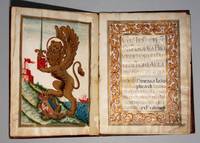
17175670<p>4to manuscript on vellum 23.5 x 17.1 cm 7 ff. 4 ff. vellum blanks including a full-page frontispiece illumination of Venetian Lion of St. Mark each text page with foliate borders in gold ink headings and initials in gold ink. Bound in contemporary Venetian morocco elaborately gold tooled gold block-printed foliate pastedowns. Edge wear and minor rubbing to spine and boards manuscript loose in binding oxidizing to edges of pastedowns. Marginal flaws to frontispiece illumination just touching border in places a few small wormholes elsewhere minor handsoiling.<br /></p><p>Finely illuminated early 18th-century Venetian manuscript issued by the city's Magistrato alla Sanità Health Department as a license to certify the physician Antonio Damugliano d. 1747 to practice medicine in the Venetian Republic using his propriety formula for topical salves <i>balsami</i> to treat "wounds and ulcers" f. 3v-3r. The manuscript ornately written out and decorated in gold and colored ink opens with a full-page image of the winged Lion of San Marco in the Venetian landscape which serves as an official seal of the document's authenticity and is inscribed by five <i>Provveditori</i> of the Magistrato and one notary who witnessed the certification.</p><p>This pharmaceutical license represents a rare material survival of how Venice's Magistrato alla Sanità regulated the practice of medicine in its territories even down to the level of controlling how individual practitioners could work with specific drugs. Damugliano presumably was required to keep the document on his person while plying his trade and to present it to the relevant authorities or even to his patients should his practice be called into question. The text of the document is written out twice – first in Italian and then in Latin – to suit the linguistic preferences of both the common Venetian citizen and the professional medical class.</p><p>Damugliano also known as Antimo Damulianos is noted in the document dated April 1717 as being a native of the Ionian island of Zante or Zakynthos at the time a Venetian colony and having recently returned from Moscow "where with good success and for a long time he practiced medicine with full official permission of many noteworthy people" f. 2v. Damugliano is said to have studied medicine in Europe likely in Italy specializing in contagious diseases and eventually practicing in Asia Minor Persia India China Egypt Constantinople and Trieste and to have been ordered by Emperor Charles VI 1685-1740 to treat the sick of a plague outbreak in Corinth see L. Zoes passim. Damugliano's name is also associated with a 1725 treatise entitled 'Medicina' which circulated in manuscript form in Venice and dealt with the use of salves pills and stones to treat hydrophobia see L. Zoes; we have been unable to locate a copy of this treatise. Damugliano is also recorded as having worked in Vienna where an April 1746 news magazine comments that the "very famous" Damugliano having traveled through numerous kingdoms has arrived to demonstrate the curative powers of "the wondrous Chinese stone called Bezoar" which is effective against fevers snake bites fatigue colic etc. <i>Nachtrag</i> p. 64. The bezoar stone an indigestible mass formed in the digestive tract of ruminants was lauded from the middle ages as a universal antidote to poison.</p><p> R. Palmer "Pharmacy in the Republic of Venice in the Sixteenth Century" in A. Wear et al. eds. <i>The Medical Renaissance of the Sixteenth Century</i> pp. 100-17; <i>Epeteris: Hetaireia Byzantinon Spoudon</i> vol. 43-44 1977 p. 417; H. Schmuck <i>Grieschischer Biographischer Index</i> vol. 1 p. 247; L. Zoes <i>Lexikon historikon kai laographikon Zakynthou</i> vol. 1; S. Carbone <i>Provveditori e sopraprovveditori alla Santità della Repubblica di Venezia</i>; P. Selmi "Il Magistrato all Sanità" in <i>Difesa della Sanità a Venezia Secoli XIII-XIX</i> pp. 28-50; <i>Nachtrag zu denen wöchentlich-kurtzgefaßter historischer Nachrichten Der neuern Europäischen Begebenheiten auf das Jahr 1746</i> p. 64.</p>
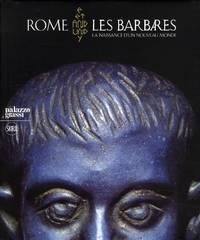
2008PMV432407QVenise: Palazzo Grassi 2008. Hardcover. Good/Good. 248 x 292 x 46 cm. Hardcover • Illustrations cartes • <b><i>French text original</i></b>. Palazzo Grassi hardcover
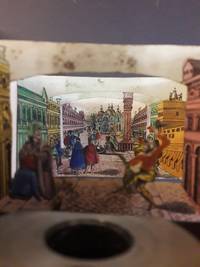
18353220261<p><em>Concertina-folding hand-coloured lithographic peepshow with three cut-out sections front-face measuring 98 × 137 mm; the peepshow extends by paper bellows to approximately 275 mm. Hand-coloured lithograph housed in a custom made cloth box.</em></p><p>Rare German peepshow of St. Mark's Square in Venice rather naive in appearance resembling the illustrations found in chapbooks of the time.</p><p>The front-face consists of the title a view of St Mark's Square viewed from an architectural arrangement at the west end of the square symbols of carnival - a tambourine masks and a jester's bauble - and a circular peephole. The staffage on the cut-outs and backboard consist of commedia del arte figures including a dancing man with a mandolin and two dwarfs. The campanile hopelessly represented and wrongly positioned features on the third cut-out and St Mark's on the backboard.</p> [Germany,
D14686Ephemera. Very Good. Group of landscape photographs in sepia ca. 19 x 25.2 cm each mounted on black board 23.5 x 30.5 cm all edges gilt showing the Piazza San Marco from various views; the logetta underneath Campanile Sansovino; Basilica di San Marco and the Battisterio; Porta della Carta; Santa Maria della Salute; Santa Barnaba signed O. Nayatot; Scala dei Giganti; the Arsenale; monuments to Titian and Canova; the tombs of Doge Vendramino and Doge Loredano; the Orologio clock; Ponte Rialto; Ponte dei Sospiri; Palazzo Ducale exterior and Sala dei Pregadi Sala del Maggior Consiglio Cortile; Canal Grande with a view of Palazzo Cavalli and Chiesa della Salute numbered 18638 in lower left corner; the Palazzo Reale loggia; Palazzo Vendramin; Palazzo Cavalli/Franchetti; Palazzo Contarini; Palazzo Pesaro; the Palazzo Minelli staircase; the canal between Palazzo Wanaxel and Palazzo Salviati perhaps from a different series; a view of Isola San Lazzaro; and panoramas. <br/><br/> unknown
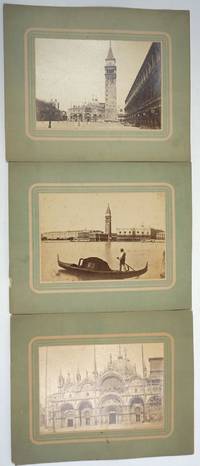
187027447Venice: Colombo Coen 1870. Photography. Otherwise very good condition. Colombo Coen was a prolific Jewish publisher based in Italy from the 1850s-70s. He was the author of a popular guide book "A Week in Venice: A Complete Guide-book to the City and Its Environs 1869. "Paved with water .the Grand Canal is the finest street in Venice and one of the finest in the world." Of the Piazza San Marco he says "one of the finest squares in the world; not the largest – for Trafalgar Square is larger – or the most regular – for it is crooked compared with the Place de la Concorde – but it defies London and Paris to produce its equal." He culminates with "One Venice one sun and one Piazza San Marco. This is the boast of the Venetians."<br /> <br /> The Images are of St. Mark's Basilica San Marco Square Rialto Bridge Grand Canal gondolas. <br /> <br /> Images approx. 7 x 5" laid down on decorative light green board 10 1/4 x 8 1/2". Albumen photos dusty slt fox spotting. Photo lithographic images dusty with title' Venezia' at top and in lower left corner "Stab. Colombo Coen Porc Vecch No 139. 140 Colombo Coen unknown
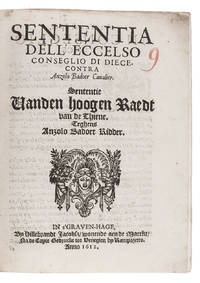
161278CAPB8HI9JLThe Hague 1612. 4to. Hillebrant Jacobsz. van Wouw Sewn without supports in later plain paper wrapper formerly side stitched through 3 holes. With a woodcut vignette face with 2 cornucopias on title-page 2 woodcut decorated initials 2 series both arabesque. With the Italian text in italic the Dutch text in textura and with incidental roman. 15 1 blank pp. First bilingual Italian and Dutch edition of a sentence pronounced by the government of the Venetian Republic the Consiglio dei Dieci or Council of Ten on 21 April 1612 declaring Anzolo Badoer in absentia a traitor stripping him of his knighthood confiscating his property banishing him from the city and the Republic's territories and sentencing him to be hanged in the original Italian with a parallel Dutch translation. It also offers a reward for his capture dead or alive 4000 ducats if captured in the Republic and 6000 ducats if captured abroad. Anzolo or Angelo Badoer 1565- 1630 was the eldest son of Alberto Badoer 1540-1592 who had served as Venetian ambassador to Spain the Holy Roman Empire and Rome until his premature death. Anzolo succeeded to his father's knighthood and followed him into diplomatic service as Venetian ambassador to France from 1602 until he came into conflict with the Council of Ten in 1607.With a large "9" on the title-page in red pencil. In very good condition. An important document of dramatic intrigues here published with a Dutch translation.l Knuttel 1938a; STCN 5 copies; cf. ICCU: PUVE019213 1612 Venice ed. in Italian only; for Badoer: Diz. Biogr. Italiani 5 1963 on www.treccani.it. unknown
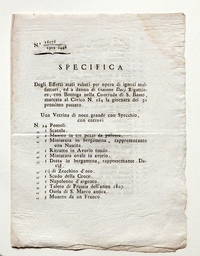
18183773<p><em>Shoplifting in Venice - Police Report</em></p><p>VENICE - THEFT. Specifica degli effetti stati rubati per opera di ignoti malfattori ed a danno di Gacome Daci regattiere con bottega nella contrada di S. Basso marcata al Civico N. 184. la giornata dei 30 prossimo passato. colophon: Venice 31 October 1818.£250</p><p>4to pp. 3 1 blank; lightly browned and discoloured in upper outer corner; uncut and unbound with mss filing note to last page.</p><p>Official order for a police investigation into the theft of a large mirrored walnut showcase from a bric-a-brac shop in Venice 1818. A full listing of the forty-five different objects stolen is given amongst them two miniature paintings on vellum one of the Nativity and the other of David; various coins identified and not; five pearl necklaces - two in pearl agate two of 'pearls' in yellow glass and a necklace of miniature black pearls with matching earrings; in mother-of-pearl a piece in the shape of an animal; four saints and an oval of St. George; two gilded crucifixes and much more all to the value of around 350 Italian Lire. A fascinating insight into Venetian life and trade.</p> n.p.
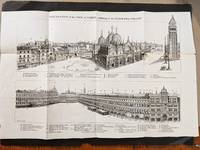
18191120London: J. and C. Adlard 1819. 8vo. 220 x 140 mm. 8 3/4 x 5 1/2 inches. 12 pp. Illustrated with a folding plate depicting the Piazza San Marco Venice. Original blank wrappers separated at the spine folded plate loose in binding. Stamp of the Minnesota Historical Society withdrawn. Tiny tears at the folds of the plate but sound. J. and C. Adlard unknown
1989IENal[VE93<p>New York: Rizzoli 1989. 1989. 4to. pp. 772 2 leaves. profusely illus. many colour. biblio. index. cloth. dw. some minor shelf wear. Exhib. Cat. First American Edition. F. Hardcover.</p> New York: Rizzoli, [1989]. hardcover
1830D7073Venice: Eugenio Testolini n.d. c. 1830. Hardcover. Very Good. Publisher's half brown cloth and printed boards; oblong folio 240 x 343 mm; contains lithographed title-page with inset view of a gondolier and 11 beautifully hand-colored lithographed plates many with the embossed stamp of the publisher in the lower margin. Boards soiled and scuffed; spine tips corners and edge of boards lightly bumped. Nice and bright on the inside! Aside from some faint marginal foxing plates are simply lovely. <br/><br/> Eugenio Testolini hardcover