Venice Laws, StatutesBiblio.com
287 résultats
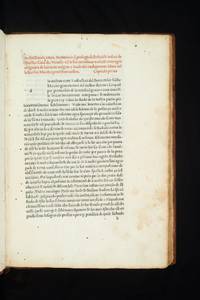
147712052Venice: Filippo di Pietro 1477. CONTEMPORARY WOODEN BOARDS backed with more recent leather no endleaves spine lined with a fragment of a 14th-century vellum manuscript evidence of clasp and catch. <p> FIRST EDITION OF THE LAWS GOVERNING VENICE AND ITS EMPIRE. Not dependent on Roman precedents these laws set the civil and criminal procedures of Europe's longest lived overseas empire - the island republic its mainland holdings immediately to the west and its colonial possessions: the stato da mar.<br /> Reflecting the preeminently commercial character of the Venetian state the majority of these statutes concern real and moveable property contracts pledges debts loans inheritance interest obligations counterfeit merchandise and trading partnerships. The nearly complete overlap in the 15th century of private Venetian seagoing business ventures and state military operations means THE RIGHTS OF WOMEN FIGURE PROMINENTLY IN THE CODE as their male family members were long abroad. Multiple and complex jurisdictions and appellate avenues developed in response to the variety of local statutes customary laws special privileges and feudal jurisdictions of the maritime and mainland states. "The judicial system played a significant role in tying the disparate parts of the maritime state together" O'Connell.<br /> THE VENETIAN MARITIME CODE CONCERNS COMMERCIAL PROJECTS AND MILITARY EXPEDITIONS. These fifty-two articles and their nine supplementary "corrections" deal with towing disabled vessels cargo luggage allowance victualing entering and leaving port arming sailors damage liability manifests transport of pilgrims and cavalry deserters daily rations of water and wine Black Sea voyages and so on. According to Cicogna these statutes were not reprinted.<br /> THIS FOLIO IS THE FIRST NON-LITERARY WORK TO BE PRINTED IN THE VENETIAN DIALECT and the fifth overall. In good condition pale stains worm holes seventeen leaves with neatly repaired worm trail not affecting legibility contemporary manuscript headlines and foliation.<br /> ¶O'Connell Men of Empire: Power and Negotiation in Venice's Maritime State 75 78 80-1 84-90 & 96; Cicogna Saggio di bibliografia veneziana 1206 "Prima e rara edizione" 1241 criminal code & 1263 maritime code; Doumerc "An Exemplary Maritime Republic: Venice at the End of the Middle Ages" in War at Sea in the Middle Ages and the Renaissance edd. Hattendorf & Unger 151-65; Bibliografia delle edizioni giuridiche antiche in lingua italiana I: 5; Manzoni Bibliografia degli statuti.dei municipii italiani I: 529-30; IGI 10143; Gamba Serie degli scritti impressi in dialetto veneziano ed. Vianello 454; ISTC is00724000; Goff S-724.</p> Filippo di Pietro unknown
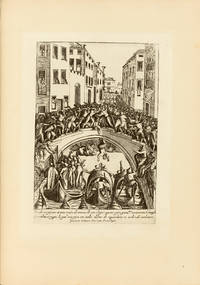
NY24<p>Venice Giacomo Franco Forma in Frezzaria al Insegna del Sole con privilegio s.d. 1610.</p><p>Small folio volume.</p><p>"<i>1 . title engraved with same view of Venice than the one for "Habiti delle Donne" 1 l. not numbered dedication to Vincent de Gonzague de Mantoue dated 1st January 1610 and printed in roman characters 25 plates out of pagination and not numbered.</i></p><p><i>Those plates represent 34 figures of men and women in very rich Venitian costumes life scenes </i></p><p><i>festivities.</i>" Colas n° 1108.</p><p>360 x 260 mm. Dimensions of the engravings: 258 x 190 mm.</p><p><b>Very rare first edition of one of the most famous books on Venice its festivities costumes and activities around 1600.</b></p><p>Colas <i>Bibliographie Générale du Costume</i> n°1108 col. 384-5; <i>Katalog Der Freiherrlich Von Lipperheide'schen Kostümbibliothek</i> repr. 1963 n°1324 p. 527.</p><p>"This collection offers great interest in the costumes of Venice during its greatness. It is sought after today especially as it has become extremely rare ". Vinet Bibliographie méthodique des Beaux-Arts.<br /><br /><b>This collection is so rare that Brunet never found a complete copy and only described an incomplete one</b> Brunet II 1378. As for Vinet he doubts the number of plates following the number 24 with a "" Vinet col 283 n° 2291.<br /></p><p>The copy of the <i>British Museum </i>only contains 20 plates out of 25 and one title leaf is missing. <br /></p><p><b>Title engraved with a birds 'eye view of Venice on an architectural frame with a view of the Rialto bridge and 24 extremely fine engravings.</b><br /><br /><b>The book shows in an extraordinary detailed way the various festivities processions and past times of the city as well as great moments in its history.</b><br /><br />"Assimilated to the genre of the costume book the work by Giacomo Franco 1556 - 1620 drawer and engraver born in Venice also shows engravings of a strong interest for the history of manners and customs of the Serenissima in the 16th and 17th centuries: festivals entertainment maritime games regattas… and carnival. The 1610 edition is probably the first. The number and order of the engravings vary greatly from one edition to another and between copies of the same edition.<br /></p><p>The copy is composed of 26 copper plates including one double plate all except one signed by Giacomo Franco. The engraving named Feste che si sogliono fare per la città della caccia del toro amazzar la Gata col capo raso pigliar l'anadre pigliar l'occa nell'acqua et altro features games with animals: a bear fighting with dogs a tied up cat a goose being plunged into water a duck hanging from a mast and a chased bull. Attested since the Middle Ages bull hunting is a traditional carnival game in the Renaissance particularly in Rome and Venice". Virtual exhibition organized by the Mazarine Library<i> Libri italiani lecteurs français</i> "Balls festivals and banquets".</p><p>"This book of engravings depicts the costumes festivals and social life of early seventeenth-century Venetians. There is no text other than a short descriptive sentence at the bottom of each engraving. Major Venetian landmarks are easily recognizable <b>and the small ovoid map on the title-page is regarded by some scholars as an important example of early Venetian cartography.</b></p><p>Very little is known about the Venetian engraver Giacomo Franco. The son of painter Giovanni-Battista Franco 1510-1561 with whom he began his artistic training at the age of eleven he worked as a painter engraver woodcutter and dealer in graphics and books. For a while he studied in Bologna with Agostino Carracci 1557-1602. In the early 1580s they opened a private teaching academy that soon became a center for progressive art. In their teaching they laid special emphasis on drawing from life and clear draughtsmanship became a quality particularly associated with their school. </p><p>In 1595 Franco took over his father's workshop and eventually became a well-known publisher. Although he was not documented as belonging to the booksellers' or printers' guilds he is recorded in 1606 and again in 1619 as belonging to the painters' guild. Franco's determination to be recognized as an artist is reflected in his will in which he refers to himself as a "designer."</p><p>The <i>Habiti d'huomini</i> is a potpourri of depictions of Venetian costumes processions and celebrations. Citizens are seen watching regattas fighting on bridges conversing in the Piazza San Marco and on the Rialto Bridge and marching in ceremonial procession into the Doge's Palace with flags flying and horns and flutes playing. Even the ubiquitous laundry is seen hanging on the line in the background. Men with rifles hunt ducks in the lagoon. The Doge's mighty Bucintoro warship returns from battle escorted by gondolas and saluted by cannon explosions. Carnival of course has a page of its own which depicts citizens in masks some of whom seem to be making best use of the cover of darkness to contact a prospective lover. The appropriately dressed widow is pictured heavily veiled and a married gentlewoman has two outfits from which to choose one for inside the house another for outside. The men are almost as ornately dressed as the women. The Doge in his palace wearing fine brocade and a crown moves his hand in a sort of blessing as – through a window behind him – life in the Piazza San Marco goes on". The Boston Athenaeum Museum</p><p><i>"From the middle of the 15th century the Venetian institutions came to maturity which allows Venice to parade every week in the fullness of its myth under the eyes of the Venetians and the whole world Urbi et orbi - including the Turks and the Chinese. Venice then shows itself united eternal strong and indestructible</i>. "<br /><br />One of the great moments of this frenzied proclamation of the political perfection of Venice is the rite of the <i>trionfo </i>- or ducal procession - where hierarchy order harmony and collective respect are the characteristics of this state liturgy.<br /><br />This urban rite we could even say ritual is a great moment in the political life - and in the life itself - of Venice. Indeed the ducal procession is intended to be a proclamation of the cohesion of the State and its strong structure in the eyes of the Venetians as in the eyes of foreigners who will necessarily receive echoes. The Milanese Pietro Casolo passing through Venice at the end of the 16th century was impressed by the unchanging - and disciplined - ordering of these Venetian processions:<br /><br /><i>In my opinion one man seemed to rule all things and he was obeyed by all without resistance. It filled me with admiration as I have never seen such a discipline at similar shows.</i><br /><i>They walk two by two behind the doge in a completely different order from what I have seen in many religious or secular courts where as soon as the prince has passed everything goes in all directions and in disorder. Here in front and behind everything is as in a perfect order as possible.</i><br /><br />The ordering and place of each are not the result of chance but the result of a rigorously thought out and unchanging ceremony. This immutability is demonstrated by the existence of commented engravings that is to say that the artists note the order of the succession of the characters as an element as perennial as the architectures that frame this ceremony. An example the engraving of Giacomo Franco which shows us the beginning of the procession which enters the basilica. The frieze arrangement evokes the Roman triumphs of the Ara Pacis or Trajan's Column." Marie-Viallon The Ducal procession in Venice.<br /></p><b>Precious and beautiful copy coming from the library of the 19th century </b><i><b>A. Brölemann</b></i><b> with ex-libris.</b><p><b><br /></b></p><p><u>Français :</u><br /></p><p>Venice Giacomo Franco Forma in Frezzaria al Insegna del Sole con privilegio s.d. 1610.</p><p>Petit in-folio.</p><p>" <i>1 f. titre gravé avec la même vue de Venise que pour " Habiti delle Donne " 1 f. non chiffr. dédicace à Vincent de Gonzague de Mantoue datée du 1er janvier 1610 et imprimée en caractères romains 25 planches h. t. gr. non chiffr.</i></p><p><i>Ces planches portent 34 figures d'hommes et de dames dans de très riches costumes vénitiens des scènes de mœurs des réjouissances.</i> " Colas n° 1108.</p><p>Le présent exemplaire compte 1 titre gravé avec vue de Venise et 24 planches portant 30 figures d'hommes et de dames ; manquent le feuillet de dédicace et une planche portant 4 figures mais le nombre et l'ordonnancement des gravures sont très variables entre les exemplaires d'une même édition " this fine collection of detailed views and scenes of Venetian life and costume was issued with varying numbers of plates ". Qq. rousseurs en marge du frontispice. Le tout monté sur grand papier et relié vers 1850 par <i>Duru</i> en demi-maroquin rouge à coins. </p><p>360 x 260 mm. Dimensions des gravures : 258 x 190 mm.</p><p><b>Edition originale rarissime de l'un des livres les plus célèbres sur Venise ses fêtes costumes et activités vers l'année 1600.</b></p><p>Colas <i>Bibliographie Générale du Costume</i> n°1108 col. 384-5; <i>Katalog Der Freiherrlich Von Lipperheide'schen Kostümbibliothek</i> repr. 1963 n°1324 p. 527.</p><p>" <i>Ce recueil offre un grand intérêt pour les costumes de Venise pendant sa grandeur. On le recherche aujourd'hui d'autant plus qu'il est devenu d'une extrême rareté</i> ". Vinet <i>Bibliographie méthodique des Beaux-Arts</i>.</p><p><b>Ce recueil est si rare que Brunet n'a jamais rencontré d'exemplaire complet et ne décrit qu'un exemplaire incomplet</b> Brunet II 1378. Quant à Vinet il doute du nombre de planches faisant suivre le chiffre 24 d'un " " Vinet col 283 n° 2291.</p><p>L'exemplaire du <i>British Museum</i> ne contient que 20 planches sur 25 et il manque le feuillet de titre. </p><p><b>Titre gravé avec vue à vol d'oiseau de Venise dans un cartouche architectural surmonté d'une vue sur le pont du Rialto et 24 gravures extrêmement fines. </b></p><p><b>Le livre montre avec un détail extraordinaire les différentes festivités processions et temps passés de la ville ainsi que de grands moments de son histoire.</b></p><p>" Assimilé au genre du livre de costumes l'ouvrage de Giacomo Franco 1556 - 1620 dessinateur et graveur né à Venise montre également des gravures d'un fort intérêt pour l'histoire des mœurs et coutumes de la Sérénissime aux XVIe et XVIIe siècles : fêtes divertissements joutes maritimes régates… et carnaval. L'édition de 1610 est probablement la première. Le nombre et l'ordonnancement des gravures sont très variables d'une édition à l'autre et entre les exemplaires d'une même édition.</p><p>L'exemplaire exposé comporte 26 planches gravées sur cuivre dont une double planche toutes sauf une signées de Giacomo Franco. La gravure intitulée Feste che si sogliono fare per la città della caccia del toro amazzar la Gata col capo raso pigliar l'anadre pigliar l'occa nell'acqua et altro met en scène des jeux avec des animaux : un ours se battant avec des chiens un chat ligoté une oie que l'on plonge dans l'eau un canard accroché à un mât et un taureau pourchassé. Attestée depuis le Moyen Âge la chasse au taureau est un jeu traditionnel du carnaval à la Renaissance en particulier à Rome et à Venise ". Exposition virtuelle organisée par la Bibliothèque Mazarine <i>Libri italiani lecteurs français</i> " Bals fêtes et banquets ".</p><p>"This book of engravings depicts the costumes festivals and social life of early seventeenth-century Venetians. There is no text other than a short descriptive sentence at the bottom of each engraving. Major Venetian landmarks are easily recognizable and <b>the small ovoid map on the title-page is regarded by some scholars as an important example of early Venetian cartography</b>.</p><p>Very little is known about the Venetian engraver Giacomo Franco. The son of painter Giovanni-Battista Franco 1510-1561 with whom he began his artistic training at the age of eleven he worked as a painter engraver woodcutter and dealer in graphics and books. For a while he studied in Bologna with Agostino Carracci 1557-1602. In the early 1580s they opened a private teaching academy that soon became a center for progressive art. In their teaching they laid special emphasis on drawing from life and clear draughtsmanship became a quality particularly associated with their school. </p><p>In 1595 Franco took over his father's workshop and eventually became a well-known publisher. Although he was not documented as belonging to the booksellers' or printers' guilds he is recorded in 1606 and again in 1619 as belonging to the painters' guild. Franco's determination to be recognized as an artist is reflected in his will in which he refers to himself as a "designer."</p><p>The <i>Habiti d'huomini</i> is a potpourri of depictions of Venetian costumes processions and celebrations. Citizens are seen watching regattas fighting on bridges conversing in the Piazza San Marco and on the Rialto Bridge and marching in ceremonial procession into the Doge's Palace with flags flying and horns and flutes playing. Even the ubiquitous laundry is seen hanging on the line in the background. Men with rifles hunt ducks in the lagoon. The Doge's mighty Bucintoro warship returns from battle escorted by gondolas and saluted by cannon explosions. Carnival of course has a page of its own which depicts citizens in masks some of whom seem to be making best use of the cover of darkness to contact a prospective lover. The appropriately dressed widow is pictured heavily veiled and a married gentlewoman has two outfits from which to choose one for inside the house another for outside. The men are almost as ornately dressed as the women. The Doge in his palace wearing fine brocade and a crown moves his hand in a sort of blessing as – through a window behind him – life in the Piazza San Marco goes on". The Boston Athenaeum Museum</p><p><i>" Dès le milieu du XVe siècle les institutions vénitiennes sont parvenues à maturité ce qui permet à Venise de parader chaque semaine dans la plénitude de son mythe sous les yeux des Vénitiens et du monde entier </i><i>Urbi et orbi</i><i> - y compris les Turcs et les Chinois. Venise se montre alors unie forte éternelle et indestructible.</i>"</p><p>Un des grands moments de cette proclamation forcenée de la perfection politique de Venise est le rite du<i> trionfo</i> - ou procession ducale - où hiérarchie ordre harmonie et respect collectif se veulent les caractéristiques de cette liturgie d'État.</p><p>Ce rite voire rituel urbain est un grand moment de la vie politique - et de la vie tout court - de Venise. En effet la procession ducale se veut une proclamation de la cohésion de l'État et de sa forte structuration aux yeux des Vénitiens comme aux yeux des étrangers qui en recevront nécessairement des échos. Le milanais Pietro Casolo de passage à Venise à la fin du XVIe siècle a été impressionné par l'ordonnancement immuable - et discipliné - de ces processions vénitiennes : </p><p><i>Selon moi un seul homme semblait ordonner toutes choses et il était obéi de tous sans résistance. Cela m'a rempli d'admiration car je n'ai jamais assisté à une telle discipline lors de spectacles similaires. Ils marchent deux par deux derrière le doge dans un ordre tout différent de ce que j'ai vu dans de nombreuses cours religieuses ou profanes où dès que le prince est passé tout part dans tous les sens et en désordre. Ici devant et derrière tout est aussi parfaitement en ordre que possible.</i></p><p>L'ordonnancement et la place de chacun ne sont pas le fruit du hasard mais le résultat d'un cérémonial rigoureusement pensé et immuable. Cette immuabilité est démontrée par l'existence de gravures commentées c'est-à-dire que les artistes notent l'ordre de la succession des personnages comme un élément aussi pérenne que les architectures qui encadrent cette cérémonie. Un exemple la gravure de Giacomo Franco qui nous montre le début de la procession qui entre dans la basilique. L'ordonnancement en frise évoque les triomphes romains de <i>l'Ara pacis</i> ou de la colonne Trajane. " Marie-Viallon La procession ducale à Venise.</p><p><b>Précieux et bel exemplaire provenant de la bibliothèque du </b><b>XIXe siècle </b><i><b>A. Brölemann</b></i><b> avec ex-libris. </b></p> hardcover
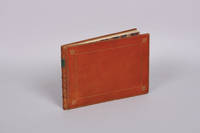
18254504048Probably Venice 1825. A few spots but generally in fine condition the watercolours well preserved and bright. Oblong small quarto album 185 x 275mm containing forty-six watercolours of various sizes and shapes ranging from delicate circular vignettes to larger scenes of urban and theatrical life elegantly bound in nineteenth-century ochre morocco with ornate gilt decoration. <p><p>A beautiful suite of watercolours including a superb series of scenes of a contemporary Venetian commedia dell'arte troupe by the Venetian painter and engraver Novelli. Featuring images from both the stage and street-performance including acrobatics and conjuring each of the 46 deftly drawn images of which 11 are signed is of considerable quality. </p> <p>Francesco Novelli 1764-1836 vividly and imaginatively illustrated Algarotti's Opere 1791-94 assisting his father Don Quixote 1819 and Gil Blas 1820. He is also known for illustrating works such as the Fasti Veneziani 1794 hinting at his abiding interest in the theatre and the performing arts. </p> <p>One of Novelli's most important teachers was the French artist Vivant Denon who visited Venice in the 1790s. Denon seems to have had a formative influence on Novelli's career not least because he introduced his pupil to the engravings of Rembrandt. This rare and exceptional collection provides a wonderful insight into Italian theatre in its golden age. The album includes an incomparable collection of Novelli's watercolours with the greatest number being piquant images of a Venetian troupe of the commedia dell'arte with especially fine depictions of Pierrot himself as well as other key figures such as Columbine and Harlequin. It includes a remarkable series of scenes from a stage play as well as studies of the individual performers. Indeed many of these images are so precisely rendered that it is likely that Novelli depicts a well-known troupe perhaps one with which he was personally connected.</p> <p>The remaining images cover all aspects of contemporary life including several military vignettes perhaps scenes from the diorama as well as charming rural scenes. Several show Novelli's work at its most sympathetic especially in his animated studies of street vendors and town squares. It is also likely that many of these scenes derive from a period when the troupe was on the road especially as some of the liveliest show street performers conjurors and Punch and Judy shows. These scenes reveal Novelli at the height of his powers especially his skill in capturing the energy and fascination of the crowds that gathered to watch the impromptu performances.</p> <p>Unpublished although the compilation of the album suggests that publication might originally have been Novelli's intention. This is a superb collection of images by one of the pre-eminent artists of his generation providing an insight into Novelli's involvement with the Venetian theatre as well as giving a unique opportunity to study the daily life of a travelling group of European artists and musicians at the turn of the nineteenth century.</p> <p>Make-up of the album:-</p> <p>• three portraits of peasants:</p> <p>• a fishmonger with his left sleeve hanging loose</p> <p>• a peasant women with a cob of corn</p> <p>• a profile of a woman in an elaborate scarf</p> <p>• a uniformed cuirassier rejects the entreaty of a woman</p> <p>• a lively scene at the market with a grenadier a Pierrot and a harlequin</p> <p>• a crowd gathers around a conjuror in the town square</p> <p>• children animatedly watch a Punch and Judy show</p> <p>• a street performer shows a dancing bear while an urchin shows a monkey</p> <p>• two small round scenes:</p> <p>• the first of a cavalry charge</p> <p>• the second a peaceful domestic scene around the hearth</p> <p>• an infantry charge perhaps a real scene or a diorama</p> <p>• three generations of women interior</p> <p>• a lively outdoors scene of the stables</p> <p>• two women work inside a darkened barn</p> <p>• four liveried horses with a cart full of hay</p> <p>• two small round scenes:</p> <p>• a scene in the yard of a hostelry</p> <p>• cooking in a well-provisioned kitchen</p> <p>• two small square scenes:</p> <p>• infants and burghers at a Punch and Judy show</p> <p>• small children crowd around an itinerant projectionist</p> <p>• two small square scenes:</p> <p>• dancing a lively jig</p> <p>• the children of the house at lessons</p> <p>• two small square scenes:</p> <p>• a muzzled bear is made to dance</p> <p>• masked members of a commedia dell'arte troupe enjoy a repast</p> <p>• two small square scenes:</p> <p>• a corpulent gent mounts his horse</p> <p>• a befrocked gentleman loses his hat in an impromptu swing</p> <p>• two small square scenes:</p> <p>• a mother with swaddled child and infant greets some friends</p> <p>• a game of cards</p> <p>• two small square scenes:</p> <p>• Pierrot chased by a 'dog'</p> <p>• Pierrot discovers Harlequin and Columbine with stylized cartouche but no caption</p> <p>• three medium square scenes:</p> <p>• the 'dog' seems to have caught Pierrot</p> <p>• Pierrot greets Columbine</p> <p>• Pierrot astride the 'dog'</p> <p>• two small square scenes:</p> <p>• a strongman lifts four children on a table by his teeth</p> <p>• Columbine's lover hides by pretending to be a sofa</p> <p>• two small square scenes:</p> <p>• Pierrot performs a balancing act</p> <p>• Pierrot discovers Harelquin and Columbine asleep</p> <p>• two small square scenes:</p> <p>• Pierrot accosted by a Satyr</p> <p>• Pierrot offers his hat to the 'dog'</p> <p>• two small square scenes:</p> <p>• an acrobat assumes a pose</p> <p>• a different acrobat stands on his hands</p> <p>• two small square scenes:</p> <p>• a female contortionist performs a trick with four glasses and a hoop</p> <p>• a female acrobat balances on the low-wire</p> <p>• two small square scenes:</p> <p>• one of the troupe strikes a pose</p> <p>• Pierrot discovers a skeleton in his closet</p> <p>• two small square scenes:</p> <p>• the skeleton torments Pierrot at table</p> <p>• Pierrot poses</p> </p> . unknown
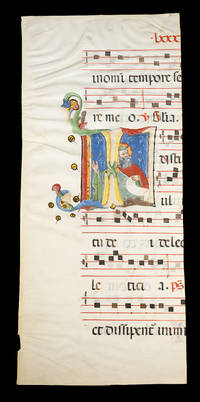
14200123<p>This exquisite miniature is by Cristoforo Cortese the most accomplished Venetian illuminator of the early fifteenth century. Executed during the formative stage of his career it once formed part of a sumptuous Camaldolese Gradual. The bearded prophet set within an initial I is rendered with Cortese's hallmark precision: expressive features painted with delicate strokes highlighted with red-rimmed haloes and radiant yellow tones. These qualities firmly align the work with Cortese's early output before 1420.</p><p>The stylistic vocabulary recalls both Florentine models and Venetian innovations. Cortese clearly drew upon the influence of Don Silvestro dei Gherarducci whose Choir Books for San Michele in Murano 1392–1399 provided prototypes for half-length prophet figures. Yet Cortese's interpretation more vibrant and emotive shows the confident individuality that would earn him recognition as the pioneer of Venetian Renaissance illumination.</p><p>The palette dominated by blues reds and yellows closely parallels related cuttings: a Bust Portrait of a Bearded Man in the Getty's Compendium moralium notabilium MS Ludwig XIV 8 f. 34v; a Saint John the Evangelist in the Victoria and Albert Museum inv. D.637B-1894; and the Entry into Jerusalem at the Fitzwilliam Museum Cambridge Marlay Cutting It. 20. The square notation on the verso written on four-line red staves rastrum 25 mm confirms its liturgical function as part of a choirbook used in monastic chant.</p><p>Provenance:<br />1. USA private collection early 20th Century framing tag S.Schwartz picture frames 128 W 42nd Street New York with a note pasted in the back of the frame "This fragment is old German. The miniature is a perfect work of art. Age no less 500 years.".</p><p>Sister Leaves Known To Exist In:<br />Victoria and Albert Museum Saint Peter initial "C";<br />Free Library of Philadelphia Saints with initials "G" and "S";<br />Additional leaves include the Apostle initial "T" and Standing Saint initial "E" formerly F. G. Zeileis collection sold at Sotheby's;<br />Cambridge Fitzwilliam Museum Entry into Jerusalem initial "D";<br />Museo Civico Medievale Bologna a prophet initial "C";<br />Softer sales—e.g. Prophet initial "V" Sotheby"s; Robert Lehman Collection;<br />Les Enluminures Paris Bearded Bishop initial "S"; Prophet and St. Paul.</p><p>Literature:<br />F. Todini in Una collezione di miniature Italiane vol. II 1994 no. VII;<br />M. Bollati Dalla Bibbia di Corradino a Jacopo della Quercia in Duecento 1997 pp. 128-29;<br />G. Freuler Tendencies of Gothic in Florence: Don Silvestro dei Gherarducci Corpus of Florentine Painting IV.7.2 1997;<br />G. Zeileis Più ridon le carte 2009 no. 11;<br />S. Panayotova "Cristoforo Cortese in Cambridge" in Miniatura. Lo sguardo e la parola 2012 pp. 186-89.</p> Illuminated Gradual on parchment
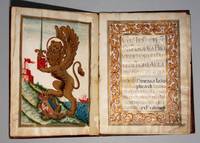
17175670<p>4to manuscript on vellum 23.5 x 17.1 cm 7 ff. 4 ff. vellum blanks including a full-page frontispiece illumination of Venetian Lion of St. Mark each text page with foliate borders in gold ink headings and initials in gold ink. Bound in contemporary Venetian morocco elaborately gold tooled gold block-printed foliate pastedowns. Edge wear and minor rubbing to spine and boards manuscript loose in binding oxidizing to edges of pastedowns. Marginal flaws to frontispiece illumination just touching border in places a few small wormholes elsewhere minor handsoiling.<br /></p><p>Finely illuminated early 18th-century Venetian manuscript issued by the city's Magistrato alla Sanità Health Department as a license to certify the physician Antonio Damugliano d. 1747 to practice medicine in the Venetian Republic using his propriety formula for topical salves <i>balsami</i> to treat "wounds and ulcers" f. 3v-3r. The manuscript ornately written out and decorated in gold and colored ink opens with a full-page image of the winged Lion of San Marco in the Venetian landscape which serves as an official seal of the document's authenticity and is inscribed by five <i>Provveditori</i> of the Magistrato and one notary who witnessed the certification.</p><p>This pharmaceutical license represents a rare material survival of how Venice's Magistrato alla Sanità regulated the practice of medicine in its territories even down to the level of controlling how individual practitioners could work with specific drugs. Damugliano presumably was required to keep the document on his person while plying his trade and to present it to the relevant authorities or even to his patients should his practice be called into question. The text of the document is written out twice – first in Italian and then in Latin – to suit the linguistic preferences of both the common Venetian citizen and the professional medical class.</p><p>Damugliano also known as Antimo Damulianos is noted in the document dated April 1717 as being a native of the Ionian island of Zante or Zakynthos at the time a Venetian colony and having recently returned from Moscow "where with good success and for a long time he practiced medicine with full official permission of many noteworthy people" f. 2v. Damugliano is said to have studied medicine in Europe likely in Italy specializing in contagious diseases and eventually practicing in Asia Minor Persia India China Egypt Constantinople and Trieste and to have been ordered by Emperor Charles VI 1685-1740 to treat the sick of a plague outbreak in Corinth see L. Zoes passim. Damugliano's name is also associated with a 1725 treatise entitled 'Medicina' which circulated in manuscript form in Venice and dealt with the use of salves pills and stones to treat hydrophobia see L. Zoes; we have been unable to locate a copy of this treatise. Damugliano is also recorded as having worked in Vienna where an April 1746 news magazine comments that the "very famous" Damugliano having traveled through numerous kingdoms has arrived to demonstrate the curative powers of "the wondrous Chinese stone called Bezoar" which is effective against fevers snake bites fatigue colic etc. <i>Nachtrag</i> p. 64. The bezoar stone an indigestible mass formed in the digestive tract of ruminants was lauded from the middle ages as a universal antidote to poison.</p><p> R. Palmer "Pharmacy in the Republic of Venice in the Sixteenth Century" in A. Wear et al. eds. <i>The Medical Renaissance of the Sixteenth Century</i> pp. 100-17; <i>Epeteris: Hetaireia Byzantinon Spoudon</i> vol. 43-44 1977 p. 417; H. Schmuck <i>Grieschischer Biographischer Index</i> vol. 1 p. 247; L. Zoes <i>Lexikon historikon kai laographikon Zakynthou</i> vol. 1; S. Carbone <i>Provveditori e sopraprovveditori alla Santità della Repubblica di Venezia</i>; P. Selmi "Il Magistrato all Sanità" in <i>Difesa della Sanità a Venezia Secoli XIII-XIX</i> pp. 28-50; <i>Nachtrag zu denen wöchentlich-kurtzgefaßter historischer Nachrichten Der neuern Europäischen Begebenheiten auf das Jahr 1746</i> p. 64.</p>
149325186Nuremberg: Anton Koberger for Sebald Screyer and Sebastian Kammermeister 1493. First Edition with the Latin text the bifolium with fine hand-colouring to the Venice view. This is one of the large double-page city-view woodcuts from the workshop of Mighael Wolgemut and Wilhelm Pleydenwurff beneith 24 lines of text. The view of Venice was adapted from the 1486 woodcut by Erhard Reuwich in the Sanctae Perigrinationes. It is handsomely and finely handcoloured in blues greens yellows reds grays etc. Double-page folio ca. 540 x 364 mm handsomely mounted framed and glazed. Leaves XLIII and XLIIII. In fine condition and very well preserved and presented. FROM THE FIRST EDITION OF THE NUREMBERG CHRONICLE ARGUABLY THE GREATEST ILLUSTRATED BOOK OF THE 15TH CENTURY. The artists Michael Wolgemut the well-known teacher of Albrecht Dürer and his stepson Wilhelm Pleydenwurff have been praised and admired for over five-hundred years for their contributions to one of the monuments of early printing. David Bland calls it "a marvelous book and a landmark in the history of illustration" and through the ages it has more than fulfilled Koberger's prophecy that it would be "the delight of the men of learning and of everyone who had any education at all."<br> HIGHLY IMPORTANT INCUNABLE the “Nuremberg Chronicle†is the most extensively illustrated book of the fifteenth century and after the Gutenberg Bible the most celebrated book printed in the fifteenth century. Its 1809 woodcut illustrations 1164 excluding repeats depict popes saints and other religious figures kings and emperors historical and biblical genealogies mythological and fanciful creatures natural phenomena and views of all the major cities of the known world as well as a brilliant creation sequence. In addition to the full-sheet maps of the world and of Europe twenty-nine city views such as this one span two pages and eight other cuts excluding the xylographic title page are full-page. The colophon explicitly acknowledges the contributions of the artists Michael Wolgemut and Wilhelm Pleydenwurff. Albrecht Dürer was at that time a pupil in Wolgemut's workshop and there is good evidence that he did many of the preliminary drawings for woodcuts and may even have cut some of them see Adrian Wilson THE MAKING OF THE NUREMBERG CHRONICLE. Anton Koberger, for Sebald Screyer and Sebastian Kammermeister unknown
1830D7073Venice: Eugenio Testolini n.d. c. 1830. Hardcover. Very Good. Publisher's half brown cloth and printed boards; oblong folio 240 x 343 mm; contains lithographed title-page with inset view of a gondolier and 11 beautifully hand-colored lithographed plates many with the embossed stamp of the publisher in the lower margin. Boards soiled and scuffed; spine tips corners and edge of boards lightly bumped. Nice and bright on the inside! Aside from some faint marginal foxing plates are simply lovely. <br/><br/> Eugenio Testolini hardcover
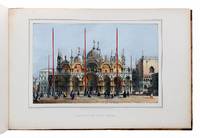
64620Venice: Gio. Brizeghel c.1855. Oblong folio 27 x 40 cm. 19 leaves. Original half cloth over printed boards. Vignette title and 18 lithographed plates with hand-colouring some heightened with gum arabic. Front free endpaper creased and slightly torn some light foxing and browning boards a bit soiled and worn generally a very good example. The plates include: Place St. Marc Petite Place de St. Marc Basilique de St. Marc Intérieur de l'Église de S. Marc Pont des Soupires Porte Principalle du Palais Ducal Cour du Palais Ducal l'Arsenal Quai des Esclavons Pont de Rialto Palais Foscari Eglise de Notre Dame la Laitiere de Venise Porteuse d'Eau à Venise Porteur d'Eau à Venise Gondolier de Venise Môle de la Place St. Marc à Venise Eglise de N.D. de la Salute sur le Grand Canal. Venice: Gio. Brizeghel, [c.1855]. hardcover
193428296<p>LONDON PRIVATELY PRINTED 1934. Hardback NODJ 1934 1ST LIMITED EDITION 200 COPIES Small Thin PURPLE BURGUNDY CLOTH WITH GOLD CREST MONGRAM ON FRONT Here is a near fine copy of The Enchanted by MDIVANI Barbara née Hutton. . NEAR FINE in burgundy hardback with GOLD gilt edges and a gilt monogram on the front cover. The book is signed "Barbara" and dated August 21 1934 - in Venice. I cannot make out the first two lines of the dedication but it appears to be "To dear Princess Jane 6 words I cannot make out and her signature and date below. - There are two small light spots on the front cover - all inside is like new 100 pgs One of the poems was read by Cliff Robertson at her funeral forty-five years later. The first volume of poetry written by the Woolworth heiress shortly before her twenty-second birthday. At the time she was married to the playboy Alexis Mdivani the first of several failed marriages. The first volume of poetry written by the Woolworth heiress shortly before her twenty-second birthday. At the time she was married to the playboy Alexis Mdivani the first of several failed marriages. Rex Whistler contributed an attractive title page to the volume in which he included small contrasting landscapes of New York Bali Peking and Venice. . Signed by Author. 1st Edition. Hard Cover. Very Good/No Jacket.</p> LONDON PRIVATELY PRINTED hardcover
196759059Venice Italy: Alfieri Edizioni D'Arte. As New. 1967. Paperback. FREE UPGRADE to Courier/Priority Shipping Upon Request IN STOCK AND IMMEDIATELY AVAILABLE FOR SHIPMENT - AS NEW THE TEXT BLOCK IS PRISTINE CLEAN UNMARKED AND IN EXCELLENT CONDITION - - Text in Italian with sections on artists in English French and German. 164 pp. With 105 ills. 3 col. . 23 x 24 cm. -- with a bonus offer-- . Alfieri Edizioni D'Arte paperback
196158611Venice Italy: Neri Pozza Editore. As New. 1961. Paperback. FREE UPGRADE to Courier/Priority Shipping Upon Request IN STOCK AND IMMEDIATELY AVAILABLE FOR SHIPMENT - AS NEW THE TEXT BLOCK IS PRISTINE CLEAN UNMARKED AND IN EXCELLENT CONDITION - - Text in Italian. 222 pp. With 128 ills. 22 x 16 cm. -- with a bonus offer-- . Neri Pozza Editore paperback
196858883Venice Italy: Palazzo Della Biennale. As New. 1968. Paperback. FREE UPGRADE to Courier/Priority Shipping Upon Request IN STOCK AND IMMEDIATELY AVAILABLE FOR SHIPMENT - AS NEW THE TEXT BLOCK IS PRISTINE CLEAN UNMARKED AND IN EXCELLENT CONDITION - - Text in Italian. 400 pp. With 196 ills. 23 x 16 cm. -- with a bonus offer-- . Palazzo Della Biennale paperback
196458610Venice Italy: Neri Pozza Editore. As New. 1964. Paperback. FREE UPGRADE to Courier/Priority Shipping Upon Request IN STOCK AND IMMEDIATELY AVAILABLE FOR SHIPMENT - AS NEW THE TEXT BLOCK IS PRISTINE CLEAN UNMARKED AND IN EXCELLENT CONDITION - - Text in Italian. 214 pp. With 120 ills. 20 x 15 cm. -- with a bonus offer-- . Neri Pozza Editore paperback
196458477Venice Italy: Neri Pozza Editore. As New. 1964. FREE UPGRADE to Courier/Priority Shipping Upon Request IN STOCK AND IMMEDIATELY AVAILABLE FOR SHIPMENT - AS NEW THE TEXT BLOCK IS PRISTINE CLEAN UNMARKED AND IN EXCELLENT CONDITION - - Text in Italian. 94 pp. With 127 ills. 22 x 15 cm. -- with a bonus offer-- . Neri Pozza Editore unknown
200529755Venezia / Venice: Sotheby's. New. 2005. Paperback. FREE UPGRADE to Courier/Priority Shipping Upon Request - IN STOCK AND IMMEDIATELY AVAILABLE FOR SHIPMENT - -- with a bonus offer-- . Sotheby's paperback
1729ST16379-042Venezia Venice: Appresso Carlo Buonarrigo 1729. FIRST EDITION. 155 x 105 mm. 6 1/8 x 4 1/8. 1 p.l. extra engraved title 122 pp. <br/> Original cream-colored wrapper of heavy paper silk ribbon stitching remnants of old shelf label at foot of spine. Extra engraved title page depicting the Bucinotoro in all its glory surmounted by the Lion of St. Mark emblem of Venice. Front pastedown with bookplate of the duke of Arenberg Castle Nordkirchen. Cicognara 4369. Binding lightly soiled front pastedown lifting occasional faint yellowing to margins other trivial imperfections but still A VERY FINE COPY--clean bright and especially fresh in its remarkably well-preserved fragile binding.<br/> <br/> This is a detailed account of the magnificent Bucintoro—a ceremonial ship used in the annual ritual in which the Doge of Venice was symbolically wedded to the sea— unveiled in 1729. The city known as La Serenissima had long been a major port for trade between Europe and points East and the people honored the role played by the Mediterranean Sea in the Republic's prosperity. Beginning in 1311 the head of state sailed forth each year on Ascension Day to be "married" to the sea aboard a boat called the Bucintoro. The wooden ship was restored or rebuilt from time to time through the centuries and in 1719 the Venetian Senate commissioned a brand new vessel to be richly ornamented and even bedecked with gold. <br /> <br /> Our volume describes the process by which the finest artists and artisans of the day--from shipbuilders to sculptors and painters--created the largest and most lavish Bucintoro in history. The engraved title page shows the stately craft in full rig banners flying as Doge Alvise Mocenigo is rowed out to meet his marine bride. Cicognara notes the volume's value in preserving for posteriority these memories of Italian greatness--and that greatness lasted only a relatively short time because after the fall of the Venetian Republic in 1797 Napoleon had the Bucintoro stripped of its finery. The denuded and humiliated ship was then used by the Austrian navy until 1824 sailing under the name "Hydra."<br /> <br /> The presence of a binding identical to ours on several copies in sales records suggests that these may have been the publisher's original wrappers which have weathered the years surprisingly well. The text here is deeply impressed on thick paper upholding the fine tradition of Venetian printing. Appresso Carlo Buonarrigo unknown
N4183fJerusalem: Makor 1972. Original Half Leather. Near Fine. Folio. 4 volumes 20pp separate Introduction brochure in English by Moshe Goschen-Gottstein." THE FIRST AND THE MOST IMPORTANT EDITION OF THE BIBLE Mikraot Gedolot which includes the Targum the traditional commentaries and the Massora as published by the renowned press of DANIEL BOMBERG. Based on manuscripts partly lost this is the prototype of all later Rabbinic Bibles." - A SUPERB FACSIMILE EDITION. Truly minimal wear on head of spine of vol.1. A FINE AND CLEAN COPY IN THE ORIGINAL HAND BOUND HALF LEATHER. - Due to the heavy weight of these four big volumes additional shipping cost above the indicated fees will apply $ 100 to Europe $ 180 to the USA - shipping with EMS airmail courier <br/> <br/> Makor hardcover
17971504061797. ZANETTI Anton Maria and Marco BOSCHINI. Della pittura veneziana trattato in cui osservasi l'ordine del Busching e si conserva la dottrina e le definizioni del Zanetti. Two volumes. viii 145 i.e. 245 3 including final blank pp.; 256 i.e. 272 pp. each volume illustrated with an engraved frontispiece. 8vo 165 x 110 mm. bound alike in contemporary paste paper decorated with red flowers against a striped ground later glassine wrappers. Venice: Presso Francesco Tosi 1797. First edition based on Boschini's Le Minere della pittura 1664 and Zanetti's Della Pittura Veneziana 1771 with additions by the publisher Tosi. Both Boschini and Zanetti were of fundamental importance to the history of art in Venice. Schlosser-Magnino calls Boschini's guide "the first true artistic guide to Venice" and Zanetti's inventory of Venetian painting "one of the best in its genre" p. 548. This handy set combines their work into a comprehensive practical guide to monuments of Venetian art and architecture including a final section Istoria della Pittura Veniziana sic with biographies of artists; and an addition made in 1797 identifying paintings that were transported out of Venice by military force the same year. Marco Boschini 1613-1678 was a Venetian painter engraver and art dealer whose most important client Cardinal Leopoldo de' Medici commissioned him to purchase Venetian paintings for the Medici collection. Zanetti 1706-1778 was the librarian to the famed Marciana Library in Venice for forty years and his familiarity with the art and artists of his city and his access to library records helped to produce his remarkable books. On Zanetti's guide Cicognara adds: "This is the best of the works which deal with Venetian painting and if every principal city possessed a book so arranged and executed we should have gathered together the materials for the best general history of art". Fossati-Bellani 2339. Cicogna 4661. Schlosser-Magnino pp. 548-549. Cicognara 2412 Zanetti & 4350 Boschini. unknown
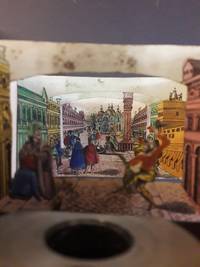
18353220261<p><em>Concertina-folding hand-coloured lithographic peepshow with three cut-out sections front-face measuring 98 × 137 mm; the peepshow extends by paper bellows to approximately 275 mm. Hand-coloured lithograph housed in a custom made cloth box.</em></p><p>Rare German peepshow of St. Mark's Square in Venice rather naive in appearance resembling the illustrations found in chapbooks of the time.</p><p>The front-face consists of the title a view of St Mark's Square viewed from an architectural arrangement at the west end of the square symbols of carnival - a tambourine masks and a jester's bauble - and a circular peephole. The staffage on the cut-outs and backboard consist of commedia del arte figures including a dancing man with a mandolin and two dwarfs. The campanile hopelessly represented and wrongly positioned features on the third cut-out and St Mark's on the backboard.</p> [Germany,
2092902141501420300-Mai N.A. Soft Cover. Fine. Size: A4 Number of copies: 300 sheets 300-Mai paperback
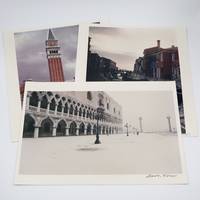
1970232456Venice 1970. Printed circa 1984. Each SIGNED in ink below the image. 1 vols. Each approximately 13 x 9 inches. Fine. Printed circa 1984. Each SIGNED in ink below the image. 1 vols. Each approximately 13 x 9 inches. Lovely luminous group of Venetian views lovingly shot and printed by the Russian-born photographer Kessel 1902 - 1995 whose work for LIFE magazine won international acclaim. As he wrote in his book ON ASSIGNMENT: DMITRI KESSEL LIFE PHOTOGRAPHER New York Abrams 1985: "In sun rain fog snow photographing Venice was for me a labor of love "<br /> <br /> The photos include several views of St. Mark's Square including the Basilica a snowy view of the Doge's palace the Campanile vaporettos parked in a canal gondolas floating in the lagoon one of the famous bronze horses undergoing restoration and others. unknown
D14686Ephemera. Very Good. Group of landscape photographs in sepia ca. 19 x 25.2 cm each mounted on black board 23.5 x 30.5 cm all edges gilt showing the Piazza San Marco from various views; the logetta underneath Campanile Sansovino; Basilica di San Marco and the Battisterio; Porta della Carta; Santa Maria della Salute; Santa Barnaba signed O. Nayatot; Scala dei Giganti; the Arsenale; monuments to Titian and Canova; the tombs of Doge Vendramino and Doge Loredano; the Orologio clock; Ponte Rialto; Ponte dei Sospiri; Palazzo Ducale exterior and Sala dei Pregadi Sala del Maggior Consiglio Cortile; Canal Grande with a view of Palazzo Cavalli and Chiesa della Salute numbered 18638 in lower left corner; the Palazzo Reale loggia; Palazzo Vendramin; Palazzo Cavalli/Franchetti; Palazzo Contarini; Palazzo Pesaro; the Palazzo Minelli staircase; the canal between Palazzo Wanaxel and Palazzo Salviati perhaps from a different series; a view of Isola San Lazzaro; and panoramas. <br/><br/> unknown
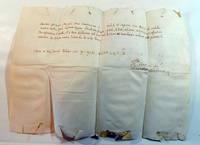
160123709Venice: Ducal Palace 1601. Leaf. Fine. Single page of vellum 12 by 16 inches folded and with cuts along two margins to seal the page. Five lines of manuscript the first two in Latin then two in Italian and the last in Latin identifying Marino di Carvallo as the Venetian Ambassador appointed by the Doge of Venice to the King of France Henry IV of Navarre. Signed at the end in Latin "Leonardus Octobonus" for the Council of Ten. He later held the post of Grand Chancellor of Venice.<br /> <p><br /> "Marino Gramani Doge of Venice sends greetings and affection to the Most Christian King through our noble and wise faithful and beloved Ambassador Marino di Cavallo." It then references the decision of the Council of Ten the Venetian Governing Body and finishes with "Dated in the Ducal Palace this 4th day of April.1601."<br /> <p><br /> The Doge Marino Gremani antagonized Pope Paul IV by trying two priests under Venetian not canon law to which the Pope responded by placing Venice under Interdict. The Ottoboni were an aristocratic Venetian family which provided Venice with more than one Chancellor and ultimately produced Pope Alexander VIII. Marino de Caballo was also from an aristocratic Venetian family and was a noted physician as well as an Ambassador who believed that the most important aspect of his job was to provide an excellent chef and fine food. Finally Henry IV of Navarre a Huguenot ruler of Navarre as Henry III secured the throne of France by converting to Catholicism: "Paris is worth a Mass." Five years later he signed the Edict of Nantes the landmark drecree granting religious tolerance to Protestants and which helped end the Wars of Religion.<br /> <p>. Ducal Palace unknown
elala5189Venice: 1737. Letter regarding penalties associated with tax arrears accumulated by the community of Asolo. one-page oblong folio. with the doge's lead seal attached with hemp. horizontal & vertical folds. postal marking 'Cito Cito Cito' haste on panel Venice: 1737 unknown
1533Ant66441533. Giovani Paulo. The books measure 6"x4" and have 16 pages 415 leaves 680 leaves 38 pages and 618 30 pages they are complete. The books are bound in full calf they are rubbed and there is a loss to the top of the spine of the first volume the hinges are strong and everything is well bound in. The first volume has an owner's bookplate some staining to the title page a little light staining in a few places and a few missing corners but no loss to the text the final leaf has a larger loss but again no loss of text. The second volume title page has marginal losses the first leaf of prelims has a loss; the rest of the text has some marginal worming a few marginal losses and slight yellowing to the outer edges. The final volume has slig unknown