1 286 résultats
Napoli, Cimmaruta,1921. In 8°gr.pp. da 17n. a 42n. bross.edit. Invio Dedica dell’A.
1905GITg113Paris Secrétariat du Comité des Pélerinages en terre Sainte 1905. In-8 broché 14pp imprimées sur 2 colonnes (liste des pélerins Français et de diverses nationalités) 4 feuillets indépendants (programme du pélerinage, excursions, prix des places, dispositions spéciales, avis divers). 4 illustrations dans les feuillets de programme.
Volume con coperta rigida illustrata in buonissimo stato di conservazione; l'interno è ottimo, ricco di illustrazioni a colori sia al testo che a tutta pagina; testo completamente in lingua inglese. Volume provvisto di cellophan protettivo. Numero pagine 67. USATO
Very light bump to 1 corner. Else fine. ; This volume explores the nature of female beauty in ancient Rome by studying depictions of heavenly and earthly women in Pompeiian art. The first section discusses the care of the body: hygiene, cosmetics, coiffure, and perfume. The second section discusses adornments like jewelry and clothing, and explains how such items were distributed in the Roman world. Here, archaeology and art come together to offer numerous insights into this fascinating subject. ; 67 pages
Book is in excellent condition with pictorial covers, map endpapers of Ephesos. Binding is solid and square, covers have sharp corners, exterior shows no blemishes, text/interior is clean and free of marking of any kind. Oversize format with a great many color photos throughout, floor plans, architectural drawings, maps. Contents include: Roman wall painting: Pompeii and beyond, Hellenistic wall painting in Ephesos, Wall painting of the Roman Imperial period in Ephesos, Terrace house 2 in Ephesos, Additional wall painting of the imperial period in Ephesos, Late antique and early Christian wall painting, The stylistic transistion of the tetarchic period and a new decorative system; etc. each of which has numerous subdivisions. 224 pages.
183215317Zürich, Fuessli, 1824 (- 1832). 28 Bll. 24 Aquatinta-Tafeln. Fol. Pp. des 19. Jahrhunderts mit Rückenschild (bestoßen).
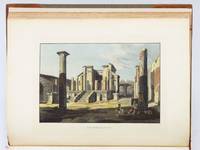
1824ST17496-014Zurich: by the author and Henry Fuessli and Comp 1824-25. FIRST EDITION. 445 x 325 mm. 17 1/2 x 12 3/4". 26 leaves of descriptive text. Lacking title page and dedication.Commentary by art historian Johann Jacob Horner. <br/> Modern tan half morocco over olive green buckram raised bands spine panels with gilt ornament red morocco label. 24 FINE AQUATINT VIEWS COLORED BY A CONTEMPORARY HAND. Brunet III 357. Text pages variably foxed from a little to very but somehow THE LOVELY PLATES IN FINE CLEAN CONDITION--fresh and bright with pleasing coloring in an unworn sympathetic binding.<br/> <br/> This is a rare complete colored set of Hüber's famed views of Pompeii much sought-after by armchair travellers after excavations uncovered that urban time capsule in the late 18th century. The German-born Hüber 1787-1871 settled in Naples in his early 20s studying landscape painting with Dutch émigré painter Jacob Philipp Hackert 1737-1807 who was known for his lush scenes often featuring ruins. His arrival in the region coincided with the occupation of Naples by the French who accelerated the excavations underway at Pomepii which had been buried by the eruption of Vesuvius in 79 A.D. The rapid burial of the city in volcanic ash had captured a moment in time and the opportunity to see a well-preserved example of life in the ancient Roman Empire caught in medias res drew eager travellers on the Grand Tour of the Continent. Hüber's well-executed views often picture these tourists and their contemporary dress contrasts sharply with the classical ruins. Lord Napier in his "Notes on Modern Painting at Naples" 1855 credits Hüber for introducing the use of watercolors to the meticulously drawn landscapes then being produced. This innovation is displayed in the hand-colored plates here which were also issued in uncolored state. Napier was correct to appreciate the value of adding colors which increases both the drama of the views and the pleasure of the viewer. Because the attractive sets with color were often broken up complete volumes of the colored plates are rarely seen for sale: we could trace just three such copies sold at auction as listed in RBH and ABPC the two best ones were the Feltrinelli copy which sold for $14330 in 2001 and the Donaueschingen copy fetching $13750 in 2014. Ours does not have the distinguished provenance attached to those copies and it lacks two preliminary leaves but the text is present and most important the lovely colored plates are in fine condition. by the author and Henry Fuessli and Comp unknown
182721955Paris Firmin Didot 1827 -in-folio demi-basane 2 volumes (1 volume de texte + un volume de planches), reliure demi-basane (half binding sheepskin) verte petit in-folio (35 x 26,5 cm), dos long (spine without raised band) décoré or (gilt decoration) et motifs à froid (blind-stamping decoration), titre frappé or (gilt title), pièce de titre et de tomaison sur fond noir avec un filet "or" de part et d'autre, doubles filets large "or" en place des nerfs et en tête et en pied, entre nerfs à fleuron mat avec roulette à froid de part et d'autre, petit accident à la coiffe de tête du tome de planches, dos légèrement épidermé, papier marbré bleu et rouge aux plats (épidermures), illustré de 121 planches hors texte lithographiées, dont quatre doubles et six en couleurs, et 17 vignettes en noir sur Chine monté, le tout dessiné par Hubert Roux, l'aîné, 143 pages (volume de texte) + 121 planches (volume de planches), 1827- 28 Paris: Firmin Didot Editeur,
Brière éditeur, Everat imprimeur 1827. Grand in-4 carré broché, sous couverture d'attente bleue. Faux-titre, titre, 110 pages et 60 planches hors-texte gravées à l'aqua-tinta, accompagnées de notices et de dissertations. Divisé en 12 cahiers : Dissertations historique sur l'Antiquité de la ville de Naples. Grottes de Pausilyppe, dissertation historique sur l'Ancienne Capour, dissertation sur l'Ile de Caprée, dissertation sur la ville d'Herculanum. Dissertation sur l'origine de pompéi. Dissertation sur l'origine de l'art dramatique et sur celle des théâtres. Dissertation historique sur le Vésuve, dissertation sur le culte d'Isis. Dissertation sur les amphithéâtres et sur les combats des gladiateurs. Dissertations sur les monumens en général. Dissertation su l'attaque et la défense des places. Dissertation sur la maison d'Arrius Diomèdes dans le moment de l'éruption de 79. Dissertation sur les volcans en général. Dissertation sur Pozzuoli. Dissertation sur les évènemens historiques dont la Campanie fut le théâtre, et sur les hommes illustres dont elle fut le séjour. Chaque Dissertation est suivie de notes relative au cahier, les planches sont insérées en suivant. Quelques rousseurs claires, néanmoins très bon exemplaire, rare complet.
1827163898Brière éditeur Brière éditeur, Everat imprimeur 1827. Grand in-4 carré broché, sous couverture d'attente bleue. Faux-titre, titre, 110 pages et 60 planches hors-texte gravées à l'aqua-tinta, accompagnées de notices et de dissertations. Divisé en 12 cahiers : Dissertations historique sur l'Antiquité de la ville de Naples. Grottes de Pausilyppe, dissertation historique sur l'Ancienne Capour, dissertation sur l'Ile de Caprée, dissertation sur la ville d'Herculanum. Dissertation sur l'origine de pompéi. Dissertation sur l'origine de l'art dramatique et sur celle des théâtres. Dissertation historique sur le Vésuve, dissertation sur le culte d'Isis. Dissertation sur les amphithéâtres et sur les combats des gladiateurs. Dissertations sur les monumens en général. Dissertation su l'attaque et la défense des places. Dissertation sur la maison d'Arrius Diomèdes dans le moment de l'éruption de 79. Dissertation sur les volcans en général. Dissertation sur Pozzuoli. Dissertation sur les évènemens historiques dont la Campanie fut le théâtre, et sur les hommes illustres dont elle fut le séjour. Chaque Dissertation est suivie de notes relative au cahier, les planches sont insérées en suivant. Quelques rousseurs claires, néanmoins très bon exemplaire, rare complet.
Inc. su rame mm. 143x225 rifilata poco oltre la battuta. Tratta da "Voyage Pittoresque ou Description des Royaumes de Naples et de Sicile" Paris, Avec Approbation Privilége du Roi, 1795-1798 (Seconda edizione).
In-8 p. (mm. 210x131), mz. pelle coeva, filetti e tit. oro alf dorso, pp. 280,(4). Da Genova, via Livorno, Civitavecchia, per un lungo soggiorno a Roma (di cui dettagliatamente descrive usi e costumi, culti religiosi, arte), quindi Napoli, Pozzuoli, Pompei, Ercolano e Stabia, e ritorno via Firenze, Pisa e Livorno. Con lieviss. e uniformi arross., altrim. ben conservato.
2001LFA-126713916Un ouvrage de 320 pages, format 250 x 335 mm, illustré, relié cartonnage sous jaquette couleurs, publié en 2001, Editions Gründ, bon état
1781H400Verona: Per Gli Eredi Di Marco Moroni 1781. First Printing. Wraps. Very Good. Translations from Latin and Greek by Marquis Ippolito Pindemonte Knight of Malta and by Girolamo Pompei Gentlemen of Verona. Royal 8vo 9.5 x 6.75 inches original heavy paper covers 158 pp very good copy some foxing and light wear to wraps minor library marks bookplate blindstamp pages bright. Pindemonte who was a Veronese author born into an aristocratic family was 28 when this was published; later the political and humanist ideas that were the basis of the French Revolution had a major effect on his work. He also spent much of his life translating The Odyssey published 1822. Girolamo Pompei 1731-88 was also a poet and translator from Verona known for his renditions of Plutarch and Ovid. This volume contains verse epigrams portions of the Heroides of Ovid the marriage of Thetus and Peleus Hero & Leander etc. Per Gli Eredi Di Marco Moroni unknown
Articles on Vesuvius & Pozzuoli (pp.557-625) Clean tight copy but cover missing. Book
Milano, 1935, stralcio con copertina posticcia muta, pp. 1491/1496 con 4 tavole fotografiche a colori. - !! ATTENZIONE !!: Con il termine estratto (o stralcio) intendiamo riferirci ad un fascicolo contenente un articolo di rivista, sia che esso sia stato stampato a parte utilizzando la stessa composizione sia che provenga direttamente da una rivista. Le pagine sono indicate come "da/a", ad esempio: 229/231 significa che il testo è composto da tre pagine. Quando la rivista di provenienza non viene indicata é perchè ci è sconosciuta. - !! ATTENTION !!: : NOT A BOOK : “estratto” or “stralcio” means simply a few pages, original nonetheless, printed in a magazine. Pages are indicated as in "from” “to", for example: 229/231 means the text comprises three pages (229, 230 and 231). If the magazine that contained the pages is not mentioned, it is because it is unknown to us.
(Roma), E.N.I.T. - Ferrovie dello Stato, s.d., in-16, mz. tela edit., pp. (8), 43, (1), 24, 46, (2), 28, 48, 44. Numerose ill. in b.n. nel t. Testi, tradotti, di: P. Ducati, G. Calza, A. Maiuri, A. Marzullo.
in-8, 234 p., abdt ill. in et h.t., index, broché, couverture illustrée. [PU-1]
4635Club des Libraires de France. 1962. In-4° à l'italienne, reliure pleine toile rouge illustrée, rhodoïd. Maquette de Pierre Faucheux. Nombreuses planches hors texte. 226 pages. Tirage numéroté hors commerce.
3471Paris, éd. Plon, 1954. In-8 rel. demi-basane, 234 p. Traduit de l'allemand. Nombreux dessins in-t., 57 illustrations h.-t + carte. Très bon état.
Soft cover / Broché. Etat de neuf / As New. 322 p. ; 19 x 13 cm Petite bibliothèque Payot 268 SHS, Histoire Géographie
32074Paris, Payot, 1995. 12 x 19, 300 pp., 48 figures, broché, très bon état.
9300Paris, Plon, 1955 14 x 20, 235 pp., nombreux dessins dans le texte et 57 illustrations hors texte, broché, bon état
45890Paris, Club des Libraires de France, 1962. 20 x 24, 237 pp., nombreuses illustrations, plans et cartes en couleurs et en N/B, reliure d'édition pleine toile, très bon état.
71353Coll. "Petite bibliothèque" n° 268, Paris, éd. Payot, 1995, pt. in-8, cartonnage souple, couv. photo coul. éd., 304 pp., nb. cartes, plans et reproductions de documents anciens en noir, bibliographie, table des illustrations, table des matières, "En l'an 79, l'éruption du Vésuve engloutissait deux petites cités romaines. Les engloutissait, mais aussi, par un manteau de lave, les préservait. Ce passé lointain, non pas mort mais figé, les exhumations entreprises depuis le XVIIIe siècle le réaniment. Le comte Egon C. Corti a écrit le roman de cette stupéfiante résurrection. Mais c'est aussi toute la civilisation romaine du Ier siècle qu'il fait magistralement revivre." Très bon état