RomaBiblio.com
195 résultats
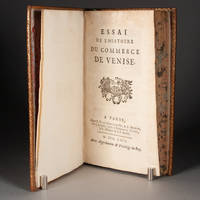
172900518<p>FIRST HISTORY OF VENETIAN TRADE --- xxiv 200 4 p. a8 b4 A-Q8/4 R6 166 x 95 mm --- First and only edition of this history of Venetian trade through 1290 which Barbier attributes to one "Roma"—and which appears to be the first printed survey of Venetian trade altogether. Barbier records the anonymous author's connections in Parisian law and finance but we know little else of him except that he perhaps took his text from a larger three-volume manuscript on the history of business in Italy. ¶ As the history of trade goes few European cities will be as synonymous with the subject as Venice. The Middle Ages saw it become one of the continent's most important ports the vital crossroads of trade between East and West. The author divides his history into three parts: the years 421-697 which he calls the age of the <em>Tribuns</em>; 697-1173 the age of elected doges; and 1173-1290 the age of sovereign doges. He covers the early development of the Rialto Venice's strategic location as a boon for international trade competition in fabric production silk especially—these and many other issues that historians continue to cite in discussions of early Venetian trade. ¶ We fully expected to identify earlier histories of trade in Venice a task we summarily failed at. The author himself complains of "the silence that historians of Venice have kept on this subject" xiij. True enough of the earlier <em>commercio</em> titles in both Cicogna and Soranzo's continuation none could be construed as a comprehensive historical survey of Venetian trade nor have our subject searches in WorldCat turned up anything earlier. Given Venice's tremendously influential role in the history of business the gap this work fills should be an important one. ¶ Hardly a common book and this may be the only copy recorded at auction; it matches the binding description of a copy offered in 2013. --- PROVENANCE: Bookplate removed from the front paste-down and a few efforts at obliterating small marks from the endleaves. --- CONDITION: Contemporary leather spine and board edges tooled in gold; marbled edges and endpapers. ¶ First and last few leaves a little dusty. Leather a bit discolored in spots; front paste-down skinned from removal of bookplate. A nice solid copy in a contemporary binding. --- REFERENCES: Emmanuele Antonio Cicogna <em>Saggio di bibliografia veneziana </em>1847 v. 1 p. 211 #1461; Ant.-Alex. Barbier <em>Dictionnaire des ouvrages anonymes</em> v. 2 col. 209;<em> Kress Library of Business and Economics</em> suppl. p. 196 ¶ Paola Lanaro "Introduction" <em>At the Centre of the World: Trade and Manufacturing in Venice and the Venetian Mainland 1400-1800</em> Toronto: Centre for Reformation and Renaissance Studies 2006 p. 34 "The Venetian Republic is still considered to be one of the first European states to accept the drastic change in mentality and in capitalistic practice brought about by the great maritime commerce between the Levant and the East above all in terms of international commerce in transit"; Edwin S. Hunt and James M. Murray <em>A History of Business in Medieval Europe 1200-1550</em> Cambridge Univ 2005 p. 60 "it was the international merchants who spearheaded the development of the techniques that transformed medieval commerce…The earliest techniques appeared in Genoa and Venice during or even before the twelfth century" 90 "One of the special characteristics of Venice and a source of its lasting power was its role as entrepôt and staple"</p> Pierre Gilles Le Mercier and A. Morin hardcover
171311573Leide: Pierre Vander 1713. First edition. Full Leather. Good . Three separate volumes labed 1-3 in somewhat worn leather bindings. Text in French. Each volume contains numerous illustrations including fold-out illustrations at the beginning of each volume. 6 1/4 x 4" wide. Still well bound. Magnificent architectural structures of ancient Europe. <br/><br/> Pierre Vander hardcover books
172812092Brüssel, Jean Leonard, 1728. Nouvelle Édition (Neue Auflage) 4° (30-35 cm). 3 Bll., SS. 608-909, 12 Bll. Ganzleder der Zeit über fünf Bünden zwei montierten Rückenschildern und goldgeprägter Rückenverzierung
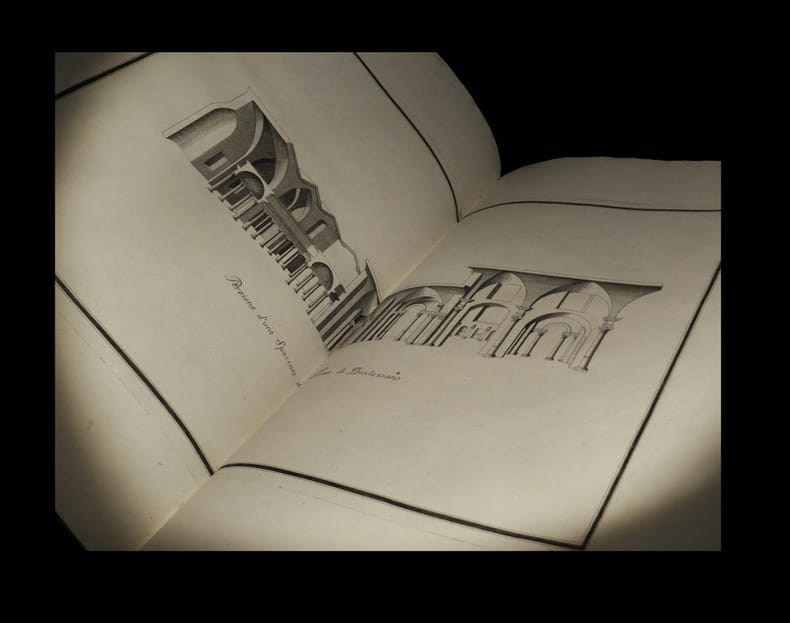
178525649Vicence [Vicenza], chez François Modena, 1785. Deux parties reliées en un vol. au format gd in-folio (522 x 353 mm) de 1 frontispice gravé n.fol., 35 et 32 pp. + 25 planches gravées. Reliure postérieure de demi-veau havane à coins, dos lisse orné de filets gras dorés, doubles filets maigres dorés, pièce de titre de maroquin havane, titre doré.
17621105901762. In der Platte signiert "Piranesi F." und mit dem Titel "Sepolcro di Cecilia Metetla". 45 x 64, 5 cm (Plattengröße).
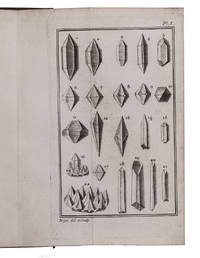
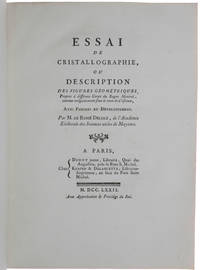
1772L3LEN89INLTKParis 1772. 8vo. Didot Knapen & Delaguette Contemporary mottled calf gold-tooled spine with red title-label red edges marbled endpapers. With 2 folding letterpress tables and 10 folding engraved plates I-X. XXXII 427 2 1 blank pp. First edition of an influential work on geometrical crystallography by the French mineralogist Jean-Baptiste Louis Romé de l'Isle 1736-1790 one of the founders of modern crystallography. "In 1772 he published his first important technical work a one volume essay on crystallography in which he identified 110 crystal forms. This was a major expansion upon the work of Linnaeus . The Essai made Romé de l'Isle a prominent name among Parisian scientists of his day" Wilson. Romé is best known for his "law of constancy of interfacial angles" now the first law of crystal habit. The preliminaries contain an annotated bibliography by the author of the principal works on crystals. The plates depict numerous crystal forms as well as some geometric figures.Occasionally some very faint foxing or a small spot. Binding only slightly rubbed along the extremities. Overall in very good condition.l Hoover 2681; Ward & Carozzi 1906; Wilson The history of mineral collecting p. 52. unknown
17700045631770 Amsterdam, Marc Michel Rey, 1770. Grand in-folio (340 X 515 mm) demi-veau fauve marbré à petits coins de vélin ivoire, dos cinq nerfs ornés d'une roulette dorée, caissons dorés ornés, palettes en queue et tête, pièce de titre maroquin grenat (reliure de l'époque) ; (4) ff. de faux-titre, titre, explication et tables, XXXIV-76 pages, 36 planches hors-texte, six cartes couleurs dépliantes. Quelques rousseurs claires marginales, déchirure sans manque habilement restaurée en marge de la planche XIX, dos pastiche entièrement refait.
1770CLL-240Paris, Desprez, 1770 In-folio de (4) ff., XXXVII, 934 pp., (1) f., demi-maroquin vert à coins, dos lisse orné de palettes, filets et motifs dorés, tranches mouchetées (reliure de l'époque).
179177<p>4° mm 250x190; pp. XII 326. Al frontespizio vignetta incisa raffigurante Ganesha e <strong>32 tavole fuori testo</strong> di cui una a doppia pagina. Nel testo <strong>caratteri in sanscrito</strong>. Legatura coeva in piena pelle marezzata. Bell'esemplare.</p><p>First edition.</p><p>As the title well explains the Systema Brahmanicum by the Indologist Paulinus of St. Bartholomew - valuable compendium of Brahmanism - is closely based on the collection of <em>Indica reperta</em> from the famous Borgia Museum in Velletri <strong>profusely illustrated by the engravings. The volume therefore can be browsed as a kind of 'exegetical catalog' of the Hindu collection</strong>.<br /><br />The ancient Borgia Museum in Velletri formed between the 17th and 18th centuries by the Roman branch of the Borgia family was greatly enriched and enlarged in the second half of the 18th century by Cardinal Stefano Borgia 1731 – 1804 a man of vast culture who was a scholar of history and ethnology. The Museum famous throughout Europe for the variety and the rarity of the <em>reperta</em> as well as the singularity of the collections included artifacts from all parts of the world and was divided into nine sections one of which dedicated to Hindu manuscripts and relics.</p><p>Paulinus of St. Bartholomew Leithaberge in Lower Austria 1748 - Rome 1806 was an Austrian Carmelite missionary and Orientalist of Croatian origin. <strong>He is credited with being the author of the first Sanskrit grammar to be published in Europe and for being one of the first Orientalists to remark upon the close relationship between Indian and European languages</strong> followed by others such as William Jones and Gaston-Laurent Coeurdoux.<br /><br />Having entered into the seminary of the missions of his order at Rome he did Oriental studies at the College of St Pancratius. He was sent in 1774 as missionary to Malabar India. After spending fourteen years in India he was appointed vicar-general of his order and apostolic visitor. He was very well versed in languages: he spoke German Latin Greek Hebrew Hungarian Italian Portuguese English Malayalam Sanskrit and some other languages of India. He became known in Kerala as Paulinus Paathiri. He was one of the first to detect the similarity between Sanskrit and Indo-European languages though the very first was likely Fr Thomas Stephens SJ.</p><p>Recalled in 1789 to Rome to give an account of the state of the mission in Indostan he was charged with editing books – to correct the Catechisms and elementary books printed at Rome – for the use of missionaries.</p><p>In Rome he came into contact with Cardinal Stefano Borgia 1731 – 1804 Secretary of Propaganda Fide antiquarian scholar and patron who had set up in Velletri his native city the very well-endowed Museo Borgiano. Cardinal Borgia appointed him his private secretary and financed the publication of many volumes of indology including the first European grammar of the Sanskrit language <em>Sidharubam seu Grammatica Samscrdamica</em> published in Rome in 1790.</p> Apud Antonium Fulgonium
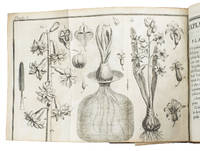
1765L3IEIGJIR4NJ1765. 252 4; 156 pp. Convolute containing the rare second editions of two botanical books one on tulips and the other on hyacinths written by the French priest and botanist Jean Paul Rome dArdène 1689-1769 famous for his studies of flowers which demonstrate his vast erudition as well as providing practical advice. His work is therefore full of information addressed not only to florists and gardeners but to scientists flower lovers and cultivated persons generally and infused with the authors profound love for his subject Oak Spring Flora. The same printer-publisher published the first editions in 1760 and 1759 respectively.Ad 1: Traité des tulipes is an extensive work exclusively devoted to tulips discussing their origin name different varieties cultivation and beauty in 12 chapters. It ends with two folding plates illustrating tulips with an explanation for each plate.Ad 2: Traité sur la connoissance et la culture des jacintes similarly discusses .different aspects of the hyacinth once again in twelve chapters. It covers etymology the right conditions for cultivation and common diseases that affect hyacinths. Like the tulips it ends with two folding plates illustrating hyacinths with an explanation for each plate. It was translated into Italian in 1763. Both first editions are very rare: WorldCat records two copies of each but also only three and four copies of the present second editions of 1765.With a small crease in the first folding engraved plate of Traité des tulipes and a small tear in one text leaf but overall in very good condition.l Ad 1: Hunt 587; Oak Spring flora 76 note p. 294; WorldCat 3 copies; cf. Cat. Lindley libr. p. 10 1760 ed. Ad 2: Oak Spring flora 76 note p. 294; WorldCat 4 copies; cf. Cat. Lindley libr. p. 10 1759 ed.; Hunt 526 note 1759 ed.; neither in: BMC NH; Nissen BBI; Bradley. unknown
176522329Roma, Roisecco, 1765. Frontispiz, 40 gestochene ausfaltbare Tafeln (darunter ein ausfaltbares gest. Schema und eine mehrf. ausfaltbare Ansicht der Stadt aus der Vogelperspektive), sowie sehr zahlreiche Textkupfer, oft fast seitengroß. XVI, 678 SS. / 670 SS. / 581 (1) SS. 8°, Pergament der Zeit, goldgeprägte Rückenschildchen, marmorierer Schnitt. Einbände etwas fleckig und angegraut.
177315686Paris, Chez Didot jeune ; Chez Knapen, 1773. In-8 de XXXII—299-(5) pp., basane havane marbré, dos orné à nerfs, pièce de titre en maroquin rouge, tranches rouges (reliure de l'époque).
17273473Pierre Gandouin, Julien-Michel Gandouin, Pierre-François Giffart. 1727
17653598Rome:: A spese di Niccola Roisecco 1765. THIRD ROISECCO EDITION. The second 3-volume edition 1st 1750. Octavo: 3 vols. 17 x 12 cm. I. a8 A-Z8 Aa-Ss8 Tt-Xx4 Xx4 blank and present. With an engraved frontis. a1 and 19 added plates. II. π1 A-Z8 Aa-Rr8 Ss-Tt4 Vv6. With 20 added plates. III. π1 A-Z8 Aa-Mm8 Nn4 Oo8 With Oo8 blank and present. Bound in three uniform bindings of contemporary patterned paste-paper over cartoncino boards. wear to extremities and spines. Internally this is as close to an immaculate set as I have seen with some deckled edges preserved. The text is bright and clean throughout. The folding engravings are crisp.The three volumes are illustrated with an engraved frontispiece in Vol. I numerous engraved illustrations in the text a folding table and 39 folding engraved illustrations of architectural monuments and sculpture. This set is complete with all engravings called for by Rossetti. Sets such as this with all three volumes complete and with all plates bound in their original bindings are rare on the market. Excellent. A beautiful three-volume set describing and illustrating the ancient medieval Renaissance and Baroque monuments and buildings of Rome. This publication marks the culmination of a long series of developments in illustrated guides to Rome. Beginning with the guidebooks produced by Girolamo Franzini and his heirs in the late 16th-century pilgrims and tourists to the once-again-thriving Eternal City could purchase increasingly more accurate guidebooks to the ancient and modern marvels of Rome. In the late-17th century building on the work of Pompilio Totti Michelangelo and Piervicenzo de Rossi published their "Descrizione di Roma". In subsequent editions the "Descrizione" grew to include the redacted works of various learned authorities. The present three-volume production the third to be published by Gregorio Roisecco is based on the final De Rossi edition of 1727 but has been again expanded to include a third volume. The work comprises two and a half centuries of scholarship. Some of the significant authorities whose works were consulted quoted and extracted for this comprehensive guide include: Bartolomeo Marliani d. 1560 Onofrio Panvinio 1529-1568 Alessandro Donati 1584-1640; Famiano Nardini d. 1661; Cesare Baronio 1538-1607; Alfonso Chacón 1540-1599 Antonio Bosio 1575-1629 and Ottavio Panciroli 16th c. Rossetti 8883; Schudt 208 A spese di Niccola Roisecco, books
1772899Paris: Didot Jeune; Knapen & Delaguette 1772. <br /> <br /> A landmark work in the history of mineralogy and crystallography by Jean-Baptiste Louis Romé de l'Isle 1736-1790 one of the principal founders of scientific crystallography. Published in Paris in 1772 Essai de Cristallographie represents one of the earliest systematic attempts to classify minerals according to the geometry of their crystal forms rather than solely by chemical composition or external appearance. Romé de l'Isle sought to demonstrate that crystals obey fixed geometric laws helping establish crystallography as a rigorous scientific discipline during the Enlightenment. The work discusses numerous classes of crystals including quartz mica feldspars zeolites metallic crystals pyrites and gemstones accompanied by detailed geometric analyses and descriptions.<br /> <br /> Particularly notable are the engraved folding tables and plates illustrating crystal forms polyhedra and geometric developments. These illustrations provided one of the earliest visual systems for understanding mineral structures and became highly influential among eighteenth-century natural philosophers mineralogists and geologists. The volume includes an extensive bibliography of earlier authors on crystallization and mineralogy reflecting Romé de l'Isle's attempt to synthesize contemporary scientific knowledge. Also present is an attractive engraved armorial bookplate of Lord Sandys adding desirable provenance and evidence of ownership by an eighteenth-century British noble family. A highly important scientific work that marks the transition from descriptive mineralogy to the quantitative study of crystal geometry.<br /> <br /> Condition & Binding: Bound in contemporary full calf with gilt roll-tooled borders marbled endpapers and all edges gilt. Binding remains attractive and solid showing moderate rubbing scuffing and wear to boards corners and spine. Spine lettering has largely faded though decorative tooling remains partially visible. Internally remarkably clean and bright for the period with light scattered foxing and occasional minor spotting. Folding engraved plates and the large folding crystallographic table appear present and in very good condition with no significant tears observed in the supplied photographs. Overall- very good. Didot Jeune; Knapen & Delaguette unknown
17503631Rome:: Gregorio Roisecco mercante di libri in Piazza Navona nella stamperia Puccinelli 1750. THE FIRST EDITION IN THREE VOLUMES. The first Roisecco edition in 2 volumes appeared in 1739. Octavo: 3 volumes:. 16.5 x 11 cm. I. 2 xvi 654 pp. Collation: Ï€2 a8 A-Z8 Aa-Ss8 lacking Ss8 blank and with an added leaf Ii after leaf Ii1. Ï€1 is the engraved t.p. With 19 folding plates of which two are folding maps of ancient and modern Rome. 68 engravings in the text. Vol. II. 2 694 pp. Ï€2 A-Z8 Aa-Rr8 Ss-Tt4 Vv6 Ï€1 is the engraved t.p. With 12 added plates. 82 engravings in the text. Vol. III. 4 523 5 pp. A-Z8 Aa-Kk8 Ï€2 is the engraved t.p. With 1 added plate and a folding letterpress table. 8 engravings in the text. Includes the four-page advertisement for other books sold by Roisecco. I. 2 xvi 654 pp. Collation: Ï€2 a8 A-Z8 Aa-Ss8 lacking Ss8 blank and with an added leaf Ii after leaf Ii1. Ï€1 is the engraved t.p. With 19 folding plates of which two are folding maps of ancient and modern Rome. 68 engravings in the text. Vol. II. 2 694 pp. Ï€2 A-Z8 Aa-Rr8 Ss-Tt4 Vv8 Xx4 Xx4 is blank. Ï€1 is the engraved t.p. With 12 added plates. 82 engravings in the text. Vol. III. 4 523 5 pp. Ï€2 1 A-Z8 Aa-Kk8 Ï€1 is the engraved t.p. 1 is the privilege With 1 added plate and a folding letterpress table. 8 engravings in the text. Includes the four-page advertisement for other books sold by Roisecco. In addition to the 3 engraved title pages the 2 folding engraved maps and the 29 folding engraved plates the three volumes are illustrated with 158 engravings in the text. Vol. I with 82 Vol. II with 68 Vol. III with 8. Bound in matching contemporary vellum bindings silk endbands titles in ink on the spines edges of text block speckled red. Fine copies throughout with some mended tears and minor faults as follows: V. 1: Short wormtrail in gutter of a few signatures at end. V. 2: Short wormtrail in gutter of a few leaves at the beginning and a few signatures at end occasionally touching a letter. V. 3 one leaf browned. A few leaves toned. A beautiful three-volume set describing and illustrating the ancient medieval Renaissance and Baroque monuments and buildings of Rome. This publication marks the culmination of a long series of developments in illustrated guides to Rome. Beginning with the guidebooks produced by Girolamo Franzini and his heirs in the late 16th-century pilgrims and tourists to the once-again-thriving Eternal City could purchase increasingly more accurate guidebooks to the ancient and modern marvels of Rome. In the late-17th century building on the work of Pompilio Totti Michelangelo and Piervicenzo de Rossi published their “Descrizione di Romaâ€. In subsequent editions the “Descrizione†grew to include the redacted works of various learned authorities. The present three-volume production the third to be published by Gregorio Roisecco is based on the final De Rossi edition of 1727 but has been further expanded to include a third volume. The work comprises two and a half centuries of scholarship. Some of the significant authorities whose works were consulted quoted and extracted for this comprehensive guide include: Bartolomeo Marliani d. 1560 Onofrio Panvinio 1529-1568 Alessandro Donati 1584-1640; Famiano Nardini d. 1661; Cesare Baronio 1538-1607; Alfonso Chacón 1540-1599 Antonio Bosio 1575-1629 and Ottavio Panciroli 16th c. Fossati Bellani 704; Olschki Choix 17963; Schudt 207 Gregorio Roisecco mercante di libri in Piazza Navona nella stamperia Puccinelli, unknown books
176739389Paris: Briasson 1767. 8vo 3 vols. 7 11/16 x 4 5/8 inches. 36 571; 6 656; 6 290 286 1 pp. 30 engraved plates some folding. Contemporary half calf and marbled boards spines in six compartments with raised bands ruled and lettered in gilt with armorial crests in two compartments red edges.<br/> <br/>First and only edition of this comprehensive catalog of the Parisian curiosity collection of Pedro Dávila.<br/> <br/>Pedro Franco Dávila was born in Guayaquil in present-day Peru and studied natural sciences in Lima before moving to Paris in 1740. He took an interest in collecting around that time and over the course of 20 years he amassed the largest collection of natural history specimens in all of Paris. He sought to preserve it by establishing an institution in Spain but after King Carlos III rejected his request Dávila was forced to put the collection up for auction to settle the debts he incurred in building it. The Dávila catalogue as it became known was prepared as a sale catalogue when he sold the collection off in Paris prior to returning to his native Peru. Considering the size of the collection the sale became one of the major auction events of that time period and the catalogue was distributed widely in Paris London Amsterdam Rotterdam and Basel. The catalogue describes 8096 mineral specimens from a broad range of places including Canada Mexico and Paraguay. It further describes over 12000 prints and engravings 1741 original artworks 441 maps plus various scientific instruments and precious stones. It also lists 5253 shells 600 preserved animals 101 plants 3915 fossils 154 bezoars and calculi and 402 books. "Dávila had already written many descriptions but it was his introduction through Balthasar Sage to the young Romé de l'Isle that created this remarkable record of the collection. Romé de l'Isle took the existing material added considerably to the mineralogical descriptions and put the catalog into publishable form. In this task he was assisted by Abbé Duguat who helped with the mineralogical descriptions and Abbé Gua de Malves 1712-1786 who described the shells. Through their efforts two volumes describing natural history specimens were produced one of which was entirely devoted to minerals. In addition a third volume written by Romé de l'Isle probably with assistance from Pierre Remy describes the fossils artwork and books. "The published catalog provides a detailed insight into his collection his special tastes and preferences. The major value of the collection lay in its superb mineral specimens many of which were finely crystallized examples. Romé de l'Isle fully described the many fine mineralogical specimens which included examples of native silver from Norway cassiterite from the Dutch East Indies crocoite from Siberia pyrite from Columbia and calcite from Saxony etc." The Mineralogical Record. Dávila was able to make more than enough to pay off his creditors and subsequently began to amass a second collection. Within three years in October 1771 King Carlos III agreed to accept this second collection and Dávila became the founder and first director of the Royal Cabinet of Natural History of Madrid now known as the National Museum of Natural Sciences where his specimens are still located today.<br/> <br/>Nissen ZBI 1050; Wilson 209; Conlon 67:1238; Sinkankas 1594. Briasson unknown books
180010568Londres, [1800] In-folio (379 x 277 mm), 62 pl. et 36 ff. n. ch. Demi-maroquin à grain long bordeaux avec coins, filet doré, dos à nerfs richement orné, titre doré (Devauchelle).
17673939Paris:: M. Lambert for Briasson 1767. SOLE EDITION. Three tall octavo volumes:. 19.5 x 12.8 cm. Vol I: xxxvi 571 pages.; Vol II: vj 656 pages; Vol III: vi 290 286 1 pp. Collation: I. a-b8 c2 A-Z8 Aa-Mm8 Nn6 plus 22 plates; II. a3 A-Z8 Aa-Ss8; III. a3 A-S8 T4 a-s8 plus 8 plates Bound in contemporary mottled calf spines gilt with morocco labels light wear small imperfections. Internally all three volumes are in excellent condition. All 30 plates are crisp and in fine impressions. First and sole edition of this comprehensive catalogue of the collection of Pedro Francisco Dávila. The Dávila catalog as it has become known describes 8096 mineral specimens that encompass a large range of localities including a suite of specimens from Potosà in Spanish America as well as many items from Canada Mexico and Paraguay. In addition the catalog lists 5253 shells 600 preserved animals 101 plants 3915 fossils 154 bezoars and calculi and 402 books. Over 12000 prints and engravings 1741 original artworks 441 maps as well as various scientific instruments and precious stones are also described. "Pedro Francisco Dávila possessor of the largest collection of natural history specimens in Paris and wishing to establish an institution in Spain to preserve it approached King Carlos III of Spain. But political difficulties and an approaching war with England distracted the king who declined the purchase. Because of debts incurred building the collection creditors forced Dávila to put the accumulation up for auction in Paris. For this purpose a detailed collection catalog was required. Dávila had already written many descriptions but it was his introduction through Balthasar Sage to the young Romé de l'Isle that created this remarkable record of the collection. "Romé de l'Isle took the existing material added considerably to the mineralogical descriptions and put the catalog into publishable form. In this task he was assisted by Abbé Duguat who helped with the mineralogical descriptions and Abbé Gua de Malves 1712-1786 who described the shells. Through their efforts two volumes describing natural history specimens were produced one of which was entirely devoted to minerals. In addition a third volume written by Romé de l'Isle probably with assistance from Pierre Remy describes the fossils artwork and books. The published catalog provides a detailed insight into his collection his special tastes and preferences. The major value of the collection lay in its superb mineral specimens many of which were finely crystallized examples. Romé de l'Isle fully described the many fine mineralogical specimens which included examples of native silver from Norway cassiterite from the Dutch East Indies crocoite from Siberia pyrite from Columbia and calcite from Saxony etc. Dávila had been a collector for over 20 years when his accumulation was auctioned. In that time he or his agents had acquired specimens at other auctions including those that liquidated the collections of Albertus Seba in 1752 the Abbé Joly de Fleury in 1755 Claude Geoffroy in 1753 and others. Dávila's catalog received wide distribution in Paris London Amsterdam Rotterdam and Basle. This helped push the total realized by Dávila to over 800000 Spanish reales more than enough to pay of his creditors and to finance a second collection which he immediately began to build. Within two or three years he had again amassed a sizable collection specializing in minerals and selected with more knowledge and experience than his first collection had been. Once again he dreamed of establishing the cabinet in Madrid. In October 1771 this became reality when King Carlos III agreed to take over his collections with Dávila serving as director for life. This enormous collection eventually passed into the National Museum of Natural Sciences in Madrid where Dávila's specimens are still preserved today."The Mineralogical Record Conlon 67:1238; Nissen ZBI 1050; Sinkankas 1594; Wilson History of Mineral Collecting 1994: 136-40 166 & 209 provides a detailed history of the collections M. Lambert for Briasson, unknown books
17725371Paris: Didot jeune and Knapen & Delaguette 1772. First edition. <p>First edition a magnificent and very rare large paper copy both larger and printed on thicker paper than the octavo issue of one of the fundamental works of modern crystallography; it appeared 12 years before Haüy's Essai d'une Théorie sur la Structure des Cristaux. "Very scarce. The Cristallographie ranks as one of the great contributions to the science of crystals. In it Roméde L'Isle attempted to make a comprehensive classification of crystals" Schuh.</p>. A FUNDAMENTAL WORK OF MODERN CRYSTALLOGRAPHY - VERY RARE LARGE PAPER COPY. <p>First edition a magnificent and very rare large paper copy both larger and printed on thicker paper than the octavo issue of one of the fundamental works of modern crystallography; it appeared 12 years before Haüy's Essai d'une Théorie sur la Structure des Cristaux. Romé de L'Isle established that various shapes of crystals of the same natural or artificial substance are all closely related to each other. Measurements he took with a goniometer enabled him to determine that the angles between corresponding faces of a crystal are always the same which earlier had only been described in specific cases in particular by Niels Steno this is often described as the first law of crystallography. In addition he demonstrated that these angles are a characteristic of mineral type introduced the concept of truncation and also enlarged the crystallographic vocabulary. He "identified 110 crystal forms drawing upon Linnaeus who had listed forty and described in minute detail the minerals that exhibited them. He subdivided the various substances into salts stones pyrites and metallic minerals stating that he agreed with Linnaeus that geometrical form is the chief characteristic by which minerals may be classified. Also like Linnaeus he held that saline principles imprinted their own geometrical form upon the earthy constituent of each mineral" DSB. "Very scarce. The Cristallographie ranks as one of the great contributions to the science of crystals. In it Romé de L'Isle attempted to make a comprehensive classification of crystals. By the time he wrote his volume he was extremely familiar with the subject and this work greatly surpassed all previous works in scope and detail. To apply his classification he adopted a morphological approach in which he attempted to relate the diverse forms of crystals of the same substance. As a general morphological concept he introduced the idea of the 'primitive form'. All crystals of the same inorganic substance no matter how different in appearance had a fundamental and common geometrical form - the primitive form - to which their actual crystal shapes related . In this first edition of the Cristallographie Romé de L'Isle identifies 110 crystal forms by which minerals crystallize. Grouped under each of these shapes are describe the minerals that exhibit similar habits including the approximate angles between crystal faces. These forms were all derived from a common saline ingredient in every mineral that worked at a molecular level" Schuh. Pages xii-xxviii contain an annotated bibliography of the principal works on crystals. The only large paper copy listed by ABPC/RBH is the Norman-Freilich copy but our copy is significantly larger than even that copy 265 x 205mm versus 249 x 193mm.</p> <br /> <p>"Romé the son of a lieutenant in the cavalry studied humanities at the Collège Ste. Barbe in Paris. In 1756 he entered the Royal Corps of Artillery and Engineering which he accompanied as a secretary to the French Indies in the following year. From 1758 until 1761 he was in the enclave of Pondicherry French India. When it fell to the English in 1761 Romé was taken prisoner and transported to China where he stayed until 1764 when he returned to France" DSB. </p> <br /> <p>"Romé de L'Isle had started collecting minerals during his travels as a naval officer. Back in Paris after the Indian Wars he was introduced into mineralogy by the apothecary chemist and mineralogist Balthazar Georges Sage 1740-1824 who became his friend. It was very fashionable at the time in Paris to have a mineral collection. The owner of an important private collection Pedro Francisco Davila wanted to sell his. At Sage's suggestion he asked Romé de L'Isle to draw up the inventory. Romé made a very thorough job of it the inventory running up to three thick volumes. This was his first work on mineralogy published in 1767 Catalogue systématique et raisonné des curiosités de la nature et de 1'art qui composent le cabinet de M. Davila. It gave him the opportunity to study crystalline forms in detail and led to his Essai de Cristallographie 1772 .</p> <br /> <p>"The context of the time was not very favourable for such studies for had not the famous French naturalist Buffon written in his Natural history of Minerals volume 1 1783: 'One has pretended that rhombohedra constitute a specific character of calcareous spar without being attention to the fact that some vitreous or metallic substances also crystallize in rhombohedra and that if calcareous spar does crystallize often in rhombohedra it also takes different other forms; and our crystallographers when trying to borrow from geometricians the way to transform a rhombohedron into an octahedron a pyramid or a lens have done nothing more than substitute ideal combinations to the real facts of Nature. This crystallization in rhombohedra like all others will never have a specific character. Not only is there no crystalline form common to different substances but conversely there are few substances which do not present different crystallization forms as shown by the prodigious variety of forms of calcareous spar itself' .</p> <br /> <p>"In the preface Romé noted that 'of the curious phenomena of the mineral kingdom those which struck him most were the regular and constant forms taken by some bodies designated by the name of crystals.' He was encouraged by the works of Linnaeus he added to undertake the study of the angular forms of crystals and of their transformations. Their polyhedral shape was only known from the Ancients only for quartz diamond and a few others and Romé widely extended this observation. Minerals were divided by him into four classes: salts stony pyritic and metallic. For each mineral the most frequent forms observed are described with a reference to Linnaeus's classification in Systema naturae . Steno's ideas relative to the growth of quartz layer by layer are quoted at length and Romé de L'Isle felt that they could be applied to all crystals. The book was a success acclaimed by Linnaeus himself and brought international fame to Romé de L'Isle . The importance of Romé de L'Isle's work was stressed by Haüy who wrote Leçons de Physique 1795: 'To the exact descriptions he gave of the crystalline forms he added the measure of the angles and which was essential showed that these angles were constant for each variety. In one word his crystallography was the fruit of an immense work almost entirely new and most precious for its usefulness.'</p> <br /> <p>"Romé de L'Isle was also the first mineralogist to give a rational description of twins . He described for instance the dovetail twin of gypsum and the feldspars twins. He introduced the term macle to designate a crystal in which 'one half is produced by the inversion in the opposite sense of the other half of the same crystal' - a property which he demonstrated by the concordance of angles" Authier pp. 313-6. </p> <br /> <p>"Romé's friendship with Sage brought him membership in a number of learned societies including the academies of Mainz Stockholm Berlin and St. Petersburg. But it did him no service with the Paris Académie des Sciences which rejected him on the ostensible grounds that he was a mere 'catalogue maker.' It is likely that Romé's controversies with Buffon also played a part in his rebuff by the Academy" DSB.</p> <br /> <p>Freilich sale 460; Hoover 2681; Norman 1847; Schuh Mineralogy & Crystallography: A Bibliography 1469 to 1920 4151; Ward & Carozzi 1906; Wellcome IV p. 553. Authier Early Days of X-ray Crystallography 2013. </p> <br/> <br/> 4to 265 x 205 mm pp. v viii-xxxii 427 3 including half-title with 2 folding letterpress tables and 10 folding engraved plates. Contemporary calf spine gilt in compartments with red morocco lettering-piece red edges. Didot jeune and Knapen & Delaguette unknown