195 résultats
1719GIT65In Roma nella Libreria di Michel'Angelo et Pier Voncenzo Rossi all Insegna della Salamandra 1719. Très fort in-8 1f n ch 2-792pp. Plein vélin ivoire, dos à nerfs avec le titre manuscrit, rel époque. Orné d'un beau titre frontispice allégorique, 25 figures dans le texte (médailles), 63 grandes vignettes finement gravées dans le texte, 11 belles planches dépliantes de vues et monuments. Petit manque de vélin sur la coupe verticale du 1er plat, manque 3,5 x 14 cm sur la planche en regard de la p668, 10 feuillets sont absents correspondant aux pages 435-436, 445-446, 455-456, 457-458, 519-520, 521-522, 533-534, 535-536, 537-538 et 539-540.
1782465759Rouen, Machuel & Racine, 1782. 430 S. Leder d. Zeit (beschabt u. bestoßen, Rückgelenk unten etwas eingerissen, Rückenschild u. freie Vorsätze fehlen). [2 Warenabbildungen]
177528139A Paris, chez Lacombe, 1775. 2 forts vol. au format in-8 (205 x 133 mm) de 1 f. bl., xxiv - 674 pp., 1 f. n.fol. et 1 f. bl. ; 1 f. bl., 1 f. n.fol., 703 pp. et 1 f. bl. Reliures uniformes de l'époque de plein veau marbré havane, plats jansénistes, dos à nerfs ornés de filets gras à froid, jeu de petits filets obliques dorés sur les nerfs, doubles caissons d'encadrement dorés, fleurons dorés, semis de cercles et de petites étoiles dorés, pièces de titre et de tomaison de maroquin miel, titre doré, tomaison dorée, palette dorée en tête et queue, filet doré sur les coupes, tranches saumon.
1786027576Didot Fils - Jombert Jeune, Debure L'aîné, Barrois, Brocas, Paris 1786. Leder Sehr gut
1784ga2720A Paris, chez Nyon, libraire Relié 1784 Trois volumes in-12 (11 x 17 cm), reliure plein veau, dos à 5 nerfs ornés de caissons dorés, d'une pièce de titre et de tomaison, tranches rouges, xxx-520, 480 et 435 pages, complet en trois tomes ; cuir un peu craquelé au dos du tome 1, petit manque de cuir au premier plat du tome 1 et au quatrième plat du tome 2 en queue, quelques frottements aux coupes, par ailleurs intérieur frais, assez bon état. Livraison a domicile (La Poste) ou en Mondial Relay sur simple demande.
1794863911794 Sans lieu, 1759, 2 volumes in 8° reliés pleine basane de l'époque, dos lisses ornés, 495 et 379 pages ; le faux-titre du tome 1 a été arraché ; frottis d'usage, coiffes supérieures usées.
1794199741794 P., Buisson, An II (1794), 3 volumes in 8° brochés, XX-389, 444 et 466pp. ; couvertures de parution (fanées, étiquettes en partie arrachées) ; rousseurs éparses.
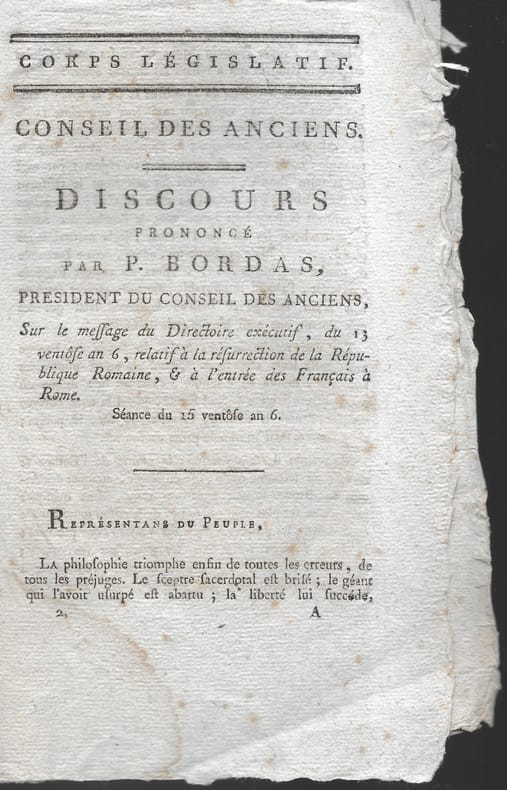
179814509P. Bordas était président du Conseil des Anciens. Discours du 15 ventôse an 6 (5 mars 1798). en feuille Très bon Paris Imprimerie Nationale 1798
17503445317Leipzig, 1750. 32 S. Geheftet.
17523466935(Maastricht), Gaebler, 1752. XVI, 77 S. Br. d. Zt. Gebräunt, teils braunfl. Unbeschnitten. Vorsatzblatt fehlt. Am Rücken kl. Einriss.
1743163081743 Paris, de l'Imprimerie Royale, MDCCXLIII,Memoires de Littérature tirez des Registres de l'Academie Royale des Inscriptions et Belles Lettres, depuis l'année MDCCXXXVIII jusques & compris l'année MDCCXLTome quinziéme,IN4 broche,21 p.couverture muette marbrée titrée,
1750A144Paris, s.e., s.d. (vers 1750) ; 205/325 mm, 1 pp., une feuille. Bon état.
179389250Chez les frères Bardou 1793 Traduit par Olivet
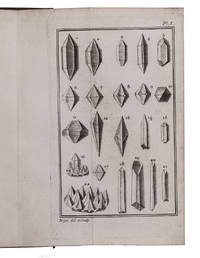
1772899Paris: Didot Jeune; Knapen & Delaguette 1772. <br /> <br /> A landmark work in the history of mineralogy and crystallography by Jean-Baptiste Louis Romé de l'Isle 1736-1790 one of the principal founders of scientific crystallography. Published in Paris in 1772 Essai de Cristallographie represents one of the earliest systematic attempts to classify minerals according to the geometry of their crystal forms rather than solely by chemical composition or external appearance. Romé de l'Isle sought to demonstrate that crystals obey fixed geometric laws helping establish crystallography as a rigorous scientific discipline during the Enlightenment. The work discusses numerous classes of crystals including quartz mica feldspars zeolites metallic crystals pyrites and gemstones accompanied by detailed geometric analyses and descriptions.<br /> <br /> Particularly notable are the engraved folding tables and plates illustrating crystal forms polyhedra and geometric developments. These illustrations provided one of the earliest visual systems for understanding mineral structures and became highly influential among eighteenth-century natural philosophers mineralogists and geologists. The volume includes an extensive bibliography of earlier authors on crystallization and mineralogy reflecting Romé de l'Isle's attempt to synthesize contemporary scientific knowledge. Also present is an attractive engraved armorial bookplate of Lord Sandys adding desirable provenance and evidence of ownership by an eighteenth-century British noble family. A highly important scientific work that marks the transition from descriptive mineralogy to the quantitative study of crystal geometry.<br /> <br /> Condition & Binding: Bound in contemporary full calf with gilt roll-tooled borders marbled endpapers and all edges gilt. Binding remains attractive and solid showing moderate rubbing scuffing and wear to boards corners and spine. Spine lettering has largely faded though decorative tooling remains partially visible. Internally remarkably clean and bright for the period with light scattered foxing and occasional minor spotting. Folding engraved plates and the large folding crystallographic table appear present and in very good condition with no significant tears observed in the supplied photographs. Overall- very good. Didot Jeune; Knapen & Delaguette unknown
1772L3LEN89INLTKParis 1772. 8vo. Didot Knapen & Delaguette Contemporary mottled calf gold-tooled spine with red title-label red edges marbled endpapers. With 2 folding letterpress tables and 10 folding engraved plates I-X. XXXII 427 2 1 blank pp. First edition of an influential work on geometrical crystallography by the French mineralogist Jean-Baptiste Louis Romé de l'Isle 1736-1790 one of the founders of modern crystallography. "In 1772 he published his first important technical work a one volume essay on crystallography in which he identified 110 crystal forms. This was a major expansion upon the work of Linnaeus . The Essai made Romé de l'Isle a prominent name among Parisian scientists of his day" Wilson. Romé is best known for his "law of constancy of interfacial angles" now the first law of crystal habit. The preliminaries contain an annotated bibliography by the author of the principal works on crystals. The plates depict numerous crystal forms as well as some geometric figures.Occasionally some very faint foxing or a small spot. Binding only slightly rubbed along the extremities. Overall in very good condition.l Hoover 2681; Ward & Carozzi 1906; Wilson The history of mineral collecting p. 52. unknown
17725371Paris: Didot jeune and Knapen & Delaguette 1772. First edition. <p>First edition a magnificent and very rare large paper copy both larger and printed on thicker paper than the octavo issue of one of the fundamental works of modern crystallography; it appeared 12 years before Haüy's Essai d'une Théorie sur la Structure des Cristaux. "Very scarce. The Cristallographie ranks as one of the great contributions to the science of crystals. In it Roméde L'Isle attempted to make a comprehensive classification of crystals" Schuh.</p>. A FUNDAMENTAL WORK OF MODERN CRYSTALLOGRAPHY - VERY RARE LARGE PAPER COPY. <p>First edition a magnificent and very rare large paper copy both larger and printed on thicker paper than the octavo issue of one of the fundamental works of modern crystallography; it appeared 12 years before Haüy's Essai d'une Théorie sur la Structure des Cristaux. Romé de L'Isle established that various shapes of crystals of the same natural or artificial substance are all closely related to each other. Measurements he took with a goniometer enabled him to determine that the angles between corresponding faces of a crystal are always the same which earlier had only been described in specific cases in particular by Niels Steno this is often described as the first law of crystallography. In addition he demonstrated that these angles are a characteristic of mineral type introduced the concept of truncation and also enlarged the crystallographic vocabulary. He "identified 110 crystal forms drawing upon Linnaeus who had listed forty and described in minute detail the minerals that exhibited them. He subdivided the various substances into salts stones pyrites and metallic minerals stating that he agreed with Linnaeus that geometrical form is the chief characteristic by which minerals may be classified. Also like Linnaeus he held that saline principles imprinted their own geometrical form upon the earthy constituent of each mineral" DSB. "Very scarce. The Cristallographie ranks as one of the great contributions to the science of crystals. In it Romé de L'Isle attempted to make a comprehensive classification of crystals. By the time he wrote his volume he was extremely familiar with the subject and this work greatly surpassed all previous works in scope and detail. To apply his classification he adopted a morphological approach in which he attempted to relate the diverse forms of crystals of the same substance. As a general morphological concept he introduced the idea of the 'primitive form'. All crystals of the same inorganic substance no matter how different in appearance had a fundamental and common geometrical form - the primitive form - to which their actual crystal shapes related . In this first edition of the Cristallographie Romé de L'Isle identifies 110 crystal forms by which minerals crystallize. Grouped under each of these shapes are describe the minerals that exhibit similar habits including the approximate angles between crystal faces. These forms were all derived from a common saline ingredient in every mineral that worked at a molecular level" Schuh. Pages xii-xxviii contain an annotated bibliography of the principal works on crystals. The only large paper copy listed by ABPC/RBH is the Norman-Freilich copy but our copy is significantly larger than even that copy 265 x 205mm versus 249 x 193mm.</p> <br /> <p>"Romé the son of a lieutenant in the cavalry studied humanities at the Collège Ste. Barbe in Paris. In 1756 he entered the Royal Corps of Artillery and Engineering which he accompanied as a secretary to the French Indies in the following year. From 1758 until 1761 he was in the enclave of Pondicherry French India. When it fell to the English in 1761 Romé was taken prisoner and transported to China where he stayed until 1764 when he returned to France" DSB. </p> <br /> <p>"Romé de L'Isle had started collecting minerals during his travels as a naval officer. Back in Paris after the Indian Wars he was introduced into mineralogy by the apothecary chemist and mineralogist Balthazar Georges Sage 1740-1824 who became his friend. It was very fashionable at the time in Paris to have a mineral collection. The owner of an important private collection Pedro Francisco Davila wanted to sell his. At Sage's suggestion he asked Romé de L'Isle to draw up the inventory. Romé made a very thorough job of it the inventory running up to three thick volumes. This was his first work on mineralogy published in 1767 Catalogue systématique et raisonné des curiosités de la nature et de 1'art qui composent le cabinet de M. Davila. It gave him the opportunity to study crystalline forms in detail and led to his Essai de Cristallographie 1772 .</p> <br /> <p>"The context of the time was not very favourable for such studies for had not the famous French naturalist Buffon written in his Natural history of Minerals volume 1 1783: 'One has pretended that rhombohedra constitute a specific character of calcareous spar without being attention to the fact that some vitreous or metallic substances also crystallize in rhombohedra and that if calcareous spar does crystallize often in rhombohedra it also takes different other forms; and our crystallographers when trying to borrow from geometricians the way to transform a rhombohedron into an octahedron a pyramid or a lens have done nothing more than substitute ideal combinations to the real facts of Nature. This crystallization in rhombohedra like all others will never have a specific character. Not only is there no crystalline form common to different substances but conversely there are few substances which do not present different crystallization forms as shown by the prodigious variety of forms of calcareous spar itself' .</p> <br /> <p>"In the preface Romé noted that 'of the curious phenomena of the mineral kingdom those which struck him most were the regular and constant forms taken by some bodies designated by the name of crystals.' He was encouraged by the works of Linnaeus he added to undertake the study of the angular forms of crystals and of their transformations. Their polyhedral shape was only known from the Ancients only for quartz diamond and a few others and Romé widely extended this observation. Minerals were divided by him into four classes: salts stony pyritic and metallic. For each mineral the most frequent forms observed are described with a reference to Linnaeus's classification in Systema naturae . Steno's ideas relative to the growth of quartz layer by layer are quoted at length and Romé de L'Isle felt that they could be applied to all crystals. The book was a success acclaimed by Linnaeus himself and brought international fame to Romé de L'Isle . The importance of Romé de L'Isle's work was stressed by Haüy who wrote Leçons de Physique 1795: 'To the exact descriptions he gave of the crystalline forms he added the measure of the angles and which was essential showed that these angles were constant for each variety. In one word his crystallography was the fruit of an immense work almost entirely new and most precious for its usefulness.'</p> <br /> <p>"Romé de L'Isle was also the first mineralogist to give a rational description of twins . He described for instance the dovetail twin of gypsum and the feldspars twins. He introduced the term macle to designate a crystal in which 'one half is produced by the inversion in the opposite sense of the other half of the same crystal' - a property which he demonstrated by the concordance of angles" Authier pp. 313-6. </p> <br /> <p>"Romé's friendship with Sage brought him membership in a number of learned societies including the academies of Mainz Stockholm Berlin and St. Petersburg. But it did him no service with the Paris Académie des Sciences which rejected him on the ostensible grounds that he was a mere 'catalogue maker.' It is likely that Romé's controversies with Buffon also played a part in his rebuff by the Academy" DSB.</p> <br /> <p>Freilich sale 460; Hoover 2681; Norman 1847; Schuh Mineralogy & Crystallography: A Bibliography 1469 to 1920 4151; Ward & Carozzi 1906; Wellcome IV p. 553. Authier Early Days of X-ray Crystallography 2013. </p> <br/> <br/> 4to 265 x 205 mm pp. v viii-xxxii 427 3 including half-title with 2 folding letterpress tables and 10 folding engraved plates. Contemporary calf spine gilt in compartments with red morocco lettering-piece red edges. Didot jeune and Knapen & Delaguette unknown
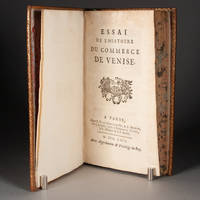
172900518<p>FIRST HISTORY OF VENETIAN TRADE --- xxiv 200 4 p. a8 b4 A-Q8/4 R6 166 x 95 mm --- First and only edition of this history of Venetian trade through 1290 which Barbier attributes to one "Roma"—and which appears to be the first printed survey of Venetian trade altogether. Barbier records the anonymous author's connections in Parisian law and finance but we know little else of him except that he perhaps took his text from a larger three-volume manuscript on the history of business in Italy. ¶ As the history of trade goes few European cities will be as synonymous with the subject as Venice. The Middle Ages saw it become one of the continent's most important ports the vital crossroads of trade between East and West. The author divides his history into three parts: the years 421-697 which he calls the age of the <em>Tribuns</em>; 697-1173 the age of elected doges; and 1173-1290 the age of sovereign doges. He covers the early development of the Rialto Venice's strategic location as a boon for international trade competition in fabric production silk especially—these and many other issues that historians continue to cite in discussions of early Venetian trade. ¶ We fully expected to identify earlier histories of trade in Venice a task we summarily failed at. The author himself complains of "the silence that historians of Venice have kept on this subject" xiij. True enough of the earlier <em>commercio</em> titles in both Cicogna and Soranzo's continuation none could be construed as a comprehensive historical survey of Venetian trade nor have our subject searches in WorldCat turned up anything earlier. Given Venice's tremendously influential role in the history of business the gap this work fills should be an important one. ¶ Hardly a common book and this may be the only copy recorded at auction; it matches the binding description of a copy offered in 2013. --- PROVENANCE: Bookplate removed from the front paste-down and a few efforts at obliterating small marks from the endleaves. --- CONDITION: Contemporary leather spine and board edges tooled in gold; marbled edges and endpapers. ¶ First and last few leaves a little dusty. Leather a bit discolored in spots; front paste-down skinned from removal of bookplate. A nice solid copy in a contemporary binding. --- REFERENCES: Emmanuele Antonio Cicogna <em>Saggio di bibliografia veneziana </em>1847 v. 1 p. 211 #1461; Ant.-Alex. Barbier <em>Dictionnaire des ouvrages anonymes</em> v. 2 col. 209;<em> Kress Library of Business and Economics</em> suppl. p. 196 ¶ Paola Lanaro "Introduction" <em>At the Centre of the World: Trade and Manufacturing in Venice and the Venetian Mainland 1400-1800</em> Toronto: Centre for Reformation and Renaissance Studies 2006 p. 34 "The Venetian Republic is still considered to be one of the first European states to accept the drastic change in mentality and in capitalistic practice brought about by the great maritime commerce between the Levant and the East above all in terms of international commerce in transit"; Edwin S. Hunt and James M. Murray <em>A History of Business in Medieval Europe 1200-1550</em> Cambridge Univ 2005 p. 60 "it was the international merchants who spearheaded the development of the techniques that transformed medieval commerce…The earliest techniques appeared in Genoa and Venice during or even before the twelfth century" 90 "One of the special characteristics of Venice and a source of its lasting power was its role as entrepôt and staple"</p> Pierre Gilles Le Mercier and A. Morin hardcover
172911159Lugduni Batavorum, apud Johannem Arnoldum Langerak, 1729. Fort volume in-8 de [80]-774-[64] pages, plein vélin blanc, dos orné de glands et filets dorés, double filet doré encadrant les plats ornés en outre d'un légionnaire s'appuyant sur un boulier décoré de la cigogne (armoiries de la Haye) ainsi que d'un hibou dorés, le tout surmontant la mention "Hagae Comitis", glands dans les coins.
175418243Paris, Joseph Barbou, 1754 1 volume In-12 (8,7 x 15,3cm) Reliure plein veau raciné d'époque; dos lisse à 5 caissons ornés de motifs floraux, pièce de titre bordeaux, double filet doré en queue; plats à triple encadrement de filets dorés; roulettes dorées sur les bords et les chasses; tranches dorées; gardes marbrées. XXVIII + 221p.; 1 frontispice, ornements et 16 vignettes en bandeaux et culs-de-lampe. Coiffes et charnières un peu frottées.
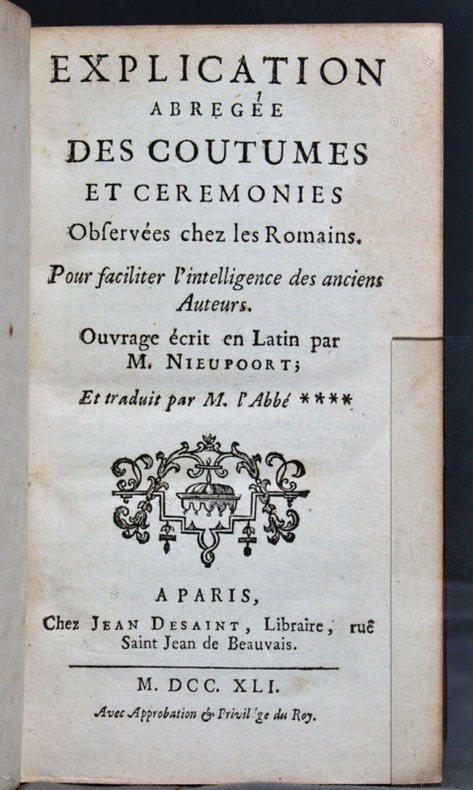
17412149A PARIS. CHEZ JEAN DESAINT, LIBRAIRE. 1741. IN-12 (10 X 17 X 3 CENTIMETRES ENVIRON) DE XVII + (3) + 415 PAGES, RELIURE D'EPOQUE PLEIN VEAU MARBRE, DOS A CINQ NERFS ORNE DE FLEURONS DORES, TITRE DORE SUR ETIQUETTE MAROQUIN ROUGE, TRANCHES ROUGES. EDITION ORIGINALE DE LA TRADUCTION DONNEE PAR L’ABBE DESFONTAINE (PIERRE-FRANCOIS GUYOT. 1685-1745). PETITS DEFAUTS EXTERIEURS, SINON BON EXEMPLAIRE.
17612874A Paris, Chez Jean Desaint, 1761. 1 vol. in-12 de XVII-[2]-415-8 pages. Plein veau marron, dos à nerfs orné, tranches rouges. Coiffes manquantes, mors du 1er plat fendu, dos frotté.
1782433917Leipzig, Kummer, 1782. 16 Bl., 632 S., 43 Bl. Mit gestochener Titelvignette. Marmorierter Pappband d. Zeit mit Rückenschild (beschabt u. bestoßen, Vorderdeckel mit Stauchstelle, Rückenschild mit Fehlstelle). [2 Warenabbildungen]
170413275Lione: Anisson Posuel 1704. Difetti sulla legatura fessurate le cerneire sbucciature antica firma sul frontespizio complessivamente ben conservato nonostante gli ovvi segni del tempo. Legatura coeva in piena pelle fessure alle estremità delle cerniere con dorso a cinque nervi arricchito da titoli e fregi dorati in quarto cm 23x16 pp 56 692 ritratto all’antiporta 4 figure silografiche nel testo e una tavola incisa. Difetti sulla legatura fessurate le cerneire sbucciature antica firma sul frontespizio complessivamente ben conservato nonostante gli ovvi segni del tempo. Sesta edizione delle opere del medico dalmata allievo di Malpighi “maestro dei clinici italiani†e convinto fautore della preminenza dell’osservazione e della prassi sulla teoria in medicina. Numerose dettagliate descrizioni di malattie e fenomeni naturali in particolare nei libri del De Praxi Medica e nel trattato De Fibra Motrice et Morbosa prime due parti del volume mostrano le teorie meccaniciste e i metodi di fisiologia sperimentale dell’autore evidenti anche nelle numerose dissertazioni raccolte nella terza parte del volume: De anatome fibrarum de motu muscolorum et de morbis solidorum; De experimentis circa salivam; … circa bilem;… circa sanguinem; interessanti poi la relazione dell’autopsia di Marcello Malpighi i capitoli sul valore terapeutico della musica dell’esercizio fisico della caccia e della dieta pitagorica le lunghe note sul terremoto dell’Aquila del 1703 e il trattato De anatome morsu & effectibus Tarantulae con la celebre tavola che raffigura la tarantola e la carta della Puglia. Wellcome II p. 85 edizioni successive; Garrison-Morton 68; Blake p. 27; la successiva settima edizione in Graesse p. 275 e Brunet c. 610 “ouvrage estiméâ€; Vinciana 1831 in nota a edizione ben più tarda: «citiamo solo l’edizione originale stampata a Lione dall’Anisson nel 1704». Anisson, Posuel unknown
179522825Paris Maillard 1795 -in-8 demi-velin un volume, reliure demi-velin blanc (half vellum) in-octavo (20 x 13,3 cm), Reliure tardive (XIXème), dos long (spine without raised bands), titre et auteur manuscrits façon janséniste à l'encre brune en partie haute du dos, papier marbré crème et noir aux plats, toutes tranches lisses, sans illustrations (no illustration), traces de mouillures ancienne en marge de quelques pages, VII + 278 pages, 1795. L'An III. de la République A Paris, chez Maillard, libraire, Quai des Augustins, n. 43. au Contrat Social. De l'Imprimerie de François Honnert, rue du Colombier, n. 1160 Editeur,
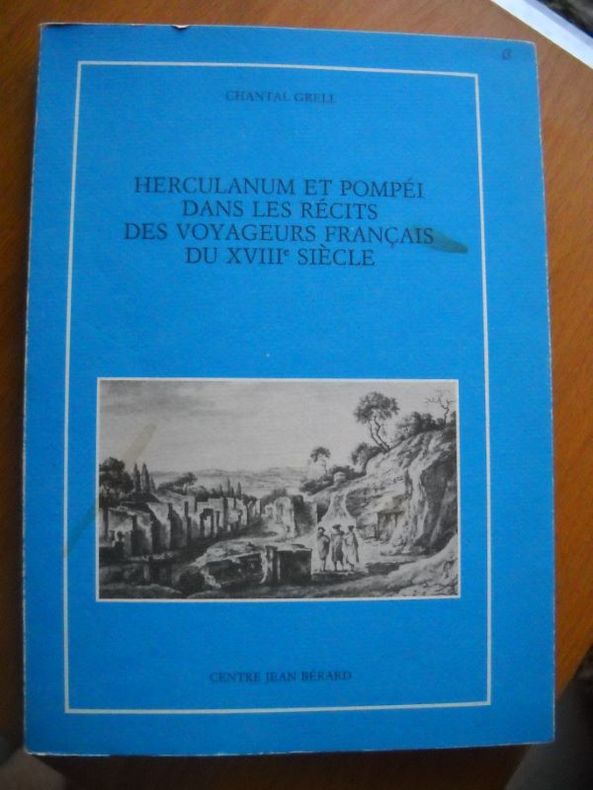
1723183421723 Broché avec jaquette - 17 x 23,5 - 230 pp - année 1982 - Bibliothèque de l'institut Français de Naples Troisième série , volume II - Publication du centre Jean Bérard Naples - illustrations annexe et planches -