806 résultats
1853143321853 Napoli, Stabilimento Typografico di Gaetano Nobile, 1853-1858 (en pages de titre) - 1857-1866 (en couvertures), 2 vol. grand in-8° (260 x 175 mm) reliés pleine percaline havane éditeur, auteur, titre et tomaisons dorés au dos, titre doré au centre des plats supérieurs, grand fleuron à froid au centre des plats inférieurs, couvertures imprimées en lithographie conservées, de XIX pp. (faux-titre, titre et « Cenno su Napoli ») de 324 pp. , 50 planches ; 340 pp. (faux-titre et titre inclus) - 50 planches. Cartonnages usagés (dos recollés, coiffes élimées, taches deau au plat supérieur du T.I et au plat inférieur du T.II), intérieur en très bon état.
137-Io.J. Aquarell, über Bleistift, auf cremefarbenem festem Velin, links unten bezeichnet und datiert ?Tivoli, 26.5.99?. 35,8:53,2 cm. ? Mit leichtem Lichtrand rundum, verso eine alte Verbräunung, die nach dem Ablösen des Aquarells von einer Holztafel, zurückblieb.
010-Io.J. Aquarell, über Bleistift, auf Papier mit Wasserzeichen: J Whatman Turkey Mill 1824, rechts unten bezeichnet (vermutlich von fremder Hand) ?Naples?. 29,3:48 cm. Zwei Braunfleckchen am Oberrand. Literatur: W. Hauptmann: Peindre l?Italie Keiserman et Knébel: deux Vaudois à Rome vers 1800, Lausanne 2005, vgl. z.B. Abb. 67 u. 75.
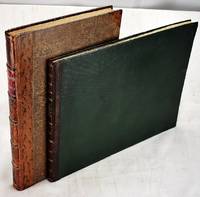
17842005060026Napoli: Presso Giuseppe Campo 1784. First Edition. Hardcover. Good. The Devastation of Nature: Sarconi's study of the Calabrian Earthquake 2 volume set. Text and Atlas volumes. Text volume collation: pp. xiv 2 352 vi 2. Plate volume is an oblong folio 48 x 36 cm. 54 of 68 plates. Bound in contemporary leather-backed boards over green cloth. Contains plates 1-51 53-54 57. Some marginal foxing. <br> In 1783 Calabria then the Kingdom of Naples and Sicily experienced a series of five devastating earthquakes. Nearly all of the built structures in the region were destroyed. The first two earthquakes created tsunamis which killed thousands of people sleeping on the beaches near Messina. Between 32000 and 50000 Italians died as a result of disaster. The Reale Accademia delle Scienze e Belle Lettere of Naples conducted the first scientific study of the event. This is the plate volume of their study engraved by Antonio Zaballi from the drawings by Pompeo Schiantarelli and Ignazio Stile. Ref: Kleemann Katrin. "Living in the Time of a Subsurface Revolution: The 1783 Calabrian Earthquake Sequence." Environment & Society Arcadia 2019 no. 30. <br> This is an oversized or heavy book which requires additional postage for international delivery outside the US. Napoli: Presso Giuseppe Campo hardcover
142-Io.J. Feder in Schwarz, über Bleistift, auf cremefarbenem Velin, aufgezogen. 31,5:48,7 cm. Das untere Drittel der Zeichnung sowie ca. 2 cm des rechten Randes wurden von Rebell korrigiert und mit dem neuen Entwurf überklebt, horizontale Mittelfalte geglättet, insgesamt etwas vergilbt. Vorstudie für ein Gemälde. Möglicherweise besteht ein Zusammenhang mit dem Auftrag für J. Murat 13 Ansichten von Neapel zu malen (s.u.).
In-4°, (80 cc), presenza di molte glosse coeve di più mani, alcune correzioni al testo, legatura in mezza pergamena moderna, due capilettera figurati. Al frontespizio nota di possesso manoscritta di William Godolphin (1635-1696), diplomatico e grande collezionista inglese. Ex libris Pagel. Dedica a Marco Antonio Colonna, firmata ex Accademia Pisana. Buone condizioni. Edizione originale dell’opera filosofico-epistemiologica di Simone Porzio, aristotelico radicale, materialista convinto, sostenitore della mortalità dell’anima. Questa è la sua più importante opera di fisica, in cui l’autore si inserisce nella disputa sul determinismo. Pensatore originale, uno dei primi grandi filosofi napoletani, profondo conoscitore dei testi in greco, Porzio fu il maggior esponente a Napoli della corrente degli ‘alessandristi’ (sostenitori della mortalità dell’anima; contro di lui scrisse Giacomo Antonio Marta), e ispiratore del pensiero di Bernardino Telesio; sosteneva la separazione di filosofia e teologia. Aristotele è accolto qui attraverso il suo interprete più famoso, Alessandro di Afrodisia (II-III sec. d.C), autore tra l’altro di uno scritto sul fato, contrario ad ogni forma di determinismo. In quest’opera Porzio definisce, approfondisce ed esamina in due libri i concetti aristotelici di materia e natura. Infine, dopo aver parlato delle cause efficienti, arriva discutere di ciò che stava diventando realmente interessante: il problema del fato e della libertà, citando Platone, Plotino, Aristotele, Crisippo. Fatum est lex nobis promulgata, instar divinae mentis. La totale libertà è negata all’essere umano, sostiene Porzio anche in due opuscoli precedenti, perché solo l’individuo che esiste in se stesso può avere completa libertà. La sua posizione si orienta verso una visione sempre più naturalistica, che riproponendo il valore centrale della visione e dell’esperienza nell’indagine dei fatti, automaticamente rinuncia alla spiegazione di questi attraverso il sacro e il miracoloso. Simone Porzio (1497-1554), filosofo napoletano, medico e professore di filosofia naturale tra le Università di Napoli e Pisa (qui per la seconda volta tra il 1545 e il ’53); a Napoli fu allievo di Agostino Nifo. E.Garin, History of Italian Philosophy, I, 362 Cesare Vasoli, Tra Aristotele, Alessandro di Afrodisia e Juan de Valdès: note su Simone Porzio, in Rivista di storia della filosofia, 4, 2001 Eva del Soldato, Simone Porzio: un aristotelico tra natura e grazia. istituto nazionale di Studi sul Rinascimento, 6, 2010 In-4 °, (80 cc), presence of many contemporary glosses by different hands, some corrections to the text, binding in modern half vellum, two figured initials. On the title page handwritten ownership note by William Godolphin (1635-1696), diplomat and great English collector. Ex libris Pagel. Dedication to Marco Antonio Colonna, by the former Accademia Pisana. Good copy. Original edition of the philosophical-epistemological work of Simone Porzio, radical Aristotelian, convinced materialist, advocate of the mortality of the soul. This is his most important work on phisics, in which the author is part of the dispute over determinism. Original thinker, one of the first great Neapolitan philosophers, profound connoisseur of Greek texts, Porzio was the greatest exponent in Naples of the current of the 'Alexandrians' (supporters of the mortality of the soul; Giacomo Antonio Marta wrote against him), and inspirer of the thought of Bernardino Telesio; he advocated the separation of philosophy and theology. Aristotle is introduced here through his most famous interpreter, Alexander of Aphrodisias (II-III century AD), author, among other things, of a writing on fate, contrary to any form of determinism. In this work, Porzio defines, deepens and examines the Aristotelian concepts of matter and nature in two books. Finally, after talking about efficient causes, he comes to discuss what was becoming really interesting: the problem of fate and freedom, quoting Plato, Plotinus, Aristotle, Chrysippus. Fatum est lex nobis promulgata, instar divinae mentis. Total freedom is denied to the human being, as Porzio stated in two previous pamphlets, because only the individual who exists in himself can have complete freedom. His position is oriented towards an increasingly naturalistic vision, which by re-proposing the central value of vision and experience in the investigation of facts, automatically renounces the explanation of these through the sacred and the miraculous. Simone Porzio (1497-1554), Neapolitan philosopher, doctor and professor of natural philosophy between the Universities of Naples and Pisa (here for the second time between 1545 and '53); in Naples he was a pupil of Agostino Nifo. E. Garin, History of Italian Philosophy, I, 362 Cesare Vasoli, Between Aristotle, Alexander of Aphrodisias and Juan de Valdès: notes on Simone Porzio, in Review of the history of philosophy, 4, 2001 Eva del Soldato, Simone Porzio: an Aristotelian between nature and grace. National Institute of Renaissance Studies, 6, 2010