806 résultats
In-4°, (80 cc), presenza di molte glosse coeve di più mani, alcune correzioni al testo, legatura in mezza pergamena moderna, due capilettera figurati. Al frontespizio nota di possesso manoscritta di William Godolphin (1635-1696), diplomatico e grande collezionista inglese. Ex libris Pagel. Dedica a Marco Antonio Colonna, firmata ex Accademia Pisana. Buone condizioni. Edizione originale dell’opera filosofico-epistemiologica di Simone Porzio, aristotelico radicale, materialista convinto, sostenitore della mortalità dell’anima. Questa è la sua più importante opera di fisica, in cui l’autore si inserisce nella disputa sul determinismo. Pensatore originale, uno dei primi grandi filosofi napoletani, profondo conoscitore dei testi in greco, Porzio fu il maggior esponente a Napoli della corrente degli ‘alessandristi’ (sostenitori della mortalità dell’anima; contro di lui scrisse Giacomo Antonio Marta), e ispiratore del pensiero di Bernardino Telesio; sosteneva la separazione di filosofia e teologia. Aristotele è accolto qui attraverso il suo interprete più famoso, Alessandro di Afrodisia (II-III sec. d.C), autore tra l’altro di uno scritto sul fato, contrario ad ogni forma di determinismo. In quest’opera Porzio definisce, approfondisce ed esamina in due libri i concetti aristotelici di materia e natura. Infine, dopo aver parlato delle cause efficienti, arriva discutere di ciò che stava diventando realmente interessante: il problema del fato e della libertà, citando Platone, Plotino, Aristotele, Crisippo. Fatum est lex nobis promulgata, instar divinae mentis. La totale libertà è negata all’essere umano, sostiene Porzio anche in due opuscoli precedenti, perché solo l’individuo che esiste in se stesso può avere completa libertà. La sua posizione si orienta verso una visione sempre più naturalistica, che riproponendo il valore centrale della visione e dell’esperienza nell’indagine dei fatti, automaticamente rinuncia alla spiegazione di questi attraverso il sacro e il miracoloso. Simone Porzio (1497-1554), filosofo napoletano, medico e professore di filosofia naturale tra le Università di Napoli e Pisa (qui per la seconda volta tra il 1545 e il ’53); a Napoli fu allievo di Agostino Nifo. E.Garin, History of Italian Philosophy, I, 362 Cesare Vasoli, Tra Aristotele, Alessandro di Afrodisia e Juan de Valdès: note su Simone Porzio, in Rivista di storia della filosofia, 4, 2001 Eva del Soldato, Simone Porzio: un aristotelico tra natura e grazia. istituto nazionale di Studi sul Rinascimento, 6, 2010 In-4 °, (80 cc), presence of many contemporary glosses by different hands, some corrections to the text, binding in modern half vellum, two figured initials. On the title page handwritten ownership note by William Godolphin (1635-1696), diplomat and great English collector. Ex libris Pagel. Dedication to Marco Antonio Colonna, by the former Accademia Pisana. Good copy. Original edition of the philosophical-epistemological work of Simone Porzio, radical Aristotelian, convinced materialist, advocate of the mortality of the soul. This is his most important work on phisics, in which the author is part of the dispute over determinism. Original thinker, one of the first great Neapolitan philosophers, profound connoisseur of Greek texts, Porzio was the greatest exponent in Naples of the current of the 'Alexandrians' (supporters of the mortality of the soul; Giacomo Antonio Marta wrote against him), and inspirer of the thought of Bernardino Telesio; he advocated the separation of philosophy and theology. Aristotle is introduced here through his most famous interpreter, Alexander of Aphrodisias (II-III century AD), author, among other things, of a writing on fate, contrary to any form of determinism. In this work, Porzio defines, deepens and examines the Aristotelian concepts of matter and nature in two books. Finally, after talking about efficient causes, he comes to discuss what was becoming really interesting: the problem of fate and freedom, quoting Plato, Plotinus, Aristotle, Chrysippus. Fatum est lex nobis promulgata, instar divinae mentis. Total freedom is denied to the human being, as Porzio stated in two previous pamphlets, because only the individual who exists in himself can have complete freedom. His position is oriented towards an increasingly naturalistic vision, which by re-proposing the central value of vision and experience in the investigation of facts, automatically renounces the explanation of these through the sacred and the miraculous. Simone Porzio (1497-1554), Neapolitan philosopher, doctor and professor of natural philosophy between the Universities of Naples and Pisa (here for the second time between 1545 and '53); in Naples he was a pupil of Agostino Nifo. E. Garin, History of Italian Philosophy, I, 362 Cesare Vasoli, Between Aristotle, Alexander of Aphrodisias and Juan de Valdès: notes on Simone Porzio, in Review of the history of philosophy, 4, 2001 Eva del Soldato, Simone Porzio: an Aristotelian between nature and grace. National Institute of Renaissance Studies, 6, 2010
142-Io.J. Feder in Schwarz, über Bleistift, auf cremefarbenem Velin, aufgezogen. 31,5:48,7 cm. Das untere Drittel der Zeichnung sowie ca. 2 cm des rechten Randes wurden von Rebell korrigiert und mit dem neuen Entwurf überklebt, horizontale Mittelfalte geglättet, insgesamt etwas vergilbt. Vorstudie für ein Gemälde. Möglicherweise besteht ein Zusammenhang mit dem Auftrag für J. Murat 13 Ansichten von Neapel zu malen (s.u.).
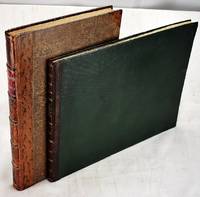
17842005060026Napoli: Presso Giuseppe Campo 1784. First Edition. Hardcover. Good. The Devastation of Nature: Sarconi's study of the Calabrian Earthquake 2 volume set. Text and Atlas volumes. Text volume collation: pp. xiv 2 352 vi 2. Plate volume is an oblong folio 48 x 36 cm. 54 of 68 plates. Bound in contemporary leather-backed boards over green cloth. Contains plates 1-51 53-54 57. Some marginal foxing. <br> In 1783 Calabria then the Kingdom of Naples and Sicily experienced a series of five devastating earthquakes. Nearly all of the built structures in the region were destroyed. The first two earthquakes created tsunamis which killed thousands of people sleeping on the beaches near Messina. Between 32000 and 50000 Italians died as a result of disaster. The Reale Accademia delle Scienze e Belle Lettere of Naples conducted the first scientific study of the event. This is the plate volume of their study engraved by Antonio Zaballi from the drawings by Pompeo Schiantarelli and Ignazio Stile. Ref: Kleemann Katrin. "Living in the Time of a Subsurface Revolution: The 1783 Calabrian Earthquake Sequence." Environment & Society Arcadia 2019 no. 30. <br> This is an oversized or heavy book which requires additional postage for international delivery outside the US. Napoli: Presso Giuseppe Campo hardcover
010-Io.J. Aquarell, über Bleistift, auf Papier mit Wasserzeichen: J Whatman Turkey Mill 1824, rechts unten bezeichnet (vermutlich von fremder Hand) ?Naples?. 29,3:48 cm. Zwei Braunfleckchen am Oberrand. Literatur: W. Hauptmann: Peindre l?Italie Keiserman et Knébel: deux Vaudois à Rome vers 1800, Lausanne 2005, vgl. z.B. Abb. 67 u. 75.
137-Io.J. Aquarell, über Bleistift, auf cremefarbenem festem Velin, links unten bezeichnet und datiert ?Tivoli, 26.5.99?. 35,8:53,2 cm. ? Mit leichtem Lichtrand rundum, verso eine alte Verbräunung, die nach dem Ablösen des Aquarells von einer Holztafel, zurückblieb.
1853143321853 Napoli, Stabilimento Typografico di Gaetano Nobile, 1853-1858 (en pages de titre) - 1857-1866 (en couvertures), 2 vol. grand in-8° (260 x 175 mm) reliés pleine percaline havane éditeur, auteur, titre et tomaisons dorés au dos, titre doré au centre des plats supérieurs, grand fleuron à froid au centre des plats inférieurs, couvertures imprimées en lithographie conservées, de XIX pp. (faux-titre, titre et « Cenno su Napoli ») de 324 pp. , 50 planches ; 340 pp. (faux-titre et titre inclus) - 50 planches. Cartonnages usagés (dos recollés, coiffes élimées, taches deau au plat supérieur du T.I et au plat inférieur du T.II), intérieur en très bon état.
096-Io.J. Bleistift, leicht gelblich laviert, auf Velin. 17,5:23,9 cm. Provenienz: Aus dem künstlerischen Nachlaß; Schweizer Privatbesitz. Zeichnungen von Frey gehören heute zu den Seltenheiten auf dem Kunstmarkt.
In-4° grande; pp. 80, (18), ai due frontespizi grande e bello stemma della famiglia De Nigris inciso su legno; a p. 80 colophon e marca tipografica incisa su legno.. Cartonato. Opera di diritto canonico del giureconsulto campano Antonio De Nigris, (1502-1570). Molto rare sono le edizioni cinquecentesche stampate a Campagna, città in provincia di Salerno. Fumagalli p. 60-61. Foro di tarlo passante alle prime carte; 3 carte hanno una parte di testo mancante reintegrata con testo manoscritto; bruniture. campania campagna salerno diritto canonico tonsura clero clemente VII giurisprudenza
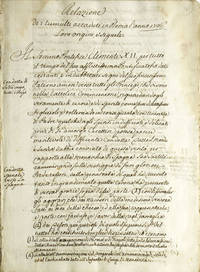
1736257005Rome 1736. 59 pp. in all on laid paper. 4to all with one exception approx. 27 x 20 cm. Provenance: Frederick North 5th Earl of Guilford 1766-1827; library of Sir Thomas Phillipps ex Ms. 7544; with H.P. Kraus. 59 pp. in all on laid paper. 4to all with one exception approx. 27 x 20 cm. Following the acquisition of the Kingdom of Naples and the Two Sicilies by the Bourbons of Spain in 1736 the conquering Spanish troops returning through Rome and Papal States provoked anti-Spanish riots in March of 1736. The following 6 manuscripts each in a different contemporary hand all from the collection of Sir Thomas Phillips and comprising Phillips Ms. 7544 relate to those events. They are as follows:<br /> <br /> 1 CONTI Antonio attributed to. "Relazione dei tumulti accaduti on Roma l'anno 1736. Loro origine e sequele." 13 pp. on 7 leaves.<br /> 2 "Sopra il tumulto populare seguito in Roma il 13 Marzo 1736." 6 2 blank pp. on rectos of 7 leaves. <br /> 3 "Se domanda se un Popolo si solleva tumultiamente nel Domnio altrui contro una nazione con offesa del Sovrano di essa ottenuto il perdona generale ." 4pp. on two leaves.<br /> 4 Same text as above with minor differences e.g. "amnistà" for "perdona". 4 pp. 21.5 x 15 cm.<br /> 5 Manuscript Letter fair copy headed "Sigl. Mio" 2 Giuglio 1736" beginning: "Non potevate far cosa pui grata all mia amicizia che commnicarmi la lettera trasmessa da Roma ."12 4 blank pp. Docketed on final page: "Relazione dei tumulti seguiti in Roma l'anno 1736 per i scrivi Austrici contro i Spagnuoli"<br /> 6 Manuscript Letter fair copy headed "Sigl. Mio". 15 pp. N.p. n.d. <br /> <br /> From the collection of Thomas Phillips 1792-1872. "His collection of over 60000 manuscripts was an outstanding achievement in the annals of bibliophily" ODNB and such was the scale that over 100 years passed after his death until the last tranche of the papers were finally sold in 1977 to H.P. Kraus.<br /> <br /> The attribution would seem to be based on a manuscript of the same title in the University of Chicago Special Collections Library v. OCLC: 154339939. unknown
1736257005Rome 1736. 59 pp. in all on laid paper. 4to all with one exception approx. 27 x 20 cm. Provenance: Frederick North 5th Earl of Guilford 1766-1827; library of Sir Thomas Phillipps ex Ms. 7544; with H.P. Kraus. 59 pp. in all on laid paper. 4to all with one exception approx. 27 x 20 cm. Riots in Rome: The Spanish Bourbons in Southern Italy - from the Thomas Phillips Collection. Following the acquisition of the Kingdom of Naples and the Two Sicilies by the Bourbons of Spain in 1736 the conquering Spanish troops returning through Rome and Papal States provoked anti-Spanish riots in March of 1736. The following 6 manuscripts each in a different contemporary hand all from the collection of Sir Thomas Phillips and comprising Phillips Ms. 7544 relate to those events. They are as follows:<br/><br/>1 CONTI Antonio attributed to. "Relazione dei tumulti accaduti on Roma l'anno 1736. Loro origine e sequele." 13 pp. on 7 leaves.<br/>2 "Sopra il tumulto populare seguito in Roma il 13 Marzo 1736." 6 2 blank pp. on rectos of 7 leaves. <br/>3 "Se domanda se un Popolo si solleva tumultiamente nel Domnio altrui contro una nazione con offesa del Sovrano di essa ottenuto il perdona generale ." 4pp. on two leaves.<br/>4 Same text as above with minor differences e.g. "amnistà " for "perdona". 4 pp. 21.5 x 15 cm.<br/>5 Manuscript Letter fair copy headed "Sigl. Mio" 2 Giuglio 1736" beginning: "Non potevate far cosa pui grata all mia amicizia che commnicarmi la lettera trasmessa da Roma ."12 4 blank pp. Docketed on final page: "Relazione dei tumulti seguiti in Roma l'anno 1736 per i scrivi Austrici contro i Spagnuoli"<br/>6 Manuscript Letter fair copy headed "Sigl. Mio". 15 pp. N.p. n.d. <br/><br/>From the collection of Thomas Phillips 1792-1872. "His collection of over 60000 manuscripts was an outstanding achievement in the annals of bibliophily" ODNB and such was the scale that over 100 years passed after his death until the last tranche of the papers were finally sold in 1977 to H.P. Kraus.<br/><br/>The attribution would seem to be based on a manuscript of the same title in the University of Chicago Special Collections Library v. OCLC: 154339939. unknown books
093-Io.J. Bleistift, auf cremefarbenem Velin, rechts unten mit zartem Bleistift bezeichnet ?al pie del capo di Misena.? 16,4:23,6 cm. Verso Bleistiftskizze. Skizzenbuchblatt. Provenienz: Sammlung Friedrich August II., Prinz von Sachsen, Lugt 971; zwei weitere Sammlerstempel getilgt.
244716S.l. [Naples], décembre 1789, in-folio, [26] ff. n. ch., couverts d'une écriture cursive, mais régulière et lisible (environ 40 lignes par page), avec 5 planches aquarellées en dépliant "in fine" regroupant 21 figures (costumes, insignes, ornements, armes), broche sous couverture à rubans, chiffra AS peint sur la première couverture, le tout dans double emboîtage moderne demi-chagrin marine, dos lisse orné de filets dorés, pièce de titre du même contrecollée sur le plat supérieur.
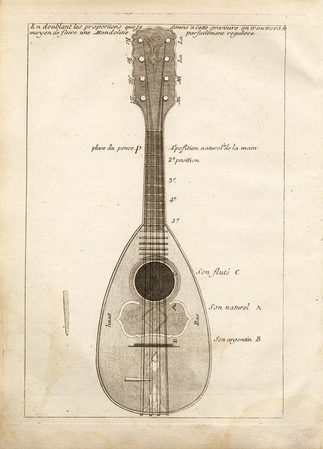
17688518A Paris, l'Auteur... chez Mr. Levinville, luthier ; gravé par Mme Vendôme, imprimé par Montuhai, sans date (circa 1768) ; in-folio ; plein vélin vert, grande pièce de titre de maroquin grenat entourée d'un large décor doré sur le premier plat (reliure de l'époque) ; (2) ff. (titre-frontispice, titre, dédicace au duc de Chartres, planche représentant une mandoline), 67 pp., imprimé sur vergé fort. Ouvrage entièrement gravé.
034-Io.J. Aquarell, über Bleistift, auf bräunlichem Velin. 18,6:26,1 cm. - Verso Reste einer alten Verklebung.
2016CBS-9781405196949John Wiley Exclusive 2016. New. John Wiley (Exclusive) unknown
183406Naples, Benedetto Gessari, 1754-1755 2 tomes en un vol. in-folio, XIV-600 pp. en numérotation continue, avec 10 planches dépliantes par Filippo De Grado d'après Michele Foschini, dont une carte de la Grande Grèce, index, manque le portrait-frontispice, veau fauve marbré, dos à nerfs cloisonné et fleuronné, encadrement de triple filet doré sur les plats, double filet doré sur les coupes, tranches rouges (reliure de l'époque). Coins inférieurs abîmés.
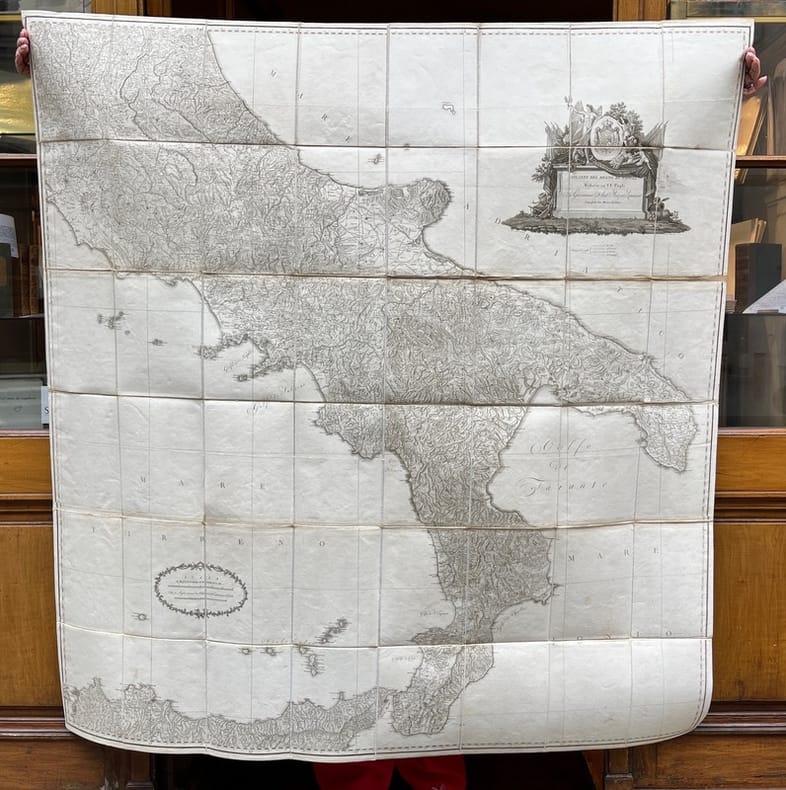
181520379circa 1808-1815. Grande carte murale, eau-forte imprimée sur papier vergé, découpée en 64 rectangles (8 par feuilles) montés sur toile de lin (138,5 x 144 cm.), rempliée et sous étui.
226986S.l., s.d. (1769) in-4, 175 ff., couverts d'une écriture cursive, moyennement lisible (environ 20 lignes par page), ratures et biffures, cartonnage d'attente de papier marbré, dos à nerfs (reliure de l'époque). Coiffes rognées, charnière supérieure entièrement fendue, coins et coupes abîmés.
047-Io.J. Aquarell, mit schwarzer Tuschlinie umrandet, auf Velin, aufgezogen. 15,5:21,7 cm. Leicht wellig. Verso auf dem Untersatzkarton alter Besitzvermerk und mit Zuschreibung an Eugène Burnand (1850-1921), auf einem beigefügten Blatt von alter Einrahmung betitelt sowie bezeichnet ?Souvenir de Naples. E. D. 1845?.
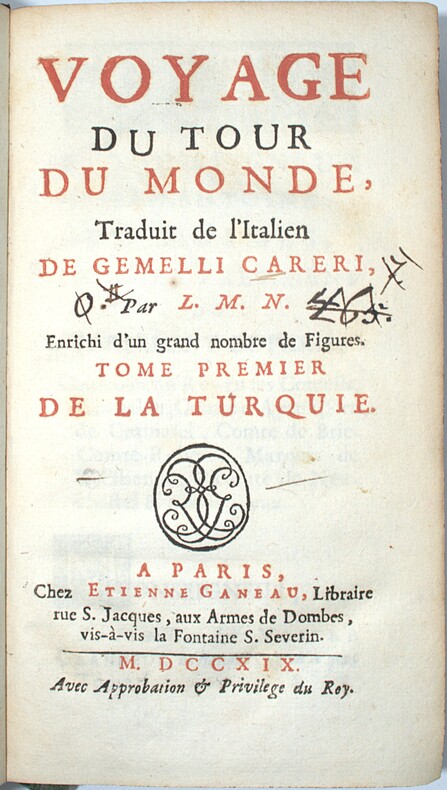
1719PHO-2391Paris, chez Étienne Ganeau, 1719. 6 vol. in-12 (17x9,5cm), 4ff.-xxvii-2ff.-454pp.-5ff. (table), 4ff.-354pp.-3ff., 4ff.-402pp., 4ff.-532pp., 4ff.-374pp., 4ff.-512pp., veau moucheté, dos à nerfs orné avec tomaison et pièce de titre, tranches jaspées, exlibris verso 1er plat, écritures aux titre, dos et charnières frottés, coins usés, petit manque plat tome 1 Édition originale L'illustration entièrement gravée sur cuivre h.-t. se compose d'un frontispice, un portrait, et 60 planches, dont dépliantes. Sabin signale 60 planches sans mentionner le frontispice et le portrait. I ; De la Turquie : Frontispice, portrait, mappemonde, 4 pl. dont 1 dépliante ; II. De la Perse : 3 pl. ; III. L'Indostan, 24 pl. ; IV. De la Chine 8 pl. dont 2 dépliantes ; V. Des Isles Philippines 2 pl. ; VI. De la Nouvelle Espagne, 18 pl. dont 3 dépliantes.
1822031-I1822. Bleistift, auf Bütten mit Wasserzeichen: H Collande, links unten bezeichnet, signiert und datiert ?Baja Wolfensberger Baja I. 6 December 1822?. 21,2:32 cm.
1842033-I1842. Bleistift, auf Velin, links unten bezeichnet und datiert ?Neapel f. 3/3 42. Vico S.M. della Neve?, rechts oben mit brauner Feder numieriert ?6.?. 21,9:29,7 cm. Provenienz: Sammlung ACCN, Inv. 393, nicht bei Lugt. Möglicherweise handelt es sich um eine Vorzeichnung, die für eine Ansichtenfolge gedacht war. Die Nummer ?6.? rechts oben könnte ein Hinweis darauf sein.
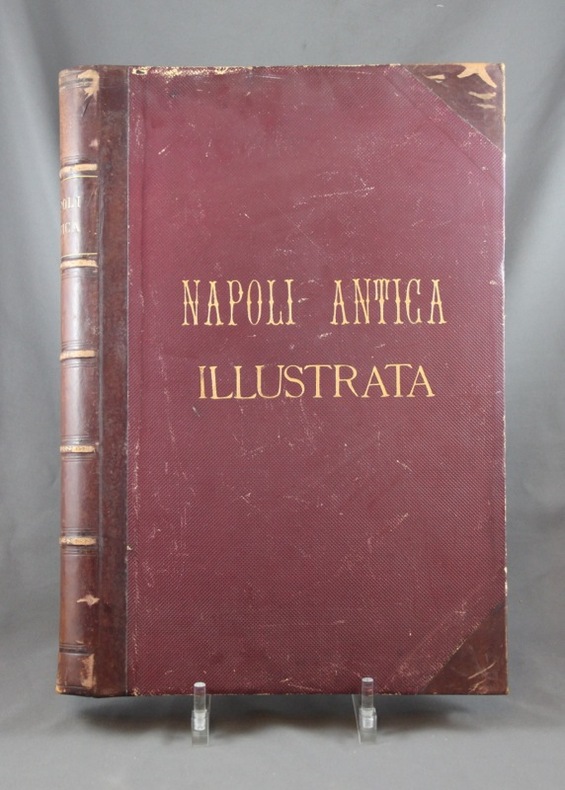
18896584Napoli, Raffaele Cardone, 1889-1893. In-folio, titre chomolithographié, [4] pages, 1 planche non numérotée, [8] pages suivies des 114 planches toutes précédées d'un feuillet de notice explicative et un plan de Naples dépliant (sur double page) avec au verso les prix reçus pour cette publication. Relié en demi-basane prune à coins, dos à nerfs orné de filets dorés, titre doré sur le premier plat. Reliure frottée, intérieur sans défaut.
186121393Lyon, Imprimerie de Louis Perrin, 1861 ; in-4° oblong (270 x 360 mm), demie-percaline vert-foncé à coins, dos lisse à faux nerfs dorés, fleurons et titre dorés (reliure de l’époque) ; [3] ff. (Faux-titre, Titre illustré gravé par I. Séon, dédicace à Auguste Caristie), 15 planches gravées par Dubouchet (9), I. Séon (5) et Thomassin (1), comportant chacune une serpente légendée d’un feuillet ; [1] f. de Table.