FLORENCEBiblio.com
10 866 résultats
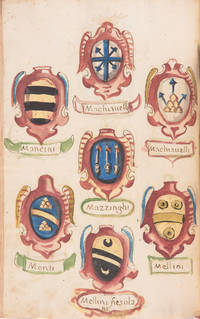
153042820806<p>Folio 348 x 224 mm. 58 leaves 116 unnumbered pages on paper with the watermark of the Sacred Monogram Briquet 9467 i.e. Vicenza 1527-38. 812 armorial shields in watercolor seven per page. Late 18th-century calf black letter spine label. Rubbed some soiling. Very good condition.</p><p><strong>This is a lovely Renaissance manuscript representing the great families of Florence at the height of the Renaissance.</strong></p><p>This beautiful manuscript contains 812 hand-colored armorial shields arranged alphabetically from Aldrobradi to Zucharini with a leaf of additions at the end.</p><p><strong>This Renaissance manuscript contains the arms of Florence's great families including its patrons of the arts financiers businessmen philosophers and political leaders. The influential names represented here include Medici Alberti Da Vinci Albizzi Pazzi Lippi Strozzi and hundreds of others.</strong> The manuscript contains the arms of the families of Galileo Galilei and of Niccolo Machiavelli whose history of Florence was written about the time of this creation of this manuscript.</p><p>Provenance: Christie's March 15 1995 lot 338.</p>
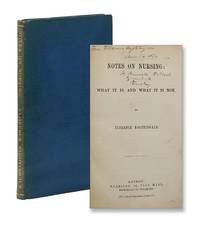
1860140947035London: Harrison 1860. First Edition Early Issue. Near Fine. First Edition early issue. Signed by the author on the title page and inscribed "From Florence Nightingale Mar 14 1860"; additional ownership signature in a different hand of "A. Russell Pollock Greenhill Paisley" inked beneath Nightingale's inscription. Bound in twentieth-century blue morocco with spine lettered in gilt with original brown limp cloth covers bound in at front and rear cup ring stain to upper cover. With "The Right of Translation is reserved." at foot of title page original yellow endpapers with printed advertisements dated 1860. Near Fine with light wear to binding fading to spine and lightly so to covers. Offsetting to modern cream endsheets from wide turn-ins former owner name in light pencil to front free endpaper. Inked date to original front pastedown contents tanned. <p>Alexander Russell Pollock 1821-1884 was the son of James Pollock and Isabella Russell of Greenhill Paisley Scotland. Alexander was a partner in the firm James Pollock and Co. a merchant and yarn agent based in Causeyside. He married Margaret Amelia Pollock the daughter of Matthew Pollock in Stillorgan Dublin on 27 April 1859 and they had 19 children in the space of 16 years. Alexander died on 23 October 1884 in Dieppe Seine-Maritime France at the age of 63 and was buried in his hometown. An obituary was published in the Paisley Gazette on November 1 1884. Alexander amassed a large library and collection of coins medals manuscripts and other antiques which were sold in a series of auction sales in 1889.<p>Signed copies of this landmark medical work are scarce. "Defining nursing as 'helping the patient to live' Nightingale 'introduced the modern standards of training and esprit de corps and early grasped the idea that diseases are not 'separate entities which must exist like cats and dogs' but altered conditions qualitative disturbances of normal physiological processes through which the patient is passing. While she did not know the bacterial theory of infectious diseases she realized that absolute cleanliness fresh air pure water light and efficient drainage are the surest means of preventing them" Garrison-Morton History of Medicine p. 773. Bishop & Goldie p. 16. Harrison unknown
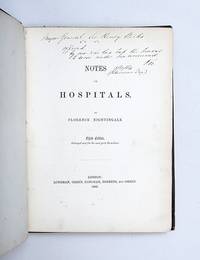
1863161784London: Longman Green Longman Roberts and Green 1863. Inscribed to her only supporter in the British military establishment Presentation copy inscribed by the author on the title page "Major General Sir Henry Storks &c &c offered by one who has had the honour to serve under his command. F.N. 5/11/64 Inkermann Day". During the Crimean War Henry Knight Storks 1811-1874 commanded the British military establishments in Turkey from the Bosphorus to Smyrna and was promoted major-general. He superintended the final British withdrawal from Turkey at the end of the war. Nightingale inscribed this copy on the tenth anniversary of the Battle of Inkerman a major British victory. Storks was a key ally in Nightingale's efforts to reform nursing in the Crimea reforms she often felt were obstructed by the British military authorities. She wrote on 6 March 1856 "I have therefore fought my own battles. I can truly say unsupported by any official out here with the exception of Genl. Storks" in Goldie p. 225. In May 1856 Nightingale was so exhausted by illness and overwork that she thought she was dying and wrote to Storks with her last requests: "As you are of all those in office whether at home or abroad the officer who has given the most steady and constant support to the work entrusted to me by her Majesty's Government I venture to appeal to you to continue that support after my death and to carry out as far as possible my last requests" Goldie. p. 265. Nightingale recovered and in 1857 secured Storks's appointment to the Royal Commission on the sanitary condition of the army. For many years after they continued to correspond on the welfare of soldiers. Nightingale's Notes on Hospitals was first published in 1858 and the second edition in 1859. This third edition was completely revised and substantially expanded and as Nightingale wrote in her preface "it is in reality a new book". The work addresses sanitation and hospital architecture arguing for the "pavilion" plan in which wards were separated into wings to improve ventilation and sunlight and to reduce infection by isolating contagious patients. The book "won Nightingale praise and inaugurated her career as an advisor to medical professionals all around the world especially those involved with hospital and infirmary construction" Orlando Women's Writing in the British Isles. Quarto. With 11 plates 2 maps of London and Paris 3 tables all folding. Original purple cloth spine lettered in gilt covers decorated in blind brown endpapers. Housed in custom red cloth solander box. Minor repairs to spine joints and inner hinges wear at extremities with loss at head of spine not affecting lettering contents clean plan of Paris with small chip to outer edge affecting border without loss to image. A good copy. Bishop & Goldie 101. Sue Goldie ed. Florence Nightingale: Letters from the Crimea 1997. hardcover
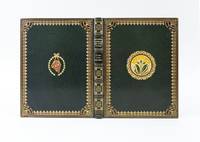
1910ST17129-032London: Published for the Florence Press by Chatto & Windus 1910. ONE OF 250 COPIES ON PAPER 12 additional copies were printed on vellum. 250 x 185 mm. 9 7/8 x 7 1/4". 5 p.l. 120 pp. 1 leaf. <br/> ANIIMATED DARK GREEN INLAID CRUSHED MOROCCO ELABORATELY GILT BY SANGORSKI & SUTCLIFFE signed on front turn-in covers with inlaid border of russet ribbon laced at each corner through a blue heart from which is suspended a pair of bells in inlaid brown morocco an inner border of red inlaid hearts alternating with small gilt floral tools front cover with centerpiece medallion of five inlaid flowers in green white and yellow on a densely stippled ground within a red inlaid circle with a gilt collar of oak leaves and acorns rear board with centerpiece inlay in brown and pink of Pan pipes suspended on a ribbon the whole enclosed in a gilt garland; raised bands spine gilt in compartments featuring floral cornerpieces and knotwork centerpiece with red heart and dot inlays very ornate gilt inner dentelles silk pastedowns and endpapers all edges gilt. In a slightly marked quarter morocco fleece-lined clamshell box with gilt titling on spine. 12 fine color plates by Norman Wilkinson. With the binders' typed description of the binding on Sangorski & Sutcliffe letterhead laid in at front. ◆Tips of joints and corners almost imperceptibly rubbed one leaf with small faint stain a few minute marginal adhesions otherwise INTERNALLY AND EXTERNALLY IN VIRTUALLY PERFECT CONDITION.<br/> <br/> This is a finely bound and finely printed edition of a group of essays short stories and autobiographical and travel sketches originally published in various periodicals and first printed as a collection in 1881. Founded in 1908 by the London publishers Chatto & Windus and operated by Philip Lee Warner the Florence Press had as its expressed intention the production of "beautiful books in the choicest types . . . in larger editions and at lower cost than was usual with such monuments of typography as the issues of the Kelmscott and other presses." Florence books are readily distinguishable by their special type designed by Herbert P. Horne after 15th century Italian faces that are elegant simple and easily readable. Binders Francis Sangorski and George Sutcliffe met as boys attending Douglas Cockerell's bookbinding classes at the L. C. C. Central School. Cockerell was so impressed by their skill that he hired Sutcliffe as a finisher and Sangorski as a forwarder. In 1901 Francis and George went into business for themselves and before long they had become two of the most renowned English binders of the 20th century. We can date the time of our binding to the decade of the 1910s because there is a letter from the binders laid in with an explanation of the decoration on stationery with the printed date "191__." The letter indicates that "250 different pieces of various colored leathers are used as inlays" many to suggest the contents of the essays: "the wedding bells and heart border are suggestive of the first essay 'Virginibus Puerisque.' The front centerpiece composed of spring flowers surrounded by a wreath of oak suggests 'Crabbed Age and Youth' and the back centerpiece suggests 'Pan's Pipes.'" In terms of its design quality of execution and condition the binding is simply beautiful. Published for the Florence Press by Chatto & Windus unknown
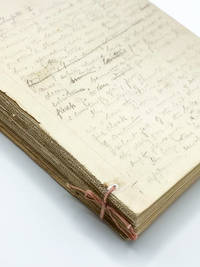
191044643n.p.: n.p. 1910. Very good. Original draft entirely written out by hand of the sequel to the international sensation THE ROSARY. While Florence Barclay was working on this manuscript she was in the midst of a life-changing experience: her romance novel THE ROSARY had just become one of the biggest blockbuster novels of the Edwardian era. It was not only a runaway bestseller for years on end but also parodied by PUNCH made into at least five films and described by the Queen of England herself as her favorite book of the year. According to Rachel Anderson it was "said to have been read and wept over by every housemaid in the British Isles." THE MISTRESS OF SHENSTONE was something of its sequel featuring characters first introduced in THE ROSARY. <br /> THE MISTRESS OF SHENSTONE is an exquisite romance between a widow and the man who accidentally killed her husband: like THE ROSARY it combines a moving arc of emotional development with an alluring charisma between the main characters. When Barclay arrived in the United States for a book tour of SHENSTONE she was greeted as a celebrity much in the way that Charles Dickens had been on his first trip to the country. In addition to photographers and journalists she was met right off the boat by a crush of fans holding welcome banners. This experience was so unlike what was expected for English authors in the period that her daughter makes special remark upon it in her biography of the author: "To English readers it may seem a surprising outburst and very different to anything that can be imagined as taking place in England by way of reception accorded to a private individual" 220. In 1921 SHENSTONE also became the first of Barclay's books before THE ROSARY to be turned into a film. <br /> This manuscript offers a window into the writing process of a famous romance author at the height of her power. In addition to the entire base text in Barclay's hand essentially every page is revised in the same hand in some cases extensively. Common editorial markings include crossed out words and sentences some replaced with new text additions to punctuation and rearranged phrases. It is illuminating to compare the manuscript itself with the details of Barclay's writing as described in her daughter's book LIFE OF FLORENCE L. BARCLAY 1921. In seeking to champion her mother as an author for "ordinary readers" her daughter asserts that Barclay "had no eye to the literary connoisseur the seeker after mere artistic effect" 242. Yet many of the revisions made by Barclay in this draft suggest that she cared much more about the art of her work than the biography claims. Altered words often reflect the author's stylistic refinements seeking a more accurate or elevated word in place of the original e.g. "empty" changed to "desolate". Other changes show a focused eye for paring down. For instance "she poured out the doctor's tea" and "passed it across the folding tea table between them" has been changed simply to "handed it to him." These decisions reflect more than a desire to "supply them her readers with that they wanted" 242: they show an author spending hours refining her craft. <br /> A manuscript offering the opportunity to research further into the working process of a major popular romance writer - a topic that has thus far been rarely recorded or studied. 9'' x 6.75''. 386 individual lines sheets thread-bound by hand with pink ribbon filled out in pencil on rectos only. Text begins with Chapter I "On the terrace of Shenstone" and ends with the phrase sentence of the final chapter "Mrs. Jim Airth" in larger script an effect reproduced in the printed final. Editorial markings throughout. Housed in later waxed canvas wrapper with two printed labels "The Mistress of Shenstone" and one handwritten annotation "1st M S of Mistress of Shenstone." Provenance: by descent from author's family. n.p. unknown
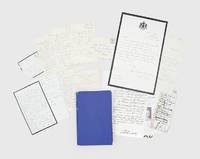
1892184236London: 1892-1938. I do not for a moment doubt that you will master or mistress the situation A group of encouraging letters to a younger nurse and mentee. De Laney trained at Nightingale's school for nurses and afterwards held senior positions in hospitals around the country. Nightingale's letters came at critical points of her career offering considered advice support and sympathy. They are accompanied by documents from de Laney's second occupation as housekeeper for the House of Lords. Amelia de Laney 1848-1940 attended the Nightingale Training School at St Thomas's Hospital between 1883 and 1886. Nightingale sent the first letter in 1891 when de Laney was considering leaving the Birmingham Workhouse Infirmary for a more senior role at the Royal Hospital for Consumption in Ventnor. Nightingale was cautiously supportive of the move. She wrote that de Laney "should have the promotion which you have well earned" but observed that the role came with a long list of duties: in addition to managing the care of patients and supervising her staff she would need to hire and train nurses look after the ten buildings and oversee the washing and cooking. Regardless Nightingale affirmed that "I do not for a moment doubt that you will master or mistress the situation if you are appointed". Nightingale provided Ventnor with an excellent reference for de Laney but the board rejected her for being insufficiently well-born. Instead de Laney moved in 1894 to a position as matron at the newly founded Epileptic Colony in Chalfont St Peter. Nightingale privately expressed her concerns to her friend Henry Bonham Carter commenting that the work was "entirely new. It is not hospital work at all. It seems to me an immense responsibility" McDonald pp. 230-31. Her concerns were proved valid. Nightingale's second letter dated April 1897 enquired after reports that de Laney had left her post. In her third letter dated May the same year Nightingale wrote to de Laney that "I grieve that you were obliged to resign & that you so much need rest" reassuring her that "you have done a good work & you will do much more good work for our cause". The fourth letter sent a month after extended Nightingale's ongoing sympathy for de Laney's "grief and distress". De Laney ultimately left nursing altogether. In 1902 she began working in the House of Lords holding the position until retirement in 1919. The correspondence here includes notices of appreciation sent on behalf of the Archduchess Maria Annunciata and Queen Alexandra. Other items include a letter from Nightingale seeking de Laney's address; an invitation card for an event at the Nightingale Training school; a document granting de Laney rooms in Westminster; a copy of Cecil Woodham-Smith's Florence Nightingale 1820-1910 1950; and a collection of clippings on Nightingale. Together 10 items: 5 autograph letters signed in black ink and pencil 1 across 2 single sheets with mourning borders 223 x 125 mm and four on bifolia 177 x 115 mm with 11 sides of writing; typed letter signed on single sheet notepaper; facsimile letter from the Home Office; invitation card; group of ephemera including newspaper cuttings and manuscript list; book octavo original blue cloth spine lettered in silver top edge blue. Modern bookplate of historian Arnold Daly Briscoe to front pastedown of volume extremities rubbed with occasional spots of wear; letters lightly creased from folding some lightly foxed one partially split along former folds. Overall a very well-preserved collection. Lynn McDonald ed. Florence Nightingale: Extending Nursing. Collected Works of Florence Nightingale vol. 13 2009. hardcover
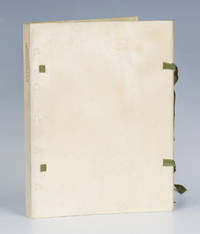
1910420London: Chatto & Windus for the Florence Press 1910. Limited Edition. Fine. Norman Wilkinson. 4to 10 x 7 1/2 in. 253 x 189 mm; 6 leaves including 1 blank 120 pp 2 leaves including 1 blank. 12 chromolithographed plates by Norman Wilkinson printed on plate paper and not included in the pagination legends on tissue guards printed in red. This is COPY no. 4 OF 12 COPIES PRINTED ON VELLUM as noted on the limitation page on verso of second leaf: «Of this edition of Virginibus Puerisque / have been printed on Aldwych hand- / made paper 250 copies of which 235 are / for sale; on vellum 12 copies of which 10 / are for sale. / Vellum Copy No. 4». Limp vellum binding with four green ties; gilt lettering on spine and upper cover t.e.g. Very faint spotting to front free endpaper slight offsetting of ties. Otherwise a pristine copy.<br /> <br /> Provenance: William Russell Flint from the family by descent.<br /> Beinecke Stevenson 79; Ransom 278:6; Tomkinson 85:6; Prideaux 13. A splendid edition of Stevenson's first collection of essays which promote a spirit of playfulness in defiance of both the hardships of human life and the restrictions imposed by bourgeois callowness. The volume brought together essays that had been previously published in the Cornhill Magazine and Macmillan's: "Virginibus Puerisque i" 1876; " ii" 1881; "iii: On Falling in Love" 1877; "iv: The Truth of Intercourse" 1879; "Crabbed Age and Youth" 1878; "An Apology for Idlers" 1877; "Ordered South" 1874; "Aes Triplex" 1878; "El Dorado" 1878; "The English Admirals" 1878; "Some Portraits by Raeburn" previously unpublished; "Child's Play" 1878; "Walking Tours" 1876; "Pan's Pipes" 1878; "A Plea for Gas Lamps" 1878<br /> The essays inspired Norman WILKINSON 1878 - 1971 to create the 12 striking and lyrical images that accompany the texts. Wilkinson was a British artist renowned for his poster work and honored by the British Admiralty for coming up with the idea and design for "dazzle camouflage" to protect Royal Navy ships from attacks by German submarines.<br /> Founded in 1908 by the London publishers Chatto & Windus and operated by Philip Lee Warner THE FLORENCE PRESS had as its mission to produce "beautiful books in the choicest types" but in somewhat larger and less costly editions than Kelmscott and the other more celebrated English fine presses. Florence books are readily distinguishable by their special type designed by Herbert P. Horne after 15th century Italian faces that are elegant simple and easily readable. Tomkinson p. 84<br /> This volume comes from the collection of Sir William Russell Flint 1880 - 1969 a Scottish artist illustrator and author who was linked to the Pre-Raphaelites and art nouveau designers. He enjoyed much commercial success during his career was on staff for years at 'The Illustrated London News' was commissioned to illustrate many books and the librettos of several Gilbert and Sullivan librettos. He served as president of both The Royal Society of Painters Etchers and Engravers and the Royal Watercolour Society and was knighted in 1946. Chatto & Windus for the Florence Press unknown
1858655051858. London: Printed by Harrison and Sons St. Martin's Lane W.C. 1858 8° IV 2 V-X 28 133 1 23 1 pp. 1 plate cloth; Stamp of "Secretary of state War office Library" on title- and flying leaf; minor spotting on title else fine. FIRST EDITION AND EXCEPTIONALLY RARE; FOR PRIVATE CIRCULATION ONLY "FEMALE NURSING IN MILITARY HOSPITALS 1858" Subsidiary Notes is developed and expanded from the 'tentative and experimental Memorandum' on Female Nurses in Military Hospitals 1857 and really constitutes a treatise on nursing at large. Her much better known Notes on Nursing published two years later was an abridged version of the detailed study which had gone into this earlier privately printed book. Contents Digest pp.v-x Thoughts submitted by order concerning- I. Hospital nurses pp.1-9. II. Nurses in civil hospitals pp.9-14. III. Nurses in Her Majesty's hospitals pp.15-19. Systems of female nursing in the war hospitals of the different nations engaged in the Crimean War pp.19-26. Note in regard to the Russian nurses employed in the war hospitals of the Crimea pp.26-28. Subsidiary notes as to the introduction of female nursing into military hospitals in peace and war pp.1-63. Addenda with regard to female nursing in a military hospital on the pavilion or Lariboisière plan pp.63-90. Addenda as to mixed nursing by nurses and orderlies in military hospitals on the double pavilion or Vincennes plan pp.91-117. Additional hints as to ventilation hospital floors and cautions in ward-building suggested by the Lariboisière Hospital pp.118-127. Note on contagion and infection pp.128-132. Note on observations by the Principal Medical Officer of the army in the East pp.132 133. Thoughts submitted as to an eventual nurses' Provident Fund pp.1-19. Note as to the number of women employed as nurses in Great Britain 2021 pp. Note as to teaching nursing 22 23 pp. "This work developed and expanded from the 'tentative and experimental Memorandum' on Female Nurses in Military Hospitals No. 1 is complementary to Notes on Matters affecting the Health Efficiency and Hospital Administration No. 50 of which it forms the second volume. Its title hardly describes its scope for it is in fact almost a treatise on nursing at large. Mrs. Gaskell in a letter of December 21 1858 wrote: 'It was so interesting I could not leave it. I finished it at one long morning sitting-hardly stirring between breakfast and dinner.' The purpose of the work was to prepare the way for the introduction of women as nurses in military hospitals and to lay down the basic principles of nursing. The subject is considered in great detail from the historical organizational and administrative points of view. Together with much that is outdated it contains a great deal of wisdom and is regarded as one of the most important of Florence Nightingale's writings. It is in this work that she lays down the Draconian code for the regulation of the nurse's life which forms such an extraordinary feature of her teaching. On the other hand it has to be realized that in 1858 the idea of a respectable woman entering a hospital as a nurse was very shocking and Miss Nightingale had to anticipate strong public opposition. 'There is nothing more dangerous than to undervalue the objections of opponents' she wrote. 'Let us give them their full weight and while firmly holding our course and trusting God to guide it draw useful cautions from the objections which we quietly and steadily confront.' Furthermore she firmly asserted in the very first paragraph that it would be desirable 'to consider all plans and rules for some time to come as in a great measure tentative and experimental.' Miss Nightingale although in many respects rigid in her ideas was nevertheless very much aware of the dangers of stagnation which she clearly perceived in later years in the blind adherence to rules of others less able and less original than herself." Sue Goldie A Bio-Bibliography of Florence Nightingale compiled by the late W.-J. Bishop completed by Sue Goldie 1962 Nr. 3 hardcover
1865187671London: Emily Faithfull Printer and publisher in ordinary to Her Majesty Victoria Press 1865. The work of destruction has at the same time begun First edition offprint issue of Nightingale's study of the treatment of indigenous Australians in British hospitals. Amid the European expansion and settler conflict of 19th-century Australia the Aboriginal population was declining rapidly. British hospitals continued to provide treatment to indigenous Australians whose survival in the colony was viewed as a matter of national concern. By 1865 Nightingale was working to implement her reforms on an institutional scale and had contributed several commissions examining public health in British colonies. Much of her data for the current paper was gathered by missionaries: a key recommendation was an official infrastructure for collecting mortality statistics. Nightingale concludes that poor sanitation and alcohol were among the primary causes for higher death rates but she also notes that European contact itself was damaging the Aboriginal population: "as soon as native habits and customs begin to undergo change under European influences the work of destruction has at the same time begun" p. 3. Nightingale's paper was originally published in Transactions of the National Association for the Promotion of Social Science the same year: Bishop and Goldie list the journal issue first but no formal priority has been established. Octavo pp. 8. Original printed wrappers. Front wrapper re-attached otherwise a very good copy indeed. Belt 15; Bishop & Goldie 95 ii. Lynn McDonald Florence Nightingale: An Introduction to Her Life and Family 2010. unknown
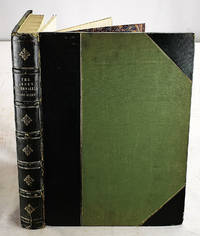
18902308170019London: Lyne & Sons for R.H. Porter 1890 1896. 1890. First Edition. Hardcover. Good. Orchidology: Great Flower Books Rare perhaps only 150 copies were printed. Complete in 9 parts bound in one volume. Folio 45 x 32 cm. Bound in contemporary green half morocco. Gilt spine. Crack at front cover joint. Includes 87 hand-colored lithographic plates a double-page map of Central and South America and 61 wood-engraved text illustrations. Nine original printed wrappers bound in at end. <br> "The person who makes the original drawings from nature should also lithograph the plates and indicate the colours to be used by the colourist for by this means the works passes through fewer hands and is more likely to turn out accurate. I have therefore pursued this method throughout the present work and have besides touched up the colouring of every plate sent out numbering nearly 9000" Introduction. Great Flower Books p 152; Nissen BBI 2185; Stafleu & Cowan TL2 18.284. London: Lyne & Sons for R.H. Porter, 1890, 1896. hardcover
1926C91597Etienne Bignou Editeur. As New. 1926. Hardcover. FREE UPGRADE to Courier/Priority Shipping Upon Request - IN STOCK AND IMMEDIATELY AVAILABLE FOR SHIPMENT - AS NEW THE TEXT BLOCK IS PRISTINE CLEAN UNMARKED AND IN EXCELLENT CONDITION - - TWO 2 VOLUME SET. Text in French. Critical study and catalogue raisonne; 357 b/w illustrations -- with a bonus offer-- - May be EITHER: out of print OOP and extremely rare in this pristine condition; signed by author or contributor; or a first or special edition; inquire for details . Etienne Bignou, Editeur hardcover
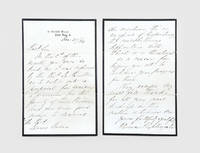
1864177463London: 21 December 1864. Your great kindness on behalf of this good man's family Nightingale writes to Davis 1820-1883 a clergyman and headmaster to rally support for the family of the recently deceased Lutheran minister Theodor Fliedner 1800-1864 Nightingale's old friend and tutor whom she viewed as a father figure. Fliedner founded and ran 30 deaconess houses where women could train in theology and nursing and his family required financial aid to continue his work. Nightingale met Theodor Fliedner in 1841 and in 1850 became a temporary resident at his flagship deaconess community the Kaiserswerther Diakonie. The women who resided there had committed to a holy life and taken vows. However they were not enclosed as they were trained to go out into the community to care for the sick. Further they could leave at any point if they wished. It was an ideal place for Nightingale for whom nursing was a religious vocation and the time she spent there was "key in the development of her mission" Macdonald p. 7. In 1851 she wrote her first publication issued anonymously titled The Institute of Kaiserswerth on the Rhine in which she recommended Fliedner's deaconess houses to English women. She commented on "the delicacy the cheerfulness the grace of Christian kindness the moral atmosphere" in the hospitals and "the kindness of the sisters in imparting their own knowledge" Nightingale p. 19. The Fliedners and Nightingale remained close long after her stay. In 1853 she became godmother to their child and upon Fliedner's death Nightingale felt that she had lost a father. Determined to support his family in their "continuance of the work" Nightingale wrote and printed an appeal and engaged a network of clergymen to promote the cause. To this end she writes to Reverend Davis that "you were so kind. as to enter into a proposal for sending a provision for the family" and asks that he circulate her pamphlets "amongst the likeliest members" of his community. Bifolium and single sheet 177 x 113 mm. Autograph letter written across 3 pages letterhead of 27 Norfolk Street Park Lane mourning borders. Previously folded occasional small splits at ends of folds: in very good condition. McDonald Lynn ed. Florence Nightingale's Spirital Journey: Biblical Annotations Sermons and Journal Notes 2001; Nightingale Florence The institution of Kaiserswerth on the Rhine for the practical training of deaconesses under the direction of the Rev. Pastor Fliedner 1851. unknown
1860355490723774London 1860. First Edition. Hard Cover. London: Harrison 59 Pall Mall Bookseller to the Queen nd 1860. First UK Edition First Issue. 79 pages. Publisher's dark brown pebbled cloth-covered flexible paper boards with gilt stamped title lettering to front board and triple blind rules to perimeter. Yellow end-papers with the Publisher's printed advertisements on front pastedown dated 1860 for Burke's Peerage and on the rear end-papers for the Foreign Office list. This copy does NOT carry 'The right of translation is reserved' on title page under the publisher's imprint. The earliest examples of the first issue were printed with plain end-papers but almost immediately the publisher's put in advertisement end-papers as per this copy. Some time in February 1860 the book was reissued its many textual errors still uncorrected but with the 'The right of translation is reserved' inserted on the title page. NB: what differentiates this copy is that it does not have the the Right of Translation slug to the title page so it is definitely first issue. A VG copy that has benefitted from the spine having been professionally and sympathetically replaced and the inner hinges strengthened by a skilled bookbinder. There is a neat inscription from 1876 to the verso of the title page. Bishop & Goldie: A Bio-Bibliography of Florence Nightingale 1962. Florence Nightingale 1820-1910 was an English social reformer statistician and the founder of modern nursing. She laid the foundation of professional nursing with the establishment of her nursing school at St Thomas' Hospital in London. Photographs/scans available upon request. hardcover
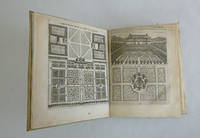
51-6506Amsterdam: Marc Doornick 1669-1670. 4to. 16.5 x 20.5cm. 4to Contemporary vellum. .5 parts in 1. Illustrated with 12 of 15 full-page copper-engraved plates plus 3 large engraved title vignettes and numerous large and full-page woodcuts. Text in French and German. Each with separate title page register continuous. Lacks leaves B4 and C1 with plates 7-8 and likely lacks a frontispiece or another plate. The first bilingual edition issued the same year as the first Dutch edition. Important early gardening book illustrating famous gardens including those of Honsholredyk Ryswyck and Huis ten Bosch in early states. Treats a wide range of topics including beekeeping husbandry sundials and description and care for foreign plants such as the aloe plant from America p.42 and datura/jimsonweed p.68. Index bound at front.OCLC Number / Unique Identifier:504764839:Notes:French and German. With an additional titlepage engraved in Dutch from the edition as part of "Het vermakelijck landt-leven". "Boutique aÌ€ remedes enseignant de quelle maniere il faut preparer les medecines pour guerir les maladies des animaux. Vieh-Apoteeck etc. By Pieter Nyland.": pp. 87-104. "TraiteÌ des abeilles . Der fleissige Bienenhalter etc. By Pieter Nyland": pp. 105-127. "24 nouveaux & curieux modelles de parterres . 24 neue . Garten-Modellen etc.": page not numbered. The titlepages of the additional works are dated 1670OCLC Number / Unique Identifier:496284071Notes:Texte sur 2 colonnesOn trouve une 2e p. de titre plus compleÌ€te apreÌ€s le privileÌ€ge et le frontispice. La "Boutique aÌ€ remeÌ€des" occupe les pp. 87-104 et le "TraiteÌ des abeilles" les pp. 105-129. Ces deux textes traductions de Petrus Nylandt ont des p. de titre particulieÌ€res dateÌes de 1670. A leur suite on trouve deux recueils de planches non pagineÌs mais chacun avec une page de titre particulieÌ€re: "24 nouveaux et curieux modelles de parterre aÌ€ la françoise pour embellir touts sorte de jardins et autres lieux de plaisance 24 neue kunstartige Garten-Modellen". avec la date de 1670 en 4 ff. et "Deux cens modelles pour ceux qui se plaisent au jardinage servant utilement a dresser & disposer toutes sortes de parterres aÌ€ fleurs & aÌ€ buissons". Zwey hundert Garten-Modellen. avec la date de 1669 en 28 ff. dont 1 frontispice.Provenance: Florence Yoch 1890–1972 and Lucile Council 1898–1964 were among the most prolific and influential landscape architects in Southern California during the early and mid-20th century. Partners both in business and in life they completed more than 250 landscape commissions over a period of roughly four decades—projects that included landmark public gardens and private gardens for Hollywood elites. The Huntington is home to the Florence Yoch Papers a trove of drawings photographs research files and office records that tell the story of the couple’s firm and provide a tremendous resource for researchers. Amsterdam,: Marc Doornick, 1669-1670 hardcover
17911909070003Florence: Niccolo Pagni and Giuseppe Bardi 1791 & 1795 1791. First Edition. Hardcover. Good. A Monumental Work of 18th century Italian engraving 2 volumes. Large folios 51 x 35 cm 19 3/4 x 13 in. 1st edition. Bound in contemporary 1/2 vellum over marbled boards. Some cover wear. Rear joint of v.1 cracked. Hinges of v. 2 cracked. Text in Italian and French printed in parallel columns. Collation: v.1 Engraved title frontispiece 64 leaves 60 plates. v.2 Engraved title 62 leaves 60 plates. Many of the plates are printed in colored ink: siena shades of brown or green and blue. 120 artists' portraits. <br> A gorgeous and large format work on Tuscan painting beginning with Guido da Siena and considering all the great painters of Florence such as Buffalmaco Cimabue Giotto Paolo Uccello Andrea Verrocchio Masaccio Fra fifilppo Lippi Andrea del Castagno Pollaiolo Botticelli Leonardo da Vinci Michelangelo Andrea del Sarto Antonio Tempesta Giuseppe Grisoni etc. Carlo Lasinio 1759-1838 was responsible for many of the engravings. Other engravers included: Giovanni Francisco Ravenet Marco Lastri Giuseppe Bardi Niccolo Pagni Matteo Carboni Ferdinando Gregori Gaetano Vascellini and Cosomo Colombini. <br> Refs: "Pregevole opera" Cicognara 3387. Cohen-Ricci 366. Thieme-Becker XXII 404. Brunet II 1095. Graesse II 509. Moreni I 509: "Ciascuno di questi volumi racchiude 60 articoli di notizie di altrettanti pittori toscani scritti in italiano da M.L. promotore di questa eccellente impresa e tradotti in francese da Bartolomeo Renard. Ognuno di essi ha una stampa incisa in rame scelta dalle Opere le piu stimate di quel pittore." <br> Armorial bookplates of Paul Beilby Thompson 1784-1852. Thompson was a Whig MP for Wenlock and East Riding; later made a Baron. <br> This is an oversized or heavy book which requires additional postage for international delivery outside the US. Florence: Niccolo Pagni and Giuseppe Bardi, 1791 & 1795 hardcover
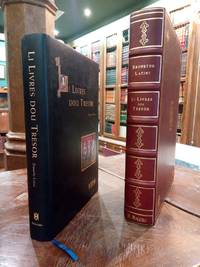
200046223EDICIÓN FACSIMIL DEL CODICE ORIGINAL CONSERVADO EN LA BIBLIOTECA NACIONAL DE RUSIA SAN PETESBURGO. ms. Fr. F.v. III Nº 4. Este códice esta datado después de 1268.- Barcelona: M. Moleiro Editor S. A. 2000.- 2 VOLS. Facsímil del códice con 1 h. 149 Folios 1 h. y traducción al español y estudios con 496 p. 1 h.: El facsímil con Profusión de preciosas miniaturas a todo color y los dorados con pan de oro auténtico; El volumen de estudios es bilingüe en español e inglés; Facsímil en Gran Folio 342 x 25 cm el estudio complementario en Folio Mayor 318 x 225 cm; Facsímil en gran papel de gruesa factura imitando la vitela pergamino fino del códice magníficamente logrado y siendo cada hoja reproducida en su tamaño y contorno original el tomo de estudios impreso sobre papel offset de gran calidad; El códice va encuadernado en Plena Piel de color marrón rojizo con las tapas estampadas en seco artísticamente a igual que el lomo con un estuche cuyos planos están dorados con un grueso filete con águilas en las esquinas y hierro al centro con un águila enmarcada por un exágono todo ello dorado al igual que el lomo del estuche también dorado y con cinco nervios. El tomo de estudios va encuadernado en Plena Tela Ed. en raso de seda azul con el título estampado en negro y camisa ilustrada.- Acompañado del acta notarial del Notario D. Arturo Pérez Morente: "DOY FE: De que al presente ejemplar facsímil del Libro del Tesoro cuyo original se conserva en la Biblioteca Nacional de Rúsia en San Petesburgo bajo la referencia ms. Fr. F.v. III Nº 4 le corresponde el Nº 472 de la edición única e irrepetible numerada en arábigo y limitada a 987 ejemplares realizada bajo la dirección de Manuel Moleiro Rodríguez y editada por: M. Moleiro Editor S. A. Forman parte de esta misma edición 55 ejemplares con numeración romana destinados al Depósito Legal y al editor.Barcelona veintidós de diciembre de 1999". Siguen los sellos y la firma del notario. Obra en impecable estado de conservación. El libro constituye una preciosa edición facsímil casi igual al códice original realizado con una gran maestría. Va acompañado por un tomo con el estudio exhaustivo del códice por eminentes especialistas y conocedores del mismo. EDAD MEDIA EUROPEA Libro en latín M. Moleiro Editor, S. A. hardcover
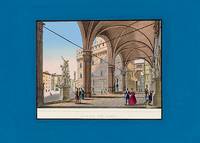
1820100050AG1820. Florence / Pisa c.1820. Original Aquatint hand-applied water-colouring over copper engraving. Plate Sizes vary: 31 cm x 22.1 cm. Sheet Sizes vary: 34.6 cm x 26.5 cm. Original Gouache-Aquatint hand-applied water-colouring over copper engraving. Florence/Pisa c.1820. Plate-Sizes vary: c. 31 cm x 22.1 cm. Sheet Sizes vary: c. 34.6 cm x 26.5 cm. Besides some smaller damages to the Ponte S. Trinita-artwork in very good actually stunning condition. Clean crisp and brightly coloured. All of these artworks are beautifully framed and the price includes worldwide free shipping per UPS - courier. The Longing for Italy the Italiensehnsucht of the german - speaking countries was forced by Johann Wolfgang von Goethe's Italian Travels and sent scores of young and old to Italy's shores countryside and cities. The Grand Tour was the 17th- and 18th-century custom of a traditional trip of Europe undertaken by upper-class young European men and women of sufficient means and rank typically accompanied by a chaperone such as a family member when they had come of age about 21 years old. The custom - which flourished from about 1660 until the advent of large-scale rail transport in the 1840s and was associated with a standard itinerary - served as an educational rite of passage. Though the Grand Tour was primarily associated with the British nobility and wealthy landed gentry similar trips were made by wealthy young men of other Protestant Northern European nations and from the second half of the 18th century by some South and North Americans. By the mid 18th century the Grand Tour had become a regular feature of aristocratic education in Central Europe as well although it was restricted to the higher nobility. The tradition declined as enthusiasm for neo-classical culture waned and with the advent of accessible rail and steamship travel. Wikipedia unknown
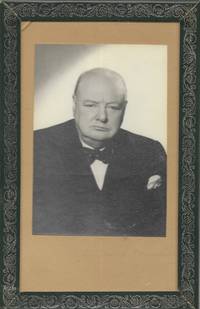
29414London: Vivienne 20th Century Studios Ltd. 1950. 1 tirage original monté sur carton fort encadré. . Tirage original. Le premier portrait de Churchill par Florence Vivienne. Rare tirage offert par Winston Churchill : il porte en marge inférieure la signature de Churchill à E. M. Pommier un résistant français. Une lettre du secrétaire privé de Churchill a été conservée au verso certifiant que cette photographie et la signature ont été envoyées à Pommier avec les compliments du Prime Minister. . Florence Vivienne Entwistle débuta dans la photographie en aidant en 1934 son mari Ernest Entwistle et son fils Antony. Elle créa son propre studio à la fin des années 1930 et se spécialisa dans les portraits de personnalités. Les relations avec les Churchill dépassèrent le strict cadre professionnel puisque en octobre 1949 la fille des Churchill Sarah épouse le fils de Vivienne Antony. Les Churchill « apprendra le mariage. par les journaux et en furent très contrariés. surtout Clémentine qui le prend très mal ». Néanmoins le 19 décembre 1949 le couple Churchill rencontre le couple Vivienne et « après un agréable déjeuner ensemble Florence Vivienne réalise le portraits de Winston Churchill dans son studio de Piccadilly » Gilbert Vol. VIII p. 496. Le portrait plut tant à Churchill qu'il l'utilisera dès l'année suivante pour la campagne des élections générales de février 1950 et qu'il deviendra l'un des plus célèbres du Prime Minister. Florence Vivienne était connue pour exiger de ses sujets qu'ils viennent dans son studio et la jaquette qui orne son autobiographie They Came to My Studio publiée en 1956 est illustrée par cette photographie. Vivienne rappelle p. 16 combien cette image est devenue iconique et qu'elle était alors la seule qu'elle ait prise de Churchill. La National Portrait Gallery conserve 214 portraits de Vivienne dont celui-ci 14 en tout pour la famille Churchill la plupart ayant été pris dans leur maison de campagne Chartwell. [London: Vivienne, 20th Century Studios Ltd., 1950]. 1 tirage original, monté sur carton fort, encadré. unknown
1975040271Stein and Day 1975. 1st Edition . Hardcover. Good/Poor. Gift inscription signed by author Florence King on front fly. No other writing inside. Tilted binding is solid. Cover has rubbed extremities. Poor dust jacket has chipped edges and closed tears. King's first book published using her name. 1975 first edition first printing. <br/> <br/> Stein and Day hardcover
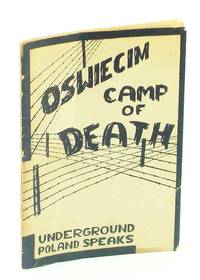
1944214h1991New York: Poland Fights. Fair. 1944. First American Edition. Paperback. "The moving and almost incredible story of Oswiecim Auschwitz concentration camp. Written under the tension of the vibrant poignancy that is an inseparable part of the miseries Poland has endured. Written by a Polish Underground Labor 'historian' experienced in the underground struggle who drew his material from actual contact with persons who underwent and saw others suffer the things that he describes. A compilation of the viciousness of Nazism as seen at Oswiecim so that all who read might understand and make a just evaluation of that which Poland faces of the problem of ridding all Europe of a scourge that gives rise to such things as Oswiecim." - Foreword. 48 page stapled booklet. Includes a one-page facsimile of the cover of the 1942 Polish first edition published underground. Full-page map shows locations of major concentration camps in Poland. According to Wikipedia this book was written by Natalia Zarembina 1895-1973 and was the first documentary about the Auschwitz concentration camp based on reports from refugees or people dismissed from the camp mainly Eryk Lipinski Henryk Swiatkowski and Edward Bugajski. Also includes information about the network of slave camps in Poland including Camp Districts Temporary Concentration Camps General Concentration Camps Forced Labor Camps Concentration Camps for Clergy Concentration Camps for Women Concentration Camps for Jews Camps for "Improvement of the Race" where "the only duty that is absolutely enforced of the young defect-free Polish and German inmates is the regular performance of sexual intercourse with the partner assigned" Camps for "Correction of Youth" and Concentration Camps for Children So-Called "Educational Institutes". Front cover loose but present. Lacking back cover. Unmarked with somewhat above-average wear. Moderate tanning to contents. Binding intact. A rare copy of this early Auschwitz exposé. 8.25" x 5.4". Weiner Library Cat. Series 7 - #1660.; Cover Art; 8vo . Poland Fights paperback
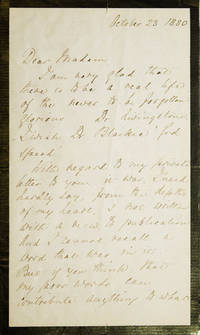
1880320579Derby 1880. 3pp. folded sheet mourning stationery. With the original mailing envelope. Usual fold. Old tape repair on conjugate leaf with resulting stain affecting a few words of text but not affecting signature. 3pp. folded sheet mourning stationery. With the original mailing envelope. "I am very glad that there is to be a real life of the never to be forgotten glorious Dr. Livingstone. I wish Dr. Blaikie God speed. With regard to my private letter to you it was I need hardly say from the depths of my heart & not written with a view to publication and I cannot recall a word that was in it. But if you think that my poor words can contribute anything to what must be the object of every English speaking nation & not only this but of every man woman & child all over the world viz. to make known one who has opened the way of peace & not terror to those who were 'lying in darkness & the shadow of death' on so large a portion of the globe. I feel that I cannot decline what otherwise is so repugnant to me . And pray believe me ever the faithful servant of yourself & the great memory of as true a hero saint as ever lived ."<br /> <br /> Written on the occasion of the preparation for imminent publication of William Garden Blaikie's biography of Livingstone published 1880 the letter gives permission for a letter of hers to be published in which she said of Livingstone: "We cannot console ourselves for our loss. He is irreplaceable" p. 458 and called him "the greatest man of his generation unknown
192390960Librairie Armand Colin. As New. 1923. Paperback. FREE UPGRADE to Courier/Priority Shipping Upon Request - IN STOCK AND IMMEDIATELY AVAILABLE FOR SHIPMENT - AS NEW THE TEXT BLOCK IS PRISTINE CLEAN UNMARKED AND IN EXCELLENT CONDITION - - Text in French. 156 pages; 8 black and white plates. Catalogue Raisonne Catalog Raisonné Complete Works La Vie et L'uvre Oeuvre Raisonnee Librairie Armand Colin paperback
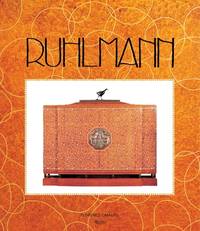
201091008Rizzoli. New. 2010. Hardcover. 0847857999 . FREE UPGRADE to Courier/Priority Shipping Upon Request - IN STOCK AND IMMEDIATELY AVAILABLE FOR SHIPMENT - FLAWLESS COPY BRAND NEW PRISTINE NEVER OPENED -- - INCLUDES CD. 652 pages. Catalogue Raisonne Catalog Raisonné Complete Works Life and Work Raisonnee -- with a bonus offer . Rizzoli hardcover
1923C90960Librairie Armand Colin. As New. 1923. Paperback. FREE UPGRADE to Courier/Priority Shipping Upon Request - IN STOCK AND IMMEDIATELY AVAILABLE FOR SHIPMENT - AS NEW THE TEXT BLOCK IS PRISTINE CLEAN UNMARKED AND IN EXCELLENT CONDITION - - Text in French. 156 pages; 8 black and white plates. Catalogue Raisonne Catalog Raisonné Complete Works La Vie et L'uvre Oeuvre Raisonnee -- with a bonus offer-- - May be EITHER: out of print OOP and extremely rare in this pristine condition; signed by author or contributor; or a first or special edition; inquire for details . Librairie Armand Colin paperback
2010C91008Rizzoli. As New. 2010. Hardcover. 0847857999 . FREE UPGRADE to Courier/Priority Shipping Upon Request - IN STOCK AND IMMEDIATELY AVAILABLE FOR SHIPMENT - FLAWLESS COPY BRAND NEW PRISTINE NEVER OPENED -- - INCLUDES CD. 652 pages. Catalogue Raisonne Catalog Raisonné Complete Works Life and Work Raisonnee -- with a bonus offer-- - May be EITHER: out of print OOP and extremely rare in this pristine condition; signed by author or contributor; or a first or special edition; inquire for details . Rizzoli hardcover