49 résultats
In 8, pp. 9 + (3b). Intonso. Taglietti ai marg. dei p. e delle cc. Br. ed.
1993ve327Museo nacional de arte romano Dos carré collé 1993 In-8 (16 x 21 cm), dos carré collé, 233 pages, texte en espagnol ; trace de colle au dos, intérieur frais, bon état général. Livraison a domicile (La Poste) ou en Mondial Relay sur simple demande.

1990ve162Editions du centre national de la recherche scientifique Collection de la maison des pays ibériques Dos carré collé 1990 In-8 (15.5 x 24 cm), dos carré collé, 334 pages ; réparation des pages dont certaines photocopiées in fine, couverture brunie, ex-libris tamponné en première page, assez bon état général. Livraison a domicile (La Poste) ou en Mondial Relay sur simple demande.
1915ABE-1620479297836 PAGES FORMAT 30,5 CM X 41 CM-EN COUVERTURE INTERIEURE "LA GUERRE NAVALE ALLEMANDE", DESSIN DE SIMONT, CADAVRE DE FEMME DANS L'EAU, DEBRIS AU SECOND PLAN-L'ASSASSINAT DE DOUZE CENTS PASSAGERS EN PLEINE MER: LE TORPILLAGE DU "LUSITANIA", 4 DESSINS SUR 2 PAGES: 2 CROQUIS D'UN SURVIVANT OLIVER P. BERNARD, DESSIN DE NORMAN WILKINSON, DESSIN DE S. BEGG-A NOTRE-DAME-DES-LORETTE, 4 PHOTOS, CARTE-LA GUERRE DES NATIONS "ETUDES PEINTES D'APRES NATURE PAR MAURICE ORANGE, 10 DESSINS SUR 2P-NOTRE JOFFRE UNE ESQUISSE D'APRES NATURE, 3P, 7 PHOTOS-AUX DARDANELLES, 3P, 7 PHOTOS, CARTE-LE PAQUEBOT "LUSITANIA" TORPILLE, PAR RAYMOND LESTONNAT
340 p. Frontis + full page photo illustrations. Uncut & unopened. 8vo. Original gold decorated cloth binding. Second printing. PA 02B
Pages 65-128. Numerous black and white illustrations and maps. Recommended for use in the public school libraries of British Columbia. Chapters include: Winter fighting in Champagne, the Argonne, and the Vosges; The Submarine Blockade Begins; The Sinking of the "Lusitania"; Stories of Submarines; More Stories of Submarine Warfare; Winter Fighting in Poland and East Prussia; A Battle of the Middle Ages; The Fall of Przemysl; Stories from Eastern Battlefields. Undated but presumably printed circa 1920. Unmarked with average wear. Binding sound. A quality vintage copy. Book
80 pages. Features: The Lusitania; The Conqueror's Gift; The Tradescants of Lambeth; The Brontes; Tobruk - part 1; The Black Prince - part III. Somewhat above-average wear. Sound reference copy. Please note: the Lusitania feature includes a full-page reproduction of the news clipping, dated 22 April 1915, in which the German Embassy in Washington warned sea passengers that they travelled at their own risk, given the state of war between Germany and Great Britain. Book
1920ABE-1675118269522DU NUMERO 4009 DU 3 JANVIER 1920 AU NUMERO 4034 DU 26 JUIN 2020-ENTRE AUTRES SUJETS: L'ACCIDENT DU PRESIDENT DE LA PEBULIQUE, 1P, 6 PHOTOS-(EM123)
19021963East AuroraNY roycrofters 1902. PAPERBACK Wraps MCMII 1902 1st edition VG tiny chips AS-IS. First Edition. Soft Cover. East Aurora,NY, roycrofters paperback
Reprint of the 1916 first edition. 224 pages. The Lusitania Massacre is one of the great landmarks in history, not alone in American history but in human history, because it ensured German defeat in the World War. Chapters include: Should passenger vessels carry war material?; English orders to fight submarines; The German warning; The American warning; The Cunard Company's warning; American Ruling (not law) on foreign armed merchant vessels; Was the Lusitania armed?; The Manifest of the Lusitania; Who is responsible?; View of the English, Austrians and Germans; The official English investigation; and more. Black and white illustrations. Some markings. Front free endpaper removed. Usual library markings. Above-average wear. Front hinge secured with librarian's tape. Spine leaning moderately. Remains a decent working copy. Book
1915ABE-1678404922592REVUE HEBDOMADAIRE DE 16 PAGES FORMAT 22,5 CM X 30,5 CM-RELIURE PLATS CARTONNES DOS MUET REGROUPANT LES NUMEROS DU 3 JANVIER 1915 AU 9 JANVIER 1916-(ETACA)
Front cover portrait of Lieutenant-Commander Norman D. Holbrook, V.C. The Development of Submarine Warfare. Przemysl and the battles of the Mountains and Rivers. Centerfold illustration of the Lusitania going down - Germany's 'Grand Coup' in crime. Photos and Illustrations: simulation of the hole blasted in the side of the Lusitania; Destruction of the Dresden off Juan Fernandez; The March of Millions - Russian troops on the way to Crakow; and more. Covers secured by tape. Above-average wear. Book
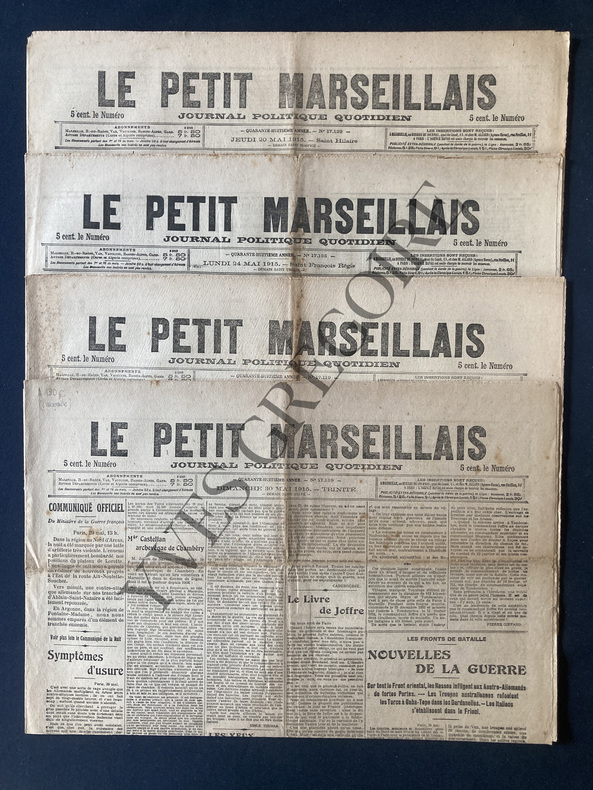
1915ABE-145279654374 PAGES FORMAT 45 CM X 60 CM-LUNDI 3 MAI-MARDI 4-MERCREDI 5-VENDREDI 7-SAMEDI 8-LUNDI 10-MARDI 11-JEUDI 13-DIMANCHE 16-LUNDI 17-MARDI 18-MERCREDI 19-JEUDI 20-VENDREDI 21-LUNDI 24-MARDI 25-MERCREDI 26-SAMEDI 29-DIMANCHE 30
52 pages. Features: Rex Woods cover illustration of deck scene on freighter at Port Arthur; Eric Nicol suggests that, if hangings are to continue, they should be done publicly; Two-page colour-photo GM ad emphasizes their quality control; How London's Mermaid Theatre Came Back to Life; Do Our Courts Dispense True Justice? - first of a two-part feature on the state of Canada's judicial system; The Lone Pine of Parliament Hill - Howard Green, Canada's new Minister of External Affairs; Photo feature on "The Driveway" in Ottawa; Are You the Victim of Your Own Ambitions?; The Tragedy of the Fat Child; The Heroes of My Boyhood, by Robert Thomas Allen; I Survived the Sinking of the Lusitania - Sir Harold Boulton was the last man rescued - 1,198 died, helping bring the U.S. into WWI; Colour-photo Coke ad on back cover shows snowy glass and bottle; and more. Unmarked with moderate wear. A quality vintage copy. Book
42 pages. A fascinating and important issue devoted to rousing American anger against Germany, particularly as a result of U.S. lives lost in the sinking of the Lusitania. Clearly, the people behind Life Magazine wanted the United States to become involved in WWI. Readers may draw parallels to recent history when 'fanatical Muslims' allegedly carried out the 9/11 attack, thus providing a pretext for George W. Bush to thrust his country into war in the Middle East. Covers detached from textblock. Last page almost loose. Unmarked. Above-average wear but still a quality copy of this significant piece of the historical record of America's road to entry into World War One. Magazine
16 pages. Features: Germany Carries the War to England's Coasts - Some Remarks on the Lusitania Hauling down the Union Jack and Hoisting the American Flag in Self-Protection; Separate Peace with Russia, by Louis Viereck; Bismarck's Great Policy, by Frank Koester; Maurice Leon, of Syria - Agent Provocateur against German interests in the United States; Military Strategy and the Enemy's Industry, by Dr. Hugo Schweitzer; German Insurance Companies - very favorable results for the past year - reserves available to protect American risks; No Double-Citizenship for American Citizens, by Dr. Bernhard Dernburg; Emperor Francis Joseph; Who Kills the Germans?, by Dr. Edmund von Mach; Nice illustrated ad for the Mosler Safe Co.; In behalf of 2,000,000 Americans; Advertising Talk - No. 6 - persuading advertisers to support this publication; Black Britain - a poem by Noel Lansing; and more. Unmarked. Average wear. A worthy copy. Magazine
16 pages. Features: Americans, Be on Guard!; Are We No Longer A Sovereign Nation? - According to Prof. Usher, Roosevelt Betrayed the United States into English Vassalage, by Frederick F. Schrader; Germany and American, by Rudolf Eucken; To Theodore Roosevelt - a poem by Joseph Bernard Rethy; An Open Letter to Colonel Roosevelt, by Dr. Edmund von Mach; The American Americans, by Frank Putnam; Ad Caesarem - a poem by Alfred Ramsey; The Lynching of Dernburg; England's Paper Offensive; "English Murder" says Hobson; Prominent statesmen on Lusitania Case - General opinion that Americans took their lives in their hands as passengers on emeny ship; and more. Unmarked. Average wear. Binding intact but beginning to loosen. A worthy copy. (Please note that "The Cartoon of the Week" on page 11 is a blank spot on the page, seemingly from a printing error.) Magazine
16 pages. Features: Wonderful full-age photo-illustrated ad for Interlaken Summer Camp for Boys, La Porte County, Indiana, inside front cover; The Vilest Crime of the Ages - The movement to discredit the Germans at home as well as the German element in this country; An Obsolete Jeffersonian Doctrine - the right to traffic in munitions of war with belligerent nations; Did the Lusitania carry cargo like this? - The Cleveland Automatic Company's high explsive shells break into smaller pieces which are poisonous and will painfully kill victims in four hours without immediate treatment - an ad for these shells from the 'American Machinist' is reproduced here; The German Army as a National Backbone, by Frank Koester; $16,000,000 "Neutrality"; Let Sir Richard Crawford Pack his Trunks; Some "English Outrages"; The New York Herald Admits the Truth; Italy's Entry into the War; American Neutrality a Myth; English Poisonous Gases; British Cabinet Breaking; Gas Bombs used by the English and French; News from Germany; Kaffee Hag ad on back cover; and more. Unmarked. Average wear. Binding intact. Three-inch opening to bottom of coverfold, otherwise a sound copy. Magazine
16 pages. Features: Humanity - American Style; United States' Debt to Germany; The War Situation; A War Organ of the Allies - Excerpts from Collier's Weekly; Wilson has lots 92% of the German-American Vote; The German-Americans; The Lusitania - a poem translated from the German by Edith Wharton; American Privateers and German Submarines, by Dr. Edmund von Mach; President Wilson and the German-Americans; Dare we celebrate July 4th?; The Significance of the Actions of William Jennings Bryan; News from Germany; Great full-page pro-German ad on back cover promotes three books; and more. Unmarked. Average wear. Front cover detached but present, otherwise a sound copy. Magazine
16 pages. Features: The Lusitania's Armament of Twelve Six-Inch Guns, by Frank Koester - includes plan of the Lusitania armed, from "Engineering", London; The Embargo on Arms is the Pivot of German-American sentiment; How They Live in Berlin During War Time, by M.M.; Loyalty and a Sovereign People, by Dr. Edmund von Mach; The Warship Lusitania - editorial; A Policy of Intimidation? - are state and federal officials in League to suppress the truth in the Lusitania case?; Cancelling American Passports; What is the trouble with the President?; News from Germany - including 'the yellow peril'; Kaffee Hag ad on back cover; and more. Unmarked. Average wear. First page holding by one staple. Covers detached but present, otherwise a sound copy. Magazine
Pages 49-64 (16 pages in this issue). Features: Wall Street Wolves in "Hyphen" Guise - How Hypocritial Financiers Masquerade as German Americans, by Charles A. Collman - includes an interesting graphic entitled 'Race-Hatred and the Insurance Business' which links names, companies and certain acts; The War of Position in France and Russia; Adventures in Belgium under German Rule, by Louis Vierenck; General Hindenburg Thanks Readers of this publication; Let Congress See to it that no harm befalls the Republic; Our Own Little Belgiums; A Typical Russian"Victori"; Foreshadowing the sinking of the Lusitania; Financial Forum; War Bond Ads; Cover graphic shows the amount of land captured by the Germans, and compares it to the (smaller) size of Great Britain; and more. Openings along coverfold. Unmarked. Average wear. A worthy copy. Magazine
191834653New York 1918. Original printed front wrapper with wrapper title as issued. 45 1 blank pp. Disbound lacking rear wrapper light rubberstamp on blank portion of wrapper. Else Very Good. Inscribed on front wrapper "To Mr. Arthur H. Masten with the warm regard of Julius M. Mayer." <br/><br/> The Cunard Steamship Company sought an adjudication that it was not liable for the horrific deaths and personal injuries suffered when a German U-Boat sank the Lusitania in 1915. Judge Mayer concludes after examining the evidence "The proof is absolute" that the "illegal act" of the German submarine commander targeting a civilian and unarmed vessel caused the tragedy. Germany acted in violation of a "simple humane and universally accepted principle" of international law that such a bedrock rule "would not be violated." <br/> Judge Mayer thus holds that the Cunard Company is not liable for the deaths and injuries. However he says "it is not to be doubted that the United States of America and her Allies will well remember the rights of those affected by the sinking of the Lusitania and when the time shall come will see to it that reparation shall be made for one of the most indefensible acts of modern times." Mayer formerly New York's attorney general was born and raised in New York City a graduate of CCNY and Columbia Law School. According to the Wisconsin Jewish Chronicle 22 September 1922 Mayer was one of only two Jewish United States District Judges. unknown books
1915247162Folkestone England 1915. Pen and ink on letterhead of Coman's Hotel 21 & 23 Castle Hill Avenue 12 pages 15 lines per page approx. 750 words. 4to. Old folds large pinhole in top center margin. Old envelope of Lewis-Clark Hotel Lewiston Idaho with "Allan Beatty's letter" in ink. Fine. Half morocco clamshell box. Pen and ink on letterhead of Coman's Hotel 21 & 23 Castle Hill Avenue 12 pages 15 lines per page approx. 750 words. 4to. "I got an awful smash in the back from the water and was thrown about thirty feet on my face. I got up and ran down stairs people were pouring up from the decks below and I caught sight of Mother. I ran up to her and kissed her goodbye then I lost her for a while . I though to myself I havent much of chance if I don't get a life belt so I thought a minute and then rushed down to my own stateroom and grabbed my own belt. . I had to hang on the side of my bed to get a hold of it. The lights were practically all out."<br /> <br /> Dramatic and detailed account by a survivor of the sinking of the Lusitania. Allan Beattie 18 of Winnipeg travelling Second Cabin with his mother Grace was sitting on the hurricane deck when the ship was struck. He gave away the first life belt he found then went down three decks to his stateroom to get his own life belt. Returning topside despite "a pretty hard time" he met his mother again.<br /> <br /> "She says 'I am not nervous I dont think there is much danger do you' I replied that 'It looked about as bad as it could' and I told her to take my life belt but she refused I made her put it on after promising that I would get another. I kissed her goobye again and just as I got the top straps of her lifebelt tied the boat went down. I was send sliding the whole width of the deck."<br /> <br /> Allan was flung free and was soon picked up by a life boat. He describes how the boat soon became perilously crowded. When another boat was located survivors were shifted across. In due course his boat was rescued by the Flying Fish and the survivors were brought to Queenstown. Beattie whose first name is given as Allen in the New York Times list of survivors writes his correspondent that "Mother is gone and altho we have not heard of her I don't think that she can be alive."<br /> <br /> A remarkable detailed narrative by a survivor of one of the most notorious maritime disasters of the twentieth century written in the immediate aftermath of the event by a young man whose actions show proof of calmness in the tumult.<br /> <br /> Beattie appears to have been one of the Lusitania survivors who was profoundly traumatized by the incident. He was rejected from military service because of poor eyesight and was reported to have suffered a series of breakdowns beginning in 1920 and was unable to hold steady employment. unknown
1915WRCAM42260Folkestone England 1915. 12pp. Pen and ink on letterhead of Coman's Hotel 21 & 23 Castle Hill Avenue. 15 lines per page approximately 750 words. Quarto. With typed transcript. Old folds large pinhole in top center margin. Old envelope of Lewis-Clark Hotel Lewiston Idaho with "Allan Beatty's letter" in ink. Fine. In a half morocco and cloth box leather labels. A dramatic and detailed account by a survivor of the sinking of the Lusitania. Allan Beattie eighteen of Winnipeg travelling Second Cabin with his mother Grace was sitting on the hurricane deck when the ship was struck. <br> <br> "I got an awful smash in the back from the water and was thrown about thirty feet on my face. I got up and ran down stairs people were pouring up from the decks below and I caught sight of Mother. I ran up to her and kissed her goodbye then I lost her for a while.I thought to myself I haven't much of chance if I don't get a life belt so I thought a minute and then rushed down to my own stateroom and grabbed my own belt.I had to hang on the side of my bed to get a hold of it. The lights were practically all out." <br> <br> He gave away the first life belt he found then went down three decks to his stateroom to get his own life belt. Returning topside despite "a pretty hard time" he met his mother again. <br> <br> "She says 'I am not nervous I don't think there is much danger do you' I replied that 'It looked about as bad as it could' and I told her to take my life belt but she refused I made her put it on after promising that I would get another. I kissed her goodbye again and just as I got the top straps of her life belt tied the boat went down. I was sent sliding the whole width of the deck." <br> <br> Allan was flung free and was soon picked up by a life boat. He describes how the boat soon became perilously crowded. When another boat was located survivors were shifted across. In due course his boat was rescued by the Flying Fish and the survivors were brought to Queenstown. Beattie whose first name is given as "Allen" in the NEW YORK TIMES list of survivors writes his correspondent: "Mother is gone and altho we have not heard of her I don't think that she can be alive." <br> <br> Beattie appears to have been one of the Lusitania survivors who were profoundly traumatized by the incident. He was rejected from military service because of poor eyesight and was reported to have suffered a series of breakdowns beginning in 1920 and was unable to hold steady employment. <br> <br> A remarkable detailed narrative by a survivor of one of the most notorious maritime disasters of the 20th century written in the immediate aftermath of the event by a young man whose actions show proof of calmness in the tumult. hardcover books