8 691 résultats
1976LFA-126716761Un ouvrage de 170 pages, format 220 x 295 mm, illustré, relié cartonnage sous jaquette couleurs, publié en 1976, Collins, bon état
562London, A. & C. Black, 1936 13 x 20, 192 pp., qques ill. couleurs, cartonné, bon état
1979107746London, Phaidon Press Limited 1979 In-4 27,5 x 20 cm. Reliure éditeur toile rouge, jaquette blanche illustrée en noir & blanc, 315 pp., 38 illustrations en noir & blanc, liste des illustrations, bibliographie, index, sommaire. Exemplaire en bon état.
1370785London: The National Trust, Weidenfeld & Nicolson, 1985 4to. 240 pp., numerous colour ills., map, index. Cloth. ** in-4, 240 pages, nombr. photographies en couleurs, carte, index. Rel. toile. Bel ouvrage illustré sur l'architecture et la décoration des chateaux anglais.
in-8°, xxviii, 228 pages, b/w illustrations. Hard Cover. Very Good/Very Good. A clean, sturdy hardcover and a undamaged dustjacket. The interior is unmarked and undamaged. ISBN: 1840130032 [EN-2/3]
19095798Londres, Macmillan, 1909, pt in-8°, xiii-351 pp, une carte dépliante en 2 couleurs en frontispice, annexes, index, reliure percaline bordeaux de l'éditeur, dos lisse avec titres dorés, bon état (Coll. History of the English Church). Texte en anglais
ix + 265pp., 22cm., softcover, good condition, R75393
1965R75393New York, Fordham University Press 1965 ix + 265pp., 22cm., softcover, good condition, R75393
1926nf556Harper & Brothers Reliure d'éditeur 1926 In-8, (19.5x13 cm), reliure d'éditeur, texte en anglais, 218 pages, illustrations de G. K. Chesterton ; plats légèrement usés, bon état. Livraison a domicile (La Poste) ou en Mondial Relay sur simple demande.
112957aafLondon, The Art of Heraldy 1970, in-8vo, XX + 199 p. + env. 40 p. n. n., + env. 20 planches en n./b., brochure originale.
194466754London: His Majesty's Stationery Office 1944. First edition. Presumed first printing. Wraps. Good. No dust jacket. Cover has some wear and soiling. 104 p. Includes: illustrations maps. This is part of The Army at War series. From Wikipedia: "The Eighth Army was one of the best-known formations of the British Army during World War II fighting in the North African and Italian campaigns. It was a British formation always commanded by British officers however its personnel came from throughout the British Empire and Commonwealth; complemented by units composed of exiles from Nazi-occupied Europe. Subordinate units came from Australia British India Canada Free French Forces Greece New Zealand Poland Rhodesia South Africa and the United Kingdom. Significant formations which passed through the Army included: V Corps X Corps XIII Corps XXX Corps I Canadian Corps Polish II Corps.Eighth Army first went into action as an Army as part of Operation Crusader the Allied operation to relieve the besieged city of Tobruk on 17 November 1941 when it crossed the Egyptian frontier into Libya to attack Erwin Rommel's Panzer Army Africa. On 26 November the Commander-in-Chief Middle East Command General Sir Claude Auchinleck replaced Cunningham with Major-General Neil Ritchie following disagreements between Auchinleck and Cunningham. Despite achieving a number of tactical successes Rommel was forced to concede Tobruk and was pushed back to El Agheila by the end of 1941. In February 1942 Rommel had regrouped his forces sufficiently to push the over-extended Eighth Army back to the Gazala line just west of Tobruk. Both sides commenced a period of building their strength to launch new offensives but it was Rommel who took the initiative first forcing Eighth Army from the Gazala position. Ritchie proved unable to halt Rommel and was replaced when Auchinleck himself took direct command of the army. The Panzer Army Afrika were eventually stopped by Auchinleck at the First battle of El Alamein. Auchinleck wishing to pause and regroup Eighth Army which had expended a lot of its strength in halting Rommel came under intense political pressure from Winston Churchill to strike back immediately. However he proved unable to build on his success at Alamein and was replaced as Commander-in-Chief Middle-East in August 1942 by General Alexander and as Eighth Army commander by Lieutenant-General William Gott. Gott was killed in an air crash on his way to take up his command and so Lieutenant-General Bernard Montgomery was appointed in his place. Alexander and Montgomery were able to resist the pressure from Churchill building the army's strength and adding a pursuit formation X Corps to the Army's XIII Corps and XXX Corps. At the beginning of November 1942 the Eighth Army defeated Rommel in the decisive Second Battle of El Alamein pursuing the defeated Axis army across Libya and reaching the Mareth defensive line on the Tunisian border in February 1943 where it came under the control of 18th Army Group. Eighth Army outflanked the Mareth defenses in March 1943 and after further fighting alongside British First Army the other 18th Army Group component which had been campaigning in Tunisia since November 1942 the Axis forces in North Africa surrendered in May 1943. '. His Majesty's Stationery Office paperback
194685740London: His Majesty's Stationery Office 1946. Presumed First Edition First printing. Wraps. Good. The format is approximately 6 inches by 9.75 inches. vi 21 3 pages plus covers. Illustrations unpaginated--12 pages two images per page. Tabular data. Diagram. Cover is worn and soiled with some damp staining at page bottoms and the back. In the course of the war the Ministry of Home Security had evolved a scientific method for the measurement of the effect of air attack in the various forms and the Home Office regarded it as desirable to invite the United States Authorities to agree that a British team of experts trained in that method should co-operate with the United States Strategic Bombing Survey to conduct an investigation into the effects of the bombing of the two Japanese cities. The United States authorities provided every possible facility for the investigation and the detailed arrangements were made by the United States Strategic Bombing Survey. In addition to factual examinations at Hiroshima and Nagasaki the United States Authorities placed at the disposal of the British experts the records and observations which their more prolonged and detailed study had produced. In particular the part of this report which deals with the effects of atomic bombs on the human structure is based on material supplied by the Medical Section of the Joint Commission for the Investigation of the Effects of the Atomic Bomb. This report by the British experts is now published in this country simultaneously with the publication in America of the corresponding report of the United States Strategic Bombing Survey. His Majesty's Government considers that a full understanding of the consequences of the new form of attack may assist the United Nations Organisation in its task of securing the control of atomic energy for the common good and in abolishing the use of weapons of mass destruction. From the Introduction: 1. On August 6th 1945 shortly after 8 a.m. an American Super-Fortress flying at 30000 feet dropped a single atomic bomb over the Japanese mercantile city of Hiroshima. The bomb exploded over the city centre. Three days later on August 9th just after 11 a.m. a Super-Fortress flying at the same height which had found its primary target cloud-obscured dropped a second atomic bomb over the industrial city of Nagasaki. This bomb exploded over the city's factory area. In Hiroshima more than four square miles of city were destroyed and 80000 people were killed. In the smaller city of Nagasaki about one and a half square miles were destroyed and nearly 40000 people were killed. The causes of destruction and of death differed in many points from those which had acted in the conventional raids of the past. It was clear that bombing had changed its character and its scale beyond recognition. 2. The British Mission which spent the month of November 1945 in Hiroshima and Nagasaki had been concerned in the past with the appreciation of air raid damage in Great Britain and subsequently on the Continent of Europe. While some of its members had for other reasons made a wartime study of Japanese conditions it was not as a whole expert in Japanese affairs. Nor was it instructed to obtain a detailed picture of those effects of the bomb which were peculiar to Japan. The report which follows tells what was seen and what could be learnt three months after the bombing in Hiroshima and in Nagasaki. But its intention is as it was the object of the Mission to point to general conclusions on the effects to be expected from similar atomic bombs should they fall outside Japan and in particular in Great Britain. The reader should picture the destruction here set down as it would strike a city which he knows well in its people its houses its public buildings its factories and its public services. His Majesty's Stationery Office paperback
3948Phaidon Press and Barbican Art Gallery, Oxford & London, 1987. In-4, broché sous couverture en couleur, 176 pp. Chronology - Introduction, Jane Beckett and Deborah Cherry - 1. Health and Hygiene : The Edwardain State and Medico-Moral Politics, Frank Mort - 2. Edwardian Childhoods : Childhood and Children : Image and Diversity, Anna Davin - 3. Working Women ...
Un volume in 12 de 76 pp; puis 86 pp. puis 88 pp.; Un frontispice gravé sur cuivre pour chaque oeuvre; reliure de l'époque en demi veau blond à coins; pièce de titre en maroquin rouge Deux coins un peu frottés; sinon bel état. Voir les photos. Exemplaire désirable.
179213950Londres John Bell British Library 1792 1 Un volume in 12 de 76 pp; puis 86 pp. puis 88 pp.; Un frontispice gravé sur cuivre pour chaque oeuvre; reliure de l'époque en demi veau blond à coins; pièce de titre en maroquin rouge
1982vb1634Cambridge University Press Cartonné avec jaquette 1982 In-8 (16 x 23,3 cm), cartonné avec jaquette, 615 pages, texte enanglais ; traces et marques d'usure sur la jaquette, rousseurs sur la tranche supérieure, assez bon état par ailleurs. Livraison a domicile (La Poste) ou en Mondial Relay sur simple demande.
1982cv2835Oxford University Press Cartonné 1982 In-4 (19.5 x 25.2 cm), cartonné avec couverture illustrée en couleur, 264 pages, texte anglais, blason en noir et blanc en frontispice, iconographie en couleur et en noir et blanc in et hors-texte ; dos insolé, coiffes légèrement frottés, l'ouvrage est équipé d'un protège-livre, par ailleurs intérieur frais, bon état. Livraison a domicile (La Poste) ou en Mondial Relay sur simple demande.
LONDON, Fisher Son & Co - 1839 - In-8 - Reliure, dos illustré, orné sur 1er et 4ème plats - Toutes tranches dorées - Portrait de l'auteur en frontispice gravé sur acier par H. Robinson avec fac-similé de sa signature - Illustrations NB HT - Texte imprimé sur 2 colonnes - XII & 908 pages - Envoi rapide et soigné
1839497881839 LONDON, Fisher Son & Co - 1839 - In-8 - Reliure, dos illustré, orné sur 1er et 4ème plats - Toutes tranches dorées - Portrait de l'auteur en frontispice gravé sur acier par H. Robinson avec fac-similé de sa signature - Illustrations NB HT - Texte imprimé sur 2 colonnes - XII & 908 pages - Envoi rapide et soigné
199338277London : HarperCollins, 1993. XIV, 914 pp. Gr. 8°. Orig. cardboard covers with gilt lettering on spine, and DJ.
244424Oxford, Bodleian library, 1984, in-8 carré, xv pp., un f. n. ch., 188 pp., 254 numéros décrits, avec des illustrations dans le texte, broché sous couverture illustrée.
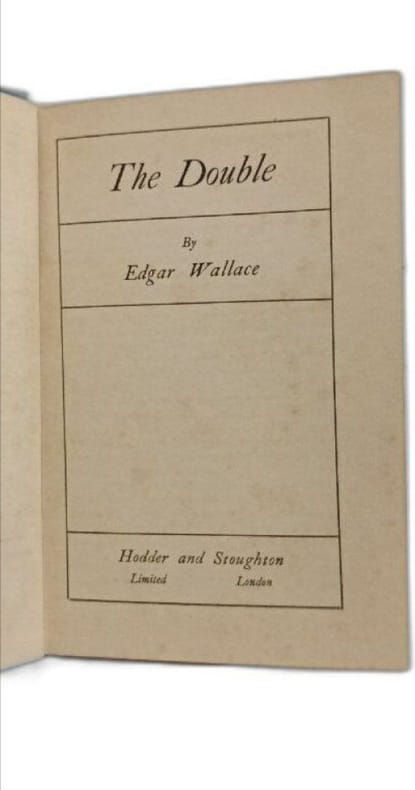
100154423Hodder and Stoughton in12. Sans date. Cartonné. Le roman 'The Double' d'Edgar Wallace raconte l'histoire d'un homme qui rencontre son double inconnu ce qui entraîne des complications. L'intrigue suit Dick Staines un policier et fait référence à l'affaire du meurtre de Staines
237451Londres, Constable, Boston & New York, Houghton Mifflin, 1928 2 vol. in-8, viii pp., 416 pp. ; [2] ff. n. ch., 417 pp., avec deux portraits-frontispices, percaline Bradel marine (reliure de l'éditeur).
243883Collection The Kress library of business and economics, 15Boston, Baker Library, Harvard graduate school of business administration, 1960 grand in-8, viii pp., 104 pp., avec un frontispice, et une collette de note (p. 33), broché.
1854254051854 London : James Ridgway, 1854,petit in8 broché,sans couvertures,32 pages,plan dépliant en frontispice,edition originale