433 résultats
1863236424Paris: Libreria de Firmin Didot Hermanos Hijos y Ca 1863. Frontispiece in Volume One. xxv 745 3; 473 3 pp. 2 vols. Modern brown cloth worming at last 4 leaves of vol. II. Frontispiece in Volume One. xxv 745 3; 473 3 pp. 2 vols. Libreria de Firmin Didot Hermanos, Hijos y Ca unknown
1847214253New York: Harper and Brothers 1847. First edition. Engraved portrait frontispieces facsimile map. 2 vols. 8vo. Original publishers' blind-stamped brown cloth. Covers slightly faded and rubbed remnants of library labels removed from spines darkening to endpapers occasional light spotting to text. Ex-library with bookplate and one other from private owner on front pastedowns. First edition. Engraved portrait frontispieces facsimile map. 2 vols. 8vo. The classic work on the subject going through scores of editions Prescott's "Peru" was one of the standard household books for the later part of the Nineteenth century. Though included in the Grolier Club exhibition of One Hundred Books Famous in English Literature it was not included in their catalogue of One Hundred American Books . simply because "Prescott's Conquest of Mexico . came first and set a new American standard for the use of source materials." This standard he maintained in his History of the Conquest of Peru. Sabin 65272; BAL 16346 Harper and Brothers unknown
19814612Lima: Instituto de Estudios Histórico MarÃtimos del Perú 1981. First Edition — Primera edición. Hardcover — Tapa dura. 250x180mm. 9¾x7". Lima Instituto de Estudios Histórico MarÃtimos del Perú 1981. 7 tomos en 10 volúmenes. En 4º 250 x 180mm. -I: lxxxvii-474 pp. -II: 567 pp. -III: 615 pp. -IV: 665 pp. -V: 495 pp. -VI: 652 pp. -VII: 538 pp. -VIII: 612 pp. -IX: 678 pp. -X: 501 pp. gran número de ilustraciones mapas y láminas en blanco y negro y a color. Encuadernación en piel editorial con camisa. Primera edición. Primera edición. Ofrecemos los 7 primeros tomos de 12 de esta importante obra. Instituto de Estudios Histórico Marítimos del Perú hardcover
Schjellerup, Inge, VictorIn Pristine Condition. unknown
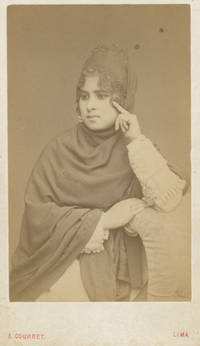
1870List1327Lima 1870. Albumen photographs measuring 2 x 3 ½ inches on larger mounts. Some slight fading a few spots to one image including one with loss about very good overall. A striking pair of early carte-de-visite portraits of Peruvian women from the Courret studios at 197 Calle de la Union one bearing the Courret Hermanos imprint and the other with just Eugenio Courret’s credit from the same studio. Eugenio formed the Courret Hermanos firm in 1863 with his brother Aquiles. The portrait of the woman and child is particularly uncommon for the Courret catalog as most of the photographs they took were of single wealth patrons. unknown
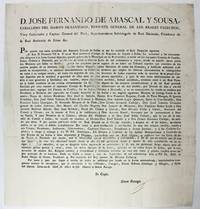
18113541Lima: April 24 1811. About very good. Broadside approximately 17 x 15.75 inches. Printed on two joined sheets. Some worming affecting a few words of text; larger losses reinforced with tissue on blank verso. Light toning and scattered small patches of staining. Contemporary manuscript rubric at foot. A scare late Spanish colonial broadside regarding appointments and alterations to administrative councils that had authority over Peru particularly the Supreme Council of the Indies. The text of this decree issued by Viceroy José Fernando de Abascal y Sousa in Lima on April 24 1811 promulgates orders from the King-in-exile Ferdinand VII and the Supreme Central Council that concerned the appointment of new officers and members of the Council of the Indies and several other government positions in the Spanish American colonies. The Supreme Central Council was a body that administered Spanish interests for the King during a six-year period following his abdication forced by Napoleon. OCLC locates one other copy at the John Carter Brown Library; Medina adds only his own example.<br /> Medina Lima 2596. Vargas Ugarte 3572. April 24 unknown
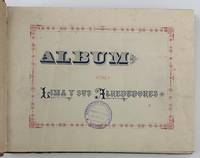
19004112Lima 1900. Very good. 210pp. Oblong quarto. Contemporary three-quarter calf and marbled paper-covered boards. Minor rubbing and scuffing to edges and boards. Handsome bookplate to front pastedown occasional very minor foxing. A delightful viewbook and commercial directory of Peru published in Lima at the turn of the 20th century. The monotone and sepia-toned photographs and photocollages picture numerous buildings interiors street scenes storefronts and more mostly in Lima but also in Callao Chorrillos Barranco and Miraflores. An Index of the "Vistas de Lima" provides a description for the photographs though almost all of the photographs are captioned beneath the image. The photographs are printed on the rectos of the work while most of the versos of each leaf contain full-page advertisements for a wide variety of businesses in the various cities including banks mercantile firms importers breweries milers and numerous others. A healthy percentage of the versos are printed with a commercial directory of Lima as well as the membership list of the Bolsa Comercial providing a snapshot of the economic life of Peru at the time. No copies in American institutions.<br /> <br /> OCLC records just two copies worldwide one in Peru and the other in France. unknown
2011Adhya-9781615207855IGI PUBLISHER 2011. Hardcover. New. IGI PUBLISHER hardcover
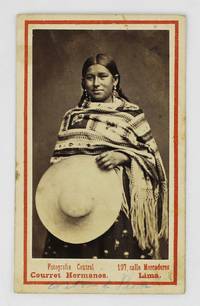
18805806Lima: Fotografia Central Courret Hermanos 1880. Very good. Carte-de-visite photo 4.25 x 2.75 inches. Minor soiling pencil notation at foot of card. Handsome image of a young Peruvian woman in traditional dress. Pictured in three-quarter length she holds a wide straw hat a printed skirt peeking out of the bottom of the photos beneath a traditional shawl wrapped around her shoulders. Her hair is in two braids and she wears elaborate earrings. The pencil notation at the bottom reads "Native of Peru." The photographer Eugene Courret was a French native who moved to Lima in 1860 to work in a photography studio; he opened his own studio with his brother in 1863 and returned to France in the 1890s. Fotografia Central Courret Hermanos unknown
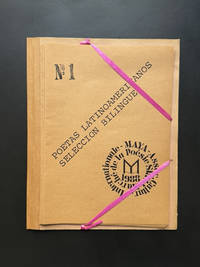
19881866<p>Nine folded leaves with texts in Spanish and French some are illustrated. 4to 21 x 29.5 cm. Very good. Numbered series with fascicles loose inside a lavender folder front cover is faded to tan with pink ribbon ties. 1866</p><p><em>Issued on the occasion of the 1988 Marché de la Poésie a major international poetry festival held every year in Saint Sulpice Square in Paris this series of bilingual broadsides showcase the talents of Latin American participants. Poets in the sequence include Orlando Jimeno-Grendi Chile José Rosas-Ribeyro Peru Elena Galván United States Jorge Nájar Peru Rubén Bareiro-Saguier Paraguay Carlos Sahakian Uruguay Luisa Futoransky Argentina Gustavo Mujica Chile and Robert Armijo El Salvador. Unrecorded.</em></p> Internationale - MAYA - Assoc. Cultur. / Marché de la Poésie
190534084Lima: Imprenta del estado 1905. First editions. Cloth. Very good copies boards and spines rubbed occasional wear some spotting or scuffing to a few boards. 8vo. Ultimately fourteen volumes would be published. Provenance: Note in first volume that it is the copy of Domingo Edwards Matte 1890-1964 Chilean book collector; earlier owner was A. Arroyo with his name in gilt on spine and is most likely the Argentinian diplomat Envoy Extraordinary and Minister Plenipotentiary in Peru Don Agustin Arroyo. Palau 14957. Imprenta del estado hardcover
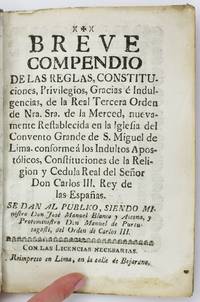
18044200Lima 1804. About very good. 66pp. Small quarto. Contemporary limp vellum. Small library label at lower left front wrap; institutional bookplate and small ink stamp to front pastedown. Vellum lightly soiled and curled. Minor worming at lower right corner of text block not affecting text. Otherwise lighting soiling and toning internally. St. Peter Nolasco founded the Order of the Blessed Virgin Mary i.e. the Order of Mercy or Mercedarians in 1218. It was quickly successful in its goal of ransoming Christian prisoners from the Crusades and other religious conflicts and the order expanded to other charitable work. A third order of Mercedarians was founded for lay male and female supporters in 1260 and the first Mercedarian convent was established in Lima in 1535 the year of the Spanish founding of the city. This work gives the rules constitutions privileges and indulgences of the third order in Lima on the occasion of its re-establishment at the conventual church of St. Michael. A fine woodcut of the arms of the Mercedarian order surrounded by a typographic border graces the verso of the title page. This is the first edition; the work was reprinted in 1870. OCLC locates four copies at Yale Indiana the BNC and the BNE. unknown
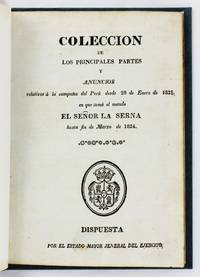
18245668Lima 1824. Good plus. 271pp. Modern paper boards printed spine label. Moderate tanning. Light worming to final leaves repaired slightly affecting text. Scarce printing of correspondence relating to the royalist military campaigns in Peru under Viceroy José de la Serna from the beginning of 1821 to early 1824. La Serna was installed as Viceroy in January 1821 following a petition of top royalist officers. He evacuated Lima and moved the colonial capital inland to Cuzco where he set about rebuilding his army and campaigning to recapture the territory lost by his predecessors. In this he was quite successful and by the beginning of 1824 he had recaptured almost all of Peru and penned in Bolivar at Trujillo. The correspondence included here follows this successful portion of his generalship and provides an important first hand accounting of events. Following this period however La Serna suffered his own military rebellion and was sufficiently weakened until he lost the Battle of Ayacucho and thereby all of Peru in December 1824. OCLC locates only two copies at U.S. institutions Harvard and the JCB.<br /> Medina Lima 3779. Vargas Ugarte 5174. unknown
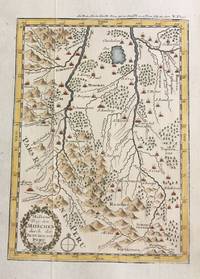
1726M8945Augsburg & Graz: Heirs of Phillip Martin & Johann Veith 1726. Very Good. Notes: Map of the Jesuit Moxo Mojo missions in Peru with a compass rose and location of settlements missions and forts included. <br> Size : 135x185 mm 5.31x7.28 Inches Coloring: Hand Colored Category: Maps South America Countries; Heirs of Phillip, Martin & Johann Veith unknown
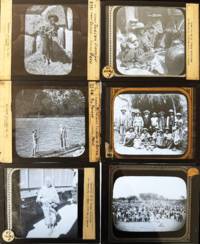
1900232171900. Peru glass lantern slide archive documenting Indigenous and rural life in the Perené and Cuzco during a period where the political economy shaped was by export agriculture regional extraction and foreign institutional interest. In this period Peru was governed by a coastal elite tied to export markets and to the expansion of state and commercial control into the interior and images of carriers river craft family groups and gathered communities register how Indigenous people were affected by that process through incorporation into frontier economies while also being recast for North American educational audiences as ethnographic subjects.<br /> <br /> Photo archive of 6 black and white glass lantern slide photographs each 3.25" x 4" Peru early 1900s. Issued as lecture materials for the Philadelphia Museum. The group includes a family or community portrait posed before a thatched structure with adults and children wearing brimmed hats layered garments shawls and patterned skirts; a closer seated group of women and children gathered around large ceramic vessels; also includes a large outdoor crowd scene showing a densely gathered public space filled with adults and children; a posed family and community portrait before a rustic structure with men women and children wearing layered garments shawls and broad-brimmed hats; a closer domestic scene centered on seated women and children gathered around large ceramic vessels; a river crossing in the Rio Perené region showing an adult and child standing on a balsa or log raft using poles to navigate the current; an "Indian Carrier" posed beside a railroad car linking Indigenous labor and movement to expanding transportation networks; and a closer portrait of an Indigenous man framed by a larger crowd gathered behind him. Several slides retain typed or manuscript labels including references to "Rio Perene" and "Hutchins Indian in Balsa" while institutional labels read "The Philadelphia Museums" and "Negative by E. Tyson Hutchins / Use restricted to school lectures in museum" establishing the archive as part of a formal educational and interpretive program rather than private travel photography alone.<br /> <br /> The archive is particularly effective because it balances portraiture with broader communal documentation. The large crowd scene family grouping and market or gathering views shift the photographs away from isolated ethnographic "types" and toward visible social environments populated by children laborers families and community members. The railroad image and river crossing additionally place Indigenous Peruvians within the transportation and frontier systems increasingly tied to trade extraction regional movement and outside institutional observation in the early twentieth century. During the late nineteenth and early twentieth centuries regions such as the central selva and Perené valley were increasingly bound to colonization schemes plantation agriculture and extractive enterprise while Indigenous communities faced land pressure labor demands and outside scrutiny from state agents missionaries traders and foreign observers. No cracks or chipping; crowd image lacking its original frame with glass and matte border loose; otherwise very good condition. A concise record of how Indigenous and local Peruvians were photographed within overlapping systems of frontier incorporation and museum interpretation. unknown
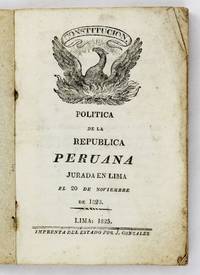
18255658Lima 1825. Very good. CXII523pp. Original blue wrappers. Lightly worn spine worn but sound. Minor foxing to title page internally clean. The second edition of the first constitution of Peru and the first to include the "Discurso con Que la Comision de Constitucion Presento el Proyecto de Ella al Congreso Constituyente." Peru declared its independence from Spain in 1821 in a period in which many of Spain's American colonies threw off the colonial yoke. We locate only a handful of copies in OCLC. unknown
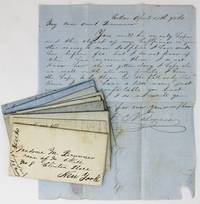
18614525Lima and Callao Peru 1861. Very good. Thirteen autograph letters signed totaling twenty-six pages. Original mailing folds minor wear some fold separations and short tears to a few letters. An informative collection of manuscript letters sent back to the United States by John C. Valencia a businessman working in Peru just before the Civil War. John is writing to his wife Josefina and his Aunt Brunner in New York City and Yorkville New York over roughly a two-year period between February 27 1859 and January 14 1861. Apparently Josefina and their children were living with Aunt Brunner in New York at least for a time while John was trying to conclude business related to Peruvian real estate held by his deceased brother and now owned by his sister-in-law. In one letter he mentions that he working in the sea port in order to raise some amount of money to send home. John misses his wife and family and writes with longing about returning to his wife often mentions the money he is sending back with each letter or plans to send soon sometimes reports on his business activities urges patience from his wife while he tries to make money and more.<br /> <br /> From his first letter John is not having a pleasant time in Peru. Writing from Lima on February 27 1859 John comments that "I am sorry of having proposed such a thing for this country is very corrupt no moral of no kind in those People.I am afraid to be contaminated with the influence of the wicked." He again bemoans the state of Peru in his next letter from Callao: "I hope the Lord will help me in coming home as soon as I can. I am disgusted with the costume of this country. They are so deprived that I can not be happy in this land but with your advice I will remain till I get some money even if I have to stay longer." John would stay almost two more years in the space of the present letters and his business was not concluded when the present letters end. While in Peru John spends some time "in the House of a friend of my Father" which may indicate John was a native Peruvian or Peruvian-American with roots in the country; reports on the process of the mail and his work in the port of Callao; details his deceased brother's real estate holdings and frequently mentions the difficulty he is having with his brother's widow he reports in one of his two short letters to his aunt that he is in a "Law Suit" with the widow. In one letter John makes it perfectly clear how he sees himself among the people of Peru: "I am tired already of this country. There is nothing but rebolution sic that is the principal business of the Perubians sic. As for my part I am American and I am always with them." The conflict John mentions may be a reference to the Ecuadorian-Peruvian War which took place between 1857 and 1860; this may also help explain why real estate issues inside Peru were difficult to conclude at this time. In his penultimate letter John states that he plans to be back in New York by May 1861 but in his last letter he sadly reports that he must remain in Peru longer in order to conclude his business affairs. unknown
1947ZB705797Callao: 1947. first edition #285-290 297-305 309-320 327-332 349-404 all complete issues or complete years in ten bindings text darkened ex library good working collection. - If you are reading this this item is actually physically in our stock and ready for shipment once ordered. We are not bookjackers. Buyer is responsible for any additional duties taxes or fees required by recipient's country. Photos available upon request. Callao: unknown
17875761Lima 1787. Very good. 23pp. Folio. Light soiling and minor wear. Small worm hole through lower center of text block occasionally affecting a word. Accomplished in a neat secretarial script. Certified copy of a document relating to 13200 ducats due to the monks of the Escorial in Spain promised to them in perpetuity by Philip IV in 1654 and paid from duties collected in colonial Peru. In exchange for this annual subsidy of proceeds from encomiendas in Huaylas Chuquitanta Conchucas and other regions in Peru the monks promised to say masses and to do other certain religious acts for the crown. This document contains specific and detailed accounting numbers for the years 1781 to 1785 inclusive. unknown
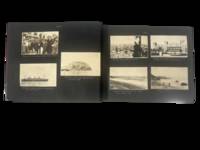
1925227551925. Latin America SS Resolute voyage photograph album 1925 documenting a steamship journey through Central and South America during the interwar expansion of international maritime tourism following the opening of the Panama Canal in 1914. The photographs record port cities landscapes and civic landmarks encountered along the Pacific and Atlantic coasts of Latin America during a period when luxury liners increasingly connected North American travelers with destinations across the hemisphere. By the 1920s transisthmian canal travel had reshaped global shipping and passenger routes allowing cruise itineraries to combine Caribbean Pacific and South American destinations within a single voyage. The album preserves visual evidence of these emerging travel circuits while also documenting major urban and cultural centers of the region during a period of modernization and expanding hemispheric exchange.<br /> <br /> Photo album compiled during the 1925 voyage of the steamship SS Resolute containing approximately 150 original silver gelatin photographs mounted to black album leaves and captioned in white ink. Contemporary red leatherette album titled "Photographs" in gilt and bound with red cord. Photographs measure approximately 3 x 4 inches to 4 x 6 inches. The photographs document the vessel's route through Panama and the Canal Zone before continuing along the Pacific coast of South America and returning through the Atlantic basin. Numerous photographs depict Panama City and the Panama Canal including views of the Culebra Cut and Gold Hill major engineering features of the canal project completed little more than a decade earlier. Other sections of the album record urban and harbor scenes in Cartagena Colombia including colonial architecture and waterfront activity. Photographs from Peru show Lima's Plaza de Armas the bullring at Miraflores and rural Andean valleys near Arequipa with terraced agricultural landscapes and local communities. Images from Chile capture the steep hills and harbor districts of Valparaíso along with coastal plazas and naval vessels near El Morro. Additional photographs from Argentina depict major civic spaces in Buenos Aires including Plaza San Martín and Plaza de Mayo documenting the monumental architecture and modernizing urban landscape of the city during the 1920s.<br /> <br /> The steamship SS Resolute operated as a passenger liner serving long distance routes during the interwar expansion of luxury cruising and international tourism. Voyages such as the one recorded in this album reflected the growing accessibility of transcontinental travel made possible by the Panama Canal and by the increasingly global network of commercial steamship lines linking the Americas. Mild toning consistent with age; mounts and binding well preserved. Overall very good condition. The photographs collectively document a hemispheric itinerary connecting canal infrastructure colonial port cities Andean landscapes and rapidly modernizing capitals offering a visual record of the cultural and geographic environments encountered by travelers during the height of the steamship era. unknown
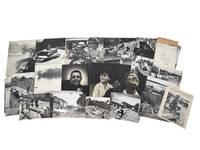
1961231231961. Baum Allyn. Peru photo archive a substantial working group of large original photographs and related New York Times material centered on Baum's Peru assignments significant for preserving a photographer's own visual record of Andean and Amazonian travel Indigenous communities village life and editorial circulation within mid twentieth century American newspaper photojournalism. Allyn Baum was a staff photographer for The New York Times from 1957 to 1967. Included is a typed note from New York Bureau Chief Gedeon de Margitay congratulating Baum on the Peru photographs published in the Magazine together with the January 21 1962 New York Times article "Into the Unknown" directly linking the images to their original publication context and to contemporary American visual encounters with Peru's Indigenous regions and frontier geographies. From the estate of Allyn Baum. Peru and New York. 1961-1973.<br /> <br /> Archive of 48 items including 46 large silver gelatin photographs a New York Times article written by Baum and a single-page typed letter regarding publication. Most photographs measure 8" x 10" while 9 larger examples measure 10" x 13". Several are mounted on board and bear Baum's signature or detailed inscriptions such as "Jungle Priest" "Headhunter" and "High Andes Quechua Indians in Peru. Working in home . producing products for sport." Many retain original press captions or handwritten notes on the versos some in Baum's own hand. The photographs document river and jungle travel in the Amazon Basin village and market scenes domestic interiors American aircraft and extensive portrait studies of Andean and Amazonian Indigenous peoples. Indigenous sitters appear weaving spinning wool knitting carrying children traveling by canoe gathered near riverside settlements or posed in both formal and informal portrait settings. Several photographs emphasize textile production and traditional labor practices among Quechua communities in the high Andes while others focus on Amazonian Indigenous groups photographed within thatched settlements and river communities preserving material evidence of architecture clothing subsistence practices and daily life during a period when American newspaper photography increasingly framed Indigenous South America through the lens of exploration modernization and remote access.<br /> <br /> The archive is a strong record of Peru in the early 1960s documenting not only transportation networks settlement patterns and regional travel but also Indigenous cultural continuity across both Andean and Amazonian environments. Baum's photographs repeatedly center Indigenous Peruvians not simply as background figures within landscape photography but as primary subjects whose labor dress craft production domestic life and physical presence structure the visual narrative of the archive. The accompanying New York Times material preserves the editorial framework through which these images entered American mass circulation while the de Margitay note confirms internal recognition of Baum's Peru work within the newspaper itself. The later date range appears to reflect continued press handling reuse and captioning rather than a single production moment giving the archive additional value as a working newspaper photography file shaped over time. Minor edgewear throughout; versos with original handwritten descriptions by Baum and press editors. A cohesive and well-preserved Peru field photography archive documenting Indigenous life regional travel and mid century American photojournalism connected to The New York Times. unknown
19124149Senior Class of 1912 Nebraska State Normal School at Peru 1912 A 1912 yearbook from Nebraska's first college first state-supported college. Stiff card boards full dark brown leather gilt front board lettering/decoration bright 10 3/8 x 8 inches 218 pp. Very good modest edgewear/rubbing; pages clean with no marks and binding sound. Rare. K071. 1st Edition. Hardcover. Very Good/No Jacket. Senior Class of 1912, Nebraska State Normal School at Peru hardcover
19114148Senior Class Nebraska State Normal School at Peru 1911 A 1911 yearbook from Nebraska's first college first state-supported college. Hardcover full brown leather gilt front board lettering and decoration bright 10 1/2 x 8 inches 232 pp. Laid in: a card with a printed Peru poem. Very good modest edgewear; sunning spine; pages clean with no marks and binding tight. Rare. K071. 1st Edition. Hardcover. Very Good/No Jacket. Senior Class, Nebraska State Normal School at Peru hardcover
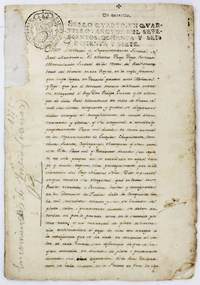
186276434Lima: N.p. 1862. Original manuscript title or deed to the Hacienda San Jacinto in the Nerena Valley of Coastal Peru. While the estate is named after a Hispanic saint San Jacinto its origin dates back to pre-Inca times. Evidence of this is the remains of cultural settlements in Punkuri Kiske and Cerro Blanco. The Spanish Crown gave this land to the Jesuits in 1720 who introduced sugarcane as part of the agricultural production in this part of Peru. They also took it away from the Jesuits in 1767.Folio. 151 leaves with manuscript on both sides of each leaf i.e. 352 pp. Each leaf bears the required tax stamp the equivalent of a notary stamp at that time and each leaf is written on paper bearing the same watermark. Each leaf also bears a blind-stamp of a seal in the inner margin of each recto. Written in a numerous hands but all quite legible. Original full brown sheepskin with gilt spine lettering and devices pattern endpapers. Like a ready made binding used for legal purposes as the text block in considerably smaller than the binding. Altogether in very nice condition.This is the original transfer title for an estate of great importance and size in one of the most fertile parts of coastal Peru the Narena Valley. It consisted of 700 fanejadas of land about 1200 acres and all that stood upon it; primarily the sugarcane and alfalfa fields but houses tools farm animals furniture etc. In fact it seems that the original name for the property still bore and can be seen on the first page of this manuscript the word "Canaverales" which is a euphemism for sugarcane. This mammoth 302-page manuscript is basically an inventory of literally everything on those 1200 acres. The detail on the inventory is incredibly extensive; every table horse cow frying pan etc is listed and priced. It was first laid out as a sugarcane plantation in 1720 by the Jesuits. The Jesuits were expelled from the New World lands and missions in 1767 by the Spanish crown with King Charles III ordering their removal from all Spanish territories including the Americas due to growing political pressure against the order; the Franciscans largely took over the operation of the missions after the expulsion. When all their lands were confiscated by the Spanish government as happened throughout Latin America the Hacienda likely went through a number of hands. It was well regarded as a solid and lucrative sugarcane plantation and would have been considered a prize acquisition. We can find no history of the buyer named on this deed Santiago Sanchez but that is likely due to the fact that Spanish people have last names that can be written in a variety of combinations. But we do know that he paid 8697 pesos for it and that was a very considerable sum for the time indeed enough to place someone in a wealthy or influential social position. The most curious thing in the inventory which is lengthy and detailed in the extreme is the list of slaves. Ostensibly President Ramon Castilla y Marquezado declared slavery abolished in 1854 yet here we have a document that clearly affixes values to each and every slave and the prices paid for each by Sanchez. Prices ranged from 0 to 500 pesos. And there were a large number of them. Staring on p. 68 of the inventory we find them all listed and they are broken down into a variety of categories. Indigenous people African people male female young old and & "Inservibles" translates as "useless people". All slaves were examined by Dr. Antonio Manriquez surgeon and the most common reasons for being deemed "inservible" included: old age hernias ulcers and missing limbs. Their value was deemed to be zero. After being examined by physician the value accorded to each was dependent on their ability to work the farm. Surprisingly African slaves were valued less than local peoples this may have been due to the language issue. It should be noted that the slaves constituted a large portion of the total price paid. So it seems that this document gives lie to the previously believed fact that slavery was abolished in Peru in 1854. But we do not find this surprising as the gulf between the monied class and the populace was great and with no ability to enforce decrees from the central government the aristocracy likely just did whatever they pleased. Apparently Santiago Sanchez was ill-equipped to manage so many people and such a large piece of land as we know that in 1868 a Scotsman by the name of Henry Swayne bought the Hacienda San Jacinto an turned it into a profitable enteerpise by his humane attitude towards the farmers. "The hacienda or estate of San Jacinto was anciently one of the largest and finest in the valley of Nepeña; but before its purchase by Mr. Swayne a few years before our visit it had very much run down. It was deserted by the negro slave soon after their emancipation; the dwellings had fallen out of repair" The Fife Post. It remains a very lucrative farming operation to this day.We conferred with a native Spanish speaker and an individual who is fluent in Spanish and this report is the result. We might be incorrect but it is doubtful and in any case it is a fine 19th century manuscript deed to a large and valuable parcel of land in 19th century Peru. N.p. unknown