2 822 résultats
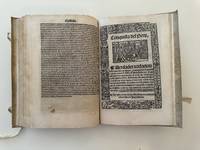
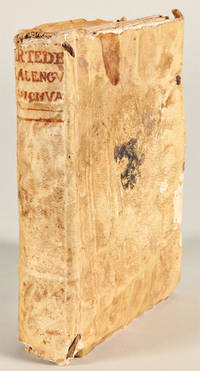
1614WRCAM40774Los Reyes i.e. Lima: Por Francisco del Canto 1614. 43528-31 i.e. 36-391176 leaves. Last five leaves in expert facsimile. Contemporary limp vellum. Light to moderate soiling of binding corner of rear cover chipped. Titlepage mutilated around edges affecting first portion of title; mounted on newer leaf. Second leaf clumsily repaired around edges not affecting text. Trimmed closely at top affecting text in some places. Light soiling. Good. An important Indian language work from the first and at the time only press in South America printed only twenty-eight years after the beginning of printing there and twenty-six years before the Bay Psalm Book was published. Del Canto the owner and operator of the only press in South America at the time was the second printer in Peru. He acquired his press directly from Antonio Ricardo the first printer in South America. This work begins with a grammar of the Quechua language followed by Quechua-Spanish and Spanish-Quechua dictionaries. The book is in a handy smaller format for use in the field. Medina says this book is "extraordinariamente raro" and it is lacking from many of the great collections. <br> <br> This work is generally credited to Del Canto the author of the introduction but parts of it may be by Gonzalez Holguin whose other publications on Peruvian Indian language were published in Lima in 1607 and 1608. Sabin attributes authorship however to Ludovico Bertonio. Only eight copies on OCLC. MEDINA LIMA 58. VARGAS UGARTE 79. PALAU 17729. SABIN 5020. JCB 3II:101. OCLC 6783843 251190642. Por Francisco del Canto hardcover books
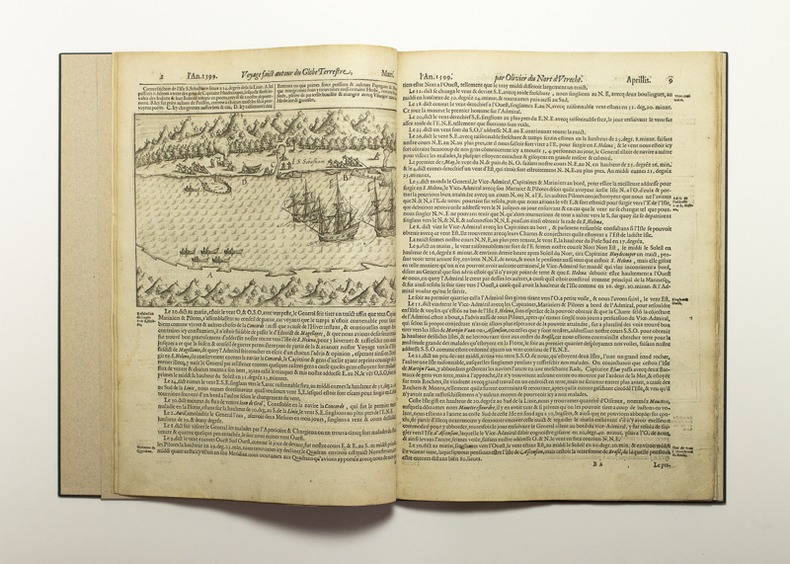
160211790Imprimé à Amstelredam [sic], chez Cornille Claessz sur l'Eau au Livre à Ecrire, l'an 1602. In-folio de [2]-61 pages (A-H4), cartonnage noir à la Bradel, signé Honegger. Restauration mineure à quelques feuillets.
154719895AB1547. Salamanca Juan de Junta 1547. 315 : 225 cm. 4 unnumbered leaves including woodcut-title 187 off 192 numbered leaves with many woodcuts in the text; 22 numbered leaves including woodcut-title 1 leaf. Vellum binding in contemporary style. Gonzalo Fernández de Oviedo y Valdés August 1478 - 1557 commonly known as Oviedo was a Spanish soldier historian writer botanist and colonist. Oviedo participated in the Spanish colonization of the West Indies arriving in the first few years after Christopher Columbus became the first European to arrive at the islands in 1492. Oviedo's chronicle Historia general de las Indias forms one of the few primary sources about it and introduced Europeans to the hammock the pineapple and tobacco as well as creating influential representations of the colonized peoples of the region. It is through the Historia that Europeans came to learn about the hammock pineapple tobacco and barbecue among other things used by the Native Americans that he encountered. The first illustration of a pineapple is credited to him. The Historia though written in a diffuse style furnishes a mass of information collected at first hand. With many interesting woodcuts like canoe o waka differents forms of houses different tools plants fuit-trees different forms of cactus pineapple etc. The second part is: CONQUISTA DEL PERU. Verdadera relacíon dela conquista el Peru y provincia del Cuzco llamada la nueva Castilla. Conquistada por Francisco picarro.Embiada a su magestad por Francisco de Xerez .Fue vista y examinada esta obra por mandado delos señores Inquisidores. With a beautiful title-woodcut complet. - Missing Folios XLVII LXVI LXXI CXXI and CLIII. The numbers for Folio LXXVI and CLXXX used twice. The copy was washed and some pages with small restaurations folio LVII lower right corner supplemented with loose of some letters also the last page. A couple of pages browned and a bit stained. Newly bound with new endpapers. - Even with this defects still a desire-able copy of this extremely rare oeuvre. hardcover
39448Ensemble complet des trois parties, relié en quatre volumes in-4 (222 x 160 mm), veau brun granité, dos à 5 nerfs, pièces de titre et de tomaison de maroquin rouge, armes dorées au centre des plats (La Rochefoucauld), tranches mouchetées de rouge (reliure de lépoque).
188046404219Berlin, Asher, 1880-87 ; 3 volumes in-folio, en feuilles sous portefeuilles toile verte d’éditeur. faux-titre, titre, 7 ff. (table des planches), 16 ff., 37 ff. en regard des planches - 2 ff., 13 ff., 59 ff. en regard des planches - 2 ff., 29 ff., 45 ff. - 141 planches lithographiées, la plupart en couleurs.ÉDITION ORIGINALE et PREMIER TIRAGE de cette publication rarissime, surtout complète des 141 planches comme c’est le cas ici.Sublimes lithographies montrant les momies, vêtements, bijoux, ustensiles, ossements découverts lors de ces fouilles.Portefeuilles abimés, quelques pâles rousseurs.
19091819600 leaves typed on recto only bound in original half leather with gilt titling. Six large fold-out maps of the period. Plates composed of postal views with a few photographs laid down. Marbled endpapers hinges reinforced. 'Confidential' stamped in violet as well as 'Office Chief of Staff 2nd section' and 'Withdrawn from Library'. American contractors had just completed the Oruro/Viacha railway in 1908 with 125 miles laid to mineral rich regions to and from La Paz. This study seems to have never been published beyond the present edition.; Folio 20.5 x 41 cm; pages; All shipments through USPS insured Priority Mail. U.S. Army hardcover books
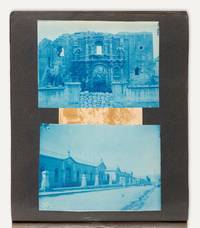
1918List2982Peru and Panama 1918. Approximately 364 photos; album and unmounted photos silver prints cyanotypes and printing-out-paper prints. Photos measure 3 x 4 to 8 x 10 inches with about half measuring 3 x 5 ½ inches. Some with photographer’s hand-stamp or credit in pencil; others with manuscript notations verso or recto; some captions to album pages. Offered in partnership with Daniel / Oliver.<br /> <br /> Rich and extensive photographic archive of Walton T. Burres of Stockton California showing his time in Peru c. 1904 as an amateur explorer and doctor for the Inca Mining and Rubber Company and his later work in Panama c. 1918 with the Rockefeller Foundation’s International Health Division.The collection consists of a large number of loose photos acquired by the gallery in 2021 and a recently discovered photo album showing some of the same subjects and containing a few duplicate images some printed in different sizes or formats as well as hundreds of previously unseen prints. Together this material makes up the largest extant archive of Burres’s photographic work. Though his work was published at the time both in Peruvian and American publications much of it was lost when he dropped it in a river that he was attempting to ford.<br /> <br /> Burres was educated at California’s Cooper Medical College the first school of medicine on the West Coast and was a prominent member of the Stockton community before sojourning to Peru around 1900 to help the Inca Mining and Rubber Company address the deadly diseases endemic to the region such as malaria and yellow fever. To encourage economic infrastructure in remote areas the Peruvian government began granting land concessions to any company that would build roads bridges or river ports. As a result the Inca Mining Company an American outfit based in Tirapata purchased the rights to mine gold along the upper Inambari River in 1896 and soon became the richest gold producer in Peru.<br /> <br /> A large portion of Burres’s Peruvian images document his 1903–1904 excursion from Arequipa 150 miles into “rubber country.†The journeys were well-recounted in U.S. papers and a number of the anecdotes described in print are seen in the present images.<br /> <br /> There are many dynamic views of Burres and his party trekking through the dense jungle and summiting the high mountains as well as shots of flora fauna and native Peruvians. Burres’s travel companions for this trip included the famed adventurer Harriet Chalmers Adams later dubbed “America’s greatest woman explorer†by the New York Times. Adams and her husband Frank both fellow Stocktonians joined up with Burres during their own multi-year expedition through South America. There are a number of portraits of a woman who bears a striking resemblance to Adams though it is possibly another person.<br /> <br /> Other Peruvian material includes numerous views of Cusco Arequipa and the surrounding environs including a beautiful interior of a chapel a Martin Chambi-esque detail shot of a stone wall and portraits of local townspeople some identified as Quechua people. There are a number of lush large-format cyanotypes rich printing-out-paper views and many handsome small-format panoramas. These were printed on Inca Mining Company surplus stationary which speaks to the makeshift nature of photo-development under the circumstances. One particularly striking image shows the top of Misti volcano barely visible above the clouds. This image was reproduced in Burres's account of his travels published in 1909 in Outing magazine.<br /> <br /> The photographs from Burres’s time in Panama document his more serious work as a virologist and health administrator in the area. One interesting photo shows a pair of recently-shot iguanas with a caption noting that “blood of these reptiles was found infected with Haemogregarina.†Another image is that of a new style of privy built from concrete and wire-mesh designed to better keep out rain water. There are also keenly-shot views of main streets and local culture in Los Santos Chiriquà and elsewhere including a number of humanistic group portraits taken at a girl’s school. unknown
In-16 p., (mm. 150x100), p. pergamena rigida antica, titolo ms. al dorso, 18 cc.nn., 324 cc.num., marca tipograf. al frontespizio e con alcune grandi iniziali figur. a vignetta, inc. su legno. Questa “seconda parte” è dedicata alla conquista del Peru (fino alla pacificazione effettuata da Gasca), delle Antille, del Chile e dell’America Centrale e anche al viaggio di Magellano e alla scoperta delle Molucche. “La prima parte de la cronica del gran regno del Perù, con la descrittione di tutte le provincie, e costumi, e riti, con le nuove città edificate..” fu scritta in lingua spagnola da Pedro Cieza de Leon. Come precisa Brunet, l’opera doveva essere composta da 4 parti ma solo la prima fu pubblicata (a Siviglia nel 1553; nella versione italiana, a Roma, 1555). La “cronica del regno del Peru” fu completata dallo storico spagnolo Francesco Lopez de Gomara, con la sua importante “Historia general de las Indias”, tradotta in italiano, in prima ediz. a Roma nel 1556, col titolo “La historia generale delle Indie Occidentali..” e, in seconda ediz. a Venezia, 1557, col titolo “La seconda parte delle historie generali dell’India..”. “Francisco Lopez de Gomara (1512 - 1560?), ecclesiastico, studiò ad Alcalà, venne a Roma, e fu poi in America cappellano di Ferdinando Cortés. Nel 1552 fu pubblicata a Saragozza la sua famosa "Historia general de las Indias".. Nella narrazione il Lopez de Gomara ha buon senso nell’utilizzare le fonti e nell’interpretarle; è colto, e scrive con correttezza e precisione.. Nel 1553 la stampa e la vendita del libro vengono proibite da Filippo II. La "Historia" fu subito tradotta in italiano, in latino e in francese” (nel XVI secolo se ne fecero circa venti edizioni). Così Enciclopedia Treccani,XXI, p. 486. Cfr. Palau,IV, p. 264/265 che cita le numer. ediz. e traduz. - Brunet,II,67 - The Hill Collection of Pacific Voyages”,1038 cita la prima ediz. illustrata in spagnolo del 1555: “The "Historia" of Lopez de Gomara is a classic work in the history of America. It contains a wealth of information about the Spaniards in the West Indies, Gran Colombia, Peru and Mexico”. Corto del margine super.; frontesp. arross. e qualche lieviss. arross. interc. nel t. altrimenti esemplare ben conservato.
17726489Lima: Oficina de la calle de San Jacinto 1772. First Edition — Primera edición. Hardcover — Tapa dura. 190x135mm. 7½x5¼". Lima Oficina de la calle de San Jacinto 1772-1773. 2 volúmenes. En 4º menor 190 x 135mm. -I: 54 2 207 i.e. 133 5 pp. 14 hojas de portadillas. -II: 158 306 i.e. 318 4 pp. 5 hojas de portadillas. Encuadernación en pergamino de época. Primera edición de los cuadernos de desamortización de los bienes de la CompañÃa de Jesús en Perú con motivo de su expulsión según las reglas que prescribe la Real Cédula dada en Madrid a 9 de julio de 1769. Los Jesuitas fueron expulsados de Perú asà como de otras posesiones de España en América por orden de Carlos III en 1767. El libro también incluye las Constituciones de diferentes colegios peruanos que estaban bajo la supervisión de los jesuitas. Obra extraordinariamente rara de encontrar completa de sus dos volúmenes especialmente un ejemplar hermoso como el nuestro. Tiene en total 19 portadillas fuera de la paginación. En España sólo he encontrado completos 2 ejemplares institucionales Ministerio de Justicia y Biblioteca Nacional. Oficina de la calle de San Jacinto hardcover
1773WRCAM41002ALima: En la Oficina de la Calle de S. Jacinto 1773. Two volumes. 562075pp. plus 14 leaves which appear between sections; 1583063pp. plus 5 leaves which appear between sections. Small quarto. Contemporary limp vellum lettered on spine. Bookplate on front pastedowns. Several ex-lib. ink stamps on titlepages one of which has been cut away from text and the page subsequently backed with paper. Some light foxing. About very good. An important collection of documents on the Jesuit order in Peru which primarily discusses the dispersal of the Order's property after their expulsion from America. The Jesuits were expelled from Peru as well as other Spanish and Portuguese possessions in 1767. Also included here are the constitutions of several schools which were under their provision. Published in two parts both of which are present here. MEDINA LIMA 1338 1358. VARGAS UGARTE 2056 2078. En la Oficina de la Calle de S. Jacinto hardcover books
1660PHO-1576Nicolas & Jean de la Coste, Veuve Nicolas de la Coste, 1660-1671 ,3 volumes in-4° de 15ff.-776pp.-12ff. ,12 ff.-784 pp.- 14 ff., 9ff-790pp., Première décade en plein vélin , dos à nerfs avec pièce de titre, Seconde décade en plein veau, dos à nerfs orné avec titre ,tranches mouchetées, Troisième décade en demi veau (reliure moderne), coiffes arasées , coins usés , début de fentes , frottements, mouillures au tome 3.
1720267561720. Folio. 23pp. Modern three-quarter morocco and cloth gilt. Woodcut arms and typographical decoration on title. Small brown stain on titlepage and second leaf. Minor soiling else.<br/> <br/>A detailed extensive proclamation to reinforce the strength and size of the Spanish fleet trading between Spain and South America primarily via Lima in Peru. Also printed in Madrid the same year though this edition is significantly rarer. Rare with no other copies of this edition appearing in auction records and the only copies appearing in OCLC located at the national libraries of Spain Chile and Britain.<br/> <br/>Palau 239622; Medina BHA 2357; LeClerc 466; Sabin 66408. unknown books
1720WRCAM46616Madrid: Juan de Ariztia 1720. 13 leaves. Folio. Modern half calf and cloth spine gilt. Spine lightly rubbed. Text quite fresh and clean; one leaf trimmed closely affecting marginal notes. Very good plus. An extensive detailed proclamation to reinforce the strength and size of the Spanish fleet trading between Spain and South America primarily via Lima in Peru. Also printed in Cadiz the same year. Only a handful of copies in OCLC. Relatively scarce; no other copies appear in auction records in the past twenty-five years. PALAU 239622. MEDINA BHA 2357 Cadiz ed. LeCLERC 466. SABIN 66408. Juan de Ariztia hardcover books
1720WRCAM46615Cadiz: Geronymo de Peralta 1720. 23pp. Woodcut arms and typographical decoration on titlepage. Folio. Modern three-quarter morocco and cloth gilt. Small brown stain on titlepage and second leaf minor soiling else very good. A detailed extensive proclamation to reinforce the strength and size of the Spanish fleet trading between Spain and South America primarily via Lima in Peru. Also printed in Madrid the same year though this edition is significantly rarer. No other copies of this edition appear in auction records and the only copies appearing on OCLC are located at the national libraries of Spain Chile and Britain. PALAU 239622. MEDINA BHA 2357. LeCLERC 466. SABIN 66408. Geronymo de Peralta hardcover books
172026755Madrid: Juan de Ariztia 1720. Folio. 13 leaves. Modern half calf and cloth spine gilt. Spine lightly rubbed. Text quite fresh and clean; one leaf trimmed closely affecting marginal notes<br/> <br/>A proclamation to reinforce the strength and size of the Spanish fleet trading between Spain and South America primarily via Lima in Peru.<br/> <br/>An extensive detailed proclamation to reinforce the strength and size of the Spanish fleet trading between Spain and South America primarily via Lima in Peru. Also printed in Cadiz the same year. Only a handful of copies in OCLC. Relatively scarce - no other copies appear in auction records in the past twenty-five years.<br/> <br/>Palau 239622; Medina BHA 2357 Cadiz ed; LeClerc 466; Sabin 66408. Juan de Ariztia unknown books
In-4°; 2 parti in 2 volumi rilegati in mezza pelle coeva con tassello e titolo in oro al dorso (del primo vol. lievemente difettosa); tagli spruzzati. Pp. 321, (1), 3 tavole f.t. a piena pagina incise su rame (una raffigura il vulcano Pambamarca nella zona di Quito in Ecuador), 2 grandi tavole ripiegate con tabelle; Pp. 400, 4 tavole a piena pagina incise su rame di cui una raffigura il, vulcano di Pichincha vicino Quito, e l’altra il vulcano Chimborazo sempre in Ecuador; 2 grandi tavole ripiegate con tabelle. Al verso dei frontespizi piccoli timbri di possesso. Interessante e poco nota opera di fisica sperimentale e sienze naturali del gesuita spagnolo Francesco Perez (1720-1807 Bologna), matematico e missionario in Ecuador, Quito, fino alla espulsione dei gesuiti dai domini spagnoli (1767); in Italia si dedicò alla scrittura di opere scientifiche che vennero pubblicate dopo la soppressione della Compagnia nel 1773. Il suo nome è legato anche all’invenzione di strumenti scientifici, tra cui uno per misurare gli angoli. Oggetto del trattato il Barometro, “istrumento in grado eminente per condurre l’intelletto alla cognizione dell’elemento dell’aria”, e il Termometro, strumenti dei quali si ricordano gli inventori, i metodi costruttivi, le evoluzioni tecniche; si esaminano le differenze tra aria e atmosfera, “l’elasticità” della materia eterea, l’atmosfera equinoziale dell’America, specialmente delle montagne e vulcani dell’Ecuador (Caraburo, Oyambaro, Pichincha Pambamarca ecc.) dove l’atmosfera fu misurata con l’aerometro, come ampiamente si descrive nella seconda parte. Un capitolo, in fine, è dedicato all’atmosfera europea.
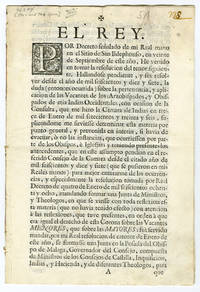
1737WRCAM36294Madrid 1737. 7 leaves. Folio. Dbd. Maltese cross at head of title. Accomplished in manuscript at San Ildefonso Spain on Oct. 5 1737 signed by Miguel de Villanueva. Manuscript inscription on verso of last printed page see below. Contemporary annotation on first page very light dampstaining in top margin a few minor instances of foxing. First leaf slit near binding still intact. A very good copy. A rare printed decree by Philip V King of Spain regarding vacancies which have occurred in archbishoprics and dioceses in the viceroyalties of Peru and New Spain. An advisory council composed of various theologians and the ministers of the Councils of Spain the Inquisition and the Indies will review this matter which affects missions throughout the New World. The King declares that the effectiveness of the missions which furthers the goals of the Spanish empire depends upon archbishops bishops ecclesiastical dignitaries canons prebends and other religious figures. He states translated here into English: <br> <br> "To be effective and without risk in each bishopric the capital of its missions that determine and establish missions in parts most suitable.taking in the necessary advice of the viceroys Audiencias and prelates with the idea of uniting the continents ensuring the secure communication and commerce of the people.it will be possible to expect to see successes in a few years: the pacification of the provinces of Nueva Vizcaya and Huasteca; the exploration of the continent of the Californias; the reduction of the barbarous nations of the Orinoco and of the Motilones Indians of Maracaybo Santa Marta and Rio de la Acha; and ensuring the subjugation population enculturation and fertility of such an extended country as remains to be conquered while expanding the Catholic religion and the dominions." <br> <br> Printed in Madrid for distribution in Spain and the New World this copy accomplished at San Ildefonso on Oct. 5 1737 is signed by Miguel de Villanueva as representative of the King of Spain with the inscription "Yo el Rey." A manuscript note on the verso of the last printed page written in the city of Santiago on Nov. 14 1738 describes an instance of the distribution of the text in Chile. <br> <br> A rare printed decree regarding the maintenance of religious offices in the New World with a contemporary manuscript inscription regarding the text's distribution in the viceroyalty of Peru. EUROPEAN AMERICANA records copies only at the John Carter Brown Library and the Archivo General de las Indias. Not in Medina BHA. OCLC lists copies at the JCB and the National Library of Spain. EUROPEAN AMERICANA 737/213. PALAU 251318 ref. unknown books
A Tolose, F. Boude, 1653. (mm.223 x 152), Legatura in pelle maculata moderna con bel dorso con titolo e fregi. Frontespizio inciso, frontespizio, pp. (8), 479 (malnumerate 481), (8), 26. Rara prima edizione francese di questa storia del Perù e dell'invio e sviluppo dei religiosi Augustiniani nel paese, con ampie descrizioni degli usi degli indigeni locali.
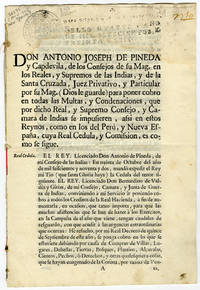
1736WRCAM36295Madrid 1736. 6 leaves. Folio. Dbd. Tax stamps dated 1736 on first and last leaves. Contemporary manuscript annotation on first leaf. Manuscript inscription on final printed page see below. Light dampstaining in top margin. Very good. A rare printed decree by Philip V King of Spain regarding the collection of fines and taxes related to the transfer of lands in Peru and New Spain. Dated Nov. 24 1735 the decree includes a printed form with spaces left blank for the names of officials to be appointed by a judicial commission concerned with the collection of money for fines and other punishments. The future appointees would be responsible for collecting taxes for the Crown. This document also includes historical background related to these concerns reprinting a decree originally issued on Oct. 30 1692 which also dealt with land titles attempts to clarify land ownership and the recovery of funds from the sale of lands that had belonged to the Crown. This earlier document includes references to appropriate sections in the RECOPILACION DE LAS INDIAS first published in 1681. <br> <br> This publication concludes with a note stating that at the first opportunity Spanish ships sailing to the New World should deliver this governmental order. Below the printed text on the final printed page is a manuscript inscription written in Madrid on Oct. 21 1737 and signed by Miguel Gutierrez noting here in English translation: "the cedula inserted in this imprint is a copy of that issued by the Secretary of the Council and the Chamber of the Indies concerned with trade in Peru." <br> <br> A rare printed decree regarding the collection of taxes on lands in Peru and New Spain formerly held by the Spanish Crown. EUROPEAN AMERICANA records only the copy at the Archivo General de las Indias. Not in Medina BHA. EUROPEAN AMERICANA 736/230. unknown books
1831PHO-2405Paris, Arthus Bertrand, 1831-1840, 20 tomes reliés en 10 vol. in-8 (21 × 12,5 cm), demi-veau fauve marbré à coins, super-libris doré, dos à nerfs ornés, pièces de titre rouges et de tomaison vertes, tranches mouchetées rouge (reliure anglaise du XIXe s). Aux contres-plats, étiquette pour cote. Petites rousseurs. Légers frottements aux reliures. Provenance « Society of Writers to His Majesty’s Signet », célèbre association privée d’avocats écossais, fondée en 1594.
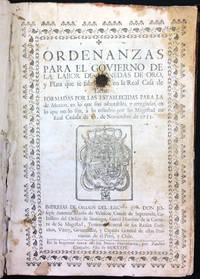
175943910Lima: En la Imprenta nueva de los Niños huerphanos por P. Gonzales 1759. First edition. Contemporary brown calf embossed boards. A good copy; tissue repairs to backstrip boards edge worn and moderately scuffed bookplate of Félix Francisco Martín y Herrera on front pastedown lacking front endpaper inked notations on front blank reattached and rear endpaper joint cracked title page worn and torn at inner margin with two small stains affecting but not obscuring the text repaired tears on corners of last page of index marginal dampstains mainly to the upper corners and fingersoilings a few wormholes but text is quite good. 2 leaves 84 pp. 5 pp. indice blank. Sm. 4to. Rare first editionxx of coinage ordinances for the mint in Lima modeled on Mexico's published just four years earlier but adapted to the needs of Lima. See Manuel Moreyra: "Apuntes sobre la historia de la moneda colonial en el peru" republished in La moneda colonial en el Perú 1980. Both the later 1788 edition and this first are uncommon: Not at the BN Spain nor in any European Libraries. OCLC locates two copies of the first at NYPL and JCB; there is also one at the BN Chile. Provenance: Felix Francisco Martín y Herrera 1918-2006 Argentinean Lawyer. Palau 203104 1788 edition only. Medina: Lima 1132. López de Azcona: Bibliografía minera hispano americana 1457. Maffei & Figueroa 3596. Moreno 1236. En la Imprenta nueva de los Niños huerphanos, por P. Gonzales hardcover
18680012009Macao Macau China Havana Cuba: Chinese Coolie Ship Manifest. Fair with no dust jacket. 1868. Non-Book. On offer is a tremendous San Salvadorian ship manifest recording the names and information of 622 Chinese men who were transported from the port of Macau to Havana Cuba to complete their indentured servitude as coolies working for Cuban sugar plantation owners. This manifest is for the January 25 1868 sailing of the Peruvian Galley the America. This sailing was captained by Cpt Ferreiro for the Compania Maritima del Peru. This sailing was under the San Salvadorian flag. The ship arrived in Macau on May 20 1868. 610 coolies departed Macau and 607 arrived in Cuba. This manifest was signed on January 241868 by Henrique W. Pearce a Macao-based emigration agent. It was also signed the day before departure on January 241868 by The Consul General of His Majesty José de Alguilar. The America had previously been used as a coolie ship called Red Rose under the British flag and under the Italian flag as the America. The America completed a total of seven coolie voyages transporting a total of 4703 Chinese passengers. The Chinese coolie trade a system of indentured labor that targeted young poor Chinese men operated from 1847-1874. Throughout this period African slavery was slowly being abolished around the world. The coolie trade was initiated by Britain and was eventually dominated by both Britain and the United States of America. Chinese coolie laborers were sent to work in British American and Spanish colonies and the nature of the trade changed throughout its 27-year operation due to social and political pressures. The coolie trade took place in large part between the shipping port in Macao now a part of China then under Portuguese rule and Havana Cuba then under Spanish control. As Macau was under Portugese rule at the time of the coolie trade they transported coolies on their vessels frequently and many of the manifests were written in Portuguese and/or Spanish. To learn more about the Chinese coolie trade and its importance in world history click here to read our in-depth research blog on the topic. This departure manifest measures 8.5x13.5 inches. It contains 18 pages of writing 9 front and back over 10 physical pages. Folded together. Significant bending with some tears at the crease lines. Some pages are fragile with some pages becoming detached from the total document however the document does remain in tact. Legible. Overall Fair. Citation: Asome J. 2020. Coolie ships of the Chinese diaspora 1846-1874. Proverse Hong Kong. ; Manuscripts; 8vo 8" - 9" tall; Signed by Author . Chinese Coolie Ship Manifest unknown
In-16 p. (mm. 152x102), p. pergam. molle coeva con unghie, titolo ms. al dorso, 11 cc.nn., 1 c.b., 219 cc.num., 1 c.b., marca tipografica al frontespizio, ornato da alcune belle testatine e grandi iniziali figur. a vignetta, inc. su legno. Tra i primi esploratori della Colombia, Pedro Cieza de Leon (1518-60) arrivò in Perù attorno al 1550, e proprio in quell’anno venne nominato “Crónista de Indias” per conto della corona spagnola. In tale veste iniziò la redazione della prima parte delle Historie, ai fatti l'unica che abbia visto la luce.. L’opera è pregevole per essere il frutto di una commistione di fonti diverse: l'Autore attinse a documenti archivistici regi sui possedimenti peruviani ma si basò anche sulle versioni fornite dagli indigeni; inoltre, riportandone i nomi, egli produsse pure un importante documento antropologico. Nella versione italiana l’opera uscì completata dalla traduzione della storia delle Indie realizzata da Francisco Lopez de Gòmara. Cfr. Brunet,II,67: “Ouvrage rare; il devait avoir quatre livres, mais le premier seul a paru” - Palau,II,198 che cita le varie ediz. e traduzioni, a partire dalla prima spagnola (Sevilla, 1553) - Sabin, 13052: “One of the most remarkable literary productions of the age of Spanish Conquest in America” - The Hill Collection of Pacific Voyages,297. Macchia su 5 cc., altrimenti esemplare ben conservato.
16842107010025Impresso en Lima 1684. First Edition. Hardcover. Good. The Administration of 17th Century Peru: the Abuse of Indians by the Clergy Folio. Bound in contemporary vellum. Good binding and cover. Minor foxing and marginal dampstaining but a still an attractive copy. Palau 267; Sabin 41987. <br> Melchor Linan y Cisneros was the Archbishop of Lima for thirty years and served as viceroy of Peru from 1678-1681. He argued for ecclesiastical liberty against the attempts of his successor Melchor de Navarra Duke of Palata's attempts to curtail clergical abuses. Some of the parish priests and friars were exacting oppressive church taxes against the indigenous population. This book's author Juan Luis Lopez served as the Duke of Palata's secretary and attempts to defend the Duke of Palata's curbs on clergical abuses. "The Archbishop of Lima Melchor de Linan y Cisneros had objected to a decree issued by the Viceroy of Peru Melchor de Navarra y Rocalfull Duke de la Palata for the suppression of certain ecclesiastical abuses. The present publication was issued by order of the Viceroy in answer to the Archbishop's objections." - Maggs SPANISH AMERICA AND THE GUIANAS 1935. Subtitle: "despachada por el govierno superior y reducida a ordenanc̜a en el tom. 1. fol. 311. : sobre que en recibir los corregidores deste reyno informaciones secretas de oficio o a instancia de parte en orden a averiguar como observan los curas y doctrineros las disposiciones canonicas synodales cedulas y ordenancas de su magestad que tratan de las obenciones que deben llevar a los indios a fin solo de dar cuenta con ellas a sus prelados y al govierno superior destos reynos paraque lo remedien no se contraviene en cosa alguna a la immunidad de la iglesia. Impresso en Lima hardcover
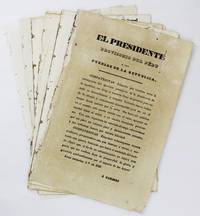
18305862Various places in Peru 1830. Good. Seven broadsides and bifolia totaling 14pp. with each sheet measuring approximately 11.5 x 7.5 inches. Previously bound with stabholes and residue at left margin. Moderate worming affecting some text but not sense. Minor tanning and soiling. A group of seven highly ephemeral and seemingly unrecorded military broadsides and bifolia reports from Peru dating to the country's war with Gran Colombia from 1828 to 1829 and just after. The conflict stemmed from a border dispute after independence was gained in 1820 and 1821 with the boundary left relatively undefined. The Armistice of Piura formally agreed in September 1829 recognized Guayaquil and its surrounding area as a part of Gran Colombia and accorded Peru recognition of its modern-day northern provinces. The documents present here include an exhortation by Peruvian President Agustin Gamarra to support the prospective peace a report on the state of the Peruvian treasury in Trujillo during the midst of the conflict a bulletin concerning military developments in April 1829 addressed to the armed forces a patriotic broadside printed in Arequipa and a congratulatory address to the army printed on the day of armistice. The titles of these works none of which are individually recorded in OCLC are as follows:<br /> <br /> 1 Gamarra Agustin. El Presidente Provisoria del Peru a los Pueblos de la Republica. Lima: September 1 1829.<br /> 2 Peru. Estado Que Manifiesta las Cantidades Acopiadas por Esta Administracion Pral. del Tesoro Público del Departamento de la Libertad en el Presente Mes de Junio. Trujillo: June 20 1829.<br /> 3 Bermudez Pedro. Ejercito Peruano. Boletin No. IV. Piura: April 1 1829.<br /> 4 Gamarra Agustin. El Presidente de la Republica a los Pueblos. Lima: September 5 1830.<br /> 5 Peru. Queja Que Interpone ante el Respetable Tribunal de la Opinion Pública el Ciudadano Evaristo Encina Capitan Graduado de Ejercito Cóntra José Policarpos Hernandes. Trujillo: Imprenta de la Municipalidad 1829.<br /> 6 Peru. Gratis. Desahogo Patriotico. Arequipa: Imprenta Libre 1829.<br /> 7 Cerdeña Blas. El Comandante en Jefe al Ejercito. Piura: September 9 1829. unknown