PeruABAA

2 822 résultats
1705WRCAM40826Lima 1705. 31 leaves. bound with: OFFICIAL MANUSCRIPT DOCUMENT DATED 1782 - 1783. 34 leaves. Folio. Contemporary limp vellum with remnants of pigskin ties lettered on cover. Very minor soiling; some small ink-related paper loss. Near fine. This document comprises the petition of Luis de Santa Cruz y Padilla general of the Royal Armies in Peru and Chile and his wife Julia Fernández Gallardo for recognition of the establishment of an entailed estate in primogeniture of their farm and lands in the Valley of Lurigancho for the confirmation of their title in Castile and of their son as perpetual treasurer of the Royal Mint of Lima as granted by Royal Order of Nov. 12 1703. This is followed by a copy of the Royal Provision of appointment and entailment as perpetual treasurer and inspector confirmation of entailed estate of lands in Lurigancho and of the title reciting in detail the various privileges and duties of the treasurer and inspector given in Madrid Nov. 12 1703 with confirmation by the Royal Accountants in Madrid Nov. 14 1703. This is continued with the confirmation accompanied by a recital of genealogy discussion of Santa Cruz lineages and reiteration of the terms of the Royal Provision dated and subscribed by notary in Lima August 3 1705 and attested to by witnesses and subscribed by a notary in Lima March 17 1735. <br> <br> The second section is lengthy testimony in Lima on July 10 1782 by MarÃÂa Narcisa de Santa Cruz y Centeno marquise and widow of Moscoso and Mariana de Santa Cruz y Centeno marquise and widow of Otero reciting lineage in support of claims in litigation with other claimants to succession in the entailed estate prior testimony and claims of numerous heirs to inheritance orders of monetary distributions termination of the post of treasurer due to incapacity of the current heir and renunciation by female descendants and agreement of the heirs to terminate the entailed estate dated Feb. 16 1782. <br> <br> Lurigancho is an agricultural region some twenty-five miles to the east of Lima on the right bank of the RÃÂo Rimac. The area was isolated until a road was built to it through mountainous terrain during the viceroyalty of Manuel de Aman y Junient 1761-76. <br> <br> José de Santa Cruz y Gallardo 1661-1743 second Count of San Juan de Lurigancho was lieutenant governor and tax collector of the province of Yamparaes tax collector of Mizque and Pocona and chief magistrate of the mines of the Royal District of Charcas. He traveled to Madrid and was received into the Order of Santiago appointed Captain General of Chile and granted the title of Count of San Juan de Lurigancho for his father in 1694-95. He returned to Lima in 1695 but his privileges were suspended by Royal Order in 1697 and he returned to Spain to reclaim them. On Dec. 10 1702 he was named perpetual treasurer of the Royal Mint in Lima established in 1565 by viceroy Lope GarcÃÂa de Castro a post inherited by his heirs following his death and he returned to Lima in 1703. His son Diego Santa Cruz y Centeno 1707-74 became assistant treasurer of the mint and in 1743 he inherited the post of treasurer from his father. In 1754 he was excommunicated but this was lifted to permit his continuing in his post. <br> <br> Entailed estates designed to maintain real property intact over generations and usually involving primogeniture deprived other heirs of opportunity to inherit. Initially this situation was resolved by entry into religious or bureaucratic life but with the passage of time and subsequent increase of the number of heirs these solutions became impossible. As more heirs of the holder of the entailed estate went from wealth to poverty on his death the practice was abolished and remaining estates such as this one were dissolved by mutual agreement of the family. hardcover books
DA08C-02495El Comercio. Collectible - Good. Lima: "El Comercio" 1879. 4to hardcover. Green and black marbled boards leather spine with gilt lettering. 125pp. Spanish. Good book. Covers shelfworn and rubbed. Slight dampstaining and small tear to marbled paper of rear cover. Corners bumped. Ink notation to title page and one rear endpage. In polypropylene bag. The congressional records of Peru from 1879 the year Peru entered the War of the Pacific or the Nitrate War 1879-1884. Peru Politics Government Congressional Records Books in Spanish Inquire if you need further information. El Comercio hardcover
Lima, P. V. Jouanny [Gravado en el Instituto geográfico de Justus Perthes en Gotha], 1867, 34 x 22,5 cm., holandesa de época con el lomo rasgado, 2 hojas plegadas, incluso portada + 13 mapas plegados en colores. (Ejemplar falto de las XVI págs. de texto. Es obra rarísima de la que no hemos localizado ejemplares en ninguna biblioteca de España).
186276434Lima: N.p. 1862. Original manuscript title or deed to the Hacienda San Jacinto in the Nerena Valley of Coastal Peru. While the estate is named after a Hispanic saint San Jacinto its origin dates back to pre-Inca times. Evidence of this is the remains of cultural settlements in Punkuri Kiske and Cerro Blanco. The Spanish Crown gave this land to the Jesuits in 1720 who introduced sugarcane as part of the agricultural production in this part of Peru. They also took it away from the Jesuits in 1767.Folio. 151 leaves with manuscript on both sides of each leaf i.e. 352 pp. Each leaf bears the required tax stamp the equivalent of a notary stamp at that time and each leaf is written on paper bearing the same watermark. Each leaf also bears a blind-stamp of a seal in the inner margin of each recto. Written in a numerous hands but all quite legible. Original full brown sheepskin with gilt spine lettering and devices pattern endpapers. Like a ready made binding used for legal purposes as the text block in considerably smaller than the binding. Altogether in very nice condition.This is the original transfer title for an estate of great importance and size in one of the most fertile parts of coastal Peru the Narena Valley. It consisted of 700 fanejadas of land about 1200 acres and all that stood upon it; primarily the sugarcane and alfalfa fields but houses tools farm animals furniture etc. In fact it seems that the original name for the property still bore and can be seen on the first page of this manuscript the word "Canaverales" which is a euphemism for sugarcane. This mammoth 302-page manuscript is basically an inventory of literally everything on those 1200 acres. The detail on the inventory is incredibly extensive; every table horse cow frying pan etc is listed and priced. It was first laid out as a sugarcane plantation in 1720 by the Jesuits. The Jesuits were expelled from the New World lands and missions in 1767 by the Spanish crown with King Charles III ordering their removal from all Spanish territories including the Americas due to growing political pressure against the order; the Franciscans largely took over the operation of the missions after the expulsion. When all their lands were confiscated by the Spanish government as happened throughout Latin America the Hacienda likely went through a number of hands. It was well regarded as a solid and lucrative sugarcane plantation and would have been considered a prize acquisition. We can find no history of the buyer named on this deed Santiago Sanchez but that is likely due to the fact that Spanish people have last names that can be written in a variety of combinations. But we do know that he paid 8697 pesos for it and that was a very considerable sum for the time indeed enough to place someone in a wealthy or influential social position. The most curious thing in the inventory which is lengthy and detailed in the extreme is the list of slaves. Ostensibly President Ramon Castilla y Marquezado declared slavery abolished in 1854 yet here we have a document that clearly affixes values to each and every slave and the prices paid for each by Sanchez. Prices ranged from 0 to 500 pesos. And there were a large number of them. Staring on p. 68 of the inventory we find them all listed and they are broken down into a variety of categories. Indigenous people African people male female young old and & "Inservibles" translates as "useless people". All slaves were examined by Dr. Antonio Manriquez surgeon and the most common reasons for being deemed "inservible" included: old age hernias ulcers and missing limbs. Their value was deemed to be zero. After being examined by physician the value accorded to each was dependent on their ability to work the farm. Surprisingly African slaves were valued less than local peoples this may have been due to the language issue. It should be noted that the slaves constituted a large portion of the total price paid. So it seems that this document gives lie to the previously believed fact that slavery was abolished in Peru in 1854. But we do not find this surprising as the gulf between the monied class and the populace was great and with no ability to enforce decrees from the central government the aristocracy likely just did whatever they pleased. Apparently Santiago Sanchez was ill-equipped to manage so many people and such a large piece of land as we know that in 1868 a Scotsman by the name of Henry Swayne bought the Hacienda San Jacinto an turned it into a profitable enteerpise by his humane attitude towards the farmers. "The hacienda or estate of San Jacinto was anciently one of the largest and finest in the valley of Nepeña; but before its purchase by Mr. Swayne a few years before our visit it had very much run down. It was deserted by the negro slave soon after their emancipation; the dwellings had fallen out of repair" The Fife Post. It remains a very lucrative farming operation to this day.We conferred with a native Spanish speaker and an individual who is fluent in Spanish and this report is the result. We might be incorrect but it is doubtful and in any case it is a fine 19th century manuscript deed to a large and valuable parcel of land in 19th century Peru. N.p. unknown
1820WRCAM41113Lima: Casa de Ninos Expositos 1820. 825pp. Folio. Modern three-quarter calf and marbled boards. Some minor scattered foxing. Very good. Manifesto published on the eve of Peruvian independence. San Martin invaded Peru in September of 1820; negotiations between San Martin and Viceroy Pezuela took place shortly thereafter at Miraflores. These proved fruitless however since San Martin would only cooperate if Peru was declared an independent state which the Viceroy refused to do. Pezuela was deposed in January of 1821 and San Martin officially declared Peruvian independence on July 28 1821. Two copies in OCLC at the National Library of Chile and at Duke University. MEDINA LIMA 3436. PALAU 148928. OCLC 55280051 55974863. Casa de Ninos Expositos hardcover books
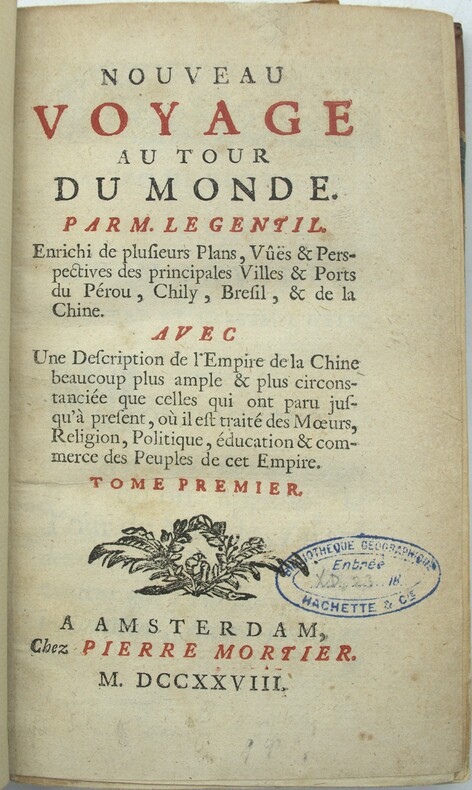
1728PHO-2076Amsterdam, Pierre Mortier, 1728. 3 vol. in-12 (17x10,5cm), 2ff.-314pp.-5ff. ; 227 pp. ; 192pp.-12ff., Reliure pastiche en demi-veau à coins, dos à 5 faux-nerfs fleuronné, pièce de titre en maroquin rouge, pièce de tomaison en maroquin vert, année dorée en pied, filet doré sur les plats. Mouillure au plan de Pisco, quelques très rares mouillure en marge sans gravité. Bon exemplaire, bien complet des cartes, plans et planches gravés, le titre gravé et le premier feuillet (page 1 &2) mal placés. Cachet de la Bibliothèque Géographique Hachette et Cie ; de la bibliothèque de Paul Lebaudy, avec son ex-libris gravé.
19124149Senior Class of 1912 Nebraska State Normal School at Peru 1912 A 1912 yearbook from Nebraska's first college first state-supported college. Stiff card boards full dark brown leather gilt front board lettering/decoration bright 10 3/8 x 8 inches 218 pp. Very good modest edgewear/rubbing; pages clean with no marks and binding sound. Rare. K071. 1st Edition. Hardcover. Very Good/No Jacket. Senior Class of 1912, Nebraska State Normal School at Peru hardcover
19114148Senior Class Nebraska State Normal School at Peru 1911 A 1911 yearbook from Nebraska's first college first state-supported college. Hardcover full brown leather gilt front board lettering and decoration bright 10 1/2 x 8 inches 232 pp. Laid in: a card with a printed Peru poem. Very good modest edgewear; sunning spine; pages clean with no marks and binding tight. Rare. K071. 1st Edition. Hardcover. Very Good/No Jacket. Senior Class, Nebraska State Normal School at Peru hardcover
1961231231961. Baum Allyn. Peru photo archive a substantial working group of large original photographs and related New York Times material centered on Baum's Peru assignments significant for preserving a photographer's own visual record of Andean and Amazonian travel Indigenous communities village life and editorial circulation within mid twentieth century American newspaper photojournalism. Allyn Baum was a staff photographer for The New York Times from 1957 to 1967. Included is a typed note from New York Bureau Chief Gedeon de Margitay congratulating Baum on the Peru photographs published in the Magazine together with the January 21 1962 New York Times article "Into the Unknown" directly linking the images to their original publication context and to contemporary American visual encounters with Peru's Indigenous regions and frontier geographies. From the estate of Allyn Baum. Peru and New York. 1961-1973.<br /> <br /> Archive of 48 items including 46 large silver gelatin photographs a New York Times article written by Baum and a single-page typed letter regarding publication. Most photographs measure 8" x 10" while 9 larger examples measure 10" x 13". Several are mounted on board and bear Baum's signature or detailed inscriptions such as "Jungle Priest" "Headhunter" and "High Andes Quechua Indians in Peru. Working in home . producing products for sport." Many retain original press captions or handwritten notes on the versos some in Baum's own hand. The photographs document river and jungle travel in the Amazon Basin village and market scenes domestic interiors American aircraft and extensive portrait studies of Andean and Amazonian Indigenous peoples. Indigenous sitters appear weaving spinning wool knitting carrying children traveling by canoe gathered near riverside settlements or posed in both formal and informal portrait settings. Several photographs emphasize textile production and traditional labor practices among Quechua communities in the high Andes while others focus on Amazonian Indigenous groups photographed within thatched settlements and river communities preserving material evidence of architecture clothing subsistence practices and daily life during a period when American newspaper photography increasingly framed Indigenous South America through the lens of exploration modernization and remote access.<br /> <br /> The archive is a strong record of Peru in the early 1960s documenting not only transportation networks settlement patterns and regional travel but also Indigenous cultural continuity across both Andean and Amazonian environments. Baum's photographs repeatedly center Indigenous Peruvians not simply as background figures within landscape photography but as primary subjects whose labor dress craft production domestic life and physical presence structure the visual narrative of the archive. The accompanying New York Times material preserves the editorial framework through which these images entered American mass circulation while the de Margitay note confirms internal recognition of Baum's Peru work within the newspaper itself. The later date range appears to reflect continued press handling reuse and captioning rather than a single production moment giving the archive additional value as a working newspaper photography file shaped over time. Minor edgewear throughout; versos with original handwritten descriptions by Baum and press editors. A cohesive and well-preserved Peru field photography archive documenting Indigenous life regional travel and mid century American photojournalism connected to The New York Times. unknown
In -4°, pp. (40), 450, (42), frontespizio in cornice con vignetta, testo su due colonne; legatura in piena pergamena con titolo manoscritto al dorso, piccoli fori su un angolo del frontespizio, non intaccano testo e cornice. Nato in Bolivia, intorno al 1626, l’autore fu sacerdote a Sucre, prolifico scrittore teologo e predicatore. Small holes on a corner of title page, text and frame are untouched. Born in Bolivia around 1626 the author was a priest in Sucre, writer, theologist and preacher. ARch. S
15960339RfKöln, Birckmann für Arnold Mylius, 1596. Titelvignette in Holzschnitt, einige Kapitelinitialen und Kapitelendvignetten, 2 Bl. Widmung, 5 Bl. Index, 581 S., 6 Bd. In 1 Band. barocker marmorierter Halblederband mit rotem goldgeprägte Rückentitelschildchen und goldgeprägten Rückernverzierungen, Lesebändchen, dreiseitiger gesprenkelter Schnitt. Zustand 3, Ecken u. Kanten bestoßen, Rückenlederflanken unten Verlust am Leder, letzte 3 Blatt 2 Wasserränder im weißen Rand, Buchblock sonst in gutem Zustand.
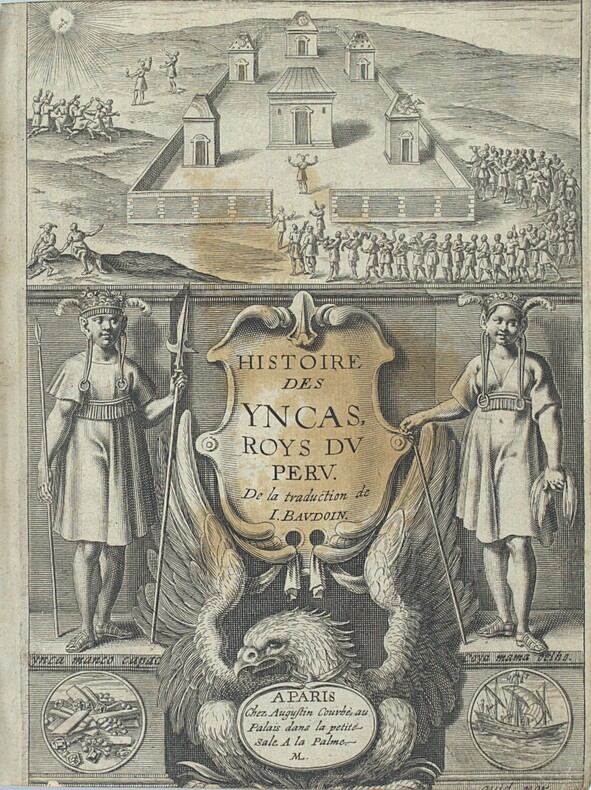
1633PHO-2398À Paris, chez Antoine Courbé, 1633. Fort petit in-4 (22,5x17,5cm). Titre gravé par Michel Lasne, 23 ff.-1319pp-18 ff.. Pleine basane usagée de l'époque (plats frottés, manque le dos). Coins usés Traces anciennes de vers et auréoles claires sans gravité sur plusieurs pages. État intérieur satisfaisant dans l'ensemble.
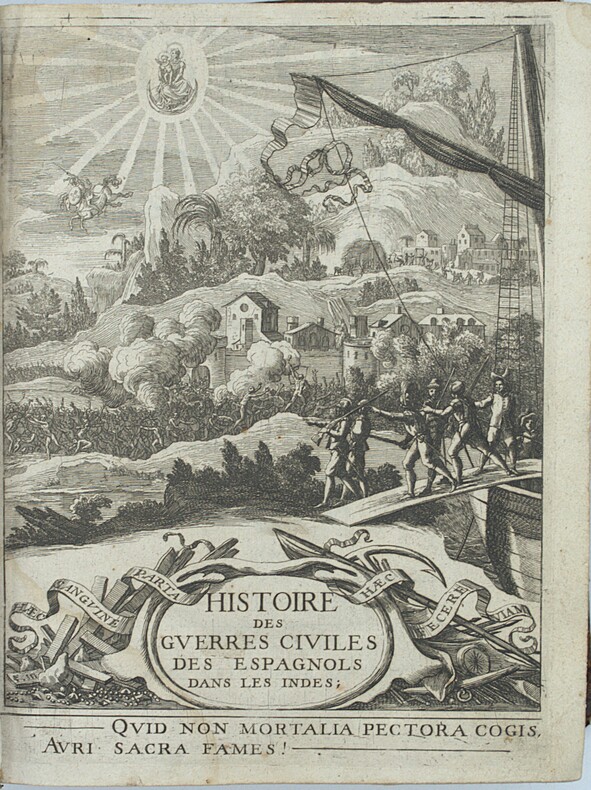
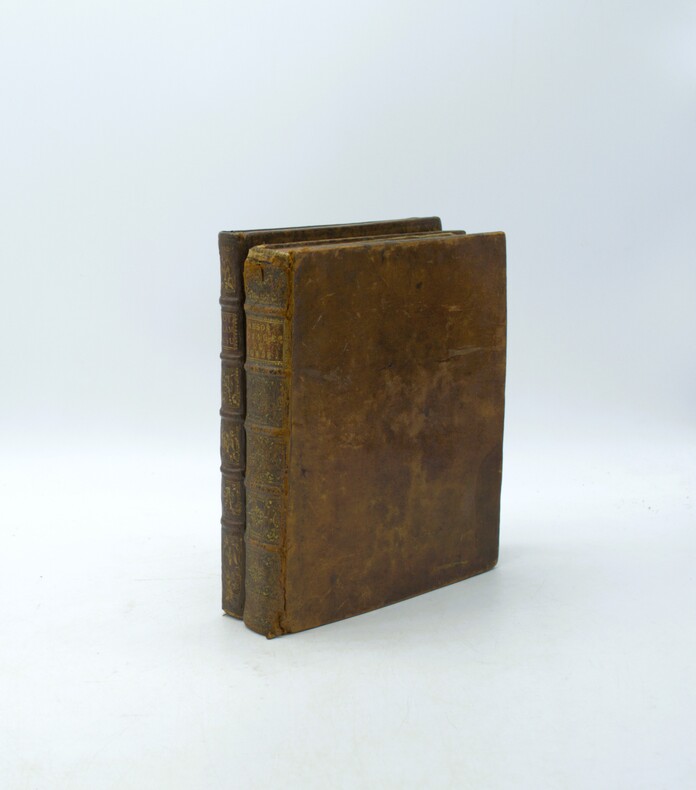
1658PHO-2397Paris ,1658. Chez Siméon Piget. 2 tomes en 1 volume in-4 (25x19cm), 16fnch.-631pp-9fnch./555pp.-10ffnch., relié veau époque, dos manquant mais corps solide, coins usés, vieille mouillure claire par intermittence.
41854Paris Librairie Universelle de P. Mongie ainé 1828 in 8 (20,5x13) 3 volumes reliures demi basane rouge, dos lisses ornés de filets et fleurons dorés, VII et 390 pages, 496 pages, 440 pages. Ouvrage illustré de 6 planches (illustrated with 6 folding plates), dont 5 dépliantes, toutes finement aquarellées à l'époque (1°/ Fermier Chileen (frontispice); 2°/ grande gravure dépliante: Vue de la forteresse de Callao et de la ville de Lima (view of Lima in colour); 3°/ Homme et femme de Quito; 4°/ Homme et femme indiens de la tribu de Malaba; 5°/ Américain Yumbo et Américain des Colorads; 6°/ Muletier indigène de Mexico et Indigène de St Pierre. Belles reliures pastiches XXe. Ou Relation historique et descriptive d'un séjour de vingt ans dans l'Amérique du Sud, suivie d'un précis des Révolutions des Colonies espagnoles de l'Amérique du Sud; traduite de l'anglais de W. B. Stevenson, [.] et augmentée de la suite des Révolutions de ces Colonies depuis 1823 jusqu'à ce jour. Traduite de l'anglais par Sétier. William Bennet Stevenson. Première édition française. Bel exemplaire ( Photographies sur demande / We can send pictures of this book on simple request )
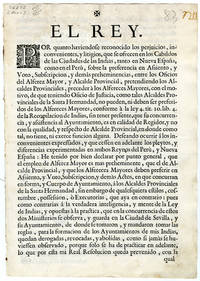
1738WRCAM36292Madrid 1738. 3pp. Folio. Dbd. Maltese cross printed at head of title. Accomplished in manuscript at Aranjuez Spain on April 11 1738 signed by Miguel de Villanueva. Manuscript inscription on verso of last printed page written on November 14 1738 in Santiago de Chile. Contemporary annotation on first page light dampstaining in margins. A very good copy. A rare proclamation by Philip V King of Spain declaring that major lieutenants Alfereces Mayores of the cities towns and villages of Peru are to be recognized over the unpaid local judges los Alcaldes of the Holy Brotherhood Santa Hermandad. Numerous local brotherhoods had served as municipal peacekeeping organizations in Spain since the Middle Ages. The Holy Brotherhood was established by Ferdinand and Isabella to suppress the original municipal leagues and guarantee personal security and public order and local brotherhoods were organized in New Spain and Peru. An attempt to regulate the power of the brotherhoods this decree was printed in Madrid and distributed to royal officials in all the provinces of the viceroyalty of Peru. This copy accomplished at Aranjuez on April 11 1738 is signed by Miguel de Villanueva as representative of the King of Spain with the inscription: "Yo el Rey." A manuscript note on the verso of the last printed page written in the city of Santiago on Nov. 14 1738 describes an instance of the distribution of the text in Chile. <br> <br> An important proclamation regarding local governance in the viceroyalty of Peru with a contemporary manuscript inscription regarding the text's distribution in Chile. Not in Medina BHA or OCLC. unknown books
1795WRCAM40957Reimpreso en Lima 1795. 160pp. 12mo. Contemporary vellum. Bright and fresh internally. Near fine. Constitution of the Congregation of the Oratory of St. Philip Neri first founded in Rome in the late 16th century. No copies on OCLC. MEDINA LIMA 1796. VARGAS UGARTE 2685. hardcover books
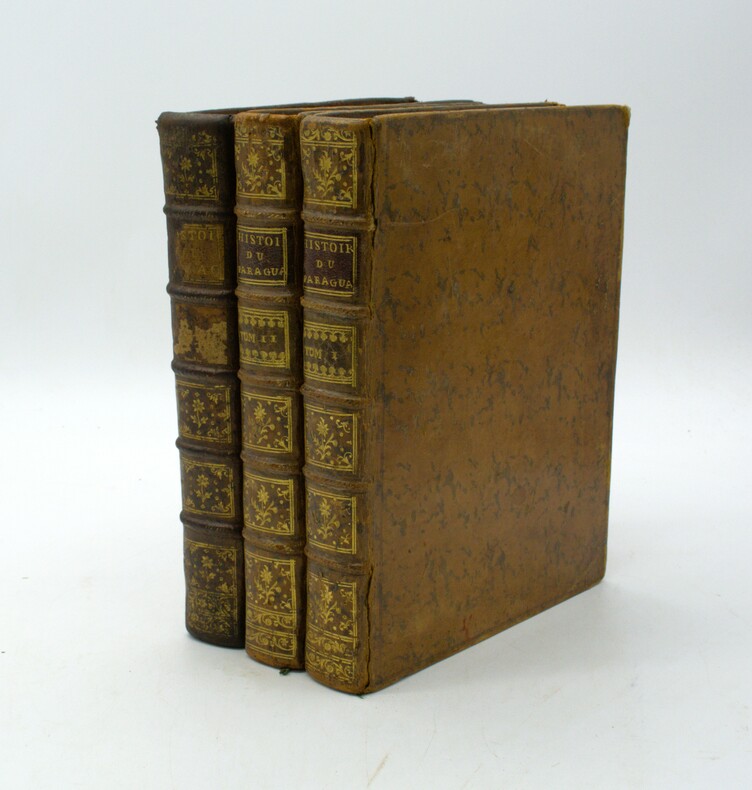
1756PHO-1895Paris, Didot, Giffart et Nyon, 1756. 3 vol. in-4 (260x200) de (5) ff., 489, xxxiii, (4) pp. ; (2) ff., 356, clviii, (2) pp. , 285pp ,cccxv,2ff .Veau marbré, dos à nerfs ornés, p. de titre et de tom., tranches rouges (reliure de l'époque),bien complets de leurs 7 cartes dépliantes dont le plan de Buenos Aires. Reliure tome 3 légèrement différente, avec pièce de tomaison absente, pièce de titre avec manque, coins usés, petit accroc.
1890c2311100201xbvkParis, imprimé par autorisation de M. le Garde de Sceaux, à L'Imprimérie National, M DCCC XC.(1890); Lithograph printed by L. Léchaudel. 26 singleside printed large-paper cardboard-sheets, incl. 1 coloured plate; large-4to.(ca. 32 x 25 cm, few plates slightly smaller ca. 31 x 24 cm).
100 color plates in two linen vols. Text in Japanese with some English Hardcover Ex-library, Very good condition in worn portfolio
Incisione in rame su doppio foglio (cm.50x57 circa) con bellissima colorazione coeva, verso velato da finissimo foglio di carta Giappone. Bella e rara carta nautica, tratta dal celebre atlante di De Witt ''Orbis Maritimus ofte Zee Atlas", che copre le coste dell'America Centrale, Perù, Cile, Jamaica e parte di Cuba e Porto Rico. . Le indicazioni toponimiche e le caratteristiche geografiche sono strettamente limitate alle coste. Rosa dei venti, linee lossodromiche e splendido cartiglio, in basso a destra, con titolo in latino, con ricche decorazioni colorate raffiguranti varie figure, anche allegoriche. "Frederick de Wit deve essere considerato uno dei più importanti editori di mappe della seconda metà del XVII secolo. La maggior parte delle sue mappe sono di ottima qualità, sono caratterizzate da un'incisione chiara e bella, dall'attualità e ricchezza dell'immagine cartografica nonché dall'equilibrio delle decorazioni cartografiche". (Lexikon der Kartographie II, p. 899), Koeman M. Wit 1, 27. Koeman, Atlantes Neerlandici, IV, pp.191 e 518-519. Shirley 444. Putnam, Early sea charts, 75.. .
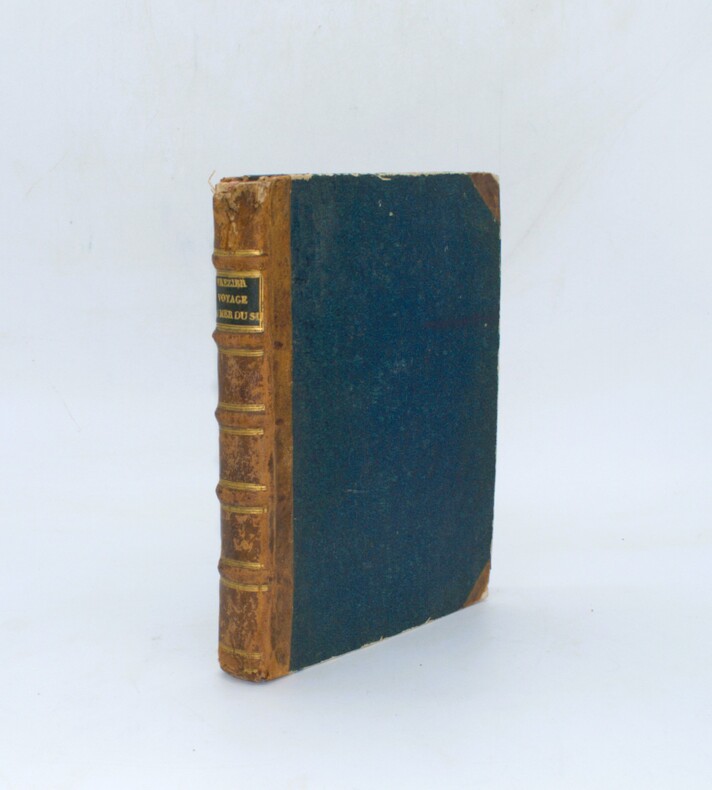
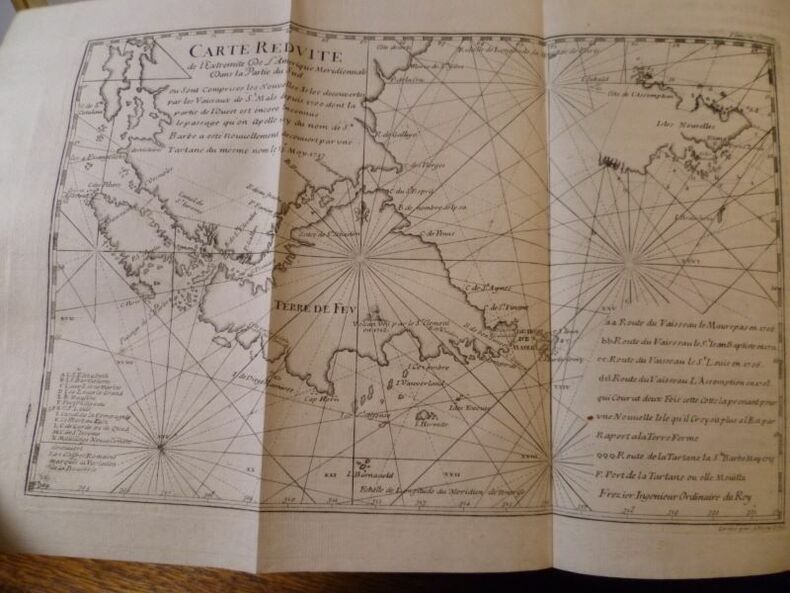
1732PHO-2447A Paris : chez Nyon, Didot, Quillau, 1732, in-4 ° (25x20cm). Pages [2], XIV, 298, [2], 63, [1] vierges + 37 planches H.T., dont dépliantes, demi basane et coins, dos à nerfs avec pièce de titre et auteur, tranches rouges. Frottements au dos, coiffes abimées avec petits manque, coupes et coins dénudés, réparation à 2 feuillets, petites rousseurs.
In -4°, pp. (108), 216, 196-199, (8), 229-326, capilettera, testatine e finali; pergamena coeva con lacci e titolo manoscritto al dorso. Qualche foro di tarlo che non incide sul testo. Vari errori di segnatura e numerazione delle pagine. Prima edizione di quest’opera del maggiore poligrafo e scienziato del Perù in epoca colonialista. Il libro si distingue per una vasta incoerenza delle segnature, per l’uso esteso dei capilettera di tipo “factotum”, caratteristiche entrambe dell’editore, Antonio José Gutierrez de Cevallos che possedeva la tipografia “extra muros de Santa Cathalina e fu attivo in città fino al 1750. Pedro Peralta Barnuevo (1663-1743) era rettore della Università di San Marcos e con evidenza scrisse questi dieci sermoni sulla Passione di Cristo per presentarli a una platea universitaria: si distinguono infatti per il ritmo narrativo del testo. Il lavoro è preceduto da un saggio di genealogia sulla famiglia Moscoso, una delle più influenti famiglie del Nuovo mondo, ed è ricco di informazioni storiche e politiche circa questa e altre importanti famiglie messicane, peruviane e spagnole. Vari errori di numerazione e segnatura ma libro completo. The first edition of this work by the major writer and scientist of Peru, at time. The book is interesting under a typographic point of view, because of the extended use of “factotum” initials and a wide incoherence in signatures, both typical of its publisher, Antonio José Gutierrez de Cevallos. The author was dean of San Marcos university and he wrote these ten speeches about Christ passion towards an academic audience. The work is introduced by a genealogic essay about Moscoso family, one of the most important in the New World, rich of historic and politic information about Peru and spanish colonies. Many page number and signature mistakes, but the book is complete.
1749PHO-2227Amsterdam et Leipzig, Arkstee et Merkus, 1749, 4, f. de titre, [4]-XVI-333-[1] p., complet des 34 pl. h. t. presque toutes dépliantes de figures et cartes, pleine basane de l'époque, dos à nerfs orné avec pièce de titre, tranche rouge, coin usé, frottements, manque en tête au dos, rousseurs, déchirure au pli (pl. 33), petit trou de vers au verso du premier plat, étiquette de Raymond Clavreuil. Lyon, chez les Frères Duplain, 1756. In-4° (25,5x19,5cm), 1f.-xvi-185 pp.- xiv pp. (table des matières), veau marbré époque, dos à nerfs orné de lions et oiseaux avec pièce de titre grenat, lions et oiseaux aux coins des plats, tranches rouges, doubles filets aux coupes, très légères rousseurs, coiffe sup. arasée, mouillure très claire, manque la page de titre
1442A Paris, chez Nyon, Didot, Quillau M. DCC. XXXII. (1732).Un volume in-4 relié de XIV-298 pp.-1f.et 63 pp., 37 gravures hors texte dont 23 cartes dépliantes. Reliure plein veau raciné d'époque, dos à nerfs orné, pièce de titre rouge, tranches rouges, reliure à lanières. Reliure en bon état, restaurée apparemment (reliure vernie et lanières qui ne sont pas d'époque). Intérieur en bel état car les feuilles ont été lavées.
1442A Paris, chez Nyon, Didot, Quillau M. DCC. XXXII. (1732).Un volume in-4 relié de XIV-298 pp.-1f.et 63 pp., 37 gravures hors texte dont 23 cartes dépliantes. Reliure plein veau raciné d'époque, dos à nerfs orné, pièce de titre rouge, tranches rouges, reliure à lanières. Reliure en bon état, restaurée apparemment (reliure vernie et lanières qui ne sont pas d'époque). Intérieur en bel état car les feuilles ont été lavées.