2 823 résultats
Milano, Studio d'arte Mazzoleni, 1974, in-8, br., pp. 93. Con 11 tavv. a col., 123 ill. in b.n., 4 cartine, schema cronologico e bibliografia.
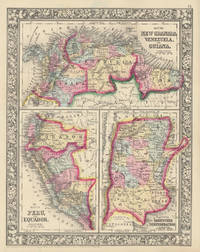
186046866New York: S. Augustus Mitchell Jr. 1860. Folio 12¼" X 15¼" image area 10½" X 13½". Hand colored. Near fine. Quite faint age toning. Bold bright and lovely map of these half dozen South American countries from the 1864 edition of "Mitchell's New General Atlas Containing Maps of the Various Countries of the World Plans of Cities Etc." Upper third contains "Map of New Granada Venezuela and Guiana" lower left third contains "Map of Peru and Equador" and lower right third contains "Map of the Argentine Confederation." Today "New Granada" consists of Colombia and Panama. Wonderfully delicately colored with fine decorative border. S. Augustus Mitchell, Jr. unknown
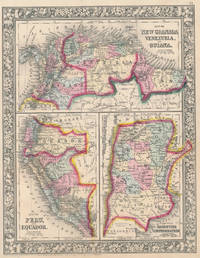
186046956New York: S. Augustus Mitchell Jr. 1860. Folio 12¼" X 15¼" image area 10½" X 13½". Hand colored. Very good. Mild age toning and bit of faint soiling. Quite nice map of these half dozen South American countries from the 1864 edition of "Mitchell's New General Atlas Containing Maps of the Various Countries of the World Plans of Cities Etc." Upper third contains "Map of New Granada Venezuela and Guiana" lower left third contains "Map of Peru and Equador" and lower right third contains "Map of the Argentine Confederation." Today "New Granada" consists of Colombia and Panama. Wonderfully delicately colored with fine decorative border. S. Augustus Mitchell, Jr. unknown
Singapore, Apa Publications, 1991, 8vo (cm. 22,5 x 15) brossura con copertina illustrata a colori, pp. 370 ampiamente illustrato da fotografie e da tavole fotografiche in nero e a colori, anche a pagina doppia (Insight Guides) .
1853236625Cuzco: Imprenta Libre por Gregorio Arriaga 1853. 48 pp. 1 vols. 12mo. Wrappers. 48 pp. 1 vols. 12mo. Imprenta Libre por Gregorio Arriaga unknown
a50331Lima 1997. In Spanish. Hardcover. 4to. 145pp. color illustrations cloth. Fine in Near Fine DJ. . hardcover
1879236621Madrid: M. Tello 1879. xliv 328 pp. 1 vols. 8vo. Bound in full brown morocco a.e.g. wrappers bound in rubbing at joints but sound. xliv 328 pp. 1 vols. 8vo. M. Tello unknown
1855236854Paris: Chez Camuzeaux Libraire-Éditeur 1855. Later edition. Frontispieces. 280 272 pp. 2 vols. 8vo. later blue cloth with original wrappers bound in uncut. Later edition. Frontispieces. 280 272 pp. 2 vols. 8vo. <br/><br/> Chez Camuzeaux, Libraire-Éditeur hardcover
1830319997London: James Duncan 1830. 3 plates & 1 folding map as frontispiece. 2 vi2 340pp. 1 vols. 12mo. Half contemp. calf. VG. 3 plates & 1 folding map as frontispiece. 2 vi2 340pp. 1 vols. 12mo. <br/><br/> James Duncan unknown
1863236623Lima: Tipografia de Aurelio Alfarno 1863. xv 104 xxii 1 pp. 1 vols. 8vo. Yellow wrappers split with some loss. xv 104 xxii 1 pp. 1 vols. 8vo. Tipografia de Aurelio Alfarno unknown
1863236424Paris: Libreria de Firmin Didot Hermanos Hijos y Ca 1863. Frontispiece in Volume One. xxv 745 3; 473 3 pp. 2 vols. Modern brown cloth worming at last 4 leaves of vol. II. Frontispiece in Volume One. xxv 745 3; 473 3 pp. 2 vols. Libreria de Firmin Didot Hermanos, Hijos y Ca unknown
1847214253New York: Harper and Brothers 1847. First edition. Engraved portrait frontispieces facsimile map. 2 vols. 8vo. Original publishers' blind-stamped brown cloth. Covers slightly faded and rubbed remnants of library labels removed from spines darkening to endpapers occasional light spotting to text. Ex-library with bookplate and one other from private owner on front pastedowns. First edition. Engraved portrait frontispieces facsimile map. 2 vols. 8vo. The classic work on the subject going through scores of editions Prescott's "Peru" was one of the standard household books for the later part of the Nineteenth century. Though included in the Grolier Club exhibition of One Hundred Books Famous in English Literature it was not included in their catalogue of One Hundred American Books . simply because "Prescott's Conquest of Mexico . came first and set a new American standard for the use of source materials." This standard he maintained in his History of the Conquest of Peru. Sabin 65272; BAL 16346 Harper and Brothers unknown
185628032Philadelphia: Charles Desilver 1856. 17¼" X 13 3/4" image 15" X 12½". Hand colored. Decorative border. Very good. 2" tear at upper right corner archivally repaired on verso touches upon one corner of border. Charles Desilver unknown
186276434Lima: N.p. 1862. Original manuscript title or deed to the Hacienda San Jacinto in the Nerena Valley of Coastal Peru. While the estate is named after a Hispanic saint San Jacinto its origin dates back to pre-Inca times. Evidence of this is the remains of cultural settlements in Punkuri Kiske and Cerro Blanco. The Spanish Crown gave this land to the Jesuits in 1720 who introduced sugarcane as part of the agricultural production in this part of Peru. They also took it away from the Jesuits in 1767.Folio. 151 leaves with manuscript on both sides of each leaf i.e. 352 pp. Each leaf bears the required tax stamp the equivalent of a notary stamp at that time and each leaf is written on paper bearing the same watermark. Each leaf also bears a blind-stamp of a seal in the inner margin of each recto. Written in a numerous hands but all quite legible. Original full brown sheepskin with gilt spine lettering and devices pattern endpapers. Like a ready made binding used for legal purposes as the text block in considerably smaller than the binding. Altogether in very nice condition.This is the original transfer title for an estate of great importance and size in one of the most fertile parts of coastal Peru the Narena Valley. It consisted of 700 fanejadas of land about 1200 acres and all that stood upon it; primarily the sugarcane and alfalfa fields but houses tools farm animals furniture etc. In fact it seems that the original name for the property still bore and can be seen on the first page of this manuscript the word "Canaverales" which is a euphemism for sugarcane. This mammoth 302-page manuscript is basically an inventory of literally everything on those 1200 acres. The detail on the inventory is incredibly extensive; every table horse cow frying pan etc is listed and priced. It was first laid out as a sugarcane plantation in 1720 by the Jesuits. The Jesuits were expelled from the New World lands and missions in 1767 by the Spanish crown with King Charles III ordering their removal from all Spanish territories including the Americas due to growing political pressure against the order; the Franciscans largely took over the operation of the missions after the expulsion. When all their lands were confiscated by the Spanish government as happened throughout Latin America the Hacienda likely went through a number of hands. It was well regarded as a solid and lucrative sugarcane plantation and would have been considered a prize acquisition. We can find no history of the buyer named on this deed Santiago Sanchez but that is likely due to the fact that Spanish people have last names that can be written in a variety of combinations. But we do know that he paid 8697 pesos for it and that was a very considerable sum for the time indeed enough to place someone in a wealthy or influential social position. The most curious thing in the inventory which is lengthy and detailed in the extreme is the list of slaves. Ostensibly President Ramon Castilla y Marquezado declared slavery abolished in 1854 yet here we have a document that clearly affixes values to each and every slave and the prices paid for each by Sanchez. Prices ranged from 0 to 500 pesos. And there were a large number of them. Staring on p. 68 of the inventory we find them all listed and they are broken down into a variety of categories. Indigenous people African people male female young old and & "Inservibles" translates as "useless people". All slaves were examined by Dr. Antonio Manriquez surgeon and the most common reasons for being deemed "inservible" included: old age hernias ulcers and missing limbs. Their value was deemed to be zero. After being examined by physician the value accorded to each was dependent on their ability to work the farm. Surprisingly African slaves were valued less than local peoples this may have been due to the language issue. It should be noted that the slaves constituted a large portion of the total price paid. So it seems that this document gives lie to the previously believed fact that slavery was abolished in Peru in 1854. But we do not find this surprising as the gulf between the monied class and the populace was great and with no ability to enforce decrees from the central government the aristocracy likely just did whatever they pleased. Apparently Santiago Sanchez was ill-equipped to manage so many people and such a large piece of land as we know that in 1868 a Scotsman by the name of Henry Swayne bought the Hacienda San Jacinto an turned it into a profitable enteerpise by his humane attitude towards the farmers. "The hacienda or estate of San Jacinto was anciently one of the largest and finest in the valley of Nepeña; but before its purchase by Mr. Swayne a few years before our visit it had very much run down. It was deserted by the negro slave soon after their emancipation; the dwellings had fallen out of repair" The Fife Post. It remains a very lucrative farming operation to this day.We conferred with a native Spanish speaker and an individual who is fluent in Spanish and this report is the result. We might be incorrect but it is doubtful and in any case it is a fine 19th century manuscript deed to a large and valuable parcel of land in 19th century Peru. N.p. unknown
192074922Lima: Lithografia Tip. Carlos Fabbri 1920. Original hand-colored lithograph map of the city of Lima. 24 x 26 1/2 inches. Key printed on left side and title on right. No copies located by OCLC. Very good."The Italian engraver and printer Carlos Fabbri studied art & design in Italy. In 1887 he moved to Peru and commenced his career as artist & designer for the journal El Peru Ilustrado in Lima. By 1888 Litografia y Tipografia Carlos Fabbri Lima Peru was set up in Calle Mercaderes 140. Having acquired the most up-to-date printing machinery from Italy they soon became leading book publishers and printers of postage stamps maps colour labels posters cheques share certificates and amongst other things cigarette insert cards for tobacco companies during the period 1890-1920 approx. Fabbri's artistic and industrial work was awarded gold medals at exhibitions in Paris Milan Madrid London 1906 and Lima 1910" World of Playing Cards. Lithografia Tip. Carlos Fabbri unknown
1024637719.Gpaperback. Good. Access codes and supplements are not guaranteed with used items. May be an ex-library book. paperback
1024633616.Ghardcover. Good. Access codes and supplements are not guaranteed with used items. May be an ex-library book. hardcover
1272943860.Gpaperback. Good. Access codes and supplements are not guaranteed with used items. May be an ex-library book. paperback
1274956250.Gpaperback. Good. Access codes and supplements are not guaranteed with used items. May be an ex-library book. paperback
188146401178Madrid, Hernandez, 1881-1897 ; 4 vol. In-4, Demi chagrin rouge, caissons dorés, chiffre doré sur les plats. Reliure de l'époque. - CLIV; 216; CLIX - XLIX; 242; CLVIII - XL;276; CLXXV - VII; 45.CCXLIII pp. - collection très précieuse de relations anciennes sur les Andes et le Pérou : 62 relations pour la plupart du XVI° et quelques unes du XVII° publiées avec un important appareil de notes, d'appendices, rapports officiels, lettres, etc… 1 Carte hors texte en couleurs sur double page. Bel exemplaire au chiffre de L.A Barbet. Petits manques de page en marge de 2 ff. sans atteinte au texte. Petites usures à la reliure.
Paris, 1858, gennaio, articolo e sei illustrazioni xilografiche stralcio di "Le Magasin Pittoresque". - !! ATTENZIONE !!: Con il termine estratto (o stralcio) intendiamo riferirci ad un fascicolo contenente un articolo di rivista, sia che esso sia stato stampato a parte utilizzando la stessa composizione sia che provenga direttamente da una rivista. Le pagine sono indicate come "da/a", ad esempio: 229/231 significa che il testo è composto da tre pagine. Quando la rivista di provenienza non viene indicata é perchè ci è sconosciuta. - !! ATTENTION !!: : NOT A BOOK : “estratto” or “stralcio” means simply a few pages, original nonetheless, printed in a magazine. Pages are indicated as in "from” “to", for example: 229/231 means the text comprises three pages (229, 230 and 231). If the magazine that contained the pages is not mentioned, it is because it is unknown to us.
Milano, 1809, 8vo stralcio con copertina posticcia muta, pp. 249/255.
Paris, 1858, febbraio, articolo e una illustrazione xilografica stralcio di "Le Magasin Pittoresque". - !! ATTENZIONE !!: Con il termine estratto (o stralcio) intendiamo riferirci ad un fascicolo contenente un articolo di rivista, sia che esso sia stato stampato a parte utilizzando la stessa composizione sia che provenga direttamente da una rivista. Le pagine sono indicate come "da/a", ad esempio: 229/231 significa che il testo è composto da tre pagine. Quando la rivista di provenienza non viene indicata é perchè ci è sconosciuta. - !! ATTENTION !!: : NOT A BOOK : “estratto” or “stralcio” means simply a few pages, original nonetheless, printed in a magazine. Pages are indicated as in "from” “to", for example: 229/231 means the text comprises three pages (229, 230 and 231). If the magazine that contained the pages is not mentioned, it is because it is unknown to us.
Paris, 1969, 8vo cop. ill. col. pp. XVI-64 con num. ill. e figurine col. n.t.
195721167Partitions sur l'Amérique Latine International Music Co. 1957