433 résultats
185418641Lima Imprenta del Gobierno 1854. Hardcover. Good. 114; 26p. disbound but tight. Lima, Imprenta del Gobierno hardcover
195718642Lima Revista Policial del Perú 1957. Hardcover. Good. unpag. facsimiles full calf scuffed. Appended by photo-facsimile mounted on board stock of the manuscript of Peru's first police legislation. Presented to active generals in the Civil Guard. Lima, Revista Policial del Perú hardcover
0259239550.Gpaperback. Good. Access codes and supplements are not guaranteed with used items. May be an ex-library book. paperback
065697379X.Ghardcover. Good. Access codes and supplements are not guaranteed with used items. May be an ex-library book. hardcover
0656787503.Ghardcover. Good. Access codes and supplements are not guaranteed with used items. May be an ex-library book. hardcover
1332518117.Gpaperback. Good. Access codes and supplements are not guaranteed with used items. May be an ex-library book. paperback
0282061673.Gpaperback. Good. Access codes and supplements are not guaranteed with used items. May be an ex-library book. paperback
0282374086.Gpaperback. Good. Access codes and supplements are not guaranteed with used items. May be an ex-library book. paperback
0666194572.Ghardcover. Good. Access codes and supplements are not guaranteed with used items. May be an ex-library book. hardcover
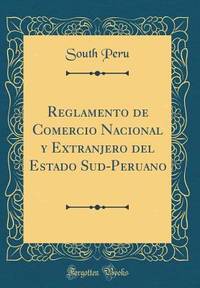
183618639Arequipa Imprenta del Gobierno 1836. Hardcover. Good. 23p. disbound but clean and tight; small marginal burn marks to top edge from edge-branding to bound volume. Decree of Andrés Santa Cruz who numbered "Protector del Estado Sud-Peruano" among his many offices and distinctions. A previous contemporaneous owner has signed his name with rubrication three times on verso of title and once beneath the colophon. Arequipa, Imprenta del Gobierno hardcover
0282772324.Gpaperback. Good. Access codes and supplements are not guaranteed with used items. May be an ex-library book. paperback
0666096740.Ghardcover. Good. Access codes and supplements are not guaranteed with used items. May be an ex-library book. hardcover
0666165750.Ghardcover. Good. Access codes and supplements are not guaranteed with used items. May be an ex-library book. hardcover
195100532420Impr. Torres Aguirre 1951. First Edition. Hardcover. Very Good/No Jacket. 8vo - over 7¾" - 9¾" Exceptionally rare regulations for captains of the Peruvian National Merchant Marine. 2 volumes complete as issued. Original blue hardcovers 2 post bindings. This is the 2nd printing 1973. Each volume has the ink stamp of prior owner a Peruvian diplomat. Description:. Impr. Torres Aguirre hardcover
0332592103.Ghardcover. Good. Access codes and supplements are not guaranteed with used items. May be an ex-library book. hardcover
0483747823.Gpaperback. Good. Access codes and supplements are not guaranteed with used items. May be an ex-library book. paperback
0483749125.Ghardcover. Good. Access codes and supplements are not guaranteed with used items. May be an ex-library book. hardcover
ria9783752489323_inpHardcover. New. New Book; Fast Shipping from UK; Not signed; Not First Edition; N/A hardcover
3752489324.Ghardcover. Good. Access codes and supplements are not guaranteed with used items. May be an ex-library book. hardcover
1390229157.Gpaperback. Good. Access codes and supplements are not guaranteed with used items. May be an ex-library book. paperback
1391442482.Ghardcover. Good. Access codes and supplements are not guaranteed with used items. May be an ex-library book. hardcover
186276434Lima: N.p. 1862. Original manuscript title or deed to the Hacienda San Jacinto in the Nerena Valley of Coastal Peru. While the estate is named after a Hispanic saint San Jacinto its origin dates back to pre-Inca times. Evidence of this is the remains of cultural settlements in Punkuri Kiske and Cerro Blanco. The Spanish Crown gave this land to the Jesuits in 1720 who introduced sugarcane as part of the agricultural production in this part of Peru. They also took it away from the Jesuits in 1767.Folio. 151 leaves with manuscript on both sides of each leaf i.e. 352 pp. Each leaf bears the required tax stamp the equivalent of a notary stamp at that time and each leaf is written on paper bearing the same watermark. Each leaf also bears a blind-stamp of a seal in the inner margin of each recto. Written in a numerous hands but all quite legible. Original full brown sheepskin with gilt spine lettering and devices pattern endpapers. Like a ready made binding used for legal purposes as the text block in considerably smaller than the binding. Altogether in very nice condition.This is the original transfer title for an estate of great importance and size in one of the most fertile parts of coastal Peru the Narena Valley. It consisted of 700 fanejadas of land about 1200 acres and all that stood upon it; primarily the sugarcane and alfalfa fields but houses tools farm animals furniture etc. In fact it seems that the original name for the property still bore and can be seen on the first page of this manuscript the word "Canaverales" which is a euphemism for sugarcane. This mammoth 302-page manuscript is basically an inventory of literally everything on those 1200 acres. The detail on the inventory is incredibly extensive; every table horse cow frying pan etc is listed and priced. It was first laid out as a sugarcane plantation in 1720 by the Jesuits. The Jesuits were expelled from the New World lands and missions in 1767 by the Spanish crown with King Charles III ordering their removal from all Spanish territories including the Americas due to growing political pressure against the order; the Franciscans largely took over the operation of the missions after the expulsion. When all their lands were confiscated by the Spanish government as happened throughout Latin America the Hacienda likely went through a number of hands. It was well regarded as a solid and lucrative sugarcane plantation and would have been considered a prize acquisition. We can find no history of the buyer named on this deed Santiago Sanchez but that is likely due to the fact that Spanish people have last names that can be written in a variety of combinations. But we do know that he paid 8697 pesos for it and that was a very considerable sum for the time indeed enough to place someone in a wealthy or influential social position. The most curious thing in the inventory which is lengthy and detailed in the extreme is the list of slaves. Ostensibly President Ramon Castilla y Marquezado declared slavery abolished in 1854 yet here we have a document that clearly affixes values to each and every slave and the prices paid for each by Sanchez. Prices ranged from 0 to 500 pesos. And there were a large number of them. Staring on p. 68 of the inventory we find them all listed and they are broken down into a variety of categories. Indigenous people African people male female young old and & "Inservibles" translates as "useless people". All slaves were examined by Dr. Antonio Manriquez surgeon and the most common reasons for being deemed "inservible" included: old age hernias ulcers and missing limbs. Their value was deemed to be zero. After being examined by physician the value accorded to each was dependent on their ability to work the farm. Surprisingly African slaves were valued less than local peoples this may have been due to the language issue. It should be noted that the slaves constituted a large portion of the total price paid. So it seems that this document gives lie to the previously believed fact that slavery was abolished in Peru in 1854. But we do not find this surprising as the gulf between the monied class and the populace was great and with no ability to enforce decrees from the central government the aristocracy likely just did whatever they pleased. Apparently Santiago Sanchez was ill-equipped to manage so many people and such a large piece of land as we know that in 1868 a Scotsman by the name of Henry Swayne bought the Hacienda San Jacinto an turned it into a profitable enteerpise by his humane attitude towards the farmers. "The hacienda or estate of San Jacinto was anciently one of the largest and finest in the valley of Nepeña; but before its purchase by Mr. Swayne a few years before our visit it had very much run down. It was deserted by the negro slave soon after their emancipation; the dwellings had fallen out of repair" The Fife Post. It remains a very lucrative farming operation to this day.We conferred with a native Spanish speaker and an individual who is fluent in Spanish and this report is the result. We might be incorrect but it is doubtful and in any case it is a fine 19th century manuscript deed to a large and valuable parcel of land in 19th century Peru. N.p. unknown
0267606206.Ghardcover. Good. Access codes and supplements are not guaranteed with used items. May be an ex-library book. hardcover
1112557822.Gpaperback. Good. Access codes and supplements are not guaranteed with used items. May be an ex-library book. paperback
0259019623.Gpaperback. Good. Access codes and supplements are not guaranteed with used items. May be an ex-library book. paperback