WEDDELL (Hugues Algernon)Livre Rare Book
550 résultats
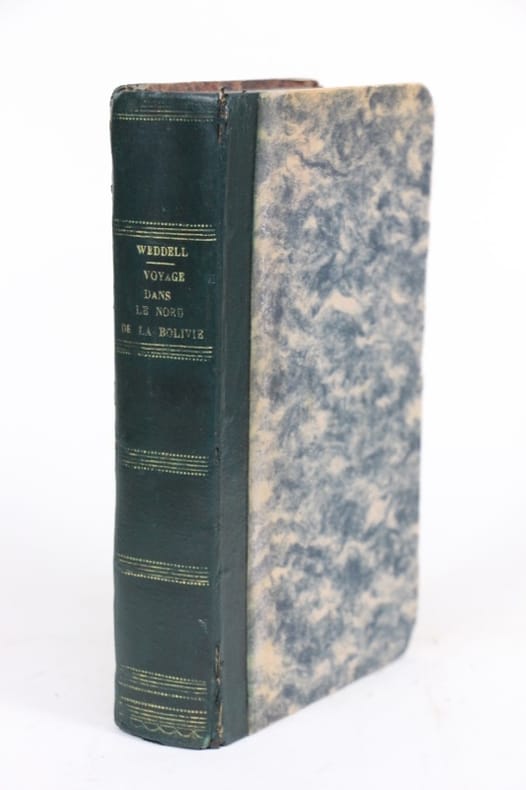
185387886Paris, Chez P. Bertrand, Libraire-éditeur 1853 In-8. Reliure demi-basane vert foncé, dos lisse orné de filets dorés, XII-571 pp., 2 gravures hors texte, 2 figures dans le texte, 1 carte repliée in fine. Reliure frottée, deuxième mors fragilisé, intérieur en assez bon état.
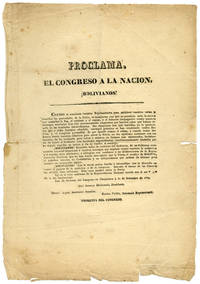
1839WRCAM51533Chuquiasca 1839. Broadsheet 12 3/4 x 8 inches. 2 1/4-inch tear at lower right edge minor soiling and tanning. Good. A short address to the Bolivian people by newly elected president José Miguel de Velasco in 1839 denouncing the previous ten years of dictatorship under Andrés de Santa Cruz and encouraging belief in a better future. Velasco was president of Bolivia four times never for more than two and a half years. Not in OCLC. <br> <br> "BOLIVIANOS: Olvidemos la època de nuestra pasadas desgracias teleremos los errores que las hicieron nacer ò recordemos los solamente como una leccion ùtil para lo futuro; depongamos los Bolivianos todos nuestros resentimientes con òsculo fraternal y que en Bolivia no haya mas que una sola familia y una sola asociacion de amigos." unknown books
368110 June 1872; drawn on the Paddington Branch of the London & County Bank Berkeley Place Edgware Road. General 1815-96 and President of Bolivia between 1880 and 1884. Dimensions seven inches by three inches. Creased and with several closed tears and with ink employed in printing cheque faded to purple and lilac. One edge perforated and with perforated numbers '17 x 6' not affecting signature. Order to pay 'General Narciso Campera' five pounds and sixteen shillings. Drawer's signature illegible. Signed 'Narciso Campero' on reverse. 10 June 1872; drawn on the Paddington Branch of the London & County Bank, Berkeley Place, Edgware Road. unknown
IN 8°, pp. ( 4 ), 532, LEGATURA D'EPOCA IN MEZZA PELLE CON TITOLO E FREGI IN ORO, PIATTI RIGIDI MAREZZATI. L'OPERA E' DIVISA IN PIU' PARTI COSI' RIPARTITA :DE LARENAUDIERE - MESSICO, pp.1 - 255. GUATEMALA, pp.257 - 331. FEDERICO LACROIX - PERU' E BOLIVIA, pp.333 -<BR>532. A SEGUIRE : 2 CARTE, 1 DEL MESSICO E GUATEMALA, L' ALTRA ANAHUAC COMPRENDENTE I REGNI DI MESSICO, D' ACOLHUACAN DI MECIOACAN E LE REPUBBLICHE DI TLASCALA DI CHOLULA, DI HUEXOTXINCO, ECC. COM'ERANO NEL 1521. ENTRAMBE f.t.+v.r.<BR>SEGUONO TAVV. 44 PER IL MESSICO, 22 GUATEMALA. 8 IUCATAN, 1 CARTA + v.r. DI PERU' E BOLIVIA, 12 PERU' E BOLIVIA. IL TUTTO f.t. in b/n. OPERA FACENTE PARTE DELLA COLLANA " L'UNIVERSO " O STORIA E DESCRIZIONE DI TUTTI I POPOLI, ECC. TRADUZIONE DI A. F. FALCONETTI, TESTO SU DUE COLONNE. COMPLESSIVAMENTE, LE TAVV. SONO 89 E NON 78,<BR>COME RIPORTATO NEL FRONTESPIZIO. OTTIMA CONSERVAZIONE.5377
114 pages. Articles: Rampageous Reuther - an intimate appraisal of the United Auto Workers' (UAW) Walter Reuther; Heels Among the Heroes - there are too many Peck's bad boys in our occupation forces - article with nice photos of Americans serving in Germany; Stop, Look and Live! - Detroit's successful campaign to reduce auto casualties; Lady Killers - Lady Roller Derby participants - article with great color photos of Gerry Murray, Evalyn Karran and others; Circus Opera - Elephants trumpet and horses galumph when Salmaggi stages Aida; Lethal Lullaby - facts to know if you take sleeping pills; Big Tin God - the saga of Simon Patino of Bolivia and his vast Gold and Tin mining empire; Interesting back page editorial on Britain's Palestine problem. Fiction: The Hard Way Home; A Sense of Echelon; Clock Without Hands; What a Man Wants; Love is Kind of Fragile; Trouble on the Autobahn. Ads include: Studebaker trucks; Listerine; Ethyl; Shell agricultural research; Admiral phonographs; Philco phonographs - with Bing Crosby photo; Life Savers; Buick (nice 2-page photo Ford cars; Anso film; Camel cigarettes with photo of hospital intern and caption "More doctors smoke Camels than any other cigarette; Gillette razor ad features caricature of footbal player Steve Van-Buren ad); Rare full-page color ad for Wurlitzer Juke Boxes; GE light bulbs - with photo of George Burns and Gracie Allen; Clicquot Club sparkling water; Good Year (color centerfold); Garod radios; Mission Orange beverage; Carole Landis is featured for Dupont; Spertt Portable Sunlamps - with color photos; Dodge cars; Schlitz beer; "The Best Years of Our Lives" movie starring Fredric March and Myrna Loy; RCA Victor phonographs; Oregon tourism - with photos; Lucky Strike cigarette ad on back cover shows farmer holding huge golden leaf. Somewhat above-average external wear. Cover pulling from one staple. A worthy vintage copy. Book
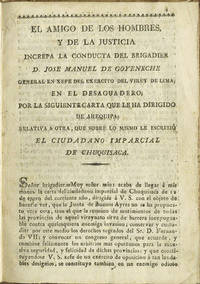
181137071Buenos Aires: Imprenta de Niños Expósitos 1811. First edition. Paper-covered boards. Small chips to spine ends lacking half of the free front endpaper catalogue listing tipped-in to verso; contents trimmed scattered wormholes affecting a few letters of text else clean. 12 pp. Sm. 8vo. 29 March 1811. Furlong cites two editions. This is the "virey de Lima" issue. Attacks General José Manuel de Goyeneche y Barreda 1st Count of Guaqui Grandee of Spain Arequipa Viceroyalty of Peru 1776-1846 who was the commander of the Spanish troops in Bolivia and who had defeated the Revolutionary forces at La Paz in 1809. Two months after this document was issued he signed an armistice with the political leader of the independentist army Juan José Castelli though it was soon broken and Goyeneche went on to occupy all of upper Peru. Furlong IV: 2470. Zinny: Bibliografía histórica p.59: No. 8. Fors: Imprenta de los Niños p. 38. Imprenta de Niños Expósitos hardcover
181137071Buenos Aires: Imprenta de Niños Expósitos 1811. First edition. Paper-covered boards. Small chips to spine ends lacking half of the free front endpaper catalogue listing tipped-in to verso; contents trimmed scattered wormholes affecting a few letters of text else clean. 12 pp. Sm. 8vo. 29 March 1811. Furlong cites two editions. This is the "virey de Lima" issue. Attacks General José Manuel de Goyeneche y Barreda 1st Count of Guaqui Grandee of Spain Arequipa Viceroyalty of Peru 1776-1846 who was the commander of the Spanish troops in Bolivia and who had defeated the Revolutionary forces at La Paz in 1809. Two months after this document was issued he signed an armistice with the political leader of the independentist army Juan José Castelli though it was soon broken and Goyeneche went on to occupy all of upper Peru. Furlong IV: 2470. Zinny: BibliografÃa histórica p.59: No. 8. Fors: Imprenta de los Niños p. 38. Imprenta de Niños Expósitos hardcover books
1837WRCAM51534Chuquisaca 1837. Broadside 12 1/4 x 8 1/2 inches. Several chips and tears one two-inch tear at lower right edge. Light foxing and tanning. About good. Nationalist broadside issued by the Bolivian congress in 1837 addressed to the people and exhorting them to have faith in the strength of the government. Published under the dictatorship of Andrès de Santa Cruz at the time of the War of the Confederation which a united Peru and Bolivia fought against Argentina and Chile from 1837 to 1839. OCLC records only one copy at Yale. <br> <br> "¡BOLIVIANOS! Reunidos todos en contorno del Gobierno de un Gobierno enteramente nacional despreciad á vuestros enemigos que emplean contra vosotros la seduccion y el engaño para alucinaros; y entregáos con confianza á las deliberaciones de la Representacion Nacional que no han tenido otro objecto que la Patria el nombre de BOLIVIA el pabellon tricolor su Constitucion y su indepencia que acaban de afianzar para siempre sin menoscabo alguno." OCLC 54309684. unknown books
18512007AG1851. London & New York J & F. Tallis 1851. Original steel engraving / Vintage map. Drawn and engraved by John Rapkin. Partly hand-coloured. Plate Size: 24.7 cm x 33.8 cm. Sheet Size: 27.4 cm x 37.5 cm. Vintage 19th century map in very good condition. John Tallis 7 November 1817 3 June 1876 was an English cartographic publisher. His company John Tallis and Company published views maps and atlases in London from roughly 1838 to 1851. Tallis set up as a publisher with Frederick Tallis in Cripplegate in 1842; the business moved to Smithfield in 1846 and was dissolved in 1849. From 1851 to 1854 Tallis operated as John Tallis and Company. He started The illustrated news of the world and national portrait gallery of eminent personages in 1858 selling it for £1370 in 1861; it folded in 1863. Wikipedia The most important project John Tallis undertook was the 'Illustrated Atlas' from 1851. The original map we offer here was part of this exceptional Atlas and all the maps it contained are still today considered as the last reminder of an era of lavish map production. Tallis worked the project together with John Rapkin 1815-1876 and it was Rapkin's style and talent that we have to thank for when we marvel at these maps today. What makes these maps so special is the detail of engraved vignettes that surround the map and often show indigenous scenes people in their environment and even more so historical buildings or historical views of towns and cities architecture and landscape. The project of 'The Illustrated Atlas' was designed to be finished just in time for the anxiously awaited "Great Exhibition of the Works of Industry of All Nations" or The Great Exhibition sometimes referred to as the Crystal Palace Exhibition in reference to the temporary structure in which it was held was an international exhibition that took place in Hyde Park London from 1 May to 11 October 1851. It was the first in a series of World's Fairs exhibitions of culture and industry that became popular in the 19th century and it was a much anticipated event. The Great Exhibition was organized by Henry Cole and Prince Albert husband of the reigning monarch Queen Victoria. It was attended by numerous notable figures of the time including Charles Darwin Samuel Colt members of the Orléanist Royal Family and the writers Charlotte Brontë Charles Dickens Lewis Carroll George Eliot and Alfred Tennyson. Music for the opening was under the direction of Sir George Thomas Smart and the continuous music from the exhibited organs for the Queen's procession was "under the superintendence of William Sterndale Bennett". Wikipedia unknown
Pages 266-352 pages plus 16 pages of great vintage ads. Features: Flying in Central Africa (part I) - adventures from the flying log-book of an R.A.F. officer during ther campaign in German East Africa; My Adventures in Bolivia - Frank Rose was arrested as a dangerous revolutionary but managed to escape; Relief Worker's Adventures (part I) - thrilling adventures among the war victims of Armenia, Syria, and Persia, with photos; Hunting Big Game by Motor-Car - Captain F.A.M. Webster describes how he does it, with photos; The Adventures of a Newspaper-man (part III) - Frederic Martyn's adventures - with photos; Pukalofa's Tragic Revenge - Captain Samuel Randall recounts the brutal behavior of a whaling captain towards his crew in 1868, and what followed; In the Wilds of Siberia (Part I) - great photo-illustrated article by Harry Somerset-Lister describes his adventures; The Theft of the Zuni God - in New Mexico three U.S. Cavalry troopers stole the idols of the Indians, thus incurring their wrath; "The Surf Deer" - Reminiscences of the Dover Destroyer Patrol by Captain E.R.G.R. Evans, the Commander of the destroyer Viking; Shooting Elephants in the Middle of a Battle - what happened during the German East African Campaign; Hunting an Elephant During War - another thrilling incident of an elephant hunt during stern fighting in German East Africa, related by a Rhodesian soldier; Our Life at Holzminden - Lieut. J. Whale describes his life in this German POW camp in Brunswick, and provides his own illustrations; The Making of a Mandarin - photo-illustrated explanation of the curious and picturesque examinations which are held every three years in China and Indo-China for the coveted diploma of Chu-Jen, which entitles the holder to call himself a full-fledged Mandarin; Smugglers' Strategy Unveiled - photo-illustrated article explaining the many ingenious methods used by German and Swiss smugglers to get food and other things into enemy territory; The Tragedy of the Sling-Chain - Miner Bill Burton is killed in Australia; and more. Unmarked with average wear. A quality copy of this great vintage issue. Book
190986872Librairie Hachette & Cie 1909 In-4. Broché, couverture bordeaux imprimée, LVI-318-12 pp., 111 gravures dans et hors texte, 12 planches en couleurs, hors texte, 1 carte générale en couleurs de l’Amérique du Sud repliée in fine, notes, index, tables des gravures. Bon exemplaire.
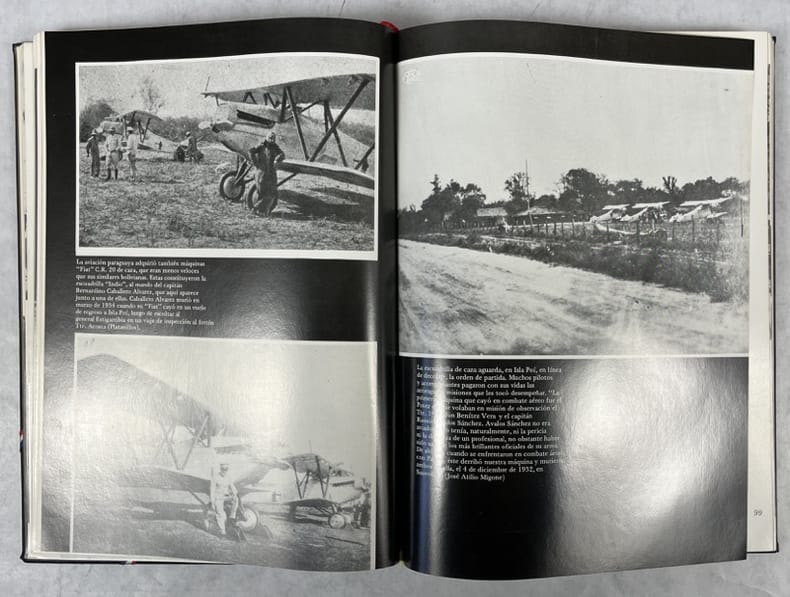
1985138564AsunciÓn, Paraguay, El Lector 1985 In-4 31,5 x 22,5 cm. Reliure éditeur simili-cuir bleu-marine, report titre argent sur le dos et le premier plat de couverture, 271 pp., abondamment illustré de photos en noir et blanc couvrant tous les aspects de la guerre : troupes, artillerie, aviation, transport maritime, publicité et propagande, santé, religion, etc., 1 carte, index des de 120 000 combattants paraguayens, dont 30 000 morts, table des matières. Tirage limité à 1000 exemplaires numérotés. Exemplaire en très bon état.
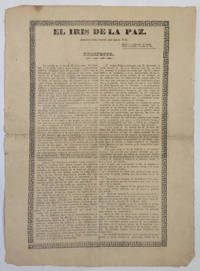
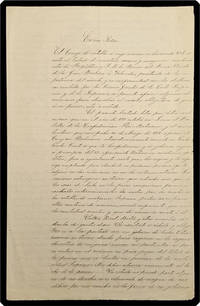
1829WRCAM51530La Paz: Imprenta del Colejio de Educandas 1829. Broadsheet 17 x 12 1/2 inches. Previously folded with tears along fold lines repaired by tape on the verso. A few minor chips and small tears at edges. Two other small holes not affecting text. Lightly tanned and dampstained. Good. A broadside prospectus for the Bolivian periodical EL IRIS DE LA PAZ which was published from 1829 to 1839. A united independent Bolivian state was officially established only four years previously in 1825 and this statement of intent strikes a particularly nationalist tone. In describing his purpose the author of the proposal writes: <br> <br> "A este papel se ha querido dar le nombre de IRIS DE LA PAZ para que désde su titulo prevenga á los lectores de que el objecto primario de su direccion es tratar los medios de conservar la armonia social fomentar el respeto á las leyes sostenar con sanos principios la necesidad de un sólido réjimen para la nacion y cuanto conduzca á cimentar entre nosotros la paz esterior y la tranquilidad interior del Estado." <br> <br> An interesting and rare document of early South American independence. Not on OCLC. Imprenta del Colejio de Educandas unknown books
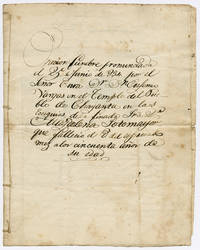
1834WRCAM43695Chayanta Bolivia 1834. 9pp. Quarto. Stitched sheets. Light creases and scattered soiling. Very good. Funeral sermon for Señora Magdalena Sotomayor whom the text refers to as an illustrious woman of the town. The first page of the oration features an elaborate manuscript frame around the text. unknown books
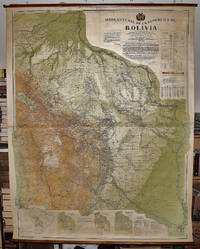
19362309280012Sociedad de Ingenieros de Bolivia y Centro de Propaganda y Defensa Nacional La Paz 1936. Maps. Very Good. Large color map of pre-WWII Bolivia. 146 x 185 cm. Mounted on muslin wood rods top and bottom. Scale 1:1000000. Relief shown by gradient tints and spot heights. Includes text climate diagram and 4 inset maps. Inset maps of: Vias de comunicacion internacional Sud America -- Vialidad y comunicaciones en Bolivia -- Riquezas explotables en Bolivia -- Isogonas magneticas para los anos 1930 y 1940 -- Perfil del territorio. <br> Note: This is a large heavy map. Additional postage will apply depending on delivery location Sociedad de Ingenieros de Bolivia y Centro de Propaganda y Defensa Nacional, La Paz, unknown
208 pages. Bibliography and glossary. Sumptuously and profusely illustrated with colour photos and reproductions of archival maps and illustrations. Text in English. "Documents the tremendous impact the arrival of New World gold and silver had upon Europe and the world economy. Describes the routes followed by the galleons on their return to Spain, loaded with precious metals, and the techniques used for their extraction. Discusses how mining towns were established, and famous fairs held in Portobelo and Jalapa. From this we learn how several mints were founded." - from Prologue. Clean, bright, tight and unmarked with negligible wear. Dust jacket now preserved in archival-grade Brodart. A suberb copy of this beautifully-presented work. Gift quality. Book
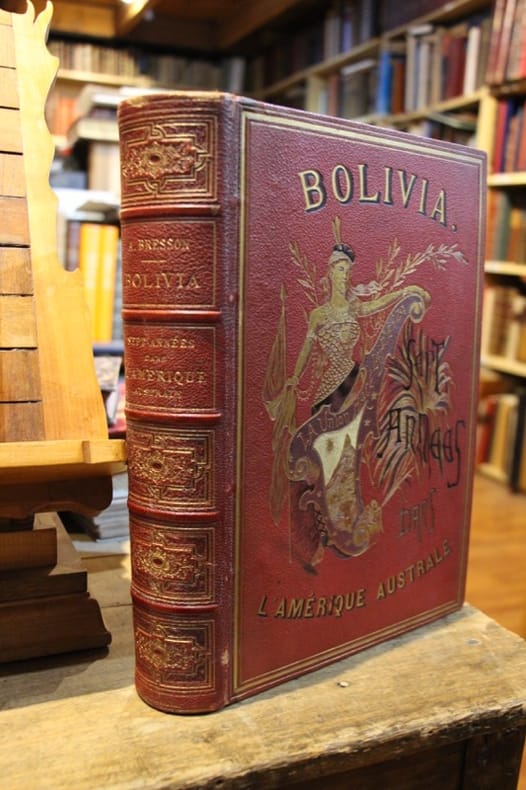
1886102771Paris, Challamel aîné, Librairie Coloniale 1886 In-4 28 x 19 cm. Reliure éditeur demi-chagrin rouge dos à nerfs encadrés de fers dorés, premier plat orné d’une composition noir et or avec report du titre doré, tranches dorées, couvertures conservées, XX-639 pp., 30 planches hors texte et de 77 vignettes dessinées par Henri Lanos, neuf vartes et panoramas polychromes, table des illustrations, table des matières. Coins légèrement émoussés et frottés, gouttière régulière, intérieur. Très bon exemplaire, enrichi d’un envoi autographe de l’auteur.
In 8° (17,3×11 cm); (2 b.), 48, 13, (3 b.) pp., 34, (2 b.) pp. Legatura novecentesca in piena pergamena semi-floscia. Esemplare in buone-ottime condizioni di conservazione. Prima edizione italiana e probabilmente, prima in assoluto, di questo interessante scritto di interesse americano. Della stessa opera, esistono diverse edizioni, una in francese (stampata a Parigi nel 1758), due in portoghese (stampate a Lisbona nel 1758 e nel 1759) e almeno tre in italiano (una del 1757, una del 1758 stampata a Siena e una del 1759 stampata a Lugano). L’opera presenta nella seconda parte la “ Breve di Nostro Signore PP. Benedetto XIV e decreti di S. M. Fedelissima”. Il “Manual Bibliographico de Estudos Brasileiros” n.° 4429, riferendosi all’edizione portoghese pubblicata nel 1759 scrive “Este escrito atribuido ao Marques de Pombal, minstero de D. Josè I, rei de Portugal e grande adversario dos Jesuitas, é un panfleto contra a Companhia … Este documento, apesr de seu tom apaixonado e muito parcial contra os Padres, é muito importante para a historia de um dos episodios maximos da vida e das atividades da Companhia de Jesus no Brasil”. Henry Stevens, Rare Anericanam n° 1326 descrive l’edizione italiana stampata a Lisbona nel 1758 dicendo” The original Portuguese Edition appeared at Lisbon in the same year (1758), and there was a edition in French, issued at Paris, also in 1758”. Oggi sappiamo che almeno un’edizione, questa, uscì già nel 1757 in lingua italiana. La seconda parte dell’opera contiene altri due scritti la “Deduzzione abbreviata degli ultimi fatti, e Procedure de’ Religiosi Gesuiti in Portogallo, e degli intrighi da essi macchiati nella Corte di Lisbona; scritta da un Ministro ben informato” e la “Breve di Nostro Signore PP. Bendetto XIV e Decreti di S. M. Fedelissima”. L’opera è un’importante pamphlet antigesuitico per attaccare i componenti della Compagnia di Gesù per la creazione delle celebri “Reducciones” , piccoli nuclei di cittadini, sopratutto nel Paraguay (ma anche in Cile, Uruguay, Bolivia, Argentina e nella Nuova Granada”), in parte autonomi dal potere centrale, da utilizzare come basi per l’evangelizzazione delle popolazioni indigene. L’idea iniziale era quella di creare realtà simili a quelle occidentali ma prive dei lati negativi di queste quali la depravazione, la corruzione, la lotta per il potere ecc. La fine delle Riduzioni fu l’inevitabile conseguenza delle lotte fra spagnoli e portoghesi, per il controllo del Sud America risolto nel 1750 con il Trattato di Madrid che sanciva i confini dei due imperi. Questo provocò migrazioni di popolazione. I gesuiti come i Guaranì non accettarono il trattato. I gesuiti ottennero dal sovrano spagnolo, dopo il pagamento di enormi ricchezze, di lasciare che l’opera di evangelizzazione potesse andare avanti con i metodi fino ad allora utilizzati basati sui valori religiosi e culturali ma impossibile fu ottenere lo stesso dal sovrano portoghese per i rapporti, già fortemente deteriorati con i gesuiti. Questa mancanza di accordi portò allo scoppio di diversi scontri, fino al definitivo inizio, di quella che sarebbe poi passata alla storia come la Guerra Guaranì che imperversò dal 1750 fino al 1756. Nel frattempo, in Europa, i gesuiti subirono fortissimi attacchi diffamatori con la pubblicazione di libelli e opere diffamatorie che puntavano a discreditare la Compagnia di Gesù agli occhi dei popoli europei. Prima edizione, assai più rara di tutte le edizioni edite nel 1758. Rif. Bibl.: IT\ICCU\CFIE\037507 che descrive questa edizione del 1757 priva però la “Deduzione, abbreviata degli ultimi, e Procedure …ecc., l’Avvertimento e la Breve di Nostro Signore PP. Benedetto XIV e decreti di S. M. Fedelissima); Borba de Moraes, II/ppp. 184-5, Palau, XVI/n. 260622; Parenti, Falsi Luoghi, p. 112; Henry Stevens, “Rare Americana” n° 1326, descrive però l’edizione italiana stampata a Lisbona nel 1758.
In-8 gr. (mm. 265x183), bellissima legatura edit. figurata in oro e nero, titolo oro al dorso interamente decorato, risg. damascati, tagli dorati, pp. (4),XI,796, magnificamente illustrato nel testo da inc. su legno: sono “plus de 1100 gravures, 27 cartes et 18 plans” di cui 4 a colori, a doppia pagina o più volte ripieg. f.t. (Pérou et Bolivie, itinéraire de Charles Wiener - Plan du Gran Chimu - Plan de Cuzco, première capitale de l’Empire de Tahuantin-Suyu - Vallée de Santa-Ana, depuis le col de la Cordillère orientale jusqu’aux cerros de Ychitariato). “Le 9 juillet 1875, le Ministère de l’instruction publique m’a fait l’honneur de me charger d’une mission archéologique et ethnographique qui s’est terminée le 26 aout 1877”, così precisa nell’introduzione l’A., lo scienziato-esploratore franco austriaco Wiener (1851-1913), forse il più noto per i viaggi effettuati in Perù. La prima parte è dedicata alla descrizione del viaggio, con partenza da Lima; la seconda all’architettura, scultura, oreficeria, ceramica, pittura; la terza si occupa di etnografia, di divinità e culti peruviani, con in fine una sintesi archeologica e storica di queste popolazioni. "Edizione originale". Con aloni e fiorit. ma complessivam. un discreto esemplare.
18423107Sucre 10 December 1842. Folio 3½ pp. <br><br>The official signed report of the Presidential Committee appointed to investigate the just-concluded "treaty of peace commerce and navigation" with Great Britain. The report observes: "The present treaty is letter for letter the same as that concluded in 1837 in Lima by the Proctor of the Peruvian-Bolivian Confederation and the same also bearing the date of 30 May 1838 that the Extraordinary Bolivian Congress meeting in Cochabamba approved" our translation. With five members dissenting the committee decides that the method of congressional approval though "farcical" was legal and binding. Bearing signatures among others of Pedro Buitrago Narciso Dulón Eusebio Gutiérrez M. de la Cruz Méndez José M. Dalence and Manuel Sagarnaga. Very good condition. Two small tears at folds not affecting text. unknown books
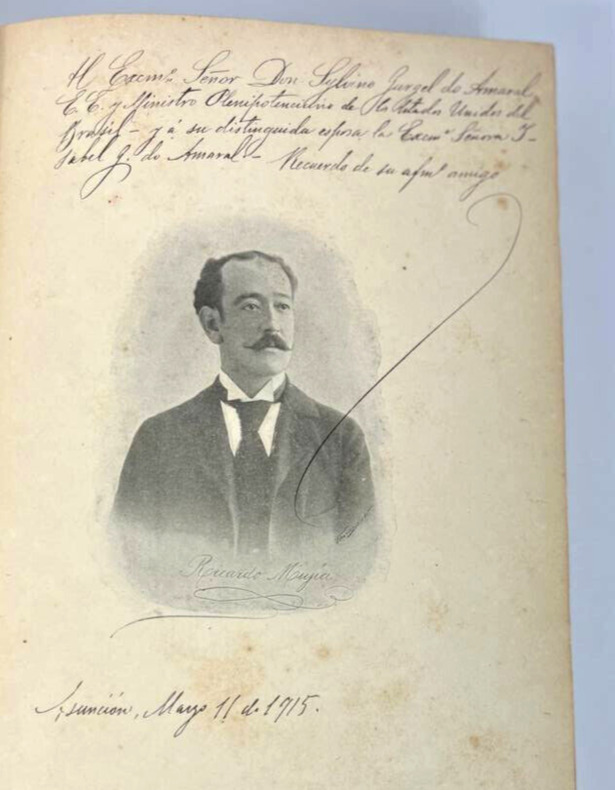
0037Barcelone, Typographie privée de Dionisio Brull, 1898. En espagnol. Édition originale. Grand in-8, 247 x 178 mm. 301 + 4 pp. Reliure artistique éditeur, dessin d'une jeune femme et titre en vert de style Art Nouveau, richement ornementé, le tout rehaussé de dorures. Dos lisse orné en vert et or, nom du livre à la verticale, nom d'auteur à l'horizontale au milieu dans une pièce de titre. Date au dos dans une plaque verte avec encadrement vert et dorure. Minuscule indication "J. Roca Barcelona" au bas de la couverture. Gardes bleutées à motif en croix, cercles et octogones à entrelacs celtiques. Photo de l'auteur en frontispice avec une remarquable dédicace à la plume, à l'écriture élégante, de 1915. Gravures d'inspiration romantique et bandeaux variés à travers l'ouvrage. La dédicace est adressée à Silvino Gurgel do Amaral (1874-1961), diplomate brésilien au long cours qui commença sa carrière à l'ambassade du Brésil à Saint-Pétersbourg, alors capitale de l'Empire russe, avant de représenter son pays dans de nombreuses villes d'Europe et d'Amérique du Sud. La dédicace, datée de 1915, coïncide avec sa période de service à l'ambassade du Brésil à Asunción en Bolivie. Né à Sucre, en Bolivie, Ricardo Mujía (1860-1938) fut avocat, professeur de littérature et d'histoire à Sucre et à Chuquisaca, où il assuma les fonctions de recteur d'université. Acteur enthousiaste de la révolution libérale de 1898, il occupe les postes de secrétaire de la présidence de la République, haut fonctionnaire du ministère de l'Instruction publique, ministre du Gouvernement et des Affaires étrangères. Diplomate, il a été secrétaire de la Légation au Brésil, chargé d'affaires au Pérou et ministre de la Légation bolivienne au Paraguay et en Argentine. Lorsque les libéraux perdent le pouvoir face à la révolution républicaine de 1920, Ricardo Mujía se retire de la vie publique et s'établit définitivement dans sa ville natale, d'où il part en 1927 rejoindre Buenos Aires, à la demande du gouvernement, où il contribue à la négociation de la frontière entre l'Argentine et le Paraguay. Poète de transition entre le romantisme et le mouvement moderniste initié par Rubén Darío, Mujía se distingue surtout par ses poèmes épiques d'inspiration patriotique. En 1925, il obtient le Flor Natural et la Banda del Gay Sabre au concours poétique du premier centenaire de la république pour son poème "La creación de Bolivia", une composition de 324 vers, dans laquelle il chante tout au long des vicissitudes de la république et ses cent ans d’histoire. Penumbras constitue son recueil poétique le plus connu. Il a également écrit divers ouvrages sur les limites de la frontière avec le Paraguay et d'autres ouvrages historiques. ********************************************************************************************************** Large octavo, 247 x 178 mm. 301 + 4 pp. Artistic publisher's binding, drawing of a young woman and title in green in the Art Nouveau style, richly ornamented, all enhanced with gilt. Smooth spine decorated in green and gold, book name vertically, author's name horizontally in the center in a title label. Date on the spine in a green plate with a green and gold frame. Tiny inscription "J. Roca Barcelona" at the bottom of the cover. Blue endpapers with a motif of crosses, circles, and octagons with Celtic interlacing. Photo of the author on the frontispiece with a remarkable dedication in elegant penmanship from 1915. Romantic-inspired engravings and various banners throughout the work. The dedication is addressed to Silvino Gurgel do Amaral (1874-1961), a long-serving Brazilian diplomat who began his career at the Brazilian Embassy in Saint Petersburg, then the capital of the Russian Empire, before representing his country in numerous cities throughout Europe and South America. The dedication, dated 1915, coincides with his period of service at the Brazilian Embassy in Asunción, Bolivia. Born in Sucre, Bolivia, Ricardo Mujía (1860-1938) was a lawyer and professor of literature and history in Sucre and Chuquisaca, where he served as university rector. An enthusiastic participant in the liberal revolution of 1898, he held the positions of Secretary to the Presidency of the Republic, senior official in the Ministry of Public Instruction, and Minister of Government and Foreign Affairs. A diplomat, he served as Secretary of the Legation in Brazil, Chargé d'Affaires in Peru, and Minister of the Bolivian Legation in Paraguay and Argentina. When the Liberals lost power in the Republican Revolution of 1920, Ricardo Mujía withdrew from public life and settled permanently in his hometown. From there, he moved to Buenos Aires in 1927 at the government's request, where he contributed to the negotiation of the border between Argentina and Paraguay. A poet of transition between Romanticism and the Modernist movement initiated by Rubén Darío, Mujía is particularly distinguished by his epic poems of patriotic inspiration. In 1925, he won the Flor Natural and the Banda del Gay Saber awards in the poetry competition for the first centenary of the republic for his poem "La creación de Bolivia", a 324-line composition in which he sings about the turmoils of the republic and its hundred years of history. Penumbras is his best-known collection of poetry. He also wrote various works on the limits of the border with Paraguay and other historical works.
1833WRCAM39277Chuquisaca: Tipografia de Chuquisaca 1833. 233pp. In Spanish. Pages 17 and 21 reversed due to printer's error. Small folio. Gathered signatures stitched. Contemporary ink ownership inscription "Señor Dn. Manuel Capiede " and later clerical ink inscription "RM No 694" in upper margin of titlepage. Ink ownership stamp on titlepage and final page. Light marginal staining on outer leaves. A very good copy. A very rare collection of the founding documents of Bolivia's "Tribunal Jeneral de MinerÃÂa" the mining tribunal created by President Andrés de Santa Cruz in 1829. The tribunal was established after years of conflict in Bolivia's fight for independence from Spain and early internal struggles that left its important mines in a state of disrepair. The present document contains presidential decrees from Santa Cruz and numerous communications from the Minister of State from 1829 to 1833 and the by-laws of the Tribunal approved Sept. 4 1830. The by- laws a major portion of the document are largely concerned with the different forms of labor at Bolivia's mines. No copies found in Palau or listed by OCLC. RENÉ-MORENO BIBLIOTECA BOLIVIANA 694. Tipografia de Chuquisaca unknown books
1890c2311100201xbvkParis, imprimé par autorisation de M. le Garde de Sceaux, à L'Imprimérie National, M DCCC XC.(1890); Lithograph printed by L. Léchaudel. 26 singleside printed large-paper cardboard-sheets, incl. 1 coloured plate; large-4to.(ca. 32 x 25 cm, few plates slightly smaller ca. 31 x 24 cm).
In -4°, pp. (40), 450, (42), frontespizio in cornice con vignetta, testo su due colonne; legatura in piena pergamena con titolo manoscritto al dorso, piccoli fori su un angolo del frontespizio, non intaccano testo e cornice. Nato in Bolivia, intorno al 1626, l’autore fu sacerdote a Sucre, prolifico scrittore teologo e predicatore. Small holes on a corner of title page, text and frame are untouched. Born in Bolivia around 1626 the author was a priest in Sucre, writer, theologist and preacher. ARch. S
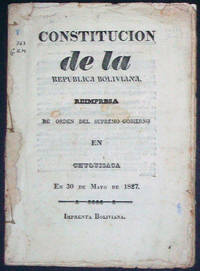
1827WRCAM39275Chuquisaca: Imprenta Boliviana 1827. 233pp. In Spanish. Pages 17 and 21 reversed due to printer's error. Gathered signatures stitched. Clerical ink inscription "763 G.R.M." in inner margin of titlepage. Minor light staining. Very good. Untrimmed. In a half morocco box. The extremely rare second and last official edition of Bolivia's first constitution after the slightly less rare first edition of 1826. In 1825 Upper Peru became the final South American republic to secure its independence from Spain under the leadership of Simón BolÃÂvar renaming itself Bolivia in his honor. BolÃÂvar himself drafted this first constitution of the country in 1825 and handed power to Gen. Antonio José de Sucre as president for life. The constitution was accepted by the second Bolivian congress in 1826 and Sucre accepted his appointment but only for two years with the provision that two thousand Columbian troops should remain with him in La Paz. In late 1827 after repeated uprisings Sucre and his army were driven from the capital and the constitution was changed the following year. This second edition which bears a serious printer's error in the section on the president is especially scarce and not recorded by Palau. OCLC records the imprint but locates no copies. RENÉ-MORENO BIBLIOTECA BOLIVIANA 763. Imprenta Boliviana unknown books