BIANCIOTTI, Héctor.MareMagnum

964 résultats
Barcelona, Tusquets Editor, 1973 ["Cuadernos Ínfimos"]. 4to. menor; 216 pp., 1 h. Cubiertas originales.
In 8' gr., br. ed. fig. col., pp. 237, ill. col. ad inizio di ogni capitolo; spaccatura e mancanza al dorso, bruniture ai piatti., e strappetti ai margini, interno in buono stato.Ampia dedica a tutta pagina dell'A. in frontespizio datata 1957.(foto)
PARIS, P.U.F. - Fondée en 1878 par Gabriel Monod, publiée avec le concours du CNRS et de la 6e section de l'Ecole des Hautes Etudes.- Revue historique N° 520, Octobre, décembre 1976 - In-8, 15,5 x24 cm - Broché - paginé 289 à 592 - Propre - Envoi rapide et soigné La Revue historique, est une revue d’histoire française créée en 1876 par le protestant Gabriel Monod et le catholique Gustave Fagniez. Cette nouvelle revue s'inscrit en réaction contre La Revue des Questions historiques créée dix ans plus tôt et qui traduisait la pensée d'une droite ultramontaine et légitimiste. La Revue historique ne se réclame d'aucune religion, d'aucun parti, d'aucune doctrine Éditée à Paris par les Presses universitaires de France
0364442913.Ghardcover. Good. Access codes and supplements are not guaranteed with used items. May be an ex-library book. hardcover
0656565837.Gpaperback. Good. Access codes and supplements are not guaranteed with used items. May be an ex-library book. paperback
Madrid, Instituto de Filología, CSIC, 1994. Dos volúmenes en 4to. mayor; 457 pp. en paginación continuada. Cubiertas originales.
27225PARIS, P.U.F. - Fondée en 1878 par Gabriel Monod, publiée avec le concours du CNRS et de la 6e section de l'Ecole des Hautes Etudes.- Revue historique N° 520, Octobre, décembre 1976 - In-8, 15,5 x24 cm - Broché - paginé 289 à 592 - Propre - Envoi rapide et soigné
Barcelona, Editorial Seix Barral, 1983. 4to.; 233 pp., 2 hs. Encuadernación original en güaflex.
Buenos Aires, Ediciones Sed, 1952. 4to.; 171 pp., con ilustraciones entre el texto, de Jorge Edgardo Lezama. Cubiertas originales.
Buenos Aires, Editorial Bell, 1950. 4to.; 274 pp.y 12 reproduciones fotográficas fuera de texto. Cubiertas originales.
1951R260117093REPUBLICA ORIENTAL DE URUGUAY. 1951. In-18. Broché. Etat d'usage, Couv. défraîchie, Dos satisfaisant, Intérieur frais. 94 pages. Manque sur le second plat.. . . . Classification Dewey : 989-Paraguay et Uruguay
In 8° (17,3×11 cm); (2 b.), 48, 13, (3 b.) pp., 34, (2 b.) pp. Legatura novecentesca in piena pergamena semi-floscia. Esemplare in buone-ottime condizioni di conservazione. Prima edizione italiana e probabilmente, prima in assoluto, di questo interessante scritto di interesse americano. Della stessa opera, esistono diverse edizioni, una in francese (stampata a Parigi nel 1758), due in portoghese (stampate a Lisbona nel 1758 e nel 1759) e almeno tre in italiano (una del 1757, una del 1758 stampata a Siena e una del 1759 stampata a Lugano). L’opera presenta nella seconda parte la “ Breve di Nostro Signore PP. Benedetto XIV e decreti di S. M. Fedelissima”. Il “Manual Bibliographico de Estudos Brasileiros” n.° 4429, riferendosi all’edizione portoghese pubblicata nel 1759 scrive “Este escrito atribuido ao Marques de Pombal, minstero de D. Josè I, rei de Portugal e grande adversario dos Jesuitas, é un panfleto contra a Companhia … Este documento, apesr de seu tom apaixonado e muito parcial contra os Padres, é muito importante para a historia de um dos episodios maximos da vida e das atividades da Companhia de Jesus no Brasil”. Henry Stevens, Rare Anericanam n° 1326 descrive l’edizione italiana stampata a Lisbona nel 1758 dicendo” The original Portuguese Edition appeared at Lisbon in the same year (1758), and there was a edition in French, issued at Paris, also in 1758”. Oggi sappiamo che almeno un’edizione, questa, uscì già nel 1757 in lingua italiana. La seconda parte dell’opera contiene altri due scritti la “Deduzzione abbreviata degli ultimi fatti, e Procedure de’ Religiosi Gesuiti in Portogallo, e degli intrighi da essi macchiati nella Corte di Lisbona; scritta da un Ministro ben informato” e la “Breve di Nostro Signore PP. Bendetto XIV e Decreti di S. M. Fedelissima”. L’opera è un’importante pamphlet antigesuitico per attaccare i componenti della Compagnia di Gesù per la creazione delle celebri “Reducciones” , piccoli nuclei di cittadini, sopratutto nel Paraguay (ma anche in Cile, Uruguay, Bolivia, Argentina e nella Nuova Granada”), in parte autonomi dal potere centrale, da utilizzare come basi per l’evangelizzazione delle popolazioni indigene. L’idea iniziale era quella di creare realtà simili a quelle occidentali ma prive dei lati negativi di queste quali la depravazione, la corruzione, la lotta per il potere ecc. La fine delle Riduzioni fu l’inevitabile conseguenza delle lotte fra spagnoli e portoghesi, per il controllo del Sud America risolto nel 1750 con il Trattato di Madrid che sanciva i confini dei due imperi. Questo provocò migrazioni di popolazione. I gesuiti come i Guaranì non accettarono il trattato. I gesuiti ottennero dal sovrano spagnolo, dopo il pagamento di enormi ricchezze, di lasciare che l’opera di evangelizzazione potesse andare avanti con i metodi fino ad allora utilizzati basati sui valori religiosi e culturali ma impossibile fu ottenere lo stesso dal sovrano portoghese per i rapporti, già fortemente deteriorati con i gesuiti. Questa mancanza di accordi portò allo scoppio di diversi scontri, fino al definitivo inizio, di quella che sarebbe poi passata alla storia come la Guerra Guaranì che imperversò dal 1750 fino al 1756. Nel frattempo, in Europa, i gesuiti subirono fortissimi attacchi diffamatori con la pubblicazione di libelli e opere diffamatorie che puntavano a discreditare la Compagnia di Gesù agli occhi dei popoli europei. Prima edizione, assai più rara di tutte le edizioni edite nel 1758. Rif. Bibl.: IT\ICCU\CFIE\037507 che descrive questa edizione del 1757 priva però la “Deduzione, abbreviata degli ultimi, e Procedure …ecc., l’Avvertimento e la Breve di Nostro Signore PP. Benedetto XIV e decreti di S. M. Fedelissima); Borba de Moraes, II/ppp. 184-5, Palau, XVI/n. 260622; Parenti, Falsi Luoghi, p. 112; Henry Stevens, “Rare Americana” n° 1326, descrive però l’edizione italiana stampata a Lisbona nel 1758.
16mo [17.5 x 10.5 cm]; [iv], 302 pp. contemporary boards, gilt rules and gilt lettering on spine red leather label, edges rubbed, very good, quite clean. A picture of this book is available upon request by email. The last 59 pages are Lettres du P. Gaetan Cattaneo, missionare de la Compagnie de Jesus, A. M. Joseph Cattaneo, which are letters from Buenos Airs dated 1729 and on.
182238198Louvain, Vanlinthout et Vandenzande, 1822. XVI, 218 S. (22 cm) Broschierte Ausgabe, unbeschnitten
PARIS, Sté Catholique des Bons Livres, 1826 - In-12 Carré - Reliure plein veau de l'époque (petit accroc & traces de vers sur 20 pages en queue) - Dos lisse orné - 302 pages - en dehors du défaut mentionné très frais intérieurement - envoi rapide et soigné Ces relations décrivent la tentative d'implantation des Jésuites au Paraguay.
Paris, Sociéte Catholique des Bons Livres, 1826, 16,5 x 10,5 cm., holandesa piel de época, 2 h. + 302 págs.
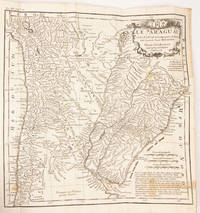
17544105Paris:: chez Bordelet libraire rue S. Jacques vis-à -vis le Collége de Jésuites à Saint Ignace 1754. FIRST FRENCH EDITION. The original Italian edition "Il cristianesimo felice nelle missioni" appeared in two parts: 1743 and 1749. Octavo:. 16.5 x 9.7 cm. 2 XXIV 402 4 p. With added map. Collation: Ï€1 a-b8/4 A-Z8/4 Aa-Kk4/8 Ll3 Lacking final blank. This is an attractive copy in contemporary mottled spine richly tooled in gold light wear to head and foot of spine and extremities. The text is in fine condition with a few small marginal stains lvs. G1-2 N8 O1 and another small stain to the margins in the final two signatures touching the text on a few lvs. The large folding map of Paraguay in nice shape with a few light stains. Faded 18th c. exlibris on title “bibliotheca….†with a globe surmounted by a Greek cross. With a large folding map of Paraguay. Muratori’s book marked an important development in the historiography of Paraguay. Muratori offered a new approach to the subject distinct from the narratives of the Jesuits the skeptical approach of the Jansenists and those writers who filled their accounts with a mixture of adventure and romance. “Muratori was far from being a propagandist for the Society of Jesus: during the research for his “Cristianesimo felice†he was locked in violent argument with them and was not allowed to consult any of their archives. He had started off with the problem of understanding the Church's missionary activity among the newly-discovered peoples and found that the original evangelical impulse remained unaffected by political considerations in the case of Paraguay… “Muratori's work was… not apologetic in intention even though his attitude regarding the State of Paraguay turned out to be a positive one but it opened up another dimension in the debate. He placed Paraguay firmly in the context of human history. Although he did not share the conclusions of the Jansenists it is nevertheless easy to understand why the Jesuits did not look favorably on his work. He did not remove the sacred element in the Jesuit enterprise but he examined what human elements lay at its root. The Jesuits finding themselves in a world which Muratori described according to Lafitau's theory employed "utility . that great driving impulse of human hearts" to civilize the Indians. "Well-regulated freedom adequate provision for food clothing and lodging public quiet and individual tranquility are in my belief the real and solid elements which contribute to a people's happiness.†These "small republics" could "in a certain sense be called an immense number of monasteries where both the spiritual and practical affairs of the day are wonderfully well regulated and the upkeep of each is provided for." It followed that Paraguay was "far in advance of the conditions of many European peoples.â€Imbruglia The Jesuit Missions of Paraguay and a Cultural History of Utopia 1568–1789 p. 135 ff. The Reductions as a restorative: Muratori was aligned with Las Casas in his estimation of the cruelty and “European barbarism†of the Conquistadors who entered the New World “totally oblivious not only to the Gospel but also to being humanâ€. In the spirit of restitution Muratori offered the reductions of Paraguay as a model for restoring and improving the happiness of the Indians -who before the Conquest had been “simple without malice patient and peacefulâ€- through a benevolent Christianity. “The Indians of the riduzioni enjoyed greater freedom than all the other subjects of the kingdom of Spain as they had no obligations other than a small tax to which men only were subjected and military duties in case of need. In any case although Muratori praised the institution of collective property and the limitation of currency as guarantees of equality he never went so far as to fantasize utopias such as proposing the "Christian communistic" system of Paraguay as a possible model for European society. He confessed to "having fallen in love" with those missions insofar as they reminded him of "the primitive Church" and praised the admirable example of the missionaries who carried the cross among barbarians.â€Buccini “The Americas in Italian Literature and Culture 1700-1825 p. 6 ff. Sabin 51419; Sommervogel II 890 et V 37. Conlon Le siècle des lumières 54:907 chez Bordelet, libraire, rue S. Jacques, vis-à -vis le Collége de Jésuites, à Saint Ignace, unknown books
Louvain, Société Catholique de la Belgique (chez Vanlinthout & Vandenzande) 1822, xvi + 218pp.["Paraguai…"] + (iv +) 59pp.["Instructions"] + (iv +) 148pp.["Marseilles…"], relié ensemble en plein cuir, bel état, rare
302pp., 17cm., reliure cart. du 19e siècle, dos en cuir brun avec titre fleurons et faux-nerfs dorés, tranches marbrées, qqs.traces d'usage, quelques cachets sur la p.d.t., ouvrage traduit de l'italien, bon état, [les pages 221 à 302 contiennent trois lettres du p. Gaetan Cattaneo missionnaire de la Compagnie de Jésus, à m. Joseph Cattaneo, son frère], R92296
xvi + 218pp., quelques rousseurs dans le texte, 22cm., br.muet marbré d'époque
xvi + 218pp., 22cm., reliure cart. moderne 'plats marbrés, dos en toile), qqs. rousseurs, bon état, R32484
Buenos Aires, Librería La Facultad, de Juan Roldán, 1919 [Biblioteca Argentina]. 4to.; 318 pp., y 1 lámina con el retrato del autor. Encuadernación original en piel estampada. Una obra destinada a crear "un nuevo sistema claro y positivo para el régimen de las Iglesias del Nuevo Mundo" mediante el análisis histórico de lo que habían sido las relaciones iglesia-estado desde la Conquista a la Independencia en la América Española. Obra destacada del autor, junto a Carlos Tejedor, de la Constitución del Estado de Buenos Aires y del Código Civil Argentino.
183314915Paris Librairie Catholique d'Ed. Bricon 1833 In-12 302 pp, traduite de l'italien par F. Muratori, toutes tranches marbrées ; fleurons, filets et roulettes dorés au dos, roulettes d'encadrement sur les plats, roulettes sur coiffes. Rares rousseurs à l'intérieur, frottis sur les plats, un petit manque de cuir sur mors en queue.
182698932Paris, Société catholique des bons livres, impr. Imprimerie de Trembay, à Senlis 1826 In-12 18,5 x 10,5 cm. Reliure postérieure XXe s. demi-chagrin fauve à coins, dos à nerfs ornés de roulettes dorées, couvertures conservées, 302 pp. Reliure postérieure en très bon état, couvertures d’origine ternies, intérieur légèrement et uniformément jauni, 3 tampons de bibibliothèque en marge.
ORD-8050Traduite de l'Italien de M. Muratori. Paris. Sté Catholique des Bons Livres. 1826. Petit in-12 pleine basane brune, dos lisse orné, pièce de titre maroquin rouge, tranches marbrées, 302pp. La relation proprement dite se termine à la page 220, elle est suivie par Lettres du P. Gaetan Cattaneo, missionnaire de la Cie de Jésus à M. Joseph Cattaneo son frère. Impression sur papier gris. Coiffe supérieur abîmée, coins lgt émoussés, dernière garde absente, sinon bon état.