ARAGO (Jacques Etienne Victor)Livre Rare Book
155 résultats
1822003091Leblanc, chez Abel Ledoux, (s. d.), 1822
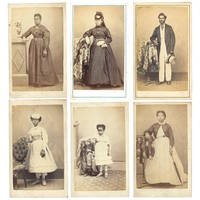
1890363568Rio de Janeiro Brazil: Photographia do Commercio 1890. A group of six carte-de-visite format albumen prints likely dating from the 1890s. The subjects are all Afro-Brazilians posed standing with their right arm resting on a piece of furniture a table a chair a pedestal. Five of the six images have printed backs identifying them as originating from Photographia do Commercio Rua da Carioca no. 40 Rio de Janeiro. These printed backs are in two styles both similar but one is smaller than the other. The sixth image has no identifying information but the distinctive pattern of the cloth on the table visible in the image places it in the same photo studio.<br /> <br /> Wilhelm Gaensby 1843–1928 emigrated to Brazil from Switzerland with his parents when he was five in 1848. He learned photography from Alberto Henschel and opened his own studio in Salvador in 1875. About 1893 he moved to Rio de Janeiro keeping his original studio in operation. A number of albums of Gaensby's landscape and scenic photographs survive but little has been written about his studio work. Perhaps the best survey of his career can be found in the chapter devoted to him in Os Fotógrafos do Império Editora Capivara 2005; translated from Brésil: Les premiers photographes d'un empire sous les Tropiques; Gallimard 2005. Generally very good or better. Medium contrast images tending towards sepia tones. Photographia do Commercio unknown
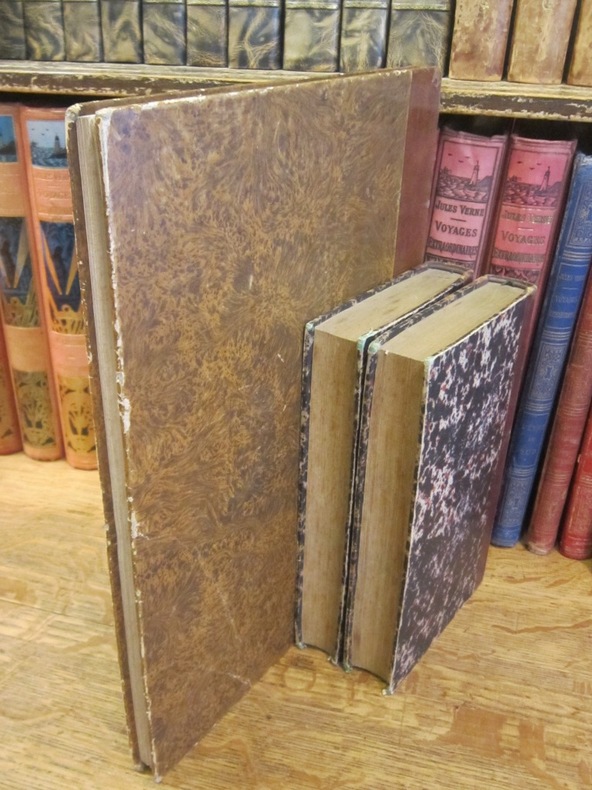
1860PHO-2406Paris, Librairie de L. Hachette et Cie, 1860-65. 2 volumes de texte in-8 (235 x 148 mm) de : I/ lxiv pp., 486 pp., (1) f. d’errata ; II/ (2) ff., 480 pp., iv pp. de table ; et 1 Atlas in-folio (57x40cm). Texte : relié demi veau, dos lisse avec titre et tomaison, dos frotté, coiffes arasés, charnières faibles au tome 2, cachets aux titres. Atlas : sous portefeuille demi toile, titre et tomaison au plat, 2 chemises de livraison comportant 13 planches (16) et 2 planches en double (Fragment de carte et Ruine de l’église Saint Michel), portefeuille frotté, chemises de livraison ébarbées, rousseurs, petites mouillures marginales, une planche plus petite en marge.
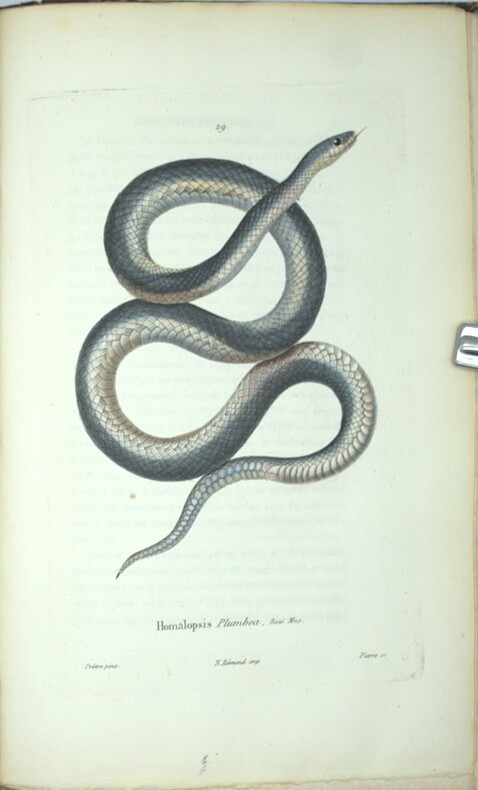
1833PHO-2302Paris, Imprimerie Royale, Arthus Bertrand, au dépôt général de la marine, 1833-1839. 5 vol. in-8 (25,5x16,5cm) demi-chevrette rouge, dos à nerfs orné (reliure de l'époque), supplément lépidoptères broché de I. [2] ff.-xli-558-[1] pp. ; II. [2] ff.-481-[1] pp., grande carte dépliante (piqûres, coupures aux pliures sans manque) ; III. [2] ff.-510-[1] pp. ; IV. [2] ff.- 480 pp. ; V. [2] ff., 195-200 pp., Supplément Lépidoptères 30pp., 70 planches dont 61 soigneusement aquarellées. Rousseurs touchant principalement le texte et très peu les planches, mouillures claires par endroits au texte, feuillets volants pour le supplément. Sans les deux grands atlas historique et hydrographique, mais bien complet du très rare 5e volume d'histoire naturelle, paru ultérieurement qui manque presque toujours et complet des planches. Ce rarissime cinquième et dernier volume de texte, qui comporte 2 parties, renferme le rapport fait à l'Académie des sciences le 4 février 1833 sur les collections d'histoire naturelle recueillies pendant le voyage de la corvette La Favorite…, les Recherches sur les marsupiaux par Fortuné Eydoux et Laurent, la 2e partie Zoologie par Fortuné Eydoux et Paul Gervais, le supplément sur les Lépidoptères nouveaux par Feisthamel.
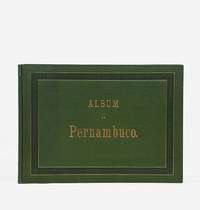
1880108232Pernambuco: F. H. Carls 1880. Brazil following independence captured in superb photorealistic chromolithography A wonderfully preserved copy of this superb visual record of Brazil in the late 19th century. "The colourful and airy rendering contributes much to the appeal of this extensive series of images that forms one of the most comprehensive visual reports carried out on any Brazilian city in the period" Correa do Lago. The album was first issued in 1873 with 50 plates under the title Album de Pernambuco e seus arrabaldes Pernambuco and its Environs. It was later reissued with varying numbers of plates some copies having as few as 15 or 20 the composition rarely the same twice. Carls was a German graphic artist designer and photographer who joined the wave of German immigration to Brazil settling in Recife in 1859 where he established one of the first lithographic presses in Pernambuco. An enterprising and innovative printer he took on a wide range of work bringing the potential of high-quality lithographic printing to advertising material diplomas stock certificates letterheads and also maps being the publisher of José Tibúrcio Pereira Magalhães's Cidade do Recife e seus arrabaldes Recife City and its Environs in 1870. It is for the present sequence of plates that Carls is best known. They comprise an inclusive collection of impressive views of the region: the public buildings provincial assembly presidential palace the Hospital Pedro II commercial streets rua do Imperador rua 1o de Março grand private homes the mansion of Dr Augusto Frederico de Oliveira which now houses the state museum and the seat of the Portuguese merchant João José Rodrigues Mendes Barão Rodrigues Mendes now the headquarters of the Pernambuco Academy of Letters theatres churches mother churches of San Antonio and Boa Vista shipping in the harbour markets and landscapes of the outlying villages and estates all teeming with life showing the signs of the accelerating modernization of Brazil following independence "a significant iconographic series for the visual memory of the country depicting scenes of everyday life customs and landscapes" Silva p. 1567. The album was a collaboration with German-born artist Louis Adam Cornell Krauss who arrived in Recife in 1877 but it has been suggested that the plates incorporate the uncredited work of pioneering Brazilian photographers such as João Ferreira Vilela Alfredo Ducasble Guilherme Gaensly Wilhelm Gänsli and Augusto Stahl. Certainly several of the views exhibit a sharpness of detail that hints at the use of photographic templates and some bear a close resemblance to images produced by these Brazilian pioneers. For example the view of Recife from the observatory of the naval arsenal is very similar to Gaensly's framing of the same subject and the plate of the Sete de Septembro bridge bears comparison with Vilela's views. When the Pernambucan organising committee for the Berlin South American exhibition of 1866 included one of Carls's albums they did so in the belief that this would present the German public with an "an idea of the beauty of our city". Landscape quarto 300 x 420 mm. High-finish pictorial chromolithographic calendar for 1880 with Carls' imprint as title page and 36 coloured lithographic plates. Original green cloth title gilt to the front board within a broad black stylised floral panel between two single gilt ruled panels the black panel repeated on the lower board edges lightly marbled floral-pattered endpapers in sepia the title in German neatly inked in purple in a contemporary hand to the first blank small bookbinder's ticket of Wilhelm Bitz Basel to the lower fore-corner of the front pastedown dated August 1885 in the same hand. Housed in a dark green cloth flat-back box by the Chelsea Bindery. Very light shelf-wear some marginal browning to the plates occasional scatter of spotting overall very good indeed. Not in Borba de Moraes; Correa do Lago Brasiliana Itaù pp.328-9; Silva "Franz Carls: Memórias Litográficas do Recife Oitocentista" in 21st Encontro Nacional de Pesquisadores em Artes Plásticas - Vida e Ficção / Arte e Fricção 2012. hardcover