BRUNE Paulin - LAVERGNE Bernard (photographies)Livre Rare Book

929 résultats
198713231987 La Réalité 1987 Un volume grand in°4 reliure cartonnée éditeur sous jaquette 141 pages Nombreuses photographies en couleurs LR15
193441848Washington D.C.: U.S. Bureau of Mines 1934. First edition. Stapled paper wrappers. A very good copy. 30 pp. Sm. 4to. U.S. Bureau of Mines unknown books
1900WRCAM52852Georgetown British Guiana: James Thomson Argosy Office 1900. Twenty-four photographic reproductions on 16pp. bound in accordion style. Original blue publisher's cloth front board gilt. Light shelf wear. Pressed leaf laid in. Internally clean. Very good. A scarce volume of images of British Guiana from approximately the end of the 19th century produced in London and published by a local newspaper office as a souvenir. The photographic reproductions consist mostly of images of the capital of the colony Georgetown including neighborhood architecture street views government buildings the botanic gardens and the coast. There are also several images of inland gold prospecting sites. Only two copies in OCLC at the University of Texas and the University of the West Indies. James Thomson, Argosy Office hardcover books
26080The Times and the Globe London. Four letters by 'NIGER' to the Globe dated 29 and 30 January 9 February and 2 March 1850. Four letters to The Times two apiece from 'NIGER' and 'JACOB OMNIUM' dated in October and November 1850. A contemporary manuscript note to the present item reveals for the first time the identity of ‘Niger’ one of the two correspondents of whose letters it consists. And minor manuscript corrections to the last of the four letters would seem to suggest the involvement of the author. This is Sir James Robert Carmichael 1817-1883 2nd Bart who was intimately connected with British Guiana through his father Sir James Carmichael-Smyth 1779-1838. Having served from 1829 as governor of the Bahamas where he abolished the flogging of female slaves Carmichael-Smyth had been appointed governor of British Guiana in June 1833. According to Carmichael-Smyth’s entry in the Oxford DNB he ‘arrived at Georgetown Demerara shortly before the emancipation of slaves when much depended on the governor. Unmoved by the reckless hostility of a section of the planters Carmichael-Smyth by a firm impartial and vigorous government won the confidence of the slaves. He so closely supervised every department of government that as he himself observed he could sleep satisfied that no person could be punished without his knowledge and sanction. Carmichael-Smyth died suddenly at Camp House Georgetown Demerara of ‘brain fever’ after four days’ illness on 4 March 1838; he was widely esteemed and his death much regretted.’ The other correspondent ‘Jacob Omnium’ is Thackeray’s friend Matthew James Higgins 1810-1868 whose entry in the Oxford DNB states: ‘In 1838–9 he visited British Guiana where he later inherited the Alliance estate after the death of his mother and repeated the visit in 1846–7. This experience enabled him to keep his estate in good order during the critical period which followed the abolition of slavery and to put the case for the West India planters in defence of the protective sugar duties. He wrote four effective pamphlets upon the difficulties of the sugar-producing colonies in 1847 and 1849.’ The material consists of eight long letters in small print to the Globe and The Times laid down on nine foolscap 8vo pages over six leaves extracted from an album. The total length of text in 7-inch wide columns is 430 cm. In good condition lightly aged and worn on worn leaves. The first four letters from ‘Niger’ to the editor of the London newspaper the Globe are on the subject of ‘British Guiana and Governor Barkly’. These four are dated 29 and 30 January 9 February and 2 March 1850. ‘NIGER’ is identified in a contemporary hand at the end of the first letter as ‘Sir J R Carmichael’. The last four letters are an somewhat intemperate exchange in The Times of two letters apiece between ‘NIGER’ writing from London on 30 October headed ‘A WORD TO WEST INDIA PROPRIETORS’ and 12 November and ‘JACOB OMNIUM’ writing from Lombard Street on 10 and 16 November. At the start of the first of his letters to the Globe Carmichael states his position: ‘Mr Barkly has earned so high a reputation among men of all parties both in his late position in Parliament and in the discharge of his present arduous functions in Guiana that he may well afford to despise the bitter revilings of disappointed faction; but the article in question contains allegations so unfair ungenerous and unscrupulous in their nature that I consider the public should be made acquainted with the true state of the case at issue between the Morning Chronicle and the Governor of Guiana.’ This he proceeds to do presenting a mass of detail including some taken from ‘the lastest accounts’ he has received from ‘the West India mail’. In the first of his letters to The Times Carmichael discusses ‘the treatment the unfortunate race of Africa hae met with at the hands of the white man’: ‘I have known a slave to be destroyed by torture and a fine inflicted on the overseer as a punishment; but these thank God are tales of a bigone day. My only object in alluding to them is to point out to the West India proprietors that they have been guilty of a great and sad dereliction of duty of which they are now reaping the unavoidable punishment. They have treated the colonies as hotbeds from whence to forcec money into their pockets; they have forgotten what they owed to those whose toil supplied their wants and luxuries’. Higgins responds: ‘All that “Niger†says concerning the unhappy fate of the slaves in the British West Indies in bygone days may for all I know be most accurate. I cannot however divine why he has reverted to it. . Without disputing the accuracy of his picture of West Indian cruelty and West Indian mismanagement under the obsolete system of slavery I submit that it is . unfair and irrelevant to endeavour to introduce it into the present question between Lord John Russell and the free-labour sugar-growers’. In his last letter Higgins complains: ‘Your correspondent “Niger†preserves a great advantage over me. He well knows who I am the nature of my connexion with the colonies and the habits of my family and he very skilfully and I think somewhat unhandsomely turns the minutest points of that knowledge to his advantage whilst he carefully preserves his own incognito affording me no clue whereby I may infer what manner of man my assailant is.’ While acknowledging ‘Niger’ to be ‘a very able partisan’ Higgins concludes by accusing him of ‘doing his best to throw dust in the eyes of the British nation’. See Scan. I've yet to find an example of Carmichael-Smyth's handwriting to make a judgment on the signature. The setting out of the articles suggests a personal interest even file copy. The Times and the Globe, London. Four letters by 'NIGER' to the Globe dated 29 and 30 January, 9 February and 2 March 1850. Fou unknown
1932HALL510223Paperback. 1932. 44 to 224pp plates & maps card covers London 1932-1961. Very good ex-library copies. . paperback
B9781019938461Hardback. New. hardcover
139096650X.Gpaperback. Good. Access codes and supplements are not guaranteed with used items. May be an ex-library book. paperback
1391243862.Ghardcover. Good. Access codes and supplements are not guaranteed with used items. May be an ex-library book. hardcover
0484311379.Ghardcover. Good. Access codes and supplements are not guaranteed with used items. May be an ex-library book. hardcover
133323242X.Gpaperback. Good. Access codes and supplements are not guaranteed with used items. May be an ex-library book. paperback
1177925397.Gpaperback. Good. Access codes and supplements are not guaranteed with used items. May be an ex-library book. paperback
1347264124.Ghardcover. Good. Access codes and supplements are not guaranteed with used items. May be an ex-library book. hardcover
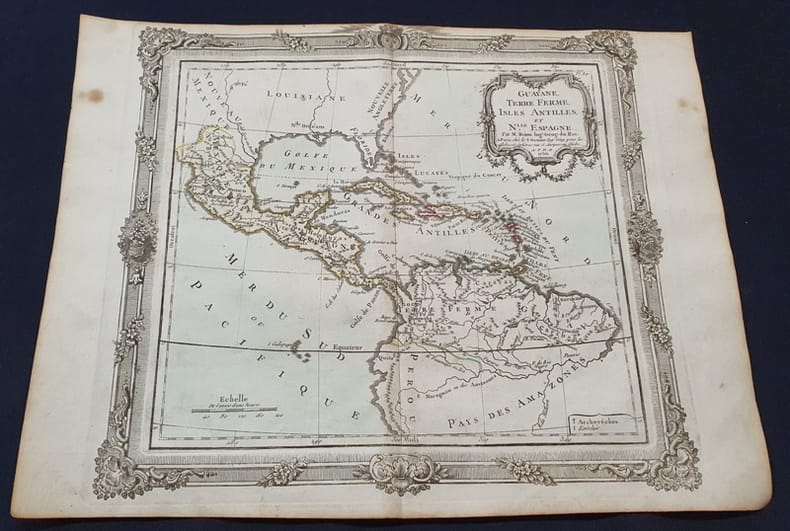
1772Tir411772 Planche seule - dimensions 38 x 29 cm - planche aquarellée - Échelle en lieux . Le pli du milieu existant déjà sera donc envoyée pliée en deux .La nouvelle Espagne correspond au Mexique , Nicaragua, Panama / la Terre ferme au Vénézuela .
1772Tir411772 Planche seule - dimensions 38 x 29 cm - planche aquarellée - Échelle en lieux . Le pli du milieu existant déjà sera donc envoyée pliée en deux .La nouvelle Espagne correspond au Mexique , Nicaragua, Panama / la Terre ferme au Vénézuela .
M13700Paris , Desnos , 1766 , carte coloriée ,encadrée par un texte collé , 49,5 x 30 cm . Mouillure claire sur la marge inférieure.
RO80220437La documentation française. Non daté. In-8. Broché. Bon état, Couv. défraîchie, Dos satisfaisant, Intérieur frais. 184 pages. Nombreuses illustrations en noir et blanc, dans le texte et hors texte. Ex-libris à l'encre en page de faux-titre. Etiquette rouge sur le 2ème plat.. . . . Classification Dewey : 988-Guyane
In-folio, pagine (8), 316; 97 incisioni di cui il frontespizio, 15 tavole fuori testo, 5 carte. Legatura originale in mezza pella rossa, dorso a nervi con decorazioni, strappo all'ultimo scomartimento, titolo e tagli dorati, piatti in tela rossa.
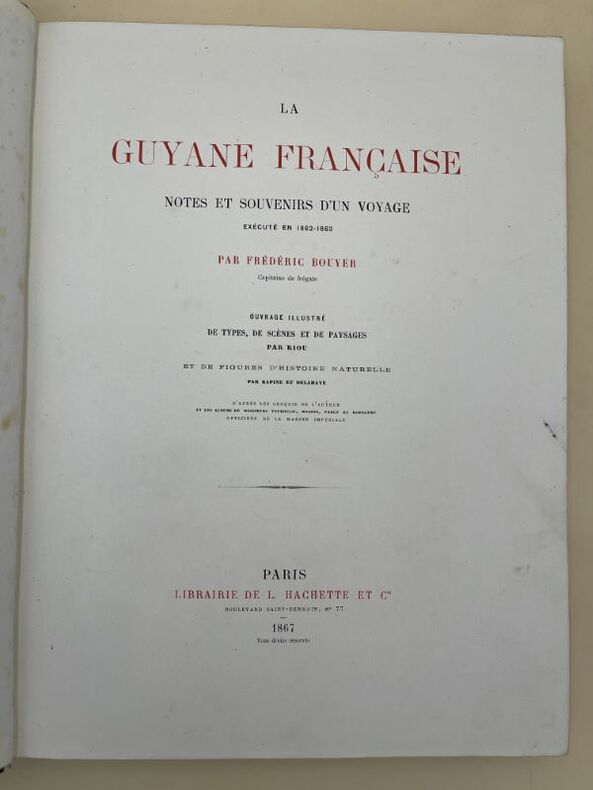
186710865Paris L. Hachette et Cie 1867 in-4° 316 pp, ouvrage illustré ( in-texte )de types, de scènes et de paysages par Riou, et de figures dhistoire naturelle par Rapine et Delahaye, d'après les croquis de l'auteur et les albums de MM. Touboulic, Masson, Farcy et Rodolphe, Officiers de Marine Impériale. Frontispice, toutes tranches dorées, dos orné de caissons dorés décors, plats muets. Traces d'humidité et rousseurs sur les pages, quelques déchirures et faibles manques de papier en marges. Epidermures sur coiffes et mors, accrocs sur coupes et coins.
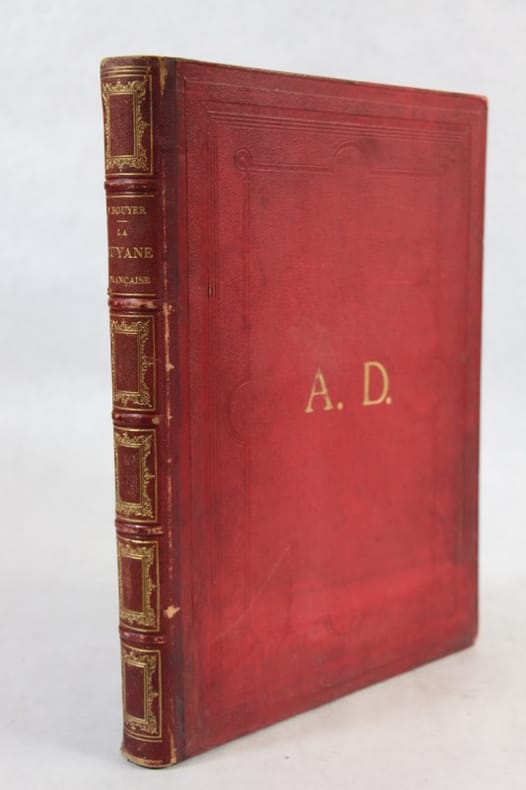
1867164165Librairie Hachette Paris, Librairie Hachette, 1867. In-folio relié demi-chagrin rouge, dos à nerfs et caissons dorés, plats de percaline rouge, filets estampés à froid, toutes tranches dorées. 316 pages. Illustré de types, de scènes et de paysages par Riou et de figures d'Histoire Naturelle par Rapine et Delahaye d'après les croquis de l'auteur et les albums de Messieurs Touboulic, Masson, Farcy et Rodolphe, Officiers de la Marine Impériale. Coins légèrement émoussés et petites taches à la percaline, pas de rousseurs.
1377536Paris: Hachette, 1867 in-4, (viii)-316 pages. demi Chafrin rouge, dos à nerfs, richement orné, tranches dorées, coins usés, bon état dans l'ensemble, prix du conseil municipal de Clichy. Edition originale.
Paris, Librairie Hachette, 1867. In-folio relié demi-chagrin rouge, dos à nerfs et caissons dorés, plats de percaline rouge, filets estampés à froid, toutes tranches dorées. 316 pages. Illustré de types, de scènes et de paysages par Riou et de figures d'Histoire Naturelle par Rapine et Delahaye d'après les croquis de l'auteur et les albums de Messieurs Touboulic, Masson, Farcy et Rodolphe, Officiers de la Marine Impériale. Coins légèrement émoussés et petites taches à la percaline, pas de rousseurs.
Stralcio in 4° dall'ebdomadario "Le Tour du Monde", 80 pp. (numerate da 273 a 352). Assolutamente inedito, ricchissimo iconograficamente di magnifiche silografie, di non facile reperibilità, senza legatura, in bello stato.
c3788Paris,Hachette, 1867 ; in-4°, demi-chagrin rouge de l'éditeur, dos à nerfs orné de fleurons et petits fers dorés dans des compartiments de double filet dor, plats de toile rouge avec titre doré au 1er plat;4ff.,316pp.;toile des plats un peu décolorée, restaurations angulaire aux 5 derniers feuillets, sinon bon état intérieur.
186722965Hachette et Cie 1867 édition originale. In-4, demi-chagrin rouge, dos à nerfs, caissons ornés, auteur et titre dorés, plats de percaline rouge décorés à froid, tranches dorées, 8 + 316 pp., frontispice sous serpente, nombreuses illustrations en noir, 15 planches hors-texte, 5 cartes in-texte. Coiffe de pied usée, coins émoussés, 1er mors interne fendillé, intérieur très frais. Bon exemplaire.
ORD-13010Illustrées de dessins par Férat, gravés par D. Dumont. Paris. A La Librairie Illustrée. Marpon et Flammarion. Sans date. 1882. Gd in-8 (196 x 276mm) percaline rouge de l'éditeur signée Engel, dos et 1er plat entièrement illustrés or de dessins exotiques, ornements géométriques en noir sur le dernier plat, gardes gris bleu, tranches dorées, 2ff., 632 pages. L'ouvrage se divise en 3 parties: Le Tigre blanc, Le Secret de l'Or et Les Mystères de la forêt vierge. Nombreuses illustrations dans le texte. Des rousseurs, petit point blanc au bord de la rosace centrale du dernier plat sinon très bel état du cartonnage.