White, Arnold [1848-1925]MareMagnum

2 632 résultats
xvii, 301, 32 [ads] pp. 7.5 x 5.3 inches. "The circumstances under which the wealth, the power, and the numbers of the Jewish race domiciled in this country are likely to be indefinitely increased seem to call for more prescience and thought at the hands of our rulers than have yet been bestowed upon them. To make people think is the object of this book. Should they refuse, they will wake up one morning only to discover that they have parted with the realities of national life, and are dominated by cosmopolitan and materialist influences fatal to the existence of the English nation." - Introduction. Chapters include: What is a Jew?; The Problem in Russia; The Jew in Austria/America/France/England/The Argentine Colonies; The Aloofness of Israel; Money Lenders; The Destitute Alien in Great Britain; Zionism; "Darkest Russia"; The Conversion of the Jews; Jewish Humour. Quarter-bound in black leather and olive cloth. Gilt lettering to spine. Top edge gilt. Modest lean to spine. Binding intact. Prior owner's name, dated 1899, inked atop front free endpaper. Large rectangular tanned area upon front free endpaper, presumably caused by an item formerly laid-in. Average wear. Faints spots upon front board, perhaps from water droplets. SINGERMAN 46. Book
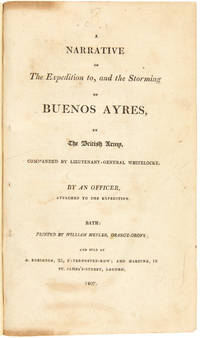
1807WRCAM35048Bath: William Meyler 1807. 238pp. plus one engraved plan. Modern half roan and boards spine gilt. Occasional minor foxing; minor titlepage repair with no loss of text. A very good copy with engraved bookplate of P. Francis K.C.B on front pastedown. An anonymous straight-forward account of the British attack on Buenos Aires in 1807 written "without any flourishing or prolix declamation on the calamities of war the effects of courage or the pursuit of wealth and fame." The unidentified author includes extensive details on the final engagements leading to the defeat of the British troops under Lieut. Gen. John Whitelocke by the Spanish citizen army of Creoles and peasants under the command of Santiago de Liniers. The plan and accompanying printed explanation of the plate assist in visualizing the narrative of the battle described in the text. Forced to withdraw from Buenos Aires after this defeat Whitelocke was court- martialed and cashiered. An intriguing record of the British engagement in Buenos Aires with an unusual Bath imprint for such a work. OCLC records only five copies. SABIN 51805. ALBERICH 1247. William Meyler hardcover books
1822WRCAM36917Buenos Aires: Imprenta de los Expósitos 1822. 5397pp. Nos. 1-23 plus supplement to No. 22 paged continuously. Quarto. Contemporary three-quarter sheep and marbled boards spine gilt. Outer joints and corners worn. A few pencil annotations. Occasional minor foxing. A very good copy. An extremely rare copy of the complete first volume of the most important Argentinean periodical of the early independence period. Edited by Florencio Varela Juan Cruz Varela and Ignacio Núñez the issues include news miscellaneous notices and short literary pieces in verse and in prose. CENTINELA was published weekly and then biweekly in 1822 and 1823. The two years of the periodical consist of seventy-two numbers and three supplements. This first volume is complete with twenty-three numbers and one supplement. Extremely rare. OCLC records four copies at New York Public the John Carter Brown Library the British Library and the Ibero- Amerikanisches Institute in Germany. PALAU 51467. OCLC 50151967. Imprenta de los Expósitos hardcover books
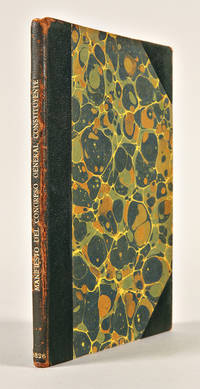
1826WRCAM37321Buenos Aires: Imprenta Argentina 1826. 12pp. Small quarto. 20th-century three-quarter morocco over marbled boards spine gilt. Edges and spine lightly worn upper outer joint moderately worn. Contemporary number inscription in top margin of first page of text. Lower right corners of first two leaves chipped. Moderate age-toning and foxing. A good copy. An extremely rare tract concerning the development of the Argentine constitution in the early republican period of that nation. In April 1819 a constitution was approved establishing a congress with two legislative branches and an elected chief executive. Due to the local political situation however that constitution was not fully enacted. A new constitution promoting a centralized system of government was eventually drafted in 1826. This manifesto of the government's constitutional commission presented to the Argentine representatives reviews various aspects of the 1819 Constitution and proposes changes to be effected in the new document. <br> <br> An extremely rare publication concerned with the early constitutional period in Argentina. OCLC locates only a single copy in the national Library of Chile. PALAU 148972. OCLC 55255075. Imprenta Argentina hardcover books
A livre d'artiste published in conjunction with an exhibition of Julio Hector Silva's work at the Galerie A.G. in Paris. A long poem by Juin, illustrated with 2 original full-page hors-texte prints by Silva, an Argentine artist with marked affinity for COBRA and abstract expressionism. The cover is a third original print. From a total edition of 61 numbered copies, this is ONE OF ONLY TEN COPIES, printed on extremely fine, textured French wove paper, WITH AN ORIGINAL SIGNED GOUACHE BY THE ARTIST LAID IN. This copy, moreover, features--although not called for--THREE ADDITIONAL COLOR ETCHINGS BY THE ARTIST, each signed and numbered in pencil. Additionally signed in the justification by both the author and the artist. 4to. Loose as issued in original wraps, board chemise, and slipcase. FINE AND BRIGHT, with no defects. OF THE GREATEST RARITY.
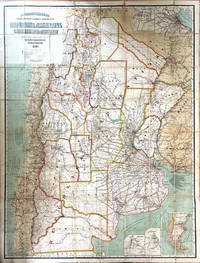
191963043Buenos Aires Argentina: Officina Cartografica de Pablo Ludwig 1919. Immense triple Atlas Folio dissected colour-lithographed map backed in linen sized 96 x 72 in. on sheet 100 x 76 in. in 64 panels which folds down into 13 x 10 in. offset toning from blue on versos of some panels age toning to fold creases minor edgewear slight occasional dustsoiling & very light foxing mounted w/in original plum-coloured cloth portfolio gilt lettering stamped on front cover wear & scuffing to spine remnants of attached label on back cover minor sunning to fore-edges & dustsoiling still a VG bright map preserved in G- original case. Second edition of this immense Pablo Ludwig commercial map of Argentina following World War I intended to aid in promoting and reviving the fast economic growth evident just before the outbreak of the Great War during the initial expansion of railroads urban trolley systems and infrastructure. Just prior to the War Argentina was one of the 10 largest economies in the World comparable with France & Germany and dwarfing Italy and Spain. Unfortunately following the WWI even though Argentina continued to expand and grow at a fairly fast clip during the Roaring 20’s the impact of the opening of the Panama Canal the decline of foreign investment in Argentina with most pouring into Europe for rebuilding or the United States the lack of industrialization severely hampered its future growth in the depths of the Great Depression. Inset maps provide close-ups of Tucuman Buenos Aires Chubut Santa Cruz and the cities of Mendoza and Rosario and the map claims the disputed Falkland Islands notes railroads proposed railroad lines trolley lines telegraph lines undersea cables wetlands salt flats and more. Ludwig fl. 1890-1962 was an active cartographer and mapmaker in Buenos Aires from the late 19th- through 20th-Century and first issued this map in 1910 at less than half the size of this one and Worldcat locates only 1 copy in the Library of Congress. Officina Cartografica de Pablo Ludwig, hardcover
1808WRCAM41553London 1808. viii2161pp. plus four folding maps. Antique-style three-quarter calf and marbled boards. Minor offsetting and foxing on titlepage and other leaves facing maps. Old library stamps on first two leaves; contemporary ownership inscription on titlepage. Errata slip pasted to verso of titlepage. Very good. Untrimmed. In 1807 Gen. John Whitelocke was sent to the Rio de la Plata with a large force. His goal was to reinforce British troops already operating there and in Argentina and to seize Buenos Aires a move designed to open up the markets of South America to British commerce and replace those lost on the Continent by Napoleon's blockade. Despite his large force Whitelocke proceeded cautiously and ineptly further hampered by bad weather. The assault on Buenos Aires was met by civilian as well as military resistance when the British had expected local merchants to welcome them with open arms. Craufurd commanded a light brigade which led the attack on Buenos Aires and successfully achieved its objectives. However a large part of the attacking force was cut off and forced to surrender while Whitelocke napped in his tent and Craufurd's brigade was ordered to surrender with the rest of the British force. Santiago Liniers the Spanish commander proposed a truce if the British would promise to withdraw in two months but said he could not answer for the safety of the prisoners if the attack was renewed. Feeling that the object of the expedition was now untenable Whitelocke accepted those terms. The British withdrew to Montevideo and then to England losing what might have been a foothold in South America. Whitelocke was the subject of the greatest scorn on returning to England where he was court-martialed and cashiered. Though this work is sometimes attributed to Gen. Whitelocke the accusatory and wounded tone of the narrative makes that unlikely. SABIN 103672. PALAU 375051. HALKETT & LAING 1 p.164. DNB online. hardcover books
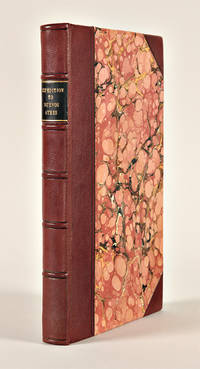
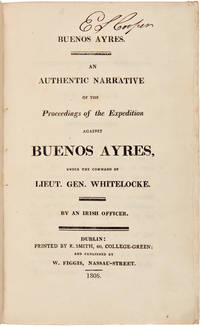
1808WRCAM35054Dublin: Printed by R. Smith and published by W. Figgis 1808. 109pp. 20th-century three-quarter morocco and cloth spine gilt. Shelf mark plate of Markree Library on front pastedown signature of E.S. Cooper on titlepage. A very good copy. An anonymous account by a field officer relating the unsuccessful British attempt under Lieut. Gen. Whitelocke to recapture Buenos Aires in 1807. The articles of the treaty ceasing hostilities between the Spanish and the British signed on July 7 1807 are included. Following this narrative the author provides a "brief description of the country and a short account of such circumstances as came under our observation in those parts we passed through." OCLC records only three copies. NAYLOR 26. ALBERICH 1210. Printed by R. Smith and published by W. Figgis hardcover books
2002mon0000095323McGraw-Hill 2002-01-01. Paperback. Acceptable. 1.4000 in x 9.8000 in x 7.2000 in. Clean pages. McGraw-Hill paperback
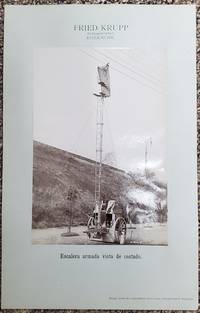
191174595Essen: Fried. Krupp Aktiengesellschaft 1911. A portfolio of forty-four original mounted silver gelatin prints of Krupp armaments designed specifically for the Argentinian Army. Published by the Krupp family in Essen in 1911. Each photograph measures 5.25 x 9 inches or a bit smaller. They are tipped onto thin gray sheets with printed captions in Spanish. Each image has a Krupp blind stamp in the lower left corner. Oblong octavo 8.5 x 13.25 inches. Housed in the original folding maroon cloth portfolio with gilt lettering on front and snap closures. Portfolio lightly rubbed but photographs and mounts crisp and clean. Near fine. Laid in are two extra photographs measuring 5 x 8.5 inches on stiff mounts measuring 7 x 9.75 inches each with printed text identifying the members of the Argentinean delegation and the Krupp employees at the Meppen Gun Testing Area December 1899. In the background of one image can be seen the massive cannon and the gun works.A striking array of military hardware is pictured including cannons and wagons for carrying ammunition spare parts and tools. Two photographs show a remarkable wagon with its observation deck extended to a height of twenty feet. In twelve photographs various tool boxes are opened to display the tight and orderly placement of saws hammers dies cordage brushes and other implements needed to keep these guns and wagons in top order. Fried. Krupp Aktiengesellschaft hardcover
Quaderno manoscritto a penna e matita in 8, pp. (30) in parte scritte e in parte bb. con gora centrale non deturpante. Indicazione ms. all'ultima p.: quaderno delle sue casse porto Dseato (sic). Importante e raro autografo di questo Capitano ed esploratore al servizio del governo argentino. Di origini chiavaresi, dopo aver viaggiato al comando di un brigantino per i mari dell'estremo oriente, fu al servizio tra il 1875 e il 1885 del governo argentino nell'attivita' dell'eslporazione e dello sfruttamento delle sue terre australi. Nel 1883, su sua proposta, venne organizzata una missione esplorativa nell'area di Porto Deseado che duro' tra l'11 aprile e il 14 novembre. In questo periodo vennero effettuate tutte le misurazioni e i rilievi finalizzati allo stabilimento di una colonia, fatto che avvenne l'anno successivo. Questo importantissimo brogliaccio risale proprio agli ultimi giorni di questa missione, come testimoniano le date apposte a margine delle 4 liste dei materiali caricati alla volta di Buenos Aires sul piroscafo Bahia Blanca comandato dal Capitano Ferro (11, 12, 13 e 14 novembre 1883). Di grande interesse l'esame delle liste dei materiali, che vanno da materiale geodeico e da rilevamento a tende, letti e coperte, tende, arnesi da lavoro ecc. Le pagine iniziali, dedicate ad una sommaria descrizione della localita', riflettono quanto pubblicato nella relazione a stampa edita nel 1884 e qui acclusa. Nel manoscritto poi, compaiono ampie annotazioni a matita di altra mano e che potrebbero attribuirdi a tal Luis Marzano, uomo al servizio dello stesso Oneto. Occore anche annotare che Antonio Oneto si reco' l'anno successivo, con 24 famiglie di coloni, al fine di fondare la citta'. La raggiunse il 15 luglio 1884 ma il 21 giugno 1885 mori' senza veder completata la sua opera. Attualmente, ogni 15 luglio, la citta' rende omaggio alla memoria dell'Oneto con cortei alla sua tomba ed al suo monumento. C. De Negri, L'attivita' geografica di Antonio Oneto in: Annali di ricerche e studi di geografia. Marzo 1955.
1890c2311100201xbvkParis, imprimé par autorisation de M. le Garde de Sceaux, à L'Imprimérie National, M DCCC XC.(1890); Lithograph printed by L. Léchaudel. 26 singleside printed large-paper cardboard-sheets, incl. 1 coloured plate; large-4to.(ca. 32 x 25 cm, few plates slightly smaller ca. 31 x 24 cm).
1823WRCAM46583Buenos Aires 1823. 4pp. Folio. Minor wear to top edge. Very good plus. In this message to Congress Rivadavia Interior Secretary and Garcia Treasury Secretary announce the recognition of Argentine independence by the United States and discuss relations with other South American countries. They also report to Congress on the condition of internal security and defense the treasury taxes debt medical sciences etc. Rivadavia later served as the first president of the Provinces of Rio de la Plata from 1826-27. Rare with one copy in OCLC at the British Library. unknown books
Due voll. in 4° gr., legatura Piena Tela edit. con titoli e fregi a secco, tagli rossi; pp. 389 + 27 tavole (di cui 15 col.), pp. 388 + 26 tavole (di cui 12 col.). Testo in lingua spagnola. Edizione a tiratura limitata, ogni esemplare con la firma del curatore e direttore dell'Istituto Lillo, H. Descole. Esemplare molto buono.
1808314806London: the author 1808. First edition. Engraved folding map and 3 folding plates. viii 216 pp with errata mounted at leaf at end. 8vo. Antiqued calf. Title and following leaf soiled and neatly repaired maps trimmed or with edgewear rear hinge separated at second work wrappers of second work chipped. First edition. Engraved folding map and 3 folding plates. viii 216 pp with errata mounted at leaf at end. 8vo. Sabin 103672; Palau 375051. Bound with: Paz José C. Estudios sobre Instituciones Libres. Buenos Aires: La Prensa 1876 the author unknown books
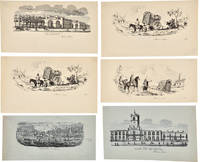
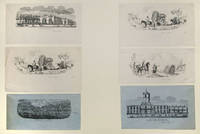
1855WRCAM41253Buenos Aires: R. Kratzenstein 1855. Lithographs on average 3 1/2 x 6 1/2 inches on slips of blue or white paper likely clipped from the top of pictorial letter sheets. Light edge wear. Very good. Matted. An attractive group of lithographic vignettes of scenes in and around Buenos Aires. These images were published by Rodolfo Kratzenstein who was one of the leading lithographers in Buenos Aires from the mid- 1850s and are likely from pictorial letter sheets issued by his firm in that period. One illustration shows a long stretch of the cityscape of Buenos Aires from the harbor and several ships are shown in the choppy waters of the port. Other images show the "Casa de Justicia" the courts and the "Palermo" neighborhood. Two other images one of them here in two examples show scenes in the countryside outside Buenos Aires both of them depicting men on horseback dealing with wagons in difficult terrain. Pictorial letter sheets from Argentina are uncommon and these are attractive images. R. Kratzenstein unknown books
185522646Buenos Aires: R. Kratzenstein 1855. Lithographs measuring on average 3 1/2 x 6 1/2 inches on slips of blue or white paper likely clipped from the top of pictorial letter sheets. Light edge wear. Very good. Matted. An attractive group of lithographic vignettes of scenes in and around Buenos Aires.<br/> <br/>These images were published by Rodolfo Kratzenstein who was one of the leading lithographers in Buenos Aires from the mid-1850s and are probably from pictorial letter sheets issued by his firm in that period. One illustration shows a long stretch of the cityscape of Buenos Aires from the harbour and several ships are shown in the choppy waters of the port. Other images show the "Casa de Justicia" the courts and the "Palermo"neighborhood. Two other images one of them here in two examples show scenes in the countryside outside Buenos Aires both of them depicting men on horseback dealing with wagons in difficult terrain. Pictorial letter sheets from Argentina are uncommon and these are attractive images. R. Kratzenstein unknown books
A wonderful gem of a livre d'artiste, illustrated with SIX ORIGINAL BURIN ENGRAVINGS BY HECTOR BALDASUA, hand-colored by Jean SaudÈ. 49 pp. Edition limited to 300 numbered copies printed on extremely fine Arches mouldmade wove paper. THIS COPY PRINTED FOR LEON PICHON, WHO PRINTED THE BOOK. Preface by Eugeni d'Ors. As issued in printed wraps. FINE AND BRIGHT, in the original board chemise and (lightly worn) slipcase.
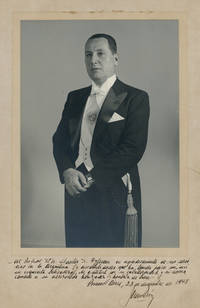
1948231092Buenos Aires 1948. Three quarter-length frontal pose in tuxedo with presidential sash and necktie. Gelatin silver print. 1 vols. Image 28.5 x 20 cm. 11-1/4 x 8 inches; approximately 16-1/2 x 12-1/2 inches overall. With embossed stamp "Sub secretaria de informacione" lower right. Tipped to larger sheet and mounted. Small tear in margin of mount image fine. Three quarter-length frontal pose in tuxedo with presidential sash and necktie. Gelatin silver print. 1 vols. Image 28.5 x 20 cm. 11-1/4 x 8 inches; approximately 16-1/2 x 12-1/2 inches overall. Inscribed on the mount by Perón in Spanish on December 23 1948 to the internationally renowned dentist Dr. Stanley D. Tylman "in gratitude for his services to Argentina and the friendliness he has shown me with his exquisite delicacy . "<br /> <br /> "Born in 1893 dentist Stanley D. Tylman not only taught more than 1000 students at the University of Illinois at Chicago College of Dentistry in his long career as a Professor of Dentistry 1920-1962 and head of the Department of Fixed Partial Prosthodontics but he influenced countless dentists internationally as well.<br /> <br /> "Tylman was particularly effective as a global educational force because he spoke four languages. His international lecture schedule took him to Asia Europe the Caribbean and South America--including Argentina where he performed dental work for President Juan Peron and First Lady Evita Peron. Dentists worldwide traveled to Chicago for personal consultations with Dr. Tylman . Tylman died in 1982." -- Wikipedia 8/3/06. unknown
1948231092Buenos Aires 1948. Three quarter-length frontal pose in tuxedo with presidential sash and necktie. Gelatin silver print. 1 vols. Image 28.5 x 20 cm. 11-1/4 x 8 inches; approximately 16-1/2 x 12-1/2 inches overall. With embossed stamp "Sub secretaria de informacione" lower right. Tipped to larger sheet and mounted. Small tear in margin of mount image fine. Three quarter-length frontal pose in tuxedo with presidential sash and necktie. Gelatin silver print. 1 vols. Image 28.5 x 20 cm. 11-1/4 x 8 inches; approximately 16-1/2 x 12-1/2 inches overall. Inscribed by Péron to Dentist Stanley Tylman. Inscribed on the mount by Perón in Spanish on December 23 1948 to the internationally renowned dentist Dr. Stanley D. Tylman "in gratitude for his services to Argentina and the friendliness he has shown me with his exquisite delicacy . "<br/><br/>"Born in 1893 dentist Stanley D. Tylman not only taught more than 1000 students at the University of Illinois at Chicago College of Dentistry in his long career as a Professor of Dentistry 1920-1962 and head of the Department of Fixed Partial Prosthodontics but he influenced countless dentists internationally as well.<br/><br/>"Tylman was particularly effective as a global educational force because he spoke four languages. His international lecture schedule took him to Asia Europe the Caribbean and South America--including Argentina where he performed dental work for President Juan Peron and First Lady Evita Peron. Dentists worldwide traveled to Chicago for personal consultations with Dr. Tylman . Tylman died in 1982." -- Wikipedia 8/3/06. unknown books
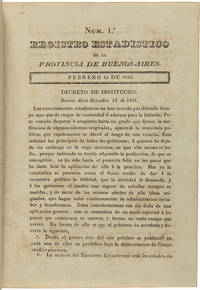
1823WRCAM36918Buenos Aires: Imprenta de la Independencia 1823. 208193-20031pp. Nos. 1-12. Nos. 1-10 paged continuously pages of No. 11 misnumbered pages of No. 12 numbered correctly 1-31 for second year of publication. The first eleven numbers were issued monthly February through December 1822; the twelfth issue was published March 1823. Contemporary diced sheep black leather label stamped in gilt. Outer joints and spine worn. Minor foxing and dampstaining. Very good. The extremely rare initial twelve issues of the first statistical register for the province of Buenos Aires. The publication was created by government decree on December 13 1821 reprinted here in the first issue published on February 15 1822. The REGISTRO ESTADISTICO. was charged with publishing statistics documenting conditions throughout the province with additional causes notes and observations. The issues are a fascinating compilation of facts and figures regarding all aspects of life in Buenos Aires in the early period of independence. On a regular basis data concerning geography meteorology the movement of populations and hospitals were recorded. Other areas documented in these issues include commerce means of production and education including courses taught at the university. <br> <br> An extremely rare government publication documenting the political economy of Buenos Aires in the early 1820s. OCLC lists nine locations for the register but only Cornell for the earliest issues. SABIN 68831. PALAU 253761. Imprenta de la Independencia hardcover books
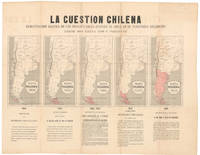
1878NL-02415<p><strong>Argentinian propaganda map of Chile's advance into Patagonia.</strong></p><p>This is an anonymous and undated propaganda map prepared by Argentina's Foreign Ministry for dissemination among potential allies on the American continents. It regards the conflict known as the "East Patagonia Tierra del Fuego and Strait of Magellan dispute" or "Patagonia Question" which was a territorial dispute between Chile and Argentina during most of the 19th century for more context see section below.</p><p>The sheet centers on five maps which are distinguished only by the varying size of the swathe of red that is meant to outline Chile's encroachment into Argentine Patagonia. The expansion process began in 1843 with only a few small islands and tiny peninsulas in the western part of the Strait of Magellan but by 1847 Chile was claiming the entire Strait as its own. The expansion continues in three subsequent phases each documented with its own map until 1876 when the territory in dispute consists of virtually all of Patagonia or the southern half of Argentina. Each of the intermediary stages in the quintet of displayed maps is dated and the territories in question are highlighted in red. Under each phase are noted the years in question as well as a brief explanation of the particulars of each phase of the expansionall of it from an Argentine perspective of course.</p><p>The Argentinian Foreign Ministry designed the map as a means of visualizing what Argentina considered the ongoing encroachment by Chile on Argentine territory. The broadsheet highlighted the blatant nature of Chilean territorial claims.</p><p>Because of this background and purpose the sheet was only distributed in limited circles making it a rarity today. The only institutional example of this map in the United States was presented to the US Minister to Argentina Thomas Ogden Osborn by the Argentine Minister of Foreign Affairs to serve precisely the purpose for which it was designed. The United States did indeed get involved and played a key role in the ensuing treaty negotiations 1879-1881.</p><p><strong>Census</strong></p><p>This sheet is rare likely because it was never produced in large quantities to begin with. There is only a single example of this sheet in US institutions. This document is located in the National Archives NAID: 5675669 and is the same sheet that Thomas Ogden Osborn sent to US Secretary of State William M. Evarts in 1880 following his role as US mediator in the negotiations for the 1881 Boundary Treaty that ended the conflict.</p><p>The only other institutional example we have been able to identify is held in the <em>Biblioteca Nacional de España</em> OCLC no. 431564806.</p><p><strong>Context is Everything</strong></p><p><em>The Strait of Magellan dispute and the "Patagonia Question" 18421881</em></p><p>The "Patagonia Question" was a nineteenth-century sovereignty dispute between Chile and Argentina over the southernmost lands of South America i.e. East Patagonia the Isla Grande de Tierra del Fuego and the strategically vital Strait of Magellan. Its roots lay in the messy inheritance of Spanish colonial jurisdictions and centuries of imprecise royal decrees that left overlapping claims along the entire Andean-to-Atlantic sweep. Both countries gradually sought to translate old legal claims into an effective national occupation: Chile concentrated on the Pacific channels and the Strait. At the same time Argentina pushed settlement eastward across the pampas and into Chubut.</p><p>Tensions hardened during the mid-1800s. Chile's deliberate occupation of the Strait of Magellan symbolized by the 1843 expedition that founded Fuerte Bulnes and formally took possession of the strait alarmed Buenos Aires and was the source of repeated diplomatic protests. Argentina in turn fostered new settlements established informal alliances with indigenous leaders and ensured a significant naval presence to assert influence on the Atlantic coast. By the 1870s both states were populating adjacent zones and commissioning maps and legal arguments to buttress their claims. This map is one such example from the Argentine side.</p><p>The trigger for a negotiated containment and ultimately a resolution of the conflict came in December 1878 when Chile and Argentina signed the FierroSarratea agreement. This was an interim pact that postponed a final delimitation and established arbitration procedures to avoid a fully fledged armed conflict. Chile quickly ratified the agreement but Argentina's Congress never gave its final approval causing it to collapse as a comprehensive settlement. The outbreak of the War of the Pacific 18791884 in which Chile fought Peru and Bolivia made rapid de-escalation with Argentina diplomatically urgent. Chile wished to avoid a second front. At the same time Argentina was engaged in the "Conquest of the Desert" on its southern frontier pushing it to resolve this old conflict as well.</p><p>The crisis was finally resolved by the <em>Boundary Treaty of 23 July 1881</em>. The treaty adopted a practical formula: north to the 52°S parallel the boundary would follow the highest Andes watershed; south of 52°S the agreement recognized Chilean sovereignty over the Strait of Magellan and assigned islands and Tierra del Fuego between the two states according to specified meridians and channels. Crucially the treaty neutralized the Strait of Magellan and guaranteed free navigation to all nations; a provision that allowed international passage through the strait and prevented any single power from controlling it.</p><p>US involvement in the dispute was modest. Washington did not act as an official guarantor or principal mediator in the 1881 settlement. However diplomatic records and dispatches confirm that the situation was under close observation and US diplomats regularly reported to their superiors on the crisis's development and its regional implications especially for shipping routes. Formal third-party arbitration and boundary adjudications were carried out by various state actors notably Britain or by various bilateral protocols. In short the U.S. was an interested observer rather than a decisive actor in both the dispute and its resolution.</p><p>The conflict illustrates how colonial legal ambiguities competing settlement policies and the strategic value of a single waterway combined to produce a long fraught boundary contest. The 1881 Boundary Treaty negotiated under the shadow of other regional wars and mediated by pragmatism rather than legality integrated competing claims into a workable frontier and ensured the neutrality of the Strait of Magellan for international shipping.</p><p>Condition Description</p><p>Good. Wear and toning along fold lines.</p> Foreign Ministry of Argentina
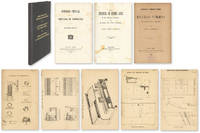
1873589331873. 3 titles all rare; the last with 5 plates. 3 titles all rare; the last with 5 plates. Three Rare Argentinean Items Argentina. Codigo Penal de la Provincia de Corrientes. Buenos Aires: Imprenta de Pablo E. Coni 1878. 110 pp. Bound with Llerena Juan. La Provincia de Buenos Aires y su Nueva Capital. Buenos Aires: Establecimiento Tipografico 1881. 54 pp. And Stegmann Carlos. Construccion y Disposicion Interior de las Escuelas Publicas en Relacion con la Higiene. Buenos Aires: Imprenta de Pablo E. Coni 1878. 24 pp. Five plates two folding. Octavo 9-1/4" x 6-1/4". Later cloth gilt titles to spine. Light shelfwear some toning to text final three leaves of Construccion detached internally clean. $950. Only editions located. The first item is the penal code for Corrientes one of the provinces of Argentina. The second title which is not legal in nature is an essay defending the establishment of Buenos Aires as the national capital in 1880. Illustrated with plates depicting classrooms and school furniture the final title is a book of regulations governing the construction of schools and the furnishing of classrooms. All of these titles are rare. OCLC locates 1 copy each of Corrientes and Provincia both in Germany no copies of Construccion. See Borchard Guide to the Law and Legal Literature of Argentina Brazil and Chile 115-116. unknown
1873589331873. 3 titles all rare; the last with 5 plates. 3 titles all rare; the last with 5 plates. Three Rare Argentinean Items Argentina. Codigo Penal de la Provincia de Corrientes. Buenos Aires: Imprenta de Pablo E. Coni 1878. 110 pp. Bound with Llerena Juan. La Provincia de Buenos Aires y su Nueva Capital. Buenos Aires: Establecimiento Tipografico 1881. 54 pp. And Stegmann Carlos. Construccion y Disposicion Interior de las Escuelas Publicas en Relacion con la Higiene. Buenos Aires: Imprenta de Pablo E. Coni 1878. 24 pp. Five plates two folding. Octavo 9-1/4" x 6-1/4". Later cloth gilt titles to spine. Light shelfwear some toning to text final three leaves of Construccion detached internally clean. $950. Only editions located. The first item is the penal code for Corrientes one of the provinces of Argentina. The second title which is not legal in nature is an essay defending the establishment of Buenos Aires as the national capital in 1880. Illustrated with plates depicting classrooms and school furniture the final title is a book of regulations governing the construction of schools and the furnishing of classrooms. All of these titles are rare. OCLC locates 1 copy each of Corrientes and Provincia both in Germany no copies of Construccion. See Borchard Guide to the Law and Legal Literature of Argentina Brazil and Chile 115-116. unknown books
In 8° (19,5x10,2 cm); 4 tomi: (2), XXX, 362 pp. e 1 grande c. di tav. fuori testo più volte ripiegata (Golfo del Messico ed paesi adiacenti), (4), 516 pp. e 1 grande c. di tav. fuori testo più volte ripiegato (America Meridionale) un piccolo restauro rinforzo al margine superiore della tavola a restaurare piccolo strappo senza perdita di carta, 552 pp. e una c. di tav. più volte ripiegata (Carta dei paesi sopra il mare meridionale) un piccolo alone al margine bianco superiore delle prime 10 carte ininfluente, 412 pp. e due grandi c. di tav. più volte ripiegate (la tavola con i disegni aztechi è solitamente inserita nel terzo volume, l'altra invece contiene Messico e Nuova Spagna, piccolo strappetto senza perdita di carta). Legatura coeva in tutta pergamena maculata con titolo e numero del volume impresso su pecette in pelle al dorso, strofinature e qualche lieve difetto alle cerniere del secondo volume che però si presenta in ogni caso solido e ben legato. Esemplare ancora in barbe. Prima non comune edizione italiana completa dei quattro volumi e delle tavole fuori testo. All'interno a parte i due strappetti senza perdita di carta a due delle tavole fuori testo, l'opera si presenta in buone-ottime condizioni di conservazione, priva delle tipiche bruniture presenti solitamente nelle altre copie e dovute alla qualità della carta utilizzata. L'opera ebbe subito grande successo e una nuova edizione uscì già nel 1778, una terza nel 1794. William Robertson nacque a Borthwick nel Midlothian nel 1721. E' considerato con Hume e Gibbon uno dei tre grandi storici inglesi del XVIII° secolo. Figlio di un ministro presbiteriano e risiedette a lungo a Gladsmuir nell'East Lothian (1743-59). Dopo aver preso parte alle rivolte contro i giacobiti che infiammarono la Scozia negli anni quaranta del settecento. Nel 1751 divenne capo del partito moderato in seno all'assemblea generale dellea Chiesa scozzese. Iniziò anche ad interessarsi attivamente alla storiografia pubblicando varie opere che ottennero subito un grande successo. Nel 1777 pubblicò il primo volume della History of America ma i moti che precedettero lo scoppio della Rivoluzione Americana lo indussero a rinunciare temporaneamete a terminare l'opera che fu completata solo posteriormente. La prima edizione italiana, contemporanea alla prima inglese, oltre a descrivere la storia dell'America, sia meridionale, centrale che settentrionale, ne analizza anche lo sviluppo economico, commerciale, gli usi e costumi, la situazione demografica, le cure tradizionali ecc. ecc. Prima rara edizione italiana.