71 résultats
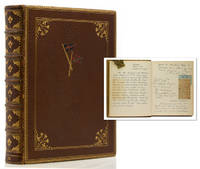
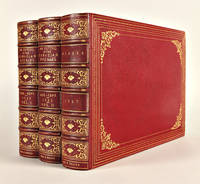
1937WRCAM54535Alaska & Canada 1937. Three albums with 601 photographs each approximately 3 3/4 x 5 3/4 inches with additional ephemera such as news clippings and a hunting license. Oblong folio. Contemporary full red morocco gilt tooled by the Harcourt Bindery. Photos mounted directly on stiff grey album leaves. Very light wear to hinges and spine ends. Contents generally fine. Very good overall. Two volumes in red cloth slipcases. A magnificent and massive collection of over 600 photographs compiled by William N. Beach famed big game hunter and author of IN THE SHADOW OF MOUNT McKINLEY. <br> <br> The first two albums here document a journey made by Beach through the Canadian Rockies in August and September 1933. The third album focuses on his excursion through Alaska in 1937. All three postdate the publication of MOUNT McKINLEY which established Beach as an important figure in the world of big game hunting. According to one of the contemporary newspaper clippings tipped into the album Beach's hunting party on his second trip documented here "was after specimens of Alaskan wild life to be placed in the Smithsonian" with W.L. Brown curator of the Institute accompanying the party. Shortly after the trip an article by Beach entitled "With Moose and Caribou in Alaska" was published in EXPLORATION AND FIELD-WORK OF THE SMITHSONIAN INSTITUTION IN 1937 and featured photography from the "Alaska" album present here. <br> <br> These expertly captured images of the Denali wilderness and the Rockies offer a rare and extraordinary glimpse not only into big game hunting but also into remote and pristine landscapes of these areas in the 1930s. An outstanding and impressive group of photographs. hardcover books
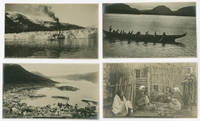
1930WRCAM56103Various locations in Oregon and Alaska 1930. Approximately 325 photographs twenty postcards and real photo postcards a linen- backed map of Alaska and a few assorted ephemeral items all housed in a contemporary leather satchel. Generally minor wear some chipping to about twenty photographs. Overall very good. A treasure house of silent cinema photography from the Pacific Northwest and Alaska featuring over 300 images from THE CHECHAHCOS and other films produced in the orbit of the film's director Lewis H. Moomaw all retained by one of his crewmen Guerney William Hays. <br> <br> THE CHECHAHCOS released in 1924 was the first feature film shot in Alaska. "Cheechako" is a native word referring to a "greenhorn" or someone newly arrived in the mining districts of Alaska or northwestern Canada. A melodramatic tale of the Klondike Gold Rush the was directed by Lewis H. Moomaw of the Alaska Moving Pictures Corporation. The story was based in part on the experiences of the film's producer Austin E. Lathrop known as "Alaska's first home-grown millionaire." The film has been preserved in the National Film Registry and can easily be viewed on the internet. Offered here is a large collection of photographs and other ephemera once belonging to a CHECHAHCOS crew member named Guerney William Hays 1880-1952 including film stills snapshots from the set and other images of Alaska scenery. Many of the images match up with scenes from the completed film. The subject matter includes all that might be expected from a film produced in and about Alaska: glaciers dogsleds saloons archvillains and damsels in distress along with shots of the crew and technology that made the film possible. <br> <br> The largest and most professionally-produced photographs in the collection are eighty 8-x- 10-inch prints almost all of them clearly from the CHECHAHCOS shoot with twenty-one stamped on the verso by the Alaska Moving Pictures Corporation and with either a printed or manuscript title written along with the stamp reading "The Chechakos" the spelling of which was later tweaked to its release title. One of the stills shows the entire company of the Alaska Moving Pictures Corporation about 150 people in the snow beside their Pullman cars; two banners for the film company hang outside the rail cars. A separate shot of the film company shows their train at the entrance to McKinley Park with a banner hanging on the train reading "Private Car Alaska Moving Pictures Corporation Entrance to McKinley Park on the Alaska Railroad." Other stills show scenes from the film shots of the cast and crew preparing to start scenes posed scenes clearly intended for use as publicity stills cast group pictures behind-the-scenes shots of the cameramen and other crew with various equipment photographs of empty interiors perhaps to be used for continuity a few featuring the dog sled teams and more. In addition to documenting the production these images also present a rare view of Alaska in the early-20th century. <br> <br> The remaining 240 images most of which measure approximately 3 x 5 inches were likely not formally produced by the film company for use as publicity but are in fact production photographs and still stand as valuable visual documentation of the early filmmaking process. While some of these photos are more of the vernacular sort the great majority of the images show a mixture of preproduction production and set-related photographs from the film company's time in Alaska shooting THE CHECHAHCOS and from other production's attached to the career of Lewis H. Moomaw the film's director. A great number of these images were likely produced as working production photographs - executed for the use of the company during the shooting process scouting for locations documenting costumes set continuity set construction what might today be called craft services suggesting or documenting potential camera set-ups or as studies for potential publicity stills and more. While not created as traditional publicity products these images capture the early filmmaking process both in front of and behind the camera presenting a quite uncommon slice of film production history. The fact that they were produced during the production of a film in Alaska make them an even more valuable source of information on the filmmaking process in the 1920s in a most unusual place. Production stills are produced in very small quantities compared to publicity stills are often unique or close to unique records of a production have a much lower survival rate and are keenly sought after as historical records of the filmmaking process. <br> <br> One of the few captioned photographs shows four wives of the CHECHAHCOS cast and crew on a fishing expedition including Moomaw's wife and Mrs. Guerney Hays. A few other photographs show an actress posing with crude dummies that were apparently about to be sent to their doom in a canoe scene in the Alaskan wilderness. Other production photographs from Alaska feature scenes on glaciers one of which shows the exact spot from a moment in the opening minute of the film a young girl with a giant Alaskan crab who is also pictured in the larger professional images and is in the film film crews poised on icy ground dog sled teams identified locations in Skagway and more. <br> <br> One of the other films pictured here is likely CALL OF THE ROCKIES 1929. This western was filmed in Oregon the usual home of the filmmakers involved in the Alaska Moving Pictures Corporation with Moomaw as supervising producer. CALL OF THE ROCKIES was directed by Raymond K. Johnson one of the cinematographers on THE CHECHAHCOS and features two actors identified in pencil captions on the verso of photographs present here: Russell Simpson and Jim Mason. There are numerous photographs featuring a western wagon train and other images of the traditional western which either appeared in CALL OF THE ROCKIES or perhaps one of Moomaw's other films produced in Oregon in the 1920s - UNDER THE ROUGE 1925 or FLAMES 1926 the latter of which climaxed in a raging forest fire and featured an early screen appearance by Boris Karloff. <br> <br> All of the postcards feature Alaskan scenes or subjects and were most likely acquired while the film company was shooting in Alaska or produced for them while they were there. This is the case for at least one of the postcards - a Christmas greeting with the banner at bottom reading "Compliments of the Alaska Moving Pictures Corporation." The final item of note here is a folding linen- backed map of Alaska issued by the Alaska Steamship Company. The map measures about 21 x 30 inches and was issued in 1917. It was almost certainly taken along to Alaska by Hays for the filming of THE CHECHAHCOS linen- backed either before-hand or while in Alaska to prevent damage from over-use. The entire collection of photographs and ephemera is housed in a period leather satchel. <br> <br> These photographs were collected and retained by Guerney or Gernie William Hays 1880-1952 who spent a career in the early film industry mostly in Oregon. Some pieces of ephemera bear his name and some of the larger stills are annotated "Hays" on the verso. His 1918 draft registration lists him as a motion picture operator in Portland and his obituary lists him as a member of the International Alliance of Stage Employees. His only film credit in the Internet Movie Database is for THE CHECHAHCOS for which he is credited with "sets and lighting" and also an uncredited supporting role on screen. One of the larger-format photographs features a crew member in a cramped equipment room with dozens of lights and mounds of cables; this is almost certainly Hays himself or perhaps one of his assistants. One of the photo developer's envelopes bears the name of Hobart H. Brownell the cinematographer of THE CHECHAHCOS. Two of the photographs here are inscribed to Hays - one from the actor Bert Sprotte in 1919 and the other from banjo player Eddie Peabody who has inscribed his portrait to Hays writing that "No finer stage manager I ever worked with." Another photograph shows Peabody's elaborate stage show. <br> <br> THE CHECHAHCOS remains an important early film for its authentic depiction of Alaskan life. Movies about the great white north were popular with early film audiences but were usually filmed in California. When Lewis H. Moomaw proposed to shoot a film entirely in Alaska about the days of the Klondike Gold Rush in the territory locals in Alaska jumped at the chance to find him funding. Upon arrival in Anchorage fully half of the town showed up to greet the film company. The cast and crew would spend three months filming in and around Anchorage the small mining town of Girdwood on Childs Glacier Abercrombie Rapids and Eyak Lake. The film premiered in the Empress Theatre in Anchorage on December 11 1923 and played to packed houses across Alaska the next year. Sadly the film never found a large audience in the continental United States playing occasionally over the next two years before falling into obscurity. The film was essentially lost until the year 2000 when a print was restored by archivists at the University of Alaska Fairbanks. Three years later the film was selected for preservation by the National Film Registry. <br> <br> The Library of Congress's press release when they selected THE CHECHAHCOS to the National Film Registry describes the film as such: "This independent regional film was the first feature film produced in Alaska and is renowned for its spectacular location footage of the lonely and unfathomable Alaskan wilderness frenzied dogsled pursuits and life-and-death struggles on the glaciers." <br> <br> A wonderful collection of great historical interest for early film scholars and of the history of Alaskan cinema. hardcover books
1931313016Brockton Mass: Harold C. Keith 1931. First edition. Illustrated with photographs. Text in two columns. 28 pp. 1 vols. 10-1/4 x 7 inches. Wood grain wrappers with pictorial onlay text gathered with cord. Cover onlay creased with a few old tape ghosts ink notation to front blank Goodspeed sales receipt 1957 bookplate of Stephen Ellsworth Clow and Ruth Hazen Clow. Green half morocco slipcase and chemise. First edition. Illustrated with photographs. Text in two columns. 28 pp. 1 vols. 10-1/4 x 7 inches. ONLY COPY. Well written and nicely illustrated privately printed account of an Alaska hunting expedition. The party of four organized by H. Wendell Endicott comprised Endicott George Perry Latham Reed and Harold C. Keith whose diary for 14 August to 7 October 1930 is printed here. Latham Reed Sr. and Gen. R. E. Wood joined the party for the first stage of the journey to Big Delta. <br/>The hunting began on 24 August when a herd of caribou passed across the road in front of their car. Mr. Collins assistant district attorney at Fairbanks" stepped out and showed us how to shoot by dropping a big caribou on the first shot."<br/><br/>Twenty-one miles up the road from Big Delta the party left Mr. Collins' car and joined their crew of 8 and 24 horses and began their trip. They hunted bear and moose and caribou and sheep near the Gerstle River and Elting Creek and Jarvis encountered heavy snow saw the northern lights and completed a large loop back to Twenty-Six Mile Cabin during their stay.<br/><br/>Endicott 1880-1954 was author of Adventures with Rod and Harpoon in the Florida Keys. Harold C. Keith Amherst class of 1908 and Endicott were both shoe manufacturers in Massachusetts. Keith was president of the George E. Keith Co. in Brockton<br/><br/>The only other copy of this book recorded is a photocopy in the Candace Waugaman Collection at the Rasmuson Library University of Alaska Fairbanks<br/><br/>RARE. Not in OCLC not in Heller Biscotti Harold C. Keith unknown books
1934320413Aboard the Hussar Washington Alaska etc. 1934. 97 pp. profusely illustrated with dozens of snapshots newspaper clippings and a map of coastal Alaska. 1 vols. 4to. Full light brown morocco gilt upper board with yachting pennant of the Yacht Hussar onlays in red blue and gold within gilt fillet border with floral corner ornaments board edges and dentelles gilt a.e.g. by James MacDonald Co. A few scuffmarks at extremities else fine. 97 pp. profusely illustrated with dozens of snapshots newspaper clippings and a map of coastal Alaska. 1 vols. 4to. "Just a shooting trip in Alaska": Signed by E.F. Hutton. Manuscript diary in a secretarial hand or perhaps by Hutton's wife Marjorie Merriwether Post but signed by each of the member of the travelling party of a 1934 cruise of Edward F. Hutton's 320-foot yacht Hussar along Alaskan coastal waters to hunt bear largely around the islands near Juneau. The party included Hutton his wife and daughter movie producer Hal Roach and wife Marguerite Ernest H. Rice and wife Miriam 'war ace' Dave McCullough and others. Roach had lived in Valdez and Fairbanks for 2 years early in his career. <br/><br/>In all besides good eating and drinking deck games and other fun on board the group saw 76 black bear and 59 brown bear on the excursion even bringing a cub on board. The trip was cut short however when McCullough was seriously wounded by one of the guides in a shooting accident. unknown books
193321317Alaska: No Publisher 1933. The movie can be loosely interpreted as the history of a journey up the Alaska coastline with some land interior footage beginning in the more southern tier and ending in the bleak far northern ice lands with 'stops' along the way; the movie has a semi-professional 'feel' - for several reasons some of which are that editing between segments is smooth and uninterrupted there are occasional professional 'titles' interspersed in the film and perhaps most importantly the quality of the imagery and the 'narrative' progression of scenes speaks to a professional behind the lens; subjects are diverse: at the beginning of the film we view the vast panoramas of the Alaskan lands mountains and rivers treated to a Robert Service quote - ".there's a land where the mountains are nameless and the rivers run God knows where." with men and a lively dog standing aboard a rapidly-moving raft poling down a river - the same men seemingly very closely for comfort observe bears fishing a stream during a salmon spawn and climbing nearby trees; the men demonstrate salmon bow-fishing and bring the catch home; the camera eventually moves on to the coastal trip being on board small steamers and sailing craft; we observe the "Wrangell Branch" of the A & P Packaging Co. with cannery scenes; visiting an outpost medical clinic seemingly obstetric; on to footage of the massive caribou movements across the tundra lands and natives hunting them; Inuit trade polar bear & other skins at a 'trading post' for goods; heavy-duty tractors used on icy surfaces to transport entire houses & populations; the stamina and strength of sled-dogs pulling up what looks like a 45-degree angle hillside at speed and in deep snow; ice-chopping for massive slabs used to build a home igloo; a costume parade of little children in a town which also shows mission children and schools young men and women in activities around sturdily-constructed multi-story brick buildings probably related to missionary work in the Territory; native carvings totem poles and other crafts; ski-planes at a small wintry airport runway - identified as "Pacific-Alaska Airways"; perhaps most exciting and interesting is the film's showing of an Inuit whale-hunt the bringing in of the great creature - hauled by hand the hunters seated on the ice in rows and strongly pulling at tremendous rope hawsers - the flensing of the blubber and an extremely lively victory party afterward obvious happiness and exhilaration of the people dances and chanting of women and men after the great capture - the fun includes being tossed in the air trampoline style done standing up the local people all dressed in the available skins and hides hunted there; various little stops are made along the way by the boat as it moves up the Alaskan fiord-scape - at one point we are treated to an exhibition of the Inuit kayak with a native spinning under the cool waters in his boat; the kayaks push offshore to greet the supply ship in this case a 4-masted schooner - we see this vessel at anchor and also magnificently under full-rigged sail - and retrieve goods in their longboat; eventually the coasting brings us to a dramatic close with a sunset silhouetting the schooner with only icebergs on the horizon; there are 'human' moments as well this is not simply an amateur travelogue - young women coquette a bit for the camera town worthies and ancient native people sit in dignity graveyard views which linger over readable headstones; people at work and play with vigor and without a 'staged' feeling -cute and very strong & skilled little kids in a wood-chopping contest and more; there is approximately 1600 feet of 16mm film run time about ½ hour; we speculate this is the original or master since there are several safety film types used here: Kodak safety positive Dupont Pathe Gevaert safety film and perhaps others - seemingly a copy of the master would have been using all one film type; these sections are professionally spliced together and viewable as we have watched this production on film a desk-type film editor as well as a through a projector; occasionally and unexplainably by checking the film types at the change there is a yellowish cast to the scene which does not obscure detail and which shifts abruptly back to clear black and white footage; on an old reel; no credits are given for the photography or direction production of the film; a possible clue is offered in an accompanying item a large sepia & black chalk portrait heightened in white on Canson & Montgolfier France watermark paper of what appears to be a reverend or Protestant cleric who bears a close resemblance to one of the characters seen several times in the film and who may have been a missionary in Alaska or perhaps ended up as the recipient of this master film; pastel portrait measures approx. 18" x 22" signed lower left Melita Hofmann C. 1907-1976 a commercial artist and illustrator originally from Toledo Ohio who worked as an art director for Grosset & Dunlap and in book illustration - the portrait with some closed edge tears repaired on verso otherwise in good shape and a good likeness accomplished with skill; the film in very good condition and viewable albeit with some vinegar syndrome - usual with films this vintage - and one of the most interesting ethnographic and historical artifacts and perhaps unique that we have had in stock filmed during a time of great change for the Inuit for Alaska and its' landscape; our thanks go to Richard Hart senior in film studies at Brooklyn College for his invaluable help in reviewing the film and revealing technical aspects of the process. First Edition. Not Bound. Very Good. No Publisher Paperback books
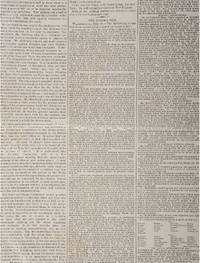
186825042<p>This copy is stamped "THE PRESIDENT" at the top of the front page indicating it belonged to President Andrew Johnson. The President would have read this copy of the act before Congress submitted it to him with some amendments on July 25. The report uses the early variant spelling of "Aliaska" for the territory and peninsula.</p> <b>ALASKA.</b>Newspaper. <i>New-York Tribune</i> July 17 1868. Featuring the terms of the "Aliaska" Bill as passed by the Senate. Copy belonging to President Andrew Johnson. New York: Horace Greeley. 8 pp. 18 x 23¾ in.<p><b><br /></b></p><p><b>Excerpts:</b></p><p>"<i>Be it enacted &c. That the laws of the United States relating to customs commerce and navigation be and the same are hereby extended to and over all the mainland islands and waters of the territory ceded to the United States by the Emperor of Russia.</i>" p1/c2</p><p>"<i>And be it further enacted that all the said territory with its ports harbors bays rivers and waters shall constitute a customs collection district to be called 'The District of Aliaska' for which said district a port of entry shall be established at some convenient point to be designated by the President at or near the town of Sitka or New-Archangel and a Collector of Customs shall be appointed by the President by and with the advice and consent of the Senate who shall reside at said port of entry and who shall receive an annual salary of $2500.</i>" p1/c2</p><p>"<i>That the President shall have the power to restrict and regulate or to prohibit the importation or use of firearms ammunition and distilled spirits into and within said territory.</i>" p1/c2</p><p>"<i>That until otherwise provided by law the Secretary of the Treasury with the approval of the President shall have power to prescribe such rules and regulations as he may deem proper for the preservation of fur-bearing animals from indiscriminate destruction provided that no special permits shall be granted under this act.</i>" p1/c2</p><p><b>Historical Background</b></p><p>After suffering defeat at the hands of the British and the French in the Crimean War of 1853-1856 Russia feared losing the Alaskan territory in some future conflict. In an effort to protect Russian interests Tsar Alexander II 1818-1881 determined to sell Alaska. After offering it in 1859 to the United Kingdom Russia negotiated a sale to the United States finalized in 1867. At the time the territory primarily offered fur trading and some natural resources. Americans generally supported the purchase and believed it enhanced American interests in the Pacific though some critics labeled it "Seward's Folly" after Secretary of State William H. Seward who had negotiated the purchase for the United States. Most newspaper editors especially those in California were enthusiastic about the purchase. Notable among the critics was Horace Greeley the editor of this newspaper and a long-time opponent of Seward. The value of the new territory increased dramatically with the discovery of gold fields in 1896.</p><p>The Senate ratified the Treaty with Russia on April 9 1867 by a vote of 37 to 2. On July 14 1868 the House of Representatives passed a resolution appropriating the $7.2 million necessary to purchase Alaska less than two cents per acre and the Senate approved the resolution with amendments. The House refused the amendments and the resolution went to a committee. The House passed the resolution as revised by the conference committee on July 23 and the Senate passed it the following day.</p><p>Meanwhile on July 15 Senator Zachariah Chandler of Michigan introduced "An Act to extend the Laws of the United States relating to the Customs Commerce and Navigation over the Territory ceded to the United States by Russia to establish a Collection District therein and for other Purposes" and the Senate passed it on July 16. In the House Representative Elihu B. Washburne of Illinois proposed amendments on July 25 and the House agreed to them. The Senate disagreed with the amendments and this bill went also to a conference committee where the Senate receded from its opposition and the bill passed. President Johnson approved and signed both the joint resolution and the act on July 27 1868.</p><p>In 1870 Congress followed up its concerns about preserving fur-bearing animals expressed in this law with "An Act to prevent the Extermination of Fur-bearing Animals in Alaska" aimed directly at regulating the killing of fur-bearing seals on Saint Paul and Saint George Islands off the western coast of Alaska north of the Aleutian Islands.</p><p><b>Additional Content</b></p><p>This issue also includes the Senate confirmation of William M. Evarts 1818-1901 as Attorney General p1/c2 p5/c4; proceedings of Congress including Senate discussion of this bill p1/c3-4; a letter from a special correspondent describing Sitka Alaska p2/c2-3; an editorial nomination of Thomas A. R. Nelson of Tennessee as Secretary of State to succeed William H. Seward "<i>now that Mr. Seward has succeeded in buying Aliaska</i>" p4/c5-6; "base ball" and cricket scores p5/c5; and a report on dozens of deaths from sunstroke during two-week heat wave especially among children p8/c1-3.</p><p><b><i>New-York Tribune</i></b> 1841-1924 was established as a daily newspaper in 1841 by Horace Greeley 1811-1872. By the 1850s it reached a circulation of 200000 copies making it the largest daily newspaper in New York City at the time. Greeley also published weekly and semi-weekly issues of the <i>Tribune</i> through much of his tenure. The <i>New-York Tribune</i>became the dominant Whig and then Republican newspaper in the United States helping to shape public opinion especially as other newspapers often copied its articles and editorials. It was one of the first newspapers in the Union to send reporters and correspondents to cover the military campaigns of the Civil War. Greeley used his newspaper to support many reforms including abolitionism pacifism socialism for a time and feminism. After Greeley's failed campaign as the Liberal Republican candidate for President Whitelaw Reid 1837-1912 assumed control of the <i>Tribune</i> until his death. His son Ogden Mills Reid 1882-1947 acquired the <i>New York Herald</i> and merged the newspapers in 1924.</p><p><b>Condition</b></p><p>Typical folds and light foxing few slight tears at some of the outer margins and appears to have been bound in a book at one point or someone reinforced the outer fold.</p> books
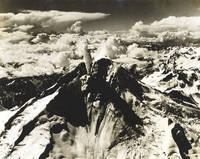
194714430Alaska various: np nd ca. 1947. Very good. Oblong folio commercial hardcover album made by The Burkhardt Company Detroit model X 89500 13.5” x 10.75” x 2.5”. Screw binding 74 black paper pages with a single black and white gelatin print mounted recto only to each most measuring approximately 7.5" x 9” with brief typed captions mounted below. Additional print mounted to front cover; 75 photographs total. Album exterior moderately worn cloth dry and flaking. Three sections of material loss at outer edge of covers and to upper rear likely mouse-bitten similar loss to edges of final two pages not effecting photos. Two images missing captions. Photographs well preserved occasional mild wear. About very good. <br/><br/>An impressive collection of 75 well-annotated predominantly aerial photographs of pre-statehood Alaska likely compiled by a U.S. Army Officer stationed at Fort Richardson near Anchorage just after WWII. 49 images captured from aircraft of some of the most spectacular unspoiled environments anywhere. Cities settlements and geographical locations include Galena Ketchikan Port Alexander Sitka Port Althrop Skagway Juneau Fort Seward Valdez Anchorage Barrow Nome the Taku Glacier Mount McKinley Mount St. Elias and Mt. Moffet. The remaining 26 prints equally as beautiful though taken at ground level display the cultural and trade aspects present around 1947. Highlights include an Eskimo mother and daughter on Nelson Island fishing boats in Ketchikan totem poles on Wrangell Island a midnight baseball game and a full salmon scowl at a cannery in southeast Alaska. Five prints with lettering in the negative though none with clear evidence as to the purpose behind their creation. Clearly the work of a skilled photographer an immediately engaging collection of images. NOTE: High resolution scans of this complete album are available. np hardcover books
1900WRCAM54627Seattle; Skagway 1900. Twelve photographs each approximately 4 1/4 x 7 1/2 inches. Overall very good. A collection of photographs taken by Seattle photographer Frank La Roche. La Roche 1853- 1934 a Philadelphia native transplanted to the Northwest established a photography studio in Seattle in 1889. He undertook many trips to Alaska documenting the Klondike Gold Rush at length from 1897 to 1899. This group contains images of Juneau Sitka Fort Wrangell here spelled Wrangle and Taku Glacier. Two images are of Chilkat Tlingit Indians and one photo of the Seymour Rapids in British Columbia is also included. Each is numbered and captioned in manuscript or in print within the negative. Exemplary images from this noted landscape photographer of Alaska and the West. unknown books
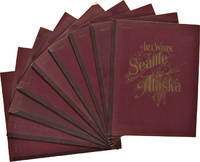
1907WRCAM54859Racine Wi.: W.D. Harney Photogravure Co. 1907. Nine parts each bound separately and uniformly complete with titlepage in first volume. 26pp. of text printed rectos only and eighty photogravure plates. Folio. Publisher's rosewood cloth backstrip and burgundy wrappers front covers gilt. Mild fraying to spine cloth some wear mild chipping and light soiling to covers. Top corner of first few leaves of first volume creased. Internally clean. Overall very good. A substantial production providing a rich photographic tapestry of the Pacific Northwest and Alaska in the early twentieth century. Each volume contains nine photogravure plates with only eight in the eighth volume most full-page but some with more than one image per plate. Each part contains two or three text leaves printed rectos only. Altogether the work is comprised of eighty photogravure plates with tissue guards containing over 100 distinct photographic images. <br> <br> Numerous photogravures depict indigenous Eskimos and other people along with stunning views of rivers mountains mining agriculture landscapes dogsled teams totem poles ships and various aspects of life in the Pacific Northwest. Highlights include the "Largest Fir in Washington" "Bird's-Eye of Nome Alaska" "An Arctic Musher" and the "Eskimo Salmon Dance." The photogravures were taken by a number of prominent western photographers including Frank H. Nowell W.P. Romans Thomas W. Tolman Wylie T. Dennison and Asahel Curtis estranged brother of Edward S. Curtis. The gravures are printed in sepia blue or green tints and retain their clarity and power more than a century after their printing. <br> <br> "A magnificent work relating mostly to Alaska with many fine full-page tinted plates" - Decker. "Contains fine plates of scenery in Seattle and Alaska" - Soliday. DECKER 26:6. SOLIDAY I:1032. WICKERSHAM 412. W.D. Harney Photogravure Co. hardcover books
19441769Amchitka & Anchorage Ak 1944. Overall very good. 111 original photographs measuring from 2.5 x 3.5 to 3.5 x 5 inches. Oblong folio album string-tied; leatherette boards front embossed and color stamped. Manuscript captions on album leaves; photos in corner mounts. A bit of soiling and wear to album leaves fading to some captions and a few images. An album of over 100 striking vernacular photographs taken and compiled by Corporal Herbert Farris of Lexington Kentucky that document his World War II service with the 39th Air Depot in Alaska. The men were involved in the maintenance and repair of Army Air Force aircraft and it appears that Farris operated a refueling truck. The unit was stationed in both Anchorage and in the Aleutian Islands and the album appears to include images from both of these areas. One image depicts the "wind indicator at Amchitka" an island in the far western Aleutians home to an Army Air Force Base constructed during the war. The album also includes many other images showing a remote base with bare bones conditions likely Amchitka or a nearby island. There are photos of the "first mess hall" a tent the "second mess hall" a series of huts a "barber shop" contained in a tent a shower tent a theater quonset hut barracks control tower and wooden walkways. The album also includes many images of aircraft including P-40s B-25 bombers and C-67 transports as well as photos of the refueling truck its operation and its crew. Finally there are images of "training planes" used for practice likely in Anchorage as well as some other images that appear to have been taken in Anchorage such as river gold dredgers and more permanent-looking buildings. A fascinating visual record of this far-flung American military outpost during World War II. unknown books
190423751Washington D.C.: Government Printing Office 1904. 47 Colored & black and white maps some double-page. 1 vols. Folio. Bound in quarter calf and pebbled black cloth spine split. Ex Libris of James Wickersham. 47 Colored & black and white maps some double-page. 1 vols. Folio. Government Printing Office unknown books
1898WRCAM32668Washington: United States Geological Survey 1898. 244pp. plus folding colored map. Original printed wrappers detached. Map with four neat closed tears. Text bright and clean. Very good. Report issued by the United States Geological Survey for the use of prospectors and miners including descriptions of routes to the Klondike and notes on the probable extent of gold-bearing deposits. The large folding map of Alaska is particularly fine and has some of the gold region shaded in bright yellow. WICKERSHAM 8223. United States Geological Survey unknown books
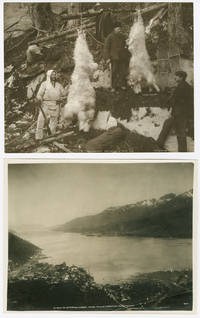
1907WRCAM54628Juneau; White Pass 1907. Two photographs each approximately 7 1/2 x 9 1/2 inches. Slight wear at edges. Captioned in negative. Very good. Two attractive original photographs by noted Skagway photography firm Case & Draper. William Case and Horace Draper followed the excitement of the Klondike Gold Rush and went North in 1898. They stayed and worked in partnership from a studio in Skagway until 1907-1908. The first of these photos depicts three armed men on a hillside at White Pass Alaska with two large mountain goats strung up after a hunt. The second is a captivating landscape of Juneau and the Gastineau Channel with the town of Douglas in the distance. Impressive examples from these significant Alaskan photographers. unknown books
1875WRCAM18480San Francisco 1875. 43pp. Original front wrapper bound into later half morocco. Very good. A propagandistic appeal by the unsuccessful bidders for a fur seal contract for the repeal of the so-called monopoly of the Alaska Commercial Company. Claims to present only the "facts" and calls on the people and press of America to petition Congress for the repeal the government granted to the Company for a monopoly in the fur seal trade. Includes a brief historical sketch of Alaska focusing on how her natural riches came into the hands of a few money-hungry robber barons and paints a dismal picture of the "serfdom" of the civilized natives on the fur seal islands of St. George and St. Paul. TOURVILLE 269. RICKS p.26. WICKERSHAM 1793. unknown books
4499KODIAK ALASKA HUNTING PHOTOGRAPH ARCHIVE. An archive of nearly 100 black and white photographs emanating from a men’s hunting trip to Kodiak Alaska about 1950. There are images of men with fishing rods and rifles and dead bears crabs fish moose and seals. Some photographs show the men inside the cabin relaxing reading sleeping and cooking. There are also photographs of the early planes that brought tourists Alaskan scenery and small Alaskan towns. The images are in three sizes 5†x 7†5†x 3†and 2 ½†x 4 and all are in fine condition with minor faults such as chipped corners. A fine frontier photography archive. unknown books
1939286138Seattle: Farwest Lithograph and Printing Co 1939. Map. Color Lithograph. 21" x 28".<br/><br/> This beautifully colored map of Alaska and the Gulf of Alaska shows the Alaskan boat lines from Seattle and was first drawn by Edward Camy for the Alaska Steamship Company in 1934. A great pictographic map includes an inset showing the Alaska Railways route from Seward to Fairbanks and the Richardson Automobile Highway. The bottom of the map shows a series of cartoons of events on the ship. In good condition a great example of Alaska.<br/><br/> Farwest Lithograph and Printing Co unknown books
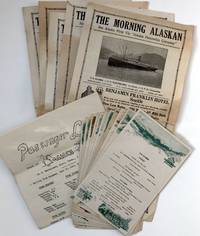
19341007At sea 1934. Very good. Five issues of The Morning Alaskan each 4pp. Also four leaves of manuscript four mimeo news sheets two passenger lists thirteen menus and related material. Light wear and chipping to edges of newsletters and news sheets heavier to news sheets. Light wear overall. A nice archive of ephemera collected during a voyage from Seattle to Alaska aboard the S.S. Alaska. Founded in 1894 the Alaska Steamship Company ran cargo and passenger service to Alaska from Seattle through the mid-1950s at which point it became a freight-only company until its demise in 1971. The materials here likely saved from a voyage in June 1934 provide a glimpse into Alaskan cruise tourism during the height of the Great Depression. There are four daily mimeo "news sheets" titled "Sense and Nonsense" which are filled with one-liner inside jokes about the goings-on about the ship: "Mr Sullivan his own is still holding against all comers and how!!" and "Who was the boyfriend in Ketchikan Rose The flowers at least were beautiful." Additionally thirteen menus for breakfast lunch and dinner meals. The shipboard newspaper The Morning Alaskan features ads and a vignette of the ship on the first page followed by a mixture of news and tidbits from locales across the globe. One issue includes news about the dock strike in San Francisco the reappearance of a missing Japanese Vice Consul in Shanghai and sports news. It was a fairly sophisticated production presumably with the first page pre-printed and then the interior mimeographed aboard ship. The manuscript leaves contain brief notes about the voyage. Upon leaving Seattle on June 13 the author made the following notes providing an insight into the other passengers on the ship: "Six mo. truce made. First boat in 6 mo. why Eng. boats no help to Alaskans. Heavy cargo interesting loading - autos personal Bride soldiers lecturer natives Alaskans going home prospectors old men going back missionaries teachers natives contractors for school projects "nails counted." Orchestra steward. News Daily - ship personals sight seeing paper. Food number of meals & type." He notes stops at Juneau and Hawkes Inlet: "Juneau again. Hawkes Inlet at 9:30 p.m. light. Beautiful. Private homes at most canneries Gov. visiting Hawkes Inlet came on board." Though brief his notes do provide interesting details about the voyage. Notably this archive also highlights possible Chinese migration to Alaska perhaps for the cannery industry based on the passenger lists. The northbound passenger list from Seattle to Skagway on June 14 lists eighty roundtrip passengers as well as 107 passengers with destinations at various ports along the way such as Ketchikan Wrangell Petersburg Juneau and Skagway. It also lists among the passengers sixty "Orientals" and forty-six passengers traveling "Oriental Steerage." At Hawk Inlet thirty-one "Orientals" disembarked -- no white passengers -- twenty-nine of them traveling steerage. An interesting group of ephemera made even more interesting by the addition of the Asian-American component in the passenger lists. unknown books
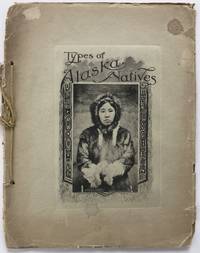
19051676Brooklyn: The Albertype Co 1905. Good. Twelve albertypes mounted on 12 leaves. Original pictorial wrappers string-tied. Wrappers chipped and worn at edges spine heavily; lightly soiled. Leaves brittle corners chipped with mounted images clean and crisp. Pictorial work with mounted images of Alaskan natives taken by the photography firm of Winter & Pond in Juneau. Lloyd Valentine Winter 1866-1945 and Edwin Percy Pond 1872-1943 arrived in Juneau in 1893 establishing a curio and photography shop there. By 1896 they were advertising a catalog of photographs for sale. They documented the local natives the Klondike Gold Rush and life in Alaska producing many popular images of the region. The company existed for over fifty years operating under original ownership until 1945 and finally closing in 1956. <br/><br/>The images here are all of local native tribes including several of the Tlingit people. The front cover image is "Eskimo Girl" and shows a young woman in a fur parka and mittens with a tattoo on her chin. Other images are: "Old Tlingit Woman"; "Native Basket Weavers"; "Old Tlingit Indian"; "Takon Indian Doctor" which shows a medicine man standing and brandishing rattles; "Old Tlingit Women"; "Schwatka a Yukon Guide"; "Chilkat Chiefs in Dancing Costume"; "Old Auk Indian"; "Potlatch Dancers" depicting a large group of dancers in native dress outside; "Auk Indian Doctor"; "Native Curio Sellers" which shows two young women wrapped in furs seated behind baskets of their wares; and "Old Eskimo Woman."<br/><br/>The Albertype Company of Brooklyn produced many such handsome viewbooks and the present work is in line with their style and quality of publication. We locate copies in OCLC at fewer than ten institutions. The Albertype Co unknown books
1914List520Nome: Lomen Brothers 1914. Silver gelatin print 6 1/2 x 9 1/2 inches. Fine. Women's baseball evolved alongside men's leagues beginning in the 1860s with many teams and leagues appearing throughout the following decades often playing indoors and often unrecorded in the annals of baseball history. Women's baseball was particularly popular in Minnesota and parts of the Midwest in the early part of the twentieth century. This photograph bears evidence as to the game's migration to Alaska Territory where long winters would have been particularly conducive to an indoor league. This photograph by the Nome Alaska firm Lomen Brothers shows the champion team of the Ladies Indoor Baseball League in Nome. We find no record in contemporary newspapers or anywhere else of the league. The Nome Brothers were a well-known photographic firm who migrated from Minnesota to Alaska at the height of the Nome Gold Rush in 1903. By 1909 at the end of the gold rush the population of Nome declined substantially to 2500 from 20000 just a few years earlier. This photograph shows interesting documentation of Nome post-rush and also of the spread of women's sports through migrant populations. We find one other example in the Fred Henton collection at the Anchorage Museum at Rasmuson Center. A fine example. Lomen Brothers unknown books
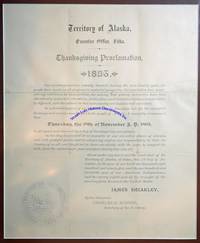
5048ALASKA. Broadside. 1pg. 10†x 12â€. 1895. Alaska. A Territory of Alaska broadside issued by Governor James Sheakley for the 1895 Thanksgiving. The Governor noted that “Our territory has been notably favored during the now-closing year the people have made rapid progress in material prosperity the population has received large additions by immigration the mining and fishing industries have been abundantly rewarded education civilization and Christian influences more widely diffused and the settlers in this new country are hopeful and contented…â€. The proclamation has an embossed seal in the lower left corner and four mailing folds; it is matted in brown. Not in OCLC. unknown books
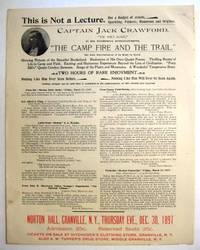
189729536New York 1897. Broadsheet 9 1/2" x 12". With a small oval half-tone portrait. On recto at the bottom printed in red: 'Norton Hall Granville N.Y. Thursday Eve. Dec. 30 1897". Near Fine.<br/><br/> A rare announcement of a public entertainment-- "Not a Lecture. But a Budget of Jewels Sparkling Pathetic Humorous and Original"-- by this popular Western hero who on his first outing as a reporter in 1875 did much to promote the Black Hills Gold Rush. John W. Crawford 1847-1917 was a "poet-scout" who memorialized Custer and Wild Bill Hickok in verse. He "was one of the original discoverers of gold on French Creek in the Black Hills in 1876." After a stint with Buffalo Bill's Wild West Show which he left when he accidentally shot himself in the groin blaming it on Buffalo Bill's drinking he moved to New Mexico to scout for the Army against the Apache. He "did more than any other man in the Territory in bringing before the public the immense mineral wealth of New Mexico."<br/> This broadsheet serves not only to publicize Captain Jack's Entertainment but also to promote "The Capt. Jack Crawford Alaska Prospecting and Mining Co." Testimonials to Crawford are printed here along with an invitation for the recipient to receive a Company prospectus.<br/>OCLC 778631567 2- Yale SMU as of March 2018. unknown books
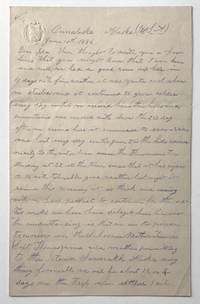
18861242Unalaska 1886. Very good. 4pp. on a small bifolium. Previously folded. In a relatively neat legible script. A manuscript letter by one S.L. Beckwith describing his 1886 travels through the Aleutian Islands and the town of Unalaska addressed to a woman named Ida perhaps his sister. It reads in part: <br/><br/>"This is a poor miserable place. The AC Co. has one comfortable house outside of storehouses coal house salt house oil house and the like. The houses are all small. There is one small church denomination the Russian Greek Catholick. There is about 40 buildings in all here and about a Doz. of Berakies that is underground houses. Everything is built on the sand beach. There is plenty of codfish here also salmon salmon trout brook trout some striped fish and plenty of clams. There is no wood growing on this land."<br/><br/>He goes on to describe the steamer and trading activity in the port and also discusses his prior travels and onward journey through the Aleutian Islands. The "AC Co." mentioned is the Alaska Commercial Company which supported the seal and fur trades in Alaska during the 19th century after it was purchased by the United States. It was headquartered in San Francisco and ran operations in Unga and St. Michael as well as in Unalaska. A brief but interesting account of this Alaskan trading outpost during the 1880s. unknown books
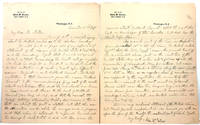
1899249256Washington D.C. 1899. 4 pp. 4to. Old folds else fine. 4 pp. 4to. The letter traces the diplomatic claims of Great Britain in Alaska and goes into detail about the 2 contested parts the "Portland Channel" and the parallel 50 degrees to Mt. St. Elias. <br/>He is grandfather of John Foster and Allen Dulles. He was also TR's head commissioner in the negotiations on Alaska-Canadian boundaries in 1903. unknown books
1891243722Philadelphia: John Y. Huber Company 1891. First edition. Frontispiece maps and illustrations throughout. 418 pp. 1 vols. 8vo. Original pictorial gray-blue cloth. Bookplate. About fine and rare thus. First edition. Frontispiece maps and illustrations throughout. 418 pp. 1 vols. 8vo. Bruns S80 John Y. Huber Company unknown books
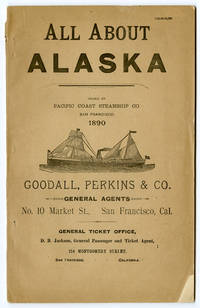
1890WRCAM52358San Francisco 1890. 63pp. Illus. Tables. Original pictorial wrappers. Minor chipping and a couple of tiny repaired tears to wrappers. Very good. Scarce early promotional from the Pacific Coast Steamship Company after the first of 1887 discussing topography industry agriculture with diagrams of steamships available for passage namely deck plans of the "Queen" "City of Topeka" and "George W. Elder." An attractive engraving of the Hotel Ramona San Luis Obispo adorns the back cover. TOURVILLE 3449. unknown books