1 275 résultats
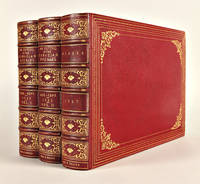
1937WRCAM54535Alaska & Canada 1937. Three albums with 601 photographs each approximately 3 3/4 x 5 3/4 inches with additional ephemera such as news clippings and a hunting license. Oblong folio. Contemporary full red morocco gilt tooled by the Harcourt Bindery. Photos mounted directly on stiff grey album leaves. Very light wear to hinges and spine ends. Contents generally fine. Very good overall. Two volumes in red cloth slipcases. A magnificent and massive collection of over 600 photographs compiled by William N. Beach famed big game hunter and author of IN THE SHADOW OF MOUNT McKINLEY. <br> <br> The first two albums here document a journey made by Beach through the Canadian Rockies in August and September 1933. The third album focuses on his excursion through Alaska in 1937. All three postdate the publication of MOUNT McKINLEY which established Beach as an important figure in the world of big game hunting. According to one of the contemporary newspaper clippings tipped into the album Beach's hunting party on his second trip documented here "was after specimens of Alaskan wild life to be placed in the Smithsonian" with W.L. Brown curator of the Institute accompanying the party. Shortly after the trip an article by Beach entitled "With Moose and Caribou in Alaska" was published in EXPLORATION AND FIELD-WORK OF THE SMITHSONIAN INSTITUTION IN 1937 and featured photography from the "Alaska" album present here. <br> <br> These expertly captured images of the Denali wilderness and the Rockies offer a rare and extraordinary glimpse not only into big game hunting but also into remote and pristine landscapes of these areas in the 1930s. An outstanding and impressive group of photographs. hardcover books
1803ST15927London: Cadell and Davies 1803. ONE OF 60 LARGE PAPER COPIES of the "considerably enlarged" Fourth Edition ours a variant retaining the date of 1803 on the title-page rather than 1804. 330 x 252 mm. 13 x 9 7/8". xviii 4 xix 1 380 pp. Two leaves usually bound at the end and containing the "List of Principle Books Referred to in this Work" and "Works by the same Author" bound between pp. xvii and xix here. <br/> VERY FINE CONTEMPORARY SPRINKLED CALF raised bands flanked by plain and decorative gilt rules and chain roll spine panels with star centerpiece red morocco label marbled endpapers. With six engravings: five maps two folding and one view. A Large Paper Copy. Front pastedown with engraved armorial bookplate of Marcus Gage; title page with ink inscription at head: "M. Gage's Book got from Mr. Asperne London April 15th 1805." Lada-Mocarski 29 note; Howes C-834; Sabin 17309; Streeter VI 3501; Cordier Bibliotheca Sinica pp. 2447-48. ◆Small chip to tail of spine corners a bit rubbed flyleaves somewhat foxed the usual minor foxing to plates and a bit of offsetting to adjacent pages otherwise A VERY FINE COPY OF AN ESPECIALLY DESIRABLE EDITION clean and fresh internally with vast margins and the binding firm lustrous and with only very minor wear to the joints.<br/> <br/> This is an extremely well-preserved copy in an elegant contemporary binding of the most sought-after edition of a key source on Russian exploration and that country's efforts to expand trade with China and Alaska. Eminent historian William Coxe 1747-1828 studied the voyages and exploration by Bering and others to the regions of Kamchatka the Aleutian Islands and Siberia to prepare this overview of the geography and cultures of the lands between Russia and North America and to analyze the economic potential of trade--particularly in furs--with the region. According to Sabin "Mr. Coxe's book contains many curious and important facts with respect to the various attempts of the Russians to open a communication to the New World." The 1780 first edition of this work covered Russian voyages of discovery between 1740 and 1769; the 1787 third edition added a supplement comparing these explorations to those of Captains Cook and Clerke. Our much-expanded fourth edition gives in the words of the Preface "a complete series of voyages from 1711 to 1792 comprising all that is known on the subject." Some of this supplementary information was gleaned from earlier accounts by German historians G. F. Muller and P. S. Pallas and some from Coxe's own travels in Russia. According to Lada-Mocarski Coxe "also succeeded in securing additional material: for instance the narrative and maps of Krenitzin and Levashev's 'secret' expedition the first official Russian government expedition since Bering's 2nd expedition of 1741. He was able to secure this particular information not widely known at the time even in Russia from Dr. Wm. Robertson who in turn obtained it through his friend Dr. Rogerson first physician to the Empress Catherine II. . . . In view of the above additions one should consider the fourth edition of 1803 as the most desirable." He concludes: "Coxe's work particularly the fourth edition is a result of contemporary and authoritative sources translated into English not to be overlooked by scholars and collectors alike." There are also distinct aesthetic advantages to the present Large Paper version over the octavo printing. Not only is the type beautifully re-set and laid out as well as surrounded by vast margins but as Streeter notes there are two charts here that are not included in the octavo issue of 1803. The original owner of this volume Marcus Gage is known to have assembled a substantial library of beautifully cared-for books on travel and discovery see for example "Exploration & Discovery 1576-1939 Books from the Library of Franklin Brooke-Hitching" passim. Gage notes that he got the book from "Mr. Asperne"—no doubt the London publisher and bookseller James Asperne 1757-1820. ABPC and RBH find just four other Large Paper copies at auction in the past 45 years two of which had condition issues. One could wait a considerable time to find a copy as attractive and desirable as the present one. Cadell and Davies unknown
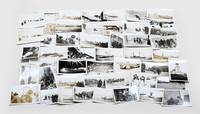
1930WRCAM56103Various locations in Oregon and Alaska 1930. Approximately 325 photographs twenty postcards and real photo postcards a linen- backed map of Alaska and a few assorted ephemeral items all housed in a contemporary leather satchel. Generally minor wear some chipping to about twenty photographs. Overall very good. A treasure house of silent cinema photography from the Pacific Northwest and Alaska featuring over 300 images from THE CHECHAHCOS and other films produced in the orbit of the film's director Lewis H. Moomaw all retained by one of his crewmen Guerney William Hays. <br> <br> THE CHECHAHCOS released in 1924 was the first feature film shot in Alaska. "Cheechako" is a native word referring to a "greenhorn" or someone newly arrived in the mining districts of Alaska or northwestern Canada. A melodramatic tale of the Klondike Gold Rush the was directed by Lewis H. Moomaw of the Alaska Moving Pictures Corporation. The story was based in part on the experiences of the film's producer Austin E. Lathrop known as "Alaska's first home-grown millionaire." The film has been preserved in the National Film Registry and can easily be viewed on the internet. Offered here is a large collection of photographs and other ephemera once belonging to a CHECHAHCOS crew member named Guerney William Hays 1880-1952 including film stills snapshots from the set and other images of Alaska scenery. Many of the images match up with scenes from the completed film. The subject matter includes all that might be expected from a film produced in and about Alaska: glaciers dogsleds saloons archvillains and damsels in distress along with shots of the crew and technology that made the film possible. <br> <br> The largest and most professionally-produced photographs in the collection are eighty 8-x- 10-inch prints almost all of them clearly from the CHECHAHCOS shoot with twenty-one stamped on the verso by the Alaska Moving Pictures Corporation and with either a printed or manuscript title written along with the stamp reading "The Chechakos" the spelling of which was later tweaked to its release title. One of the stills shows the entire company of the Alaska Moving Pictures Corporation about 150 people in the snow beside their Pullman cars; two banners for the film company hang outside the rail cars. A separate shot of the film company shows their train at the entrance to McKinley Park with a banner hanging on the train reading "Private Car Alaska Moving Pictures Corporation Entrance to McKinley Park on the Alaska Railroad." Other stills show scenes from the film shots of the cast and crew preparing to start scenes posed scenes clearly intended for use as publicity stills cast group pictures behind-the-scenes shots of the cameramen and other crew with various equipment photographs of empty interiors perhaps to be used for continuity a few featuring the dog sled teams and more. In addition to documenting the production these images also present a rare view of Alaska in the early-20th century. <br> <br> The remaining 240 images most of which measure approximately 3 x 5 inches were likely not formally produced by the film company for use as publicity but are in fact production photographs and still stand as valuable visual documentation of the early filmmaking process. While some of these photos are more of the vernacular sort the great majority of the images show a mixture of preproduction production and set-related photographs from the film company's time in Alaska shooting THE CHECHAHCOS and from other production's attached to the career of Lewis H. Moomaw the film's director. A great number of these images were likely produced as working production photographs - executed for the use of the company during the shooting process scouting for locations documenting costumes set continuity set construction what might today be called craft services suggesting or documenting potential camera set-ups or as studies for potential publicity stills and more. While not created as traditional publicity products these images capture the early filmmaking process both in front of and behind the camera presenting a quite uncommon slice of film production history. The fact that they were produced during the production of a film in Alaska make them an even more valuable source of information on the filmmaking process in the 1920s in a most unusual place. Production stills are produced in very small quantities compared to publicity stills are often unique or close to unique records of a production have a much lower survival rate and are keenly sought after as historical records of the filmmaking process. <br> <br> One of the few captioned photographs shows four wives of the CHECHAHCOS cast and crew on a fishing expedition including Moomaw's wife and Mrs. Guerney Hays. A few other photographs show an actress posing with crude dummies that were apparently about to be sent to their doom in a canoe scene in the Alaskan wilderness. Other production photographs from Alaska feature scenes on glaciers one of which shows the exact spot from a moment in the opening minute of the film a young girl with a giant Alaskan crab who is also pictured in the larger professional images and is in the film film crews poised on icy ground dog sled teams identified locations in Skagway and more. <br> <br> One of the other films pictured here is likely CALL OF THE ROCKIES 1929. This western was filmed in Oregon the usual home of the filmmakers involved in the Alaska Moving Pictures Corporation with Moomaw as supervising producer. CALL OF THE ROCKIES was directed by Raymond K. Johnson one of the cinematographers on THE CHECHAHCOS and features two actors identified in pencil captions on the verso of photographs present here: Russell Simpson and Jim Mason. There are numerous photographs featuring a western wagon train and other images of the traditional western which either appeared in CALL OF THE ROCKIES or perhaps one of Moomaw's other films produced in Oregon in the 1920s - UNDER THE ROUGE 1925 or FLAMES 1926 the latter of which climaxed in a raging forest fire and featured an early screen appearance by Boris Karloff. <br> <br> All of the postcards feature Alaskan scenes or subjects and were most likely acquired while the film company was shooting in Alaska or produced for them while they were there. This is the case for at least one of the postcards - a Christmas greeting with the banner at bottom reading "Compliments of the Alaska Moving Pictures Corporation." The final item of note here is a folding linen- backed map of Alaska issued by the Alaska Steamship Company. The map measures about 21 x 30 inches and was issued in 1917. It was almost certainly taken along to Alaska by Hays for the filming of THE CHECHAHCOS linen- backed either before-hand or while in Alaska to prevent damage from over-use. The entire collection of photographs and ephemera is housed in a period leather satchel. <br> <br> These photographs were collected and retained by Guerney or Gernie William Hays 1880-1952 who spent a career in the early film industry mostly in Oregon. Some pieces of ephemera bear his name and some of the larger stills are annotated "Hays" on the verso. His 1918 draft registration lists him as a motion picture operator in Portland and his obituary lists him as a member of the International Alliance of Stage Employees. His only film credit in the Internet Movie Database is for THE CHECHAHCOS for which he is credited with "sets and lighting" and also an uncredited supporting role on screen. One of the larger-format photographs features a crew member in a cramped equipment room with dozens of lights and mounds of cables; this is almost certainly Hays himself or perhaps one of his assistants. One of the photo developer's envelopes bears the name of Hobart H. Brownell the cinematographer of THE CHECHAHCOS. Two of the photographs here are inscribed to Hays - one from the actor Bert Sprotte in 1919 and the other from banjo player Eddie Peabody who has inscribed his portrait to Hays writing that "No finer stage manager I ever worked with." Another photograph shows Peabody's elaborate stage show. <br> <br> THE CHECHAHCOS remains an important early film for its authentic depiction of Alaskan life. Movies about the great white north were popular with early film audiences but were usually filmed in California. When Lewis H. Moomaw proposed to shoot a film entirely in Alaska about the days of the Klondike Gold Rush in the territory locals in Alaska jumped at the chance to find him funding. Upon arrival in Anchorage fully half of the town showed up to greet the film company. The cast and crew would spend three months filming in and around Anchorage the small mining town of Girdwood on Childs Glacier Abercrombie Rapids and Eyak Lake. The film premiered in the Empress Theatre in Anchorage on December 11 1923 and played to packed houses across Alaska the next year. Sadly the film never found a large audience in the continental United States playing occasionally over the next two years before falling into obscurity. The film was essentially lost until the year 2000 when a print was restored by archivists at the University of Alaska Fairbanks. Three years later the film was selected for preservation by the National Film Registry. <br> <br> The Library of Congress's press release when they selected THE CHECHAHCOS to the National Film Registry describes the film as such: "This independent regional film was the first feature film produced in Alaska and is renowned for its spectacular location footage of the lonely and unfathomable Alaskan wilderness frenzied dogsled pursuits and life-and-death struggles on the glaciers." <br> <br> A wonderful collection of great historical interest for early film scholars and of the history of Alaskan cinema. hardcover books
1931313016Brockton Mass: Harold C. Keith 1931. First edition. Illustrated with photographs. Text in two columns. 28 pp. 1 vols. 10-1/4 x 7 inches. Wood grain wrappers with pictorial onlay text gathered with cord. Cover onlay creased with a few old tape ghosts ink notation to front blank Goodspeed sales receipt 1957 bookplate of Stephen Ellsworth Clow and Ruth Hazen Clow. Green half morocco slipcase and chemise. First edition. Illustrated with photographs. Text in two columns. 28 pp. 1 vols. 10-1/4 x 7 inches. ONLY COPY. Well written and nicely illustrated privately printed account of an Alaska hunting expedition. The party of four organized by H. Wendell Endicott comprised Endicott George Perry Latham Reed and Harold C. Keith whose diary for 14 August to 7 October 1930 is printed here. Latham Reed Sr. and Gen. R. E. Wood joined the party for the first stage of the journey to Big Delta. <br/>The hunting began on 24 August when a herd of caribou passed across the road in front of their car. Mr. Collins assistant district attorney at Fairbanks" stepped out and showed us how to shoot by dropping a big caribou on the first shot."<br/><br/>Twenty-one miles up the road from Big Delta the party left Mr. Collins' car and joined their crew of 8 and 24 horses and began their trip. They hunted bear and moose and caribou and sheep near the Gerstle River and Elting Creek and Jarvis encountered heavy snow saw the northern lights and completed a large loop back to Twenty-Six Mile Cabin during their stay.<br/><br/>Endicott 1880-1954 was author of Adventures with Rod and Harpoon in the Florida Keys. Harold C. Keith Amherst class of 1908 and Endicott were both shoe manufacturers in Massachusetts. Keith was president of the George E. Keith Co. in Brockton<br/><br/>The only other copy of this book recorded is a photocopy in the Candace Waugaman Collection at the Rasmuson Library University of Alaska Fairbanks<br/><br/>RARE. Not in OCLC not in Heller Biscotti Harold C. Keith unknown books
161959078Anchorage & Seward A.T.: Alaska Engineering Commission AEC Phinney S. Hunt ca. 1916-1917. 4to. 86 silver print photographs sized 6.25 x 8.25 in. nearly all w/ photographer’s imprint w/in negative at lower fore-edge as well as caption negative number and AEC some w/ occasional pencil annotations on verso all preserved in mylar sleeves occasional creasing at corners a couple w/ slight loss at corners in the small blank margin. Recent 3-ring clamshell binder an excellent set of photos with all retaining bright strong contrast. This outstanding photo archive provides not only some of the earliest photographs of Anchorage Alaska Territory but also this immense railroad project first authorized by the US Congress in 1912. The few existing privately-run railroads operating in Alaska at the time including the Alaska Northern Railway and the Tanana Valley Railroad primarily fulfilled the needs of the mining companies carrying resources to sea ports and very little allowance was made for passenger traffic and it was impossible to travel by rail from Ship’s Creek at the Cook Inlet north to Fairbanks. Through an April 1915 executive order President Wilson directed that the newly created Alaska Engineering Commission construct a railroad along the surveyed “Western Route†from Seward or Portage Bay along the Turnagain & Knik Arms of Cook Inlet North through the Suitna Valley and then follow the Nenana River until it joined the Tanana with the intent it would connect eventually to Fairbanks. Employing discarded surplus railroad equipment from the Panama Canal Railroad project and under the direction of engineer Mears who had worked on both the Panama Canal and Great Northern Railroads the tiny tent city of Ship’s Creek swelled to 5500 people within two years and was officially labeled by the Post Office as “Anchorage.†Photos included here reveal the barren original landscape of Ship’s Creek with one of the photos showing the steam launches “Alaska†& “Seagull†who carried cargo and passengers from ships offshore. In addition there are views of the construction of the immense AEC Railway machine shop by Sept. 1916 as well as the newly completed first Railroad Depot in Anchorage with the progression of buildings erected beyond. These early views of the fast developing project portray the Commissary Hospital Bunkhouses finished machine shop interiors of the powder house for blasting along with a view of the AEC’s photo studio and the completed electrical power house. Early street views of the nascent city are quite scarce and one of particular interest shows Fourth Ave. looking East with newly built stores and homes built along both sides of the roadway stretching into the distance. Brutal working conditions continually interfered with the pace of the project with one of the images showing the AEC’s “Electric Thawing Machine†on a sled whie others depict piles of snow work camps in snow and even sternwheeler and docks trapped in an ice flow in March 1917. A couple of the photographs feature the sternwheeler SS Omineca underway which had been originally constructed in 1909 for the Grand Trunk Railway running the Skeena River from 1909-1912 and powered by the original SS Caledonia’s engines. By the end of 1916 60 miles of track had been laid 100 miles were graded and right-of-way cleared for 230 miles with photos in this archive showing AEC Construction camps at various mile markers blasting activity and track laying. At the same time they rehabilitated the bankrupt Alaska Northern Railroad tracks and by Oct. 24 1917 the first AEC Railway train reached the Chickaloon coal mines 74 miles North of Anchorage. The railroad would actually not be finished until 1923 when the Tanana River Bridge was completed and last 57 miles of track to Fairbank converted to standard gauge. Photos also show the Anchorage Baseball Field which featured games for the Cook Inlet Baseball League composed at the time of Matanuska Anchorage and Turnagain Arm teams. There’s also a very fine series of the Decoration Day parade held May 30 1917 depicting many of the main streets and businesses in the background. In addition several photographs show the ocean docks completed which allowed ships to directly dock at Anchorage rather than lightering passengers and cargo to shore prior to 1917. Hunt 1866-1917 originally worked as a California optician before trekking to Valdez Alaska as a gold rush prospector but quickly established himself as a photographer opening his studio and documenting Valdez and development of the region. He would bring his wife and children to Alaska by 1907. He later secured work as one of the AEC’s official photographers shooting some of the early survey work by 1914 and through the project until suffering a heart attack Oct. 14 1917 in Seward AK. Hunt’s son A.O. Hunt also worked as an assistant photographer for the AEC. A few of these images appear as negatives in the Alaska State Library Historical Collections with a couple shown in their Digital Archives and some appear in the Alaska Engineering Commission archive at the U of W Collect. No. PH0495 but the bulk of that collection features photographs by James McPherson H.G. Kaiser and A.J. Johnson who were the other official photographers on the project; See: Phinney S. Hunt Photographs of Alaska 1902-1909 Photographs in and around Valdez and Sitka Alaska University of Washington Special Collections; Phinney S. Hunt Obituary Alaska Railroad Record Vol. I No. 49 Oct. 16 1917 p. 389. Alaska Engineering Commission, AEC, Phinney S. Hunt, unknown
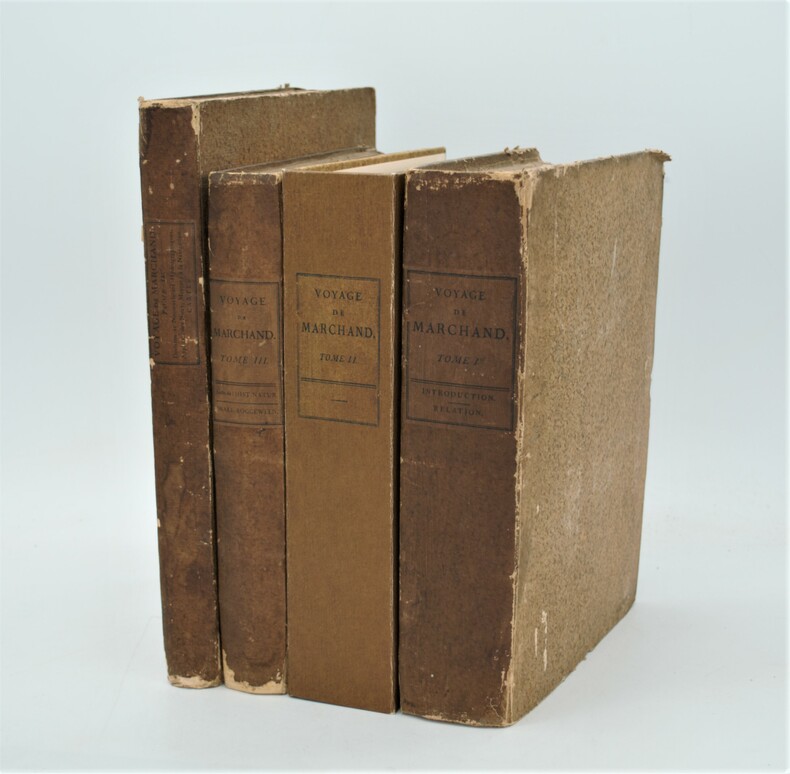
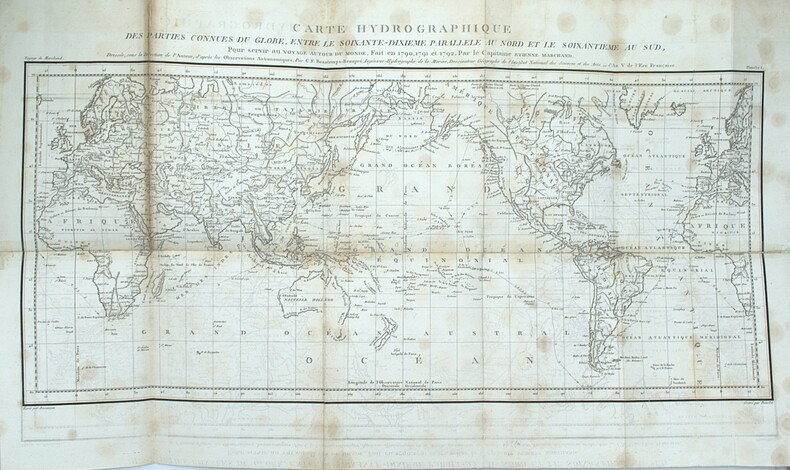
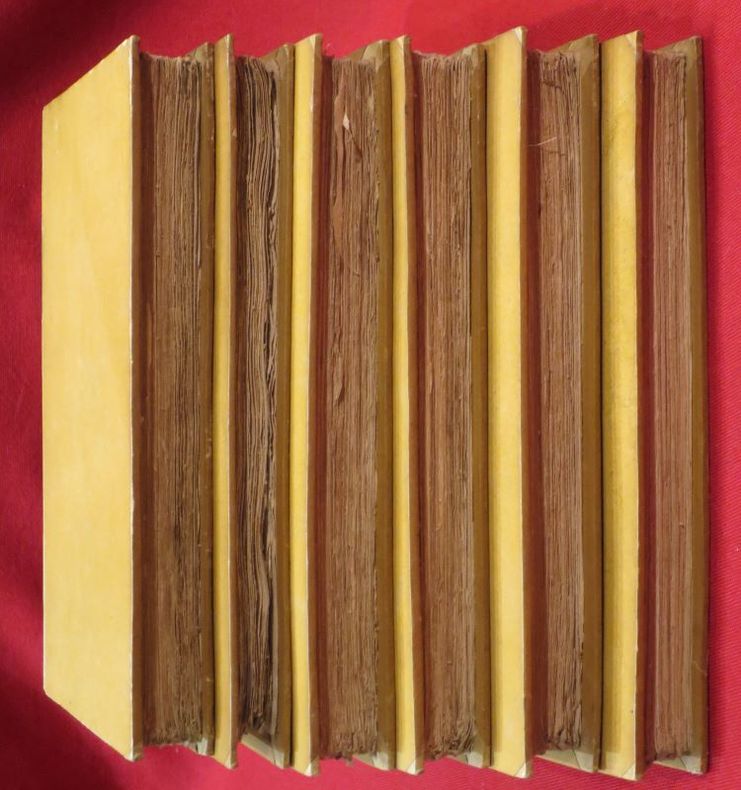
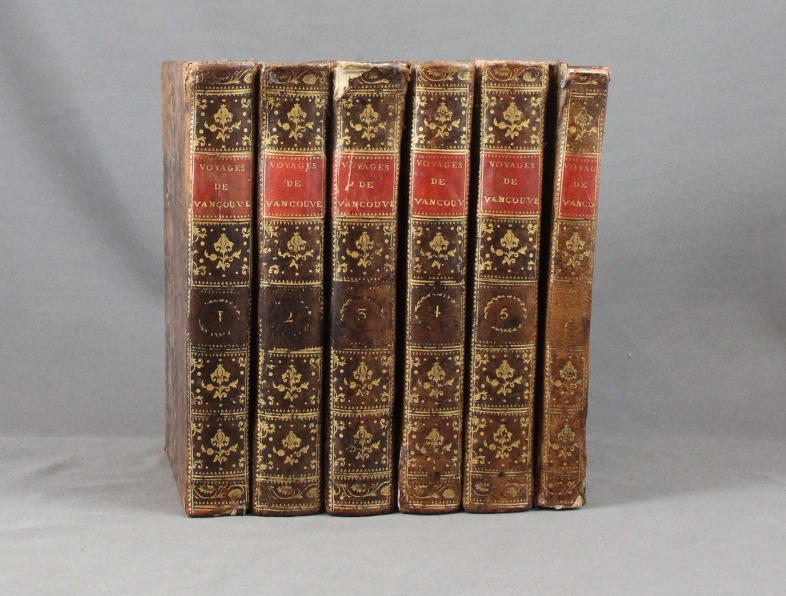
1798PHO-657Paris, De l’Imprimerie de la République, An VI-An VIII [1798-1800]. In-4 (28x22 pour les T.I et II,31,5x24 pour le T .IV) ,xii, cxliv, 628, [3] ; xvi, 676, [2] ;[xi], 431, [1];[2],viii, 158pp, relié couverture d’attente éditeur en cartonnage beige chiné , non rogné , le tome IV n’étant pas ouvert ,défauts d’usage , papier à grandes marges et bruni aux bords ,mouillures au tome III , quelques rousseurs ,tome II reliure demi cuir sous emboîtage à l’identique.Tome I,III et IV premier tirage , Tome II ,1841, ,édition originale remise en vente en 1841 avec un titre de relai portant la mention fictive , "nouvelle édition"(quelques exemplaire imprimés en 1798 n'avaient pas trouver preneur) .L’illustration comprend 16 planches dépliantes gravées sur cuivre, numérotées de I à XV, dont une planche notée VI bis, toutes réunies dans le 4éme tome . Les 15 cartes gravées par Bouclet, Collin, Tardieu, Fortier, etc., levées pour les côtes nord-ouest de l’Amérique du Nord, les îles des Marquesas de Mendoça (îles Marquises), les îles Tupaya (dans l’actuelle Polynésie française), la baie de Tchinkîtâné (actuelle Sitka Sound, près de la ville de Sitka en Alaska), les îles de la Reine-Charlotte (archipel canadien au large de la Colombie-Britannique), les îles Sandwich (Hawaï), le détroit de Magellan, le détroit entre les îles Banca et Billiton (actuelle Belitung) en Indonésie, etc., et une jolie planche à caractère ethnographique (n°V) représentant des échasses de Whûtahô, une des îles de l’archipel des Marquises. Le tome I renferme un tableau dépliant donnant les concordances de mots français avec la langue de Wahîtahô et le tome IV les Observations sur la division hydrographique du Globe .
1934320413Aboard the Hussar Washington Alaska etc. 1934. 97 pp. profusely illustrated with dozens of snapshots newspaper clippings and a map of coastal Alaska. 1 vols. 4to. Full light brown morocco gilt upper board with yachting pennant of the Yacht Hussar onlays in red blue and gold within gilt fillet border with floral corner ornaments board edges and dentelles gilt a.e.g. by James MacDonald Co. A few scuffmarks at extremities else fine. 97 pp. profusely illustrated with dozens of snapshots newspaper clippings and a map of coastal Alaska. 1 vols. 4to. Manuscript diary in a secretarial hand or perhaps by Hutton's wife Marjorie Merriwether Post but signed by each of the member of the travelling party of a 1934 cruise of Edward F. Hutton's 320-foot yacht Hussar along Alaskan coastal waters to hunt bear largely around the islands near Juneau. The party included Hutton his wife and daughter movie producer Hal Roach and wife Marguerite Ernest H. Rice and wife Miriam 'war ace' Dave McCullough and others. Roach had lived in Valdez and Fairbanks for 2 years early in his career. <br /> <br /> In all besides good eating and drinking deck games and other fun on board the group saw 76 black bear and 59 brown bear on the excursion even bringing a cub on board. The trip was cut short however when McCullough was seriously wounded by one of the guides in a shooting accident. unknown
1934320413Aboard the Hussar Washington Alaska etc. 1934. 97 pp. profusely illustrated with dozens of snapshots newspaper clippings and a map of coastal Alaska. 1 vols. 4to. Full light brown morocco gilt upper board with yachting pennant of the Yacht Hussar onlays in red blue and gold within gilt fillet border with floral corner ornaments board edges and dentelles gilt a.e.g. by James MacDonald Co. A few scuffmarks at extremities else fine. 97 pp. profusely illustrated with dozens of snapshots newspaper clippings and a map of coastal Alaska. 1 vols. 4to. "Just a shooting trip in Alaska": Signed by E.F. Hutton. Manuscript diary in a secretarial hand or perhaps by Hutton's wife Marjorie Merriwether Post but signed by each of the member of the travelling party of a 1934 cruise of Edward F. Hutton's 320-foot yacht Hussar along Alaskan coastal waters to hunt bear largely around the islands near Juneau. The party included Hutton his wife and daughter movie producer Hal Roach and wife Marguerite Ernest H. Rice and wife Miriam 'war ace' Dave McCullough and others. Roach had lived in Valdez and Fairbanks for 2 years early in his career. <br/><br/>In all besides good eating and drinking deck games and other fun on board the group saw 76 black bear and 59 brown bear on the excursion even bringing a cub on board. The trip was cut short however when McCullough was seriously wounded by one of the guides in a shooting accident. unknown books
1798PHO-1092Deuxième reliure de la première édition. Édition originale in-4 sur grand papier, remise en circulation en 1841 avec un nouveau titre avec la mention fictive "nouvelle édition" (quelques exemplaires imprimés en 1798 n'avaient toujours pas trouvé preneur). Une édition octavo en six volumes a également été publiée. in-4 ,y compris l'atlas. Avec 16 (10 dépliantes) dont 15 cartes gravées, 1 planche gravée et table dépliante. - Beau demi-cuir contemp , dos lisse avec titre et tomaison , petits manques au dos , quelques mouillures intermittentes et vieille trace d’humidité (T1), déchirure carte hydrographique sans manque. xii, cxliv, 628, [3] ; xvi, 676, [2] ;[xi], 431, [1];[2],viii, 158pp.
193321317Alaska: No Publisher 1933. The movie can be loosely interpreted as the history of a journey up the Alaska coastline with some land interior footage beginning in the more southern tier and ending in the bleak far northern ice lands with 'stops' along the way; the movie has a semi-professional 'feel' - for several reasons some of which are that editing between segments is smooth and uninterrupted there are occasional professional 'titles' interspersed in the film and perhaps most importantly the quality of the imagery and the 'narrative' progression of scenes speaks to a professional behind the lens; subjects are diverse: at the beginning of the film we view the vast panoramas of the Alaskan lands mountains and rivers treated to a Robert Service quote - ".there's a land where the mountains are nameless and the rivers run God knows where." with men and a lively dog standing aboard a rapidly-moving raft poling down a river - the same men seemingly very closely for comfort observe bears fishing a stream during a salmon spawn and climbing nearby trees; the men demonstrate salmon bow-fishing and bring the catch home; the camera eventually moves on to the coastal trip being on board small steamers and sailing craft; we observe the "Wrangell Branch" of the A & P Packaging Co. with cannery scenes; visiting an outpost medical clinic seemingly obstetric; on to footage of the massive caribou movements across the tundra lands and natives hunting them; Inuit trade polar bear & other skins at a 'trading post' for goods; heavy-duty tractors used on icy surfaces to transport entire houses & populations; the stamina and strength of sled-dogs pulling up what looks like a 45-degree angle hillside at speed and in deep snow; ice-chopping for massive slabs used to build a home igloo; a costume parade of little children in a town which also shows mission children and schools young men and women in activities around sturdily-constructed multi-story brick buildings probably related to missionary work in the Territory; native carvings totem poles and other crafts; ski-planes at a small wintry airport runway - identified as "Pacific-Alaska Airways"; perhaps most exciting and interesting is the film's showing of an Inuit whale-hunt the bringing in of the great creature - hauled by hand the hunters seated on the ice in rows and strongly pulling at tremendous rope hawsers - the flensing of the blubber and an extremely lively victory party afterward obvious happiness and exhilaration of the people dances and chanting of women and men after the great capture - the fun includes being tossed in the air trampoline style done standing up the local people all dressed in the available skins and hides hunted there; various little stops are made along the way by the boat as it moves up the Alaskan fiord-scape - at one point we are treated to an exhibition of the Inuit kayak with a native spinning under the cool waters in his boat; the kayaks push offshore to greet the supply ship in this case a 4-masted schooner - we see this vessel at anchor and also magnificently under full-rigged sail - and retrieve goods in their longboat; eventually the coasting brings us to a dramatic close with a sunset silhouetting the schooner with only icebergs on the horizon; there are 'human' moments as well this is not simply an amateur travelogue - young women coquette a bit for the camera town worthies and ancient native people sit in dignity graveyard views which linger over readable headstones; people at work and play with vigor and without a 'staged' feeling -cute and very strong & skilled little kids in a wood-chopping contest and more; there is approximately 1600 feet of 16mm film run time about ½ hour; we speculate this is the original or master since there are several safety film types used here: Kodak safety positive Dupont Pathe Gevaert safety film and perhaps others - seemingly a copy of the master would have been using all one film type; these sections are professionally spliced together and viewable as we have watched this production on film a desk-type film editor as well as a through a projector; occasionally and unexplainably by checking the film types at the change there is a yellowish cast to the scene which does not obscure detail and which shifts abruptly back to clear black and white footage; on an old reel; no credits are given for the photography or direction production of the film; a possible clue is offered in an accompanying item a large sepia & black chalk portrait heightened in white on Canson & Montgolfier France watermark paper of what appears to be a reverend or Protestant cleric who bears a close resemblance to one of the characters seen several times in the film and who may have been a missionary in Alaska or perhaps ended up as the recipient of this master film; pastel portrait measures approx. 18" x 22" signed lower left Melita Hofmann C. 1907-1976 a commercial artist and illustrator originally from Toledo Ohio who worked as an art director for Grosset & Dunlap and in book illustration - the portrait with some closed edge tears repaired on verso otherwise in good shape and a good likeness accomplished with skill; the film in very good condition and viewable albeit with some vinegar syndrome - usual with films this vintage - and one of the most interesting ethnographic and historical artifacts and perhaps unique that we have had in stock filmed during a time of great change for the Inuit for Alaska and its' landscape; our thanks go to Richard Hart senior in film studies at Brooklyn College for his invaluable help in reviewing the film and revealing technical aspects of the process. First Edition. Not Bound. Very Good. No Publisher Paperback books
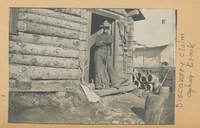
1901List2108Alaska 1901. Oblong folio 12 ½ x 9 inches. Twelve leaves with 89 photographs rebound in modern cloth. Binding in fine condition photographs generally excellent some leaves with clear tape repairs. A well preserved album of photographs showing mining operations in the Golovin Bay region about fifty to seventy-five miles northwest of Nome during the tail end of the Klondike Gold Rush period in 1900-1901. The album shows the operations of the Pioneer Company in Alaska in great detail including the travel by boat and the camps along Opher Creek as well as many photographs of the mining operation itself. According to a caption in one of the photographs $12000 worth of gold was taken out of the “Discovery Claim†on Ophir Creek. The album also includes several photographs of the indigenous population. The compiler of the book appears to have been a student at a mining college at some point as some of the photographs show a “Class of ‘04’†sign. The photographs are dated from 1897 to 1901. Interior scenes and a particularly broad portrayal of mining life and operations make this an uncommonly informative photographic document of Alaskan mining operations during this period. <br /> <br /> Lowny J.D. The Golovin Bay Region of Northwestern Alaska. In: The Engineering and Mining Journal Vol. 71 pp. 781-782. June 15 1901. Accessed online 6/23. unknown
xi, 227 pages. Index. Fold-out map. Signed and inscribed by author to renowned historian William Hickling Prescott inside front board. Upon front free endpaper a subsequent owner (late 1800s) has documented the provenance of this copy and documented Prescott's pencil markings to pages 23 through 27 which deal with Cortes and Mexico. Occasional light markings to contents. Prior owner's mini-bookplate inside front board. Narrow openings along both hinges. Usual library markings. Fold-out map bears several short openings and a tape repair along right edge. Front free endpaper loose but present. Prior owner's signature atop title page. Above-average external wear to brown marbled boards. WHALE 508, TPL 2369, HOWES G-389, RICKS P.112, TOURVILLE 1850, SMITH 3848, WICKERSHAM 4086. Book
19053538Copper River Valley Ak 1905. Very good. Forty-five printing-out paper photographs between 3.25 x 3.25 and 4 x 6 inches plus three real photo postcards. Minor wear a few creases occasional light soiling. A unique collection of almost fifty images capturing scenes in and around Copper Center in the Copper River Valley of Alaska in the years after gold was first found there in 1898. The images document pioneers panning for gold running dog sled teams posed in front of early wooden buildings in a bleak snow-covered landscape and more as well as capturing shots of a riverside mill a wooden bridge scenery on the Copper River and the majesty of the surrounding forests. A handful of the images capture pioneer women and children posed for the camera in winter clothing worn to combat the bitter Alaskan winters. One image pictures three men and two dogs standing outside the Hotel Holman an early Copper Center roadhouse that began in a tent but was opened in a wooden structure in 1899; the present image captures the post-1899 wooden structure. The Holman Hotel was established in July 1898 by Copper Center's first resident Andrew Holman in order to provide shelter for prospectors on their way to the Klondike gold fields. Copper Center is located northeast of Anchorage and served as a brief but important way station for gold prospectors in southeastern Alaska; one image here apparently pictures the early riverside settlement or is perhaps an early view of Anchorage. A rare view of Alaskan life in an uncommonly-seen settlement during the first decade of the 20th century. unknown
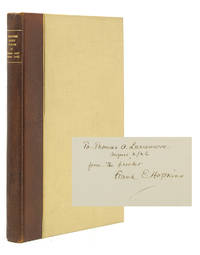
1924313772Flushing Long Island: Marion Press 1924. Copy #X of 50 copies. Printed at the Marion Press. Inscribed on the colophon page to Thomas A. Larremore April 2/26 from the printer Frank E. Hopkins. Larremore was the bibliographer of the Marion Press. Illustrated with folding map folding view numerous photographic plates and inserted sketch maps. Pp. 103 1 colophon. 1 vols. 8vo. Original quarter brown morocco and cloth titled in gilt. Stamp of Robert Pierce on the front pastedown. Copy #X of 50 copies. Printed at the Marion Press. Inscribed on the colophon page to Thomas A. Larremore April 2/26 from the printer Frank E. Hopkins. Larremore was the bibliographer of the Marion Press. Illustrated with folding map folding view numerous photographic plates and inserted sketch maps. Pp. 103 1 colophon. 1 vols. 8vo. "A very interesting journal with sketch maps and drawings and photographs. Touches much country not before described and goats are discovered near Frances Lake ." - Phillips<br /> <br /> Streeter: Hunter's narration of his journey "to the Yukon in quest of Frances Lake" is taken from his diary. "Many things that I wrote in the field last summer read queerly today but that may be accounted for by the fact that here on Long Island I am neither tired hungry nor wet. These three things strangely influence the amateur explorer."<br /> <br /> The author thanks Charles Sheldon of Washington D.C. in the Apologia for giving him the idea to search for sheep at Frances Lake. Hunter retraced some of the 1887 explorations of George M.Dawson published in The Yukon Territory 1898 which collected acounts by Dall Dawson and Ogilvie. Streeter 3627; Phillips p. 190. Larremore The Marion Press no. 183 & pp. 150 & 160; Not in Heller [Marion Press] unknown
1932177173Alaska: 1932-3. The first Hollywood film to be shot in a Native American language A collection of behind-the-scenes photographs documenting the production of Eskimo 1933. With a mostly Native American cast it was the first feature film shot entirely on location in Alaska and the first to incorporate the Iñupiat language. Produced over a 17-month period it captured scenes of hunting and daily life with documentary realism. The photographs include images of the cast and crew among them the Iñupiaq lead Ray Mala Lotus Long Peter Freuchen and director W. S. Van Dyke as well as indigenous actors in traditional parkas and mukluks. Also shown are scenes of walrus and moose hunts extras posed in igloos animal processing and film equipment in use. Mala accompanied the Danish Arctic explorer Knud Rasmussen on an expedition from 1921 to 1924 collecting and describing Inuit songs and legends. The following year Mala commenced his career in Hollywood where he worked for almost 30 years. Eskimo later re-released as Mala the Magnificent was directed by Van Dyke and adapted from Freuchen's writings. Depicting encounters between Inuit communities and Western traders the film was not a commercial success. Still it was praised for its realism and awarded the inaugural Academy Award for Best Film Editing. Van Dyke known as "One Take Woody" for his efficient work made several other early sound films including Tarzan the Ape Man 1932 The Thin Man 1934 and San Francisco 1936. 48 silver gelatin prints from 64 x 88 to 87 x 105 mm. portrait and landscape format some stamped "Velox" on the verso others with pencilled numbers. A small number are copy prints. Some a little yellowed or with silver mirroring a few minor surface abrasions: a very good collection. Frank Javier Garcia Berumen American Indian Image Makers of Hollywood 2020; R. Bruce Macdonald Sisters of the Ice 2021. unknown
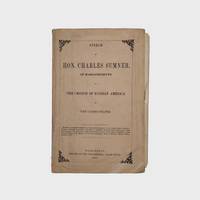
1867376097Washington: Printed at the Congressional Globe Office 1867. First edition. With the large 24 x 35 in. folding map of Northwest America "second edition May 1867" by A. Lindenkohl not found in all copies. 48 pp. text in double columns. 8vo. Publisher's pink wrappers minor soiling small repaired split at lower front joint. Minor foxing. First edition. With the large 24 x 35 in. folding map of Northwest America "second edition May 1867" by A. Lindenkohl not found in all copies. 48 pp. text in double columns. 8vo. Sumner gives an account of the history of the Alaskan Territory just recently purchased by Secretary of State William Seward from Russia for $7.2 million. Sumner was a strong exponent of the purchase and Seward praised his speech. <br /> <br /> This example with the large folding map not always present and not issued with all copies of the speech according to Lada-Mocarski - the first map to represent the Alaska Purchase and the first to use the name "Alaska". Howes S1134; Lada-Mocarski 159; Tourville 4391; Wickersham 4128 Printed at the Congressional Globe Office unknown
1798PHO-2367Paris, De l’Imprimerie de la République, An VI-An VII [1798-1799]. Texte : 5 volumes in-8 (22,5x14cm), 1f.-CCI-1f.-294pp.-1f., VII-529pp. (3 tableaux dépliants), VIII-474pp.1f. (8 tableaux dépliants), VIII-494pp., XII-559pp.-2ff., relié toile moderne, pièce d’auteur, titre et tomaison, non rogné, mouillure. Atlas : 1 vol. In4° (4) (26,5x22cm), VIII-158pp.-1f., 15 cartes et 1 gravure. Demi veau, titre et tomaison au dos, frottements, coins usés, accroc au dos, charnière fendillée, piqures sur quelques feuillets et cartes, renforcement et réparation sur 1 carte, la carte 15 en fac-similé Rare édition in-8, parue en même temps en format in-4, accompagné de l’atlas correspondant au tome 4 de l’édition in-4.
19004544Various locations in British Columbia and Alaska 1900. Very good. 14 leaves illustrated with 111 vernacular sepia-toned photographs between 2.5 x 4.5 inches and 3.5 x 5.5 inches. Mostly mounted four per page. Oblong folio. Contemporary black cloth gilt string tied. Minor edge wear and rubbing. Some edge chipping to a handful of album leaves occasional dust-soiling. With 5pp. typed and numbered list laid in keyed to manuscript numbering beneath each photograph. A phenomenal collection of vernacular photographs taken by an unidentified traveler on a voyage to British Columbia and Alaska around the turn of the 20th century. Most of the photographs were taken from aboard a steamship or from a railroad car when they venture inland but occasionally the compiler includes shots from the ground. The photographs begin with numerous scenic landscapes in and around Nelson Rossland and Victoria British Columbia picturing landmarks such as Kootenay Lake Bonnington Falls the Cascade Mountains and a "Government House" in Victoria. The scene then shifts to Alaska picturing Devil's Thumb various glaciers a wonderful totem in Simpson distant shots of Juneau and Skagway and much more. Once inland the compiler takes pictures of the White Pass Lake Bennet White Horse and more before getting back on a steamship. One particularly interesting image from White Horse shows a pair of businesses set up in tents - Cap. P. Martin's Cigar Store and the Vancouver Hotel. Once back on the steamship the compiler shoots Five Finger Rapids before reaching the "town" of Yukon really just a loose handful of wooden huts. The intrepid traveler lands next in Dawson City where they include at least half a dozen fantastic shots of the settlement and its downtown area. The next series of images in Grand Forks show exterior shots of gold mines called Gold Hill and Eldorado #26 and a sweeping "View of Klondike Valley." The traveler then apparently turned south as the next series of images picture Taku Alert Bay with images of five Totems and the local cemetery and eight views of Fraser Canon. The album concludes with a few shots of the Illecillewaet Glacier Lakes Agnes and Louise and several views in and around Banff. The latter images include one of a bear and two featuring grazing buffalo. An interesting and wide-ranging collection of photographs featuring the untouched majesty of the landscapes of Alaska and the Canadian Northwest mixed with areas already being developed and exploited by human prospectors and travelers. The images are accompanied by an invaluable list of captions which are vital to identifying the locations of the images which appear to emanate from slightly earlier than usual in photographic groups from these areas. unknown
186825042<p>This copy is stamped "THE PRESIDENT" at the top of the front page indicating it belonged to President Andrew Johnson. The President would have read this copy of the act before Congress submitted it to him with some amendments on July 25. The report uses the early variant spelling of "Aliaska" for the territory and peninsula.</p> <b>ALASKA.</b>Newspaper. <i>New-York Tribune</i> July 17 1868. Featuring the terms of the "Aliaska" Bill as passed by the Senate. Copy belonging to President Andrew Johnson. New York: Horace Greeley. 8 pp. 18 x 23¾ in.<p><b><br /></b></p><p><b>Excerpts:</b></p><p>"<i>Be it enacted &c. That the laws of the United States relating to customs commerce and navigation be and the same are hereby extended to and over all the mainland islands and waters of the territory ceded to the United States by the Emperor of Russia.</i>" p1/c2</p><p>"<i>And be it further enacted that all the said territory with its ports harbors bays rivers and waters shall constitute a customs collection district to be called 'The District of Aliaska' for which said district a port of entry shall be established at some convenient point to be designated by the President at or near the town of Sitka or New-Archangel and a Collector of Customs shall be appointed by the President by and with the advice and consent of the Senate who shall reside at said port of entry and who shall receive an annual salary of $2500.</i>" p1/c2</p><p>"<i>That the President shall have the power to restrict and regulate or to prohibit the importation or use of firearms ammunition and distilled spirits into and within said territory.</i>" p1/c2</p><p>"<i>That until otherwise provided by law the Secretary of the Treasury with the approval of the President shall have power to prescribe such rules and regulations as he may deem proper for the preservation of fur-bearing animals from indiscriminate destruction provided that no special permits shall be granted under this act.</i>" p1/c2</p><p><b>Historical Background</b></p><p>After suffering defeat at the hands of the British and the French in the Crimean War of 1853-1856 Russia feared losing the Alaskan territory in some future conflict. In an effort to protect Russian interests Tsar Alexander II 1818-1881 determined to sell Alaska. After offering it in 1859 to the United Kingdom Russia negotiated a sale to the United States finalized in 1867. At the time the territory primarily offered fur trading and some natural resources. Americans generally supported the purchase and believed it enhanced American interests in the Pacific though some critics labeled it "Seward's Folly" after Secretary of State William H. Seward who had negotiated the purchase for the United States. Most newspaper editors especially those in California were enthusiastic about the purchase. Notable among the critics was Horace Greeley the editor of this newspaper and a long-time opponent of Seward. The value of the new territory increased dramatically with the discovery of gold fields in 1896.</p><p>The Senate ratified the Treaty with Russia on April 9 1867 by a vote of 37 to 2. On July 14 1868 the House of Representatives passed a resolution appropriating the $7.2 million necessary to purchase Alaska less than two cents per acre and the Senate approved the resolution with amendments. The House refused the amendments and the resolution went to a committee. The House passed the resolution as revised by the conference committee on July 23 and the Senate passed it the following day.</p><p>Meanwhile on July 15 Senator Zachariah Chandler of Michigan introduced "An Act to extend the Laws of the United States relating to the Customs Commerce and Navigation over the Territory ceded to the United States by Russia to establish a Collection District therein and for other Purposes" and the Senate passed it on July 16. In the House Representative Elihu B. Washburne of Illinois proposed amendments on July 25 and the House agreed to them. The Senate disagreed with the amendments and this bill went also to a conference committee where the Senate receded from its opposition and the bill passed. President Johnson approved and signed both the joint resolution and the act on July 27 1868.</p><p>In 1870 Congress followed up its concerns about preserving fur-bearing animals expressed in this law with "An Act to prevent the Extermination of Fur-bearing Animals in Alaska" aimed directly at regulating the killing of fur-bearing seals on Saint Paul and Saint George Islands off the western coast of Alaska north of the Aleutian Islands.</p><p><b>Additional Content</b></p><p>This issue also includes the Senate confirmation of William M. Evarts 1818-1901 as Attorney General p1/c2 p5/c4; proceedings of Congress including Senate discussion of this bill p1/c3-4; a letter from a special correspondent describing Sitka Alaska p2/c2-3; an editorial nomination of Thomas A. R. Nelson of Tennessee as Secretary of State to succeed William H. Seward "<i>now that Mr. Seward has succeeded in buying Aliaska</i>" p4/c5-6; "base ball" and cricket scores p5/c5; and a report on dozens of deaths from sunstroke during two-week heat wave especially among children p8/c1-3.</p><p><b><i>New-York Tribune</i></b> 1841-1924 was established as a daily newspaper in 1841 by Horace Greeley 1811-1872. By the 1850s it reached a circulation of 200000 copies making it the largest daily newspaper in New York City at the time. Greeley also published weekly and semi-weekly issues of the <i>Tribune</i> through much of his tenure. The <i>New-York Tribune</i>became the dominant Whig and then Republican newspaper in the United States helping to shape public opinion especially as other newspapers often copied its articles and editorials. It was one of the first newspapers in the Union to send reporters and correspondents to cover the military campaigns of the Civil War. Greeley used his newspaper to support many reforms including abolitionism pacifism socialism for a time and feminism. After Greeley's failed campaign as the Liberal Republican candidate for President Whitelaw Reid 1837-1912 assumed control of the <i>Tribune</i> until his death. His son Ogden Mills Reid 1882-1947 acquired the <i>New York Herald</i> and merged the newspapers in 1924.</p><p><b>Condition</b></p><p>Typical folds and light foxing few slight tears at some of the outer margins and appears to have been bound in a book at one point or someone reinforced the outer fold.</p>
186825042<p>This copy is stamped "THE PRESIDENT" at the top of the front page indicating it belonged to President Andrew Johnson. The President would have read this copy of the act before Congress submitted it to him with some amendments on July 25. The report uses the early variant spelling of "Aliaska" for the territory and peninsula.</p> <b>ALASKA.</b>Newspaper. <i>New-York Tribune</i> July 17 1868. Featuring the terms of the "Aliaska" Bill as passed by the Senate. Copy belonging to President Andrew Johnson. New York: Horace Greeley. 8 pp. 18 x 23¾ in.<p><b><br /></b></p><p><b>Excerpts:</b></p><p>"<i>Be it enacted &c. That the laws of the United States relating to customs commerce and navigation be and the same are hereby extended to and over all the mainland islands and waters of the territory ceded to the United States by the Emperor of Russia.</i>" p1/c2</p><p>"<i>And be it further enacted that all the said territory with its ports harbors bays rivers and waters shall constitute a customs collection district to be called 'The District of Aliaska' for which said district a port of entry shall be established at some convenient point to be designated by the President at or near the town of Sitka or New-Archangel and a Collector of Customs shall be appointed by the President by and with the advice and consent of the Senate who shall reside at said port of entry and who shall receive an annual salary of $2500.</i>" p1/c2</p><p>"<i>That the President shall have the power to restrict and regulate or to prohibit the importation or use of firearms ammunition and distilled spirits into and within said territory.</i>" p1/c2</p><p>"<i>That until otherwise provided by law the Secretary of the Treasury with the approval of the President shall have power to prescribe such rules and regulations as he may deem proper for the preservation of fur-bearing animals from indiscriminate destruction provided that no special permits shall be granted under this act.</i>" p1/c2</p><p><b>Historical Background</b></p><p>After suffering defeat at the hands of the British and the French in the Crimean War of 1853-1856 Russia feared losing the Alaskan territory in some future conflict. In an effort to protect Russian interests Tsar Alexander II 1818-1881 determined to sell Alaska. After offering it in 1859 to the United Kingdom Russia negotiated a sale to the United States finalized in 1867. At the time the territory primarily offered fur trading and some natural resources. Americans generally supported the purchase and believed it enhanced American interests in the Pacific though some critics labeled it "Seward's Folly" after Secretary of State William H. Seward who had negotiated the purchase for the United States. Most newspaper editors especially those in California were enthusiastic about the purchase. Notable among the critics was Horace Greeley the editor of this newspaper and a long-time opponent of Seward. The value of the new territory increased dramatically with the discovery of gold fields in 1896.</p><p>The Senate ratified the Treaty with Russia on April 9 1867 by a vote of 37 to 2. On July 14 1868 the House of Representatives passed a resolution appropriating the $7.2 million necessary to purchase Alaska less than two cents per acre and the Senate approved the resolution with amendments. The House refused the amendments and the resolution went to a committee. The House passed the resolution as revised by the conference committee on July 23 and the Senate passed it the following day.</p><p>Meanwhile on July 15 Senator Zachariah Chandler of Michigan introduced "An Act to extend the Laws of the United States relating to the Customs Commerce and Navigation over the Territory ceded to the United States by Russia to establish a Collection District therein and for other Purposes" and the Senate passed it on July 16. In the House Representative Elihu B. Washburne of Illinois proposed amendments on July 25 and the House agreed to them. The Senate disagreed with the amendments and this bill went also to a conference committee where the Senate receded from its opposition and the bill passed. President Johnson approved and signed both the joint resolution and the act on July 27 1868.</p><p>In 1870 Congress followed up its concerns about preserving fur-bearing animals expressed in this law with "An Act to prevent the Extermination of Fur-bearing Animals in Alaska" aimed directly at regulating the killing of fur-bearing seals on Saint Paul and Saint George Islands off the western coast of Alaska north of the Aleutian Islands.</p><p><b>Additional Content</b></p><p>This issue also includes the Senate confirmation of William M. Evarts 1818-1901 as Attorney General p1/c2 p5/c4; proceedings of Congress including Senate discussion of this bill p1/c3-4; a letter from a special correspondent describing Sitka Alaska p2/c2-3; an editorial nomination of Thomas A. R. Nelson of Tennessee as Secretary of State to succeed William H. Seward "<i>now that Mr. Seward has succeeded in buying Aliaska</i>" p4/c5-6; "base ball" and cricket scores p5/c5; and a report on dozens of deaths from sunstroke during two-week heat wave especially among children p8/c1-3.</p><p><b><i>New-York Tribune</i></b> 1841-1924 was established as a daily newspaper in 1841 by Horace Greeley 1811-1872. By the 1850s it reached a circulation of 200000 copies making it the largest daily newspaper in New York City at the time. Greeley also published weekly and semi-weekly issues of the <i>Tribune</i> through much of his tenure. The <i>New-York Tribune</i>became the dominant Whig and then Republican newspaper in the United States helping to shape public opinion especially as other newspapers often copied its articles and editorials. It was one of the first newspapers in the Union to send reporters and correspondents to cover the military campaigns of the Civil War. Greeley used his newspaper to support many reforms including abolitionism pacifism socialism for a time and feminism. After Greeley's failed campaign as the Liberal Republican candidate for President Whitelaw Reid 1837-1912 assumed control of the <i>Tribune</i> until his death. His son Ogden Mills Reid 1882-1947 acquired the <i>New York Herald</i> and merged the newspapers in 1924.</p><p><b>Condition</b></p><p>Typical folds and light foxing few slight tears at some of the outer margins and appears to have been bound in a book at one point or someone reinforced the outer fold.</p> books
104239De l'Imprimerie Didot Jeune, An X (1801-1802), 5 volumes +1atlas in-8 de 220x140 mm environ, viij-341 pages - 384 pp., - 381 pp., - 368 pp.,- 438 pp., dernier volume-atlas contenant 17 vues sous serpentes et 9 cartes dont 8 dépliantes, cartonnage de l'éditeur portant titres et tomaisons dorés sur le dos. Feuillets non rognés. Dos insolés, frottements sur les coins et coiffes, petits défauts de marge sur quelques pages sans atteinte au texte, sinon bon état.
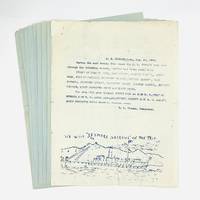
1908770201908. Significant collection of bulletins clarifying the route of the S.S. Spokane in the summer of 1908. Each is naively illustrated with views from the ship - Sitka Seymour Narrows Taku Glacier Patterson Glacier and Devil's Thumb - as well as Alaska Natives and even baseball.<br /> <br /> An elegant passenger liner the S.S. Spokane was constructed by the Pacific Coast Steamship Company. The vessel was launch in San Francisco in 1901 and made her first voyage to Seattle in 1902. A year later she had the distinction of transporting President Theodore Roosevelt and his party to Seattle. The Spokane was able to carry nearly 300 passengers at a time including 171 in first class.<br /> <br /> From these broadsides we learn the S.S. Spokane sailed from the Strait of Juan de Fuca and on to Kasaan Discovery Passage Queen Charlotte Sound and Juneau in August 1908. Three years later the ship was wrecked on an uncharted rock in Seymour Narrows with the loss of two lives. The Spokane was later raised and repaired returning to service in early 1912.<br /> <br /> Nine broadsides 8 1/2" x 11" or 280 x 215 mm printed on the recto only of the blue or white paper. Old folds with evidence of stapling to the upper left corner and some minor edgewear. unknown
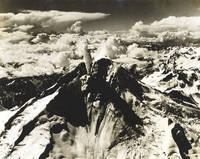
194714430Alaska various: np nd ca. 1947. Very good. Oblong folio commercial hardcover album made by The Burkhardt Company Detroit model X 89500 13.5” x 10.75” x 2.5”. Screw binding 74 black paper pages with a single black and white gelatin print mounted recto only to each most measuring approximately 7.5" x 9” with brief typed captions mounted below. Additional print mounted to front cover; 75 photographs total. Album exterior moderately worn cloth dry and flaking. Three sections of material loss at outer edge of covers and to upper rear likely mouse-bitten similar loss to edges of final two pages not effecting photos. Two images missing captions. Photographs well preserved occasional mild wear. About very good. <br/><br/>An impressive collection of 75 well-annotated predominantly aerial photographs of pre-statehood Alaska likely compiled by a U.S. Army Officer stationed at Fort Richardson near Anchorage just after WWII. 49 images captured from aircraft of some of the most spectacular unspoiled environments anywhere. Cities settlements and geographical locations include Galena Ketchikan Port Alexander Sitka Port Althrop Skagway Juneau Fort Seward Valdez Anchorage Barrow Nome the Taku Glacier Mount McKinley Mount St. Elias and Mt. Moffet. The remaining 26 prints equally as beautiful though taken at ground level display the cultural and trade aspects present around 1947. Highlights include an Eskimo mother and daughter on Nelson Island fishing boats in Ketchikan totem poles on Wrangell Island a midnight baseball game and a full salmon scowl at a cannery in southeast Alaska. Five prints with lettering in the negative though none with clear evidence as to the purpose behind their creation. Clearly the work of a skilled photographer an immediately engaging collection of images. NOTE: High resolution scans of this complete album are available. np hardcover books
6293Paris, Didot jeune, an X. 6 volumes in-8 de [4]-VIII-341p., [4]-384p., [4]-381p., [4]-368p., [4]-438p., et un atlas de [4]p., 17 vues et 9 cartes, plein veau moucheté, dos lisses ornés de filets et fleurons dorés, pièces de titre rouge. Reliures un peu malmenées, coiffes frottées, mors un peu fendus, épidermures, auréoles pales à trois volumes, plus présentes dans l'atlas. Chaque première page est frappée d'un large tampon non identifié par votre serviteur.
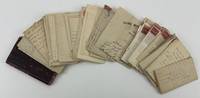
19104010Various locations including Sprague Wa.; Vancouver British Columbia; and Nome Ak 1910. Very good. Thirteen autograph letters signed totaling thirty-nine pages and a few original transmittal envelopes. Original mailing folds occasional short fold separations otherwise minor wear. Overall a well-preserved group stored in an antique wooden box from the St. Paul Rubber Company. An interesting collection of manuscript letters written to Fred Lindberg of Hallock Minnesota by his brother and other individuals participating in the Alaskan and Yukon gold rushes between 1897 and 1910. The preponderance of the correspondence relates to the ill-fated experiences of Fred's brother Albert William Lindberg who writes four letters while on his way to the Alaskan gold fields before apparently committing suicide in Nome in 1909. Albert William "Willie" Lindberg was a Swedish-American gold prospector from Minnesota who spent significant time in Washington State before trying his luck albeit unsuccessfully in Alaska.<br /> <br /> The four letters from Willie begin with his February 20 1897 letter to his brother Fred in Hallock Minnesota. With unbridled enthusiasm Willie writes from Sprague Washington that he has "heard so much about Alaska that I made up my mind to go." Willie encourages Fred to join him to work in the mines where he expects to "pick gold nuggets." Willie informs Fred that he has sold his horses and saddle and has collected about $400 with which he intends to "make a raise or go broke" in Alaska. He extolls Fred to raise his own money and come to Alaska where he intends to "make a fortchen sic fortune." Willie concludes: "And when we get there you will see one of the luckiest Swedes that ever struck Alaska." Lindberg next writes from Vancouver on March 20 1898 again to his brother Fred informing him that he is on the way to Alaska. He promises to "stake out a clame" for Fred once he gets there though he now believes that going to Alaska might be "a foolish trip." Still he intends to stay "as long as I can" in the Alaskan gold fields in the company of "an old miner he has mined for the last 35 years."<br /> <br /> Willie writes another letter on March 20 after he arrives in Juneau which he describes as "quite a town and everything is just as cheap here as in Seattle or Vancouver and food and lodging is $1.00 a day." Here Willie informs Fred that he intends to go further north to Dyea north of Skagway because "I want to go where the big strikes is made." Willie's last letter emanates from Seattle where he has apparently returned perhaps for the winter from the previous year but now informs Fred that he intends to start on his "wild goose chase again." Instead of "Cape Nome" Willie intends to go to Skagway then "down the Youkon River it is mining camps all along the Youkon River and I think it will be better up there than down at Cape Nome it is bound to be over down at Cape Nome this summer when all these people get there."<br /> <br /> Willie's letters are accompanied by a pocket-sized notebook in which he recorded a small amount of financial information for the Nome Bank in 1908-09 as well as listings of food and other goods he purchases there and a five-page diary-style entry dated February 15 1907. In the latter Willie writes introspectively about his state of mind and habits at one point noting that "at times you are liable to become blue and depressed really there is no cause to be that way." <br /> <br /> Lindberg's single diary entry in the notebook is especially intriguing considering he apparently committed suicide in Nome in 1909 according to five letters present here dated in the summer and fall of 1909. This includes two letters sent from Wentworth Brothers the undertakers in charge of Willie's remains. The first of these letters dated May 24 1909 begins: "On May 11th 1909 Mr. Lindberg W. was found in cabin on Belmount Point dead. Cause gun shot wound and the Coroners Jury brought in verdict of suicide. Two of his friends Mr. Godfry Johnson and John Olson furnished the funeral arrangements - as he was without money." In each of the two letters the undertakers ask that Fred Lindberg respond to them whether he wishes Willie to be buried in Alaska or have the body shipped to Minnesota. The other three letters were written from two of the men who found Willie's body; the authors were responding to Fred Lindberg's wife who sent letters to Nome inquiring about Willie's death. Two of the letters were written by Phillip Corrigan of the Nome Mine Workers Union in August and the third by Gotfred Johnson in September. Corrigan details finding the body wondering if "may be he was fooling with the gun and accidentally shot himself." He then writes that he has known of Willie prospecting in the area since 1907 but that he "did not find pay at any time" and had no money at the time of his death" though "he may have some claims here."<br /> <br /> In the next letter Corrigan details both a quartz and placer claim in which Willie had an interest then provides further detail on the claims and what must be done to maintain them. Johnson writes a highly-detailed five-page letter conveying his background and experiences with Willie providing important biographical material and informing Fred that Willie seemed in "good spirits" when he last saw him "3 or 4 days" before his suicide. Another letter from Nome in August 1909 is present here written on the same Nome Mine Workers Union stationery as Corrigan's letters by Carl de la Motte; the two-page letter seems to relate information on Willie but is written in Swedish.<br /> <br /> The present archive also includes four letters written to Fred Lindberg from his friend Edward A. Johnson in Circle City Alaska. Written between July 5 1905 and June 10 1906 Johnson's letters indicate he was tasked by Fred to find his brother Willie. In his first letter Johnson writes from Mastodon Creek that he has been unable to find anything "about Will." In his subsequent three letters Johnson details his search for Willie often mentioning that he expects to locate him in Fairbanks or Nome but never does. In the process Johnson relates other interesting details about Alaska and his experiences there including a report on weather patterns as they relate to the seasonal nature of the mining industry informative descriptions of the Alaskan country he visits in "the Tanana districts at Fairbanks" his decision to acquire claims near Mastodon Creek and the unreliable nature of the Alaskan postal schedule. The archive also includes several unrelated Lindberg family letters mostly written to Willard Lindberg of Hamline University in St. Paul Minnesota in the mid-1920s but these are not included in the letter and page counts above.<br /> <br /> An unusual collection of manuscript letters of particular interest to the study of suicide in American history documenting both the optimism of a young Minnesota man on his way to find fortune in the Alaskan gold fields and his tragic end by his own hand in Nome a little over a decade later. unknown