469 résultats
19961-187796221XUniv of Alaska Fairbanks Center for 1996. Paperback. New. 5th edition. 66 pages. 8.50x5.50x0.25 inches. Univ of Alaska Fairbanks Center for paperback
1992MASTER373036IFairbanks: University Of Alaska. VG- In Wraps. Oversize. Lightly Edgeworn. Light Soiling To Rear Wrap. All Pages Clean Binding Tight. Errata Sheet Tipped IN. Pages: 757. 1992. 4th Printing. Trade Paperback. University Of Alaska paperback
192539563Portland OR: George Edward Lewis 1925. 12mo. 69 1 pp. Numerous text illusts. Printed gray wrappers blk lettrng & decrtn mnr shlfwr VG copy inscribed by the author on half-title. First edition inscribed by an Alaskan pioneer who eventually made the first silent movies produced in Alaska including The Chechakos Hearts of Alaska and North of Nome. Certain scenes shot of miners crossing the Chilkoot pass were used by Chaplin in The Gold Rush 1925. George Edward Lewis, unknown
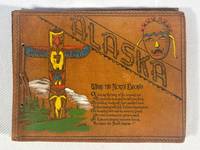
1943217811943. Civilian construction labor photo album documenting on the Alaska-Canada Military Highway during World War II one of the largest emergency infrastructure projects undertaken in North America during the war. The material records wartime military logistics federal civilian contracting and frontier transportation construction through photographs official permits military certifications and worker inscriptions connected to the rapid building of the ALCAN Highway in 1942-1943. Compiled by civilian laborer Paul Cecil Pemble an employee of Ferguson-Diell Construction Company the album connects private contractors federal agencies and the U.S. Army Corps of Engineers to the construction of a strategic military supply route linking the contiguous United States to Alaska following Japan's Aleutian Islands campaign. The archive provides primary-source evidence for wartime infrastructure mobilization civilian labor under military authority and the logistical expansion of defense systems in the North American Arctic frontier.<br /> <br /> Oblong string-tied photo album in original painted suede leather covers titled Alaska - Where the North Begins with embossed and hand-colored totemic decoration. Contains approximately 66 silver gelatin photographs ranging in size from approximately 4.5 x 3.25 inches to 10 x 8 inches alongside multiple official documents licenses permits correspondence and autograph pages. Included documents identify Paul Cecil Pemble as a civilian heavy equipment operator employed on the Alaska Highway project. These include a Public Roads Administration license issued under the Federal Works Agency dated June 29 1943; a U.S. Army Corps of Engineers certification dated August 4 1943 signed by First Lieutenant Colin L. Park authorizing operation of trucks tractors and wheeled scrapers; and an Alcan Military Highway Command permit dated August 19 1943 authorizing travel on the restricted military roadway. A typed letter from Tok Junction dated October 8 1943 confirms the extension of Pemble's Selective Service deferment due to essential wartime labor. Several opening pages titled "Memory Leaves" contain approximately sixty signatures and inscriptions from fellow workers many identifying hometowns in Iowa and including humorous remarks and nicknames such as "Cook" "Butch" and "Alaska Thunderbolt." The photographs extensively document construction activity and camp life including bulldozers graders cranes timber bridge scaffolding military truck convoys wrecked vehicles stranded in ditches muddy roadbeds and large encampments of prefabricated structures. Multiple images show men constructing river crossings operating machinery and posing in work clothes beside heavy equipment. Additional photographs depict interior bunkhouses mess hall scenes with workers gathered around tables and a large group portrait of more than fifty civilian laborers posed before a treeline. Wildlife and recreation also appear throughout the album including black bears scavenging through refuse fishing scenes with large catches displayed by workers dogs resting beside snowy roads and Pemble's trailer quarters attached to the back of a truck. The final pages include panoramic camp views and directional signpost photographs listing construction companies and distances to Fairbanks Whitehorse and multiple contractor camps along the route.<br /> <br /> The album records the logistical effort required to construct the Alaska Highway across remote and environmentally severe terrain during wartime emergency conditions. Built in response to fears of Japanese expansion into Alaska and the North Pacific the highway became a critical military supply corridor linking airfields fuel depots transport infrastructure and defense installations across Alaska and western Canada. The album focuses on civilian laborers operating within military-controlled systems including contract workers represented through photographs permits deferment documents and personal inscriptions. The combination of photographs permits deferment documents and personal inscriptions records daily life labor conditions and federal wartime administration on the ALCAN project. Photographs mounted cleanly to black paper leaves with corner tabs; occasional light creasing and minor wear to several prints. Leather covers lightly rubbed but structurally sound and visually bright. Overall very good condition. A documentary archive of civilian wartime labor and military infrastructure construction during one of the most ambitious engineering projects of the Second World War. unknown
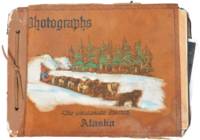
1945191491945. Unidentified compiler photograph album of United States Army troops stationed near Seward Alaska circa 1945 documenting military life and operations in a strategic northern deployment during the closing period of World War II. The material provides primary visual evidence of troop activity infrastructure development and social life within a remote military environment supporting research into wartime logistics soldier experience and the role of Alaska in U.S. military defense during the conflict.<br /> <br /> Photograph album containing 58 black and white silver gelatin prints most measuring approximately 3.5 x 6 inches depicting soldiers engaged in both formal and informal activities. Images include groups of men standing at attention with rifles constructing wooden buildings in rugged terrain and participating in daily routines within camp settings. A series of photographs documents a dance event for troops featuring a jazz band with music stands marked "153" alongside an emblem suggesting a possible connection to the 153rd Infantry Regiment which was stationed in Alaska during the period. Additional images show steamships including the S.S. Baranof S.S. Alaska S.S. Denali and S.S. Columbia navigating the Inside Passage and areas near Taku Glacier indicating transportation and supply routes. The album also contains a "memory leaves" section with handwritten notes and addresses from fellow servicemen reflecting interpersonal networks and efforts to maintain contact beyond deployment.<br /> <br /> 58 photographs mounted in an album with decorated leather covers featuring a hand-painted image of Alaskan sled dogs titled "The Malamute Limited." During World War II Alaska served as a critical military zone due to its geographic proximity to the Pacific theater with troop deployments focused on defense infrastructure and logistics in challenging environmental conditions. This album captures both operational and social dimensions of that presence including labor recreation and movement through the region. Light handling wear to album and photographs contents well-preserved; overall very good condition. A cohesive and detailed visual record of U.S. Army life in wartime Alaska. unknown
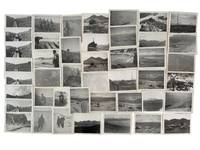
1945215781945. AArchive of 64 original black-and-white photographs documenting American military operations and engineering activities in the Aleutian Islands during World War II. Photographs measure approximately 4.5" x 3.5" and provide an extensive visual record of one of the most remote and environmentally challenging theaters of the war. The images chronicle the daily work of U.S. Army personnel and Army Engineers stationed across the Aleutian chain where military forces confronted not only the threat of enemy action but also some of the harshest conditions faced by American troops anywhere during the conflict. Soldiers appear throughout the archive wearing cold-weather gear field jackets heavy boots and M1 steel helmets while working patrolling and constructing infrastructure amid windswept volcanic landscapes.<br /> <br /> A significant portion of the collection documents the enormous logistical effort required to sustain military operations in the islands. Engineers are shown surveying terrain operating equipment cutting and processing timber and building facilities essential to maintaining isolated military outposts. Several striking photographs depict large timber-log chutes descending steep hillsides toward the shoreline apparently designed to move heavy equipment and supplies through terrain where conventional transportation proved difficult. Other images record lumber operations construction projects and the continual adaptation of military infrastructure to the rugged environment. The archive also contains numerous panoramic views of the Aleutian landscape itself. Snow-covered mountains barren volcanic ridges isolated coastlines glacial valleys and treeless tundra dominate many photographs illustrating why the campaign became as much a battle against geography and weather as against enemy forces. The Aleutian chain stretching deep into the North Pacific and containing dozens of active and dormant volcanoes represented one of the most isolated regions under American military control during the war.<br /> <br /> Naval and maritime operations are likewise represented. Several photographs show transport and supply vessels anchored offshore or approaching remote coastal installations highlighting the dependence of Aleutian bases upon sea-borne logistics. Military camps consisting of Quonset huts and tent encampments appear throughout the collection while one particularly notable image captures an aircraft flying above a military installation underscoring the importance of aerial reconnaissance and patrol operations in protecting the northern approaches to Alaska. Although often overshadowed by campaigns in Europe and the Central Pacific the Aleutian campaign held considerable strategic importance. Following the Japanese occupation of Attu and Kiska in 1942 American forces undertook a costly effort to secure the islands and maintain control of the northern Pacific. These photographs document the infrastructure manpower and determination required to operate in a theater where extreme weather isolation and difficult terrain shaped every aspect of military life. A substantial and visually compelling archive documenting the engineering logistical and environmental realities of America's northernmost front during World War II. Photographs remain in very good condition with minor surface wear and occasional light creasing. unknown
15-6914Anchorage: Alaska Pacific University 1979. POSTER. 4to. 7 x 9 inches Very Good some minor creasing. Photograph of Snyder. Anchorage: Alaska Pacific University, 1979. unknown
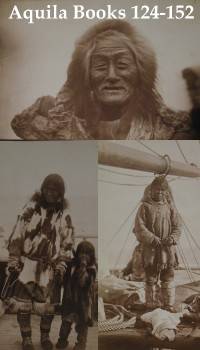
1890124152Alaska c 1890. Undetermined. near fine. Three card mouted 19th century albumen photorgraphs of eskimo from the Kotzebue Sound area of Northwestern Alaska. The images are mounted on black bevel mounts with grey backs 17.5 X 25 CM with the images being 11 X 19.5 cm. The condititon of the photos is excellent with good rich tones and little fading. All are captioned as above in an old hand. Two of the images were taken on the deck of a ship with the third undetermined. near fine Three very attractive images. We were unable to determine who the photographer is but the quality is so good that further research may yet results. 1890 unknown
20192-1698166214Independently published 2019. Paperback. New. 686 pages. 10.00x8.00x1.72 inches. Independently published paperback
0882401750New. paperback. New. Satisfaction Guaranteed or your money back. paperback
1972Q-0882401750Alaska Northwest Books 1972-01-01. Paperback. New. In shrink wrap. Looks like an interesting title! Alaska Northwest Books paperback
19004544Various locations in British Columbia and Alaska 1900. Very good. 14 leaves illustrated with 111 vernacular sepia-toned photographs between 2.5 x 4.5 inches and 3.5 x 5.5 inches. Mostly mounted four per page. Oblong folio. Contemporary black cloth gilt string tied. Minor edge wear and rubbing. Some edge chipping to a handful of album leaves occasional dust-soiling. With 5pp. typed and numbered list laid in keyed to manuscript numbering beneath each photograph. A phenomenal collection of vernacular photographs taken by an unidentified traveler on a voyage to British Columbia and Alaska around the turn of the 20th century. Most of the photographs were taken from aboard a steamship or from a railroad car when they venture inland but occasionally the compiler includes shots from the ground. The photographs begin with numerous scenic landscapes in and around Nelson Rossland and Victoria British Columbia picturing landmarks such as Kootenay Lake Bonnington Falls the Cascade Mountains and a "Government House" in Victoria. The scene then shifts to Alaska picturing Devil's Thumb various glaciers a wonderful totem in Simpson distant shots of Juneau and Skagway and much more. Once inland the compiler takes pictures of the White Pass Lake Bennet White Horse and more before getting back on a steamship. One particularly interesting image from White Horse shows a pair of businesses set up in tents - Cap. P. Martin's Cigar Store and the Vancouver Hotel. Once back on the steamship the compiler shoots Five Finger Rapids before reaching the "town" of Yukon really just a loose handful of wooden huts. The intrepid traveler lands next in Dawson City where they include at least half a dozen fantastic shots of the settlement and its downtown area. The next series of images in Grand Forks show exterior shots of gold mines called Gold Hill and Eldorado #26 and a sweeping "View of Klondike Valley." The traveler then apparently turned south as the next series of images picture Taku Alert Bay with images of five Totems and the local cemetery and eight views of Fraser Canon. The album concludes with a few shots of the Illecillewaet Glacier Lakes Agnes and Louise and several views in and around Banff. The latter images include one of a bear and two featuring grazing buffalo. An interesting and wide-ranging collection of photographs featuring the untouched majesty of the landscapes of Alaska and the Canadian Northwest mixed with areas already being developed and exploited by human prospectors and travelers. The images are accompanied by an invaluable list of captions which are vital to identifying the locations of the images which appear to emanate from slightly earlier than usual in photographic groups from these areas. unknown
198681204Canton CT: Kidder Corp Coins 1986. Presumed first minting thus. Coin/Medal. Very good. Coin is oval shaped approximately 2 inches in length and 1.5 inches in width. Front side has a gold color rope braid at the outer edge then a red inner ring stating USS Alaska SSBN 732 with the word Alert Confident and Able the boat's motto in gold rectangular boxes and white images of a porpoise and a sea lion. The center has a whale at the top over a shield with a Trident on a blue background. The other side has gold color rope braid at the outer edge and a blue center areas with the words USS Alaska 1986 SSBN 732 and Kodiak Tough under the image of a large bear exiting a waterfall with a fish in its mouth. In a small plastic envelop with information on Kidder Corp Coins printed on it. USS Alaska SSBN-732 is a United States Navy Ohio-class ballistic missile submarine which has been in commission since 1986. She is the fourth US Navy ship to be named for the Territory or State of Alaska. The contract to build Alaska was awarded to the Electric Boat Division of General Dynamics Corporation in Groton Connecticut on 27 February 1978 and her keel was laid down there on 9 March 1983. She was launched on 12 January 1985 sponsored by Mrs. Catherine Stevens wife of US Senator Theodore F. Stevens of Alaska; and commissioned on 25 January 1986. USS Alaska spent much of 1986 engaged in shakedown training for her two crews and in clearing up the many details that attend a new fleet ballistic missile submarine's addition to the Fleet. She operated initially from New London Connecticut and Port Canaveral Florida but shifted homeport to the Pacific Northwest later in the year 4 September to 1 October 1986. Alaska sailed through the Panama Canal and visited San Francisco California 21-29 September while en route. She then served with Submarine Squadron 17 Submarine Group 9 at Naval Submarine Base Bangor Washington. Alaska sailed on her first missile deterrent patrol manned by her Blue Crew in the Pacific 7 December 1986 to 19 February 1987. Her Gold Crew carried out Patrol 2 16 March to 28 May 1987. She completed an engineered overhaul at Puget Sound Naval Shipyard Bremerton Washington 1 May 2000 to 9 December 2001. The work included a Trident II D5 "backfit" that enabled Alaska to fire the improved version of the submarine launched ballistic missile. In addition the overhaul upgraded her to shoot the Mk 48 Advanced Capability ADCAP torpedo. Alaska had carried out 47 Trident I C4 and 12 Trident II D5 deterrent missile patrols when she sailed from Kitsap for the final time on 8 July 2006. The submarine subsequently completed a 27½-month engineered refueling and overhaul at Norfolk Naval Shipyard Virginia on 8 March 2009. Alaska shifted to Submarine Squadron 20 Submarine Group 10 at Naval Submarine Base Kings Bay Georgia on 1 May 2009; she arrived at Kings Bay on 1 April. On 28 April 2010 the Navy announced plans to convert living spaces on Alaska to accommodate female crewmembers. Kidder Corp Coins unknown
198681255Canton CT: Kidder Corp Coins 1986. Presumed first minting thus. Patches. Very good. Coin is oval shaped approximately 3.5 inches in length and 2.5 inches in width. Patch has a gold color rope braid at the outer edge then a red inner ring stating USS Alaska SSBN 732 with the word Alert Confident and Able the boat's motto in gold rectangular boxes and white images of a porpoise and a sea lion. The center has a whale at the top over a shield with a Trident on a blue background. USS Alaska SSBN-732 is a United States Navy Ohio-class ballistic missile submarine which has been in commission since 1986. She is the fourth US Navy ship to be named for the Territory or State of Alaska. The contract to build Alaska was awarded to the Electric Boat Division of General Dynamics Corporation in Groton Connecticut on 27 February 1978 and her keel was laid down there on 9 March 1983. She was launched on 12 January 1985 sponsored by Mrs. Catherine Stevens wife of US Senator Theodore F. Stevens of Alaska; and commissioned on 25 January 1986. USS Alaska spent much of 1986 engaged in shakedown training for her two crews and in clearing up the many details that attend a new fleet ballistic missile submarine's addition to the Fleet. She operated initially from New London Connecticut and Port Canaveral Florida but shifted homeport to the Pacific Northwest later in the year 4 September to 1 October 1986. Alaska sailed through the Panama Canal and visited San Francisco California 21-29 September while en route. She then served with Submarine Squadron 17 Submarine Group 9 at Naval Submarine Base Bangor Washington. Alaska sailed on her first missile deterrent patrol manned by her Blue Crew in the Pacific 7 December 1986 to 19 February 1987. Her Gold Crew carried out Patrol 2 16 March to 28 May 1987. She completed an engineered overhaul at Puget Sound Naval Shipyard Bremerton Washington 1 May 2000 to 9 December 2001. The work included a Trident II D5 "backfit" that enabled Alaska to fire the improved version of the submarine launched ballistic missile. In addition the overhaul upgraded her to shoot the Mk 48 Advanced Capability ADCAP torpedo. Alaska had carried out 47 Trident I C4 and 12 Trident II D5 deterrent missile patrols when she sailed from Kitsap for the final time on 8 July 2006. The submarine subsequently completed a 27½-month engineered refueling and overhaul at Norfolk Naval Shipyard Virginia on 8 March 2009. Alaska shifted to Submarine Squadron 20 Submarine Group 10 at Naval Submarine Base Kings Bay Georgia on 1 May 2009; she arrived at Kings Bay on 1 April. On 28 April 2010 the Navy announced plans to convert living spaces on Alaska to accommodate female crewmembers. Kidder Corp Coins unknown
0882401831New. paperback. New. Satisfaction Guaranteed or your money back. paperback
195573867Washington DC: Geological Survey 1955. Very large color wall map of Alaska on original rollers. 1 map on two sheets measuring 4 feet 3 inches by 5 feet 7 inches. Inset map of the Aleutian Islands. Scale 1:1584000.1 inch=25 miles. A remarkably attractive map in unexpectedly nice condition. Geological Survey unknown
193058585Boston: W.A. Wilde Co. 1930. 8vo. xv 1 402 pp. Photo frontisp. numerous photo plates. Blue cloth gilt lettering map endpapers w/ d.j. chipping & tear head of spine upper corner front cover affecting a few letters minor scuffing couple closed tears still NF/Fair copy from the library of Wilma Burmester Bishop 1887-1969 widow of Roy T. Bishop 1881-1950 former owner of the Pendleton Woolen Mills. First edition of this anthology of stories personal accounts and historical references to Klondike Gold Rush figures Native America Eskimos traveling the Yukon River and more by this famed Alaska pioneering woman. Mary Lee Davis arrived in Fairbanks in 1917 on the steamer Alaska because her husband John had been assigned by the U.S. Geological Survey to create a mine experiment station in Fairbanks. Mary Davis purchased the famed arts & crafts bungalow built by Lucille McCarthy now known as the Mary Lee Davis House. W.A. Wilde Co., hardcover
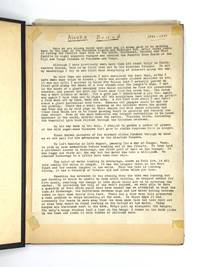
74398Typescript account of 32 pages accompanied by 31 black and white photographs gathered in a scrapbook album documenting an unidentified Washington’s man’s hiking climbing and sight-seeing adventures in Alaska. Written along the top edge of the first page is “Alaska Bound 1946-1947.†Twenty-three of the onion skin paper pages are scotch taped to the album pages and the final nine pages of the typescript are loose and laid into the back of the string-tied album. The black and white photographs measure 4 ½ x 2 ¾†and are affixed to the album pages with black photo corners. The tape affixed to the pages has oxidized but otherwise overall on very good condition.<br/> <br/> The unknown author was a crewman on a cargo ship and wrote that he had made more than 150 prior trips to Southeastern Alaska. On this trip his ship set out from Seattle to the Aleutian Islands and made a stop at Anchorage to drop off some dogs for the Army. “As part of the cargo which we were carrying we had on deck sixty-one sled dogs raised in Nebraska†he wrote. “They were supposed to be mostly huskies but in reality were a mixture of almost everything…It was remarked: ‘They are nothing but a darned bunch of Nebraska coyotes.’â€<br/> <br/> Beyond Anchorage the ship’s itinerary included Adak Attu Shemya Whittier and Amchitaka. The narrative covers his experiences on board but is mainly devoted to his shore adventures oftentimes with other members of his crew which include mountain climbing hiking fishing trips and sight-seeing during his free days while cargo is being off loaded. One of his first adventures was a trip to Wasilla and Palmer. “Back in Palmer once more we made the acquaintance of one of the old timers who gave us quite a history of Alaskan mining from the early gold rush days up to the present time†he wrote. “He tried to persuade us to go back into the mountains with him to take pictures of his claims.<br/> <br/> On the way to Adak he spotted “whale birds†and soon whales were also seen. “During the war whales in these waters were frequently attacked by both bombers and submarines in error†he wrote. “It was it seems difficult to detect the difference between submarines and whales.â€<br/> In addition to being an avid and skillful storyteller and photographer the diarist had a wide-ranging knowledge and interest in the flora and fauna of the region. During a port stop in Attu he explored Holty Holtz Bay and traveled to the summit of Jarmin Pass where the Japanese once maintained a principal base until it was recaptured by the United States during World War II. “In the foreground and also in the distance some dummy guns and other equipment could be seen scattered about†he wrote. “I followed along the stream and before long came across a few small willow bushes less than three feet in height bravely struggling for existence against the elements. They were located in a thicket of Russian thistles wild cherry tanzzy monk hood and numerous other kinds of vegetation. That was my first glimpse of anything in the form of wood growing in the Aleutians.â€<br/> <br/> On this break he undertook the first of several climbing expeditions – this one of Gilbert Ridge. It was a near catastrophe after the weather turned foggy while he was climbing the jagged peaks made the wrong decision dead-ending against sheer cliffs and fell while back tracking his route. “In that next instant I found myself bouncing over the wet cozy ground like a toboggan over a snowbank…I started flying through space at what seemed to me a mile a minute. In the next instant there was a big swoosh as I cut a path three feet wide and five feet long through a patch of Indian celery Russian thistle and Monk’s Hood and landed with a flop in the creek bed below and that was that.†Although he was fortunate to escape with a sore shoulder and sprained thumb he was soaking wet and faced a long journey back to the ship.<br/> <br/> The scrapbook is filled with numerous descriptive accounts of his adventures during the journey. The photographs complement the text and include various images of his explorations ranging from Whittier Glacier to two men holding a crippled Bald Eagle a trading store in Wasilla and fishing at Finger Arm. At the end of the trip before returning to Seattle he and his shipmates went into the woods and cut Christmas trees which they delivered to families on the treeless remote Aleutians. unknown
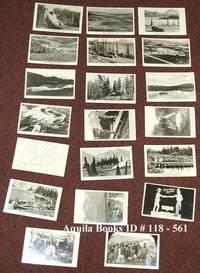
1941118561c1941-1949. Softcover. near fine. Complete set of 20 different real photo postcards: 18 from photos one cartoon facsimile and one map with route indicated. Cards printed on AZO post card photo paper. near fine 8 postcards printed "Permission Wartime Information Board" being numbers 1 2 3 4 14 15 1 6 and 17 9 postcards printed by "Permission of Public Roads Administrations" being numbers 5 6 7 8 9 10 11 12; no. 18 by the Canadian Post Card Co. Toronto Uncle Sam shaking hands across the border with a Mountie; and nos. 19 and 20 by "Permission of the National Film Board". 1941 paperback
186829032London John Murray 1868. Later full green cloth without title on back. Endpapers renewed. A stamp on htitle and verso of title. Engraved frontispiece. Halftitle. XIX331 pp. 15 wood-engraved plates many textillustr. and 1 large folded lithographed map mounted on thin linen. Throughout some foxing and brownspots. <br/><br/><em>First edition. An American edition issued 1869. One of the first expeditions after Alaska was bought from Russia in 1867. It also includes description of Kamchatka. </em> hardcover
SONG0615196675Alaska Native Tribal Health Consortium 0000-00-00. spiral_bound. Used: Good. 0.00x0.00x0.00. Buy with confidence. Excellent Customer Service & Return policy. Alaska Native Tribal Health Consortium unknown
0615196675.Gspiral_bound. Good. Access codes and supplements are not guaranteed with used items. May be an ex-library book. unknown
0364975733.Ghardcover. Good. Access codes and supplements are not guaranteed with used items. May be an ex-library book. hardcover
133209449X.Gpaperback. Good. Access codes and supplements are not guaranteed with used items. May be an ex-library book. paperback
1904ZB460975Washington: 1904. 6 pp disbound in self wrappers. - If you are reading this this item is actually physically in our stock and ready for shipment once ordered. We are not bookjackers. Buyer is responsible for any additional duties taxes or fees required by recipient's country. Washington: unknown