Bednarz, KlausAntiquariat.de

1 204 résultats
200384629Reinbek : Rowohlt-Taschenbuch-Verlag, 2003. 389 S.; 19 cm; OKart. (Taschenbuch);
020506Reinbek, Rowohlt. 389 S.; originalverschweißtes Expl., minimale Lagerspuren Pappband 21,9 cm Tadelloser Schutzumschlag Sehr gut
2007110862München ; Zürich : Piper, 2007. 7. Aufl.; 119 S. mit zahlreichen Abbildungen; 17 cm; gebunden, illustrierter Orig.-Pappband;
1998110896München : Heyne, 1998. 141 S. ; 18 cm; OKart. (Taschenbuch);
199883868München : Heyne, 1998. 141 S. ; 18 cm; OKart. (Taschenbuch);
2013144397München ; Zürich : Piper, 2013. 119 S. Kl.-8°, Hardcover/Pappeinband
2005138639München ; Zürich : Piper, 2005. 119 S. : Ill., Kt. 8° , Hardcover/Pappeinband
2005229381München ; Zürich : Piper, 2005. 119 S. : Ill., Kt. 17 cm. Pp., gebundene Ausgabe.
200317234München, Wilhelm Heyne Verlag 2003. Taschenbuch, 8°, 141 S., 35. Auflage, illustriet von Heinke Both, aus dem Amerikanischen von Christel Dormagen, »Mit spasamen epischen Mitteln hat Velma Wallis diese mündlich überlieferte Legende ihres Stammes, der Athabasken, eindringlich nacherzählt.«
199027955Melsungen : Neumann-Neudamm, 1990. 191 S. Ill. 8°. Bibl.- Einbd.
197031501Berlin, Safari Verlag, 1970. 180 Seiten. Mit vielen farbigen Photographien. 8°, Leinen. Goldprägung auf Rücken mit Originalumschlag.
19961-187796221XUniv of Alaska Fairbanks Center for 1996. Paperback. New. 5th edition. 66 pages. 8.50x5.50x0.25 inches. Univ of Alaska Fairbanks Center for paperback
1992MASTER373036IFairbanks: University Of Alaska. VG- In Wraps. Oversize. Lightly Edgeworn. Light Soiling To Rear Wrap. All Pages Clean Binding Tight. Errata Sheet Tipped IN. Pages: 757. 1992. 4th Printing. Trade Paperback. University Of Alaska paperback
192539563Portland OR: George Edward Lewis 1925. 12mo. 69 1 pp. Numerous text illusts. Printed gray wrappers blk lettrng & decrtn mnr shlfwr VG copy inscribed by the author on half-title. First edition inscribed by an Alaskan pioneer who eventually made the first silent movies produced in Alaska including The Chechakos Hearts of Alaska and North of Nome. Certain scenes shot of miners crossing the Chilkoot pass were used by Chaplin in The Gold Rush 1925. George Edward Lewis, unknown
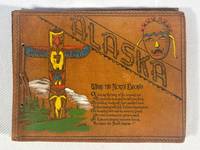
1943217811943. Civilian construction labor photo album documenting on the Alaska-Canada Military Highway during World War II one of the largest emergency infrastructure projects undertaken in North America during the war. The material records wartime military logistics federal civilian contracting and frontier transportation construction through photographs official permits military certifications and worker inscriptions connected to the rapid building of the ALCAN Highway in 1942-1943. Compiled by civilian laborer Paul Cecil Pemble an employee of Ferguson-Diell Construction Company the album connects private contractors federal agencies and the U.S. Army Corps of Engineers to the construction of a strategic military supply route linking the contiguous United States to Alaska following Japan's Aleutian Islands campaign. The archive provides primary-source evidence for wartime infrastructure mobilization civilian labor under military authority and the logistical expansion of defense systems in the North American Arctic frontier.<br /> <br /> Oblong string-tied photo album in original painted suede leather covers titled Alaska - Where the North Begins with embossed and hand-colored totemic decoration. Contains approximately 66 silver gelatin photographs ranging in size from approximately 4.5 x 3.25 inches to 10 x 8 inches alongside multiple official documents licenses permits correspondence and autograph pages. Included documents identify Paul Cecil Pemble as a civilian heavy equipment operator employed on the Alaska Highway project. These include a Public Roads Administration license issued under the Federal Works Agency dated June 29 1943; a U.S. Army Corps of Engineers certification dated August 4 1943 signed by First Lieutenant Colin L. Park authorizing operation of trucks tractors and wheeled scrapers; and an Alcan Military Highway Command permit dated August 19 1943 authorizing travel on the restricted military roadway. A typed letter from Tok Junction dated October 8 1943 confirms the extension of Pemble's Selective Service deferment due to essential wartime labor. Several opening pages titled "Memory Leaves" contain approximately sixty signatures and inscriptions from fellow workers many identifying hometowns in Iowa and including humorous remarks and nicknames such as "Cook" "Butch" and "Alaska Thunderbolt." The photographs extensively document construction activity and camp life including bulldozers graders cranes timber bridge scaffolding military truck convoys wrecked vehicles stranded in ditches muddy roadbeds and large encampments of prefabricated structures. Multiple images show men constructing river crossings operating machinery and posing in work clothes beside heavy equipment. Additional photographs depict interior bunkhouses mess hall scenes with workers gathered around tables and a large group portrait of more than fifty civilian laborers posed before a treeline. Wildlife and recreation also appear throughout the album including black bears scavenging through refuse fishing scenes with large catches displayed by workers dogs resting beside snowy roads and Pemble's trailer quarters attached to the back of a truck. The final pages include panoramic camp views and directional signpost photographs listing construction companies and distances to Fairbanks Whitehorse and multiple contractor camps along the route.<br /> <br /> The album records the logistical effort required to construct the Alaska Highway across remote and environmentally severe terrain during wartime emergency conditions. Built in response to fears of Japanese expansion into Alaska and the North Pacific the highway became a critical military supply corridor linking airfields fuel depots transport infrastructure and defense installations across Alaska and western Canada. The album focuses on civilian laborers operating within military-controlled systems including contract workers represented through photographs permits deferment documents and personal inscriptions. The combination of photographs permits deferment documents and personal inscriptions records daily life labor conditions and federal wartime administration on the ALCAN project. Photographs mounted cleanly to black paper leaves with corner tabs; occasional light creasing and minor wear to several prints. Leather covers lightly rubbed but structurally sound and visually bright. Overall very good condition. A documentary archive of civilian wartime labor and military infrastructure construction during one of the most ambitious engineering projects of the Second World War. unknown
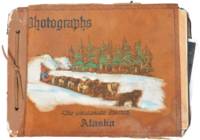
1945191491945. Unidentified compiler photograph album of United States Army troops stationed near Seward Alaska circa 1945 documenting military life and operations in a strategic northern deployment during the closing period of World War II. The material provides primary visual evidence of troop activity infrastructure development and social life within a remote military environment supporting research into wartime logistics soldier experience and the role of Alaska in U.S. military defense during the conflict.<br /> <br /> Photograph album containing 58 black and white silver gelatin prints most measuring approximately 3.5 x 6 inches depicting soldiers engaged in both formal and informal activities. Images include groups of men standing at attention with rifles constructing wooden buildings in rugged terrain and participating in daily routines within camp settings. A series of photographs documents a dance event for troops featuring a jazz band with music stands marked "153" alongside an emblem suggesting a possible connection to the 153rd Infantry Regiment which was stationed in Alaska during the period. Additional images show steamships including the S.S. Baranof S.S. Alaska S.S. Denali and S.S. Columbia navigating the Inside Passage and areas near Taku Glacier indicating transportation and supply routes. The album also contains a "memory leaves" section with handwritten notes and addresses from fellow servicemen reflecting interpersonal networks and efforts to maintain contact beyond deployment.<br /> <br /> 58 photographs mounted in an album with decorated leather covers featuring a hand-painted image of Alaskan sled dogs titled "The Malamute Limited." During World War II Alaska served as a critical military zone due to its geographic proximity to the Pacific theater with troop deployments focused on defense infrastructure and logistics in challenging environmental conditions. This album captures both operational and social dimensions of that presence including labor recreation and movement through the region. Light handling wear to album and photographs contents well-preserved; overall very good condition. A cohesive and detailed visual record of U.S. Army life in wartime Alaska. unknown
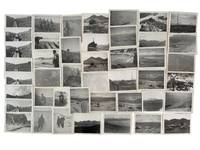
1945215781945. AArchive of 64 original black-and-white photographs documenting American military operations and engineering activities in the Aleutian Islands during World War II. Photographs measure approximately 4.5" x 3.5" and provide an extensive visual record of one of the most remote and environmentally challenging theaters of the war. The images chronicle the daily work of U.S. Army personnel and Army Engineers stationed across the Aleutian chain where military forces confronted not only the threat of enemy action but also some of the harshest conditions faced by American troops anywhere during the conflict. Soldiers appear throughout the archive wearing cold-weather gear field jackets heavy boots and M1 steel helmets while working patrolling and constructing infrastructure amid windswept volcanic landscapes.<br /> <br /> A significant portion of the collection documents the enormous logistical effort required to sustain military operations in the islands. Engineers are shown surveying terrain operating equipment cutting and processing timber and building facilities essential to maintaining isolated military outposts. Several striking photographs depict large timber-log chutes descending steep hillsides toward the shoreline apparently designed to move heavy equipment and supplies through terrain where conventional transportation proved difficult. Other images record lumber operations construction projects and the continual adaptation of military infrastructure to the rugged environment. The archive also contains numerous panoramic views of the Aleutian landscape itself. Snow-covered mountains barren volcanic ridges isolated coastlines glacial valleys and treeless tundra dominate many photographs illustrating why the campaign became as much a battle against geography and weather as against enemy forces. The Aleutian chain stretching deep into the North Pacific and containing dozens of active and dormant volcanoes represented one of the most isolated regions under American military control during the war.<br /> <br /> Naval and maritime operations are likewise represented. Several photographs show transport and supply vessels anchored offshore or approaching remote coastal installations highlighting the dependence of Aleutian bases upon sea-borne logistics. Military camps consisting of Quonset huts and tent encampments appear throughout the collection while one particularly notable image captures an aircraft flying above a military installation underscoring the importance of aerial reconnaissance and patrol operations in protecting the northern approaches to Alaska. Although often overshadowed by campaigns in Europe and the Central Pacific the Aleutian campaign held considerable strategic importance. Following the Japanese occupation of Attu and Kiska in 1942 American forces undertook a costly effort to secure the islands and maintain control of the northern Pacific. These photographs document the infrastructure manpower and determination required to operate in a theater where extreme weather isolation and difficult terrain shaped every aspect of military life. A substantial and visually compelling archive documenting the engineering logistical and environmental realities of America's northernmost front during World War II. Photographs remain in very good condition with minor surface wear and occasional light creasing. unknown
15-6914Anchorage: Alaska Pacific University 1979. POSTER. 4to. 7 x 9 inches Very Good some minor creasing. Photograph of Snyder. Anchorage: Alaska Pacific University, 1979. unknown
164 pages. Features: Interview with Larry Dahlmer; ELLY - a Swedish treasure in America; A New Kag - building a trunnel-fastened traditional Swedish workboat; Sardine Carriers - Part I; AMARETTO - from the log of an old sardine carrier still earning her way; The Kodiak (Alaska) Kayak; The Hooper Bay Kayak - the last outpost of the authentic native kayak; Sailing a Tancook Whaler - one of the handiest gaff schooners afloat; Sophisticated wooden shipbuilding is alive and well in Wisconsin; The Wizzard of Speed - Spud Rowsell and his performance dinghies. Bending SPARTAN's frames - a scientific approach to steam-bending large frames. Average wear. A sound copy. Magazine
1951ROW2648Hamburg, Rowohlt, 1951. (rororo Leinenrücken ; 19), 195 Seiten, H 17,5 x 11,5 cm, TB, OKart. - Seiten gebräunt, ungelesen, oben leichte Knickspuren vord. u. hint. Einband, sonst guter Zustand. broschiert/ Taschenbuch/ paperback
195919812Stuttgart : Union-Verl., 1959. 207 S. 8°. [Nachaufl.]. OHLwd. mit ill. Einbd.
A clean, unmarked book with a tight binding. 132 pages. Slight edge wear to dust jacket. Oblong format: 11 3/4"w x 10"h. Inscribed by Michael Duncan.
200514482Augsburg: Weltbild, 2005. 348 Seiten , 21 cm Pappeinband
Boards a bit darkened and with light wear to extremities; Collected diary entries from a trip to Alaska in 1918-19 undertaken by Kent and his son. Illustrated by the author. Kent's first book; B&W Illustrations; 4to 11" - 13" tall; 217 pages
577 p. Hardcover Good condition, spine worn