Zim, Herbert SAntiquariat.de
Williams, WinstonAntiquariat.de
Florida's Fabulous Waterbirds. Their Stories
1996129372World Publications, USA, 1996. 64 S. ; 30,5 x 23 cm ; kart. ;

Antiquariat Weber · DE - Neuendorf6,50 €
364 résultats
199248614Newe York, Western Publishing Company, Inc. Racine, Wisconsin, 1992. 80 Seiten , 15 cm, kartoniert
19414925fdTallahassee: Florida State Department of Agriculture n.d. ca. 1941. First Edition. Octavo pictorial wrappers 87 pp. Fold-out map photographs. Very Good. Florida State Department of Agriculture, n.d. [ca. 1941]. First Edition. unknown books
1941ZB1279368Northport: Bacon Percy & Daggett 1941. first edition first printing; 202 pp. plates; original orange cloth hardcover very good in an edge-worn dust jacket. - If you are reading this this item is actually physically in our stock and ready for shipment once ordered. We are not bookjackers. Buyer is responsible for any additional duties taxes or fees required by recipient's country. Photos available upon request. Northport: Bacon, Percy & Daggett hardcover
194190215Northpoint NY: Bacon Percy & Daggett 1941. Presumed First Edition First printing. Hardcover. Good. xx 202 pages. Illustrations. Maps. Chronology. Bibliography. Index. No dust jacket present. Some cover wear noted. Writing inside both covers. Some page soiling noted. This is one of the American Guide series. The cover title is "Guide to Miami and Environs". Foreword by Marjory Stoneman Douglas. The books in the series were to contain accurate and thorough accounts of American history according to a letter to State directors on the project. Each book's primary purpose was to not only outline the history of the individual states but the following as well: Geography Agriculture Tourist attractions Ethnic groups ArchitectureArts and Industry. Three different types of guides were published: state regional and city guides. Each guide had its own distinct features but followed the same uniform structure. The city guides had the most narrow scope out of all three types as the focus was on a single location. Because of this their maps could be in the greatest detail not only giving an overview of a city's layout but individual neighborhoods as well. City Guides highlighted points of special interest in greater detail. In the Philadelphia guide sites such as Carpenters' Hall and Girard College an-all boys boarding school in the city's northern section each had several pages dedicated to them. The maps that were included in each book added value to them as material objects and not just literature. With the increasing mobility afforded by the number of Americans who owned automobiles the guides served as reliable and durable resources for travelers moving throughout the country. The American Guide Series includes books and pamphlets published from 1937 to 1941 under the auspices of the Federal Writers' Project FWP a Depression-era program that was part of the larger Works Progress Administration in the United States. The American Guide Series books were compiled by the FWP but printed by individual states and contained detailed histories of each of the then 48 states of the Union with descriptions of every major city and town. The series not only detailed the histories of the 48 states but provided insight to their cultures as well. In total the project employed over 6000 writers. The format was uniform comprising essays on the state's history and culture descriptions of its major cities automobile tours of important attractions and a portfolio of photographs. Many books in the project have been updated by private companies or republished without updating. Although not then a state a guide for Alaska was published and also for Puerto Rico but not for Hawaii. If there had been room in Rocinante I would have packed the W.P.A. Guides to the States all forty-eight volumes of them.The complete set comprises the most comprehensive account of the United States ever got together and nothing since has approached it." — John Steinbeck Travels with Charley 1962. As part of the Federal Writers' Project established under the Emergency Relief Appropriation Act of 1935 and the Works Progress Administration over 6500 men and women were employed around the country as writers collecting stories interviews and photographs on a variety of subjects. The project attracted many unemployed writers and artists offering a wage of twenty dollars a week. President Franklin D. Roosevelt enlisted Henry Alsberg a journalist and playwright to head the project. As part of this the FWP developed and published a series of books that served as guides to the 48 existing states. Each book's primary purpose was to not only outline the history of the individual state but its culture and geography as well. Their predecessor Baedeker's Handbook for Travelers: United States lacked much of what was needed to give a picture of America during the 1930s. Alsberg insisted that the new series of books paint a picture of American culture as a whole and celebrate the nation's diversity. From 1937 to 1941 thousands of writers set out around the country to capture America's culture conducting fieldwork interviewing citizens and observing and recording folk traditions and local customs. Writers from all over the country sought to capture American culture during the Great Depression a difficult task given the dire circumstances. Alsberg tasked Benjamin A. Botkin a folklorist and scholar with running the folklore division of the project. Botkin was responsible for coordinating and managing the writers a task that was too large for Alsberg to handle as the volume of work coming in was plentiful for the project. In this role Botkin not only influenced the writers' folklore division but also had a great influence on their coverage of culture. The project's beginnings did not come without challenges. During its infancy various writers' organizations pressured the project because of the parameters that were set by the FWP. With the project bringing many established writers back into the workforce the Authors' Guild of America became aggressive in the pursuit of relaxing guidelines for the writers and also developed a disdain for the project's employment of writers with a lack of experience. With the FWP's main focus on creating jobs for the unemployed the Author's Guild and organizations similar to it continued to criticize the amateurism of many writers on the project. The solution to this critique was a simple one: find enough work for all of the writers. The roles of the writers enlisted to work on the project not only included their initial role as writers but also as photographers geographers and cartographers allowing the creation of additional white collar jobs. Bacon, Percy & Daggett hardcover
1941GA001206INorthport NY: Bacon Percy & Daggett. Very good plus with no dust jacket. 1941. First edition. Hardcover. Special version bound in blue cloth for the Brewer's Association. With an introduction by Marjory Stoneman Douglas. . Bacon, Percy & Daggett hardcover
1901116721901. Small 8vo pp. 27. Lacking about 1/3 of the front wrap. Clean otherwise with 2 photos. Includes a detailed report of the activities of the Ybor City Missionary school and reports from chapters throughout Florida. unknown books
1996129372World Publications, USA, 1996. 64 S. ; 30,5 x 23 cm ; kart. ;
197997797Marathon, Florida, Selbstverlag, 1979. 12 S. mit einigen Zeichnungen. 21 cm. OBroschur.
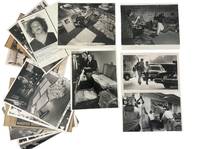
1970231661970. Narcotics raids arrests rehabilitation scenes and evidence displays across Florida in press photographs and magazine pages. Photograph archive spanning Miami Fort Lauderdale Pasco County and related Florida sites from 1970 to the early 1990s establishing how drug control operated through police action newspaper circulation and treatment institutions during the War on Drugs. Produced for press use by newspaper staff photographers wire services and law enforcement publicity channels the group shows the public face of narcotics enforcement at the point when South Florida had become a major corridor in the national drug economy and anti drug policy was being made newly visible through staged photographs official briefings and widely circulated arrest imagery. Named figures included such as Bob Gladden Larry Csonka Jim Kiick Admiral Rickover Carl Mingo and several rehab subjects identified by hand on the versos. The photographs depict suspects detained searched paraded identified displayed beside seized contraband and in other cases shown within rehabilitation settings revealing how law enforcement courts newsrooms and treatment programs handled the same crisis through different institutional forms.<br /> <br /> Photo archive of 18 press photographs including 16 silver gelatin press photographs and 2 wire photos approximately 8 x 10 inches Florida 1970 to early 1990s. The core images show narcotics policing in action: a helmeted officer beside a paddy wagon crowded with detainees; a bench filled with young men under detention in an interior holding space; two handcuffed men led from a courthouse or station entrance; a police-released mugshot with typed caption identifying former New England Patriots running back Bob Gladden after arrest in Fort Lauderdale on a marijuana charge; and a street arrest with an armed officer escorting a suspect between parked cars. Several photographs center on the staged display of evidence including tables covered with packets of drugs stacked currency pistols taped "cookie sheets" and open suitcases packed with bricks or cutting materials. One image shows a narcotics dog inspecting rows of luggage; another shows officials at microphones before a sign for the Vice President's National Narcotics Border Interdiction System; another records cocaine seized from a concealed boat compartment. The group also includes rehabilitation scenes with young adults identified en verso in cursive extending the archive beyond arrest photography into treatment culture. Versos carry a dense record of press handling and editorial use including Miami Herald staff photo stamps dated Dec. 15 1970 and Jan. 5 1971 a St. Petersburg Times credit and clipping backing for a Pasco County drug ring case dated May 29 1974 typed bureau captions circled editorial notations such as "cocaine" "marijuana" "drug raid" and "Operation Crackdown" plus handwritten shot descriptions and date-used stamps.<br /> <br /> The earliest prints fall at the threshold of the modern War on Drugs while later additions carry the record forward into the crack era and the more theatrical seizure photography of the 1980s and early 1990s. Florida is central to that story not only as a site of smuggling and interdiction but as a place where narcotics enforcement became highly visual with press conferences celebrity linked arrests tactical raids canine inspections and rehabilitation coverage all translated into newspaper images for public consumption. The present grouping combines an earlier core of related press photographs with later additions and it preserves a strong visual record of how narcotics control was communicated to the public through local papers wire distribution and agency captioning. Light surface wear minor edge and corner handling editorial markings and stamps to versos scattered adhesive residue and toning; overall very good condition. A concentrated Florida press record of the machinery publicity and human management of drug enforcement across two decades. unknown
199510277München: Droemersche Verlagsanstalt Th. Knaur Nachf., 1995. 460 Seiten , 18 cm, kart.,
19908117BBMünchen, Droemer Knaur, 1990. 8° 493 S., Ill. Pp. u. or. Umschl. innen etw. gebräunt u. schwach fleckig, Titelbl. leicht angerissen, sonst guter Zust.
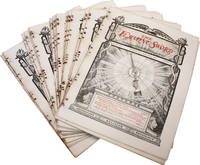
190646061Estero FL: Guiding Star Publishing House 1906. First Edition. 22 quarto issues 31cm; original illustrated wrappers disbound; 16pp per issue. Holes with corresponding oxidation from saddle staples some offsetting to spine-folds from fabric tape binding with some light wear and dust-soil to wrappers; No.52 with several tears and toning to rear wrapper; a handful of issues with some light scattered underlining else quite clean; Very Good or better. Early run of this periodical edited and written by Dr. Cyrus R. Teed a Utica NY native and founder of the Koreshan Unity. "Koreshanity" as it was also known was born in the wake of two related movements: the millenial fervor that swept early-to-mid-19th century central and western New York State and the utopian communalism that began attracting increasing numbers of adherents during the same period and into the later 19th century." A graduate of Eclectic Medical College of the City of New York Teed's interests went beyond medicine to encompass alchemy botany physics and metaphysics and he would regularly conduct experiments in these areas inside his medical laboratory. It was in this laboratory in 1869 that "Teed conceived what would become known as Koreshanity after experiencing a late-night religious vision. During what he called his "illumination" he saw a beautiful woman who revealed to him a series of universal truths which formed the fundamental principles of Koreshan belief." Among Teed's most interesting beliefs was cellular cosmogony or the hollow earth - the notion that the earth was not a convex sphere but instead a hollow concave cell containing the entire universe with the sun at its center. <br/><br/>After failed attempts at founding communal settlements in Moravia Syracuse and New York City Teed moved to Chicago IL where his persuasive oratory enabled him to assemble a firm core of followers in the late 1880's and form the commune called Beth-Ophra. Teed incorporated his organization there as the College of Life in 1886 and established a printing house that began producing three major publications: The Guiding Star The Flaming Sword and The Plowshare and Pruning Hook. "These publciations began a long legacy of Koreshan publishing aimed at the public as well as their own members intended to explain and promote their beliefs relate and preserve their story and discuss political social scientific and religious ideas and issues." <br/><br/>Believing himself to be a messiah who would lead his people in establishing a New Jerusalem Teed assumed the name Koresh in 1891 after Cyrus the Great King of Persia. As with his previous locations Teed's beliefs did not endear him or his followers to the general public forcing him to relocate from Chicago to the quiet beach town of Estero FL in 1894 the final home of the Koreshan Unity where Teed would establish his New Jerusalem. It was here that the Koreshan Unity established a growing self-sustaining community though at the height of the movement their membership numbered no more than 250. Though Teed died in December 1908 The Flaming Sword continued to be published from Estero through the 1960's with the Koreshan publishing tradition continuing well into the 1980's. Guiding Star Publishing House unknown books
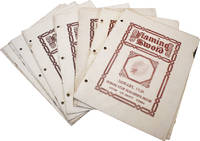
192846058Estero FL: Guiding Star Publishing House 1928. First Edition. Twelve quarto issues 31.5cm; illustrated wrappers stapled; 16pp per issue. Seven of the twelve issues with brass eyelets along left edge one with eyelets removed; all issues show modest wear oxidation to staples some scattered soil light biopredation and occasional staining to wrappers; several with vertical folds smoothed-out; small loss to lower corner of Dec.1928 issue; contents fairly clean and complete with some occasional notes in the margins; Good to Very Good. Complete year of this periodical formerly edited and written by Dr. Cyrus R. Teed a Utica NY native and founder of the Koreshan Unity. "Koreshanity" as it was also known was born in the wake of two related movements: the millenial fervor that swept early-to-mid-19th century central and western New York State and the utopian communalism that began attracting increasing numbers of adherents during the same period and into the later 19th century." A graduate of Eclectic Medical College of the City of New York Teed's interests went beyond medicine to encompass alchemy botany physics and metaphysics and he would regularly conduct experiments in these areas inside his medical laboratory. It was in this laboratory in 1869 that "Teed conceived what would become known as Koreshanity after experiencing a late-night religious vision. During what he called his "illumination" he saw a beautiful woman who revealed to him a series of universal truths which formed the fundamental principles of Koreshan belief." Among Teed's most interesting beliefs was cellular cosmogony or the hollow earth - the notion that the earth was not a convex sphere but instead a hollow concave cell containing the entire universe with the sun at its center. <br/><br/>After failed attempts at founding communal settlements in Moravia Syracuse and New York City Teed moved to Chicago IL where his persuasive oratory enabled him to assemble a firm core of followers in the late 1880's and form the commune called Beth-Ophra. Teed incorporated his organization there as the College of Life in 1886 and established a printing house that began producing three major publications: The Guiding Star The Flaming Sword and The Plowshare and Pruning Hook. "These publciations began a long legacy of Koreshan publishing aimed at the public as well as their own members intended to explain and promote their beliefs relate and preserve their story and discuss political social scientific and religious ideas and issues." <br/><br/>Believing himself to be a messiah who would lead his people in establishing a New Jerusalem Teed assumed the name Koresh in 1891 after Cyrus the Great King of Persia. As with his previous locations Teed's beliefs did not endear him or his followers to the general public forcing him to relocate from Chicago to the quiet beach town of Estero FL in 1894 the final home of the Koreshan Unity where Teed would establish his New Jerusalem. It was here that the Koreshan Unity established a growing self-sustaining community though at the height of the movement their membership numbered no more than 250. Though Teed died in December 1908 The Flaming Sword continued to be published from Estero through the 1960's with the Koreshan publishing tradition continuing well into the 1980's. Guiding Star Publishing House unknown books
19681660glsGainesville FL: University of Florida 1968. Octavo purple cloth hardcover gilt letters 91 pp. Fine. University of Florida, 1968. hardcover books
19537284fd2Gainesville: University of Florida Department of Alumni Affairs 1953. Quarto stiff illustrated wrappers stapled 22 pp. Photos throughout. Very Good. University of Florida, Department of Alumni Affairs, 1953. unknown books
1990234343PN. New. 1990. Soft Cover. Date is original print. This is a reprint edition . PN paperback
1989795371PN. New. 1989. Soft Cover. Date is original print. This is a reprint edition. . PN paperback
19991320291PN. New. 1999. Soft Cover. Date is original print. This is a reprint edition . PN paperback
1991246788PN. New. 1991. Soft Cover. Date is original print. This is a reprint edition . PN paperback
197858098University Gallery University of Florida. As New. 1978. Paperback. FREE UPGRADE to Courier/Priority Shipping Upon Request IN STOCK AND IMMEDIATELY AVAILABLE FOR SHIPMENT - AS NEW THE TEXT BLOCK IS PRISTINE CLEAN UNMARKED AND IN EXCELLENT CONDITION - - 52 pp. With one text ill. And 28 ills. On 20 pls. One map. 23 x 19 cm. -- with a bonus offer-- . University Gallery, University of Florida paperback
19971301411PN. New. 1997. Soft Cover. Date is original print. This is a reprint edition . PN paperback
197059605Gainesville Florida U. S. A.: University Gallery University of Florida. As New. 1970. Paperback. FREE UPGRADE to Courier/Priority Shipping Upon Request IN STOCK AND IMMEDIATELY AVAILABLE FOR SHIPMENT - AS NEW THE TEXT BLOCK IS PRISTINE CLEAN UNMARKED AND IN EXCELLENT CONDITION - - 22 pp. With 16 ills. 23 x 19 cm. -- with a bonus offer-- . University Gallery, University of Florida paperback
198126725Tallahassee FL: University. As New. 1981. Paperback. FREE UPGRADE to Courier/Priority Shipping Upon Request - IN STOCK AND IMMEDIATELY AVAILABLE FOR SHIPMENT - -- with a bonus offer-- . University paperback
198058230Marceline MO: Military Division Walsworth Publishing Company 1980. Hardcover. Very good. No dust jacket as issued. Three photographs laid in two of formation one of three female trainees. Includes illustrations. Partially paginated approximately 100 pages. Some illustrations in color. Title from cover. Logo on front cover in gold with a crossed sword and rifle. Commissioned on July 1 1968 the Naval Training Center Orlando Florida was established to enhance the manpower training capabilities of the United States Navy. It is not coincidential that it was established during the height of the Vietnam War which saw a significant increase in the membership of the Arms Forces. This training facility occupied the site of the former Orlando Air Force Base. Women began training in Orlando in 1972. This was published in 1980. This version is specific to Traning Unit 3105 which spent June 1980 to August 1980 at the training facility. Military Division, Walsworth Publishing Company hardcover
2000644G1466Canada: Brookus. Very Good. 2000. First Edition. Paperback. 1550567659 . 136. Index of names. Black and white photographic plates. Signed by author upon title page. Covers the history of Britannia British Columbia. Light wear. A nice copy.; 8vo - over 7¾" - 9¾" tall; Howe Sound British Columbia Britannia BC History; Signed by Authors . Brookus paperback