967 résultats
229637of California miners by William Wax Studios Redding California. All on the original photographer's printed mount. Each approximately 7 3/4" x 4 3/4". 1. Two men a woman and three young children standing in front of a miner's cabin. 2. Group of eight miners and two Chinese men standing in front of a miner's cabin. 3. Group of 15 miners and a dog dressed in their Sunday's best clothes standing and seated in front of a cabin. 4. Group of 18 men and 1 child standing and seated in front of the general store. 5. Group of 23 men mostly dressed in boots and work clothes standing and seated in front of a shed. A few smoking pipes one holding an ax. 6. Group of 22 men dressed in work clothes boots with lantern on their hats outside of the mine. Provenance: from the estate of Charles H. Segerstrom. No Binding. Very Good/No Jacket. hardcover books
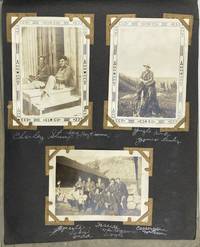
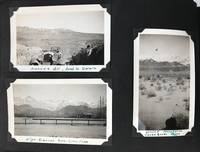
19321252Various locations in California 1932. Very good. 219 photographs on fifty leaves most 3 x 5 inches; plus six real photo postcards. Oblong octavo. Original black cloth string-tied. Light wear to covers. Images crisp and clear. Many images with typed captions. A wonderful photo album documenting road trips taken in the Eastern Sierra and western Nevada in the area in and around Owens Valley. The photographer and his friends explored numerous mines and mining towns in the region braving the desert in their car. The album winds from Owen's Lake to the National Soda Products Company and the Estelle Mine to the tiny town of Keeler where they celebrated Easter. They continue on to the mining camps of Panamint City and Ballarat both now ghost towns. There are photographs of the town of Lone Pine the Cerro Gordo Mine Darwin and in Nevada the towns of Lida and Goldfield. They take an extended trek through Big Pine California staying in Glacier Lodge Canyon and spend time in Onion Valley. There is also a lengthy series of photographs taken out at Lone Pine California documenting the Universal Pictures film "Oh Promise Me" with images of the actors and sets and crew. An altogether fascinating album documenting the region of the Eastern Sierra and Owens Valley. unknown books
188231379San Francisco: B. F. Alley 1882. xi 509 48pp. plus woodcut frontispiece and eleven other woodcut portraits. Later half calf and contemporary sheep gilt morocco spine label edges sprinkled brown. Ownership inscription on front endpaper recto scattered manuscript notations in pencil several on portraits. Final contents page tipped in.<br/> <br/>A rare history of Tuolumne County California covering a variety of topics.<br/> <br/>It recounts the foundation of its towns by miners arriving from the East in the summer of 1848 at the beginning of the California Gold Rush and contains a chronology of important events and a section of biographies for significant county figures. The volume also provides lurid accounts of various crimes committed including lynchings robberies and murders as well as of natural disasters and mining accidents. A significant portion of the book is dedicated to the county's mining history and its geology as well as its the promotion of its agricultural resources. Includes a portrait and brief biography of Samuel Clemens Mark Twain who spent time around the mines in California as a reporter during the Civil War and apparently stayed in Tuolumne County during the winter of 1864-65 where he wrote "The Celebrated Jumping Frog of Calaveras County." "One of the rarest of all California histories. with only a few copies in existence" - Norris.<br/> <br/>Adams Six-Guns 2248; California Local History 15345; Cowan II p. 646; Howes l71 "b"; Norris Catalogue 3968. B. F. Alley unknown books
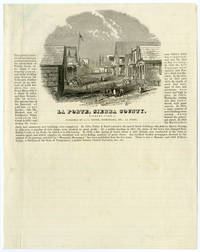
1858WRCAM44297La Porte Ca.: Published by J.C. Lester Bookseller etc. 1858. Pictorial letter sheet 9 3/4 x 7 3/4 inches on ruled white paper. Wood engraved illustration 3 3/4 x 5 inches. A slight bit of edge wear else fine. A scarce California pictorial letter sheet giving a view of the mining town of La Porte. The view shows the town's main street and several businesses are identified including Everts Wilson & Co. banking house; Lee & Ned's Pioneer Livery Stable; the Hotel de France; and the Union Hotel. A number of men women and children are shown in the street along with a miner carrying a pickaxe. The view of the town which carries an "AE" monogram is attributed to artist Alexander Edouart son of silhouettist Auguste Edouart. La Porte is located near the north bank of Rabbit Creek after which it had formerly been named on a ridge between the Yuba and Feather rivers at an altitude of 4500 feet. Mining began in La Porte around 1850 and continued throughout the decade. A printed description and history of the town surrounds the image the two occupying the upper half of the whole sheet. Baird locates a total of only four copies of this view of La Porte. BAIRD CALIFORNIA'S PICTORIAL LETTER SHEETS 129. CLIFFORD LETTER SHEET COLLECTION 136. Published by J.C. Lester, Bookseller, etc. unknown books
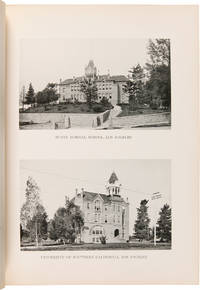
1900WRCAM55762San Francisco & Chicago: California Photogravure Co. 1900. Twelve parts. 24pp. plus 130 photogravures on 109 leaves. Folio. Original green cloth-backed textured burgundy leatherette wrappers foredges reinforced with same green cloth gilt title on front wrapper. Minor wear to upper or lower edges of a few volumes. Occasional light offsetting to margins images not affected. Bindings very good; plates near fine. A wonderful complete set of the "Art Work" series for Southern California with many striking views from Santa Barbara to San Diego and from the beaches to the Inland Empire. It is a marvelous record of Los Angeles and numerous small communities during an important period in the area's development. <br> <br> Like many sets in this series the majority of plates depict recently constructed civic buildings such as schools churches hospitals etc. as well as landscaped public spaces and expanding agricultural scenes. Although citrus farming was already a major industry and immigration was booming these scenes show Southern California "before": before the movie industry the freeways etc. Notable in this collection are lovely photogravure images of the State Normal School Los Angeles in 1919 it became the southern branch of the University of California; the College of Liberal Arts building "Old College" at the University of Southern California; the A.K. Smiley Public Library in Redlands; the Los Angeles County Court House the first building built as a courthouse in L.A.; and shots of several streets in and around downtown Los Angeles including tree-lined Sunset Boulevard in Hollywood - then still a dirt road. A brief text authored and signed in facsimile by Lou V. Chapin promotes Southern California as a land happily blending a modern and industrialized region with lush parks and gardens abundant agriculture and long beaches but it's the exquisite images that close the deal. <br> <br> This set has only appeared once at auction in recent years and is scarce in the trade. OCLC lists seventeen copies the majority held by California institutions. A fantastic visual record of California's "Southland" on the cusp of a boom in growth. OCLC 20876322 13326640. California Photogravure Co. hardcover books
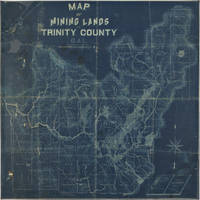
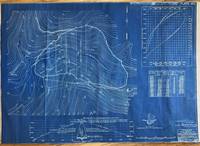
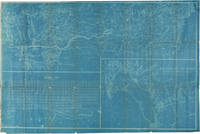
1890WRCAM54816Weaverville Trinity County Ca 1890. Blueprint map 33 1/2 x 33 inches. Old folds a handful of small areas of loss on the left side and along folds minor staining. Good plus. Framed under plexiglass. An exceedingly rare blueprint map enumerating the mining prospects in Trinity County California in the late 19th century. Located in northwestern California between the towns of Eurkea and Redding Trinity County is better known as a logging region rather than for its mining. This map is revealing of the high level of mining activity in the county at the time. It shows rivers creeks lakes mountain ranges and other topographical features and is laid out in a grid pattern with lines delineating wagon roads trails and county boundaries. The reference key at bottom indicates places on the map where one can find auriferous gravel land containing gold-bearing quartz cinnabar and coal. Mining-related locations specifically identified on the map include the Hawkins Bar Mine the Golden Chest Quartz Mines the La Grange Mine the largest hydraulic mine in the county Musser Hill Mines Bullychoop Quartz Mines and others. A California court ruling known as the Sawyer Decision of 1884 aimed to protect California public lands and waterways from mining debris caused by hydraulic blasting of entire mountains. Judge Lorenzo Sawyer's ruling is sometimes referred to as California's first environmental law and it forced miners to look at alternatives for unearthing valuable minerals. Dredging gravel beds became a commonplace practice and the current map shows the way to numerous locations where miners might try their luck at this newest method. <br> <br> The map was compiled by Henry L. Lowden U.S. Deputy Mineral Surveyor and civil engineer and John F. Johnson topographical engineer. It is perhaps a precursor to what Vogdes calls the first map of Trinity County also compiled by Lowden and Johnson and published in 1894 as OFFICIAL MAP OF TRINITY COUNTY CALIFORNIA. Mining in the Trinity County region began slowly in the 1850s but was most active between 1880 and the late 1950s when over two million ounces of gold were produced mostly from placer mines. <br> <br> Rare with no copies in OCLC. unknown books
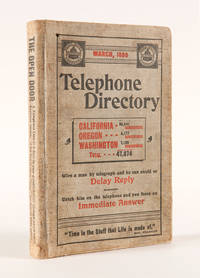
1899WRCAM56200San Francisco: Pacific States Telephone Companies 1899. 4vi2vii-viii4942pp. Original printed buckram boards. Small hole drilled through front and rear boards for hanging. Boards soiled and edge worn remains of adhesive to rear pastedown bookplate affixed to rear pastedown. Minor soiling and tanning to text small tear in upper part of pp. 493-94 affecting a few letters of text. Very good overall. Scarce telephone directory for California Oregon Washington and northern Idaho advertising listings for all 47874 subscribers often including addresses. The front pastedown provides instructions for how to use the telephone and make calls along with advice on telephone etiquette and how to contact non-subscribers. Although the telephone had been around for over twenty years at this point people apparently still benefited from the advice to "speak in a moderate tone and directly into the transmitter with the lips as close as possible to the mouthpiece." Likewise callers are advised to be clear about who they are and whom they are calling: "Much friction and annoyance will be avoided if this simple plan is carried out." <br> <br> After a few pages with information on long distance and line rates there is a "Supplemental List" for San Francisco dated April 1 1899 and printed on pink paper. Between pp.vi-vii of this supplement facing a page titled "Chinese Exchange" is a yellow leaf printed in Chinese on one side. The final leaf and rear pastedown have additional information on features available to subscribers and printed in black and red on the rear board is a map of the coverage area highlighting the "21000 miles of copper wire" running up and down the west coast. <br> <br> The directory begins with San Francisco listings organized alphabetically by subscriber and then covers the rest of California - Acampo to Zaca - alphabetically by city. Next are Oregon listings printed on pink paper and arranged alphabetically by city. Washington follows again arranged alphabetically by city; and then the final two pages include listings for sixteen towns in north Idaho. <br> <br> The invention of the telephone by Alexander Graham Bell in March 1876 created a new and swiftly-developing commercial market for rapid communication. Less than a year later the first newspaper report was delivered over the phone. The invention of the microphone in 1877 paired nicely with the new telephone technology and the Bell Telephone Company was born in July of that year. The first telephone directory in the U.S. was issued in New Haven Connecticut seven month later in February 1878 and the second directory in the U.S. was issued in San Francisco in June 1878. <br> <br> OCLC lists five copies of this March 1899 issue: Yale damaged Sacramento Public Library L.A. County Natural History Museum and the Nevada State Library. OCLC 55676511 19667877 29785821. Pacific States Telephone Companies hardcover books
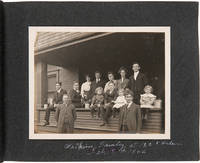
1906WRCAM55775Pasadena Los Angeles Long Beach and elsewhere described below 1906. 103 silver gelatin photographs from 1 1/4 x 1 to 4 3/4 x 5 inches mounted to album leaves. Oblong octavo album. Limp textured calf. Some wear and rubbing. One or two smudges to captions photographs in excellent condition overall. Very good. An engaging and remarkably well-preserved album recording over a year in the life of a large and jovial Church of the Brethren family from Pasadena. Most photos are captioned in white pencil often with location and date but rarely identifying the people photographed; some photos also include a date stamp including month and day. <br> <br> Although the identity of the skilled amateur photographer is not revealed the families featured appear to be part of one of the large migrations of the Brethren to Southern California. In search of cheap fertile land the Brethren typically migrated west in groups by which they could more easily hold on to their faith and lifestyle while at the same time winning converts by demonstrating their prosperous communities and godly lives. One of the families may be the Snyders as two photos of a house labeled "752 Hull St. Pasadena" matches the address of one J.S. Snyder in THE BRETHREN FAMILY ALMANAC for 1908. There is also a photo labeled "Watkins Family at 122 N. Hudson" and while that address is not found in the ALMANAC there is a T.J. Watkins listed with a post office box in Los Angeles. <br> <br> The album follows the family on an extensive tour of Southern California - from the mountains to the beach to the desert. The album begins with a number of photos of the extended family in various poses groupings and settings around a house in Pasadena. Some of the family group photos are repeated shots with only minor changes in composition. <br> <br> The tour begins with a Fourth of July picnic in Eaton Canyon in the foothills just above Pasadena; views of and from Mt. Wilson including a man riding a burro; the Pasadena Library; San Gabriel Mission; Hotel Green Pasadena; Pasadena High School at Euclid and Sierra Madre; and the train station at Lordsburg a Brethren settlement now La Verne. Interspersed are six photos of floats in the 1906 Tournament of Roses Parade. There are also views of the Salt Lake Railroad Station and other scenes of downtown Long Beach including the Bath House; a shack near Redlands; the Riverside Cactus Garden; a bridge over Devil's Gate Reservoir; the hotels Raymond and Maryland both in Pasadena; the Ocean Park Bath House on Christmas Day 1905; Port Los Angeles Railway Station; the First Brethren Church in Los Angeles and the Baptist Brethren Church on Hull Street in Pasadena. There are also several photos of the grand houses on Orange Grove Boulevard in Pasadena. <br> <br> An exceptional vernacular photograph album of Southern California. unknown books
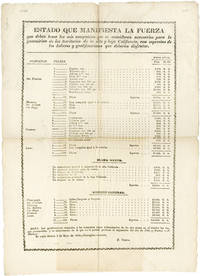
1828WRCAM43468Mexico 1828. Broadside 16 3/4 x 12 1/2 inches. Old folds. Slight wear and a few closed tears at edges. Very good. In a half morocco and marbled boards folding box spine gilt. A scarce broadside enumerating the number of troops and officers which were needed for posts in California. The various posts are listed including San Francisco Monterrey Santa Barbara San Diego and Loreto as well as frontier forces. The number of soldiers called for at each is given as well as physicians and surgeons inspectors etc. The annual budgets for the forces are also provided. Signed in print at the end: "F. Castro." This broadside is sometimes found with an accompanying printed circular announcement not present here. hardcover books
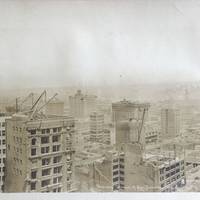
19071270San Francisco: R.J. Waters & Co 1907. Very good. Panoramic photograph 12 x 66.5 inches. Light wear and soiling faint creasing in a few places. Striking large panoramic photograph of San Francisco depicting the heart of the city a year after the Great Earthquake of 1906. Taken from Nob Hill one can see the Call Building in the immediate right foreground cable cars running busily down Market Street in front of it. In the direct center of the photo in the far distance one can see the spire of the Ferry Building with Russian and Telegraph Hills off to the left in the distance. a swathe of ruined landscape greets the viewer though with a number of cranes and buildings under construction. OCLC indicates Yale has a similarly-large panoramic image of San Francisco by Waters taken in 1906 just before to the fire. A handsome view of the city documenting its progress after the earthquake and fire that nearly leveled it. R.J. Waters & Co unknown books
1929651Placerville Ca 1929. Very good. Five blueprints measuring from approximately 24 x 34 to 29 x 41 inches. Tipped onto modern cardboard backing at left edge overlaid with brown paper. Light wear a couple of archival repairs at edges. Contemporary blind stamps. A group five large and fascinating blueprints that delineate proposed modifications to the Weber Dam near Placerville California that were carried out in 1930. The Dam was originally built in 1922 and 1923 without steel reinforcement and as a result improvements have been required periodically from its completion up to the present day. The designs present here outline the first set of such improvements overseen by an engineer named George W. Hawley in 1929 and 1930. These include the construction of new tunnels outlets gates and spillways and also include detailed topographical charts of the area surrounding the dam. The blueprints which were intended to accompany an engineer's report on the project are as follows: 1 Contour Map Showing Plan & Section of Dam and Location of Supply Tunnel & Wasteway. 2 Outlet Structures Showing Tunnel and Shaft Control Works & Appurtenances. 3 Details of Spillway. 4 Details of Tunnel Valves & Controls. 5 Contour Map of Borrow Area for Weber Creek Dam. The dam and the reservoir that it created managed by the El Dorado Irrigation District provide vital power and water services to area agriculture. The present plans comprise an important document of the early upkeep and development of the structure. unknown books
1869WRCAM48140Sacramento: H.S. Crocker & Co. 1869. 62752pp. including index and in-text advertisements. Original half pigskin and printed paper boards spine gilt. Boards quite rubbed scuffed and soiled. Rear blank endpaper lacking. Final text leaf index leaf torn in upper outer corner not affecting text. Several instances of early ink or pencil marginalia. Toned scattered foxing. Good. The near completion of the transcontinental railroad saw Sacramento's population increase by twenty-five percent in a year from sixteen thousand to twenty thousand in early 1869. This is the third of three Sacramento directories by Draper between 1866 and 1869 and includes information not only on the city but on the surrounding county as well. Descriptions of several small townships are included such as Alabama Brighton Cosumnes Dry Creek Granite Natoma Sutter and more and the names of resident voters are listed. Also included is a table of depots of the Central Pacific Railroad distances from Sacramento and the location of telegraph stations. "Very rare" - Quebedeaux. QUEBEDEAUX 57. ROCQ 6515. HOWES D487 1866 Draper directory. H.S. Crocker & Co. hardcover books
19351876Various places in Idaho & California 1935. Very good. 103 original photographs most 2.5 x 3.5 inches. Oblong octavo album coated stiff paper covers string-tied. Photos in corner mounts most with manuscript captions on album leaves. Later contemporary ownership inscription on front board. This photo album provides an excellent visual record of the life and work of Joseph Grosjean a member of Civilian Conservation Corps Company No. 569. This unit commanded by Lt. Roy Strange was the first CCC Company sent to Camp Horse Heaven in Coeur d'Alene in 1934 where they were assigned to road construction and control of "Blister Rust" tree fungus important work ordered by the U.S. Forest Service in order to prevent the loss of white pine forests in Eastern Washington and Northern Idaho. The photos here show many of the participants the camp site the ruggedness of the surroundings; a young Grosjean who was then eighteen years old is pictured in many of the shots. Other photos show activities such as clearing brush on Hog Lake Road and installing a gate and other roadwork on Thomas Mountain near present day Kachess Dam in Washington. <br/><br/>In 1935 Grosjean moved to work details that were based out of Camp Kenworthy and Keen Camp both near Hemet California although there is no indication that he was transferred to another unit. In the San Jacinto Valley his work including brush clearing maintaining fire breaks and several landscaping and irrigation projects. His unit apparently also had more time for and access to leisure activities while in California as there are a couple shots of CCC camp members "skiing in sunny California" and another snapshot of "Jean Harlow's house." Overall a fine document of Civilian Conservation Corps life in the somewhat divergent locales of Northern Idaho and Southern California. unknown books
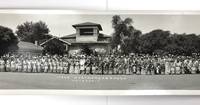
19311520Fresno: Frank Kamiyama 1931. Near fine. Silver gelatin photograph 10 x 46 inches. Minor wear and soiling. Image strong and crisp. A handsome panoramic photograph by Japanese-American photographer Frank Kamiyama depicting the worshippers for the service to reinstate the Buddha's statue in the temple. The photo shows a large group of Japanese Americans assembled on the street in front of a bungalow-style building whose porch is draped with large curtains. The children who line the front row are in ceremonial and traditional costume; behind them at the center are three men wearing stoles of office; a band stands at the right end armed with brass and wind instruments; several spectators appear at the left edge of the image some in parked cars waiting to drive through the street. Most of the worshippers are women.Panoramic photographs such as this one were often taken to commemorate important events or celebrations and were particularly popular from the 1920s through the 1940s. Frank Kamiyama 1886-1974 was a Japanese-American photographer with a studio located on Tulare Street in Fresno. He was an important documentarian of the Japanese community in Fresno and the surrounding area. Given the modest nature of the temple here we presume this image to have been taken in an outlying community. Frank Kamiyama unknown books
229634with 180 photographs laid down on album leaves. Most photos are 3 3/4" x 4 1/2". Album is 6 1/2" x 9 3/4" black flexible cloth. Very good. ca. 1900-1905. Album of photographs from the family of Charles H. Segerstrom mostly capturing family outings get-togethers vacations the scenic spots of California the town of Sonora etc. Included are excursions to the Big Trees climbing on and passing through them; a large group on an open train crossing a trestle evidently on their way to a picnic or similar event; the ornate Victorian Cliff House in San Francisco which burned in 1907 parades in San Francisco; Sonora including its city hall; Golden Gate Park in San Francisco; various picnics outdoor gatherings etc. A very interesting glimpse at the lives and activities of a prominent wealthy family residing in the Sierra foothills and the California which was their playground. There are occasional notes laid in identifying or speculating on subjects and locations. Provenance: from the estate of Charles H. Segerstrom. Soft cover. Very Good/No Jacket. hardcover books
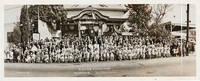
1940WRCAM55967Los Angeles: Japanese Photo Studio Association 1940. Panoramic photograph 10 x 24 3/4 inches. Minor wear vertical crease through image near the right edge. Very good. A striking panoramic photograph picturing the Japanese-American celebrants at the 40th anniversary of the opening of the Buddhist school at the Los Angeles branch of the Higashi Honganji Temple. The photograph is titled and dated in Japanese script; it relates the date of the celebration as the 13th 14th and 15th of September in the year 2600 after the birth of the Emperor Jimmu which is 1940. The photograph pictures a few hundred Issei and Nissei men women and children in a mixture of traditional Japanese gowns and caps and western suits and dresses. There are a few banners in the background relating to the temple and the celebration. The Higashi Honganji Buddhist Temple is still active in Los Angeles. <br> <br> The celebration depicted here came just two short years before the beginning of the Japanese-American internment period which triggered fundamental changes in the practice of the Buddhist faith in America among Japanese-American citizens. As a result of anti-Japanese sentiment in the early 1940s Buddhists sometimes changed the names of their churches to sound more patriotic. They began to meet on Sundays to emulate Christian worship while singing from new hymnals that echoed those found in Christian churches. Sects within the church were forced to worship together. And the swastika - a Buddhist symbol for thousands of years - was replaced by the dharma wheel. <br> <br> In addition to the faith itself Buddhists within the Japanese American community were particularly vulnerable during the internment period. The American government believed that Japanese-American Buddhists were more likely to support Imperial Japan than Japanese-American Christians or those of another faith. Sadly this also represented the majority of Japanese Americans since most were Buddhist in the first place. Further the FBI classified Buddhist priests as "known dangerous Group A1 suspects" and sought them out among the first groups to be imprisoned. Many Buddhist priests were whisked away to relocation centers even before Franklin Roosevelt's issuance of Executive Order 9066. <br> <br> We could locate no other copies of the present panoramic photograph in institutions or auction records. An important photographic record of a portion of the Japanese-American Buddhist community in Los Angeles just a short time before the internment period changed everything. Japanese Photo Studio Association unknown books
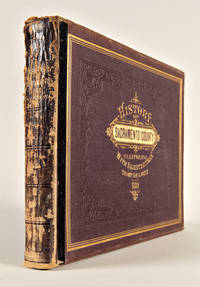
1880WRCAM38805Oakland: Thompson & West 1880. 294pp. plus two colored maps one folding and 216 lithographic plates several with more than one illustration eight of them double-page. Oblong quarto. Original half sheep and cloth stamped in gilt and blind spine stamped in gilt. Spine and hinges rubbed and scuffed boards moderately worn at edges. Long closed tear in folding map and one text leaf else internally very clean and fresh and in near pristine condition. A magnificently illustrated comprehensive history and description of Sacramento. While the text provides a history of the city from its settlement to the date of publication the illustrations provide excellent views of numerous key buildings. Included are the state capitol courthouses the Sacramento Brewery the Arcade Hotel the offices of the Sacramento Bee and other newspapers the Sacramento Seminary cattle ranches farms lumber yards merchants mills Breuner's furniture shop the county hospital and much more. Homes of several prominent citizens are shown including Mrs. E.B. Crocker's mansion her main residence as well as a smaller - yet still grand - home a block away the opulent home of Albert Gallatin and the ranch of cattle baron Frederick Cox. Scores of more modest homes in the city and country are shown as well including the residences of several farmers and ranchers in what was once open countryside but is now part of Sacramento's suburban sprawl. One map is of California and surrounding states while the folding map shows Sacramento County. An exhaustive effort designed to attract additional residents and businesses to California's booming capital and providing an unequalled visual record of Sacramento in the late 19th century. COWAN p.548. HOWES S9 "b." ROCQ 6512. NORRIS CATALOGUE 3351. Thompson & West hardcover books
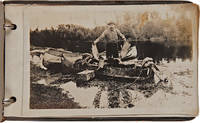
1927WRCAM55131Oakland 1927. Twenty-eight silver gelatin photographs each approximately 4 x 6 1/2 inches. Each photograph backed with canvas and with a detailed typed caption on verso. Oblong octavo. Ring-bound flexible leather boards. Upper 1 1/2-inch portion of spine and front cover chipped away. Covers rubbed crude repairs to spine toning and minor wear to photographs. Very good. In a cloth box. An unusual album featuring boats and canoes manufactured by the King Boat Company of California. Many of the photographs are dated 1927 and the album serves not only as a visual catalogue of various boats available from the King Boat Company but also as a document of water travel in Alaska California and the Pacific Northwest in the 1920s. The canvas backing on the first and last images bears the inkstamped name of F.R. Frederick a distributor based in Boston. Whether this album was prepared by Frederick or by the King Boat Company is unclear. What is clear is that these are very interesting images of various King Boat Company boats and canoes in use. Nine are identified as having been photographed by "Lewis R. Freeman Noted Explorer and Writer for National Geographic Magazine on Thousand Mile Canadian Trip. Summer of 1927"; a tenth is an image of Freeman with an Arrow Boat. Freeman a noted traveler explorer and writer published over twenty books on his travels. Other images reveal "Arrow Model on Heart Lakes in the High Sierra - 11500 Feet Elevation. Colonel H.G. Thompson at the Oars"; "Boat owned by T. Wherry Taxidermist Victoria B.C. was built in 1893 and in service for over 34 years up to November 1927 on display in King Boat Company Factory Oakland California"; a couple images of canoes loaded on pack horses; several of Henry W. Partridge "Noted Packer" navigating the Salmon River in Idaho; images of boats in Alaska and the Yukon; and several others of boats on shore in use as shelters or otherwise employed. hardcover books
1881WRCAM50288San Diego 1881. Folding map 23 1/2 x 34 3/4 inches folded to 8 1/4 x 4 1/2 inches. Minor separations at crossfolds a couple short fold separations ink stamp on front. Else very good. A rare blueprint map showing the harbor of San Diego along with a scaled map of the U.S. from northern California east to Boston south to Charleston South Carolina and west to Sonora Mexico; with a grid of the property of the San Diego Land & Town Co. in National City a small city within San Diego and including the "Terminal Grounds" of the railroad. Heliographed by O.N. Sanford in San Diego. Frank A. Kimball was the agent for California Southern or the San Diego Land & Town Co. in National City and the front cover bears his ink stamp. Rare with only three copies on OCLC at Yale the University of California San Diego and the Sacramento Public Library. Not in Rocq. OCLC 54146621 35291187 34434276. unknown books
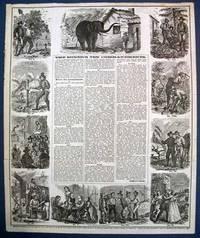
185334042San Francisco: Sun Print 1853. 1st separate issue Baird 167; Clifford 180. Subtle age toning to extremities. Fold lines which are a bit tender & starting at the edges. Still a respectable VG copy. 1 sheet of lined light blue laid paper folded once vertically. Text printed p. 4 in 3 columns with a surrounding border of 11 wood engraved vignettes of mining-camp life as drawn by Harrison Eastman. Eastman's images portray the temptations which the commandments exhort the miners to resist such as gambling drinking staking false claims stealing fighting lying etc. 11-1/4" x 9-1/4" <br/><br/>"Thou shalt have no other claim than one." "Thou shalt not go prospecting before thy claim gives out." "Thou shalt not steal a pick or a shovel or a pan from thy fellow miner; ." "Thou shalt not tell any false tales about 'good diggings in the mountains' to thy neighbor ." "Thou shalt not commit unsuitable matrimony." So declares 'The Miner's Ten Commandments.' These divine rules of the California Gold Rush came about in the early 1850s when keeping the Sabbath became a point of issue in Placerville and other mining regions. Such religious observance was favored by James Hutchings but not so by many other residents. Their lack of spiritual reverence was lampooned along with many other shady miner practices by Hutchings in this famous and subsequently oft-imitated parody of the Ten Commandants. The work was first published 4 June 1853 in the Placerville Herald and this the first separate publication. For more detailed history of this piece see Kruska's HUTCHINGS Chapter 5. Sun Print unknown books
1920259670Los Angeles 1920. 156 original photographs most 3-1/2 x 5-1/2 inches mounted on black album leaves. 1 vols. Oblong 4to. Original black pebbled leather album. Some toning of photographs. Very good. 156 original photographs most 3-1/2 x 5-1/2 inches mounted on black album leaves. 1 vols. Oblong 4to. A very good and representative photograph album from the home of Zane Grey documenting some of the best selling author's outdoor trips including sailfish off Catalina Island California a trip to the grand Canyon and a pack trip into the hills of Arizona after wild turkey. Provenance: Estate of Zane Grey unknown books
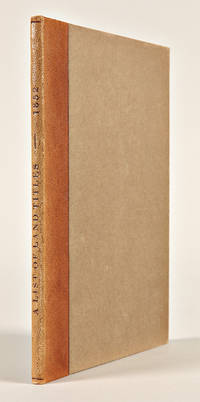
1852WRCAM46585San Francisco: Monson Whitton & Co. 1852. 43pp. Modern half calf and plain paper boards. Text lightly age-toned. Extensive early pencil notes see below. Very good. The Thomas W. Streeter copy with his bookplate on the front pastedown and his pencil notes on the front free endpaper. A very significant publication indicating that from the earliest days the United States government would contest the validity of claims to land in California that had been granted before statehood. <br> <br> California came under American control during the Mexican-American War and attained statehood in 1850. One of the most vexing legal questions in the 19th-century history of the state was the status of lands that had been granted by the former Spanish and Mexican governors. These "ranchos" at times amounted to thousands of acres and questions of their ownership were quite contentious despite the provisions of the Treaty of Guadalupe Hidalgo to respect all Mexican land titles. In 1851 the U.S. Congress created a three-person commission to consider the validity of land claims each of which would ultimately be challenged by the U.S. government. The list of land title cases at the end of this volume the first to have been printed shows that 247 cases were presented to the courts in the year after the Commission was created. "This pamphlet states the first official acts of the land commissioners. The list of land claims at the end gives the names of the attorneys on which a former owner has penciled in many instances the final action of the commissioners" - Streeter. Of the three original commissioners Harry I. Thornton was a frequent upholder of the validity of the claims against the interests of the U.S. government and was removed from the Commission in 1853. <br> <br> Not in Cohen or Sabin. This copy was bought at the Streeter sale for $300 in 1968 by Warren Howell who asked $1000 for it shortly thereafter. He sold it to a private California collector from whom the Reese Company acquired it. STREETER SALE 2725 this copy. COWAN p.374. GREENWOOD 364. Monson, Whitton & Co. hardcover books
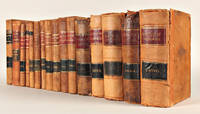
1866WRCAM17607New York San Francisco & Sacramento 1866. Sixteen volumes. Contemporary legal sheep leather labels. Some volumes with tender or almost detached hinges. Contemporary and later ownership inscriptions including those of Walter Norris of Salinas Lucas F. Smith of Santa Cruz Victor L. Hicks Wright & Wright of San Francisco and Fred V. Wood of Oakland. Overall a very good set. A complete run of the first editions of the statutes of California during her formative years. As the third and fourth volumes are very rare it is extremely difficult to find a consecutive run of these early laws. At this early stage of California legal printing any given state printer was not kept for long. Those represented herein are as follows: J. Winchester first volume; Eugene Casserly State Printer second volume; G.K. Fitch & V.E. Geiger Co. State Printers third volume; George Kerr State Printer fourth volume; B.B. Redding State Printers fifth and sixth volumes; James Allen State Printer seventh and eighth volumes; James O'Meara State Printer ninth and tenth volumes; Charles T. Botts State Printer eleventh and twelfth volumes; Benj. P. Avery State Printer thirteenth and fourteenth volumes; O.M. Clayes State Printer fifteenth and sixteenth volumes. <br> <br> There is an interesting note to the printing history of the statutes. According to Wagner the Governor refused to acknowledge Casserly as state printer at the end of the 1851 session and instead appointed G.K. Fitch to the position. Fitch turned over all state printing copy to be done in New York. Casserly brought the matter to court and won back his position as state printer whereupon the already printed statutes were sold to him in a compromise agreement. Casserly then proceeded to have new titlepages added to the statutes that had been printed in New York and added errata slips and an index. All subsequent laws were printed in California. COWAN p.610 ref. GREENWOOD 167 ref. WAGNER CALIFORNIA IMPRINTS 147 149 150 ref. hardcover books
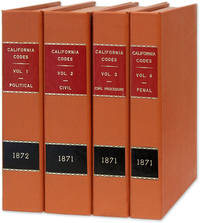
1872688091872. Sacramento 1871-1872. 4 Vols. Sacramento 1871-1872. 4 Vols. California's Field-Based Codes of 1872 California. Haymond Creed 1836-1893. Burch John C. 1826-1885. Lindley Charles. Revised Laws of the State of California: In Four Codes: Political Civil Civil Procedure And Penal. Volume I: Sacramento: T.A. Springer State Printer 1872; Volume II-IV: Sacramento: D.W. Gelwicks State Printer 1871. Four volumes. Complete set. Lacking the 2 tables one of consanguinity the other a schematic overview of the civil code. Octavo 8-3/4" x 5-1/2". Contemporary three-quarter law calf over marbled boards raised bands and red and black lettering pieces to spines. Some rubbing and a few minor scuffs to boards heavier rubbing to extremities with wear to spine ends and corners boards detached a few endleaves detached and lightly edgeworn card-pocket residue to front pastedown of Volume I. Light to moderate toning a few early owner signatures to front endleaves of Volumes I and II later library stamps to title pages other library marks to versos. Volumes housed in recent buckram clamshell cases with red and black lettering pieces. $3000. First edition Volume I was published last. Volume I: Political Code; Volume II: Civil Code; Volume III: Code of Civil Procedure; Volume IV: Penal Code. Based on David Dudley Field's New York Field Codes these volumes comprise the proposed code of laws for the state of California. The codes were adopted in 1872. The Political Code is no longer in force but the other three remain the fundamental basis of California law. Babbitt Hand-List of Legislation Sessions and Session Laws 25. unknown books
186738094Nevada i.e. Nevada City California: Daily Gazette Book and Job Office 1867. 8vo. vi 6 424pp. Tipped-in ad slip between pages 184 and 185. Contemporary purple morocco<br/> <br/>Provenance: E.G. Waite of Gregory & Waite Grocers Nevada City bookplate name in gilt on upper cover<br/> <br/>The first Nevada County directory the first history of the county as a whole and the first book printed in Nevada County.<br/> <br/>First edition of this "notable compendium of early source material similar in import to the county histories of Thompson and West" Wheat. The work also includes sketches of the towns and mining camps a directory of the residents including their occupations as well as statistics of mining and other resources and a plethora of fascinating advertisements. Bean's history and directory is quite scarce and contains a great wealth of early material on this vitally important mining region. A substantial essay is given over to mining gold from quartz deposits which as the author notes has been the subject of numerous false starts. "Bean's history and directory is by far the best-known of all California directories. One of the great 'standard' county histories it is in the minds of many collectors dealers historians and libraries one of the most valuable - content wise - of all directories published in the United States" Quebedeaux.<br/> <br/>Cowan II p 170; Graff 219; Howes B-278; Wheat Books 13; Quebedeaux 36; Streeter Sale 2913. Daily Gazette Book and Job Office unknown books