CaliforniaABAA
967 résultats
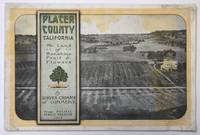
1913679Auburn: Auburn Chamber of Commerce 1913. About very good. 12pp. Original pictorial wrappers stapled. Covers lightly soiled previously damp; edges reinforced with tape. Contents reinforced with tape at lower corner minor soiling. Promotional work published by the Auburn Chamber of Commerce promoting the county as an ideal place for agriculture and profit with an article extracted from the Pacific Serves Magazine entitled "Enlarging the Bear River Canal: A Part of Our Development Work in the Sierras." This article which is illustrated describes work on the canal and the ways in which it will benefit the region's farmers with irrigation. We locate one copy in OCLC at the University of California at Davis. Auburn Chamber of Commerce unknown books
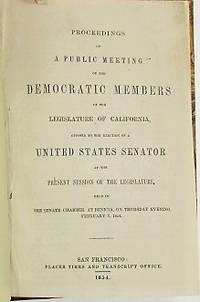
185433622San Francisco: Placer Times and Transcript Office 1854. 8pp bound in attractive modern quarter calf and marbled boards gilt spine lettering. Very Good. <br/><br/> A significant chapter in the epic Gwin-Broderick struggle which split the California Democratic Party on the Kansas-Nebraska issue and ended only with Broderick's death in a duel with Chief Justice David Terry of the California Supreme Court. At the time of this public meeting Broderick was President of the California Senate and sought to engineer his own election to the U.S. Senate to replace Senator Gwin whose term would expire on March 4 1855. These California Democrats resist the attempt to steamroll Broderick's election arguing that only "the Legislature next preceding a new senatorial term has the right to elect." <br/> Discussing this item Eberstadt says "The 'public meeting' was held in the Senate Chamber at Benicia and the proceedings give a clear insight into local politics just prior to vigilante days." <br/>Cowan 502. Greenwood 491 1- CU-B. 136 Eberstadt 157. OCLC 21658923 6- 4 in CA Yale KY Hist. Soc. as of January 2021. Placer Times and Transcript Office unknown books
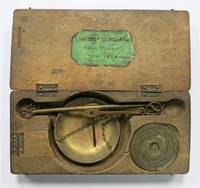
42777New York: E. Fabreguettes Fils & Morra n. d. Circa 1850. Wooden case with a hinged lid and hook clasps seller's label to inside of lid. Interior has carved compartments for the brass scale and weights including a small compartment for grain weights with a hinged lid. Light general wear to case and weights brass balances a bit tarnished. Only contains the three grain weights so perhaps others missing VG overall. Suspension gold scale made of brass with troy and grain weights. Troy weights nested ranging from 1/16 to 4 oz; grain weights include 2 6 and 10. Case: 1-11/16" x 6-11/16" x 3-1/8". Scale when hanging: ~8-1/4" x 7-1/8" brass balances 2-1/2" in diameter. <br/><br/>In 1850 the New York firm of E. Fabreguettes Fils & Morra importers of French fancy goods attempted to capitalize on the California Gold Rush by adding gold scales to their wares. Notices in several of the city's papers in late October and early November of that year including the Monday November 4th edition of The Evening Post advertised the following: "GOLD SCALES. The subscribers offer for sale the best and most approved pattern of French Standard Gold Scales adjusted exactly to the United States Mint Standard of every size and weight. These scales are so made that they take but very little compass when packed and are much more neatly and conveniently finished than either the English German or American article. As we have all that are made of this pattern parties having orders for shipment to California are solicited to examine them before purchasing elsewhere. Also for sale a variety of French fancy goods accordeons sic &c. E. Fabreguettes Fils & Morra 73 William Street up stairs." E. Fabreguettes Fils & Morra was located at 61 Maiden Lane until at least 1847 moving to their William Street address in 1848 or 1849. No later advertisements for these scales appear to have been issued in New York newspapers leading us to conjecture that the firm's venture into the gold mining market was perhaps not particularly successful. It is of course impossible to say with any certainty if this particular scale was originally used during the Gold Rush though this one here offered was purchased in California giving rise to possibility it may very well have been. In either case a nice artifact from the California Gold Rush era. E. Fabreguettes Fils & Morra unknown books
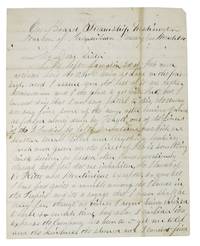
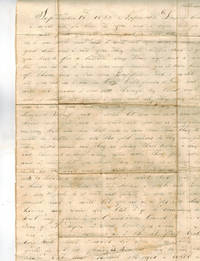
1851476391851. Now housed in an archival mylar sleeve. Age-toning especially along fold-line. Penmanship clear & easily read. Bifolium i.e. 4 pages of lined paper 23 lines per page ~ 10 words per line ~ 900 words. 9-3/4" x 7-5/8" <br/><br/>While no year is written on the ALs itself we posit 1851 as the Maritime Heritage website shows the only visit to San Francisco by the Washington was July 21 1851 arriving from Baltimore per a newspaper entry in the Daily Alta. That said per a online perpetual calender March 14th came on a Tuesday in 1852 not 1851. We lean towards 1851 as the actual year this letter was written. And this historic letter is replete with interesting content written by a man bound for the promised land of California. Chamberlin is from Boston writing a newsy letter his sister posted from the Harbor of Pernambuco Brazil March 14 where the ship in taking on supplies including coal. He describes the voyage thus far the expense of the company that sent him and the trip ahead around the Horn expecting to arrive in California in about 30 days. He describes conditions aboard the ship the places he has visited the people he has met in Brazil his own experiences with the heat and fever and more. Letters from this era are apprearing ever more infrequently on the market. unknown books
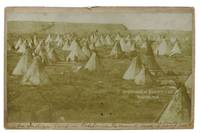
47248n. p. n. d. Ca late 1860s / early 1870s. Now housed in an archival mylar sleeve. Mount soiled with some edge wear. Yellowing to image. About Very Good. Rectangular creme-colored mount square corners no imprint. 4-1/2" x 7" <br/><br/> unknown books
1921802Colusa Ca. 1921. About very good. 8pp. Pictorial self wrappers stapled. Light wear and creasing; a few short closed tears at wrapper edges. Contemporary ownership inscription on front wrap. Even tanning. A scarce promotional for the Young Oil Company and its development of an apparently lucrative oil strike at Bear Creek in Colusa County during 1921. The pamphlet prints a story first published in the local Colusa Sun newspaper which documents history of oil production at the site chronicles the purchase of the lease by Young Oil in 1915 and relates positive comments from several contemporary geologists' reports that convinced the company to significantly increase its investment and work on the property including the imminent arrival of an industrial drilling rig from Texas. The remainder of the text publishes a letter from a Sacramento oil man William Babcock which describes the operation as "The best oil venture that I know of -- in fact it looks so good to me that while I have for all intents and purposes retired from active participation in the development of the oil business I shall in this case make an exception." The final leaf prints an enjoinder from the company to "Buy all the Young Oil Company stock you can afford" and gives the organizational information of the firm. Illustrated with five halftone images of the site; not in OCLC. unknown books
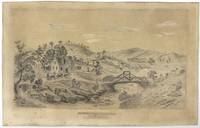
18501475Medway Ma. 1850. Very good. Pencil sketch on heavy paper with faint tempera highlights. Image measuring 7.5 x 11.5 inches on a sheet 8.25 x 13 inches. Light dust soiling and faint foxing. Evenly tanned. A skilled contemporary pencil sketch after a classic California Gold Rush pictorial letter sheet by San Francisco lithographers Britton & Ray depicting Jamestown and Woods Creek. The original letter sheet published in 1853 utilized a work by English artist and civil engineer George Henry Goddard who settled in Sacramento the previous year. It shows the town and stream from the south with all in a relatively tranquil mode as a horse-drawn carriage approaches a bridge on the road in the foreground. Jamestown "The Gateway to the Mother Lode" was founded in 1848 and gold was discovered there relatively quickly thereafter and the town continued to enjoy long periods of prosperity until the end of the 19th century due to its rail connections and quartz mining.<br /><br />The present folk art iteration of the letter sheet is signed "H. Baker" in the lower right corner and it seems likely that it was accomplished by a family member of another well-known California lithographer George Holbrook Baker. Baker came to California during the Gold Rush from Medway Massachusetts settling in Sacramento around the same time as Goddard and his work was also used by Britton & Rey and others in their productions. He certainly would have known his fellow artist and neighbor in Sacramento and probably sent copies of pictorial letter sheets home to Massachusetts where the present sketch turned up in a sale of some of Baker's other art and drawings in order to keep them apprised of his work and well-being. Overall this copy is a decent imitation by its recipient and well demonstrates the popularity use and extended life of the letter sheet genre in this case as it relates to California and the Gold Rush. books
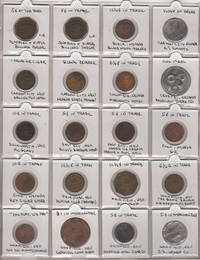
1900009672Collection of forty-eight western tokens plus other exonumia composed mostly of merchant "good for" tokens several Pony Express commemorative 'so-called-dollars' a tool-check and a 'dog house' license. These were issued at various locales mostly in Nevada with a couple from California. The tokens were identified by Palazzo John Schilling or Holabird Auctions. Palazzo's old and badly worn cardboard mounts have been replaced with new Lighthouse coin 'flips' and the original information has been transferred. Mixed condition; some near mint and others well-worn as is common with many tokens. One of the images at the link displays a list of all the tokens which will also be provided in hard copy.<br /><br />Trade tokens were a form of unofficial 'minor coinage' made from base metals such as brass copper nickel or aluminum and usually cast as circular disks but occasionally as octagons triangles or in scalloped shapes. They seldom if ever had a value of more than a dollar. Trade tokens sometimes referred to as "Good Fors" because they were usually stamped "Good for" followed by a product service or monetary value first appeared in the United States during the late 1700s and it's been suggested that George Washington used a trade token to attend Bill Rickett's Philadelphia Circus in 1793. <br /><br />Often like some of the tokens in this lot they were issued to be exchanged for a specific product or service such as a loaf of bread game of pool meal hotel room or brothel visit. In the western states company stores and independent businesses made frequent use of tokens in mining towns and camps where coinage was often scarce. As an added incentive for businesses they could only be redeemed at the place of issue and with little if any law enforcement they were a safe substitute for gold and silver. Also if the tokens were never redeemed business owners pocketed a little extra profit.<br /><br />The towns and cities represented in this collection include Aztec Blair Carson City Crystal Duckwater East Ely Elko Fairview Goldfield Los Angeles McGill Mound Hill Reno Tonopah Tuscarora and Winnemucca. Today some of these places are ghost towns. <br /><br />The lot includes tokens distributed by the American Borax Company general stores drug stores tobacco stores billiard parlors hotels and saloon/brothels. <br /><br />Four of the most interesting tokens in this lot are<br /><p><p style="margin-left:5%; margin-right:10%;">Two different tokens from Goldfield Nevada's most famous saloon The Northern. One of these tokens was originally bimetallic with an aluminum ring around a copper or brass disc. The disc is missing on this token just as it is on almost all the others that have survived. Tex Rickard and his silent partners Wyatt and Virgil Earp opened The Northern in 1905 and Wyatt briefly managed the establishment during its first year of operation. In time Rickard became a very successful fight promoter; he promoted the championship fight between James J. Jeffries and Jack Johnson. He later used his fortune to build the third iteration of Madison Square Garden--which lasted from 1925 to 1968. During his Garden's second year of operation Rickard formed a professional hockey team to play there Tex's Rangers known today as the New York Rangers.<br /></p><p><p style="margin-left:5%; margin-right:10%;">A 12½ cent token for the Red Top Bar one of Goldfield's notorious brothels.<br /></p><p><p style="margin-left:5%; margin-right:10%;">Two 5-cent tokens from the Jeffries & Kipper Billiard Parlor and Gentlemen's Café in Los Angeles which the two men opened in partnership in 1907. Kipper was a frustrated boxer who eventually became the manager of the Los Angeles Coliseum. Jeffries was the legendary Heavy Weight Champion James J. Jeffries who was lured back into the ring for a $1 million payday in today's dollars six years and an additional 110 pounds after he retired as the "Great White Hope" to fight the then-current champion Jack Johnson. </p><p>For additional information about trade tokens see Rulau's <i>Standard Catalog of United States Trade Tokens 1700 to 1900</i> Ascarza's "Mine Tales: Trade tokens were used widely but are rare today" in the 9 Dec 2013 issue of the <i>Arizona Daily Star</i> and "John Bill Ricketts and the Ricketts Circus" at Circuses and Sideshows online.<br /><br /> A fascinating physical record of commerce in the boomtowns of the American West. Recent auction results found at Worthpoint suggest the total value of this lot to be just under $1600.</p> books
1929303902Sacramento CA n.p. 1929. 1929. Tall thin 8vo. Original black limp leatherette stamped in gilt rubbing. Very good. 78 pages. Assembly Concurrent Resolution No. 20. Adopted in Assembly March 22 1929. Signed by six officials including: Chief Clerk of the Assembly Arthur A. Ohnimus; Secretary of the Senate J.A. Beek; Private Secretary of the Governor Chas. A. Whitmore; Speaker of the Assembly Edgar C. Levey; President of the Senate . . . and Secretary of State Frank C. Jordan. Signed and inscribed on the front free endpaper: "Compliments Cherster M. Kline California Legislature 1929 77th Dstr." The copy belonged to Charles E. Brouse who was a member of the 15 member Riverside Board of Freeholders with his gilt stamped name on the front cover. See Rocq 6494 citing what appears to be a later printing with 81 pages. Hardcover. Very Good/No Jacket. [Sacramento, CA, n.p., 1929]. hardcover books
189245920San Francisco: Published by H. W. Faust 1892. 12th Edition. Map mounted at some past juncture and then housed in a simple black wooden frame. Original printed buff wrappers attached to rear of framed map. Usual bit of age-toning. Modest wear & soiling. Very Good. Relief shown by hachures. Depicts drainage rancho and tract names block numbers radial distances from Ferry Building railroads and street railways selected public buildings etc. Adverts in margins. Printed in sepia. Map:. <br/><br/>OCLC records 5 holding instituions. Published by H. W. Faust unknown books
1855007164Sacramento California 1855. Two manuscript letters in ink both on ruled paper with folding creases the 1855 letter 8" x 12 1/2" with single spaced writing both sides approx. 500 words. The 1856 letter 15" x 10" folded in half to make 4 pp. approx. 300 words with small blindstamp top left corner depicting an eagle. The earlier letter is headed "September 18th 1855 Naperville Dupage County Illinois" and ends "Michael direct your letters Nevada County Nevada post office California". George writes to his brother Michael in Naperville that he has "seen a good dele sins i rote you they last letter" including a hundred "inshins" and some "Buffellow". He adds that "we had good luck all they way of may we left Council Bluff" and that he is not home sick yet. He then talks of the gold mines river mining what they are paying and the cost of things such as board "from five to ten dollars a week" "Beaf" "wors 15 to 20 cents" and "potato" "4 cent per pound". He adds that he intends to have some gold before he comes home and that "girls are not so plenty here as they are in state". He closes by asking his brother to write him and to remain at home in Illinois to care for their parents. The 1856 letter headed Sacramento august 3th 1856 informs his brother that he is well and "down to Sacramento now" working on a farm feeding a "schrasing" thrashing machine and that "they times is verry hard in California now". He adds that he had some money "stole" while he was in the mountains but since coming down into the valley he was making money and will send some home soon. The letter ends with George wishing to see them all soon and that he is not home sick. The third page of the letter bears a drawing of a wing or leaf eleven smaller versions of the same image interspersed on page 2. A fascinating testimonial on California during the gold rush written in a strong hand and in a wonderful vernacular style by a good observer. . HOLOGRAPH LETTER SIGNED. Manuscript. Very Good. books
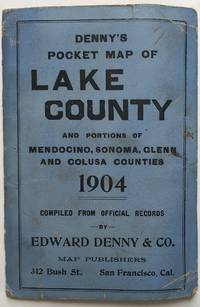
1904725San Francisco: Edward Denny & Co 1904. Very good. Folding map 26.5 x 17 inches. Original printed wrappers. Some wear and creasing to wrappers. Light dust soiling and scattered faint foxing. A rare pocket map of Lake County California published by Edward Denny in 1904. The map is printed in blue ink and is divided into townships with Guenoc and Gallayomi Ranchos identified near the foot of the map area and major roads through the county delineated. Clear Lake the county's namesake is prominently depicted at center and numerous springs are located and named in its vicinity. The present edition of this map is the first with revised editions published in 1907 and 1910. All are quite rare but the 1904 edition is particularly so with only one copy located by OCLC at the Bancroft Library. Edward Denny & Co unknown books
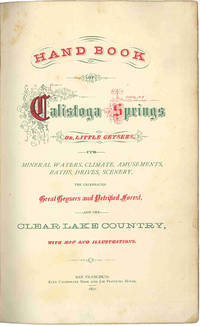
1871WRCAM45708San Francisco: Alta California Book and Job Printing House 1871. 304pp. plus folding map and six of seven lithographic plates. Lacks the folding view of "Calistoga Springs in 1871." Titlepage printed in red and green. Original limp purple cloth stamped in gilt and blind white cloth backstrip. Cloth sunned rear cover repaired with tape at upper edge. Two small chips in titlepage else quite clean internally. Very good. A scarce illustrated pamphlet promoting the lovely Napa Valley community of Calistoga and its healing springs. "Justly called the Saratoga of the Pacific Calistoga has been a renowned resort for over a hundred years. This guide proudly describes the numerous advantages and beauties of the northern section of the Napa Valley. Originally settled by Sam Brannan Calistoga provides the visitor with natural mud baths geysers mineral baths the grape cure and the famous 'air and sun' cure to this day" - Howell. The map shows routes to Calistoga Springs from various places throughout California. The attractive plates like the map lithographed by Britton & Rey show various views of Calistoga including the railroad depot Mount St. Helena vineyards the swimming baths and Wapoo Indians. <br> <br> We can locate only two copies of this attractive work offered for sale in the past thirty-five years one copy at auction in 1991 and the copy offered by Warren Howell in his Catalogue 50. Two copies were offered by the Holmes Book Company as part of the Norris Collection in 1948 one with the folding view of "Calistoga Springs in 1871" priced $5 and one without priced $3. The present copy lacks the folding view. A scarce promotional with early and attractive views of this Napa Valley landmark. ROCQ 5876. COWAN p.102. HOWELL 50:345. NORRIS CATALOGUE 501 3666. Alta California Book and Job Printing House hardcover books
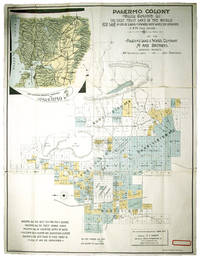
1890WRCAM40516San Francisco: H.S. Crocker & Co. 1890. Chromolithographic map 26 3/4 x 20 3/4 inches. Old folds. Worn along the edges. Long clean split along one fold but with no loss. A few other shorter closed tears along the edges with no loss. A few early pencil notes. Good. An attractive and rare map promoting lands in and around Palermo in Butte County California. Located about sixty miles north of Sacramento Palermo is touted as having "the best soil for fruit culture.the finest orange groves.an unlimited supply of water.a healthy and salubrious climate" all of which make it "the best place to make money in." The map is oriented with north to the left and a colored inset map shows the relative position of Palermo in northern California. The scale is four inches to the mile. The lots are numbered with size noted in acres on many of them and the owners often named. The routes of streets railroads creeks and rivers are also shown. About two-thirds of the lots are colored blue or gold indicating that they have been sold and those colored blue are designated as being planted in fruit trees. McAfee Brothers agent for the Palermo Land & Water Company was headquartered at 108 Montgomery Street in San Francisco. OCLC locates only a single copy of this map at the Bancroft Library at the University of California. Rare. OCLC 26431384. H.S. Crocker & Co. unknown books
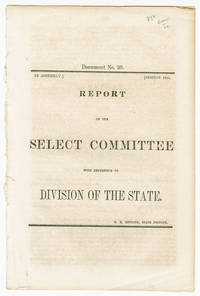
1855WRCAM28879Sacramento: B.B. Redding 1855. 8pp. Dbd. Light tanning. Very good. An intriguing document submitting a proposal entitled "An Act to Create Three States Out of the Territory of California." The states are to be named California Colorado and Shasta. The state of California is to occupy the territory between the forty-second and thirty-fifth parallels; Colorado is to exist roughly between the mouth of the Pajaro River and the Sierra Nevadas extending south to Mexico; Shasta is to be comprised of the remaining territory. The purpose of the proposed division was twofold: it would be far easier to collect revenue from California's booming population if the territory had three separate administrative governments; and secondly California's tremendous coastline was represented in Congress by only two senators in contrast to the ten senators representing the eastern coastal states. The authors do raise the serious issue of whether or not slavery will be permitted in the new states. It is their contention that only the middle state would profit from the institution its economy most likely based entirely on agriculture and they reject the argument that the issue is critical to the balance between North and South. They maintain that balance is destroyed already and that the fabric of the Union is held together only by the failing patriotism of its citizens. Not in Greenwood. Quite scarce with OCLC locating only six copies. OCLC 11847469 21618433. B.B. Redding unknown books
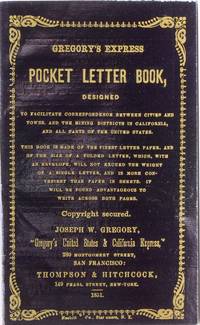
1851320912San Francisco: Joseph W. Gregory 1851. 20 blank leaves. 24mo. Original dark purple wrappers printed in gilt. Minor ink stains on inner wrappers otherwise a near fine copy with the original unused plain paper envelope. 20 blank leaves. 24mo. A lovely example of an unused Gold Rush letter book intended to advertise Joseph Gregory's California and New York Express Line by means of a convenient way for gold seekers in California to communicate with friends and family back home. According to the wrapper "this book is made of the finest letter paper and of the size of a folded letter which with an envelope will not exceed the weight of a single letter and is more convenient than paper in sheets." Gregory also published a pamphlet GREGORY'S GUIDE FOR CALIFORNIA TRAVELLERS; VIA THE ISTHMUS OF PANAMA 1850. This is a scarce California Gold Rush ephemeron. Joseph W. Gregory unknown books
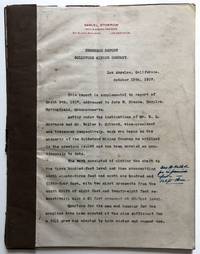
19171262Los Angeles 1917. About very good. 12pp. plus eleven silver gelatin photographs. Folio. Typescript with brown card spine and rear cover. Spine perished leaves loose. Manuscript notations light soiling. Typescript report by mining engineer Samuel Storrow supplemented with eleven original photographs. Storrow 1865-1939 was the manager of the Goldstone Mining Company of Delaware and he reports here on work conducted about thirty-five miles north of Barstow California describing the sinking of a mining shaft and other related operations as well as the quality of ore discovered. He also comments on some of the difficulties with the operation: "The unusual labor conditions brought about by shortage of labor and by serious labor disturbances in the nearby Arizona mines and then an additional shortage of labor due to war conditions rendered the work more expensive than had been anticipated; and the same causes have made it difficult at times to obtain the necessary materials promptly but on the whole the work has been prosecuted steadily and within the estimates previously prepared." Additionally there is mention of the assessment and exploration of the "Big Drum group the Lucky Find group and the Golden State group" which also operated in the area. The report concludes with Storrow's recommendation to continue with the mining program developed by the company and with a detailed financial report. The photographs all have typed captions and depict the area around the mine as well as its machinery and buildings.<br/><br/>Gold was reportedly discovered at Goldstone as early as the 1880s. With the discovery in 1915 of an especially productive claim at Redfield prospectors began to flood into the area. By February 1917 a boomtown had emerged and the Goldstone Mining Company had established a mill. Rather unexpectedly and inexplicably however prospecting declined precipitously in 1917 and by August 1918 the post office established for the town closed its doors. Today Goldstone is regarded as the last in a series of boomtown gold rushes that began around 1906 with the discoveries in Goldfield Nevada. unknown books
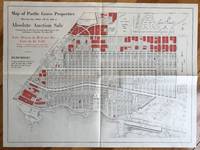
1919832San Francisco 1919. Very good. Folded map 21 x 28 inches. Promotional text printed on verso. Minor wear. Map highlighting lots in the city Pacific Grove on the Monterey peninsula owned by the Del Monte Properties Co. and to be sold by auctioneers Barry & Austin with no reserve. The text printed on panels on the verso highlights this as a brilliant investment opportunity particularly targeting the concept of the vacation rental: "The country today is on the eve of tremendous prosperity and every city large or small will naturally feel the effect. Keep in mind that real estate is the safest and soundest investment you can possibly make. . Buy a lot in Pacific Grove at this sacrifice sale build a small bungalow live in it when you want to and rent the bungalow the rest of the year at a rental which will give you the use of the house free." Interestingly the text notes that Liberty Bonds will be accepted at par value as forms of payment. The map shows lots for auction in red with a tidy block fronting Monterey Bay. An attractive map depicting the post-war real estate boom in California leading into the Roaring 20s. We locate four copies in OCLC -- at Yale California Historical UC Berkeley and UC Santa Cruz. unknown books
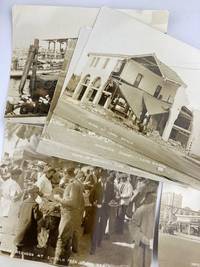
19331962Long Beach Ca 1933. Very good plus. Forty silver gelatin photographs. Twenty-six mounted on leaves with typed captions the remainder loose but captioned in negative. Images 3.5 x 5.75 inches and 3.5 x 4.5 inches. Images crisp and clean mounting leaves a bit rumpled with light wear. Small collection of images documenting the Long Beach Earthquake of May 10 1933. The images mounted to sheets are numbered and captioned in typescript with the heading "Earthquake Damage - Long Beach and Vicinity. March 14 1933". They provide a visual survey of the damage to major sites around Los Angeles and Compton such as the Masonic Temple the Dominguez Sub-station the Security First National Bank in Compton buildings along East Compton Boulevard and several of the local schools. The loose photos all show damage in Long Beach itself including the Seaside Hospital the Catholic Church the Imperial Theatre schools and an image captioned "Feeding refugees at Lincoln Park - Long Beach Cal."<br/><br/>The Long Beach Earthquake occurred just before 6 o'clock in the morning and was a magnitude 6.4 killing more than 100 people. The epicenter was offshore south of Los Angeles with much of the damage limited to Long Beach but also spreading north into southern L.A. It is notable that many of the images here document school buildings as more than 200 schools were damaged in the event. This highlighted a need for earthquake-proof construction in school buildings where the death toll would have been much higher had the earthquake struck during school hours and the legislature passed the Field Act on April 10th as a result. An altogether interesting set of images. unknown books
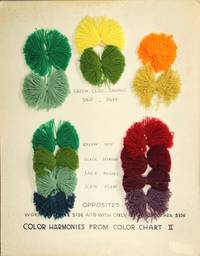
195047835Los Angeles: Helen of California 1950. 4to 42 leaves mostly printed on rectos only on various color paper each with a fashion design by "Helen" and each with accompanying text; full-page "fabric story" incorporporating a printed tree on which are applied various cool woolen samples in the shape of hearts and a bow-tie 1 thumnail-size sample missing; one mounted illustration within a hand-applied frame and another cut-out possibly not original mimicking one of the designs; comb-bound in original green suede textured wrappers printed in red and accompanied by 3 sample cards of "color harmonies" with 12 14 and 18 mounted color samples of woolen yarn; all in all very good. Wonderful fashion catalogue filled with designs by "Helen of California" and based on the 14th century designs of Marco Polo. The designer details how her Fall 1950 Marco Polo fashions emphasize the Basic Dress Plus with her designs accentuating a slim straight silhouette while highlighting ajn Oriental line inthe shoulder a mandarin collar pagoda peplum Hindu sari and other elements borrowed from descriptions of costume made by Marco Polo. These include fashions in wool such as the Aladdin a worsted wool spiked with silk jacquard taffeta dress; the Siamese Dancer dress of worsted wool crepe with long and pointed sleeves a stiletto slim skirt and turned-back shoulder flanges; the Saracen a long side-swept silhouette one-piece with a velvet hat and many others. Gudgell worked as a fashion and costume designer in L.A. in the 1930s moved to Minneapolis during World War II and then returned to the L.A. area. Her "Helen of California" label was popular until the endof the 1950s. The color wool yarn sample cards and harmony chart offer an excellent example of the color palate balance intended. <br/><br/> Helen of California unknown books
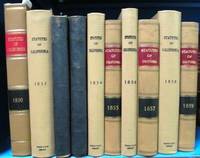
1859298771859. The bindings are generally tight with some inner hinges reinforced. Binding styles and paginations vary: some legal buckram others sheep; some with morocco spine labels others issued without spine labels. Several volumes include folding tables. The majority have the usual institutional marks which are rarely obtrusive. Occasional text spotting and light wear but generally clean and Very Good.<br/><br/> The stated printing locations are San Jose and San Francisco for the first two Sessions but these were actually printed in New York. The third and fourth Sessions were printed in San Francisco the others in Sacramento. <br/> These volumes present the earliest legal history of the State of California. The First Session includes not only the Statutes enacted but the Treaty of Peace with Mexico and documents supplementary thereto the 1849 California Constitution the U.S. Constitution with amendments and other foundation enactments. Joint Resolutions Index Table of Contents for each Session are printed along with the Laws. The 1852 and 1853 volumes are evidently rare. The Statutes deal with all the significant events of that interesting ten-year period: the settlement of the State the development of infrastructure and unfolding of commercial life the multiple social and political institutions the Gold Rush immigration the political strife that engulfed the Nation and all other aspects of early Statehood. <br/>FIRST EDITIONS. Greenwood 167 note. Cowan California 610. Wagner California Imprints 147 149 150. unknown books
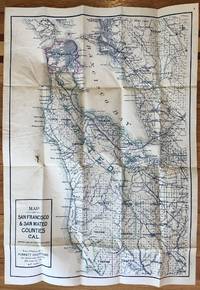
19081268San Francisco: Punnett Brothers 1908. About very good. Folding map 28.5 x 20.25 inches. Three short separations along folds; one small area of loss not in map area. Faint foxing at left edge; light tanning. A rare 1908 map of San Francisco San Mateo and the surrounding Bay Area by late 19th- and early 20th-century California cartographers Punnett Brothers. The upper portion of the map depicts the Bay with San Francisco and San Mateo County outlined in pink and pale green respectively. The lower half of the map consists of the southern half of San Mateo County and the area below the bay much of which makes up today's Silicon Valley. Most of this section of the map as well as the areas east of Berkeley Oakland and San Lorenzo are platted. The map is also marked with significant geographical features as well as roads and railways and shows the locations of the many ranchos still extant in the region during this period. An interesting and attractive land map for the Bay Area and the surrounding region during the early 1900s. We locate only one copy at Berkeley. Punnett Brothers unknown books
1852WRCAM50098San Jose & San Francisco 1852. 558; 314pp. with three-page errata bound into the first volume. Modern buckram gilt leather labels. Minor shelf wear and soiling slight chipping to labels. Faint ink library stamps and embossed blindstamps on titlepages a few signatures tanned in first volume occasional contemporary ink marginalia in second volume minor foxing. Very good. Two of the earliest imprints in the state of California and two of the first three publications of laws printed in the state constituting the laws for the second and third sessions of the California legislature. The first STATUTES of 1850 was actually printed in New York and the 1851 STATUTES is one of two printings in that year with an edition also printed in San Francisco. The laws instituted here are commensurate with those of a fledgling state with additional provisions covering mining as California was in the grips of the Gold Rush at this time. "The second STATUTES is as rare as the first which was published in San Jose actually New York 1850" - Decker. Rare with only two and three copies in OCLC respectively. DECKER 50:62. CLIFFORD 12a 12b. MIDLAND NOTES 59:98. OCLC 77805265 65114630 166509049. hardcover books
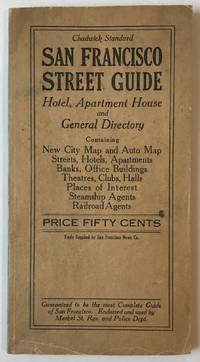
1923805San Francisco: J.P. Chadwick 1923. Very good. 128pp. plus folding map 14 x 16.5 inches. Narrow octavo. Original printed wrappers stapled. Minor wear and soiling. Slight chipping to first and last few leaves text lightly tanned. Directory and street guide for San Francisco designed to help navigate the city's streetcar lines. "Containing all streets hotels apartments buildings banks churches consulates railroad and steamship agents; city and auto road maps. Clubs theatres hospitals places of interest pier directory." The information is all keyed to the various streetcar lines indicating which lines are most convenient to which hotels etc. With information on all the major sights and municipal attractions as well as hotels banks theatres etc. A listing of the routes of each streetcar line occupies the final two pages. The map shows the city and county of San Francisco with the streetcar lines demarcated in red. A rare survival -- we find one copy of this edition in OCLC at the Milwaukee County Library with one or two copies of other editions located at UC Berkeley the New York Public Library California Historical and the Marin County Library. J.P. Chadwick unknown books
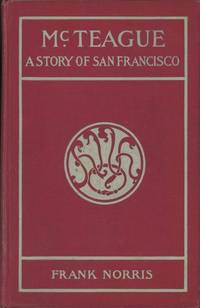
189954675New York.: Doubleday & McClure. First Edition. 1899. 442 pages 4 unnumbered pages 8 x 5 1/4 inches red cloth-covered boards with silver embossed decorative front cover and spine. Light fading to spine and extremities hinges a little loose and slightest tilt to spine previous owner's name in pencil on front free endpaper. First edition. . Doubleday & McClure. hardcover books