227 résultats
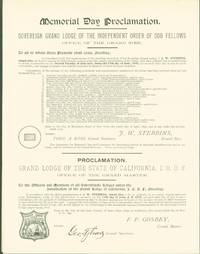
1900290194Independent Order of Odd Fellows I.O.O.F. 1900. Poster. 4 sheets 8.5 x 11 inches printed in black on white. Insignia of Grand Lodge of the State of California on all 4 sheets. The Memeorial Day proclamations are to honor those lodge members in California who have died in the past year. The May 1900 sheet deals with rules governing 'Official Certificates' and 'Dispensations' in California. The October 8 1900 sheet deals with requests for contributions to assist with relief for victims of the flooding in the coast of Texas. First edition first printing. Near fine copies. 3 sheets have 2 holes punched at top edge.<br> Independent Order of Odd Fellows (I.O.O.F.) unknown
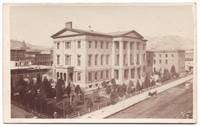
186670879San Francisco CA: Lawrence & Houseworth 1866. Photograph. Near Fine. Lawrence & Houseworth unknown
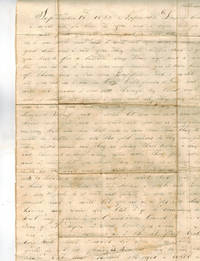
1855007164Sacramento California 1855. Manuscript. Very Good. No Binding. HOLOGRAPH LETTER SIGNED. Two manuscript letters in ink both on ruled paper with folding creases the 1855 letter 8" x 12 1/2" with single spaced writing both sides approx. 500 words. The 1856 letter 15" x 10" folded in half to make 4 pp. approx. 300 words with small blindstamp top left corner depicting an eagle. The earlier letter is headed "September 18th 1855 Naperville Dupage County Illinois" and ends "Michael direct your letters Nevada County Nevada post office California". George writes to his brother Michael in Naperville that he has "seen a good dele sins i rote you they last letter" including a hundred "inshins" and some "Buffellow". He adds that "we had good luck all they way of may we left Council Bluff" and that he is not home sick yet. He then talks of the gold mines river mining what they are paying and the cost of things such as board "from five to ten dollars a week" "Beaf" "wors 15 to 20 cents" and "potato" "4 cent per pound". He adds that he intends to have some gold before he comes home and that "girls are not so plenty here as they are in state". He closes by asking his brother to write him and to remain at home in Illinois to care for their parents. The 1856 letter headed Sacramento august 3th 1856 informs his brother that he is well and "down to Sacramento now" working on a farm feeding a "schrasing" thrashing machine and that "they times is verry hard in California now". He adds that he had some money "stole" while he was in the mountains but since coming down into the valley he was making money and will send some home soon. The letter ends with George wishing to see them all soon and that he is not home sick. The third page of the letter bears a drawing of a wing or leaf eleven smaller versions of the same image interspersed on page 2. A fascinating testimonial on California during the gold rush written in a strong hand and in a wonderful vernacular style by a good observer. unknown
186074708Downieville CA: N.p 1860. Original 4-page letter from H. I. Thornton Jr. to his mother and dated August 3rd of 1860. Contemporary lined blue paper with each page measuring 7 3/4 x 9 7/8 inches. Written in a very legible hand. Expected fold-lines and one short marginal tear else and excellent letter filled with California politics before the Civil War.Harry I. Thornton Jr. was born and raised in Alabama in a highly distinguished family; his father was Alabama Supreme Court Judge and his uncle John J. Crittenden of Kentucky was a United States Senator for four terms. Harry Jr. came to California in 1854 and immediately took up his law practice in Nevada City. Soon thereafter he moved to Downieville in Sierra County. He was enormously popular and in 1857 was elected District Attorney. As his popularity grew he was soon induced into running for State Senator. He did and won. This letter is to his mother telling of his political wishes and hesitations. He tells her that the incumbent Kirkpatrick has endorsed him and that he thinks winning the elections is an actual possibility. He writes - "All considered I am wavering. I will leave the matter open until the / comes in from Washoe which will be next week. it is more likely I will be lured off by the trumpet call of this war into the Constitutional Rights of the States and the People of the States against the dangerous sectional doctrines of Douglass-ism and Republicanism." He also writes much about the Platform of John Breckinridge for President. In a lighter vein he writes - "A burglar entered my room and stole my watch and $.50 from my pocket. I awoke and flushed the felon and gave chase had no forearm or could have shot him and have finally lost my pet my old companion." Thornton did win the election.When the Civil War broke out Thornton gave a famous speech on the Senate floor in Sacramento defending the South. Along with many other Democrats in office at that time he quit his position after his speech and left for the South to join the Confederacy. He was promoted rapidly eventually making the rank of Colonel. After the war he removed to Nevada and teamed up with John Garber to form the most powerful law firm in the state. N.p unknown
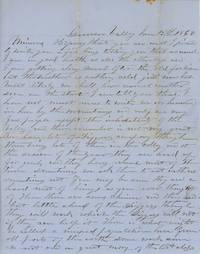
1860List3317Likely Plumas County California 1860. Single four-page letter measuring 7 ½ x 9 ½ inches. Folded with some small tears at folds; excellent. A letter from “Charly†to his wife or fiance written in January of 1860 from “Ganser possibly sic Valley†likely in Plumas County California. Located in the Sierra Nevada Plumas County contained a number of mining towns following the California gold rush; however Charly does not specify his line of work or discuss any particulars. Instead—besides inquiring after the health of family and friends and considering when he would return home—Charly discusses the other residents of the valley. He writes:<br /> <br /> “I can tell you that I have not much news to write we are hemmed in here by the mountains and only see very few people except the inhabitants of the valley and their number is not very great we have lots of Digger company though there being lots of them in the valley and at this season of the year they are hard up for grub and they hang round most of the time sometimes we ask them to eat with us sometimes not You may be sure they are a hard nest of beings as you ever thought of them there are sorry Chinese and they are but little ahead of the Diggers though they will work which the Diggers will not if they can help it There is what might be called a mixed population here from all parts of the earth some work some do not and there are a great many of the last classâ€.<br /> <br /> “Digger†is a derogatory term applied to several Indigenous peoples in the region referring to their diet of root vegetables. In this part of California they would likely have been Northern Paiute or Mono people. Following the US’s acquisition of California and especially after the discovery of gold these groups were decimated by murder enslavement and disease; an 1896 article notes that the Plumas area had proportionally more survivors of American depredations.1<br /> <br /> Of interest to historians of the late gold rush especially relations between Anglo-Americans and other races.<br /> <br /> 1 Mabel L. Miller “The So-Called California ‘Diggers’†Popular Science Monthly 50 December 1896 201–214. unknown
186932728Virginia City California 1869. Paper. Very good. Approx. 8" x 3" check with printed green borders information and 2 stamps. Check is drawn on the account and signed by Isaac L. Requa. The information printed on the check is "Gould & Curry Silver Mining Company W. C. Ralston Treasurer. Agency of the Bank of California Virginia City. The written date is Aug 3 1869. <br /> <br /> Requa was a mining engineer early Oakland pioneer and later President of Oakland Bank and Savings. unknown
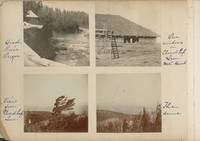
1890List2871Oregon Washington and California 1890. One forty-two page photo album with 9 ½ x 7 inch pages; 109 total photographs with eighteen 4 x 7 inch and larger and ninety-one 3 ½ x 3 ½ inch. Larger photographs captioned on negative and likely purchased while smaller ones are original. Album pages with chipping at corners and some repair with tape; photographs with some wear and very good to excellent contrast; overall very good to excellent. A photo album from two trips taken by an unknown tourist one around the Pacific Northwest and the other in central and southern California with written captions describing location and subject matter. The California trip starts in San Francisco and includes shots of Monterey “Mexicans at Los Angeles†and many of the Santa Barbara Mission and San Diego. <br /> <br /> The Pacific Northwest photos show scenery around Mts. Hood and Rainier including from the recently-built Cloud Cap Hotel; the Columbia River Paradise Valley American Lake and others. There are also shots of the Hotel Groe built in 1893 and Kernahan home in Pierce County Washington – James Kernahan was one of the earliest Euro-Americans to homestead in the region arriving in the area in the late 1880s. The Kernahan family is mentioned in an account told by John Muir’s photographer of summiting Mt. Rainier with John Muir in 1888.1 Further towards Rainier there are shots of the Longmire buildings built in about 1884.<br /> <br /> Four interesting shots from Puyallup also in Pierce County are worth mentioning. Two show hops fields one a line of tents identified as belonging to the “Indians†and one of an “Old Indian woman†standing barefoot on train tracks. Before 1892 growing hops drove the economy of Pullyup; Indigenous people would travel from the US and Canada to Pullyup to work the harvest.2 These photographs likely postdate the hops crash.<br /> <br /> Of interest to historians of the Pacific Northwest and California and especially of Pierce County Washington.<br /> <br /> 1 “John Muir’s Ascent of Mt. Rainier As Recorded by his Photographer A. C. Warner†The Mountaineer 50 no. 1 1956: 38–45.<br /> 2 Hans Zeiger “Indigenous Hop Pickers in Western Washington†HistoryLink October 3 2021 https://www.historylink.org/file/21295. unknown
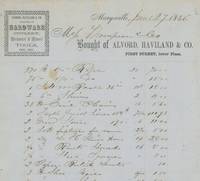
1860List2417Marysville 1860. Marysville 1850s-1860s the bulk mid-1850s. A collection of documents including eleven receipts three manuscript legal documents four manuscript documents relating to land claims; five partially printed documents relating to land claims; two letters from the US Land Office in Marysville 1858 regarding land claims; six billheads from Marysville firms with receipts for a range of goods some illustrated; one letter from Marysville written in 1853 concerning a death in a family. Generally fine condition. Fine. A mini-archive or assemblage of documents relating to the early Euro-American citizens of Marysville and its environs in the 1850s. The population of Marysville grew quickly after the town’s incorporation to 10000 by the mid-1850s due to its strategic location close to the gold fields but the levee system put in place to control flood damage limited the town’s growth beyond this initial phase. The documents here relate to Marysville in this early period of growth and include several quitclaim land deeds as well as illustrated billheads. As a group they offer an ephemeral record of the city in its early period with the legal documents and deeds showing the means with which the area was settled. A well preserved group overall. unknown
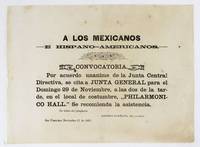
18635596San Francisco: La Voz de Mexico 1863. Very good. Broadside 7.75 x 10.75 inches. Central vertical fold minor creasing light tanning and scattered foxing. A very rare broadside calling a combined meeting of the juntas patrióticas of San Francisco community organizations of Californios and Mexican expatriates convened to support Benito Juarez against the French in the war with Napoleon III. The text announces a meeting at San Francisco’s Philharmonic Hall on Sunday November 29 1863 at 2p.m. Juntas patrióticas like this grew out of a tradition of Latino volunteer organizations in California originally started in 1825 to organize celebrations for Mexican independence. Established in many towns over the following years they continued to promote Mexican culture and traditions after California was annexed by the United States. This largely apolitical role changed however in the face of the twin threats of the Civil War and the French Intervention in Mexico:<br /> <br /> "Despite a time lag of four to eight weeks the newspapers carried stories about the French incursion into Mexico. California's Latinos learned about the landing of the Triple Alliance in Veracruz to collect debts contracted by previous administrations the agreement of Soledad in which President Benito Juarez pled national bankruptcy and asked for an extension the withdrawal of the English and Spanish forces on the strength of Juarez's promises and the menacing French presence continuing after the Spaniards and English had departed. In May 1862 events took a serious turn when the French broke off diplomatic relations with Mexico complaining of 'outrages of which the victims have been French subjects' living in Mexico.<br /> <br /> "But then on May 5 1862 there was a sudden flash of hope -- the outnumbered ragtag Mexican army repelled the seemingly inexorable French advance at Puebla sending the French troops victors of Crimea Sebastopol and the Italian campaign reeling back to Orizaba to lick their wounds. When the news reached California the Spanish-language headlines were enthusiastic: 'Hurrah for Mexico!! Hurrah for independence!!.' For California's Latinos U.S. citizens and immigrants alike this news was a bracing tonic. Suddenly they were part of a force to be reckoned with. Their peers at Puebla had taken a daring stance and had emerged victorious against the odds. Spontaneously Latino residents of the gold country town of Columbia in Tuolumne County celebrated 'our triumph against the French' by firing artillery salutes singing patriotic songs and toasting Mexico's success. Dozens of cities responded and dozens of juntas were formed in the next few months to raise funds to help repel the French invaders from Mexico" – Hayes-Bautista.<br /> <br /> Funneled through a Junta Central Directiva headquartered in San Francisco juntas across California and Nevada raised funds which were sent across the border to the Republican government usually in excess of $1000 every two weeks. This flyer was printed by one such junta known as the Sociedad Patriótica Mexicana and informs its members that the Junta Central Directiva has called a general meeting of all the local juntas on November 29 1863. This was a particularly dark time for the Mexican government in exile – the French had occupied Mexico City in June officially proclaimed the Second Mexican Empire in July and Maximilian was offered the throne at the start of October. This document was most likely printed by La Voz de Méjico a tri-weekly Spanish-language paper centered in San Francisco which became the unofficial organ of the regional juntas. A pencil note on the verso of this copy reads "Mass meeting called to contradict the lies of paper's enemies and newspaper reports this is what I referred to in my 2 notation." A rare piece of ephemera evidencing the active social and political role played by Mexican-American community organizations in the late-19th century. We locate only two recorded copies held by the Bancroft Library and UC Santa Barbara.<br /> David E. Hayes-Bautista et al. "Empowerment Expansion and Engagement: Las Juntas Patrióticas in California 1848-1869" in California History Vol. 85 No. 1 2007 pp.4-23. [La Voz de Mexico?] unknown
189356869Salem OR: Buren & Hamilton 1893-1904. 4to. 90 mylar sleeve leaves unnumbered. containing 403 invoices shipping & waybills TLS ALS TL copy letters and more many of which appear on steel-engraved letterhead many printed on colour-tinted paper often shipping and weight bills still retaining original stamps a few mailing envelopes a number of check receipts many w/ manuscript and stamped autographs others w/ corrections and/or annotations in ink or pencil; also included are actual samples of velvet fabrics wallpapers and textured colour sample papers printing sample for perforated business card. All preserved in recent 3-ring cloth binder stamping on front cover. An exceptional archive of original letters invoices waybills business cards and receipts all documenting the thriving business of Buren & Hamilton at the end of the Gilded Age and beginning of the Progressive Era in Salem Oregon in the aftermath of the 1893 economic crash. Drawing from suppliers in California just a few years before the San Francisco Earthquake & Fire the company also sourced from Seattle WA New York and Chicago. Portland was the manufacturing and industrial hub of Oregon as can be seen in these invoices and receipts: such companies as The Columbia Chair Company Dealers who sold chairs office chairs and rockers from 309-311 Front St. shipped rocking chairs and office chairs to Salem in 1903; Henry Jenning & Sons located at 172-174 First St. shipped a load of leather oak chairs in 1903; J.G. Mack & Co. located at 86 & 88 Third St. in Portland supplied velvet rugs oil cloths and lamp shades in 1903; while the A. Merle Co. and McCord & Work located on Water St. supplied brass and iron bed frames the same year. Buren & Hamilton also sourced mattresses and sacks of recycled denim cotton “Shoddy†from Peters & Roberts Furniture Co. for mattresses; and purchased often from the Portland Mattress & Upholstery Co. at 18-20 Front St. which supplied wool-combed coverings mattresses mattress tops from 1900-1904 -- their factory would be gutted by fire in 1907. Many of the items were shipped down the Willamette River on the Oregon City Transportation Co. ships with a note from 1904 indicating the company had completed a sale of odd sized mattresses to them; numerous Southern Pacific Oregon Division freight bills; as well as a shipment on the SS Oregonian via the American-Hawaiian Steamship Co. of five crates of chair seats from Marshall Field & Co.In addition it appears that Oregonians in and around Salem purchased heavily from the store luxury goods such as beveled mirrors framed artwork sleek wallpapers velvet fabrics tapestries oriental rugs and more. Many of the invoices letters waybills and documents record many items supplied by the storied W.P. Fuller & Co. of San Francisco & Sacramento CA as well as their subsidiary in Portland OR. They were main suppliers of beveled and mirrored glass on the Pacific Coast which often had to be imported from England into the U.S. and several of the orders in 1899-1901 note that the company was having issues supplying such pieces to Buren & Hamilton due to labor difficulties finally sourcing mirrors from Pilkington Bros. English Picture Glass. They occasionally canceled orders and the Fuller Co. writes in 1901 over a canceled order of “deadening felt.†The W.P. Fuller Co. explain that “your reasons for wishing to cancel your order are not considered sufficient to justify us in doing so . . . †and that they were aware that “some of our competitors are circulating unjust and untrue reports concerning us all the time.†Included amongst these letters are samples of cotton backing for carpets and even three original samples of wallpaper. There are also present a number of letters and invoices from the firm of Tozer & Son which took over the W.P. Fuller Wallpaper division about 1901 with letters present making that announcement. Of additional interest are the many invoices letters and waybills back and forth with the storied Schussler Bros. on 119-121 Geary St. Star King Building in San Francisco detailing many of the popular framed and matted photographs and images for Salem shoppers. These encompassed the “Lone Indian†which were often reproductions of the iconic End of the Trail sculpture by James Earle Fraser; Athletes Dutch Windmills Shakespeare prints of assorted types and sizes Lone Arab a Chinese print a boxing series of matted “Deal of a Fellow†Madonna Artotypes -- typically reproductions of Raphael’s Madonna and Taber art photos. Many of the letters bill heads and invoices sport steel engraved architectural vignettes documenting buildings which would be destroyed in the 1906 San Francisco Earthquake & Fire as well as many of the business records for those companies. One of the freight bills bears the photographic letterhead of the Chicago & North-Western Railway Co. dated 1904. Another significant supplier was the D.N. & E. Walter & Co. of San Francisco which supplied linoleum flooring fabrics and more for Buren & Hamilton from 1899-1904 and even includes in one of the letters a piece of the red velvet fabric they no longer carried.Buren & Hamilton was originally founded in the late 1880’s by A.T. Yeaton as a furniture/undertaker business later sold to A.B. Buren and finally sold to Max O. Buren and Clarence Hamilton who operated at three locations along Commercial St. including Greenbaum’s Building at 298 Commercial the building at 136 Commercial 340 Court St. now Sid’s Furniture. Clarence bought out Max Buren’s shares in 1916 becoming the C.S. Hamilton Furniture Co. and operating until it was sold to Rubenstein’s in the 1960’s. See: Norma Hamilton Cochran Historic Businesses -- Hamilton Furniture Salem History Matters March 17 2017; New Stationery Department of Schussler Brothers San Francisco The American Stationer Vol. LIV 1903 pp. 4-5; John Caldbick Panic of 1893 and its Aftermath HistoryLink Essay 20874 Oct. 1 2019. Buren & Hamilton, hardcover
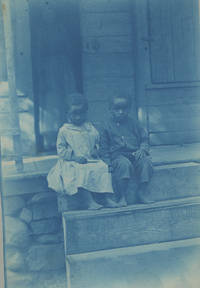
1880List1314Northern California 1880. 4to one album in burgundy cloth the other oblong brown pebbled cloth. Seventy-one sepia-toned and cyanotype photographs most measuring 6 ½ x 4 ½ inches. Near fine with some light wear to albums photographs very good or better with very good contrast some showing a hint of fading. A very early pair of vernacular photograph albums centering on the experiences of a wealthy family in San Francisco Monterey and the surrounding areas in the late 1880s. The bulk of the images show the family and their unidentified circle in domestic scenes with the vernacular architecture and landscapes of the Bay Area on full display. Other images show landmarks including Golden Gate Park the Francis Scott Key monument various views of the first Hotel del Monte in Monterey which would burn in 1887 dating the photographs to the period prior to the fire. The album also includes photographs of African American families. <br /> <br /> The image quality is generally quite strong and the photographer was either a professional assembling the album which includes many portraits of family and presumed friends for themselves or the work of a highly skilled amateur. The Initials on the front pastedown are “M.J.R.†though this could be a later owner. The albums were from the estate of the muralist Clara Fargo Thomas who was a resident of New York and could possibly have been from one of her family members though we are unable to glean much detail from the contents. The few annotations offer little clues one just reading “5/11/89 - Golden Gate Park†and another identifying a house as 509 Webster St. in San Francisco though the typical Victorian architecture and sloped street of the house suggest it could have just been a photograph of San Francisco’s unique architecture. <br /> <br /> The photographs of the people give insight into the lives of the new wealthy class of San Francisco residents of the late 19th century with others interestingly showing rural scenes and people. The photographer also had an eye for the flora of the region which is displayed throughout. It is unclear what the relationship of the African-American subjects was to the photographer and why they appear in the album. Overall a compelling group of images and the earliest example of vernacular photograph albums of California images we can find in the trade. unknown
186027304San Francisco: Towne & Bacon Book and Job Printers 1860. First edition. Woodcut illustrations. Pp. 133. 1 vols. 12mo. Disbound some light marginal soiling else a very good copy with the signature of M. Standish of Boston on the endpaper. First edition. Woodcut illustrations. Pp. 133. 1 vols. 12mo. Towne & Bacon, Book and Job Printers unknown
189357405New York: International League of Press Clubs 1893. 4to. 9 x 11.5 in. 149 1 pp. Photo frontisp. with sepia-tinted illustration of locomotive numerous text illustrations historiated initials decorated initials woodcut-engravings & tail-pieces. Brick-red publisher’s simulated morocco over beveled boards gilt lettering & border decoration in blind dyed fore-edges to textblock minor rubbing to corners light rubbing head & foot of spine still VG bright copy. First edition of this nicely illustrated souvenir travel account of the International League of Press Clubs traveling to the Press Club Convention organized to promote the West Coast and the forthcoming 1894 California Midwinter International Exposition. Michael Henry de Young 1849-1925 noted Jewish-American co-founder of the San Francisco Chronicle arranged for the Eastern Press Clubs and Midwestern Clubs to travel in the lavishly appointed Wagner train with stops in Denver side trip to Salt Lake City UT the Citrus Fair in Auburn CA and Sacramento lunched with the Sutros stayed at the palatial Hotel Del Monte in Monterey visited the Lick Observatory & Los Angeles. The memorable dinner banquet included courses of California Oysters Kennebec Salmon in Holland Sauce Broiled Mushrooms Filet of Beef Richelieu and the Canvas-Back Duck with Celery Sauce. Return stops included viewing the Mojave Indians the Apache in Needles the pueblos in New Mexico and a stop later at Niagara Falls. International League of Press Clubs, hardcover
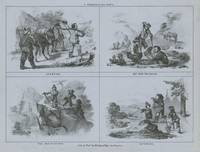
1850List1315Britton and Rey 1850. Single sheet measuring 8 ¼ x 10 ¾ inches on blue wove paper. Small chip to corner not affecting image some older tape repairs verso at margins else fine very good plus overall and quite attractive. Very Good. A series of four illustrations telling the story of a mining party that heads out with a pack mule only to fail to find gold and lose their mule before returning to a new prospect with their clothes in shambles. This is entry 209 in Baird’s California’s Pictorial Letter Sheets in which he sets the publication date as being prior to 1855. The series possibly illustrates scenes from a song. A particularly fine example on the classic blue wove paper of the period. unknown
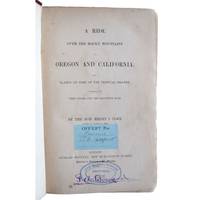
18521866London: Richard Bentley 1852. First edition. Good. 23 cm. x 388 2 2 blank 16 ads. Original burgundy marbled cloth frontispiece portrait of the author. Edgeworn with slight chipping to spine foot and joints; evidence of adhesive removal presumably library labels to spine; front joint cracked with corresponding gutter break following title leaf; one leaf detached but present; spine cocked; occasional minor foxing. Ex-library with moderate markings and bookplate signature and label of donor to title page. With the bookplate of the first French library in San Francisco. Richard Bentley hardcover
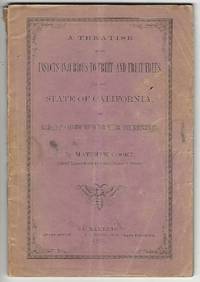
188120560Sacramento: State Office 1881. 72 pp illustrated with small wood engravings in original lavender printed wrappers. Some chipping to spine old tears and tape repairs to back wrapper else very good. Matthew Cooke was in the business of manufacturing fruit boxes in the 1870s when California's apple crop was devastated by Codlin moths. He began studying entomology to find defense against the moths and ensure the security of his business and quickly became an expert on a range of pests affecting California's fruit crops. He was appointed Chief Executive Horticultural Officer of California in 1881. This report prepared at the request of the State Board of Horticultural Commissioners describes the life cycles of the major insects damaging fruit crops moths scale insects mites caterpillars borers aphids etc. and recommends remedies for dealing with each. It also includes the text of new legislation intended to protect and promote the horticultural interests of the State of California. State Office unknown
188810048Sacramento Cal: State Office: J.D. Young Supt. State Printing 1888. Slim octavo 23 x 15 cm 96 pages. Illustrated with a chromolithograph frontispiece and wood engravings throughout. Several errata have been overprinted in purple ink rubber stamp. FIRST EDITION. Byron Martin Lelong 1856-1901 was the Secretary of California's State Board of Horticulture and amongst a generation of farmer-scholars working and publishing in California in the 1880s and 90s. Others included Thomas Garey and William Andrew Spaulding and in a different way Santa Rosa's Luther Burbank the great seedsman. Lelong's published work focused on citrus as well as prunes figs and walnuts. This treatise is mostly a technical manual on the best varieties of oranges and other citrus to plant in California as well as a guide for how to care for them. It also includes recipes for lemon pie orange souffle and citron cake. Illustrations show the physical differences in each variety of citrus including one of the cross section of a "Pumpel-mouse". Boards lightly scuffed with soiling to margins and fading to spine. Corners bumped and gently rubbed with boards bowing out at fore-edge. Rippling to endsheets with page margins lightly toned. Title page offset by frontis. Text has overprinted errata in blue to correct spellings to a few pages. In publisher's dark blue pebble-grained cloth lettered in gilt. Overall very good or better. Presentation slip tipped in at first free endsheet presented by Ellwood Cooper the then-president of California's Board of Horticulture. Zamorano Select 65. State Office: J.D. Young, Supt. State Printing hardcover
1896225006Bosotn Raymond & Whitcomb 1896. 1896. Small oblong 8vo 5 1/2" x 4 1/4". 10 full page illustrations of hotels etc. 69 pages covers. A tight fresh copy. No signatures or bookplates. Printed by American Printing and Engraving Boston. Includes information on Mt. Lowe Pasadena Santa Barbara etc. Soft cover. Bosotn, Raymond & Whitcomb, 1896. paperback
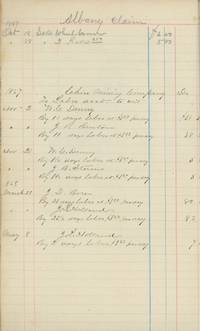
1868List2828Eureka South CA 1868. 7 ½ x 12 inch ledger book 33pp with many more blank. Front cover near detached and back cover detached missing spine some staining of inside pages. Many inside pages torn out. Overall good to very good. An accounting ledger with some annual meeting notes of the American Exchequer Gold Mining Company based in Eureka South California dating between 1866 and 1868. Eureka South was a small remote mining community with a population of about 400 people during the peak of its diggings’ productivity – now called Graniteville it had a population of twelve as of 2022. <br /> <br /> According to a copy of the company’s notice of location for its mine in Eureka South recorded in this ledger in November 1866 the company was founded on August 24th of that year following the discovery of a quartz ledge. A history of Nevada County describes 1866 as the year of the “revival of the quartz excitement of 1851†in Eureka South.1 Before this as the surface diggings began to dry up people had begun to abandon the town; with the quartz excitement the population swelled from twenty to 400 in a few months.<br /> <br /> However it does not seem as if the “American Exchequer Ledge†as they named the quartz vein in the location notice proved very productive. The minutes of the company’s 1866 annual meeting state:<br /> <br /> “matters of interest to the company were discussed ‘twas thought best to do but little more this winter than run the tunnel in some 50 to 100 feet further if we do not strike the ledge in the tunnel with this amount of labor added to it that we try and be prepared with money from assessments to put in a contemplated long tunnel down in the Hill in search of the Ledge.†November 27 1866<br /> <br /> Otherwise the ledger lists specific locations or other companies and associated expenses including “Albany claim†and the “Chico Mining Company†from whom American Exchequer bought the Chico mine; and wages and purchases such as hiring a horse for locating claims and “Whiskey for the boys†costing $4. Of interest to historians of mining and Northern California.<br /> <br /> 1 Harry Laurenz Wells History of Nevada County California Thompson & West: 1880 62–63. unknown
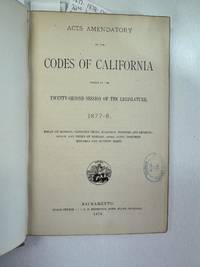
187840411Sacramento: State Office: F.P. Thompson 1878. ix 3 130 pp. Contemporary sheep several library marks else Very Good. State Office: F.P. Thompson unknown
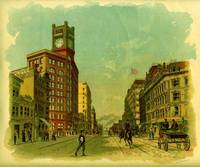
189417969San Francisco: H.J. Crocker Co 1894. First printing. Print. Very good condition. Chromolithograph of San Francisco and the Alameda County Building which boasted views of the 1894 California Midwinter Exposition which was held on 200 acres of what is now the Music Concourse of Golden Gate Park. The fair was the brain child of Michael de Young San Francisco Chronicle publisher who wanted a fair in his home city which would serve as an adjunct to the Chicago World's Fair. With descriptive text on the verso. 13 1/4 x 10 H.J. Crocker Co unknown
188747663Columbus OH: Ward Brothers 1887. 12mo. 20 tinted lithograph plates tipped-in on accordion style leaves including birds-eye views. Elaborately decorated red boards w/ decoration & lettering in gilt and black backed in black cloth very minor rubbing light toning to rear pastedown still a VG copy. First edition of this wonderfully illustrated pocket-sized viewbook which featured the technique of lithographic images made from photo negatives and then finished with varnish to add depth. This piece includes birds-eye views of Riverside San Benardino County Riverside Orange Groves and vineyards early views of Magnolia Avenue local residences including P.K. Klinefelter O.T. Johnston O.T. Dyer as well as the Rowell Hotel First National Bank of Riverside the Calico Mining District an Indian Village and more. Worldcat locates 2 copies at UC Berkeley & Yale; See: Gottfried Landscape in American Guides and View Books: Visual History of Touring pp. 28-30. Ward Brothers, hardcover
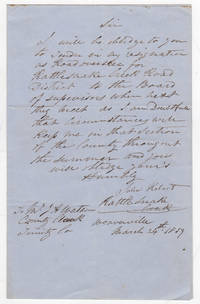
185944772Weaverville CA 1859. Very good minor creasing along edges and folds minor soiling contents clean. 1 pp. Bifolium. 5 x 8 inches. March 24th 1859. Gold Rush era letter from John Hobart to Trinity County Clerk J.A.Watson resigning from his post in Weaverville California . "I will be obliged to you to tender in my resignation as Road overseer for Rattlesnake Creek Road District to the Board of Supervisors when next they meet as I am doubtfull that circumstance will keep me in that section of the County throughout the summer." <br /> <br /> Weaverville California founded in 1850 was a Gold Rush town and once had a population of nearly 2500 Chinese goldminers. In 1855 the Weaverville Trinity Times called attention " the large and rapidly increasing number of Chinese among us.crowding themselves into every vacant spot they can find." unknown
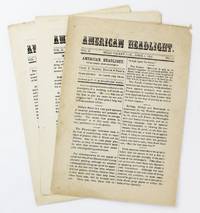
18876367Seiad Valley Ca 1887. About very good. Three issues 4pp. each. Light wear one issue splitting at center fold. A semi-monthly amateur periodical edited and issued by Charles T. Bailey. Present here are issues from Volume Two for 1887 numbers 17 21 and 23. The periodical seems to be full of the editor's witticisms and opinions and we note that very often the letter "E" is missing from a wide variety of words. As an exemplar "It has been discoverd that sea-watr may be made drinkabl by the addition to it of citric acid or citrate of silver." Of note is one opinion on the migration of the Chinese to the eastern half of the country which the author says makes the Californians quite pleased: "There is said to be a gradual xodus of the Chinese from San Francisco to easter cities where they will be right royally welcomd until their real natures become known. Then and not till then will our neighbors of the east become aware that the Asiatic is not such a desirabl companion as they would now hav us believ. Meanwhile the Californian is enjoying himself with the thought that by xperience shall they gain wisdom." We locate issues at four institutions -- the American Antiquarian Society the University of California at Davis the Newberry Library and the Huntington. unknown
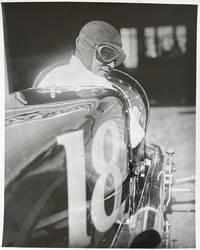
190062411Los Angeles Costa Mesa Huntington Beach Fullerton San Jose Hollywood CA: Gene Sherman Leigh Peffer Briggs Cunningham Briggs Cunningham Museum Ted Wilson et al ca. 1900-1990. Five Vols. & 1 scale model. First four vols. are 4to. 82; 76; 64; 88 leaves all unnumbered. archival mylar sleeves holding 266 photographs sized from 4 x 5 in. up to 8.5 x 11 in. with over 90% sized 8 x 10 in. most are black & white silver gelatin nearly all w/ photographer’s imprint either within the negative or stamped on verso many w/ pencil & ink manuscript annotations on versos most in the bold hand of Leigh Peffer but also many w/ markings by Gene Sherman and a couple possibly Briggs Cunningham several colour negatives many colour photographs some studio others snapshot a couple 1944 Kodacolor shops of young Peffer in US Army uniform during World War II together with over 100 pieces of ephemera including racing forms postcards art brochures promotional materials Midget Car racing rules Auto and racing promotional packets ALS & TLS many on letterhead and more. Three of these 4 vols. with archival mylar sleeves held in 3-ring binders in gray and black cloth 4th vol. a flexible plastic portfolio archival mylar sleeves printed label at spine; Together with: Peffer’s “A Scrap Book of Motor Sports History. . . Peffer Collection†a Oblong folio. 13.5 x 10.5 scrapbook/photo album. 80 pp unpaginated. on thick tan paper with 150 original photographs tipped-in with corners and mounted including 12 original colour negatives many identfied additional ephemera either mounted or laid-in two colour slides several clippings laid-in at rear and mimeographed sales list. Contemporary blue board post-binder nickel-plated screw posts at gutter margin printed metallic gold label mounted front cover neat manuscript hand of Peffer on label front cover occasional edgewear toning to clippings still VG exemplar; Scale model 12 x 4 x 2.5 in. of the So-Cal Streamline racer by Gene Sherman rubber tires leather fittings for cock-pit painted as the original preserved in chamois bag NF exemplar all from the libraries of Leigh Peffer and Gene Sherman. This noteworthy and expansive archive captures the glories of automobile sporting culture in California during the first several decades of the 20th-Century assembled through the effort and passion by several significant figures in the auto-racing and sports car scene of Southern California. These include Gene Sherman 1944-2007 famed auto designer and builder Leigh Peffer 1918-2000 auto racing enthusiast sports car racer and collector and photographer Briggs Cunningham 1907-2003 famed American sportsman whose Cunningham Motors fielded race teams and built race cars for the 24 Hours of Le Mans and later the Briggs Cunningham Automotive Museum in Coasta Mesa CA which operated from 1966-1987 and finally the racing photographs of Ted Wilson famed photographer of California auto racing and race tracks during the 1920’s and 1930’s. Amidst the hundreds of photographs many pieces of ephemera race programs original letters and postcards the joy and energy of the West Coast automobile culture trace the development of automobile manufacturing and racing from the Hodge Brothers electric car manufacturing in Pasadena CA in 1900-1902 through the design and model building and car museums in the 1980’s. Peffer & Sherman sorted the photo collection into race car drivers action shots and miscellaneous which includes photographs from Ted Wilson Doinseau-Rapho Briggs Cunningham Museum Strother MacMinn Thomas Milana Studebaker Ford D.M. Woodhouse of San Diego as well as Peffer and Sherman themselves. The photographs include those of Carroll Shelby driving one of his early Cobra prototypes Rex Mays Dan DePaolao Stubby Stubelfield Bill Schuffler Johnny Parsons Bill Stepp Earl Mansell and Louis Meyer Jr. “Sonny†one of the most successful and accomplished engine builders in Indianapolis 500 history. Still others include veterans of the vaunted Legion Ascot race track in Los Angeles known as the “Killer Track†with such drivers as Howard Wilcox II Jimmie Miller Lon Webb the Robson Bros. Spider Webb Bud Rose Harris Insinger in the Miller Special Gus Schrader Roland Frost Babe Stapp in his Cragar Special April 2 1933 Tony Radeitch Woestman McDowell & Pintorelli. After the Legion Ascot became too dangerous and closed down and AAA racing moved out of the West Coast the dirt track and gritty midget cars moved elsewhere.The Southern Ascot Speedway was a racetrack located at Atlantic and Tweedy Blvd. and ran from 1937 to 1942 now site of the Legacy High School Complex. Other race tracks represented in these photos include the Gilmore Stadium Speedway including photos of the open wheel Krause Offy Offenhauser or Jimmy Miller in the pits in the Scheffler Offenhauser special at Oakland Speedway or Bill Reed and Spud Hinkley at the San Jose Speedway. The Oakland Speedway was in San Leandro CA and was a banked dirt oval built in 1931 operated through the Great Depression and featured roadster motorcycle Big Car Stock Car Midget Car races and was the “fastest dirt track in the Nation.†Another historic race track capturing racers and races was the Mines Field race track including Stubby Stubblefield in 1934 today the site lies under LAX airport. Amidst the hundreds of photos are images of the concept car U.S. Discovery speed model designed by Marshall Space Flight Center Boeing Rockwell Lockheed and Cobalt Boats engines such as the Miller-Ford Motor Ford Motor & Front End Bentleys along with a myriad of photos of famed race cars and spots cars. These automobiles include the Studebaker No. 34 driven by Tony Gulotta fitted with Stromberg carburetors mechanic Carl Rischingo placing 7th in the Indy 500 in 1934; Miller cars powered with 220 cubic in. motors; Allard Race Cars MG race cars Lester MG in 1994; 1948 MG TC 1937 Jaguar SS Bugatti 57C L.P. Breen’s 1926 Bentley the 1925 Lamda Roadster inscribed by Mark Shuttle to Briggs Cunningham the Spike Jones Special and even Peffer’s own Peerless GT at the start of a Southern California vintage sports car rally. Others capture Bill White’s Red Lion Special No. 1 Al Gordon in the Sparks-Weirick Gilmore Special No. 1 the 1934 Pacific Coast champion in Eddie Winfield’s Winfield Special 1949 Ferrari and Ralph De Palma in his Miler Special after winning the Italian Helmet Dash at the Legion Ascot Speedway in the 1920’s. Peffer’s “Scrap Book of Motor Sports History†opens with photos tickets and ephemera for the Brands Hatch Boxing Day Races Dec. 26 1959 which opened with the 10-lap Yuletide Trophy for sports cars up to 1100 C.C. and for all the races that day featured Threlfall Chapman Hill and Crab in Lotus Eleven’s and Seven’s Baillie in 3.4 Jaguar and others. He’s also included photos of his Little Riley restored in Dehham Engladnd with Cecil Cutton’s famed Bugatti next to him along with photos of the rare and famous MG Tigresse. Of particular interest amidst the many different ALS & TLS sent to both Peffer and Sherman is the lengthy and detailed 3 p. letter ALS sent to Gene Sherman at the Briggs Cunningham Automotive Museum June 26 1968 in which Sara J. Hodge of Solana Beach CA describes and explains the founding of the first and largest automobile garage West of the Mississippi by her father Nathaniel Hodge and uncle Arthur Hodge listed in the 1902 Pasadena City Directory. Later named the Hodge Brothers Co. they produced and sold electric automobiles and she has included four historic copy photographs capturing the Hodge Brothers machine shop & garage factory and even a whole bank of 1902 Hodge Bros. EV cars charging. Another letter to Sherman documents the life of Briggs Cunningham after he had sold his collection and museum contents to his friends the Colliers they moved to Naples FL and explaining how their “house is not finished as yet so I don’t believe we can move in until next year. . . I am busy with packing up the mags etc. ready to move. My new library will be larger tha the present one.†The scale model by Gene Sherman painstakingly recreates the famed So-Cal Speed Shop Streamliner. The car was built after Dean Batchelor a So-Cal Speed Shop customer sold his 1932 roadster to raise the capital and built by famed speed shop builder Alex Xydias who would take the body off the tank and subsequently build the Streamliner. Batchelor felt a small streamliner like the MG EX-135 was the best way to move forward on the design. The completed chassis was taken to Valley Custom in Burbank CA where Neil Emory one of the finest early custom craftsmen began working with aluminum to shape the Streamliner designed as a flattened oval with no compound curves. Early test runs at El Mirage ranged from 135 to 142 mph with a 156ci Flathead Ford and at the first Bonneville Nationals held in 1949 on the salt flats the So-Cal Speed Shop Special in iconic white and gold was the star of the show. In the midst of the runs they switched engines to an Edelbrock-built Mercury Engine and 190 mph. The car also achieved a 210.892 mph average a Class C Record and bagged the Hot Rod Magazine “Top Time†trophy. The next year after rolling in high winds Batchelor escaped serious injury and never raced again. Special note should be made of the Ted Wilson photographs although very little personal biographical information is known of him. He was inducted into the Sprint Car Hall of Fame shot historic racing photos during the 1920’s through 1950’s on California race tracks including Oakland Speedway Alviso Speedway San Jose Speedway at King Road mostly in a 4 x 5 format and was a pioneer in marketing his photos often running ads in racing and motoring periodicals at the time. He began purchasing other negative collections from other photographers and amateurs expanding his collection including Carroll Studio Roy Richer’s the Crest Collection and the Douthat Speed Photo collection. Eventually the entire collection was sold to Bruce Craig and Vincente Alvarez and subsequently to Jeannie Hinnershitz and Dale Snyder partner to the Florida-based Collier family which took the collection private. He maintained ongoing relationships with Leigh Peffer often writing and selling him photos Gene Sherman at the Briggs Cunningham Museum and Briggs himself. See: Lawrence Berman Kane Rogers The Cunningham Museum Briggs Cunningham 2023; Norm Bogan Ted Wilson National Spring Car Hall of Fame & Musuem 2023; Cunningham The American Dream at Le Mans Roarington Nov. 1 2023; Greg Sharp Racing History: Alex Sydias the Man Behind the Famous So-Cal Speed Shop In the Garage Media Oct. 3 2021. Gene Sherman, Leigh Peffer, Briggs Cunningham, Briggs Cunningham Museum, Ted Wilson, et al, hardcover