California State LotteryBiblio.com

6 880 résultats
16-3126Sacramento: California State Lottery 1986. 25 x 18 inches. Sacramento: California State Lottery, 1986 unknown
1957MASTER311078ILOS ANGELES CA.: MOUNT ST. MARY'S COLLEGE. G IN BLACK EMBOSSED CLOTH WITH BLUE & WHITE TRIM. Pages: 104. . 1957. HARDCOVER. BOARDS LIGHTLY EDGEWORN & SCUFFED. PAGES CLEAN BINDING TIGHT. NO INSCRIPTIONS OR AUTOGRAPHS. . MOUNT ST. MARY'S COLLEGE hardcover
63-5628San Francisco CA: Magic Theater circa 1986-1987. Poster for Theatrical Presentation 15" x 10.5" with photograph Very Good. San Francisco, CA: Magic Theater, [circa 1986-1987]. unknown
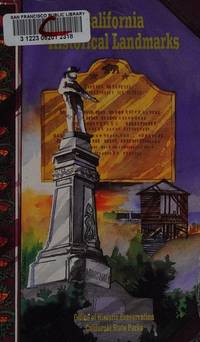
1996Q-0941925196California Dept Parks & 1996-01-01. Paperback. New. In shrink wrap. Looks like an interesting title! California Dept Parks & paperback
031422761X.Gpaperback. Good. Access codes and supplements are not guaranteed with used items. May be an ex-library book. paperback
Snyderman, Evan & Karin ÃIn Pristine Condition. unknown
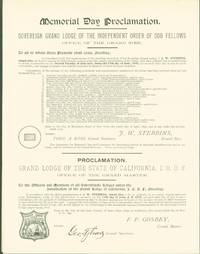
1900290194Independent Order of Odd Fellows I.O.O.F. 1900. Poster. 4 sheets 8.5 x 11 inches printed in black on white. Insignia of Grand Lodge of the State of California on all 4 sheets. The Memeorial Day proclamations are to honor those lodge members in California who have died in the past year. The May 1900 sheet deals with rules governing 'Official Certificates' and 'Dispensations' in California. The October 8 1900 sheet deals with requests for contributions to assist with relief for victims of the flooding in the coast of Texas. First edition first printing. Near fine copies. 3 sheets have 2 holes punched at top edge.<br> Independent Order of Odd Fellows (I.O.O.F.) unknown
ria9781108790833_inpPaperback / softback. New. New Book; Fast Shipping from UK; Not signed; Not First Edition; This book covers the science and methods behind a worldwide transition to 100% clean renewable energy for scientists engineers and social scientists. It is accessible to students general readers professionals policymakers advocat paperback
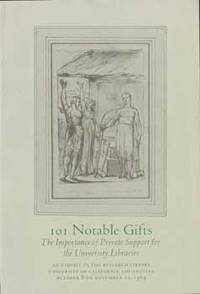
69-4960Los Angeles California: University of California Los Angeles Research Library: 1964. 8vo. Staplebound Wraps with French flaps. 13 pp. B&W Plates Very Good.From the collection of the late Frederick G Ruffner Jr founder of Gale Research Detroit. Los Angeles, California: University of California Los Angeles Research Library: 1964 paperback
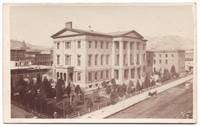
186670879San Francisco CA: Lawrence & Houseworth 1866. Photograph. Near Fine. Lawrence & Houseworth unknown
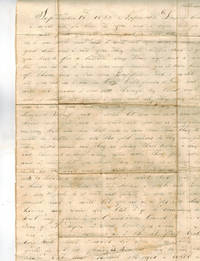
1855007164Sacramento California 1855. Manuscript. Very Good. No Binding. HOLOGRAPH LETTER SIGNED. Two manuscript letters in ink both on ruled paper with folding creases the 1855 letter 8" x 12 1/2" with single spaced writing both sides approx. 500 words. The 1856 letter 15" x 10" folded in half to make 4 pp. approx. 300 words with small blindstamp top left corner depicting an eagle. The earlier letter is headed "September 18th 1855 Naperville Dupage County Illinois" and ends "Michael direct your letters Nevada County Nevada post office California". George writes to his brother Michael in Naperville that he has "seen a good dele sins i rote you they last letter" including a hundred "inshins" and some "Buffellow". He adds that "we had good luck all they way of may we left Council Bluff" and that he is not home sick yet. He then talks of the gold mines river mining what they are paying and the cost of things such as board "from five to ten dollars a week" "Beaf" "wors 15 to 20 cents" and "potato" "4 cent per pound". He adds that he intends to have some gold before he comes home and that "girls are not so plenty here as they are in state". He closes by asking his brother to write him and to remain at home in Illinois to care for their parents. The 1856 letter headed Sacramento august 3th 1856 informs his brother that he is well and "down to Sacramento now" working on a farm feeding a "schrasing" thrashing machine and that "they times is verry hard in California now". He adds that he had some money "stole" while he was in the mountains but since coming down into the valley he was making money and will send some home soon. The letter ends with George wishing to see them all soon and that he is not home sick. The third page of the letter bears a drawing of a wing or leaf eleven smaller versions of the same image interspersed on page 2. A fascinating testimonial on California during the gold rush written in a strong hand and in a wonderful vernacular style by a good observer. unknown
186074708Downieville CA: N.p 1860. Original 4-page letter from H. I. Thornton Jr. to his mother and dated August 3rd of 1860. Contemporary lined blue paper with each page measuring 7 3/4 x 9 7/8 inches. Written in a very legible hand. Expected fold-lines and one short marginal tear else and excellent letter filled with California politics before the Civil War.Harry I. Thornton Jr. was born and raised in Alabama in a highly distinguished family; his father was Alabama Supreme Court Judge and his uncle John J. Crittenden of Kentucky was a United States Senator for four terms. Harry Jr. came to California in 1854 and immediately took up his law practice in Nevada City. Soon thereafter he moved to Downieville in Sierra County. He was enormously popular and in 1857 was elected District Attorney. As his popularity grew he was soon induced into running for State Senator. He did and won. This letter is to his mother telling of his political wishes and hesitations. He tells her that the incumbent Kirkpatrick has endorsed him and that he thinks winning the elections is an actual possibility. He writes - "All considered I am wavering. I will leave the matter open until the / comes in from Washoe which will be next week. it is more likely I will be lured off by the trumpet call of this war into the Constitutional Rights of the States and the People of the States against the dangerous sectional doctrines of Douglass-ism and Republicanism." He also writes much about the Platform of John Breckinridge for President. In a lighter vein he writes - "A burglar entered my room and stole my watch and $.50 from my pocket. I awoke and flushed the felon and gave chase had no forearm or could have shot him and have finally lost my pet my old companion." Thornton did win the election.When the Civil War broke out Thornton gave a famous speech on the Senate floor in Sacramento defending the South. Along with many other Democrats in office at that time he quit his position after his speech and left for the South to join the Confederacy. He was promoted rapidly eventually making the rank of Colonel. After the war he removed to Nevada and teamed up with John Garber to form the most powerful law firm in the state. N.p unknown
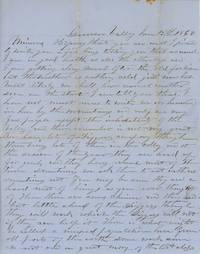
1860List3317Likely Plumas County California 1860. Single four-page letter measuring 7 ½ x 9 ½ inches. Folded with some small tears at folds; excellent. A letter from “Charly†to his wife or fiance written in January of 1860 from “Ganser possibly sic Valley†likely in Plumas County California. Located in the Sierra Nevada Plumas County contained a number of mining towns following the California gold rush; however Charly does not specify his line of work or discuss any particulars. Instead—besides inquiring after the health of family and friends and considering when he would return home—Charly discusses the other residents of the valley. He writes:<br /> <br /> “I can tell you that I have not much news to write we are hemmed in here by the mountains and only see very few people except the inhabitants of the valley and their number is not very great we have lots of Digger company though there being lots of them in the valley and at this season of the year they are hard up for grub and they hang round most of the time sometimes we ask them to eat with us sometimes not You may be sure they are a hard nest of beings as you ever thought of them there are sorry Chinese and they are but little ahead of the Diggers though they will work which the Diggers will not if they can help it There is what might be called a mixed population here from all parts of the earth some work some do not and there are a great many of the last classâ€.<br /> <br /> “Digger†is a derogatory term applied to several Indigenous peoples in the region referring to their diet of root vegetables. In this part of California they would likely have been Northern Paiute or Mono people. Following the US’s acquisition of California and especially after the discovery of gold these groups were decimated by murder enslavement and disease; an 1896 article notes that the Plumas area had proportionally more survivors of American depredations.1<br /> <br /> Of interest to historians of the late gold rush especially relations between Anglo-Americans and other races.<br /> <br /> 1 Mabel L. Miller “The So-Called California ‘Diggers’†Popular Science Monthly 50 December 1896 201–214. unknown
186932728Virginia City California 1869. Paper. Very good. Approx. 8" x 3" check with printed green borders information and 2 stamps. Check is drawn on the account and signed by Isaac L. Requa. The information printed on the check is "Gould & Curry Silver Mining Company W. C. Ralston Treasurer. Agency of the Bank of California Virginia City. The written date is Aug 3 1869. <br /> <br /> Requa was a mining engineer early Oakland pioneer and later President of Oakland Bank and Savings. unknown
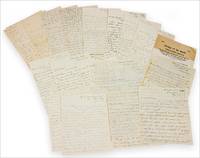
3726573<p>Various places in California and Nevada 1872–1936. Approx. 132 pages. 8vos. and mostly 4tos. 42 Autograph Letters Signed. Four telegrams. Various papers and ephemera. All Very Good to Near Fine.</p> <p>Archive of letters and papers of the Kize Gilchrist Lamb 1876–1959 and Annie P. née Koch Lamb 1880–1936 Family of California 1872 to 1936. The majority of the letters were written by or addressed to the Lamb’s daughter Miss Marie Lamb of Salinas California. Over half the letters in the archive 23 letters and over 60% of the manuscript pages were written to her from Frans Hanson of Taft California.</p> <p>Other correspondents in this archive include Annie Koch before her marriage to Kize G. Lamb Annie Lamb Mary Denker Charles Denker J.H. Burchard and Francis E. Lamb son of Kize and Annie Lamb and brother of Marie Lamb. Other places from which the letters were mailed include San Francisco Salinas San Ardo Monterey and Truckee California and Bull Head Ranch Winnemucca Austin Carson City Fallon Battle Mountain Tuscarora and Paradise Nevada.</p> <p>Accompanying papers include the 1901 marriage certificate of Kize G. and Annie P. Lamb and some typed and manuscript poetry. Ephemera here includes Christmas cards calling cards newspaper clippings graduation and wedding announcements and Vol. 1 No. 1 of the W.P.I.C. Bulletin issued by the Women’s Public Information Committee of the Coast Valleys Gas and Electric Company February 1925.</p> unknown
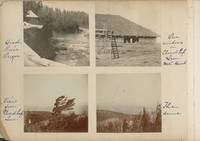
1890List2871Oregon Washington and California 1890. One forty-two page photo album with 9 ½ x 7 inch pages; 109 total photographs with eighteen 4 x 7 inch and larger and ninety-one 3 ½ x 3 ½ inch. Larger photographs captioned on negative and likely purchased while smaller ones are original. Album pages with chipping at corners and some repair with tape; photographs with some wear and very good to excellent contrast; overall very good to excellent. A photo album from two trips taken by an unknown tourist one around the Pacific Northwest and the other in central and southern California with written captions describing location and subject matter. The California trip starts in San Francisco and includes shots of Monterey “Mexicans at Los Angeles†and many of the Santa Barbara Mission and San Diego. <br /> <br /> The Pacific Northwest photos show scenery around Mts. Hood and Rainier including from the recently-built Cloud Cap Hotel; the Columbia River Paradise Valley American Lake and others. There are also shots of the Hotel Groe built in 1893 and Kernahan home in Pierce County Washington – James Kernahan was one of the earliest Euro-Americans to homestead in the region arriving in the area in the late 1880s. The Kernahan family is mentioned in an account told by John Muir’s photographer of summiting Mt. Rainier with John Muir in 1888.1 Further towards Rainier there are shots of the Longmire buildings built in about 1884.<br /> <br /> Four interesting shots from Puyallup also in Pierce County are worth mentioning. Two show hops fields one a line of tents identified as belonging to the “Indians†and one of an “Old Indian woman†standing barefoot on train tracks. Before 1892 growing hops drove the economy of Pullyup; Indigenous people would travel from the US and Canada to Pullyup to work the harvest.2 These photographs likely postdate the hops crash.<br /> <br /> Of interest to historians of the Pacific Northwest and California and especially of Pierce County Washington.<br /> <br /> 1 “John Muir’s Ascent of Mt. Rainier As Recorded by his Photographer A. C. Warner†The Mountaineer 50 no. 1 1956: 38–45.<br /> 2 Hans Zeiger “Indigenous Hop Pickers in Western Washington†HistoryLink October 3 2021 https://www.historylink.org/file/21295. unknown
3729963<p>Oakland. November 10 1892. 12mo 3½ pages. Very Good.</p> <p>Letter from the founder of the Catholic institution St. Mary’s College Brother Sabinian i.e. John Downey i.e. an Irishman of birth who died in 1909. The letter is written to an Anne R. Meade regarding her father a man named Riley a cattle rancher who kept a ranch near the school in Oakland California. Sabinian writes entirely of Meade’s father and notes that he was a “special friend of the Christian Brothers.â€</p> unknown
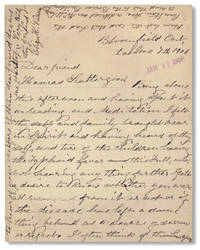
3730384<p>Delaware Ohio 1899 and 1901 and San Jose California 1912. 63pp. 8vos. Overall very good with original envelopes.</p> <p>A collection of 18 letters. The first 14 were written by Gladys M. Manweiler of Santa Cruz California when she was a student at San Jose’s College of the Pacific during the 1912 Spring semester. Manweiler writes to her future husband Rev. Hugh K. Hamilton a 1907 graduate of Pacific School of Religion in Berkeley and a San Francisco minister. </p> <p>Manweiler writes of girls’ college basketball; attending a concert by German-American opera singer Ernestine Schumann-Heink; women versus men “The ‘Woman’s Pacific’ weekly is out now. The boys are ‘sore’ about it. There were several jokes about athletics and they could not take a joke and are very indignant.â€â€”March 21 1912; reading Jane Austen’s Pride and Prejudice; and audaciously—as she describes it—registering to vote in early January 1912 women’s suffrage just having been enacted in California. She is also an officer in the college’s Sopholectia a women’s literary society at College of the Pacific and the local Y.W.C.A. </p> <p>Manweiler engages in “shocking things†beyond registering to vote:</p> <p>“I must tell you what father and I did Sunday evening. It is most shocking I admit. My older sister says she will not be surprised anymore at anything I do. There was a Mr. Eddy a Medium at the opera house. Father and I both seemed to be possessed with a great sense of curiosity so what did we do but go on Sunday night. I had my curiosity satisfied but paid for it seeing ‘spooks’ all night long. What do you think of us Mr. Metz went and had no chance to escape unseen for he was called upon the platform as one of the committee to prove that things were done OK. I have left the thing which I suppose will please you the most until last. Just be patient now and sit down if you are not already for you may not be able to stand the shock. Are you ready Well I will sum it up in just three words. They are these – Listen – now dramatically continuing at the top of the next page I have registered. Father took me down Wednesday morning. He wanted us all three to go but mother was sick and Grace would not do it. I do not know whether or not I will be home to vote but I will be able to if I am.†January 12 1911</p> <p>Manweiler recounts a campus measles outbreak and female students’ coordination in response to the college’s nursing policy:</p> <p>“I received your letter this after-noon. Now don’t worry about me please. I have not got the measles yet. I have been feeling mighty ‘bum’ the last few days but they are not measles symptoms I don’t think. I am determined not to get them. I am going home next Tuesday sick or well. So far there are only three cases of measles here in the dormitory. They are all quite bad though one of them especially so. Some of us girls became real desperate yesterday. Nothing was being done as a preventative and it seemed we were all doomed to have it. It would be dreadful to be sick with anything like that in this place. If we were going to be sick we wanted to be home where our mothers could take care of us. A delegation of about fifteen of us girls go together and went to Dr. Guth college president William W. Guth to lay our case before him. We found that he was in the city and our efforts in vain. Some precautions have been taken since and the doctor thinks that there is little danger of any more cases. I hope he knows what he is talking about. There are three others of the girls sick who haven’t the measles. Edith Dennett is getting better slowly and is able to sit up a little every day. We are running a regular hospital here. Miss Ban says she’s going to put out a sign.†March 28 1912</p> <p>The final four letters in the collection were sent to Hugh K. Hamilton see above by his mother during his time as an undergraduate and O.W.U. Cadet at Ohio Wesleyan University. These letters cover topics such as local church affairs women’s temperance canvassing activities and updates from home.</p> <p>Refs. “Methodist Minister Emeritus Dr. Hugh K. Hamilton Dies†in Santa Clara Sentinel Santa Clara Calif. Wednesday September 29 1965 p18. Also see in same Wednesday June 27 1951 p4: “After Rev. and Mrs. Hamilton were married ca. early 1910s Hamilton enrolled at the Boston university where he received an STB degree. Later Dr. Hamilton received honorary degrees of doctor of divinity from the Pacific School of Religion and the College of the Pacific. The latter also is the alma mater of Mrs. Hamilton. For a number of years he was a member of the board of trustees of both institutions. He held pastorates in San Francisco Berkeley Hughson Los Gatos and Lodi in addition to Santa Cruz and Visalia. … Dr. Hamilton also served in World War I as army YMCA secretary at Camp Kearny near San Diego and later in San Francisco. For eight years he was superintendent of the Sacramento and Nevada Districts of the Methodist church supervising about 60 churches.â€</p> unknown
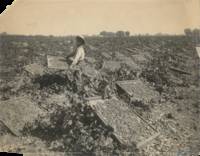
1901List3115Fresno California: Detroit Photographic Co 1901. Single photograph measuring 7 x 8 ¾ inches. Captioned on negative with Brown Brothers and Frank A. Munsey stamps verso. Wear and damage with large folds on right hand side missing upper and lower left corners including intersecting with caption text. Very good plus. A photograph of a young man standing in a grape field and holding a drying rack in Fresno 1901. Grape farming in Fresno began in the early 1870s and by the 1880s grapes including raisin grapes were the area’s main crop. Cultivation in Fresno’s semi-arid climate required a system for irrigation and so was generally up to wealthy capitalists corporations or sometimes farming colonies like the Fresno Colony.1<br /> <br /> 1 Thomas Pinney A History of Wine in America: From the Beginnings to Prohibition University of California Press 1989. Detroit Photographic Co unknown
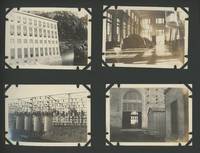
1921List3510California 1921. Photo album measuring 10 x 12 inches containing approximately 360 photographs. Photos are approximately 3 ½ x 4 ½ and smaller with very good to excellent contrast. Album with wear to covers and edges of pages; photos generally excellent to Near Fine. A photo album belonging to an unknown Southern California family; license plates date the album to about 1914 to 1921. Most of the photographs are of family life including farm work: piles of hay; cows pigs chickens turkeys and horse-drawn plows; gigantic watermelons; and family members posing outside vineyards and in cornfields. The family also documented their car and their recreational activities including swimming hiking and fishing picnics and carriage rides. It appears that they were quite proud of their car and were frequent “auto-campers.†They seem to have taken a trip to Mexico or the Southwest as some shots show wide desert landscapes Joshua trees and low Spanish colonial-era buildings.<br /> <br /> Identifiable subjects include the ferry boat Ramona; the Rose Parade in Pasadena showing Culver City Pasadena and Glendale floats; San Gorgonio Mountain Half Dome and the Wawona Tree a giant sequoia in Yosemite; and the Fairview Farm Club parade—a line of cars driving down a dirt road the first decorated with cornstalks—which is probably related to the ranching development located between Huntington Beach and Newport Beach.<br /> <br /> Someone in the family had an interest in hydroelectric power as many shots show ongoing or completed hydroelectric works projects in Southern California. Several show the Southern California Edison Big Creek plant. Located in the Sierra Nevada the Pacific Light & Power Corporation began the Big Creek project in 1910 to provide power to the growing metropolis of Los Angeles. The photographs in this album appear to include both exterior and interior shots. Another set of shots show a dam under construction; this may be Devil’s Gate Dam on the Arroyo Seco which was constructed in 1920.<br /> <br /> Of interest to historians of Southern California in the early twentieth century and some of its public works projects. unknown
MA04K-00180University of California. Collectible - Acceptable. H.S. Crocker and Company for the University of California 1918. Volume 45 of the Yearbook. 78.8 oz. Sm 4to hardcover. Brown suede over boards with gilt on brown leather labeling to the spine and front board. 525pp. Tipped in plates b/w photos. Near Good book. Corners gently bumped as is the spine. Spine label shows minor wear with a dime sized scrape and adjacent dark brown stain near the foot. Light soil to the rear board. small 2" crack to the lower front hinge. uc berkeley bears gilman hilgard 1917-18 year book yearbook Inquire if you need further information. NOT AVAILABLE FOR SHIPMENT OUTSIDE OF THE UNITED STATES. University of California hardcover
1333054777.Gpaperback. Good. Access codes and supplements are not guaranteed with used items. May be an ex-library book. paperback
0260040134.Ghardcover. Good. Access codes and supplements are not guaranteed with used items. May be an ex-library book. hardcover
76913An album containing 24 silver prints measuring 6 x 4 inches many showing the popular Smith's automotive businesses in downtown San Diego. The automotive service and parts company was founded and operated by Howard B. Smith known to many San Diegans at the time as "Service Smith". A native of Connecticut he trained as an engineer at U.C. Berkeley working his way through college in a repair shop and as a taxi driver. He moved to Michigan to work with the Chalmers Motor Company before relocating to San Diego in 1914 where he became an agent for cheap automobiles. In 1916 he opened the Smith automotive businesses and in 1918 the Owl Taxi with five Ford cabs.<br /> <br /> It would appear from the age of the automobiles in the photographs that the images date from the early 1920s. In 1921 Clemens W. Stose purchased Smith's Savoy Garage Smith's Motor Supply and Smith's Repair Shop. Laid into the album is a handwritten letter on Owl Taxi letterhead postmarked 1922. The album also contains early images of advertisements for tires and batteries along with a few other automotive-related businesses in the area. <br /> <br /> The album and photographs are in very good condition. The photographs are held in place with photo corners. The oblong black cloth album is bound with a string tie. unknown
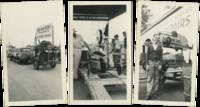
1940Cat332United States 1940. Photo album measuring 7 x 10 inches containing fifty-three photographs: two tintypes c. 1890s and 1920s six RPPCs and forty-five modern photographs. Photographs mainly measure 4 x 6 inches and smaller. Conditions vary; some with wrinkling and damage especially to corners and edges; others Fine. Overall excellent. A photo album of an unknown couple. Early shots include two tintypes which appear to be turn of the century to 1920s and six real photo postcards dating to the 1920s at the latest based on stampboxes. The RPPCs include portraits shots from a farm and a souvenir photo from Brooklyn. Later shots are likely WWII-era showing several men posing in military uniforms.<br /> <br /> The album is highlighted by its photographs of Californian auto tourism and a Soap Box Derby event likely also in California. Identifiable tourist locations include Bear Canyon Campground in Altadena and Cedarpines Park in the San Bernardino mountains; people pose with the car in deep snow and at the campside and shots show the car with luggage strapped to the outside and filling up at a Shell. One Cedarpines photo is dated captioned “Winter ‘28â€. Later auto tourism shots—with what appears to be a 1940s model car—show the car at a Los Angeles mechanic with a teardrop camper and a boat on top and later parked at a beach with the camper set up with manuscript verso indicating that the location is Mexico. Alongside these photographs is a shot of a Depression-era billboard reading “NO JOBS in California / KEEP OUT / 6 MEN FOR EVERY JOB / NO STATE RELIEF AVAILABLE FOR NON-RESIDENTSâ€; on the verso it is captioned “1929 / This sign was posted in Tennesseeâ€.<br /> <br /> Soap Box Derby is a Depression-era invention beginning in 1934 in Dayton Ohio and quickly becoming a national phenomenon. Derby shots in this album appear to be Californian or at least to highlight Californian entrants: the cars pictured are sponsored by Siminow Bros. a Los Angeles gas station and mechanic. These include the cars being towed in the line for the inspection station the starting line and action shots.<br /> <br /> Highlighting two very different forms of car-based recreation the album is of interest to historians of the car in American leisure in the period surrounding the Great Depression. unknown