1 249 résultats
191063830New York: G.P. Putnam’s Sons 1910. Tall thick 8vo. xvi 308 pp. plus 8 pp. publisher’s ads. Photo frontisp. photo plates maps 1 folding. Blue ribbed publisher’s cloth photo illust. mounted front cover decorative gilt lettering front cover & spine t.e.g. minor shelfwear slight bumping to foot of spine couple corners still VG bright copy. First edition of this installment in the American Waterways Series describing the great Mississippi River the area’s role in the opening of the American West including the Lewis & Clark Expedition acquisition of the Louisiana Purchase and impact of the Civil War. G.P. Putnam’s Sons, hardcover
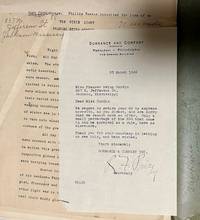
194234721Jackson Mississippi: n.p. 1942. Manuscript. Good. Unpublished typed manuscript. 242 pages typed on the rectos only. 1942 rejection letter from the publisher signed by the secretary is included. Manuscript housed in torn and chipped paper folder with author's Jackson Mississippi address on the front side. Manuscript inscription on the first page. Contents clean and in good condition. n.p. unknown
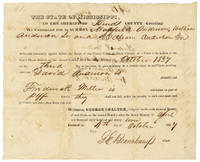
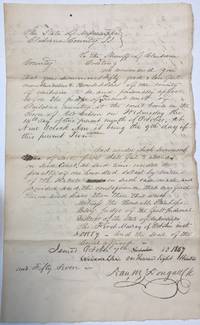
3726430<p>Raymond Mississippi October 4 1837. 1p. Partly-printed document. 6¼ x 8 inches. Contemporary docketing on verso. Folds; some ink bleed-through; very good.</p> <p>1837 legal summons addressed to the Sheriff of Hinds County Mississippi William C. Demoss. The sheriff is hereby directed to summon Maxfield Anderson William Anderson Sr. and William Anderson Jr. to give evidence in the case of David Anderson plaintiff against Frederick Miller defendant. </p> <p>The Andersons were summoned to appear on the third day of the October 1837 term by Judge George Coalter Judge of the Seventh Judicial District. The summons is signed by court clerk G.E. Beauchamp. There is docketing on the verso as well as Sheriff Demoss’ acknowledgement of receipt dated October 4 1837.</p> <p>In 1830 prior to serving as Sheriff of Hinds County William C. Demoss was appointed an Associate Justice of the county court of Hinds County and served as a member of its probate court.¹ An owner of enslaved African Americans he also served in the Mississippi legislature and was a founding trustee of Hampden Academy at Raymond.</p> <p>Of mention: Maxfield Anderson may be the progenitor of the Anderson Family of Harrison County Texas.</p> <p>Notes. 1. Journal of the Senate of the State of Mississippi… Jackson 1830 pp13 and 87. Refs. Rowland Encyclopedia of Mississippi History Volume II Madison Wis. 1907 p83. Clarion-Ledger September 24 1939 Jackson Miss. p23. TX Historical Landmark - Stephen F. Austin State University accessed online.</p> unknown
19851597282471MISSISSIPPI DEPARTMENT OF AGRICULTURE AND COMMERCE 1985. Hardcover. Good. Pages can have notes/highlighting. Spine may show signs of wear. ~ ThriftBooks: Read More Spend Less.Shelf and handling wear to cover and binding with general signs of previous use. Secure packaging for safe delivery.Dust jacket quality is not guaranteed. MISSISSIPPI DEPARTMENT OF AGRICULTURE AND COMMERCE hardcover
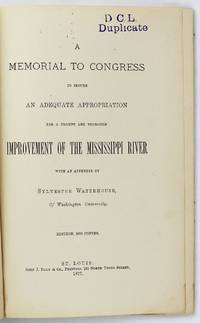
18775827St. Louis 1877. Good. 239pp. Original limp cloth covers gilt. Light fading and wear. Library ink stamp on title page. Minor wear to contents. Memorial submitted to Congress by the members of the River Improvement Convention held in St. Paul advocating for an allocation of government funds to improve the flow and path of the Mississippi River to better accommodate trade along the water route. unknown
190421167New York:: Mississippi Wire Glass Co. ca. 1904. original red gilt cloth. Near fine. 8vo. Illustrated throughout from photographs. Excerpts from newspaper commentaries mostly relating to why the fires spread with a pitch for wire glass windows at the end. Mississippi Wire Glass Co., hardcover
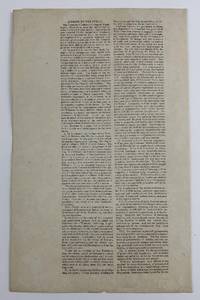
18393269Natchez Ms. 1839. Very good. Broadside 13 x 15.75 inches. Printed in four columns; central vertical fold. Light wear and toning. In the present broadside the trustees of Jefferson College announce that they are once again prepared to admit students in 1839 following a reorganization and give their mission statement courses of study faculty list tuition fees and more. The school located in Washington Mississippi just north of Natchez opened in 1811 and was the first college in the Mississippi Territory. In the text of this broadside one can clearly see sentiments and dispositions that would bring the Civil War to fruition. The first two columns are chiefly dedicated to a description fo the new faculty and their skills but also new measures put in place during the reorganization of the school. In place of gymnastics a daily military drill was substituted and a military police was to be established "for the preservation of good order and regularity."<br /> <br /> The remainder of the broadside descends into sectional paranoia arguing that students must be kept close to home in order for them to maintain allegiance to Mississippi and the South: "At this very moment a formidable content has commenced between the North and the South from the possible results of which the eye of the patriot instantly revolts. It surely becomes us to preserve our children from any influence that might mislead their judgment or weaken their patriotism. To do this effectually we must keep them at home!. Send your sons to other States where they are relased from social bonds you not only cut off these powerful incentives to emulation but you do more and worse you weaken or detach the growing virtues of the heart. and you estrange them from their native land."<br /> <br /> OCLC locates only a small handful of examples. unknown
187140107Jackson Miss.: Kimball Raymond & Co. State Printers 1871. Original printed pale green wrappers lightly spotted. Stitched. 67 1 blank pp. Clean text. Very Good plus. Contemporary ownership inscription in pencil "W.H. Bullard." <br /> <br /> Alcorn 1816-1894 born in Illinois Territory was Governor of Mississippi from March 1870 through November 1871. He was active in Mississippi politics from about 1845. During the Civil War he served as a Confederate. After the War as a "Scalawag" he supported the 14th Amendment and votes for freedmen. Nevertheless he clashed with his new Republican friends by opposing federal intervention against the Klan and federal laws abolishing segregation in public facilities. <br /> Alcorn addresses "what remains to be done of the work of reconstruction" thus focusing on "the restoration of our social and material ruin." With tables and data he demonstrates the disastrous economic effects of the War. But his data also give "encouragement to the practicability of educating the great body of our labor to the moral level of freedom." Marriage licenses are up; extreme "sexual license" is down. Preachers teachers schools property ownership and trades for the freedmen are all on the increase.<br /> Denouncing vigilantism he says that "A class of lawless violence the most cruel and cowardly proceeds in a few quarters in the person of the masked assassin; and so far has succeeded in evading punishment if not detection."<br /> OCLC 28758840 3- Columbia Yale LSU as of June 2024. Not at online AAS. Kimball, Raymond & Co., State Printers unknown
1882JC111661882. Hardcover. Very Good. Mottled black cloth backed in ornately gilt-ruled black calf; oblong 184 x 132 mm; contains 25 pencil drawings most of them titled and dated. It includes Fort Snelling; Minnehaha Falls; Oak Drive in White Bear Lake; a boat on White Bear Lake; St. Anthony's Falls in Minneapolis; Lake Minnetonka; Wabasha St. Bridge; an Old Brewery in St. Paul; Shanty-ville; Shelter Island New York; Goat Island; plus 3 portraits a bonfire scene and other views of the upper Mississippi River Niagara Falls and St. Paul Minnesota. Boards detached and spine perished; a few leaves loose and laid-in. Skilled work most of it on one side of the leaf therefore removable and suitable for display. <br/><br/>Harley DeWitt Nichols 1859-1939 was born in Barton Wisconsin. He began his education in art as early as 11 years of age. His first job putting his talent and training to use came in the form of an apprenticeship with the Milwaukee firm Marr & Richards where he stayed for 3 years drawing and engraving on wood. The subsequent years included many moves from Milwaukee to Chicago and later to New York where he studied at ASL and was encouraged by Professor Packard to pursue a career as an illustrator at a European school. Nichols left for Munich in October 1885 to attend the Royal Academy where he studied under Heckel became a member of the American Club and socialized with Carl von Marr the clubs president. He went to London for a little while and worked as an illustrator. By 1893 hed returned to New York working mostly in advertising and illustrating for Harpers Weekly and Century magazines. He helped organize the New York Water Color Club. Nichols didnt curb his parapatetic lifestyle until he moved to Laguna Beach California in 1894. The art community in Los Angeles was in its infancy but he got a teaching job at the Echo Mountain summer school and he was inspired by the scenery of Yosemite Monterey San Juan Capistrano and other locations in southern California. He stayed in Laguna Beach until his death in 1939. hardcover
187032897Jackson: W.W. Gates & Co. 1870. 16mo. 15 1 pp. Stitched in original printed and lightly worn wrappers. Very Good.<br /> <br /> The By-Laws of Jackson Council No. 13 are printed at pages 12-15. Page 16 prints a list of eight "Officers for 1870" and 24 Members.<br /> Not located on OCLC as of May 2016. W.W. Gates & Co. unknown
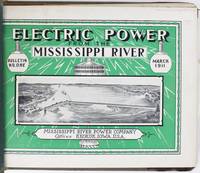
19135027Keokuk Ia: Mississippi River Power Company 1913. Very good. Ten volumes complete. Profusely illustrated. Oblong folio. Each issue measuring 9 x 12 inches in original pictorial wrappers two holes punched along spines and bound together in a later gray cloth Tatum-style Y binder with leather corners. Minor edge wear and staining to boards. Light edge wear to contents. A couple of panoramic photographs detached but present. A complete run of bulletins tracking the progress of construction on the Keokuk Dam & Power Plant which was then the longest monolithic concrete dam in the world and a pioneering effort in large-scale low-head hydroelectric power. Still in operation today the dame served as a prototype for many future power plants harnessing the power of the Mississippi River between Keokuk Iowa and Hamilton Illinois generating clean low cost and reliable energy enough to power 75000 homes. The present bulletins are chock full of facts figures photographs renderings and progress reports intended to familiarize the public with the project by illustrating the methods employed in its construction from beginning to completion. The bulletins are about equal parts text and photographs providing an easy-to-follow format for learning about the Keokuk project. Some of the issues also have folding maps or larger-format photographs which provide further visual accompaniment to the explanatory text.<br /> <br /> Known as a "run-of-river" plant the Keokuk Dam uses the natural energy of falling water to generate electricity. The power of this part of the river was identified by none other than Robert E. Lee in 1836 when he was serving as a surveyor for the U.S. War Department. Lee called attention to the turbulent waters but found no way to control it. In 1899 a group of leaders from Keokuk and Hamilton teamed up raised the backing funds received governmental approval for the dam and hired Hugh L. Cooper to oversee the project. Cooper had previously engineered construction of a hydroelectric plant at Niagara Falls. Interestingly an observation tower was also built on both sides of the river to allow the public to watch the progress of the Keokuk project then the largest privately-funded construction effort in the world. In addition to the dam a powerhouse and a new lock and dry system to accommodate river traffic were also built. The final bulletin includes comments from the chief engineer who noted that in the first bulletin it was stated that the project would be completed by July 1 1913. He remarks: "It is naturally a source of great satisfaction to all concerned with construction to see this prediction fulfilled."<br /> <br /> An informative and substantial production relating to a major construction project on the Mississippi River in the early-20th century. OCLC records a smattering of institutional holdings but complete runs appear to be rather rare. Mississippi River Power Company unknown
185737204Claiborne County MS 1857. 4to. 4 pp entirely in ink manuscript. Signed with a flourish by the Clerk Dan McDougall and the Deputy Sheriff G.R. Girault.<br /> <br /> Daniel McDougall 1813-1863 born in Schenectady migrated to Port Gibson Claiborne County. He was appointed Clerk of the Claiborne County Circuit Court in 1853 and served as such until his death. Colonel George Rogers Girault c.1815-1857 also of Port Gibson was a farmer owning 11 slaves as of 1850 and was also a County Deputy Sheriff. He died two months after this writ was issued. <br /> Stanhope Posey c.1813-1859 full name John Stanhope Posey a Wilkinson County lawyer owned 38 slaves as of the 1850 census. He was elected District Attorney of the Third District of Mississippi in 1839 and a Judge of the First Judicial District Circuit Court in 1845. We don't know who "Everett a Slave" was or what happened to him. We can guess that a jury of slaveholders was not sympathetic to him. unknown
186330260Memphis 1863. Broadside 9" x 11". Lined paper with columns in blue and red inks entirely in manuscript. Two large stains at left edge moderate dusting to right edge on verso. A few small edge chips old folds with archival tape repairs of short splits on verso. Good to Good.<br /> <br /> The Mississippi Central Railroad Company was chartered in 1852; construction began in 1853 and was completed in 1860. The road ran from Canton Mississippi to Jackson Tennessee; it connected to the New Orleans Jackson and Great Northern Railroads at Canton; the Memphis and Charleston Railroad at Grand Junction Tennessee; and the Mobile and Ohio Railroad at Jackson Tennessee. The Mississippi Central Railroad was the scene of several military actions during 1862-1863 and was severely damaged.<br /> R.S. Taylor & Co. of Memphis Tennessee advertised as Cotton Factors and Grocers "We have a large and well selected stock of Groceries and Flour among which is the old favorite Grafton 000 and Reincke's Elegant." THE MEMPHIS DAILY APPEAL VOLUME 31 NUMBER 67 FEBRUARY 22 1871 Page 1. unknown
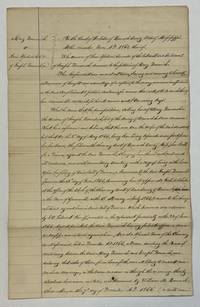
186840969Hancock County MS 1868. 6 pp on lined legal-size paper entirely in ink manuscript. Consisting of the answer of the Executor to the complaint of Mary Tomasich. Light wear a couple of short closed tears without loss. Very Good.<br /> <br /> Mary Tomasich calling herself "the widow of Joseph Tomasich late of the County of Hancock but now deceased" filed a claim against Joseph's estate. But in 1866 while Joseph was still alive she petitioned for a divorce from Joseph "charging him therein with continued ill treatments and with committing adultery with a negress living with him."<br /> The Hancock County Court issued a decree of divorce which the Executor attaches to this Answer. Having dissolved the bonds of holy matrimony Mary thus has no claim to Joseph's estate. unknown
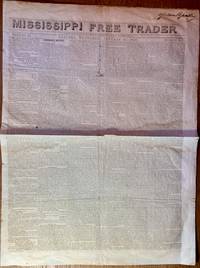
184636784Natchez: T. A. S. Doniphan 1846. Newspaper. Fair. Newspaper. Approximately 24" x 18." 4 pages. Paper has multiple folds damp stains creases and holes at the folds. Paper restored. Holes patched and tears repaired with transparent tissue. <br /> <br /> Contents include Governor A. G. Brown biannual message regarding State finances Rail Roads State Seminary Banking; Education Militia General Jackson James Gadsen discussing the Railroads several advertisements etc. An article from the New Orleans Picayune reports "The rumors which have been for some weeks in circulation that Gen. Paredes had at last declared against the Government appear at length likely to be verified by the course he is pursuing. The revolution is now on foot or has already been consummated." Also a small notice that a "joint resolution approving the new constitution of Texas and admitting her into the Union as well as a bill for extending the laws of the United States over Texas were this day signed by the President of the Senate and then signed by the President of the United States. T. A. S. Doniphan unknown
181525113Washington 1815. 6pp caption title as issued disbound and toned. Good. <br /> <br /> Considering the terms of the Georgia Cession of the Mississippi Territory to the United States the Committee recommends admission. <br /> AI 36393 2. Not in De Renne. unknown
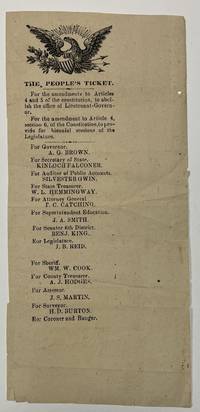
187732913Copiah County MS 1877. Broadside 4-1/4" x9-1/4". Illustration of American Screaming Eagle at head of title. Light wear Very Good.<br /> <br /> The unrecorded and probably unique political ticket is from Copiah County Mississippi: the candidates on the underticket-- Sheriff County Treasurer Assessor and Surveyor-- were all from Copiah County. They won the election. <br /> Mississippi Republicans-- whom white Mississippians viewed as pariahs-- did not nominate a candidate for governor in 1877. The contest was between the regular Democrats who nominated John M. Stone for governor and old-timer Albert Gallatin Brown who had been Mississippi's governor a generation earlier. Brown was nominated by the People's Party Mississippi's brief experiment with Populism. He lost overwhelmingly to Stone. The New Orleans Times-Picayune reported that the election results showed "that the Radicals have lost all their influence" and that "several negroes who last year voted the Radical ticket this year voted with the Democrats." The Times-Picayune Friday Aug. 31 1877 page 2 and Sunday Nov. 11 1877 page 11. <br /> Brown 1813-1880 had been Governor Congressman U.S. Senator and Confederate Senator. He had been an integral part of Mississippi politics for nearly forty years. Kinloch Kinlock Falconer 1838-1878 was a lawyer from Holly Springs editor of the Holly Springs Reporter and one time mayor. During the Civil War he served with the 9th Regiment Mississippi Infantry and was assigned to General Bragg's headquarters. He was Secretary of the State in 1878 and died that year during the Holly Springs yellow fever epidemic. <br /> Silvester Gwin 1830-1891 of Lawrence County was Clerk of the Circuit Court of the County before winning the Auditor's position. During the Civil War he was Captain of Co. A 22nd Mississippi Infantry. William L. Hemingway 1839-1925 of Hinds County was 2d Lieut. of Co. K 11th Mississippi Infantry. He held the position of Mississippi State Treasurer from 1875-1890. In 1890 he was tried on charges of embezzlement when he was unable to account for a shortage of over $315000. He was found guilty and sentenced to five years in the state penitentiary.<br /> Thomas C. Catching Catchings 1847-1927 of Hinds County Mississippi joined the Confederate Army in 1861; was admitted to the bar in 1866 and was a perennial politician. unknown
184528130Claiborne County MS 1845. Folio manuscript broadside 8" x 13" in a neat legible hand. With a detailed plat drawing at head. Lightly tanned and worn. Small corner tear costing a couple of letters. A few expert tape repairs to fold splits no text loss. Good. <br /> <br /> The document shows several tracts along Kennison's Bayou which is likely what is now known as Kennison Creek running between Bayou Pierre River and Big Black River. Kennison's Creek was the site of a Civil War skirmish on May 3 1863 between Grant's Union forces and Bowen's Confederate forces. <br /> The 1850 Federal Census for District #3 of Claiborne Mississippi lists James A. Hutchinson as a planter aged 53 born in Georgia; and Wm. Dotson as a planter aged 55 born in South Carolina. Dotson Hutchinson Turpin and Shelby were all listed in the 1850 Federal Slave Schedules as owning slaves with Hutchinson and Turpin each owning more than thirty such. Shelby and Dotson are also listed in the Civil War Soldiers & Sailors Database as having served with the 1st Regiment Mississippi during the War. unknown
184032117New Orleans: E. Johns & Co. Stationers' Hall verso of title page: Printed by T.K. and P.G. Collins Philadelphia 1840. xii 885 pp with the half title. A very clean text with minor exceptions. Bound in worn contemporary sheep hinges starting spine chipped institutional bookplate on front pastedown institutional rubberstamp on title page. Else Very Good.<br /> <br /> The origins of the State of Mississippi are recounted in the printing of the Cession from Georgia the Act admitting Mississippi into the Union and the Act establishing its northern boundary. The complete set of laws organized by subject and the constitutions of the United States and the State of Mississippi with a detailed Slave Code and other subjects are printed. <br /> Jumonville 1156 noting that it is "not a New Orleans imprint". Sabin 33282. OCLC records mostly Kirtas Technologies reprints. E. Johns & Co. Stationers' Hall [verso of title page: Printed by T.K. and P.G. Collins, Philadelphia] unknown
ORD-14243Indianapolis. Indiana Historical Society. 1954. In-8 (154 x 228mm) broché, couverture gris bleu imprimée, 23 pages, 3 cartes dont une sur double page, texte en français. Couverture lgt passée, très bon état intérieur. Rare.
19246015CA: N.p. 1924. First edition. 19x13cm 45pp. Photographs. Printed in two colors throughout. Stapled white glossy wrappers. Foxing to covers few small edge tears single interior signature loose likely originally not stapled all the way through. Very good. <br /> <br /> Copiously illustrated record of the USS Mississippi's fifth consecutive victory in the "Iron Man" competition the Navy Department General Excellence Athletic Trophy. Includes photos and short descriptions of events from the Seattle and Bremerton Cups to the Whale Boat Crews baseball basket ball sic track and field wrestling boxing football tug o' war and many others. Apparently unrecorded as we find no mention of this booklet in OCLC. N.p. unknown
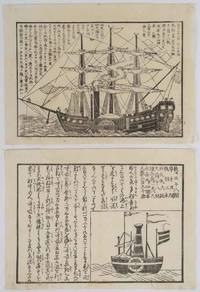
1853218388Japan. Circa1853. Two black and white woodblock kawarabans 18 x 24cm some light staining at margins but overall very good. A black-and-white kawaraban popular broadsheet woodblock print showing Commodore Matthew Perry's flagship the Mississippi at the time of his visit to Japan in 1853. The text accompanying the carefully depicted ship gives the dimensions of the vessel and other details including the number of crew. It then goes on to give an interesting summary of world geography explaining to readers that the world has four great oceans and six continents and that Japan is situated in the east of Asia. They are also told that America lies 5000 ri about 10500 miles to the east of Japan and that its capital is Washington. On the second sheet with an illustration of a steam ship it gives the sizes of the boat and its crew. It also refers to the speed and the distance a steam ship is able to cover and amazes with the vast distance the ship can travel. <br> <br>The kawaraban is a vivid illustration of the astonishment with which Japanese people responded to the coming of Perry and his "Black Ships" and of the curiosity about the outside world which this event generated. The Mississippi was particularly impressive because it was a steam-powered paddle ship. In this image we see not only the ship and its rigging and paddle-wheel but also the small figures of crew members including one starting to climb the mast and another apparently sounding the depth of the water. . unknown
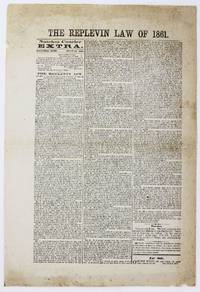
18654629Natchez Ms: July 22 1865. Very good. Broadside 13.75 x 9.5 inches. Printed in three columns. Moderate toning and foxing old folds couple of small tears expertly repaired on verso two tape remnants at top edge likely from previous matting. A very rare newspaper extra printing the first civilian law in Occupied Mississippi following the conclusion of the Civil War. After the war only military justice was in force in Mississippi. According to an 1866 Mississippi court case: "civil government of the State having been subverted and all power having passed into the hands of the authorities of the United States the question whether any and what civil government should be permitted was a matter in the discretion of those authorities. During this military occupation the laws of the State could only operate so far as they chose to allow and could only be administered by such agents as they pleased to appoint." On June 13 1865 President Andrew Johnson appointed William Lewis Sharkey 1789-1873 -- a Mississippi judge and staunch Unionist who opposed secession -- as the state's provisional governor. His first public act was to appoint judges and clerks to probate courts as well as appoint police justices of the peace and other country officers and authorized them to immediately begin to discharge their duties but excluded any orders regarding circuit and chancery courts.<br /> <br /> Two days later on July 3 Sharkey ordered the first civilian law to be operative which is published in the present broadside newspaper extra by the Natchez Courier. Sharkey's transmittal at the top begins: "Ordered. That the act in regard to the action of replevin and the amendments thereto passed by the legislature of Mississippi since the 9th day of January 1861 be and the same is hereby declared to be in full force from this date." The text of the act in twenty-six sections is then printed beginning: "The Replevin Act. An Act to provide for the speedy recovery of personal property wrongfully taken or detained." Somewhat oddly at the time this was the only civilian law in effect in Mississippi in the summer of 1865. According to the same 1866 court case excerpted above which explains the issues inherent in the issuance of the Replevin Law and Sharkey's organization of county probate courts "in all cases of the wrongful taking or detention of personal property a summary remedy by action of replevin before two justices of the peace was given to the party injured to recover the property and damages for the wrongful taking or detention. This was the only court created by the governor for the adjudication of legal rights; and these are the only cases committed to its jurisdiction; leaving all the rest of the immense mass of legal rights wholly without any redress." OCLC and other newspaper sources reveal just a single mutilated copy of the present broadside at the American Antiquarian Society. A fantastic broadside dealing with Mississippi law at the outset of Reconstruction.<br /> Scott v. Bilgerry April Term 1866 in Reports of Cases Argued and Determined in the High Court of Errors and Appeals for the State of Mississippi. Vol. XL. New York: Bank Brothers 1867 pp. 119-157. July 22 unknown
171846350Crockett Houston Co. Texas Feb. 17th 1866. The writer laments "the wreck of his affairs" loss of his crops and library "and even the negroes" and hopes for news of a mutual friend; with the recipient's notation on the envelope "ratifying sale of land because I wrote him the facts & he orders a sale of the articles reserved from sale." . unknown
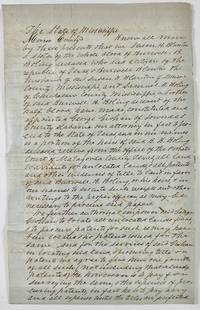
185112761Monroe County Ms 1851. 3pp. on a single folded sheet with a partially-printed document completed in manuscript affixed to third page. An interesting document relating to lands in the former Republic of Texas owned by Burwell B. Boling who has passed away. His sister Susan H. Boling Blanton her husband Burwell Blanton and brother Samuel H. Boling here appoint George Giohan of Lowndes County Alabama to represent them in Texas and to locate land warrants and other documentation of Boling's properties. The power of attorney is signed by all three of the next of kin and attested to by two officials in Mississippi. A certification of the Justice of the Peace is affixed to the third page. While the document is rather straightforward it involves two names that are rather prominent in Texas -- Blanton and Boling. According to records on Ancestry descendants of Susan Blanton settled around Galveston and may be related to the modern Blanton family whose philanthropy in Texas is well known. unknown