[Civil War]. [Mississippi]Biblio.com
1 250 résultats
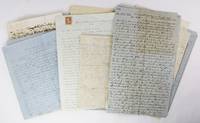
18656242Various locations 1865. About very good. Forty letters approximately 96pp. Many with original envelopes. Light wear and soiling old folds. In a legible hand. Together with twelve additional family letters and two military commissions. A wonderful archive of correspondence written home from the Confederate lines by William Henry Tabb of the 14th Mississippi Infantry. William Henry Tabb 1837-1864 was the son of a minister at the Choctaw Agency in Oktibbeha County Mississippi. In April 1861 he was commissioned as a lieutenant in the Agency Guards which were soon absorbed as a company in the 14th Mississippi Infantry. He was captured at Fort Donelson exchanged reached the rank of captain and was with his regiment when he suffered a fatal wound in the defense of Atlanta on August 5 1864. <br /> <br /> Tabb begins his letters with optimism. On August 1861 after training in Corinth Mississippi the regiment met with a parade in Huntsville en route to eastern Tennessee: "The women men and children were down to see us and a regiment turned out to do us honor. Such cheering from beautiful young ladies all along our way is enough to make men brave." On October 22 1861 he recounts the recent death by disease of his brother Thomas Tabb in Marion Alabama also of the 14th Mississippi calling him "my dearest friend on earth."<br /> <br /> Tabb was captured at Fort Donelson in February of 1862. Two of these letters were written from the Union prison at Johnson's Island near Sandusky Ohio. In May 1862 he writes: "We are not allowed to write what nor as much as we please. I have no friends to work for me see no indications of a general exchange or parole and it is almost impossible to escape from this island. It is amusing to see men one day Confederate officers and the next day cooking or around the wash tub. We have no servants. I am well treated have a plenty not a variety of food and clothing that we need issued to us." By September 24th he was back with his regiment in Mississippi: "The Yankees stole my shoes and I am wearing an old pr of boots. It appears that my conduct at Donelson has been very highly spoken of. Well I.tried to do my duty but I am sure I did nothing extra. Indeed our regt in my opinion fell little short of disgracing itself." He adds a word on the troubled home front situation: "Am sorry to hear that the Negroes have commenced stealing. I would very much like to see all that have behaved themselves and wd thrash those who have been stealing."<br /> <br /> On April 11 1863 he describes the recent Battle of Ponchatoula which other companies in his regiment participated in: "Rollins was sent out with ten of the company on our right wing to try to flank them. As soon as he commenced firing on them we attacked their center and they broke to run. They were zouaves red pants we never could catch them." He lamented the loss of his enslaved servant on June 7th near Yazoo City: "I expected John to come to me. I have become attached to John and don't know how to get along without him. I look for him every day now." Tabb had some great stories about Grant's efforts to take Jackson the Mississippi capital from which Johnston's Confederates performed a stealth evacuation. On the 19th and 20th of July 1863 he wrote: "All of the boys wanted to stay and fight but Grant had 80000 men and we had only 30000. It is true we were behind breastworks but they were not good and the place could be easily flanked. Johnson prepared to evacuate the place from the time we got there. The Yankees knew it. Not a word was spoken not a command given. The Yankees knew nothing of our leaving. Some of our men did not know we had left and were left behind but overtook us. I hear that the Yankees commenced shelling the town the other morning after we left and kept it up til 9 o'clock when some of the citizens hoisted the white flag and surrendered the place. They were vexed to know that we had left them without their knowing anything about it."<br /> <br /> Tabb had been away from the regiment for the start of the Atlanta campaign and on July 9 1864 he wrote: "I reached the command the evening of the 5th and found my company.8 miles from Atlanta. I found the men dirty and many of them with worn out clothes and not very good rations but all in good spirits and glad to see me. The people of Atlanta are leaving rapidly. They think the place will be evacuated. Do not be surprised if you hear it. We will not be whipped if we do leave it." This is Tabb's final letter in the collection. He was shot a month later. The group concludes with nine condolence letters and memorials. An October 1864 memoriam copied in 1894 recounted his death: "At the time he received the fatal shot he was commanding the brigade skirmishers & was just forming the line to proceed to the front. Though terribly mangled & in great pain he was calm & collected." He survived long enough to send farewell thoughts to his family and to regret "that I was not spared to see my country through her troubles." Also included are two of Tabb's military commissions in the Agency Rifles from the State of Mississippi: as Second Lieutenant on 24 April 1861 and as First Lieutenant on 25 December 1861. Both are signed by Governor John J. Pettus. In all a wonderful archive from a Confederate soldier who saw significant action and imprisonment during the war. unknown
1720WRCAM51443Amsterdam 1720. Title-leaf 25152311810pp. plus seventy-five plates forty-seven double page sixteen folding including frontispiece and three maps. Large folio. Contemporary paneled calf ornate gilt covers and spine black gilt morocco label. Remarkably clean and bright. Bookseller's label pasted to front free endpaper. An excellent copy with additional engraved plate laid in. One of the great satirical plate books of the 18th century directing its invective at the Mississippi Company of John Law and the wild speculation and financial collapse engendered by the pioneering stock issuance of the company. The Netherlands was a particular hotbed of speculation with over 350 million guilders invested in the scheme before its collapse. The plates and their accompanying text in prose and poetry begin with a portrait of John Law and follow the course of the speculation in ludicrous and sometimes obscene images. It is a remarkable final chapter to the literature of Law and the Mississippi speculation. <br> <br> "The book is divided into six sections with no general table of contents. The first part contains the articles of various Dutch companies. The second section consists of comedies and farces; the third part poems often containing street language; the fourth part descriptions of playing cards satirizing speculators; the fifth part four letters to 'N.N.'; and the sixth section chiefly pictures although pictures appear elsewhere in the book as well" - BOUND TO PLEASE. <br> <br> This book has always been a bibliographically perplexing one with no two copies seeming to collate alike. Sabin states that copies have anywhere from sixty to seventy-four plates but ignores the supplementary series. Even Cole the most diligent student of the book notes: "Rarely does a single volume combine in itself so much economic interest and so many bibliographical puzzles." BOUND TO PLEASE 5. SABIN 28932. Cole THE GREAT MIRROR OF FOLLY. EUROPEAN AMERICANA 720/114. GOLDSMITH 5879. HOWES G442. MULLER AMERICA 1503. unknown books
1721Features the first appearance of William Faulkner's name in print. On page 163 "William Falkner" appears near his illustration. unknown
1720322009Nuremberg 1720. Broadsheet printed in three columns recto and verso. Folio 14-1/2 x 17 inches. Folded. Very minor staining trimmed close but without loss small expert repair at the lower left corner. Housed in a quarter morocco case. Broadsheet printed in three columns recto and verso. Folio 14-1/2 x 17 inches. Promoting John Law's Mississippi Bubble in Germany. ;"This very rare German tract was issued to encourage sales in Germany of shares in Mr Law's Mississippi Company" Streeter. The concluding paragraph confirms that the broadsheet was issued in connection with the promotion of Law's Mississippi bubble and its contents would occupy over 20 pages if printed in pamphlet form. Although published separately the broadside is sometimes found with the first state of Christopher Weigel's Nuremberg-printed version of Delisle's map of North America titled Novissima Tabula Regionis Ludovicianae Gallice dictae La Louisiane. Alden 720/102; Streeter sale 116 unknown books
172136880London 1721. Together 9 works in one volume octavo. Collations as below. Contemporary panelled calf spine with raised bands red morocco lettering piece.<br/> <br/>Provenance: Nathaniel Thorn engraved bookseller's label; Robert Warner signature dated 1727<br/> <br/>Sammelband of early 18th-century English poetry including works relating to the South Sea Company and the Mississippi Bubble.<br/> <br/>GAY John. The Shepherd's Week. In Six Pastorals. Jacob Thompson 1721. 14 60 4pp. Engraved frontispiece and six plates included in pagination. Without the half-title. Foxon G74; ESTC T13918. GAY John. Two Epistles; One to the Right Honourable Richard Earl of Burlington; the other to a Lady. Bernard Lintott 1715. 36pp. Without the final ad leaves. Foxon G88; ESTC T13938. GAY John. The What D'Ye Call It: a Tragi-Comi-Pastoral Farce. Bernard Lintott 1715. 12 41 1pp. Engraved frontispiece. ESTC T13939. GAY John. Trivia: Or the Art of Walking the Streets of London. Bernard Lintott 1716. 4 80 12pp. Title with engraved vignette. Foxon G81; ESTC T13930. RAMSAY Allan. Wealth or the Woody: A Poem on the South-Sea . second edition corrected. T. Jauncy 1720. 18 11-23 1pp. Foxon R107; ESTC T140396. AMHURST Nicholas. An Epistle with a Petition in it to Sir John Blunt Bart. one of the Directors of the South-Sea Company . The second edition. R. Francklin 1720. 18 2pp. Half-title. With only one of three ad leaves in the rear. Foxon A197; ESTC T94046; Goldsmiths' 5715. RAMSAY Allan. Patie and Roger: A Pastoral in the Scots Dialect. J. Pemberton 1720. vii 1 23 1pp. Foxon R77; ESTC N11180. BOCKETT Elias. Yea and Nay Stock-Jobbers or the 'Change-Alley Quakers Anatomiz'd. In a Burlesque Epistle to a Friend at Sea. J. Roberts A. Dodd & J. Billingsly 1720. 32pp. Half-title. Foxon B308; ESTC T109160; Kress S.2846. CENTLIVRE Susanna. A Woman's Case: in a Epistle to Charles Joye Esq. Deputy-Governor of the South-Sea by Mrs Cent-Livre. E. Curll 1720. 4 13 1 2pp. Half-title and a final advertisement leaf. Foxon C97; ESTC N24952; Kress S.2857. unknown books
1871WRCAM52816Jackson Ms 1871. Twenty-six volumes publication details and pagination provided in the listing below. Mostly uniform 20th-century buckram gilt leather labels. A few labels chipped minor shelf wear. Small ink library stamp to titlepages some with embossed blindstamp some with contemporary ink ownership inscription. Minor foxing some tanning. Good. An interesting collection of mid-19th-century Mississippi state laws from the period between 1831 and 1870. These session laws deal with issues relevant to a growing state in the American south including slavery Mississippi River development and later legal matters related to Reconstruction among a multitude of other concerns. A complete list of the imprints is as follows: <br> <br> 1 LAWS OF THE STATE OF MISSISSIPPI PASSED AT THE FIFTEENTH SESSION OF THE GENERAL ASSEMBLY. Jackson: Peter Isler 1831. 172xviii pp. <br> <br> 2 LAWS OF THE STATE OF MISSISSIPPI PASSED AT THE SIXTEENTH SESSION OF THE GENERAL ASSEMBLY. Jackson: Peter Isler 1833. 252xxv pp. First two leaves chipped with minor loss of text. <br> <br> 3 LAWS OF THE STATE OF MISSISSIPPI PASSED AT THE SEVENTEENTH SESSION OF THE GENERAL ASSEMBLY. Jackson: George R. Fall 1834. 200pp. <br> <br> 4 LAWS OF THE STATE OF MISSISSIPPI; PASSED AT A REGULAR BIENNIAL SESSION OF THE LEGISLATURE. Jackson: G.R. & J.S. Fall 1836. 440pp. <br> <br> 5 LAWS OF THE STATE OF MISSISSIPPI PASSED AT AN ADJOURNED SESSION OF THE LEGISLATURE. Jackson: G.R. & J.S. Fall 1837. 67pp. A photographic facsmile of the original work. <br> <br> 6 LAWS OF THE STATE OF MISSISSIPPI; PASSED AT A REGULAR BIENNIAL SESSION OF THE LEGISLATURE. Jackson: B.D. Howard 1838. 4ii-viii9-368pp. <br> <br> 7 LAWS OF THE STATE OF MISSISSIPPI PASSED AT AN ADJOURNED SESSION OF THE LEGISLATURE. Jackson: B.D. Howard 1839. 491pp. Includes the text of the CONSTITUTION OF THE STATE OF MISSISSIPPI. <br> <br> 8 THE STATUTES OF THE STATE OF MISSISSIPPI OF A PUBLIC AND GENERAL NATURE WITH THE CONSTITUTIONS OF THE UNITED STATES AND OF THIS STATE. New Orleans: E. Johns & Co. 1840. xii885pp. <br> <br> 9 LAWS OF THE STATE OF MISSISSIPPI PASSED AT A REGULAR SESSION OF THE LEGISLATURE. Jackson: C.M. Price 1840. 2xii213- 366pp. <br> <br> 10 LAWS OF THE STATE OF MISSISSIPPI PASSED AT AN ADJOURNED SESSION OF THE LEGISLATURE. Jackson: C.M. Price 1841. 1417-302pp. <br> <br> 11 LAWS OF THE STATE OF MISSISSIPPI PASSED AT A REGULAR BIENNIAL SESSION OF THE LEGISLATURE. Jackson: C.M. Price & G.R. Fall 1842. iii-xvi17-271275-285pp. as printed. <br> <br> 12 LAWS OF THE STATE OF MISSISSIPPI PASSED AT A CALLED SESSION OF THE LEGISLATURE. Jackson: C.M. Price & G.R. Fall 1843. vii9-135pp. <br> <br> 13 LAWS OF THE STATE OF MISSISSIPPI PASSED AT A REGULAR BIENNIAL SESSION OF THE LEGISLATURE. Jackson: C.M. Price & S. Rohrer 1844. xxi25-395pp. <br> <br> 14 LAWS OF THE STATE OF MISSISSIPPI PASSED AT A REGULAR BIENNIAL SESSION OF THE LEGISLATURE. Jackson: C.M. Price & G.R. Fall 1846. 3-2833-6131pp. <br> <br> 15 LAWS OF THE STATE OF MISSISSIPPI PASSED AT A REGULAR SESSION OF THE MISSISSIPPI LEGISLATURE. Jackson: Price & Fall 1848. 584pp. <br> <br> 16 LAWS OF THE STATE OF MISSISSIPPI PASSED AT A REGULAR SESSION OF THE MISSISSIPPI LEGISLATURE. Jackson: Fall & Marshall 1850. 544pp. bound with: LAWS OF THE STATE OF MISSISSIPPI PASSED AT A CALLED SESSION OF THE MISSISSIPPI LEGISLATURE. Jackson: Fall & Marshall 1850. 425-48pp. Lacks the CONSTITUTION pp.5-24. <br> <br> 17 LAWS OF THE STATE OF MISSISSIPPI PASSED AT A CALLED SESSION OF THE MISSISSIPPI LEGISLATURE. Jackson: Fall & Marshall 1850. 48pp. A complete copy of the latter work from the previous listing above. <br> <br> 18 LAWS OF THE STATE OF MISSISSIPPI PASSED AT A CALLED SESSION OF THE MISSISSIPPI LEGISLATURE. Jackson: Palmer & Pickett 1852. iii-xvi21-219pp. <br> <br> 19 LAWS OF THE STATE OF MISSISSIPPI PASSED AT A REGULAR SESSION OF THE MISSISSIPPI LEGISLATURE. Jackson: Palmer & Pickett 1852. xxviii537pp. <br> <br> 20 LAWS OF THE STATE OF MISSISSIPPI PASSED AT A REGULAR SESSION OF THE MISSISSIPPI LEGISLATURE. Jackson: Barksdale & Jones 1854. iii-xxvi229-613pp. Bottom portion of titlepage chipped costing most of the imprint. <br> <br> 21 LAWS OF THE STATE OF MISSISSIPPI PASSED AT A REGULAR SESSION OF THE MISSISSIPPI LEGISLATURE. Jackson: E. Barksdale 1856. xvi455pp. <br> <br> 22 LAWS OF THE STATE OF MISSISSIPPI PASSED AT AN ADJOURNED SESSION OF THE MISSISSIPPI LEGISLATURE. Jackson: E. Barksdale 1857. 125pp. <br> <br> 23 LAWS OF THE STATE OF MISSISSIPPI PASSED AT A REGULAR SESSION OF THE MISSISSIPPI LEGISLATURE. Jackson: E. Barksdale 1858. 197pp. <br> <br> 24 LAWS OF THE STATE OF MISSISSIPPI PASSED AT A REGULAR SESSION OF THE MISSISSIPPI LEGISLATURE. Jackson: J.J. Shannon 1867. xliv800pp. <br> <br> 25 LAWS OF THE STATE OF MISSISSIPPI PASSED AT A REGULAR SESSION OF THE MISSISSIPPI LEGISLATURE. Jackson: Kimball Raymond & Co. 1870. lxiii704689-720i.e. 736pp. <br> <br> 26 JOURNAL OF THE PROCEEDINGS OF THE CONSTITUTIONAL CONVENTION OF THE STATE OF MISSISSIPPI. 1868. Jackson: E. Stafford 1871. 776pp. OWEN MISSISSIPPI pp.742-745. hardcover books
1704PHO-2363Amsterdam, Chez Adriaan Braackman, 1704. In-12 (16x10cm) de 19ff.-604pp.-16ff.,Titre gravé en frontispice, 2 grandes cartes dépliantes et 6 planches dépliantes h.-t., Basane postérieure, dos à nerfs orné, pièce de titre rouge et auteur verte, tête dorée, rajout sur l’adresse de l’imprimeur à la seconde partie. Frottements et épidermures, traces de renforcements aux cartes.
In 4°, piena tela edit., tit. in oro e decori impressi ai piatti, pp. XIV-(2nn)-494-(2nn). Bellissima, rara pubblicazione corredata da 13 splendide tavv. in cromolito f.t. + 1 cartina geografica del viaggio, più volte pieg. posta in fine, alcune incisioni xilografiche a piena pag. Diario di una spedizione americana nel 1853 attraverso le Montagne Rocciose in California, descritto da Möllhausen che nel 1851 aveva intrapreso il viaggio con il Duca Paul di W?rttemberg da St. Lozius a Fort Laramie e le Montagne Rocciose dove trascorse diversi mesi tra gli indiani Omaha. Tracce d'uso alle cerniere, qualche piccolo rinforzo.
1703PHO-2014À La Haye, Chez les Frères L'Honoré, 1703. 2 tomes en un volume in-12, veau, dos à nerfs orné avec pièce de titre (reliure de l'époque) défauts d’usage. Rare édition de l'une des relations de voyage les plus importante pour l'histoire du Canada. - + 279 pp. & -- 220 + 8ff., Un frontispice et 24 planches ou cartes, certaines repliées, dont la « Carte Général de Canada ». Ex-libris manuscrit sur le titre. Première édition, troisième tirage.
17450030241745 Fontenoy [recueil A], Paris [recueils C à Y], Bruxelles [recueil Z], sans nom d'éditeur, 1745-1762. Vingt-quatre parties reliées en douze volumes in-12 (106 X 174 mm) basane fauve, dos cinq nerfs ornés, caissons dorés, dentelles dorées en queue et tête, pièce de titre maroquin ocre, coupes filetées, tranches rouges (reliure de l'époque). Tome I : titre imprimé en rouge, IV (avertissement), un feuillet de table, 224 pages - titre imprimé en rouge, un feuillet (avertissement et table), 222 pages ; Tome II : IV (dont titre imprimé en rouge & avertissement), 2 feuillets de table, 208 pages - titre imprimé en rouge, 247 pages, 2 feuillets de table ; Tome III : titre imprimé en rouge, 265 pages, 3 feuillets de table - titre imprimé en rouge, II (avertissement), un feuillet de table, 195 pages ; Tome IV : titre imprimé en rouge, 248 pages, 1 feuillet de table, (1) - titre imprimé en rouge, 236 pages, 1 feuillet de table ; Tome V : titre imprimé en rouge, 209 pages, 1 feuillet de table - titre imprimé en rouge, 210 pages, 3 feuillets de table ; Tome VI : titre imprimé en rouge, 235 pages, 2 feuillets de table & avertissement - titre imprimé en rouge, 235 pages, 2 feuillets de table ; Tome VII : titre imprimé en rouge, 227 pages, 5 pages non chiffrées (table) ; titre imprimé en rouge, 226 pages, 1 feuillet de table ; Tome VIII : titre imprimé en rouge, 219 pages, 2 feuillets de table - titre imprimé en rouge, 216 pages, 1 feuillet de table ; Tome IX : titre imprimé en rouge, 226 pages, 1 feuillet de table - titre imprimé en rouge, 214 pages, 1 feuillet de table ; Tome X : titre imprimé en rouge, 235 pages, 1 feuillet de table - titre imprimé en rouge, 256 pages, 2 feuillets de table ; Tome XI : titre imprimé en rouge, 239 pages, (1) page de table - titre imprimé en rouge, 219 pages, 4 pages de table non chiffrées ; Tome XII : titre imprimé en rouge, 210 pages, 3 feuillets de table - titre imprimé en rouge, 197 pages, (3) pages de table.
1720WRCAM48868Amsterdam 1720. Single-sheet map 9 3/4 x 7 3/4 inches. Minor foxing. Near fine. A scarce early map of the Mississippi River Valley depicting the American region between the Gulf of Mexico and the Great Lakes taken from HET GROOT TAFEREEL DER DWAASHEID. THE GREAT MIRROR OF FOLLY a scathing account of the speculative crashes that led to European financial disaster in 1720. The work was a chronicle of the failed attempts by John Law Controller General of Finances for the French government to open Louisiana to trade in order to help alleviate France's financial problems. This led to the creation of the Mississippi Company which created the "Mississippi Bubble" incident that destroyed the Banque Générale Privée the General Private Bank which Law founded. The map depicts the Mississippi River parts of Louisiana and Florida Lake Michigan referred to here as "Lac de Illionis" and Lake Superior the extent of French colonial explorations in the region and names of Indian tribes. It is decorated with a title cartouche incorporating the arms of John Law and depicting two Native Americans holding a cornucopia through which flows the mighty Mississippi River. unknown books
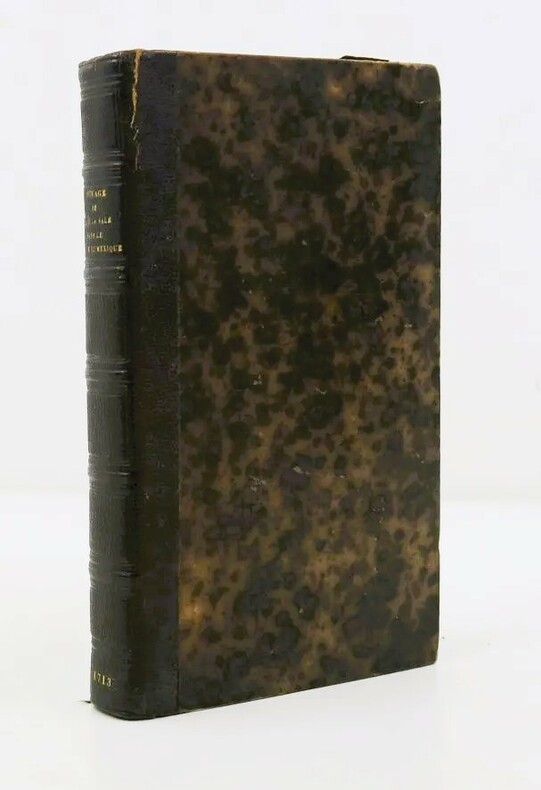
1713PHO-1659Paris, Robinot, 1713. In-12 de xxxiv-386 pp. Demi-chagrin brun foncé, dos à nerfs, titre doré, date en queue (reliure XIXe s.). Début de fente à un mors. La rare grande carte dépliante représentant la Louisiane, le cours du Mississipi et le golfe du Mexique est ici en fac-similé.
1753PHO-2353Paris, Broca, 1753, 4 volumes in-12 (16x9,5cm), 7pp.-370pp.-2ff./ titre-356pp.-4ff./6ff.-310pp.-3ff./titre-271pp.-2ff., basane postérieure (19ème ), dos à nerfs orné avec pièce de titre rouge et tomaison verte, ex-libris manuscrit répété, étiquette de libraire (Beauchemin & Valois, Montréal). Frottements et épidermures, 1 planche détachée (t1), 1 feuillet de table monté à l’envers (t4), défaut au titre (t1) Illustré de 25 (28) cartes et gravures, dont dépliantes, manque les 2 planches de musique et la carte de l’Hudson.
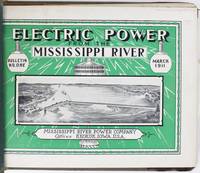
19135027Keokuk Ia: Mississippi River Power Company 1913. Very good. Ten volumes complete. Profusely illustrated. Oblong folio. Each issue measuring 9 x 12 inches in original pictorial wrappers two holes punched along spines and bound together in a later gray cloth Tatum-style Y binder with leather corners. Minor edge wear and staining to boards. Light edge wear to contents. A couple of panoramic photographs detached but present. A complete run of bulletins tracking the progress of construction on the Keokuk Dam & Power Plant which was then the longest monolithic concrete dam in the world and a pioneering effort in large-scale low-head hydroelectric power. Still in operation today the dame served as a prototype for many future power plants harnessing the power of the Mississippi River between Keokuk Iowa and Hamilton Illinois generating clean low cost and reliable energy enough to power 75000 homes. The present bulletins are chock full of facts figures photographs renderings and progress reports intended to familiarize the public with the project by illustrating the methods employed in its construction from beginning to completion. The bulletins are about equal parts text and photographs providing an easy-to-follow format for learning about the Keokuk project. Some of the issues also have folding maps or larger-format photographs which provide further visual accompaniment to the explanatory text.<br /> <br /> Known as a "run-of-river" plant the Keokuk Dam uses the natural energy of falling water to generate electricity. The power of this part of the river was identified by none other than Robert E. Lee in 1836 when he was serving as a surveyor for the U.S. War Department. Lee called attention to the turbulent waters but found no way to control it. In 1899 a group of leaders from Keokuk and Hamilton teamed up raised the backing funds received governmental approval for the dam and hired Hugh L. Cooper to oversee the project. Cooper had previously engineered construction of a hydroelectric plant at Niagara Falls. Interestingly an observation tower was also built on both sides of the river to allow the public to watch the progress of the Keokuk project then the largest privately-funded construction effort in the world. In addition to the dam a powerhouse and a new lock and dry system to accommodate river traffic were also built. The final bulletin includes comments from the chief engineer who noted that in the first bulletin it was stated that the project would be completed by July 1 1913. He remarks: "It is naturally a source of great satisfaction to all concerned with construction to see this prediction fulfilled."<br /> <br /> An informative and substantial production relating to a major construction project on the Mississippi River in the early-20th century. OCLC records a smattering of institutional holdings but complete runs appear to be rather rare. Mississippi River Power Company unknown
192140729Washington D.C.: Published by the United States Coast and Geodetic Survey 1921. Large folding nautical chart printed on heavy paper stock. Colored. A rare original coastal survey of the Northern Gulf coast from Florida to Louisiana encompassing Panama City Rosemary Beach Seaside Grayton Destin Pensacola Gulf Shores Mobile Gulfport and the Mississippi Delta.<br/> <br/> Established by President Thomas Jefferson in 1807 as the Survey of the Coast the U.S. Coast and Geodetic Survey was the United States' first civilian scientific agency. This agency has followed its mission to survey the U.S. coastline create nautical charts of the coast and help increase maritime safety since its founding and has often played fascinating roles in significant chapters of U.S. history. It served in all theaters of the Civil War in the service of the Union Army and Navy pioneered acoustic exploration in the wake of the sinking of the Titanic and during WWI it worked to detect enemy submarines. In addition this agency worked to survey and produce detailed maps and renderings of the U.S. coast. These nautical survey maps commonly referred to as "T-sheets" provide fascinating insights into the history of the United States coastline which has and will continue to shift. These maps are the most important data source for understanding the physical and ecological characteristics of the U.S. shoreline. The present map is a highly detailed and accurate sea chart of the Gulf coasts of Florida Alabama Mississippi and Louisiana and an important historical view of the developing states. Published by the United States Coast and Geodetic Survey unknown
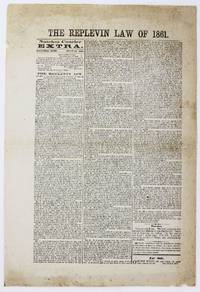
18654629Natchez Ms: July 22 1865. Very good. Broadside 13.75 x 9.5 inches. Printed in three columns. Moderate toning and foxing old folds couple of small tears expertly repaired on verso two tape remnants at top edge likely from previous matting. A very rare newspaper extra printing the first civilian law in Occupied Mississippi following the conclusion of the Civil War. After the war only military justice was in force in Mississippi. According to an 1866 Mississippi court case: "civil government of the State having been subverted and all power having passed into the hands of the authorities of the United States the question whether any and what civil government should be permitted was a matter in the discretion of those authorities. During this military occupation the laws of the State could only operate so far as they chose to allow and could only be administered by such agents as they pleased to appoint." On June 13 1865 President Andrew Johnson appointed William Lewis Sharkey 1789-1873 -- a Mississippi judge and staunch Unionist who opposed secession -- as the state's provisional governor. His first public act was to appoint judges and clerks to probate courts as well as appoint police justices of the peace and other country officers and authorized them to immediately begin to discharge their duties but excluded any orders regarding circuit and chancery courts.<br /> <br /> Two days later on July 3 Sharkey ordered the first civilian law to be operative which is published in the present broadside newspaper extra by the Natchez Courier. Sharkey's transmittal at the top begins: "Ordered. That the act in regard to the action of replevin and the amendments thereto passed by the legislature of Mississippi since the 9th day of January 1861 be and the same is hereby declared to be in full force from this date." The text of the act in twenty-six sections is then printed beginning: "The Replevin Act. An Act to provide for the speedy recovery of personal property wrongfully taken or detained." Somewhat oddly at the time this was the only civilian law in effect in Mississippi in the summer of 1865. According to the same 1866 court case excerpted above which explains the issues inherent in the issuance of the Replevin Law and Sharkey's organization of county probate courts "in all cases of the wrongful taking or detention of personal property a summary remedy by action of replevin before two justices of the peace was given to the party injured to recover the property and damages for the wrongful taking or detention. This was the only court created by the governor for the adjudication of legal rights; and these are the only cases committed to its jurisdiction; leaving all the rest of the immense mass of legal rights wholly without any redress." OCLC and other newspaper sources reveal just a single mutilated copy of the present broadside at the American Antiquarian Society. A fantastic broadside dealing with Mississippi law at the outset of Reconstruction.<br /> Scott v. Bilgerry April Term 1866 in Reports of Cases Argued and Determined in the High Court of Errors and Appeals for the State of Mississippi. Vol. XL. New York: Bank Brothers 1867 pp. 119-157. July 22 unknown
182263107Columbia MS 1822. Oblong folio 7 5/8 x 12 3/8 inches. Partly printed broadside document headlined "The State of Mississippi / To all who shall see these presents greeting / followed by 14 printed lines with spaces left for appropriate material to be entered by manuscript in this case appointees name and position place of execution date and officials' signatures. Leake a native of Virginia served in the Revolutionary War and in the state legislature moving to the Mississippi Territory in 1807 when appointed judge by Thomas Jefferson; following Mississippi's admission to statehood he was appointed one of its first two senators taking a seat of the state's supreme court following his resignation from the senate in 1820 and was elected governor in 1821 assuming office in January 1822. During his two terms Leake oversaw the beginning of a major road system arranged for the transfer of land to support a state university and signed a law abolishing imprisonment for debt among other achievements. Grimball was the second Secretary of State for Mississippi serving 1821-1833. Columbia served as capital of Mississippi for a about 18 months 1821-1822 before Jackson became its permanent site. Somewhat browned but very good. Previously folded. A scarce early Mississippi state document. 9863. <br/><br/> unknown books
53661Folio. 21 pages approximately 3500 words in pencil; accompanied by a letter to the editor of the Memphis Commercial Appeal suggesting an effort to organize a Confederate reunion trip to Gettysburg folio two pages approximately 225 words. Poor quality paper very browned and brittle the text quite legible. An affecting personal manuscript memoir written near the turn of the 20th century by a private who served in Co. G. Camden Rifles of the 18th Mississippi Infantry a unit raised in Madison County Mississippi under the command of Col. Erasmus R. Burt mortally wounded at Leesburg in October 1861 and immediately sent to Virginia where it participated in most of the battles of the Army of Northern Virginia. Maxwell includes notes on some of the battles including Bull Run "Captain Adam McWillie was commanding our Co. and was killed. John Tucker Bishop and a number of others wounded and died at Hospital" Leesburg "We fought Gen. Baker killed him and captured all the force but we lost our Col. Burt and I lost one of my schoolmates Johnson Sutherland . H.F. Adams shot and his gun kicked he and I into a ravine close by just at that time Col. Burt was wounded and thought we were too and said boys lets get of the field if we can. He died" Malvern Hill "2 brothers dead . the bros. were Hansetts fell across each other. Baker Barnett & C. Hix was wounded and died at the hospital. we lost heavy but the victory was so complete in the main that Gen. Lee concluded to go into MD" Antietam "I put my hand on Gen. Jacksons foot in the stirrup as sat erect on his horse telling the men who had surrendered what to do. All this would have been grand to me if it had not been for the loss of another dear classmate Thompson Walker who was wounded and died at Charlestown Va." Fredericksburg "the most complete victory Gen. Lee ever won . we were well protected behind a stone fence. We never lost many but we killed dead on the field over 1000 men" Chancellorsville "Gen Hooker concluded he would go to Richmond . history will tell you how he got there" Gettysburg "a private soldier does not see of know much about a fight that he is engaged in but we had been cut to pieces . in fact there was but 8 out of 38 left of us" Chattanooga "We made a flying trip . the Yanks did not know who we were nor where we came from" Chickamauga "we did not lose heavy" and Knoxville "we kept exchanging fire . he missed me. I ran up to the pit and demanded them to surrender which they did and I captured two yanks with an empty gun" especially mentioning by name officers and school chums who were killed or wounded along the way. The manuscript ends rather abruptly at Knoxville before the unit returned to service in Virginia at the Wilderness. Along the way Maxwell records several anecdotes that bring his narrative to life an extended account of a day's trip back to an abandoned camp with Yankee troops near by to rescue the company's fiddle an account of dueling Yankee and Rebel bands finally playing and singing together at Christmas before Fredericksburg in 1862 another extended report of aid given to a young soldier who was searching for his dead brother killed at Chickamauga and an account of two young ladies met while traveling to Tennessee promising to pray for his safety and sending him a letter received while fighting at Knoxville. Maxwell closes his narrative in tragedy relating stories of one friend being shot as a deserter on orders from Gen. Longstreet in Tennessee and another at Gettysburg pleading to be "put out of misery" after having "his entrails shot all to pieces. We have not discovered any indication of publication. For the 18th Mississippi Dornbusch lists two publications both by Major Lamar Fontaine one of the Immortal 600 dealing primarily with his experiences as a prisoner of war. <br/><br/> unknown books
40447Paris.Le Jay.1768. Seconde édition.2 vols.in-12 en demi-reliure à coins d'époque.2 frontispices et 2 planches gravées par St.Aubin.244 et 264 p.avec Table. BE.
1683PHO-1237Paris, Amable Auroy, 1688. In-12 (165x100mm), relié avec papier, étiquette avec titre manuscrit au dos , 10ff.-312pp. à la suite Les mœurs des Sauvages 107pp. SANS la carte .
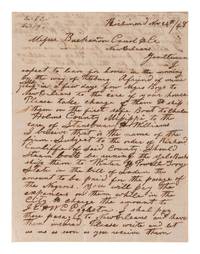
1848215241848. J.E. Eggleston correspondence dated 24 November 1848 documents the commercial shipment and sale of enslaved boys from Virginia to Mississippi within the interstate slave trade that expanded across the American South during the nineteenth century. The letter records logistical arrangements for transporting enslaved individuals through New Orleans before forwarding them by steamboat into the Mississippi interior. Written during a period when enslaved people were regularly moved from the Upper South to expanding plantation regions in the Deep South the document illustrates the economic and geographic structure of the domestic slave trade and reveals how enslaved children were treated as movable property within commercial networks linking Virginia Louisiana and Mississippi. The letter also directly references the relationship between the cotton market and the price of enslaved labor demonstrating how fluctuations in the agricultural economy shaped the buying and selling of enslaved people.<br /> <br /> Eggleston J.E. Autograph Letter Signed to "Messrs. Buckannon Carrol & Co." New Orleans. Richmond Virginia: 24 November 1848. One and one quarter pages written on a bifolium with address panel and postal markings. Eggleston informs the New Orleans firm that "a friend of mine will ship in a few days four Negro Boys to New Orleans to the care of your house" instructing them to receive the boys upon arrival and arrange onward shipment by steamboat to Mississippi. He directs the firm to "take charge of them & ship them on the first safe Boat to Chula Holms County Mississippi to the care of Stansbuary & Williams" with alternate instructions if river traffic permits delivery through another route. The letter treats the boys as financial cargo noting that the shipping record should state "the amount to be paid for the passage of the Negroes" and instructing the firm to cover any temporary expenses and charge them to the Eggleston account. Eggleston further notes that he will insure the enslaved individuals during the journey indicating the practice of protecting enslaved property through commercial insurance policies during transport.<br /> <br /> The letter also connects the purchase of enslaved labor directly to the speculative cotton economy of the nineteenth century South. Eggleston explains that falling cotton prices influenced his purchasing decisions writing that "owing to the low price of cotton I determined to purchase no more negroes at present. They are selling too high for the prospect of the price of cotton." Such remarks demonstrate the close relationship between commodity markets and the valuation of enslaved people within the plantation economy. Correspondence documenting the logistics of the interstate slave trade provides direct evidence of how enslaved individuals were transported through commercial networks linking coastal ports and inland plantations. Bifolium measuring approximately 6.5 x 8.75 inches with address panel postmark and "Paid 10" postal marking. Light creasing and toning with minor ink bleed through; folded for mailing. Overall very good condition. The letter preserves firsthand documentation of the commercial mechanisms that sustained the nineteenth century domestic slave trade. unknown
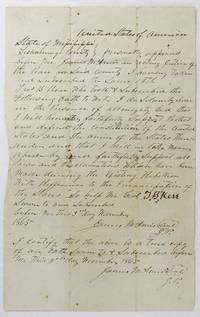
18655112Tishomingo County Ms: November 3 1865. Very good. 1p. of manuscript on a folio sheet. Old folds minor wear and soiling. A manuscript true copy of a loyalty oath taken by Thomas B. Kerr of Tishomingo County Mississippi following the end of the Civil War. The oath itself reads: "I do solemnly swear in the presence of almighty God that I will hereafter faithfully support protect and defend the Constitution of the United States and the Union of the states thereunder and that I will in like manner abide by and faithfully support all laws and proclamations which have been made during the Existing Rebellion with reference to the Emancipation of the Slaves. So help me God." The document is signed by Kerr as well as the Justice of the Peace James M. Amis and docketed on the verso "Thos. B. Kerr amnesty oath." Amnesty oaths from Mississippi are increasingly more rare in the market especially those directly referencing the Emancipation Proclamation and the end of slavery. November 3 unknown
1964List1009Atlanta: The Student Voice Inc. 1964. Single page measuring 12 ¾ x 7 ¾ inches folded. An exceptional copy very fine with no noted flaws. Fine. Offered here is a pristine copy of a fundraising pamphlet for the Mississippi Summer Project likely printed in in February of 1964 at the beginning of the fundraising and organization efforts by The Student Voice Inc. the separately incorporated publishing company for the SNCC. Over 1000 volunteers would travel to Mississippi and join thousands of local participants in what would eventually be known more commonly as Freedom Summer. The brochure lays out the scope of the effort which includes voter registration Freedom Schools community centers a research project a white community project and a law student project. The iconic photographs by Danny Lyon and Norris McNamara were taken during the Freedom Day protests at Hattiesburg Mississippi in January of 1964. [The Student Voice, Inc.] unknown books
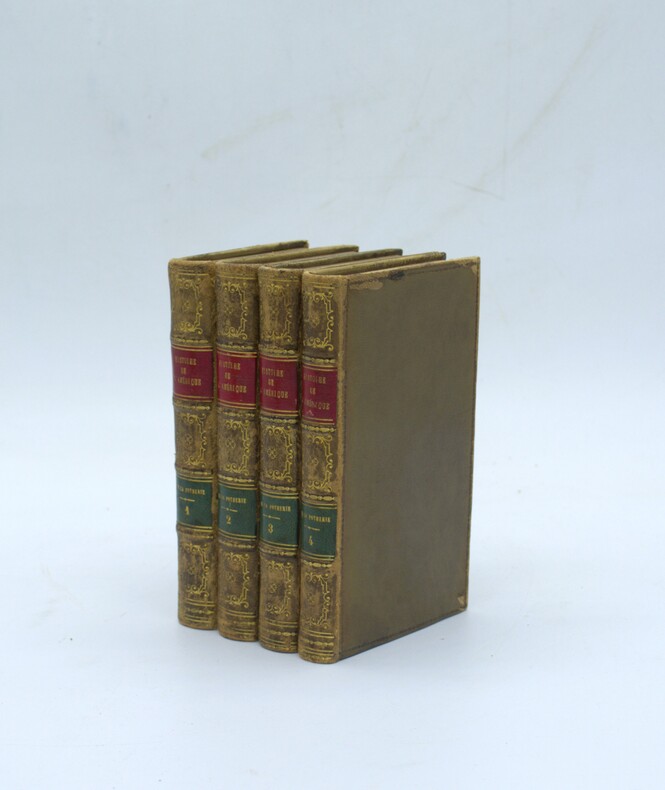
18041502190017City of Washington : A. & G. Way 1804-01-01. Hardcover. Very Good. Ocatvo. 7 109 p. ; 22 cm. Bound in publisher's paper wraps. In custom made box. Small stain to front wrap. Wear to extremities. Library stamp to second page from NYPL dated 1902. Contemporary owners name to head of title page of Thomas Dwight Massachusetts representative during the 8th Congress. Dwight's notations to some pages. Shaw & Shoemaker 7540. Sabin 52708 OCLC 1484388 <br> An extremely important Yazoo document. The Yazoo land scandal was a massive fraud perpetrated from in the mid-1790s by Georgia governor George Mathews and the state legislature. They sold large tracts of land in the Yazoo lands in what are now portions of Alabama and Mississippi to political insiders at very low prices in 1794. <br>With the end of the American Revolutionary War most of the states of the new Union attempted to extend their territorial claims from the Proclamation line of 1763 to the lands towards the Mississippi River. <Br> The Yazoo scandal began after the Bourbon County Act was dissolved in 1788 under pressure by the federal government a secret society was formed called the Combined Society formed with purpose money by land speculation. The group gained power in the state legislature and in the following year three companies The South Carolina Yazoo Company The Virginia Yazoo Company which was headed by Patrick Henry and the Tennessee Company built by the society's interests formed to buy land from Georgia. These venture were exposed and the deal for the land fell through in 1792 though the members of the Society still wished to develop Georgia lands. <br>In 1794 four companies were formed with several principal being from the original members of 1789 purchases and high ranking Georgian politicians to purchase 40 million acres of land for $500000. On January 7 1795 Governor Mathews signed into law a bill authorizing the sale of the 40000000 acres known as the Yazoo Act. When the details of the sale were revealed public outrage was widespread and people protested to federal officials and Congressmen. Jared Irwin and U.S. Senator James Jackson led the reform efforts: Irwin was elected Governor of Georgia and less than two months after taking office signed The Rescinding Act on February 13 1796 nullifying the Yazoo Act. <br> On the same day of The Rescinding Act 11 million acres of the Yazoo land was sold to the New England Mississippi Land Company who felt the repel was illegal for $1138000 a 650% profit in 13 months' time. The lands west of Georgia would be ceded to the United States government in the Compact of 1802 for 1.25 million. This last act threw land holders into a limbo and claims by third-party owners who had innocently purchased land from the original companies would not be resolved till 1816. <br> With the last private sale prior to the Compact of 1802 coupled with the 11th amendment the landmark case of Fletcher v. Peck would occur. John Peck of Massachusetts bought land from someone who could trace his title to the state of Georgia from 1795 when the Act was legal. He then sold 15000 acres to Robert Fletcher of New Hampshire based on a warranty deed warranting good title. The two were obviously citizens of different New England states and in June 1803 Fletcher sued Peck in federal circuit court in Massachusetts on diversity grounds alleging that the title was bad and requesting the return of his money. This landmark Yazoo document attempts to serve the land holders affected by the 1802 Compact the fledgling court case as well as an attempt to repel the sale by the State of Georgia. City of Washington : A. & G. Way hardcover
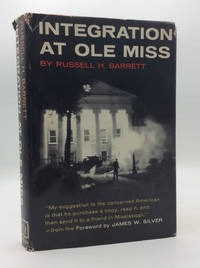
1282914A small group of material relating to the October 1962 riots at the University of Mississippi following the enrollment of the school's first Black student James H. Meredith.<br /> The highlight of this collection is a copy of the book INTEGRATION AT OLE MISS by Russell Barrett which is annotated by Ole Miss professor William B. Keith. Included is a xerox copy of an unpublished two-page typed letter by Keith detailing his experiences during the riot.<br /> The letter is addressed to his close friend Don Davis a high school history teacher and principal in Ohio. In the letter Keith recalls the trepidation of not knowing how Gov. Barnett would respond the the Federal government forcing the issue of desegregation at Ole Miss; his recollection of the Sept. 30 Ole Miss football game; and the subsequent beginning of the riots the following day.<br /> Keith and a friend then graduate students at Ole Miss went over the Lyceum where students were gathering. He notes there are actually pictures of him in the crowd included in the Barrett book and that he has marked them. He was still in the crowd when the first volley of tear gas was fired into the crowd. A State Patrol officer next to him was struck in the head and Keith and a Miss. patrolman carried the officer to safety. It then occurred to Keith to go over to the biology building to lock up the dangerous acids kept there a smart move as rioters did break into the building to search for flammable acids. His account then ends as he watched the rest of the action on television.<br /> The letter is included in a copy of Russell Barrett's Integration at Ole Miss Chicago: 1965 1st ed which is inscribed from the author to Don Davis the recipient of Keith's letter. Also included is a two-page ALS from Keith to Davis discussing hopes they can visit soon. Keith became a long-time Professor of Biology at Ole Miss until his death in 2007. The whereabouts of the original of the letter if it still exists are unknown.<br /> Also included:<br /> James W. Silver. Mississippi: The Closed Society NY: Harcourt Brace 1964. Inscribed to Davis by Bill Keith along with an original one-page typed letter signed from Keith to Davis.<br /> <br /> James W. Silver. Running Scared: Silver in Mississippi. Inscribed from Keith to Davis.<br /> <br /> A four-page typed document which was distributed on the Ole Miss campus in late Sept. 1962 by the school's Board of Trustees. The first page is a statement from the Trustees that they are complying with the Federal Court order to enroll James Meredith. The remaining three pages are a copy of the official court order. The document is is signed by Wm. B. Keith on the first page. unknown