Bolivar, SimonBiblio.com
837 résultats
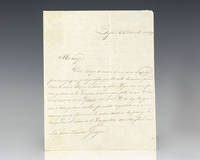
1827126188Bogota 1827. Rare autograph letter signed by 'El Libertador' Simón Bolívar as President of Gran Colombia. One page script in Spanish. Sent from Bogota the letter is dated December 6 1827 and reads in full "A la Senora Manuela Garaycoa. Umd. siempre se eccele a si misma on bondades para conmigo y me prodiga elofios ques ellos solo bastarian para saviar la codica del mas ambivioiso de gloria. Y que otra cora podria yo esperar de las Garaycoas de esas amigas fieles de esas Colombians constantes de esa Gloriosa sin rival Yo les doy las gracias a todas y seame tambien permitido congratulamme a mi mismo ya que e algun modo be podidos sustitur la paz y la tranquilidad al corazon de los Guayaquilenos un sacrificio me ha cortado - el de mi reposo pero que importa que paderca yo para que umds. gozen Que yo peresac para que viva un Puebla Tenga v Senora la bondad de coreesponder a las espreciones de toda su buena y amable familia. Digale mil cosas a Pepe ese pepe tan bueno tan patrista y de quien esperaba yo nada menof de lo que ha hecho por su pais y creame como he sido diempre. Su mas afectisimo amigo de corazon. Simón Bolívar" which translates into English as "To Senora Manuela Garaycoa. My friend who always shows kindness to me and lavishes praise on me that they alone would suffice to savor the greed of the most ambivalent of glory. And what other heart could I expect from the Garaycoas of those Faithful friends of those constant unrivaled Glorious Colombians I thank you all and let me also congratulate myself since in some way I have been able to substitute the peace and the tranquility to the heart of the Guayaquilenos a sacrifice has made me cut off - that of my rest but what does it matter what I suffer for you to enjoy That I perish for a people to live Have you Senora the kindness to respond to the expectations of all your good and kind family tell a million things to Pepe so good. and from whom I expected nothing less than what he has done for his country and believe me as I have always been. His most affectionate friend at heart. Simón Bolívar. " The recipient Manuela Garaycoa was an Ecuadorian independentista. She participated in the anti-colonial struggle in the second war of independence and despite the death of her son Abdón Calderón at a young age in battle maintained a strong bond with the independence struggle and frequently corresponded with Antonio José de Sucre and Simón Bolívar. In near fine condition. With a portrait of Bolivar. Venezuelan military and political leader Simón Bolívar also known as 'El Libertador' led what are currently the countries of Venezuela Bolivia Colombia Ecuador Peru and Panama to independence from the Spanish Empire in the campaign for the independence of New Granada which began in 1808 and was consolidated with the victory at the Battle of Boyacá on 7 August 1819. Despite a number of hindrances including the arrival of an unprecedentedly large Spanish expeditionary force the revolutionaries eventually prevailed culminating in the victory at the Battle of Carabobo in 1821 which effectively made Venezuela an independent country. Following this triumph over the Spanish monarchy Bolívar participated in the foundation of the first union of independent nations in Latin America Gran Colombia of which he was president from 1819 to 1830. Through further military campaigns he ousted Spanish rulers from Ecuador Peru and Bolivia the last of which was named after him. He was simultaneously president of Gran Colombia present-day Venezuela Colombia Panama and Ecuador Peru and Bolivia but soon after his second-in-command Antonio José de Sucre was appointed president of Bolivia. Bolívar aimed at a strong and united Spanish America able to cope not only with the threats emanating from Spain and the European Holy Alliance but also with the emerging power of the United States. At the peak of his power Bolívar ruled over a vast territory from the Argentine border to the Caribbean Sea. unknown
1892296808New York: COLTON G. W. and COLTON C. B. 1892. unbound. very good. Large folding map mounted on linen 29 1/2 x 37 1/2 inches in very good condition bound with 28 pp of text 10 blank pages. Manuscript notes in pencil. 8vo 3/4 polished calf. New York: G.W. Colton & C.B. Colton 1892. Scarce. Very good .<br/> <br/> "Real estate speculators shippers and business interests could not agree on the best way to utilize the Harlem river debating whether public works should facilitate traffic across the river or shipping along the river. Coastal trade interests advocated for a Harlem River Canal but their opponents argued that transportation across the river was more important. This map of the river between the Hudson River top and the East River bottom accompanied an unsuccessful proposal to have the state legislature turn the Harlem into a subterranean river and connect Manhattan with the mainland between Third and Eighth Avenues section shaded red." Gotham Center for New York history. Small abrasions along folds. Includes notes for the proposed site for Columbia University.<br/> <br/> COLTON, G. W. and COLTON, C. B. unknown
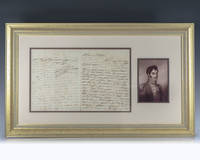
18291261831829. Rare autograph letter signed by ‘El Libertador’ Simón Bolívar as President of Gran Colombia. One page script in Spanish on both recto and verso. The letter is dated May 13 1828 and offers the recipient Colonel José Félix Blanco Bolívar's support in his struggle to maintain the security of Barinas of which was made Governor in 1827 in the midst of heavy criticism from several officers including General José Antonio Páez. Bolívar notes that the offending officers have been dismissed in order to prevent the possibility of partial influence on the resulting hearings and regrets that he will be unable to the proceedings in Orinoco but expects Blanco's reputation to be restored in four to six months. Signed by Bolívar at the conclusion of the letter. The recipient Colonel José Félix Blanco joined the war of independence in 1810 serving as chaplain and was appointed intendant Governor of Barinas in 1827. He was among the defenders of Valencia in the first siege of the city and participated in the first battle of Carabobo. Active in a variety of military government and religious capacities over the course of several decades he was later appointed commander of arms of the province of Maracaibo Secretary of War and Navy in 1837 and Secretary of the Treasury and Foreign Relations in 1847 after an unsuccessful run for the vice-presidency of the Republic in 1844 and for the presidency in 1846. In near fine condition. Double matted and framed with a portrait of Bolívar with a glass pane on the verso of the frame displaying the letter in full. A unique association. Venezuelan military and political leader Simón Bolívar also known as 'El Libertador' led what are currently the countries of Venezuela Bolivia Colombia Ecuador Peru and Panama to independence from the Spanish Empire in the campaign for the independence of New Granada which began in 1808 and was consolidated with the victory at the Battle of Boyacá on 7 August 1819. Despite a number of hindrances including the arrival of an unprecedentedly large Spanish expeditionary force the revolutionaries eventually prevailed culminating in the victory at the Battle of Carabobo in 1821 which effectively made Venezuela an independent country. Following this triumph over the Spanish monarchy Bolívar participated in the foundation of the first union of independent nations in Latin America Gran Colombia of which he was president from 1819 to 1830. Through further military campaigns he ousted Spanish rulers from Ecuador Peru and Bolivia the last of which was named after him. He was simultaneously president of Gran Colombia present-day Venezuela Colombia Panama and Ecuador Peru and Bolivia but soon after his second-in-command Antonio José de Sucre was appointed president of Bolivia. Bolívar aimed at a strong and united Spanish America able to cope not only with the threats emanating from Spain and the European Holy Alliance but also with the emerging power of the United States. At the peak of his power Bolívar ruled over a vast territory from the Argentine border to the Caribbean Sea. unknown
1892296808New York: COLTON G. W. and COLTON C. B. 1892. unbound. very good. Large folding map mounted on linen 29 1/2 x 37 1/2 inches in very good condition bound with 28 pp of text 10 blank pages. Manuscript notes in pencil. 8vo 3/4 polished calf. New York: G.W. Colton & C.B. Colton 1892. Scarce. Very good .<br/><br/> "Real estate speculators shippers and business interests could not agree on the best way to utilize the Harlem river debating whether public works should facilitate traffic across the river or shipping along the river. Coastal trade interests advocated for a Harlem River Canal but their opponents argued that transportation across the river was more important. This map of the river between the Hudson River top and the East River bottom accompanied an unsuccessful proposal to have the state legislature turn the Harlem into a subterranean river and connect Manhattan with the mainland between Third and Eighth Avenues section shaded red." Gotham Center for New York history. Small abrasions along folds. Includes notes for the proposed site for Columbia University.<br/><br/> COLTON, G. W. and COLTON, C. B. unknown books
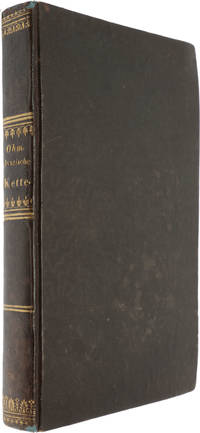
18275475Berlin: J.G.F. Kniestädt for T.H. Riemann 1827. First edition. <p>First edition of "Ohm's great work" DSB containing the fully-developed presentation of his theory of electricity including Ohm's Law. "Ohm's great contribution − 'The Galvanic Chain Mathematically Calculated' − was to measure the rate of current flow and the effects of resistance on the current. 'Ohm's law' − that the resistance of a given conductor is a constant independent of the voltage applied or the current flowing was arrived at theoretically by analogy with Fourier's heat measurements" PMM.</p>. PMM 289 - Measuring Electricity. First edition of "Ohm's great work" DSB containing the fully-developed presentation of his theory of electricity including Ohm's Law. "Ohm's great contribution − 'The Galvanic Chain Mathematically Calculated' − was to measure the rate of current flow and the effects of resistance on the current. 'Ohm's law' − that the resistance of a given conductor is a constant independent of the voltage applied or the current flowing that is C = E/R where C = current E = electromotive force and R = resistance − was arrived at theoretically by analogy with Fourier's heat measurements 1800-14" PMM.<br/> <br/> <br /> <br /> "The expression "investigated mathematically" in the title of Ohm's book described his objective: to deduce the properties of the galvanic circuit from a set of "fundamental laws." The first of these laws states that electricity passes only between adjacent particles of the conductor and that the quantity passed is proportional to the difference in electroscopic force at the two particles. Here Ohm drew on an analogy to Fourier's heat theory in which the quantity of caloric passed between two particles is proportional to the difference between their temperatures. Ohm's second law supported by Coulomb's experiments states that the loss of electricity in unit time from the conductor to the air is proportional to the electroscopic force of the electricity to the amount of surface exposed and to a coefficient that depends on the air; acknowledging that this second law has little bearing on the phenomena of galvanic currents Ohm included it to make the theory complete and parallel to Fourier's theory of heat. The third and last law states that two bodies in contact maintain the same difference of electroscopic force at their common surface which is the basic tenet of the contact theory of the battery. From these three laws Ohm derived differential equations for electric currents analogous to Fourier's and Poisson's for heat which indicated to him an "intimate connection" between the two phenomena. <br/> <br/> <br /> <br /> "The mathematical expression of Ohm's physical analogy between the conduction of electricity and the conduction of heat is an equation identical in form to Fourier's. The only difference is in the physical significance of the symbols entering the equation: in Fourier's the independent variable is the temperature; in Ohm's it is the electroscopic force which is the force with which an electroscope a body of constant electrical condition is attracted to or repelled from a body it is brought into contact with. Following an approach Fourier had made familiar Ohm mathematically divided the conductor into infinitely thin discs and calculated the quantity of electricity transferred per unit time across the parallel surfaces and outward through the edges of the discs. The result was the fundamental second-order partial differential equation of Ohm's theory . Having formulated the physical problem as a differential equation Ohm then solved it to obtain relations between directly measurable quantities. Manipulating the solution written as an infinite series of sine and cosine functions with damping coefficients Ohm arrived at . his law relating electric current resistance and tension. <br/> <br/> <br /> <br /> "The "torch of mathematics" Ohm wrote shines through physics illuminating its dark places. With his Galvanic Circuit he could claim that mathematics had "incontrovertibly" possessed a "new field of physics from which it had hitherto remained almost totally excluded." By means of mathematical deductions from a few experimental "principles" galvanic phenomena had been brought together in "closed connection" and presented as a "unity of thought." The deductions showed that the seemingly disparate phenomena of electric tension and current are really connected in nature partially realizing Ohm's goal of fashioning the theory of electricity as a "whole" .<br/> <br/> <br /> <br /> "When the Galvanic Circuit appeared few physicists in Germany knew mathematical physics sufficiently to understand it. Journal editors were afraid their readers could not understand papers containing the simplest mathematics as Ohm complained. For reviewing Ohm sent a copy of his book to Schweigger at Halle who did not see the point of a mathematical treatment. To have it evaluated the Prussian minister of culture sent a copy to Kämtz Schweigger's colleague at Halle who could not follow the mathematical derivation as is clear from his cautious review of it. In Berlin which desperately needed a "mathematical physicist" Ohm's work received its most famous and to Ohm irritating review from Pohl who was neither a mathematical nor a typical Berlin physicist . Pohl complained that Ohm had not paid attention to the "essence" of the circuit and had merely expressed some properties of electricity in formulas. This was no achievement but only a replication of Fourier's and Poisson's work in another part of physics . In general the response to Ohm's book reflected a paucity of physicists with good mathematical knowledge in Germany in the late 1820s. But one German review of Ohm's book showed complete comprehension. Ohm sent his book to Kastner in Erlangen to be reviewed in his journal. Kastner asked the mathematician Wilhelm Pfaff to write the review but Pfaff did not know the literature . The review that appeared under Pfaff's name was apparently written by Ohm himself after his brother had interceded. The review was of course favourable but a favourable review does not necessarily make a successful book. Sales of the Galvanic Circuit were unimpressive and Ohm paid friends to order the book from out of town to make a better impression on the publisher. The book was in print for eight years then not again for sixty years though in the meantime it had come out in several translations. Ohm sent free copies to everyone who might help him as he did not want to return to his teaching in Cologne" Jungnickel & McCormmach pp. 53-7. <br/> <br/> <br /> <br /> Georg Simon Ohm 1789-1854 was educated together with his brother Martin the mathematician principally by his father who gave his sons a solid education in mathematics physics chemistry and the philosophies of Kant and Fichte; their considerable mathematical ability was recognized in 1804 by the Erlangen professor Karl Christian von Langsdorf who enthusiastically likened them to the Bernoullis. Ohm received his Ph.D. from the University of Erlangen in 1811 but after teaching there for three semesters as a Privatdozent he was only able to find employment as a schoolteacher first at Bamberg and then from 1817 at the recently reformed Jesuit Gymnasium at Cologne. "The ideals of wissenschaftliche Bildung had infused the school with enthusiasm for learning and teaching; and this atmosphere which appears later to have waned coupled with the requirement that he teach physics and the existence of a well-equipped laboratory stimulated Ohm to concern himself for the first time avidly with physics. He studied the French classics − at first Lagrange Legendre Laplace Biot and Poisson later Fourier and Fresnel − and especially after Oersted's discovery of electro-magnetism in 1820 did experimental work in electricity and magnetism. It was not until early in 1825 however that he undertook research with an eye toward eventual publication" DSB.<br/> <br/> <br /> <br /> "Feeling increasingly burdened by his teaching at a secondary school in Cologne Ohm took his father's advice and asked the Prussian minister of culture for a year off. To the minister he explained that for a long time he had divided his attention between mathematics and physics though for practical reasons he had emphasized physics. By taking up physics he did not have to give up mathematics he said since the two were closely connected. His appeal to the minister contained an element of calculation: he regretted that the French had recently dominated physics and he had been studying the mathematical works by Laplace Fourier Poisson Fresnel and other French masters to see what they had left for him to do. He had been doing purely experimental work on the whole but he had in hand a mathematical theory of galvanic current; all he needed was time off to complete it and he added to work out a theory of light as well. On the recommendation of Ermann the minister approved Ohm's request. With half salary Ohm went off to Berlin in 1826 to live in his brother's house where he had a small apartment with space for doing experiments. With these improved working conditions he developed the mathematical theory of the galvanic current perhaps with his brother's help with the calculations. The result was the Galvanic Circuit .<br/> <br/> <br /> <br /> "After the Galvanic Circuit Ohm carried out important researches on tones and on crystal optics and he undertook a comprehensive theory of physics. In the year the Galvanic Circuit was published he began to speak of a greater work to come one that would treat the whole of molecular physics. Apparently he wanted to derive all physical phenomena from analytical mechanics and molecular hypotheses. Ohm published the first volume containing the mathematical preliminaries. In the second volume he intended to treat dynamics and in the third and fourth its application to physical phenomena. But Ohm's late call to Munich University interfered with his plan and the volumes never appeared. The existence of the plan however pointed to the confidence of the author of the Galvanic Circuit in the power of mathematical physics to complete the understanding of nature that Newton had begun" Jungnickel & McCormmach pp. 53-8. <br/> <br/> <br /> <br /> Widespread understanding and acknowledgement of the importance of the Galvanic Circuit did not come until the late 1830s and early 1840s when Ohm's work began to receive official recognition with corresponding memberships of the Berlin and Turin academies in 1839 and 1841 respectively the award of the Royal Society of London's Copley Medal in 1841 and finally just before his death the chair of physics at the University of Munich in 1852. In 1881 when the importance of Ohm's work was fully understood the standard unit of electrical resistance was named the ohm in his honour at the Paris Conference on international standards. <br/> <br/> <br /> <br /> Waller 11419; Wellcome IV p. 260; Wheeler Gift Cat. 835. Jungnickel & McCormmach Intellectual Mastery of Nature. Theoretical Physics from Ohm to Einstein Volume 1: The Torch of Mathematics 1800 to 1870 1990. <br /> <br/> <br/> 8vo 195 x 123 mm pp. iv 245 errata on p. 245 1 folding engraved plate. Contemporary patterned German cloth gilt spine lettering light wear to capitals and corners. Previous owner's signature removed from title. Custom half leather clamshell box. J.G.F. Kniestädt for T.H. Riemann unknown
18252471825. Folding engraved plate in Vol. IV. Five vols. Large 4to handsome antique blue morocco-backed marbled boards flat spines nicely gilt. Paris: J.B.M. Duprat & others An VII 1798-1825.<br/> <br/> First edition and a complete set with all the supplements. In this monumental and fundamental astronomical work Laplace -- the "Newton of France" -- codified and developed the theories and achievements of Newton Euler d'Alembert and Lagrange. "Laplace maintained that while all planets revolve round the sun their eccentricities and the inclinations of their orbits to each other will always remain small. He also showed that all these irregularities in movements and positions in the heavens were self-correcting so that the whole solar system appeared to be mechanically stable. He showed that the universe was really a great self-regulating machine and the whole solar system could continue on its existing plan for an immense period of time. This was a long step forward from the Newtonian uncertainties in this respect.Laplace also offered a brilliant explanation of the secular inequalities of the mean motion of the moon about the earth -- a problem which Euler and Lagrange had failed to solve.He also investigated the theory of the tides and calculated from them the mass of the moon."Printing & the Mind of Man 252. <br/> <br/> A very nice set. Our set has the first state of the titles of Vols. I and II and all the supplements. It lacks the title leaf for the first supplement in Vol. IV. <br/> <br/> Dibner Heralds of Science 14. D.S.B. XV pp. 273-403. En Français dans le Texte 201. Horblit 63. Roberts & Trent Bibliotheca Mechanica pp. 197-98. unknown
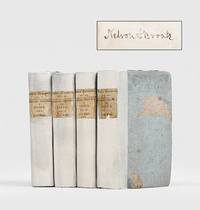
1803178761London: James Ridgway 1803. Nelson seeks intelligence on an ambivalent ally Horatio Nelson's set with his ink signature "Nelson & Bronte" on the front free endpaper of volumes VI VII and VIII and occasional marginal pencil marks. This is the first edition to be translated by Francis Blagdon being volumes V-VIII in the publisher's Modern Discoveries series. The review in the Monthly Mirror may have caught Nelson's eye which noted that "the abilities of Mr Blagdon are fully adequate to this important undertaking. We have no doubt that this publication will become extremely popular". Nelson has recently April-June 1801 concluded a term as second-in-command Baltic Fleet which naturally brought him into contact with Britain's Russian allies. In this theatre Russia "did not share the maritime commercial interests of her Scandinavian clients: she sought control of the theatre and a rapprochement or worse with France. The British had long recognised this strain in Russian policy. Consequently Denmark Prussia and Sweden were coerced into following a Russian programme which had at its heart the assertion of dominance over their countries and the establishment of the Baltic as a Russian mare clausum closed sea - a consistent aim of Russian policy since the days of Peter the Great" Lambert p. 189. For this journey through Russia the German naturalist and traveller Peter Simon Pallas 1741-1811 accompanied by his wife and daughter and the artist C. G. H. Geissler travelled down the Volga to Astrakhan and then through the Caucasus to the Crimea. His earlier gruelling six-year expedition through Siberia to the borders of China 1768-74 resulted in one of the most acclaimed contemporary accounts of those regions Travels into Siberia and Tartary. 4 vols duodecimo. With 22 engraved plates 2 folding. Uncut in original pale blue-grey boards sometime neatly rebacked preserving the original labels. Housed in a custom leather-entry pale green cloth slipcase. Some stripping of paper from boards of vols. II-IV pale tidemark to back cover of Vol. III inner hinges cracked but firm that of Vol. IV holding on one cord at front damp staining at beginning and end of Vol. II general toning and dust marking paper flaw to leaf H13 Vol. I without loss yet this remains a very good set. Cross D67 for the Longman edition; Troelstra p. 331. Andrew Lambert Nelson: Britannia's God of War 2005. hardcover
182733731827. One folding engraved plate. iv 245 pp. lacking the errata leaf & leaf of ads. 8vo cont. grey paste-paper boards lower joint with short split at head & foot. Berlin: T.H. Riemann 1827.<br/> <br/> First edition and a splendid association copy of this pioneering work which contains one of the most important discoveries in electrical science — “Ohm’s law†— the basis of the present system of electrical measurement. Ohm discovered the unit of resistance in an electrical current. This copy belonged to the “Prince of Mathematicians†— Carl Friedrich Gauss — and has the “Gauss-Bibliothek†stamp on the title. It is quite exciting to be able to link two of the greatest 19th-century scientists through an important book like this. <br/> <br/> “In the field of electrical measurement Ohm was the great pioneer…Ohm’s great contribution — ‘The Galvanic Chain Mathematically Calculated’ — was to measure the rate of current flow and the effects of resistance on the current. ‘Ohm’s law’ — that the resistance of a given conductor is a constant independent of the voltage applied or the current flowing — was arrived at theoretically by analogy with Fourier’s heat measurements 1800-14.â€â€“Printing & the Mind of Man 289. <br/> <br/> It is known that the publisher was forced to pulp most of the copies of this book due to lack of sales. <br/> <br/> A very fine and fresh copy. Lacking the errata leaf it clearly was never bound-in and as usual the leaf of ads. With the stamp of the Royal Observatory at Göttingen on free front endpaper with release stamp facing on the front paste-down endpaper and title. <br/> <br/> ⧠Dibner Heralds of Science 63. Horblit 81. Sparrow Milestones of Science 154. Wheeler Gift Cat. 835. unknown
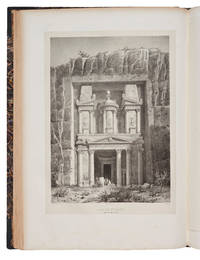
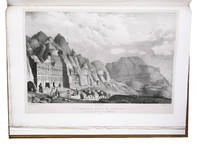
1830ABC_47846Paris 1830. Imperial folio 42 x 59.6 cm. Giard Simier binding in gold-tooled half green morocco and marbled paper over boards elaborately gold-tooled spine and stamped in gold: "Simier R. du Roi" marbled endpapers. With a large lithographed title vignette and the coat of arms of Wilhelm II on the dedication leaf. 69 lithographed plates maps and plans after Laborde and Linant de Bellefonds mostly mounted on India paper including 3 folding and 2 coloured. 8 87 1 pp. The first edition of this "important work" Blackmer: a monumental folio beautifully bound by René Simier 1772-1843 for King Louis-Philippe of France from whose library it came into the hands of the great art collector and founder of the French branch of Rothschilds Baron James de Rothschild.The volume is complete with all the magnificent views in large folio format; all subsequent editions including the English one were published in octavo and retained only a few plates of the original edition all considerably reduced in size. The work was published following the trip undertaken by the Marquis Léon de Laborde 1807-69 and remained famous in particular for its views of Petra and its Khazneh. Laborde made the journey to Petra with the engineer Linant de Bellefonds in 1828 travelling from Suez via St. Catherine's and through Wadi al-Araba to Akabah. Although Burckhardt Irby and Mangles had explored Petra before Laborde he was the first to make detailed drawings of the area.Born in Frankfurt under the Holy Roman Empire James de Rothschild initially moved to Paris to aid his brother Nathan Mayer Rothschild's business there; shortly he established himself and his family at the heart of France's industrial revolution and charted a steady course through the upheavals of 19th century French politics. Elevated to the status of Baron his interest in art was genuine and his collection well-respected.A beautiful text with an important provenance: bound for King Louis-Philippe of France. Latterly in the collection of the banker James Mayer Rothschild 1792-1868 founder of the French branch of the prominent Rothschild family.With the armorial bookplate of James de Rothschild and label of the Château de Ferrières on the front pastedown. Marbled paper subtly and professionally recovered at an early stage. Marginal dampstain apparent throughout.l Blackmer 929; Brunet III 714; Gay 929; Henze III 101; Nissen ZBI 2335; Vicaire IV 758f; not in Atabey; cf. Howgego 335 L2 1830-33 ed.; Macro 1386 2nd ed. only. ABE CAT Art History hardcover
1830J3RDYNHESRKMParis: Giard colophon: printed by the Imprimerie Normale/Jules Didot l'ainé 1830. Period-style half calf with gilt title to spine. Royal 1mo 42 x 59.5 cm. With a lithographic title page with a large lithographed title vignette separately printed on "India" paper and mounted on the title page and lithographed coat of arms of the dedicatee Wilhelm II of Hesse printed directly on dedication leaf 69 lithographed plates 3 double-page and 1 larger folding showing views maps and plans after Laborde and Linant de Bellefonds most separately printed on "India" paper and mounted on the leaves. With 1 zoological plate of a marmot and young: "El Oueber" subtly coloured as published. First edition of "an important work" Blackmer of a stunning and beautifully illustrated account of some of the earliest explorations in the Sinai southern Jordan and northwest Arabia complete with all the magnificent views in extremely large format the double-page plates measuring about 58.5 x 83 cm and the folding map of the Sinai about 74 x 102 cm. All subsequent editions including the English one were published in octavo and contained only a few plates based on the present first edition all in drastically reduced format. The plates show maps plans of ancient sites views of ruins and other buildings coastal and other topographic views costume plates hieroglyphic and other inscriptions flora and fauna. Laborde journeyed to the ancient city of Petra in what is now Jordan with the engineer Linant de Bellefonds in 1828 travelling from Suez via St. Catherine's and through Wadi al-Araba to Akabah. The topographic term Arabie Pétrée derives from Ptolemy's division of Arabia into three regions. The maps in the present book show it as the Sinai peninsula the southern part of what is now Jordan and the northwestern part of the Arabian peninsula. The city of Petra itself is extensively documented in many of the present beautiful plates.Slight browning and foxing occasional waterstaining and tears to folds; a small tear in the map repaired but in all a good wide-margined copy in loose sheets apparently never bound. Rare: the last complete copy came up for auction in 2009 Christie's 3 June lot 120: £23750.l Blackmer 929; Brunet III col. 714; Gay Bibl. de l'Afrique et l'Arabe 929; Henze III 101; Vicaire IV cols. 758-759; cf. Macro Bibliography of the Arabian peninsula 1386 2nd ed.; not in Atabey. Giard (colophon: printed by the Imprimerie Normale/Jules Didot l'ainé), unknown
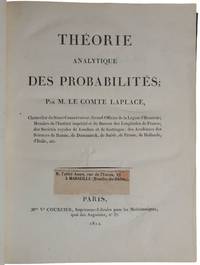
18256347Paris: Courcier; Huzard-Courcier 1825. First edition. <p>First edition very rare complete with all four supplements the fourth being especially scarce of what Anders Hald called "the most influential book on probability and statistics ever written." John Herschel praised it as "the ne plus ultra of mathematical skill and power." In this landmark work Laplace gave probability and statistics their first comprehensive theoretical foundation shaping the field for over a century. The supplements-composed between 1816 and 1825-extend its applications to natural philosophy and geodesy. No copy with all four supplements appears in RBH; even the Honeyman copy lacked the last three. This is the finest copy we have encountered. Provenance: Barthélémy Aoust 1814-1885 French mathematician and professor at Marseille.</p>. The Most Influential Book on Probability and Statistics Ever Written. <p>First edition very rare - especially when accompanied as here by all four supplements the fourth of which is of extreme rarity - of the most influential work on probability and mathematical statistics ever written. Pierre-Simon Laplace's Théorie analytique des probabilités published at Paris by Veuve Courcier in 1812 codified into a single mathematical framework the principal results of probability theory from Jakob Bernoulli's Ars Conjectandi of 1713 through Laplace's own four decades of research and established the analytical methods - generating functions characteristic functions asymptotic approximations the method of least squares the central limit theorem - that governed the subject for the next century and beyond. John Herschel called it 'the ne plus ultra of mathematical skill and power'. The DSB observes that it came to have the same relation to the later development of probability that Newton's Principia had to the later science of mechanics. This is the finest copy we have seen. RBH lists no copy with all four supplements and only two copies with the first three Gonnelli 2024 €35280; Sotheby's 2007 $25000; the Honeyman copy had only the first supplement.</p> <br /> <br /> <p>The work emerged from a long series of memoirs. Laplace had been publishing on probability since the early 1770s but the results were scattered across the publications of the Académie Royale des Sciences and the Institut de France and no single treatise had brought them together. The Théorie analytique is that treatise and Laplace's introduction to the first edition - eliminated in the second and third editions in favour of the Essai philosophique - sets out the programme in his own terms: he is concerned he writes to determine the probability of causes and results as exhibited in events that occur in large numbers and to investigate the laws according to which that probability approaches a limit in proportion to the repetition of events. The investigation he adds will benefit observers in identifying the mean to be chosen among the results of their observations and the probability of errors still to be apprehended and it will interest philosophers in showing how there is a regularity underlying the very things that seem to pertain entirely to chance. He closes by noting that the same analysis can in principle be applied to annuities tontines insurance inoculation with vaccine and the decisions of electoral assemblies. He never wrote the separate work on civil applications he here promises but the thought of it may have been what led him to expand his old École Normale lecture into the Essai philosophique sur les probabilités two years later - the non-mathematical companion that contains the celebrated passage on Laplace's demon and the philosophical argument that probability is the rational response to ignorance not a measure of it.</p> <br /> <br /> <p>Book I subtitled Calcul des fonctions génératrices develops the algebraic machinery of the treatise. Generating functions - power series whose coefficients encode the probabilities of interest - transform combinatorial and probabilistic problems into problems of analysis making them accessible to the methods of the calculus. The first part presents the theory of generating functions as a branch of the calculus of finite differences; the second develops the method of approximating by definite integrals the values of expressions containing very large numbers the technique that yields the asymptotic formulas on which all the practical results of the later chapters depend. Laplace traces the historical lineage of these methods through Lagrange Leibniz Newton and Wallis back to Descartes's invention of numerical exponents situating his own work as the natural continuation of two centuries of analytical development. The most important revision from his earlier memoirs of the 1780s is the omission of material on partial differential equations that was relevant to physics but not to games of chance and a correspondingly greater emphasis on the passage from finite to infinitesimal quantities and from real to imaginary complex numbers - two processes that Laplace found increasingly fertile as his command of the subject deepened.</p> <br /> <br /> <p>Book II Théorie générale des probabilités constitutes the subject. It is more than a republication of earlier memoirs: Laplace drew together the main types of problems from the theory of chance already treated by many mathematicians in a somewhat haphazard manner and re-handled them in tandem with problems from the new areas of application in the philosophy of science astronomy geodesy instrumentation error population and the procedures of judicial panels and electoral bodies. The first chapter lays down the general principles: the definition of probability the rule for multiplying the probabilities of independent events and a verbal statement of Laplace's theorem on the probability of causes inverse probability now called Bayesian inference - still without mentioning Bayes by name. Chapter 2 the most considerable occupying about a quarter of Book II treats the probability of compound events: lotteries Laplace adduces the French national lottery with its ninety numbers drawn five at a time the extraction of balls from urns order and sequence in the retrieval of numbered objects the division of stakes and the ruin or survival of a gambler - the classical problems of the subject now solved systematically by generating functions and arranged not for their own sake but to illustrate a typology of problems in probability at large.</p> <br /> <br /> <p>Chapter 3 concerns the laws that result from the indefinite multiplication of events. It contains Laplace's most general statement of the central limit theorem: that when the number of independent observations increases the distribution of their mean tends toward a Gaussian form regardless of the distribution of the individual observations and that the limits within which the mean will fall with a given probability grow closer together as the number of observations grows. The theorem is the mathematical foundation of modern statistics; it explains why the bell curve appears ubiquitously in nature and why averaging works. Laplace illustrates the theorem from birth records - the ratio of boys to girls taken from the registries of Paris London and Naples provides empirical figures for the prior probabilities that the theory then subjects to analysis.</p> <br /> <br /> <p>Chapter 4 on the probability of error represents the most significant development in the subject as a whole compared to Laplace's earlier memoirs. It derives the least-squares law for combining observations - the method that Legendre had published in 1805 and that Gauss had claimed priority for - first for the case of a single unknown element and then for two or more together with the probability that the resulting estimate will fall within given limits. The chapter includes instructions on the application of the analysis to the correction of astronomical tables and closes with a historical sketch in which Laplace renders Legendre and Gauss each his due in the development of the method.</p> <br /> <br /> <p>Chapter 5 applies probability to the investigation of phenomena themselves - to establishing the physical significance of data amid the complexities of the world. The principal example is the daily variation of the barometric pressure which long observation shows to be normally highest at nine in the morning and lowest at four in the afternoon. Laplace calculates the probability that this diurnal pattern is due to a regular cause the action of the sun rather than to chance and determines its mean extent. He raises the further question of atmospheric tides as a second contributing cause - a question he could not then resolve for lack of data but which became the subject of the last calculation he ever performed. The chapter closes with an application of probability to Buffon's needle problem - the probability that a needle tossed onto a grid of parallel lines will cross a line a problem Laplace adapts to a statistical method for approximating the value of π. Chapter 6 reworks Laplace's early memoir on the probability of causes applying inverse probability and the method of definite-integral approximation to population statistics; he now has figures from the partial census which at his request the French government had conducted in 1801.</p> <br /> <br /> <p>The brief seventh chapter returns to the effect of unequal prior probabilities mistakenly assumed to be equal - a finding Laplace always considered among his most important since it demonstrated the care required when mathematical calculations are applied to physical events. There are he insists no perfect symmetries in the real world and allowance must be made for slight deviations of parameters from assumed values. Chapters 8 through 10 treat life expectancy annuities tontines insurance the effect of vaccination on the death rate Laplace concludes that the eradication of smallpox would increase life expectancy by three years provided the resulting population growth did not outrun the food supply and moral expectation - Daniel Bernoulli's principle that the prospective benefit of a gain is not its absolute amount but its ratio to the total wealth of the beneficiary. Laplace adopts the principle as a guide to prudent conduct and concludes that in the most mathematically advantageous games of chance the odds are always unfavourable over time and that diversification is a prudent practice in the investment of wealth.</p> <br /> <br /> <p>The four supplements issued between 1816 and 1825 extend the theory into applied territory. The first 1816 applies inverse probability to the analysis of criminal proceedings - Laplace calculates the probability that a conviction is erroneous given assumptions about the truthfulness of jurors and concludes that the English jury system with its requirement for unanimity weights the odds too heavily against the security of society while the French criminal code with its plurality rule across two courts is unjust to the accused. The second 1818 turns to geodesy comparing Laplace's method of combining equations of condition with the method of Boskovic; Stigler considers this discussion the earliest instance of a rigorous comparison of two well-elaborated methods of estimation for a general population strikingly similar to the analysis that led R. A. Fisher to the concept of sufficiency in 1920. The third 1819 applies the method to the extension of the Delambre-Méchain survey of the meridian from Perpignan to Formentera; Laplace estimates the law of error on the basis of all 700 triangles in the original survey and calculates the probabilities of error in the resulting length of the meridian. The fourth 1825 the rarest generalises the Problem of Points using the method of generating functions and includes corrections to earlier results in the main text.</p> <br /> <br /> <p>The bibliographical context of the supplements compounds the difficulty of assembling a complete set. Each was issued separately by Veuve Courcier and her successor Huzard-Courcier in print runs of unknown but evidently small size and the four were never gathered together as a single bound publication during the early nineteenth century. Copies that left the publishing house with the supplements bound in were assembled by the binder copy by copy from sheets purchased separately; copies sold without binding rarely retain the supplements at all since these were slim pamphlets without the binding of their parent and easily separated from it. The fourth supplement of 1825 the rarest of the four was issued only two years before Laplace's death in 1827 and saw no further reprinting in the parent author's lifetime; it is the supplement most often missing from copies offered for sale. RBH records no copy of the work with all four supplements; the two copies recently in commerce with the first three lack the fourth and the Honeyman copy lacked the second third and fourth. The probability of all four reaching a single contemporary owner surviving together through two centuries of binding rebinding and dispersal and arriving intact in a single contemporary cloth was in any literal sense vanishingly small.</p> <br /> <br /> <p>Laplace's analytical apparatus passed quickly into general use after his death. Adolphe Quetelet the Belgian astronomer and statistician who had visited Laplace in Paris in the 1820s applied the central limit theorem to social phenomena in his Sur l'homme of 1835 founding what he called physique sociale - the systematic statistical study of human populations. Francis Galton in the 1880s adapted Laplace's framework to the study of inheritance defining regression to the mean and the correlation coefficient. Karl Pearson at University College London working from Galton formalised the chi-squared test in 1900 and established the moment-generating function Laplace's generating function under another name as the standard apparatus of the new mathematical statistics. R. A. Fisher's 1922 paper On the Mathematical Foundations of Theoretical Statistics introduced the concepts of likelihood and sufficiency that defined the modern subject; Stephen Stigler's 1986 study of the history of statistics observes that Fisher's argument on sufficiency closely parallels the comparison Laplace had drawn in the second supplement of 1818 between his own method of combining equations of condition and that of Boskovic. Through Quetelet Galton Pearson and Fisher the analytical framework of the Théorie analytique survived intact into the twentieth century and it continues to underlie every confidence interval hypothesis test and regression analysis performed in any field that depends on quantitative inference. The hidden continuity is part of what Laplace meant when he wrote in the introduction here suppressed that probability furnishes a regularity to the very things that seem to belong to chance.</p> <br /> <br /> <p>Pierre-Simon Laplace 1749-1827 the son of a cider-farmer in Normandy arrived in Paris in 1769 and within a decade had established himself as the foremost mathematical astronomer in Europe. His Mécanique céleste 1799-1825 is the most important work in mathematical astronomy since the Principia; the Théorie analytique des probabilités holds the same position in its own field. Between them the two works secured his reputation as - in the phrase that has clung to him since his own century - the Newton of France. He served Napoleon as Minister of the Interior for six weeks in 1799 Napoleon dismissing him observed that he had brought the spirit of the infinitely small into the work of government; he was elected to the Académie française in 1816 made a count of the Empire under Napoleon in 1806 and elevated to the rank of marquis at the Bourbon Restoration in 1817. He died at Paris on 5 March 1827 on the eve of the issue of the fifth volume of the Mécanique céleste which his son Charles-Émile saw through the press in his name. The 1812 Théorie analytique was the keystone of his late career and the work that consolidated mathematics as the apparatus of a quantitative science of human and natural events.</p> <br /> <br /> <p>Provenance: Barthélémy Aoust 1814-1885 French mathematician professor in the Faculty of Sciences at the University of Marseille from 1854 until his retirement. Aoust's research interests centred on differential geometry and on the analysis of curves and surfaces - questions distant enough from probability theory for the present volume to have functioned in his library as a reference work rather than a working text and the absence of marginalia in his hand suggests as much. His contemporary printed address label pasted to the title page in the early 1850s when he established himself at Marseille places this copy among the books he assembled for his teaching there and identifies it as part of his personal library.</p> <br /> <br /> <p>References: DSB XV 367-376 - Evans 12 - Grolier/Horblit 63a - Honeyman 1923 - Printing and the Mind of Man 252 - Stigler ch. 24 in Grattan-Guinness ed. Landmark Writings in Western Mathematics 1640-1940 2005 - Hald A History of Mathematical Statistics from 1750 to 1930 1998 - Stigler The History of Statistics: The Measurement of Uncertainty before 1900 Harvard 1986.</p> <br /> <br/> <br/> <br /> <p>Five parts bound in one vol. 4to 253 × 194 mm pp. vi 464 2: errata and blank; 34; 50; 36; 2 28. Contemporary green half-cloth over green marbled boards spine with raised bands compartments ruled in gilt and decorated in blind with a gilt lettering-piece top edges yellow-speckled spine very slightly rubbed small paper label at tail. A fresh well-margined copy internally clean.</p> . Courcier; Huzard-Courcier unknown
182754811827. Folding engraved plate in Vol. IV. Five vols. Large 4to 281 x 200 mm. cont. polished calf sides panelled in blind & gilt spines decorated in blind & gilt a.e.g. Paris: J.B.M. Duprat & others An VII 1798-1825-1827.<br/> <br/> First edition a magnificent set on large and fine paper complete set with all the supplements. This is the only large and fine paper set I have ever seen on the market.<br/> <br/> In this monumental and fundamental astronomical work Laplace — the “Newton of France†— codified and developed the theories and achievements of Newton Euler d’Alembert and Lagrange. “Laplace maintained that while all planets revolve round the sun their eccentricities and the inclinations of their orbits to each other will always remain small. He also showed that all these irregularities in movements and positions in the heavens were self-correcting so that the whole solar system appeared to be mechanically stable. He showed that the universe was really a great self-regulating machine and the whole solar system could continue on its existing plan for an immense period of time. This was a long step forward from the Newtonian uncertainties in this respect…Laplace also offered a brilliant explanation of the secular inequalities of the mean motion of the moon about the earth — a problem which Euler and Lagrange had failed to solve…He also investigated the theory of the tides and calculated from them the mass of the moon.â€â€“Printing & the Mind of Man 252.<br/> <br/> A magnificent set preserved in two boxes. Our set has the first state of the titles of Vols. I and II and all the supplements the supplement in Vol. V issued in 1827 is on regular paper.<br/> <br/> ⧠Dibner Heralds of Science 14. D.S.B. XV pp. 273-403. En Français dans le Texte 201. Horblit 63. Roberts & Trent Bibliotheca Mechanica pp. 197-98. Sparrow Milestones of Science 125. unknown