468 résultats
19021511San Francisco 1902. Very good. 120pp. including twenty plates many folding. 12mo. Original limp calf front cover gilt lettered. Light wear to spine and extremities. Internally quite clean. A very interesting early 20th-century manual and rule book for personnel in the Maintenance and Way Department of the Southern Pacific Railroad. Contained here are rules and instructions for a wide array of railroad employees including roadmasters bridge superintendants trackmen bridgemen and other watchmen. The principal portion of the text comprises nearly 270 general rules and regulations such as those governing the adjustment of woodtruss bridges lining and surfacing track keeping clear rights of way and establishing standards for numerous other basic repairs on track ties signals and other critical infrastructure. A short appendix contains laws from the several states in which Southern Pacific operated regarding the accidental killing of livestock by trains and railroad employees. At the rear are twenty plates many folding with reference diagrams for track and other maintenance projects.<br /><br />This edition is revised from the first edition of 1898 with a substantially different pagination. Several plates have been excised from the rear of this copy; however the only other copy that we locate of this work at UC Santa Barbara also is lacking a number of plates. books
1896WRCAM56242Chicago: Poole Bros. 1896. Chromolithographic broadside 24 x 9 inches. Old horizontal folds. Small tear at upper margin likely from posting no text affected. Very good. Rare and colorful broadside advertising "the Shortest and Quickest Route" to "all points West" on the Wabash Line connecting through St. Louis. The sheet features a full-color image of the famous Wabash flag as well as the seals of Colorado and California. Customers are promised that all trains feature "Free Reclining Chair Cars and Pullman Buffet Sleeping Cars" and are provided a name and address to acquire maps and timetables. <br> <br> At the time this broadside was issued Charles M. Hays was general manager and the Wabash railroad was under the control of financier Jay Gould who was working feverishly to establish a full coast-to-coast system. He had merged the St. Louis Kansas City & Northern Railroad with Wabash creating the Wabash St. Louis & Pacific Railroad. Then as with many other Eastern and Midwest railroads Wabash partnered with Union Pacific to provide service further west. By 1896 Gould's son George had taken over the railroad and proceeded to expand it further swallowing up the Missouri Pacific Western Pacific Denver & Rio Grande Western Western Maryland and Wheeling & Lake Erie railroads. Hays left in 1896 to become general manager and later president of the Grand Trunk Railway in Canada which helped extend the Wabash network north. <br> <br> An attractive artifact from one of the great American railroads. We could find no copies recorded in OCLC. Poole Bros. unknown books
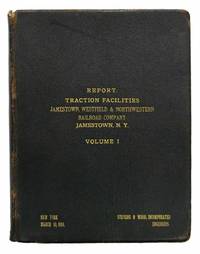
192644099New York: Stevens & Wood Incorporated 1926. 1st Edition. Leather binding with title gilt stamped to front cover. Brown marbled paper eps. Edgewear. Minor chipping at spine ends. Very Good. 83 numbered leaves. Typed text recto only on onionskin paper with red rule border. Leaves 71 through 83 with 26 b/w captioned photographs 2 per leaf on recto. Of the 26 photographs 3 show rolling stock e.g. 'Class "B" Passenger Car No. 310' with the remainder showing divers buildings etc e.g. 'Passenger Station - Village of Westfield' & 'Signal Tower at Pennsylvania R.R. Crossing in Mayville'. 11" x 8-3/8" <br/><br/>This report 1 volume of 3 submitted on March 10 1926 in New York by Stevens & Wood to George L. Maltby General Manager of the Jamestown Westfield & Northwestern Railroad Company is an inventory and appraisal of the property of the railroad including: 1 the electric railway line located in the County of Chautauqua NY owned and operated by the railroad including roadways tracts paving bridges culverts fences signs signals telephone lines poles and fixtures distribution and transmission system; 2 railroad lines located in Chautauqua County NY known as the Chautauqua and Falconer Branches of the railroad which have not been electrified and have been abandoned including roadways tracks bridges and culverts; 3 cars and their electrical equipment; 4 substation buildings and equipment in Westfield and Mayfield; 5 feeder lines interconnecting the distribution system along the right of way of the railroad with the Chautauqua Traction Company’s substation at Stow and in Mayville; 6 all stations waiting rooms and miscellaneous buildings and structures identified as the property of the railroad; 7 Midway Park owned by the railway company. Not present are Volumes II & III with "inventory summaries showing quantities prices and extensions grouped according to Tax Districts and by accounts and the Cost References." An excellent source of New York local history for the mid-1920s. Stevens & Wood, Incorporated hardcover books
1940WRCAM55587Various places in the American West as described below below 1940. Sixty-nine photographs 8 x 10 inches each mounted on linen and bound in two volumes. Oblong small folios. Black pebbled vinyl secured by brads. Moderate wear to covers a few photos creased at edge and most starting to curl linen backing fraying on some photos but overall very good. A collection of striking promotional photographs created to enhance Union Pacific Railroad travel brochures. This collection is focused almost exclusively on the Western United States. The first volume consists primarily of campus photos of western universities with captions in pencil on the verso. Photographs portray the Universities of Nebraska Oregon Wyoming Colorado Denver Kansas Idaho and Montana; Oregon Washington Montana and Kansas State Universities; and finally Stanford University College of Idaho Midland College Nebraska Doane College and Creighton University. The last five photos are images of entrees perhaps for dinner menus on western routes. A number of these photos are stamped "Please Credit Union Pacific Railroad Photo" on the verso. <br> <br> The second volume is composed exclusively of scenes from Colorado with typed captions on the verso. There are images from Rocky Mountain National Park more broadly including Alberta Falls Pike's Peak Railway and the Hidden Inn but the majority are in and around Colorado Springs. There are shots of the Broadmoor and Antlers Hotels downtown Colorado Springs Seven Falls Garden of the Gods Cheyenne Mountain Zoo Cheyenne Mountain Lodge and Will Rogers Shrine. The album then moves to southwestern Colorado with images of Ridgway scenes along the Million Dollar Highway Steamboat Springs San Juan Mountains and Silverton and Molas Lake. A number of these photos are also stamped on the verso with Union Pacific stamps these specifically mentioning the Public Relations Department in Los Angeles and including the identification number of the negative. unknown books
1884280East Tennessee Virginia and Georgia Railway Company O'Brien John F. General Superintendent and Flippen T. D. Auditor. <i>East Tennessee Virginia and Georgia Railway Company List No. 14. List of Stations and Names of Agents. </i>ETV&G Railway Office of the Auditor Knoxville January 31 1884. A broadside directory listing the agents by name and by town for the East Tennessee Division and branches for the Alabama division the Atlanta division and the Brunswick division and branches. A broadside sheet 34 cm x 36 cm black ink on white paper fold creases otherwise very good. The ETV&G railway became part of the Southern Railway in 1894. The ETV&G made Knoxville Tennessee a wholesaling center as it provided both passenger and freight rail service to many small communities in Appalachia. East Tennessee, Virginia and Georgia Railway Company books
1851406078New York: Wm. C. Locke & Co 1851. Wrappers chipped at edges professionally rebacked some unobtrusive offsetting on map. 8vo. 50 pages. Large folding map on three joined sheets 21 x 1788 cm; 8.25 x 61.75 inches. 11 woodblock illustrations in text and with 2 more not recorded in the index but always present. Original printed wrappers with woodblock vignette. SCARCE Hudson River Railroad travel guide published the first year in which the full line was completed. It covers points of interest along the route with woodblocks illustrating the text. Topics include: the history of the Hudson River the history of the construction of the Hudson River Railroad and the cities towns and villages along the Hudson from New York City all the way to Troy. Concerning the West Point Foundry at Cold Spring the guide states: "the iron foundry was established here by Gouverneur Kemble. The works are situated about a mile west of the village upon a small stream which tumbles rapidly down the mountains affording considerable water power. It is the largest establishment of its kind in the country employing nearly five hundred hands constantly." The building of the Hudson River Railroad is another topic in the guide. The project was considered highly impractical since much of the route had to be cut through extremely difficult rock and terrain. This section includes a description of the tunnels which had to be constructed. The railroad was opened in three stages. In September 1849 it allowed passengers to travel from New York to Peekskill. By that December 6 twenty-three additional miles were opened extending to New Hamburg. By the 31st of the month it was open the remaining distance of nine miles to Poughkeepsie. The Hudson River Railroad was an extension of the Troy and Greenbush Railroad which was chartered in 1845 connecting Troy South to Greenbush now Rensselaer on the east side of the Hudson. The Hudson River Railroad was chartered on May 12 1846 to extend this line south to New York City. The full line opened on October 3 1851 the same year in which this travel guide was published. WorldCat/OCLC records 25 copies but it is scarcely found complete with the map and the map is also excluded from the digitized versions available online. <br/><br/> Wm. C. Locke & Co unknown books
18821204Portland Or: George H. Himes 1882. About very good. 328pp. plus photograph frontispiece. Original printed wrappers. Spine ends chipped; some light dust soiling and wear to wraps. Slight fading to frontispiece photo but a clear image. Light even tanning internally; three leaves with small patches of damp staining. A scarce 1882 promotional for potential excursions from Portland Oregon published in conjunction by the Northern Pacific Railroad and the Oregon Railway & Navigation Company. The work is illustrated with a real photograph of the Multnomah Falls east of the city on the Columbia River. The text prints itineraries for ten trips from Portland in the Pacific Northwest to the Cascades the Dalles Seattle Tacoma Olympia Ilwaco and even Alaska almost all via the steamers of the Oregon Railway & Navigation Company. The final four leaves of text contain numerous illustrated advertisements for Portland businesses. The frontispiece photograph of the Multnomah Falls is credited in print to Issac Grundy Davidson. "One of the Northwest's premier photographers Davidson published an extensive series of scenic photographs covering many aspects of life and scenes throughout Oregon Washington and Alaska. He operated portrait studios a traveling gallery and contracted with the Northern Pacific Railroad. A keen businessman who produced the finest photographic record of Oregon during the 1870s-80s" - Mautz. An excellent example of the collaboration between a pre-eminent photographer of the Pacific Northwest and the Northern Pacific Railroad as well as an unusual and scarce specimen of a rail and river travel promotional illustrated with a real photographic print. George H. Himes unknown books
1868WRCAM33573Washington 1868. 39pp. plus large color folding map. Modern maroon cloth gilt maroon morocco label. Minor dust soiling in text. Map bright and clean. Overall very good. An application to Congress by the Northern Pacific Railroad headed by Minnesota railroad magnate James J. Hill for federal aid to support the Railroad's expansion to the West Coast. The petition reviews the railroad's original charter and includes an impressive color folding map "Map of the Country from Lake Superior to the Pacific Ocean" which illustrates the railroad's route from Duluth to Seattle and Portland. This map was originally produced to accompany Edwin Johnson's report on the feasibility of the railroad. This is one of the finest maps of the region traversed to be issued up to this time and was produced by Colton in New York not by the government. Wheat devotes several pages to discussing it noting that "the detail of such a map defies cataloging." Above the map appears an elevation chart for the same distance. <br> <br> A fine account of railroad expansion in the Northwest. Rare. Not on OCLC. MIDLAND NOTES 68-164. WHEAT TRANSMISSISSIPPI 1169. hardcover books
1860100432Large thick 4to contemporary calf spine and tips with marbled boards 70 very attractive color lithograph plates 358 41 pp. Extremeties worn minor aging one map has tear in lower corner plates bright and clean. The Pacific Railroad Surveys 1853-1855 explored possible routes for a transcontinental railroad. However the surveys went beyond looking for a place for a railroad they included and incredible amount of information on natural history and the peoples that inhabited the areas where the surveys explored. Representing the first part of the final volume of these surveys this installment focused on the northern route for a railroad. The 12 volumes included in these surveys is also known for rich illustrations many of which were in color. With 70 color plates one folding and three folding maps in Volume XII part 1 this edition is particularly rich in illustration and the plates are bright and clean. Thomas A. Ford hardcover books
30107Philadelphia: Press of J. B. Lippincott & Co n. d. 1st edition Romaine p. 301. Ca 1871 - 72. Original publisher's pebbled terra-cotta cloth binding with gilt stamped lettering to spine & front board. Beveled edges. Overall VG slightly shaken/some shelfwear. 134 pp. T.p. printed in red & black. Text within rectangular red-rule border. Illustrated with wood engraved frontis depicting the 'Baldwin Locomotive Works' factory 11 intratextual cuts & 16 pasted-in photographs of divers Baldwin locomotives. 4to: 11" x 7-5/8" <br/><br/>The Baldwin Locomotive Works an American builder of railroad locomotives was located in Pennsylvania originally Philadelphia then moving in 1906 to nearby Eddystone. The company was the largest US producer of custom made-to-order steam locomotives. Founded in the early 1830s by Matthais Baldwin the firm stopped producing locomotives in 1956 ceasing business in 1972 having produced over 70000 engines the vast majority powered by steam. This one of the firm's first photograhically illustrated catalogues a lavish production issued in the ealy 1870s as Baldwin overtook Rogers as the premier locomotive manufacturer in the United States. Herein will be found photographs of their divers products including fill in with some names of locomotives. While not a particularly rare catalogue it's importance & desirablility lies in documenting the ascent to prominence of this significant US heavy equipment manufacturer as well as being an early trade catalogue illustrated with actual photographs. Press of J. B. Lippincott & Co hardcover books
1868WRCAM33573AWashington: Government Printing Office 1868. 39pp. plus large color folding map 23 1/4 x 44 3/4 inches. Original printed wrappers. Presentation inscription on front wrapper see below. Wrapper edges chipped minor soiling and tanning to wrappers spine partially chipped old vertical fold to pamphlet. Light foxing and tanning and occasional soiling throughout Map with a few small closed tears at cross-folds with no loss. About very good. This copy is inscribed on the front wrapper: "With Regards of James Tilton C.E." Tilton 1819-78 was then chief engineer of the Washington Division of the Northern Pacific Railroad. Thanks in part to his support for Franklin Pierce's presidential campaign Tilton was appointed the first Surveyor General of Washington Territory and served from 1853-61. Both the Tilton River and Fort Tilton near Fall City Washington are named for him. <br> <br> An important report to Congress by the Northern Pacific Railroad headed by Minnesota railroad magnate James J. Hill for federal aid to support the Railroad's expansion to the West Coast. The petition reviews the railroad's original charter printing with it a memorial from the NPRR's Board of Directors and supporting communications from military figures including Montgomery Meigs and Ulysses S. Grant. Since the early 1850s Edwin Johnson described by Wheat as a "visionary" engineer had been associated with the plan to build a railroad across the northern part of the United States from the Great Lakes to the Pacific Coast. In 1867 he was named chief engineer of the Northern Pacific and this memorial is a work of major importance for the history of the railroad. It includes Johnson's topographical survey of the route to the Pacific a discussion of potential problems that may be encountered and a detailed economic and military survey of the area in justification of construction. <br> <br> The exceptional large folding "Map of the Country from Lake Superior to the Pacific Ocean from the Latest Explorations and Surveys" was produced by the Colton firm in New York. One of the finest maps of the region to date it shows the area from Detroit to the Pacific well into Canada and south to about the 39th parallel. Johnson has drawn the route of the Northern Pacific from Lake Superior to Washington Territory where the line splits with one branch heading toward Fort Vancouver and the other to Puget Sound. Among the details shown on the map are the Pony Express route wagon routes and overland mail routes exploration routes and other proposed railroad routes the locations of Indian tribes mineral deposits military forts and much more. Wheat gives a long description of the map and remarks that "the detail of such a map defies cataloging." Construction on the Northern Pacific Railroad began in 1870 and was completed in 1883. Edwin Johnson did not see its completion dying in 1872. An edition of this report with the supporting documents and map was also privately published in Hartford. <br> <br> A significant early account of railroad expansion in the Northwest. We could find only ten copies listed in OCLC and this is the first copy we have seen in wrappers and with a presentation from an important engineer on the project. RAILWAY ECONOMICS pp.242-43. SABIN 55819 Hartford edition. WHEAT TRANSMISSISSIPPI WEST V item 1169 pp.205-09. PHILLIPS MAPS p.916. DECKER 37:266 Hartford ed. MIDLAND NOTES 68:164. OCLC 60578657. Government Printing Office unknown books
18871408San Francisco 1887. About very good. 668pp. including numerous in-text or full page illustrations and eight photolithographed plates plus large folding map. Folio. Original pictorial wrappers. Wraps with some soiling wear at edges; front wrap with a few signs of biopredation; two small chips to rear wrapper; spine perishing at extremities. Minor worming at upper corner of a few interior leaves. Light tanning. A rare and extravagant promotional for the Pacific Cable Railway Company which manufactured installed and operated the famous streetcar system of San Francisco and in several other American cities. The present work also serves as a declaration of patent with a list of patents and patent holders at the rear and the text comprises a detailed technical description of the wire cable system with many illustrations of its mechanisms and operation as well as general accounts of the systems running in San Francisco Los Angeles Chicago and Kansas City. In addition to the technical diagrams are several attractive line illustrations and eight photolithographed plates reproduced by artotype of the cable cars of San Francisco in action all by Britton & Rey. The folding map at the rear provides a detailed delineation of the lines running across the city. Very scarce OCLC locates only five copies.<br /><br />Cowan II p.512. books
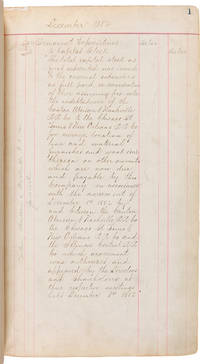
1944WRCAM55833N.p. likely Chicago 1944. 190pp. Folio. Contemporary black pebbled cloth boards with later red leather corners and backstrip gilt title on front board. Endpapers renewed. Minor rubbing and soiling to boards. Light thumb-soiling to text. Very good. An extensive and informative company ledger listing the assets properties profits losses and other business activities of the Canton Aberdeen & Nashville Railroad a subsidiary of the Illinois Central based in Chicago maintained over a period of more than sixty years. This ledger offers a rare glimpse into the economics of the railroad industry in the American South over a vast period of development from the immediate post-Reconstruction era to the requirements of the American war effort during World War II. <br> <br> The Canton Aberdeen & Nashville Railroad was incorporated on February 17 1882 as a subsidiary of the Illinois Central to acquire the branch already built in 1874 from Durant to Kosciusko Mississippi and extend it to Aberdeen and eventually to Nashville Tennessee. The line was completed as far as Aberdeen in 1888. A short disconnected section was also built from Winfield to Brilliant Alabama to serve several coal mines. The railway was officially dissolved and absorbed into the Illinois Central Railroad on August 21 1953. The current ledger records company activity for the great majority of the life of the Canton Aberdeen & Nashville Railroad. <br> <br> The ledger begins in December 1882 the year of incorporation of the railroad and is written in at least five distinct but highly readable hands. The early pages detail the "permanent expenditures" such as stock commitments construction costs equipment and interest; the construction costs are broken out into thirty-three line items including bridges cross ties grading iron rails right of way section houses stationery almost $50000 worth telegraph lines water stations and much more. This is followed by earnings statements profit and loss reports land costs mortgages additional permanent expenditures "sundries" to the Illinois Central and capital stock officers' and clerks' salaries bond payments advertising costs and other types of regularly-reported accounting through December 1944. Railroad accounting here is often reported as "Gross Receipts" balanced against "Operation Expenses" every quarter or six months and is later encapsulated as periodic "Additions and Betterments" and "Profit and Loss" statements in the latter two decades of the ledger. <br> <br> As the 20th century proceeds the ledger records business transactions between the Illinois Central and the Chicago St. Louis and New Orleans Railroad. The latter was based in Kentucky but was also working to build railroad lines in Mississippi and Tennessee during this time. The Illinois Central apparently made occasional "capital advances" to the Chicago St. Louis and New Orleans starting in 1913 which the latter then repaid in December 1919. The Illinois Central continued to make capital advances to the Chicago St. Louis and New Orleans throughout the time period recorded here. The Illinois Central would buy the Chicago St. Louis and New Orleans outright in 1951 absorbing its operations in Kentucky Tennessee and Mississippi. <br> <br> Other activities beyond the normal operations of the company include additional tracks and rail services provided to mining and manufacturing companies in the late 1930s and early 1940s. In December 1939 the Illinois Central agreed to construct "tracks to industry" located on property belonging to the American Colloid Company in Aberdeen Mississippi. The American Colloid Company appears to have been mining bentonite in Aberdeen and was in need of spur tracks to move their product to market or perhaps manufacturing plants. The Illinois Central also constructed further "tracks to industries" in December 1941 namely to the Nickles Lumber Company in Aberdeen and Moeller & Vandenboom also a lumber company in Ethel Mississippi. Depreciation "retirement or abandonment of nondepreciable property" "service value of nondepreciable" retired property and other "property retirements" occupy the latter few pages of the ledger. <br> <br> A dense and useful record of a southern railway's business activities for over half a century. Records for railroads operating in the American South are scarce especially for such a vast span of time. hardcover books
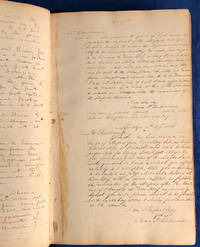
183524879<p>This volume is a fascinating primary source for the nation's oldest railroad still operating under its original name including correspondence setting the course for routes now traveled by millions of riders every month. Later use of this book by a New Jersey hatmaker and Civil War veteran gives insights into the daily life and expenses of a craftsman and farmer in the 1870s.</p> <b>LONG ISLAND RAILROAD.</b>Memorandum and Letter Book 1835-1872. 344 pp. of which 212 pp. have writing 8¼ x 13 x 1¼ in.<p><br /></p><p>This volume likely originally belonging to chief engineer James P. Kirkwood contains a wide variety of memoranda relating to the railroad. It begins with two pages of diary-like entries from February 8 to May 16 1836 including mention of Matthias W. Baldwin 1795-1866 the founder of Baldwin Locomotive Works February 8 and discussion of the route for the new Williamsburg Branch April 1 and reports on the contractors at Jamaica May 4 and 11.</p><p>It is followed by copies of two letters from the chief engineer regarding the delivery of railroad ties from Maine May 27 and August 4 1836 then six pages of estimates for grade work on new lines between Jericho and Ronkonkoma Pond between Jamaica and Jericho and between Flushing and Jericho.</p><p>Next are three draft letters totaling 40 pages to the president and directors of the railroad reporting engineering details on three different routes which had been surveyed from Jamaica to Greenport. The letters are dated November 4 1835 January 1836 and September 19 1836 and include tables estimating the costs for grading each route.</p><p>The following 37 pages include copies of letters to and from Long Island Rail Road engineer James P. Kirkwood between August 11 1835 and March 28 1837 mostly about surveying and construction issues. Among the interesting letters is one from Postmaster General Amos Kendall to the President of the Long Island Rail Road April 26 1836 asking for a map or plan of the route so the post office could update its maps. These pages also include an August 9 1836 letter from Lieutenant George Gordon Meade 1815-1872 acknowledging payment of $45.44 for "services rendered" to the railroad likely surveying shortly before he resigned from the army to pursue work as a civil engineer. Meade went on to lead the Army of the Potomac to victory at the Battle of Gettysburg in July 1863 and continued in command until the end of the Civil War.</p><p><b>James Pugh Kirkwood</b> 1807-1877 was born in Edinburgh Scotland. After his education and an apprenticeship to a land surveyor he began his own business in Glasgow in 1832. Later that same year he immigrated to the United States where he worked as an engineer on the Norwich & Worcester the Boston & Providence and the Stonington & Providence Railroads. In 1837 he became the resident engineer for the Long Island Rail Road. From 1840 to 1843 he was resident engineer for the Western Railroad of Massachusetts. Over the course of his career Kirkwood became one of the foremost civil engineers of the mid-nineteenth century. He was involved in many improvement projects to enhance the harbor of New York City. As general superintendent of the New York & Erie Railroad he pioneered the use of telegraph signals to manage trains. From 1850 to 1855 he was the chief engineer of the Missouri Pacific Railroad and managed its construction. He was a co-founder of the American Society of Civil Engineers in 1852 and served as its president from 1867 to 1868. He also became involved in a variety of water supply projects for various cities in the United States and Europe.</p><p><b>Long Island Rail Road</b> 1835-1928 1949-present is the oldest U.S. railroad still operating under its original name and charter. The New York General Assembly passed an act to incorporate the Brooklyn and Jamaica Railroad in 1831 which incorporated in 1832 to build a ten-mile line between those cities. Engineer Major D. B. Douglass planned for a continuation through the center of Long Island to near its eastern end to connect New York and Boston via rail and steamship. The legislature chartered the Long Island Rail Road Company in 1834. The railroad organized in June 1835 with Knowles Taylor as the first president and it soon acquired the Brooklyn and Jamaica line. The main line from Brooklyn to Greenport was completed in 1844 but rail and steamship service to Boston lasted only until 1847 when competing rail lines through southern Connecticut and steamships directly from New York took away business. The railroad then turned its attention to local service and added more branches to the northern and southern shores while small rival rail lines opened on the island. In 1875 New York rubber baron Conrad Poppenhusen acquired all of the railroads and consolidated them under the Long Island Railroad Company. By 1900 the Pennsylvania Railroad purchased a controlling interest in the Long Island Railroad and the railroad served more and more commuters into Manhattan. From 1928 to 1949 the railroad was largely owned by the Pennsylvania Railroad but it declared bankruptcy in 1949 and the Pennsylvania Railroad stopped supporting its debts. The Long Island Railroad came out of bankruptcy in 1954 and the State of New York purchased it in 1965. Today the railroad carries more than 300000 passengers each weekday over more than seven hundred miles of track.</p><p><b>Further items in the book:</b></p><p>Next comes eight pages of descriptions of land purchases dated between 1798 and 1842 which may be related to the Long Island Rail Road.</p><p>A three-page undated anti-Whig political letter regarding civic responsibility follows: "<i>There is no higher duty we owe to ourselves to each other and to our country in whatever situation we may be placed in whatever sphere of action we may fill than to understand the nature of our government and the civil institutions by which our rights are maintained as citizens and by which our civil duties & obligations towards each other are to be regulated</i>."</p><p>The latter half of the book was apparently used by at least two different owners who recorded property acquisitions reports on canals and railroads in different states and various memoranda.</p><p>Peter J. Butler used fifty-eight pages in the latter half of the volume for a diary with income and expenditures from January 1870 to March 1872. Later pages record Butler's individual accounts with John Allen Johnson Abner Reeves Charles Bessing the School District Nathan Squire and M. P. Hart. Four additional pages give school receipts and expenditures for school years ending August 31 1873 and July 31 1875; Butler served as clerk for the school. The diary provides an interesting view of the household finances of a craftsman and Civil War veteran in the years after the war.</p><p><b>Peter J. Butler</b> 1842-1889 was born in New Jersey as the son of Peter Butler 1806-1874 and Catherine Butler 1802-1893 both Irish immigrants. Peter J. Butler was a farmer and hatmaker in Livingston New Jersey twenty miles west of New York City. During the Civil War Butler served as a landsman for the navy steamers USS <i>North Carolina</i> and USS <i>Monticello</i> from August 1864 to June 1865. In February 1867 he married Hettie C. Denman with whom he had two children.</p><p>Among the interesting items is the following letter to a soldier perhaps Peter J. Butler from the Civil War:</p><p><i>Dear Friend</i></p><p> <i>I arrived at home on Saturday as I left on Thursday after a verry pleasant ride. I intended to write before but I have been on the go day and night since I have been home so that I have had no time yet I am anxious to hear from you as ever. The 4 of July was selebrated in great stile all over the country and all had a good time in general I am in hopes that you will not have to serve the whole of your time out in fact I think you ought to be entitled to your discharge oferd the verry reason that you have served in the army and navy ever since the commencement of the war and before and never had a bounty I think the Captain will interseed for you and he will if he has any manly principle in him whatever</i></p><p>Another owner of the book appears to have been John S. Cunningham who is likely responsible for the copy of the "<i>Speech of Adherbal to the Roman Senate imploring their Protection against Jugurtha</i>" in parallel Latin and English columns and a map of a battle from the Jugurthine War in 108 B.C. with Latin labels and narrative. Both have the initials "<i>J.S.C.</i>" at the bottom. Among other items in the book is a brief "List of John S. Cunningham's private library" including books on Greek Latin and French and an 1847 account of J. S. Cunningham with Andrew A. Smalley 1814-1893 covering two pages. Early in Butler's diary is an entry for January 9 1870: "<i>Wrote to John S Cunningham</i>" so perhaps Cunningham had given the ledger to Butler.</p><p><b>John S. Cunningham</b> 1827-1893 was born in New Jersey and educated at Orange Academy. He particularly studied surveying and civil engineering. He was involved in the manufacture of wrought bar iron for several years. In 1848 he became an assistant engineer with the Morris & Essex Railroad and then the Patterson & Ramapo Railroad. From 1849 to 1851 he worked as an engineer on the Chesapeake and Ohio Canal. He then returned to railroad work through the 1850s. He settled in Coalsmouth Virginia St. Albans West Virginia thirty-five miles east of Huntington. During the Civil War he served as an officer in a loyal Virginia regiment then returned to St. Albans where he held a variety of local offices including from 1889 judge of the Kanawha County Court.</p><p><b>Condition</b></p><p>Overall good. Cover wear and some missing spine cap; marbled endpapers; one torn page; interior clean.</p> hardcover books
194441488New York 1944. Ca. 1910 - 1944. Contemporary flexible embossed black calf post binder gilt "Photographs" lettered to front cover along with title of "New York State" in white ink to front cover nickel-plate posts at gutter margin. Minor edgewear with some rubbing and chipping to both album and leaves. Some lifting to the photos many of the leaves have wear to fore-edges. 1 of the nickel posts has snapped due to the weight of the textblock a few leaves detached. Withal a G/VG remarkable album. Unpaginated though 346 pp. 1111 real photographs tipped-in to thick black paper mounted with corners. Two colored postcards 2 maps 1 large folding brochure for the Jamestown Westfield & Northwestern Railway many with photographers notes stamped in ink many in pencil including some copy photos from magazines newspapers and trade magazines ranging in size from 2-1/4" x 3-1/4" all the way up to 9" x 11" including many panoramic photos and even some real photo postcards. Thick oblong format: "10-1/4" x 13-1/4" x 5" <br/><br/>A massive photo album brimming with over 1100 images of street cars trolleys motor cars locomotives service trains interurban railway lines and railroads across New York from the 1890s up to WWII. With neatly handwritten captions photographer's notes often on verso and even some typed text. The compiler has traced the development of the New York transit system before WWII including many short lines and trolley lines that have become defunct and most absorbed into the modern New York railway system. This tremendous photograph album supplies one of the most lavishly illustrated visual archives of New York Interurban Railways Street Cars Trolleys and the development of mass transit in the Northeastern United States before WWII we have ever seen. Included within the album are images of over 60 different Interurban lines Trolley Lines and Short Line railways including the Albany Southern RR Albany & Hudson Railway Batavia Traction Co. operated 1914-1927 Bennington & Hoosik Valley Railway Co. 1989-1927 the Coney Island and Brooklyn Railroad which was the first railroad of any kind to reach Coney Island and after 1923 became part of the Brooklyn-Manhattan Transit Corporation along with the Brooklyn & Manhattan Transit Brooklyn & Queens Traction Co. and the Brooklyn Rapid Transit. In addition there are substantial sections devoted to the Empire State Railroad the Fonda Johnstown & Gloversville RR - significant for showing the ultra modern art deco Bullet interurban cars acquired in 1932 to boost ridership; the Schenectady Railway Company which connected Schenectady -Albany -Troy -Saratoga and was one of the most extensive trolley lines in the Northeastern US; as well as the New York Elevated Railroad the New York Railways Co. which operated trolleys and streetcars from 1911 until 1925 when their lines were replaced with buses the Rochester & eastern Rapid Railway which operated from 1901 until 1930 when the line was dismantled; the Steinway Lines Co. which began as the Steinway Railway Company and would become part of the New York & Queens County Railway until 1932 when it broke free and operated as a trolley line until 1939 when they were replaced with buses. This album is filled with trolleys electric trolleys electric motor cars and electric locomotives which were built by numerous different companies including J. M. Jones & Sons Interurban Car Builders Wason Manufacturing Co. Jackson-Sharp Manufacturing Baldwin-Westinghouse Sheffield Car Co. and many others. The photographers stamps on the versos of some images include Howard Humes of Balston Spa NY Fred Abele of Albany NY Charles A. Brown of Chicago IL and many others. The photos provide a vivid picture of New York in the first part of the 20th century depicting the advertising signage the architecture fashions civic movements the impact of Pearl Harbor with trolleys outfitted to look like Navy Recruiting posts and much more. Of particular interest are many of the images showing abandoned trolleys and motor cars in wrecking yards sideyards others showing accident damage from being hit by trucks some being sold at auction and others being burned for scrap as much of the Interurban system was being scrapped for buses at the outbreak of World War II. unknown books
019999Washington: Beverley Tucker 1855-59; George W. Bowman 1861 and Thomas H. Ford 1860. Quarto. 33nd Congress. 2nd Senate. Ex. Doc. No. 78. 12 Volumes in 13. All Senate Issue. All uniformly bound in publisher's dark brown cloth decoratively stamped in blind spine lettering gilt. A very good set complete set with noted faults listed within the collation some volumes with expert repairs or cosmetics. complete collation on request 9 pages. Beverley Tucker, 1855-59; George W. Bowman, 1861 and Thomas H. Ford 1860 books
6295Japan: ca. 1898-1912. Copper mining at Ashio in Tochigi Prefecture began about 1600 and production continued until 1973; in the late 19th century it produced 39 percent of Japan's copper output. At the end of that century it was decided to build a railway connecting the mine to major rail lines to facilitate transportation of the outbound copper ore and inbound supplies horses had carried or pulled everything before. The engineering problems were considerable: the line runs along the Watarase River through a deep valley subject to frequent flooding. The railway was finished in 1911-12. The collection contains a series of letters containing reports on design and construction printed documents regarding the stock company formed to finance the building of the railway "Ashio Tetsudo Kabushikigaisha" reports from engineers regarding preparations further reports regarding expected capacity needs for the railroad line six photographs of the construction and a very fine and large 1820 x 760 mm. manuscript diagram on four joined sheets of tissue paper showing the route through the valley and elevations. This large diagram has been heightened in color green blue red and brown. In fine condition. unknown books
1860WRCAM41089BWashington 1860. Twelve volumes bound in thirteen. Profusely illustrated with maps lithographic plates colored lithographic plates profiles etc. Large thick quarto. Original blindstamped cloth spines gilt. Minor edge wear. Each volume rebacked retaining original backstrip but with new endpapers. All but one volume from the Senate issue Vol. XII Part 1 is the House issue with a Senate backstrip. Lacking the general map of the routes surveyed from Vol. XI. Several maps with holes and separations along fold lines many with large tears including Warren's map of the western United States. Occasional tideline affecting text or an illustration scattered foxing and toning. Overall quite clean internally. Good plus. This large quarto set is the most important and massive compilation of exploration reports and data ever published about the trans-Mississippi West. Under the direction of Secretary of War Jefferson Davis the Pacific Railroad survey in two years increased the contemporary knowledge of the geography topography geology and natural history of the West by a quantum leap. Included herein are the reports of Humphreys Stevens Beckwith Whipple Warren Williamson Lander et al supplemented with reports on scientific observations and numerous significant achievements in cartography including Warren's "Map of the Territory of the United States from the Mississippi to the Pacific Ocean." here present in the eleventh volume which has been hailed as "the best cartographical work on the West up to its time." Howes. The illustrative material engraved and lithographed views specimens of birds fishes and other animals is of the highest quality often in colored state and encompasses thousands of illustrations either in the text or as separate plates. Wheat devotes twenty-four pages of detailed discussion to the maps in this series of reports singling out the Warren map as "among the great maps of the United States that preceded the Civil War." <br> <br> All things considered this edition of the Pacific Railroad Surveys stands as a testament to one of the greatest government sponsored projects in our history and is a foundation work for any collection devoted to Western Americana or cartography. HOWES P3 etc. WHEAT TRANSMISSISSIPPI 822 through 824 843 through 846 852 853 864 through 867 874 875 877 through 882 898 936 23 in all. TWENEY 89 59. WAGNER-CAMP 262 through 267. RITTENHOUSE 442. REESE STAMPED WITH A NATIONAL CHARACTER 75. ZAMORANO SELECT 108. REESE BEST OF THE WEST 138. hardcover books