56 631 résultats
1999BN332799London Language & Literacy Unit 1999. 1999. Writing Works: Using a Genre Approach for Teaching Writing to Adults and Young People in Esol and Basic Education Classes <br/><br/>Writing Works: Using a Genre Approach for Teaching Writing to Adults and Young People in Esol and Basic Education Classes Marina Spiegel Helen Sunderland London Language & Literacy Unit unknown
185703466X.Gpaperback. Good. Access codes and supplements are not guaranteed with used items. May be an ex-library book. paperback
1842850776.Gpaperback. Good. Access codes and supplements are not guaranteed with used items. May be an ex-library book. paperback
1857032942.Gpaperback. Good. Access codes and supplements are not guaranteed with used items. May be an ex-library book. paperback
2023x-1646423917The Wac Clearinghouse 2023. Paperback. New. 454 pages. 9.01x6.01x0.98 inches. The Wac Clearinghouse paperback
194353652Annapolis MD: U.S. Naval Institute 1943. First Edition. First Printing. fair to good fair. 160 illus. index lesson plans some wear and soiling to DJ: tear in front DJ and a few small pieces missing stains inside boards. Stains to a few pages. One of a series of Naval Aviation Physical Training Manuals. This important physical education work provides snapshot of practice during World War II. U.S. Naval Institute hardcover
20012090502128900094All Japan Seamen's Union 2001. Soft Cover. Fine. Number of pages: 100p Size: 30cm x 21cm Number of books: 1 All Japan Seamen's Union paperback
202004721Hamburg, Ein buch der Zitschrift Tauchen - jahr verlag, 1995 ; in-4, 167 pp., cartonnage de l'éditeur.
A9780199672783Hardback. New. McCoy examines how Greek epic tragedy and philosophy offer important insights into the nature of human vulnerability especially how Greek thought extols the recognition and proper acceptance of vulnerability. Beginning with the literary works of Homer and Sophocles she also expands her analysis to the philosophical works of Plato and Aristotle. hardcover
19526236like new. unknown
19526236-nnew. unknown
20135752575Oxford University Press 2013. This is an ex-library book and may have the usual library/used-book markings inside.This book has hardback covers. In good all round condition. No dust jacket. Please note the Image in this listing is a stock photo and may not match the covers of the actual item500grams ISBN:9780199672783 Oxford University Press hardcover
20131-0199672784Oxford Univ Pr 2013. Hardcover. New. 256 pages. 8.50x5.75x1.00 inches. Oxford Univ Pr hardcover
0199672784New. Brand new and still unused unknown
1987140549Big Timber MT: Seven Buffaloes Press 1987. First edition. Softcover. 67 pages. A collection of poems printed in an edition of 500 copies. A near fine copy in wrappers. Seven Buffaloes Press unknown books
32521<p>Consacré au couturier Charles Frederick Worth (1825-1895) et à la<br>maison qu’il a fondée, cet ouvrage en retrace la chronologie sur<br>quatre générations, de 1858 à 1954.<br>Une vaste fresque qui se déploie au fil d’une riche iconographie et<br>de textes scientifiques décrivant un tournant majeur dans l’histoire<br>de la mode de la fin du XIXe et du début du XXe siècle : l’invention<br>de la haute couture. Du Second Empire aux Années folles, une page<br>d’histoire s’écrit : la mise en place de la figure du grand couturier<br>et de techniques de création et de commercialisation nouvelles,<br>fondatrices du fonctionnement actuel de la mode. Ce livre de<br>référence témoigne de savoir-faire d’exception mis au service<br>d’une créativité éblouissante<br>Un ouvrage de référence, qui témoigne d'un monde naissant mêlant créativité et savoir-faire d'exception.</p><p>Textes de Miren Arzalluz, Alex Aubry, Elizabeth Block, Carole<br>Damour, William DeGregorio, Sophie Grossiord, Émilie Hammen,<br>Amy de la Haye, César Imbert, Marine Kisiel, Camille Kovalevsky,<br>Raphaële Martin-Pigalle, Fabrice Olivieri, Anastasia Ozoline, Pascale<br>Pavageau et Wilfried Zeisler</p> Paris, 2025. Paris-Musées 272 p., nombreuses illustrations couleur, cartonnage éditeur. 24x30 cm.

1980260326David & Charles, 1980.
1976263189London, Macdonald and Jane's, 1976.
2 vols., 4to., First Edition, with illustrated titles and very numerous photographs and maps throughout; cloth (black/red respectively) , gilt backs, a near fine set in dustwrapper. Ian Allan's acclaimed 'Sea Battles in Close-Up' series, launched in 1970 and continued through to 1976, constitutes a landmark in British naval publishing. Compiled by a carefully selected cadre of authors, many of whom have since developed reputations as naval historians of international standing, the series was universally praised for its accuracy and detail. The first compendium volume (1988) collects eight of the original sixteen volumes, and adds two new engagements - Barents Sea and Midway; the second volume (1993) collects the remaining volumes. In this new edition, the original accounts are considerably revised and updated in the light of fresh evidence.
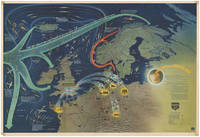
1944NL-02478<p><strong>Large-format 1944 U.S. Navy "NavWar" training map of the North Sea celebrating Allied victory over the German U-boat threat.</strong></p><p>This is a scarce very large-format 1944 map of the North Sea prepared by the U.S. Navy's Educational Service Section.</p><p>The stunning visuals executed in offset lithography are reminiscent of propaganda materials intended for public consumption but these were in fact prepared to train and educate Naval personnel on the conflict. The map traces the history of naval warfare in the North Atlantic and North Sea up to that point and celebrates Allied successes with the tide clearly having turned in their favor.</p><p>Perhaps the most striking feature of the map is the large arrow occupied by Allied shipping convoys titled 'Our Navy Breaks the U-Boat Scourge on the Allies' Supply Lines with Destroyers Destroyer Escorts and Escort Carriers.' Similar blue bands emanate from southern England towards the Continent with the label 'The R.A.F. And The A.A.F. Control The Industrial Heart Of Europe From England the World's Most Powerful Air Base.' Throughout German ships are depicted as sinking and burning while German industrial areas and key occupied strongholds are bombed relentlessly from the air. A timeline and legend at right provide further background information on the conflict and the map.</p><p><strong>Context is Everything</strong></p><p>During the Second World War the North Sea was a critical arena of naval operations serving as a strategic chokepoint for controlling maritime routes and access to the Atlantic. As in the First World War the Royal Navy maintained a constant patrol presence to enforce blockades against Germany restricting access to vital raw materials and trade. The North Sea's shallow waters and unpredictable weather made it a difficult environment for large-scale fleet engagements but it was heavily mined – one of the most extensively mined seas in history. Mines submarines and fast attack craft rather than battleships defined its warfare creating a deadly environment for both military and merchant shipping.</p><p>German naval operations in the North Sea centered on disrupting British trade and supply lines while protecting their own coastal traffic. The Kriegsmarine used U-boats E-boats <em>Schnellboote</em> 'fast boats' and aircraft to harass Allied convoys while the British developed extensive anti-submarine and radar networks to counter them. Air power especially from bases in eastern England and occupied Norway increasingly shaped the conflict turning the North Sea into an air-sea battlefield. Germany's limited fleet of battleships had by this point been sunk as with the <em>Bismarck</em> seen ablaze at left heavily damaged or forced to stay in port to prevent their loss as with the <em>Tirpitz</em> sunk later in 1944 and <em>Prinz Eugen</em> both stationed in Norway. The Allies' control of the North Sea by 1944 proved essential for the success of the D-Day invasion allowing the safe buildup of forces in Britain and denying Germany the ability to strike effectively from the sea. By war's end the North Sea had become a heavily fortified and scarred maritime zone symbolizing the constant struggle for maritime supremacy that underpinned the wider European conflict.</p><p><strong>Census</strong></p><p>This map was produced by the U.S. Navy's Bureau of Naval Personnel printed by the Government Printing Office and distributed by the Navy's Educational Service Section in 1944. It is one of six 'NavWar Maps' all of which are quite scarce now and generally in poor condition due to being folded for many years. The present map is independently cataloged among the holdings of perhaps fifteen institutions in the OCLC and appears occasionally on the market. Some institutions also hold all six maps in the series and catalog them together OCLC 53073135. For reasons that are unclear some examples of NavWar Maps are printed as double-sided while others are only printed on one side.</p><p>Condition Description</p><p>Very good. Fold creases as issued originally faint discoloration at corners from old tape reinforcing pinholes minor shelfwear slight scuffing couple minor tears</p> Educational Service Section / U.S. Navy
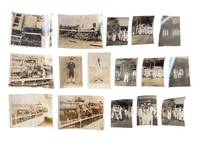
1943215061943. African American MilitaryWWII African American U.S. Navy sailors photographic archive 1943-1946 documenting Black naval service during World War II and the immediate postwar demobilization period capturing lived experience within a still-segregated military structure. Produced during a pivotal era when the Navy began to expand African American participation beyond steward and mess attendant roles the photographs reflect the evolving challenges and opportunities faced by Black servicemen in wartime. A dated postcard image from March 21 1943 anchors the collection to the height of the war when the Navy was under mounting pressure from civil rights advocates to expand enlistment for Black servicemen.<br /> Archive consists of 19 original silver gelatin photographs including 16 black and white prints measuring approximately 3 x 4 inches to 5 x 7 inches along with a postcard photograph dated March 21 1943. The images depict Black sailors in U.S. Navy service uniforms identifiable by white "Dixie cup" hats dark jumper tops and neckerchiefs. Several photographs show sailors gathered outside a Ship's Service facility a recreational and supply center on naval installations suggesting moments of rest or liberty. Group portraits emphasize camaraderie including one image of four sailors standing closely with arms around one another. Additional photographs document crowded military transport ships with servicemen lining railings and lifeboat stations. One image captures a transport vessel entering San Francisco Bay with the Bay Bridge visible in the background strongly suggesting return to a principal West Coast demobilization port. Such scenes are consistent with large-scale troop returns at the close of the Pacific War when thousands of servicemen were processed through West Coast ports following overseas deployment.<br /> <br /> During World War II the Navy maintained formal segregation policies initially restricting Black sailors to service roles before gradually permitting broader enlistment classifications beginning in 1942. The photographs capture this transitional moment: some images depict exclusively Black groups while others suggest more integrated spaces reflecting incremental institutional change that would culminate in President Harry S. Truman's Executive Order 9981 in 1948 mandating desegregation of the armed forces. The archive preserves evidence of African American participation in naval mobilization transoceanic transport and postwar demobilization at a time when service abroad coexisted with racial inequality at home. Light surface wear and minor corner curling visible on several prints; images retain strong tonal contrast; overall very good. A cohesive photographic record of Black naval service at the intersection of global war and the early movement toward military desegregation. unknown
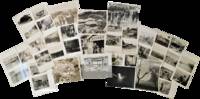
1945189141945. U.S. Army and Navy photographs of Okinawa 1945 document the immediate aftermath of the Battle of Okinawa and the establishment of American control over a strategically critical island at the close of the Pacific War. The images place American troops within the Okinawan interior and along coastal installations following the April 1945 landings including the secured Yontan airfield a primary objective of the invasion. The archive records the physical destruction resulting from one of the war's most intensive campaigns alongside scenes of civilian movement and return situating the photographs within the transition from active combat to military occupation.<br /> <br /> Archive of 37 black and white silver gelatin photographs. Okinawa Japan circa 1945. Photographs measure approximately 3.75 x 4.5 inches to 7 x 10.5 inches with brief handwritten captions on verso. Images depict American troops in villages farmland and near shrines as well as at Yontan airfield. Several photographs show destroyed aircraft including a crashed Japanese plane and associated debris along with damaged infrastructure and equipment. Naval activity is represented through images of American ships in harbor and offshore including a landing ship dock LSD transport vessel. An aerial photograph shows a harbor with multiple wrecked ships and flattened industrial areas. One image documents a column of civilians carrying belongings captioned "civilians returning to homes."<br /> <br /> The Battle of Okinawa fought from April to June 1945 resulted in extensive military and civilian casualties and widespread destruction of the island's infrastructure. The subsequent American occupation transformed Okinawa into a major U.S. military base in the western Pacific a status it retained even after reversion to Japanese administration in 1972. These photographs document both the operational objectives of the invasion and the conditions encountered in its aftermath including the displacement and return of local populations. The archive provides material for examining military strategy occupation practices and the impact of large-scale warfare on civilian landscapes in the Pacific theater. Light wear consistent with handling; overall very good condition. unknown
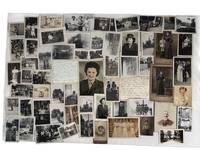
1944213131944. United States Marine Corps Women's Reserve service of Lucille documented in photographs created primarily during the Second World War. The images provide direct visual evidence of women's integration into the United States Marine Corps through the Women's Reserve program established in 1943 which expanded military labor by assigning women to administrative communications and logistical roles that freed male Marines for overseas combat service. Lucille appears repeatedly in uniform as a non-commissioned officer her sleeve chevrons indicating rank within a branch that became one of the most visible examples of women's wartime military participation. The photographs situate her service within a broader life history that includes family life in Chicago and Polish immigrant heritage placing the wartime mobilization of American women within the social networks of ethnic urban communities that supplied many of the nation's wartime workers and service personnel.<br /> <br /> Archive of 168 black and white photographs primarily silver gelatin prints dating from the mid-1930s through the immediate post-war years accompanied by several earlier family portraits including cabinet cards and cartes de visite. The collection centers on Lucille's Marine Corps service and includes a hand colored portrait inscribed "Lucille 1944" depicting her in USMC Women's Reserve dress uniform with jacket tie and rank chevrons visible on the left sleeve. Additional images show her standing at attention on the steps of a large institutional building and posing in formation with fellow servicewomen wearing winter coats and garrison caps scenes consistent with stateside training or official gatherings. Other photographs document civilian life in Chicago including family gatherings wedding celebrations and leisure outings along the Lake Michigan shoreline north of the city. The archive also preserves earlier generational photographs of relatives in traditional Polish dress and an inscribed carte de visite of "Miss Sobaleski" from Włocławek Poland linking the wartime Marine to a late nineteenth century immigrant family network.<br /> <br /> Creation of the United States Marine Corps Women's Reserve marked a significant expansion of women's participation in the armed forces during World War II when more than 20000 women served in the Marine Corps between 1943 and 1945. Photographic documentation of individual service members provides an important record of how women navigated military authority uniformed identity and wartime labor during a period of rapid institutional change within the armed forces. The inclusion of prewar family portraits and Polish immigrant imagery situates Lucille's military service within the longer trajectory of ethnic community life in Chicago one of the largest centers of Polish American settlement in the United States. Together the photographs document the intersection of immigrant family history urban American life and women's wartime military service. Photographs range in size from approximately 2 x 3 inches to cabinet card formats; the archive preserved loose. Minor edge wear and light toning consistent with age; overall very good condition. The breadth of images linking immigrant heritage civilian life and Marine Corps service gives the archive strong documentary value for the study of women in the U.S. military and Polish American community history during the Second World War era. unknown
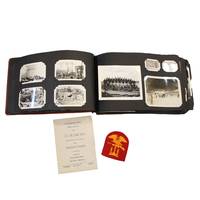
1943185431943. United States Marine Corps World War II photograph album documenting global American military operations across the Pacific and Atlantic theaters during the 1940s including combat scenes naval deployments and high level wartime leadership meetings. The album records the experience of U.S. Marine personnel during the global campaigns against Axis powers with photographs spanning the South Pacific Japan North Africa the Mediterranean Greenland and Alaska. Numerous images show Marines in active combat environments amphibious landings and wartime garrison life providing visual documentation of the operational geography of the war. The album also preserves photographic evidence of a significant wartime meeting in Hawaii on July 26 1944 when President Franklin Roosevelt met with General Douglas MacArthur and Admiral Chester Nimitz to determine the strategic direction of the Pacific campaign. Roosevelt ultimately endorsed MacArthur's plan to return to the Philippines a decision that shaped the final phase of the Pacific war.<br /> <br /> Photograph album compiled by a U.S. Marine during World War II containing 364 black and white silver gelatin photographs and 21 real photo postcards depicting American military operations across multiple theaters including Namur Island Peleliu New Guinea the Solomon Islands Tarawa Cape Gloucester Saipan North Africa and Alaska. Several photographs appear to be official Marine Corps press images with printed captions such as "Marines take cover in invasion of Tarawa" "Actual landing operations on South Sea Island" and "Two rear gunners in Guadalcanal bomb shelter." Other images show Marines moving through tropical marshes occupying foxholes standing watch in lookout towers assembling on invasion beaches and operating aboard naval vessels. The album also contains candid images of President Franklin Roosevelt General Douglas MacArthur and Admiral Chester Nimitz taken during the Pacific Strategy Conference in Hawaii with approximately twenty nine photographs documenting the leaders meeting and greeting during wartime consultations. Additional photographs depict local populations encountered by American forces in the South Pacific and North Africa scenes of war damaged buildings and the daily lives of servicemen both on duty and during periods of rest.<br /> <br /> Album containing 385 photographs in total including 364 silver gelatin prints and 21 real photo postcards with image sizes ranging approximately from 1.75 x 2.75 inches to 3.5 x 4.5 inches. Photographs mounted in an original tobacco leather album. The archive also includes several loose photographs handwritten greeting cards an invitation for officers and crew of the seaplane tender USS Pine Island dated April 26 1945 with program details and a shoulder sleeve insignia for an Engineer Special Brigade. Minor age wear present; photographs remain clear with strong contrast and legible captions. The album provides a wide ranging visual record of American Marine operations during the Second World War linking frontline combat imagery with documentation of the strategic leadership decisions that shaped the Pacific campaign. unknown
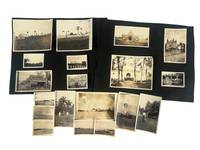
1915224781915. Polk George Washington Jr. Havana and rural Cuba photo archive 1915 documents Cuba through the viewpoint of an American military traveler during the Platt Amendment era when U.S. power shaped Cuban sovereignty port security naval access and commercial movement. The photographs record ships in Havana Harbor coastal fortifications rural dwellings Cuban farmers agricultural landscapes and colonial plazas providing insight into how U.S. military personnel visually encountered Cuba just before American entry into World War I. The Platt Amendment gave the United States broad authority to intervene in Cuban affairs and required Cuba to lease land for naval stations remaining central to U.S.-Cuba relations until its repeal in 1934; this archive therefore places vernacular travel photography within a larger framework of military oversight and commercial access. <br /> <br /> Polk George Washington Jr. Havana Cuba vernacular photo collection. Havana Cuba: unpublished December 1915. Twenty-eight silver gelatin photographs pasted to album pages with some loose or partially detached ranging from approximately 2 x 2½ inches to 4½ x 3½ inches many with handwritten ink annotations dated December 22 to 29 1915. The images include vessels anchored in Havana Harbor harbor views from on board ship Morro Castle and other coastal fortification views colonial civic plazas local laborers and civilians thatched rural huts or bohíos sugarcane fields and agricultural scenes captioned "Orange Trees & Coconut Palms Near Havana." One photograph is captioned "Cuban Farmer & Son Near Havana Dec 22 1915" giving the archive direct documentary value for rural family life and American observation of Cuban agricultural communities. Other captions identify boats as "U.S.C. 5th Protectors off Havana" and refer to the United Fruit Company steamer Abangarez on the Havana-Colon route; the Abangarez was a United Fruit Company passenger and cargo vessel completed in 1909 and later brought under United States registry during World War I.<br /> <br /> The photographs combine military commercial and rural subjects in a compact record of U.S.-Cuban contact. Polk's annotations and the repeated Potchernick-Birdsong Co. Kodak Place San Antonio Texas stamps on versos indicate that the images were developed in the United States after the trip or sent home for processing preserving the path by which overseas military travel became a personal photographic record. Polk's later military service is supported by burial and veterans' records identifying George Washington Polk Jr. as born May 13 1889 died July 27 1976 and buried at Fort Rosecrans National Cemetery; the supplied description identifies him as later a Colonel in the U.S. Army Air Corps and instructor in the early U.S. Air Force. Most photographs lightly pasted along one edge to scrapbook leaves with some detached or partially affixed; a few corner creases otherwise sharp images with strong contrast good to very good overall. Focused 1915 Cuba archive linking Havana Harbor rural Cuban labor vernacular architecture United Fruit maritime movement and American military observation during the U.S. protectorate period. unknown