Transatlantic Publishing CompanyBiblio.com

119 résultats
112090918X.Gpaperback. Good. Access codes and supplements are not guaranteed with used items. May be an ex-library book. paperback
1167227190.Gpaperback. Good. Access codes and supplements are not guaranteed with used items. May be an ex-library book. paperback
1908849576.Gboard_book. Good. Access codes and supplements are not guaranteed with used items. May be an ex-library book. unknown
3867930392.Gpaperback. Good. Access codes and supplements are not guaranteed with used items. May be an ex-library book. paperback
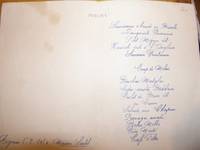
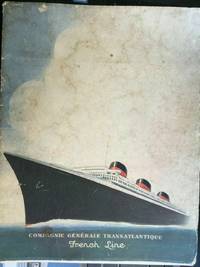
68-7451Paris France: CGT 1965. 4to. Menu. Decorative covers with menu items printed within and loose card with additional menu items for dogs. Very Good. En Francais.Provenance: Collection of M. Denis Schneider ancien Chef de Cuisine 1980s - 1990s Copenhague Maison du Danemark. 142 Ave. des Champs-Elysees 75008 Paris. Paris, France: CGT, 1965. unknown
68-6344Paris France: CGT 1937. Folded Card Stock. 4to. 20 pp. Good with tears & minor staining to cover else Very Good. En Francais & English. Paris, France: CGT, 1937. unknown
68-3503Paris France: Dutal & Cie. 1950. Folded Menu Light Card Stock. 13.5 x 20 cm. Cover Illustration menu in French. Very Good. Paris, France: Dutal & Cie., 1950. unknown
1960148729C.G.T 1960. Paperback. Illustration double page par Marin-Marie. <b>Livre en français</b>. Couverture souple. Brochure 21 x 27 cm. 16 pages. <i>ref. 148729</i> C.G.T paperback
P29850Compagnie Generale Transatlantique: 1907 Paris softcover 86 pages with information for travelers with the diverse routes and advertisements. Some marks of use. paperback
1960148730C.G.T 1960. Paperback. Illustration double page par Marin-Marie. <b>Livre en français</b>. Couverture souple. Brochure 21 x 27 cm. 32 pages. <i>ref. 148730</i> C.G.T paperback
68-6417Paris France: Compagnie Generale Transatlantique 1896. Program. Folded Page 4 pp. 16 x 21.5 cm. B&W Photograph on cover. Very Good.Provenance:Colette Monceau born Nancey 1921-2016. Biographical note: born in Nice in 1921 Colette Monceau was a student of Charles Dullin in the second half of the forties and played in several plays during the same period. At the end of the 1950s she took courses at Pierre Foix's school of graphology in Paris and worked in particular on dance as part of the exam for the Group of Consulting Graphologists of France. Having become a consultant graphologist she also teaches this technique. Particularly interested in the writings of Louis Jouvet and Sarah Bernhardt she wrote three works that remained unpublished as well as several articles. It constitutes a thousand files devoted to actors and actresses as well as personalities from varied backgrounds. Colette Monceau née Nancey 1921-2016. Notice biographique : née à Nice en 1921 Colette Monceau est élève de Charles Dullin dans la seconde moitié des années quarante et joue dans plusieurs pièces à cette même période. À la fin des années cinquante elle suit les cours de l’école de graphologie de Pierre Foix à Paris et travaille notamment sur la danse dans le cadre de l'examen du Groupement des graphologues conseils de France. Devenue graphologue-conseil elle enseigne également cette technique. S'intéressant notamment aux écritures de Louis Jouvet et de Sarah Bernhardt elle rédige trois ouvrages restés inédits ainsi que plusieurs articlesExpertise by Daniel BRUKARZ Expert auprès de la CEA. Paris. Paris, France: Compagnie Generale Transatlantique, 1896. unknown
19354000099491935. 1935. Bon état unknown
P9434Compagnie Generale Transatlantique: 1912 France softcover 36 pages French Language with photo's of the ship interior and machinery. In very good condition 22x15cm paperback
25434Letter from 'S. S. Transylvania' en route from Glasgow to New York 24 26 and 29 November 1928. Postcard undated but contemporaneous. TSS Transylvania the prefix stands for ‘Twin Screw Steamship’ was built in Glasgow for the Anchor Line and launched in 1925. She had three funnels but two were redundant only serving to render the ship more attractive to prospective passengers. In 1940 she requisitioned by the Royal Navy and the following year she was torpedoed by the Germans sinking with the loss of 36 lives. The letter is 13pp 12mo; with neat single-space typing on thirteen leaves. It contains three line diagrams and on a separate 12mo leaf is an ink drawing with captions titled ‘As the Herrewich sic appeared when we last saw her’. Also present is a sepia postcard of ‘T.S.S. TRANSYLVANIA’. The letter and diagram are in fair condition aged and worn but with text clear and entire. The postcard is good with light aging. Signed in type ‘Alex.’ With manuscript diagrams and salutation to ‘Dear Mother and Father’. A well written missive the use of catch-words implies a good education beginning: ‘It is surprising that now more than five days after leaving Glasgow we should be only about 1000 miles from home. The explanation is probably well known to you all: but although you will have had newspaper accounts of the great storm and of the wreck we stood by I’m quite sure that some amplifications in the form of our personal experiences will be both welcome and of interest. In the first place let me hasten to assure you that none of us came to any harm. In the main we are all well. Mary has not been able to be out of bed much so far but on the other hand she has been free from sickness - which is a very remarkable thing considering our experiences.’ After news of ‘Anne’ and ‘Virginia’ ‘Mary’ and ‘Aunt Mima’ are also referred to he reports that they ‘arrived at Moville about midnight on Monday and spent a great night in Lough Foyle. At 10.00 o’clock next morning the Londonderry tender came alongside and we took 350 passengers and their baggage on board - making the total passenger compliment about 1100. There are about 25 in the first class.’ He finds the Transylvania ‘a splendid ship for watching the sea from. The forward extension of B. deck in front of the bridge is very clear of truck and there are no boats on it as there are on the others’. The account of the journey continues followed by a seven-page account of the storm and rescue beginning: ‘In the evening of Tuesday it was apparent that the sea was rising higher and higher as was the wind: and through the night it was obvious that something unusual in the way of weather was blowing up. / Now I’ve thought previously that we have been in Atlantic storms before. Two years ago on the “Cameronia†was a bad time: and one day last year the “Caledonia†was thrown about considerably: but our in pencil ‘my’ farthest stretch of imagination - even my wildest fears - have never pictured anyting so in pencil ‘as’ tremendous as we awoke in pencil ‘the situation’ to on Wednesday morning.’ He gives a vivid description of the ship ‘riding out the storm magnificently’ as he is caught by ‘plants flowerpots chairs and so on’: ‘The second and third class passengers were locked in and battened down for about two days. The stern of the ship was almost completely under water and the hatchways to the steward’s quarters were stove in during the night and all the stewards woke up to find themselves invaded by a foot or two of water.’ The storm subsides and she comes across the wreck of a ‘large German tramp’ he calls the ‘Herrenwich’ ‘a poignant and pathetic spectacle; and more so was the view we had of the hapless crew clinging to what was left on the bare decks. We gradually got the story bit by bit as it filtered through the bridge where it was picked up I suppose by signals. A great wave had landed on the “Herrenwich†and had stove in the hatch of No. 3 hold on the forward well deck. This hold was full of water and the restraining bulkheads were bulging. The captain sent out his S. O. S. and immediately there - after another sea came on board and carried off bodily the bridge the wireless the wireless room and all the boats save one which was stove in. The captain and a quartermaster were swept overboard with the bidge and were lost immediately.’ He describes ‘a masterly exposition magnificently executed of the tactics of sea rescue. It was obviously impossible to go right up to the ship but sometimes we were not more than 100 yards away and communication by megaphone was possible. It was equally impossible for us simply to take up a position on the nether side and so act as a breakwater. The manoeuvre which was carried out time after time therefore was to circle the wreck as quickly as possible and to drift past her on the weather side and so give her a certain degree of intermittent protection. This meant that twice in every circuit the captain had to bring the “Transylvania†broadside on to the seas and every time this happened there came the sickening sense of going over on our beam ends - as I believe many less seaworthy and splendid ships would have done. And each time of course until everything was secured anything movable was thrown about in the wildest way. Oil was poured on the water with each circuit and the difference it made was wonderful.’ The seven-page account of the storm and rescue ends with the information that ‘the bridge is 62 feet from the waterline and when we were in the trough 19 out of every 20 waves were seen to be on a level with or higher than the bridge’. It reflects: ‘I’ve often told myself that I wanted to experience a real Atlantic storm. Now I have experienced it. I’d like it again but never again would I like to take Mary and the children into it.’ The letter finishes with two two-page updates from 26 and 29 November the last beginning with the information that the ship has ‘passed Nantucket light ship and may therefore expect to reach quarantine to-night’. See Image. Letter from 'S. S. Transylvania' (en route from Glasgow to New York), 24, 26 and 29 November 1928. Postcard undated, but contemp unknown
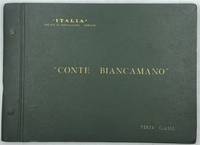
14650SD anni ’40. Alcune foto lievemente scollate ma ben conservato nel complesso. . Album fotografico in percallina verde con titoli dorati e legatura a vista con bulloni d'ottone cm 24 x 34 contenente 8 fotografie in bianco e nero cm 23.5 x 29.25 montate su tavole telate. Alcune foto lievemente scollate ma ben conservato nel complesso. Pubblicazione promozionale riservata presumibilmente alle agenzie turistiche ed agli agenti della compagnia di navigazione che presenta il transatlantico Conte Biancamano e in particolare le cabine gli spazi comuni e i servizi per la terza classe. La nave venne varata nel 1925 per il Lloyd Triestino e con il riassetto delle flotte passò negli anni '30 alla compagnia Italia di Navigazione venendo destinata alle rotte per il Sud America. Questo album risale agli anni '40 e testimonia il riallestimento civile del dopoguerra con arredi progettati da Gustavo Pulitzer Finali Giò Ponti e Nino Zoncada. Le fotografie con didascalia in lastra mostrano una veduta del transatlantico e alcuni ambienti della terza classe: Sala da Pranzo Sala fumatori e bar Sala delle Signore Cabina a quattro posti Cabina a due posti La piscina Ambulatorio medico chirurgico. Cat. 26 n. 20. unknown
97101875. Gibson & Sons Penzance & Scilly Isles. Three striking unfamiliar photographs the last two in particular excellent compositions of a significant historical event. The three slides are bound in 8 cm glass squares with none of the glass shattered and the images themselves in good condition clear and unfaded. Each mount carries the stamp of the photographers Gibson & Sons. With numbered labels carrying a shelfmark. Each mount titled in manuscript. ONE: ' Schiller" wreck. Lifeboat in which Survivors came ashore'. Shows the white lifeboat with 'SCHILLER' and 'HAMBURG' on the bow on a beach with the background showing sailing ships in the bay. TWO: ' "Schiller" wreck - Digging the last graves. <> Scilly'. Striking composition showing five workmen toiling among stones before a country wall in front of which appears to be a long row of wooden markers. Stone building and horse in background. THREE: 'Schiller wreck at Scilly. A Funeral.' Strking composition show a large group of people one lady with an umbrella gathered around a country grave with metal railings with a stone building behind. The Schiller has been dubbed in the title of a 2001 book by Keith Austin 'The Victorian Titanic'. It is said that the German army in both world wars were instructed to spare the Scilly Isles in recognition of the inhabitants' assistance to the survivors of the wreck. [1875.] Gibson & Sons, Penzance & Scilly Isles. unknown
19509752Paris Editions Blondel la Rougery 1950. Route map of the western Mediterranean and Northwest Africa 63.5 x 99 cm printed in three colours lined on linen. Shows the routes from Marseille and Bordeaux to Tunisia Alergira and Morocco with considerable detail of the road network inland. Decorative elements include a compass rose a matelot steering a ships wheel and a couple of steamships in the upper border. Map unknown
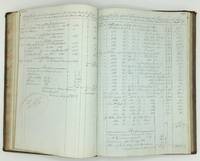
18521338Original manuscript. 1852-1854. Folio 38 x 27cm. Full contemporary reverse calf with gilt morocco titles labels to the spine "Rough Sales Book / S & L / B". Marbling to page edges. Marbled endpapers with engraved label for "Baily Brothers Booksellers Stationers Account Book Manufacturers" London to the front pastedown. 172pp. of manuscript text in ink on red-ruled laid paper watermarked "W. King / 1850" followed by c.160pp. blank with a handful of pages torn out following the conclusion of the manuscript text section and another within the text. The majority of entries are in English with some in Spanish mostly written in the same hand. Condition is very good the binding firm with marking to the boards chipping to the head of the spine and a little wear to the extremities. The contents with a 3cm tear to the head of the first text page and two pages partially cut/torn away at the bottom are otherwise in good order. The ledger of a British sales agents operating in Panama during the mid-nineteenth century detailing the importation and sale of a wide variety European and South American goods into the country.</p><p>The manuscript meticulously records the origin city/country importer ship the goods received and sold and the charges entailed for each shipment. A typical entry for example records the arrival of "gunpowder received per "Alexander" and sold on behalf of the Kames Gunpowder Company Glasgow" followed by details of the subsequent purchasers "J. D. Cordova" etc. and the charges/commissions taken by the agent including fees for landing expenses and "carriage to arsenal". </p><p>Many of the entries describe large diverse cargoes combining both essential and luxury goods including: alpacas; chocolate pots; "41 cases of pickles and mustard"; lavender water; rocking chairs; a "copying machine"; cinnamon; scissors razors; bone buttons; horse brushes; compasses; gin; hatchets; bedsteads; looking glasses; children's toys; cloves; muslins; kegs of shot; cups and saucers; tobacco; machetes; claret; playing cards rat traps; "Aqua de Colonia" cologne; silk gloves; saddles; blunderbusses; padlocks; lace; pantaloons; "Jamaica rum"; almonds; vinegar; bonnets; sausages; gold frames; water closets; wash stands; champagne; mosquito nets; and much else besides.</p><p>The origin ports include major European trade centres such as Liverpool and Glasgow but also include many South American ports such as Guayaquil Equador carrying beans cocoa coffee sugar and quinoa amongst other things; Buenaventura Colombia; Callao Peru carrying candlesticks coffee mills and bayonets; Lima Peru "bottled fruits" and cherry cordial; and Valparaiso Chile; as well as San Francisco and New York to the north. The importers themselves are also a mixture of British and Panamanian companies.</p><p>A fascinating detailed insight into Panama's transatlantic and South American trade during the mid-nineteenth century. [Original manuscript]. hardcover
1869316802Boston: Alfred Mudge and Sons 34 School Street 1869. First Edition. With 6 original mounted photographs. 57 pp. 1 vols. 8vo. Original burgundy cloth. Very good small nick and loss to upper spine. First Edition. With 6 original mounted photographs. 57 pp. 1 vols. 8vo. Celebration of the arrival of first transatlantic telegraphic cable on American shores with speeches of the dignitaries of Duxbury and Boston and a patriotic summary of the history of telegraphy; n appendix gives material on the cable fleet and press accounts. Alfred Mudge and Sons, 34 School Street unknown