19 492 résultats
200803286Paris, Edition Rouff - collection patrie, vers 1918 ; grand in-12, 24 pp., broché, couverture illustr. N°92.
200803282Paris, Edition Rouff - collection patrie, 1948 ; grand in-12, 24 pp., broché, couverture illustr. N°74.
200803280Paris, Edition Rouff - collection patrie, 1949 ; grand in-12, 24 pp., broché, couverture illustr. N°87.
200803279Paris, Edition Rouff - collection patrie, 1948 ; grand in-12, 24 pp., broché, couverture illustr. N°60.
200803278Paris, Edition Rouff - collection patrie, 1948 ; grand in-12, 24 pp., broché, couverture illustr. N°55.
201203895Hamburg, Verlag fur geschichtliche dokumentaion gmbh & co., 1977 ; in-4, 168-168-168-168-168 pp., cartonnage de l'éditeur. Les 5 volumes. Très bon état avec jaquette - en allemand band 1 bis band 5 - Eine kommentierte auswhal abgeschlossener, vollig unveranderter beitrage aus der propaganda zeitschrift der deutschen luftwaffe - 1939 band 1 - 1940 band 2 - 1941 band 3 - 1942 band 4 - 1943/44 band 5 série complète.
201206467Oldenburg und Hamburg, Verlag Gerhard Stalling, 1974 ; in-4, 128 pp., cartonnage de l'éditeur. Très bon état mais sans sa jaquette - luftaufnahmen aus den jahren 1929-1933.
171961835Akron OH: The Goodyear Tire & Rubber Co. 1917-1918. Three parts in one vol. 4to. 68 pp; 13 leaves typescript on onion-skin paper; 14 pp unpaginated. in ink manuscript on ruled paper. With 16 cyanotype blueprint leaves of hydrogen gas plants water bags equipment numerous tables diagrams 2 original linen-backed silver gelatin photo plates on linen hinges. Black-ribbed cloth split-pin post binder as issued gilt lettering & Goodyear winged logo on front cover marbled pastedowns minor soiling to edgewear fraying minor splitting to cloth at spine minor bumping to corners still a VG- exemplar with many annotations from the library of Arthur Sewell 1880-1973 longtime specialist with Goodyear Tire & Rubber instructor at the Airship Training School during World War I which also specialized in training U.S. Navy and U.S. Army ground crews for blimps balloons and dirigibles and Lt. Steven B.aker Hagadorn 1920-2007 who was serving during the Korean War at the U.S. Naval Air Station Ocean City New Jersey in 1950-1954. First edition of this exceedingly scarce manual written to train and educate Navy Balloonists before the U.S. entered World War I after the Goodyear Tire & Rubber Company secured a contract to train 20 men in free ballooning in May 1917. This work describes the free balloon how to construct and use various parts of the balloon details the physical properties of gases used for lift the physics behind the gases and atmosphere preparations for flight the proper methods of handling the balloon in the air as well as on the ground as well as advising the balloonist to exercise care in using gasoline to remove oil from balloon fabrics by avoiding the seams because it will cause the seam to deteriorate. The illustrations and photos at the end show a balloon being laid out for inflation inflated setting the sandbags rigging and ascension of the balloon. The Jan. 28 1918 typescript by Lieut. Comm. Teed specifically outlines the technical advantages and uses of employing hydrogen in the free balloons with specific equations and calculations for volume lift and more. Goodyear had established its Aeronautics Department in 1910 to market rubber impregnated fabrics and coatings for airplanes and lighter-than-air craft and began buildings its first balloons in 1912. In 1916 Goodyear bought 720 acres of land southeast of Akron to serve as their flying school and manufacturing site. Around the same time they began building their first airship in March 1917 they were also negotiating for a contract with the government to train balloonists for the Navy. Of particular interest in this work are the presence of the original manuscript “Free Balloon Log Sheets†documenting free flights starting in Winfoot Lake OH and landing in East Lewistown Homeworth Youngstown & Minerva OH; Sagerstown & Hallston PA Columbia Station. Several of the sheets note weather conditions flight altitudes how they landed and manuscript observations taken during the flights. Roth 1885-1950 was a noted sport balloonist before and after World War I up through the 1930s was a balloon instructor during World War I for Goodyear Tire & Rubber Co. and also was a pilot in the U.S. National Balloon race in 1930. Original editions of this early Goodyear aviation work are quite scarce. No copies in Worldcat for the First Edition several located for the 77 pp. 2nd edition varying number of blueprints plans; No copies located of Typescript MS by Teed or printed version of Lift of Hydrogen Technical Note No. 21; See Hamlen First Lighter-than-air Class at Akron; Goodyear Blimp History. The Goodyear Tire & Rubber Co., hardcover
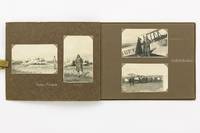
1929142560Adelaide: Harry Carew Nott 1929. Fine. Adelaide Harry Carew Nott 1929. A commercial photograph album oblong quarto 230 × 318 mm comprising 4 card leaves cord-bound in overlapping card covers with 21 gelatin silver photographs 84 × 136 mm or the reverse loosely attached with photocorners on both sides of the leaves and the inside surface of the covers; all photographs are captioned in white ink on the mount. Cord-bound commercial album stamped in blind 'Portraiture'; covers slightly marked and a little worn at the corners; the contents are in fine condition the last photograph is creased and cracked at one corner. A lengthy article related to this event appeared in 'The Advertiser' Thursday 23 May 1929: 'The Victorian section of the Australian Aero Club will conduct an aerial pageant at the Essendon Aerodrome near Melbourne on Saturday afternoon. The programme of events includes the Aerial Derby for which over 20 machines have been entered. Of these about eight will represent New South Wales and eight Victoria. South Australia will also have a strong representation. <p>Seven planes will leave the Parafield Aerodrome for Melbourne this morning at 9.30 if the weather permits. The following planes will comprise the formation: D.H. 60 Gipsy Moth G-AUIB D.H. Moth V-HUAM D.H. Moth V-EUAR D.H. Gipsy Moth G-AUIV D.H. Gipsy Moth G-AUKO Avro Avian G-AUSY and probably the De Havilland "Old Gold" passenger machine. The first three are Aero Club planes and the others are privately owned. <p>Flying-Officer J.A. Mollison Aero Club instructor will be leader of the formation and Mr. C.A. Hewitt will be deputy-leader. Others making the flight to Melbourne are Messrs. N. Birks J.A. Jukes A.H. Wilkins E.B. Lawson P. Knapman F. Wellington S. Hamilton L. Wood J. Churchill Smith secretary of Aero Club and Dr. H.C. Nott. The flight to Essendon will be made via Nhill Victoria. Friday will be spent by the airmen in tuning up engines for the races on the following day'. <p>The first eight photographs were taken at Parafield Aerodrome in outer-suburban Adelaide with portraits of Nott and Wood identified. These are followed by two at Nhill Aerodrome 'Mollison refuelling' and 'Lawson'; two at Ararat Aerodrome 'on Racecourse'; and eight taken at Rockbank 28 kms west of Melbourne. These are captioned 'Mollison taking off in "1B"'; 'Hewitt'; 'Nott in "A5"'; Lawson Mollison Hewitt & Wellington éxamining "A17"'; 'Hewitt Mollison Lawson & Wellington'; 'Nott Mollison Lawson & Wellington'; and 'Mollison Lawson & Hewitt'. <p>The last one taken from the air is captioned 'Crashed Aero at Nhill'. The Nhill Aviation Heritage Centre website records that on 23 May 1929 'J.A. Mollison arrived from Adelaide with 6 aircraft. One crash-landed at old Dimboola road aerodrome instead of landing at New site at Halpin Park'. The pilot was possibly Lin Wood. Harry Carew Nott unknown
201305605Paris, Gautier langereau, 1974 ; in-8, 221 pp., cartonnage d'éditeur. Avec jaquette.
1939106338<p>Program 4to 13" x 10" original colored wrappers illustrated 64 pp. Wrappers lightly worn small ad clipped from last leaf slight aging; otherwise very good. Rare program from the 19th annual National Air Races held in Cleveland Ohio September 2-5 1939. Contains some wonderful early aviation ads including those for United Airlines Lochheed Aircraft Corporation Firestone Airplane Tires and American Steel/ Another ad shows past winners of the Bendix Trophy Race for the past eight years. The 1938 winner was a woman named Jacqueline Cochrane who flew from Burbank California to Cleveland in 8 hours and 10 minutes. Program also includes a daily program of events. A great piece of aviation history.</p>
200702769Paris, Imprimerie adrien maréchal, s.d. ; in-8 oblon, 44 pp., broché.
151979430Hammondsport New York and Newport News Virginia 1915-1917. The captions were formerly attached to the photographs with paperclips with some crimping to the photographs and captions. Some marginal damage to a couple of the photographs; images unaffected and quite interesting. . Various sizes; 14 measure 8 / 10 inches; 54 are 4 x 6 inches. . Many of the captions are quite informative if a bit illiterate for example: "Capt. Baldwin in the first Derigable sic were built for the U.S. Gov. Capt. Baldwin built his machine and was accepted by U.S. Gov. on all trials. Capt. Baldwin--inventor of a Parachute and first man to ever jump. built at Hammondsport." In addition to the the 68 photographs that clearly belong to a single archive there are two additional 8 x 10" Curtiss photographs and 15 additional smaller early aviation photographs. unknown
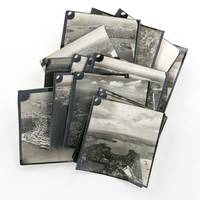
118695Fifteen gelatin silver prints one 127 × 129 mm all others 134 × 139 mm slightly curled around the vertical axis; in uniformly fine condition Numbers pencilled on the verso of all but the small print include '/43' so we will suggest 1943 as the date. The only caption is a later one in ballpoint pen identifying Darling Harbour; there are another two featuring the same general area. Eight feature Garden Island prominently in all but one instance and four focus on Cockatoo Island; the former was a major naval base and the latter the main ship repair facility during the Second World War. Although the photographs are not credited given the nature of the images and the fact they were taken during wartime they were presumably taken with authorisation. Offered with the photographs is 'Sydney an Aerial Close-up' by Walter Brooks with photography by Neil Sutherland 1986; those familiar with Sydney in 2024 may derive some pleasure in drawing two comparisons . 16 items. unknown
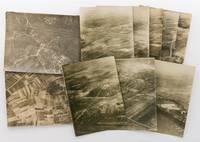
118696Very Good. All are gelatin silver prints on thick stock; eight are oblique photographs 207 × 154 mm; two are vertical views approximately 165 × 220 mm; the larger ones are slightly creased at the corners one of them a little more so; the others are in excellent condition. All images are captioned in the negative. All eight oblique views carry the same date 25 June 1918 preceded by 'A3 AEO 62°' ranges from 110 to 121. Place names on them are Hamel Hamel Wood Somme Accroche Wood Tailloux Wood and Vaire Wood. The vertical images are dated 3 May and 27 June 1918 and carry a larger set of alpha-numeric references commencing 'A3 AE A 715' and '35 AE B 929' respectively. All ten prints have the signature 'Capt Sexton' in indelible pencil on the verso. Digitised service records indicate the signature is that of Eric James Sexton of the Adelaide suburb of Hindmarsh; he enlisted on 14 August 1914 shortly before his 21st birthday and was appointed to the 10th Battalion with the rank of lieutenant. He was wounded at the landing at Gallipoli promoted to captain the following day and later invalided back to Australia disembarking on 6 August 1915. By January 1916 he was declared fit again for active service and re-embarked in April for England where he performed various training roles. On 14 February 1917 he transferred to the Australian Machine Gun Training Depot with the rank of major. He embarked for Australia on 12 March 1918 arriving in Melbourne on 22 May 1918. Accordingly Sexton did not serve in France and was a major not a captain by the time these photographs were produced. We cannot explain the anomalies but will let the photographs speak for themselves. Significantly they show the area where the important Battle of Hamel was fought on 4 July 1918. <p>'Hamel was a big battle in miniature involving the experimentation of tanks and small ammunition drops as part of a broader all-arms offensive. While a coordinated offensive was not a new approach to warfare Hamel represented the culmination of three years of learning and innovation on the Western Front testing an all-inclusive approach to mobile warfare. The flawless execution of the operation resulted in Hamel becoming a model for future operations on the Western Front. In his account of the event Monash famously wrote that "the perfected modern battle plan is like nothing so much as a score for an orchestral composition where the various arms and units are the instruments and the tasks they perform are their respective musical phrases' Ellen Cresswell: 'The Experiment - Innovations at the Battle of Hamel' Australian War Memorial website. 10 items. unknown
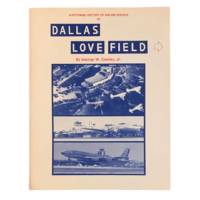
19896265Dallas: George W. Clearley Jr. 1989. First edition. 4to 200pp. Diagrams illustrations facsimiles. Signed by Clearley on the title page. Perfect bound in glossy illustrated wrappers. Nearly fine. <br /> <br /> Copiously illustrated and researched history on Dallas Love Field which began as a training base during WWI and later became open for civilian use in 1927.<br /> <br /> Clearley self-published several works on the airline industry most of which are quite uncommon. . George W. Clearley, Jr. unknown
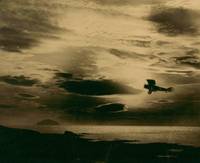
107816Fine. The sepia-toned print image size 232 × 289 mm is behind glass in its original timber frame 425 × 475 mm; the window mat is wood-grained possibly cut from a veneer sheet. Remnants of the contemporary Adelaide framer's label 'Dimond Bros' are on the verso along with the pencilled details of the job. Small scratch to the bottom portion of the image; one tiny spot; otherwise in fine condition. The framer's pencilled notes indicate that the original client's name was Butler almost certainly Harry Butler himself during his brief years in Adelaide between the war and his early death in 1924. An article from the Adelaide 'Advertiser' for Tuesday 21 May 1946 records Butler's own description of this scene in a pencilled note dated 2 February 1918 uncovered on the verso of another example of this photograph. 'It was taken by our school photographer as I was on a Bristol Fighter about sunset to do a submarine patrol. You notice the Christmas card-looking island in the distance. That is known as Ailsa Craige in fact Ailsa Craig and is about halfway between here and Belfast'. <p>'Harry Butler 1889-1924 showed his enthusiasm and aptitude for mechanics by building models of primitive aircraft while still at school in Koolywurtie; he later accorded farm-work a lower priority than collaboration with a neighbour and lifelong mentor S.C. Crawford in building and flying one of Australia's early aeroplanes. Among the February 1915 candidates Butler alone gained entrance as an aeromechanic to the Australian Flying School at Point Cook Victoria. Commissioned three weeks after joining the Royal Flying Corps in 1916 he became fighting-instructor at Turnberry Scotland in 1917 and chief fighting-instructor at No. 2 Yorkshire School of Aerial Fighting in 1918. He alternated teaching with studying German aerial combat tactics over France and he received the Air Force Cross in 1918' 'Australian Dictionary of Biography'. <p>Our thanks to Mr Les Parsons for providing us with many important details regarding this image. unknown
118812Very Good. A gelatin silver print 216 × 166 mm lightly creased at the corner-tips; in excellent condition. The aircraft appear to be a Sopwith Camel and two Avro 504s specific models not determined. Offered with two other photographs of a biplane possibly a Sopwith Camel in the air: one is silhouetted above billowing sunlit clouds 147 × 199 mm printed without margins; the other is shown flying between clouds above hedgerows and fields 216 × 166 mm. We purchased these photographs with a small group of aerial photographs of Leighterton Aerodrome. <p>'By 1917 the Australian Flying Corps AFC consisted of four operational squadrons which outstripped the ability of the Army's Central Flying School at Point Cook to supply sufficient trained airmen. It was decided therefore to establish training squadrons within the AFC. Four such squadrons were subsequently established in the United Kingdom during 1917. 8 Squadron AFC was formed at Wendover on 24 October 1917. It was originally identified as 33 Australian Training Squadron Royal Flying Corps but was renamed along with all of the Australian squadrons in January 1918. The squadron relocated to Cirencester on 9 January 1918 and thence to Leighterton where it remained until disbanded in April 1919. The squadron's principal role was to prepare personnel for service with what was at first 71 Australian Squadron RFC and subsequently 4 Squadron AFC which was operating with British forces over the Western Front' Australian War Memorial website. 3 items. unknown
118803An unmounted sepia-toned gelatin silver print 149 × 199 mm; in fine condition We suggest the eighteen members of the squad come from the Aeroplane Repair Section of the Australian Flying Corps based at Leighterton. We purchased this photograph with a small group of aerial photographs of Leighterton Aerodrome about which the Australian War Memorial has this to say: 'By 1917 the Australian Flying Corps AFC consisted of four operational squadrons which outstripped the ability of the Army's Central Flying School at Point Cook to supply sufficient trained airmen. It was decided therefore to establish training squadrons within the AFC. Four such squadrons were subsequently established in the United Kingdom during 1917. 8 Squadron AFC was formed at Wendover on 24 October 1917. It was originally identified as 33 Australian Training Squadron Royal Flying Corps but was renamed along with all of the Australian squadrons in January 1918. The squadron relocated to Cirencester on 9 January 1918 and thence to Leighterton where it remained until disbanded in April 1919. The squadron's principal role was to prepare personnel for service with what was at first 71 Australian Squadron RFC and subsequently 4 Squadron AFC which was operating with British forces over the Western Front' AWM website. unknown
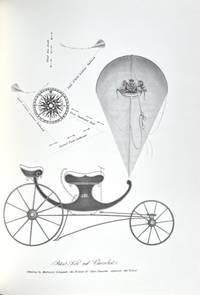
196959614San Francisco: Edward L. Sterne 1969. 4to. 2 51 1 pp. Illustrated title w/ vignette 3 plates. Quarter-brown cloth over brown boards printed label on front cover minor shelfwear slight rubbing still NF copy from the library of Otto C. Winzen 1917-1979 pioneering German-American aeronautical engineer was interned during World War II and later significantly advanced material and construction of high-altitude balloons after World War II. First facsimile edition 1 of 95 copies printed of this curious treatise detailing how Pocock achieved nearly 20 miles per hour while driving his Charvolant a kite-hauling carriage from Bristol to Marlborough in 1827. Pocock was an aviation pioneer who conducted experiments on the use of kites how to lift draw and move items by using kites and finally capped it with his huge kites drawing the Charvolant. One of Pocock’s giant kites still exists in the Museum of Bristol a BBC team recreated and flew the kite successfully in 2009 and in 2009 Takeshi Sugimoto of Kanagawa University determined that as long as the carriage was not exposed to the wind and kites were aloft they did produce sufficient lift to offer steady driving speeds for the carriage. See: Takeshi Sugimoto Mechanics of Classical Kite Buggying or How Mr. Pocock Gained 9 m/s by his Charvolant Sevent Asia-Pacific Conference on Wind Engineering Taipei Taiwan 2009. Edward L. Sterne, hardcover
202502644Paris, Les editions tony vassilliere, s.d. ; in-8 oblong , 35 pp., br. Format a l italienne tres bon état.
202502643Paris, Edité sous le patroange de la ligue aeronautique de france , 1942 ; in-8 oblong , br. Les 6 volumes. Du n° 1 au n°6 inclus, format a l italienne tres bon état.
193388120New York: The Geograhpical Press / Columbia University 1933. First Edition. Octavo. Brown simulated leather over boards hardcover; 207pp; illus; map endpapers; large folding map in rear pocket as issued. Private or non-circulating library copy with neat white ink shelf-number at base of spine and ink annotation to rear endpaper no institutional markings. Light external wear but still a sound Very Good copy.<br /> <br /> A fascinating work dating from the earliest years of American commercial aviation utilizing aerial photography to identify prominent geological and geographical features visible to the trans-continental air traveller. The book's sub-title suggests that this was the first of a planned series of related studies but we find no evidence that further works were published. The Geograhpical Press / Columbia University unknown
116420Many of the photographs appear to have been taken at Vickers' Brooklands factory near Weybridge Surrey the famous banked race track is visible in many images and possibly also at the nearby Royal Aircraft Establishment Farnborough Hampshire. Nearly all are dated ranging from 1937 to 1946. The gelatin silver prints have been cropped to highlight the stationary aircraft; the resulting photographs are in a visually appealing panoramic format with most of them between 55 and 75 mm high some smaller some larger and approximately 190 mm wide. They are loosely mounted from three to five per page under clear celluloid sheets in a later commercial photograph album. The album is neither here nor there; apart from a crease near a short edge of one print the photographs are in excellent condition. Approximately 35 different aircraft are shown each represented by between two and five photographs taken from different angles. The verso of each print carries the inkstamp of the RTP Research and Technical Publications Photographic Section of variously the Air Ministry Ministry of Aircraft Production or Ministry of Supply. These stamps restricting reproduction are completed in manuscript with a reference number and date; at least one image is also stamped 'Secret'. <p>The aircraft shown are: Vickers Wellesley Production; Armstrong Whitworth Whitley; Vickers B1/35 1939 1940 and 1941 models - these are prototypes for the Warwick; Vickers Wellington Mk II with and without experimental turret Mk III Mk IV Mk V Mk VIII an unidentified model with an experimental turret Mk X Mk XI Mk XII Gr Mk IV Mk XVI Mk XVII Mk XVIII and T Mk X; Vickers Warwick Mk I Mk I freighter Mk II ASR Mk I ASR Mk I Tropical C Mk I C Mk III Gr Mk II and Gr Mk V; De Havilland Vampire Mk I Mk II Prototype; Westland Welkin Prototype F Mk I F Mk 2; and Vultee Vengeance Mk I. unknown
202205904S.l., s.e., 1994 ; in-8 oblong, 81 pp., br.