10 344 résultats
1962022929Washington D. C.: Government Printing Office 1962. Book. Paperbound with Stiff Covers. v 107p. A near fine copy the back cover of which has a 1 1/2" crease that is visible into page eighty-three. Size: 4to - over 9 3/4" - 12" Tall. Government Printing Office unknown
1963ZB455963NASA 1963. 25 pp. softcover very good. - If you are reading this this item is actually physically in our stock and ready for shipment once ordered. We are not bookjackers. Buyer is responsible for any additional duties taxes or fees required by recipient's country. NASA paperback
196181080Washington DC: United States The Secretary of the Air Force and The Chief of the Bureau of Aeronautics 1961. Revised version. Wraps. Good. FORMERLY CLASSIFIED AS CONFIDENTIAL. Security classification has expired based on Executive Order 13526. Also designated as NAVWEPS 01-4DAVA-1A. Three-hole punched. Ink notation on front cover. Some ink notations to text and at rear. Front and back cover stiff card. Latest date observed was 1961 some earlier dates present. 2 iv 5- 168 2 pages. Pages 1-4 were officially deleted. Pagination uncertain as some pages have additions such as 6A. Page numbers 15-16 and 41-42 absent. Based on preceding and following pages These could be "page intentionally left blank" and were removed. Illustrations diagrams drawings tables some with color. This version canceled or previously incorporated Interim Revisions Nos 1 through 34. This includes the following sections: Description and Operation of Auxiliary Equipment Operating Limitations Flight Characteristics Appendix I Operating Data Charts. Two mimeographed copies of Target Study Log notations on back. Includes information on ASM-N-7 Bullpup Guided Missile Weapon System AN/AWW-1 Fuze Function Control System Carrier Operations Flight Controls Diving Angle of Attack Long Range Attack Tanker Configuration. The Douglas A-4 Skyhawk is a single-seat subsonic carrier-capable light attack aircraft developed for the United States Navy and United States Marine Corps in the early 1950s. The delta-winged single turbojet engine Skyhawk was designed and produced by Douglas Aircraft Company and later by McDonnell Douglas. It was originally designated A4D under the U.S. Navy's pre-1962 designation system. The Skyhawk is a relatively lightweight aircraft with a maximum takeoff weight of 24500 pounds 11100 kg and has a top speed of 670 miles per hour 1080 km/h. The aircraft's five hardpoints support a variety of missiles bombs and other munitions. It is capable of carrying a bomb load equivalent to that of a World War II-era Boeing B-17 bomber and can deliver nuclear weapons using a low-altitude bombing system and a "loft" delivery technique. The A-4 was originally powered by the Wright J65 turbojet engine; from the A-4E onwards the Pratt & Whitney J52 engine was used. The Douglas A-4 Skyhawk is a very versatile light attack-bomber that has been a U.S. Navy first-line aircraft for many years. Despite its relatively small size it is able to carry a large and varied assortment of aerial weapons. In the early 1950s some of the aircraft design group at the Douglas Aircraft Company became concerned by the trend toward increasing complexity and weight in combat aircraft. The group led by Ed Heinemann whose design philosophy was to "Simplicate and Add Lightness" proposed a new attack plane with a gross weight of about half the official specification weight of 30000 lb. The A4D-1 was the first production version of the Skyhawk. The first A4D-1 BuNo 137813 took off on its first flight on August 14 1954 only two months after the first flight of the prototype XA4D-1. A total of 165 A4D-1s were built the last one being delivered in 1957. The A4D-1 was much the same as the XA4D-1 but differed from the XA4D-1 in having a "sugar scoop"-shaped jet tailpipe fairing. and was fitted with an arrester hook. All three weapons pylons were fitted one underneath the fuselage centerline and one underneath each wing just outboard of the main landing gear. Up to 5000 pounds of ordinance could be carried on the three underwing pylons. Alternatively up to three drop tanks could be carried with a combined capacity of 800 gallons. A large blade antenna for the UHF radio was installed immediately aft of the cockpit. The frameless windshield of the XA4D-1 was replaced by a framed windscreen. An internal armament of two 20-mm Colt Mk 12 cannon was fitted one gun in each wing root with 100 rounds per gun. The aircraft did not carry any radar the nose cone being filled with avionics equipment. The A4D-1 was powered by the 7700 lb.s.t Wright J65-W-4 or W-4B turbojet. The next model of the Skyhawk was the A4D-2 A-4B which included provisions for inflight refueling both as a receiver and as a tanker a powered rudder and some structural strengthening. The A4D-2N A-4C first flown in 1959 incorporated radar in the nose and an improved ejection seat. United States, The Secretary of the Air Force and The Chief of the Bureau of Aeronautics paperback
1984011296Washington D.C.: U.S. Government Printing Office 1984 317 numbered pp.; HB. Pages: clean bright tight off-white eps; no defects. Cover: green reverse artwork front reverse titles front/spine; minimal shelfwear mild bump head. Includes: Aseroids Comets and Planet Formation; Mercury; Venus; Earth; Moon; and Mars. Includes maps of each terrestrial planet. Edited by Michael H. Carr. U.S. Government Printing Office hardcover
200967232Moffett FIeld CA: United States National Aeronautics and Space Administration 2009. Reprint. Second Printing. Wraps. Very good. Includes: illustrations diagrams. Various paginations approximately 125 pages. References. From Wikipedia: "The Stratospheric Observatory for Infrared Astronomy SOFIA is a joint project of NASA and the German Aerospace Center DLR to construct and maintain an airborne observatory. NASA awarded the contract for the development of the aircraft operation of the observatory and management of the American part of the project to the Universities Space Research Association USRA in 1996. The DSI Deutsches SOFIA Institut manages the German parts of the project which are primarily science and telescope related. SOFIA's telescope saw first light on May 26 2010. SOFIA is the successor to the Kuiper Airborne Observatory.SOFIA is based on a Boeing 747SP wide-body aircraft that has been modified to include a large door in the aft fuselage that can be opened in flight to allow a 2.5 meter diameter reflecting telescope access to the sky. This telescope is designed for infrared astronomy observations in the stratosphere at altitudes of about 41 000 feet about 12 km. SOFIA's flight capability allows it to rise above almost all of the water vapor in the Earth's atmosphere which blocks some infrared wavelengths from reaching the ground. At the aircraft's cruising altitude 85% of the full infrared range will be available. The aircraft can also travel to almost any point on the Earth's surface allowing observation from the northern and southern hemispheres. Once ready for use the expectation is for observing flights to be flown 3 or 4 nights a week for the next 20 years. SOFIA is now based at NASA's Dryden Aircraft Operations Facility at LA/Palmdale Regional Airport California while staff at NASA Ames Research Center in Mountain View California operate the SOFIA Science Center where astronomical observation missions are planned for the flying observatory. The NASA logo reflected in SOFIAs 2.5-meter primary mirror. SOFIA uses a 2.5-meter reflector telescope which has an oversized 2.7 meter diameter primary mirror as is common with most large infrared telescopes. The optical system uses a Cassegrain reflector design with a parabolic primary mirror and a remotely configurable hyperbolic secondary. In order to fit the telescope into the fuselage the primary is shaped to an f-number as low as 1.3 while the resulting optical layout has an f-number of 19.7. A flat tertiary dichroic mirror is used to deflect the infrared part of the beam to the Nasmyth focus where it can be analyzed. An optical mirror located behind the tertiary mirror is used for a camera guidance system. The telescope looks out of a large door in the side of the fuselage near the airplane's tail and will initially carry nine instruments for infrared astronomy at wavelengths from 1 655 micrometres and high-speed optical astronomy at wavelengths from 0.3 1.1 micrometres. The main instruments are the FLITECAM a near infrared camera covering 1 5 micrometres; FORCAST covering the mid-infrared range of 5 40 micrometres and HAWC which spans the far infrared in the range 42 210 micrometres. The other four instruments include an optical photometer and infrared spectrometers with various spectral ranges. SOFIA s telescope is by far the largest ever to be placed in an aircraft. For each mission one interchangeable science instrument will be attached to the telescope. Two groups of general purpose instruments are available. In addition an investigator can also design and build a special purpose instrument. On April 17 2012 two upgrades to HAWC were selected by NASA to increase the field of view with new detector arrays and to add the capability of measuring the polarization of dust emission from celestial sources. The open cavity housing the telescope will be exposed to high-speed turbulent winds. In addition the vibrations and motions of the aircraft introduce observing difficulties. The telescope was designed to be very lightweight with a honeycomb shape milled into the back of the mirror and polymer composite material used for the telescope. United States, National Aeronautics and Space Administration paperback
1942EM.044US Navy 1942. Book. Good. Plastic Comb. First Edition. Oblong 24mo. soil and wear to edges and covers with some loss to sticker pull on the front cover. 51pp. US Navy Paperback
194486762Washington DC: United States Navy Bureau of Aeronautics Special Devices Division 1944. Presumed First Edition First printing. Collectible Cards boxed in Card deck package. Good. Set of 75 cards with black and white photographs on one side and silhouette images of US Army Aircraft on the other side. Each card marked RESTRICTED and dated August 1944. Believed to be a complete set of cards Box has some wear and soiling. The Bureau of Aeronautics BuAer was the U.S. Navy's material-support organization for naval aviation from 1921 to 1959. The bureau had "cognizance" i.e. responsibility for the design procurement and support of naval aircraft and related systems. Aerial weapons however were under the cognizance of the Navy's Bureau of Ordnance BuOrd. World War II brought immense changes as well. BuAer was forced to expand rapidly in order to comply with the nation's defense needs. By the war's end the bureau had developed an administrative structure that oversaw thousands of personnel and the procurement and maintenance of tens of thousands of aircraft. In 1943 the Navy established the position of Deputy Chief of Naval Operations for Air or DCNOAir a move which relieved some of BuAer's responsibility for Fleet operations. RADM McCain now promoted to vice admiral was the first to fill the position. It is likely that this set was produced to be used in the European Theater perhaps in connection with the ground invasion of the German homeland. United States Navy Bureau of Aeronautics Special Devices Division unknown
194486758Washington DC: United States Navy Bureau of Aeronautics Special Devices Division 1944. Presumed First Edition First printing. Collectible Cards boxed in Card deck package. Good. Set of 54 cards with black and white photographs on one side and silhouette images of United States Navy Aircraft on the other side. Each card marked RESTRICTED and date August 1944. Believed to be a complete set comparable to a playing card deck with 52 standard cards and two additional cards/jokers. Box has some wear and soiling. The Bureau of Aeronautics BuAer was the U.S. Navy's material-support organization for naval aviation from 1921 to 1959. The bureau had "cognizance" i.e. responsibility for the design procurement and support of naval aircraft and related systems. Aerial weapons however were under the cognizance of the Navy's Bureau of Ordnance BuOrd. World War II brought immense changes as well. BuAer was forced to expand rapidly in order to comply with the nation's defense needs. By the war's end the bureau had developed an administrative structure that oversaw thousands of personnel and the procurement and maintenance of tens of thousands of aircraft. In 1943 the Navy established the position of Deputy Chief of Naval Operations for Air or DCNOAir a move which relieved some of BuAer's responsibility for Fleet operations. RADM McCain now promoted to vice admiral was the first to fill the position. It is likely that this set was produced to be used in the Pacific Theater possibly in connection with the planned invasion of the Japanese Home Islands that was made unnecessary by the Atomic Bombings of Hiroshima and Nagasaki and the subsequent Unconditional Surrender of Japan. United States Navy Bureau of Aeronautics Special Devices Division unknown
197356062ABParis-Argenteuil, Imprimerie art graphiques modernes (imp), 1973. 4° (28x21), 176 p., avec nombreues photos et illustrations, reliure d'editeur rigide, tres bon etat,
ORD-18743Paris. Combet & Cie. s.d. In-4 (205 x 292mm) dos et coins toile bleue, plats jaspés, 245 pages, illustrations en noir dans le texte. Dos un peu plissé mais bon exemplaire.
N. PAG. 91 - BROSSURA ILL. - TESTO IN OTTIME CONDIZIONI, DORSO CON MODESTI SEGNI DI USURA
Ufficio di Stato Maggiore della regia aeronutica. 1 reparto.Divisione addestramento Addestramento dell'aviazione da caccia. Roma, Ministero dell'aeronautica 1936, Copertina uso tela, con banda, sporca e sbiadita. Tagli e pagine ingialliti lievemente. Cucitura allentata. Mediocre (Poor) . <br> <br> <br> 137<br>
In-4 (cm. 31.70), similpelle editoriale verde, titoli in oro al dorso, pp. X, (2), 933, (1), con numerosissime illustrazioni soprattutto in bianco e nero nel testo ed una carta ripiegata fuori testo. Minime mancanze alle cuffie. Risguardi e guardie ingiallite. Rarissime fioriture a rare carte. Peraltro, volume in buono stato (good copy).
(Codice AV/2511) Fascicolo in 4°, 21 pp., vari disegni e diagrammi. Brossura originale, ottimo. Allegato altro fascicolo della FAA: "Weight and Balance", 10 pp., con vari schemi. Tutto in ottimo stato. ~~~ SPEDIZIONE IN ITALIA SEMPRE TRACCIATA
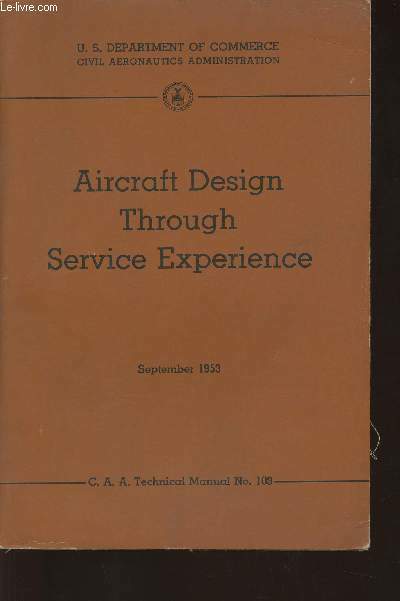
1953RO60146121U.S. Government printing office. 1953. In-8. Broché. Etat d'usage, Coins frottés, Dos frotté, Papier jauni. 203 pages. Nombreux schémas en noir et blanc, in texte. Texte en anglais. Nombreuses rousseurs. Pliures au dos.. . . . Classification Dewey : 420-Langue anglaise. Anglo-saxon
194408871n.p.: USN Bureau of Aeronautics 1944. 3 1/2" x 2 1/2" - 75 cards in original box; August 1944 illustrated in black and white obverse with photogravure of the aircraft verso shows illustration; there are 3 cards for each aircraft versos showing views from side front and from below. The word "RESTRICTED" in lower left of obverse of each card. The cards are fine the box shows wear at edges. <br/><br/> USN Bureau of Aeronautics unknown books
0260304883.Gpaperback. Good. Access codes and supplements are not guaranteed with used items. May be an ex-library book. paperback
0260913189.Ghardcover. Good. Access codes and supplements are not guaranteed with used items. May be an ex-library book. hardcover
033164648X.Ghardcover. Good. Access codes and supplements are not guaranteed with used items. May be an ex-library book. hardcover
0365155276.Ghardcover. Good. Access codes and supplements are not guaranteed with used items. May be an ex-library book. hardcover
1334228795.Gpaperback. Good. Access codes and supplements are not guaranteed with used items. May be an ex-library book. paperback
195490-21431U. S. Government Printing Office 1954-01-01. Paperback. Good. Good condition with some wear to cover. Writing on two pages. U. S. Government Printing Office paperback
026658991X.Ghardcover. Good. Access codes and supplements are not guaranteed with used items. May be an ex-library book. hardcover
028289537X.Gpaperback. Good. Access codes and supplements are not guaranteed with used items. May be an ex-library book. paperback
<br/> TITOLO: Guida ai musei aeronautici d'Europa. <br/> AUTORE: Turri,Matteo(A cura di).<br/> EDITORE: Odos Ediz.<br/> DATA ED.: 1990,<br/> EAN: 9788885270138