857 résultats
200347793Washington DC: GPO 2003. First Edition. First Printing. good. 166 wraps illus. map appendices. Serial No. 108-2. Joint Hearing with the Senate Committee on Commerce Science and Transportation. GPO paperback
197546110Washington DC: NASA 1975. First Edition. First Printing. fair. 859 wraps illus. diagrams references covers worn and soiled slightly cocked damp staining at edges. This was prepared at Goddard Space Flight Center. The Symposium was held in Silver Spring MD and was sponsored by the Institute of Environmental Sciences The American Institute of Aeronautics and Astronautics The American Society for Testing and Materials and the National Aeronautics and Space Administration. NASA paperback
197246119Washington DC: NASA 1972. First Edition. First Printing. good. 23 cm 1071 wraps illus. references covers somewhat worn and soiled some edge soiling. This symposium was sponsored by the Institute of Environmental Sciences The American Institute of Aeronautics and Astronautics; The American Society for Testing and Materials; and the National Aeronautics and Space Administration. NASA paperback
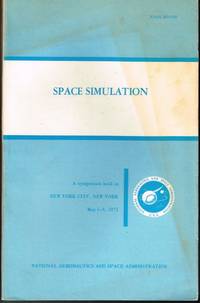
197241200Washington DC: NASA 1972. First Edition. First Printing. fair ex-lib. 1071 illus. references usual library markings front flyleaf removed "withdrawn" stamp on title page bds worn/soiled/faded. NASA SP-298. This symposium was sponsored by the Institute of Environmental Sciences The American Institute of Aeronautics and Astronautics The American Society for Testing and Materials and the National Aeronautics and Space Administration. These proceedings are the sixth of a series of conferences. NASA unknown
1975MASTER171811IWASHINGTON D.C.: NASA. G IN WRAPS. PREV. OWNER NAME AT FRONT MAILING LABEL AT REAR. Pages: 859. . 1975. TRADE PAPERBACK. WRAPS EDGEWORN WITH SMALL TEARS LIGHTLY CREASED & SOILED. PAGE CORNERS BUMPED. TEXT BLOCK CLEAN. . NASA paperback
1508722633.Gpaperback. Good. Access codes and supplements are not guaranteed with used items. May be an ex-library book. paperback
1508722633New. Brand new and still unused unknown
23710525like new. unknown
23710525-nnew. unknown
B9781508722632Paperback / softback. New. paperback
195988472Washington DC: U. S. Government Printing Office 1959. Presumed First Edition First printing. Wraps. Good. The format is approximately 10.5 inches by 8.5 inches. 32 pages plus covers. Wraps. Illustrations photographs and drawings. Diagrams. Tabular Data. Some wear and soiling to covers. On July 29 1958 President Eisenhower signed an act of Congress creating the National Aeronautics and Space Administration. The act declared "that is is the policy of the United States that activities in space should be devoted to peaceful purposes for the benefit of mankind." On October 1 1958 this new agency was established. This 1959 initial publication there were later editions/versions is thus one of the earliest official NASA publications. This work briefly presents a historical perspective then discusses Sounding Rockets Satellites and Space Probes Manned Space Flight Human Factors and Future Explorations. NASA traces its roots to the National Advisory Committee for Aeronautics NACA. Despite being the birthplace of aviation by 1914 the United States recognized that it was far behind Europe in aviation capability. Determined to regain American leadership in aviation the United States Congress created the Aviation Section of the U.S. Army Signal Corps in 1914 and established NACA in 1915 to foster aeronautical research and development. Over the next forty years NACA would conduct aeronautical research in support of the U.S. Air Force U.S. Army U.S. Navy and the civil aviation sector. After the end of World War II NACA became interested in the possibilities of guided missiles and supersonic aircraft developing and testing the Bell X-1 in a joint program with the U.S. Air Force. NACA's interest in space grew out of its rocketry program at the Pilotless Aircraft Research Division. The Soviet Union's launch of Sputnik 1 ushered in the Space Age and kicked off the Space Race. Despite NACA's early rocketry program the responsibility for launching the first American satellite fell to the Naval Research Laboratory's Project Vanguard whose operational issues ensured the Army Ballistic Missile Agency would launch Explorer 1 America's first satellite on February 1 1958. The Eisenhower Administration decided to split the United States' military and civil spaceflight programs which were organized together under the Defense Department's Advanced Research Projects Agency. As the United States' premier aeronautics agency NACA formed the core of NASA's new structure by reassigning it its 8000 employees and three major research laboratories. NASA also proceeded to absorb the Naval Research Laboratory's Project Vanguard the Army's Jet Propulsion Laboratory JPL and the Army Ballistic Missile Agency under Wernher von Braun. This left NASA firmly as the United States' civil space lead and the Air Force as the military space lead. U. S. Government Printing Office paperback
195980605Washington DC: National Aeronautics and Space Administration c1959. Presumed First Edition First printing. Booklet. Good. Format is approximately 10.5 inches by 8 inches. 32 pages plus covers. Illustrations. Reference was found on page 21 to selection of candidates having begun in early 1959. Other references to early 1959 and 1958 noted. This work starts out with a brief history of the scientific inquiry into space and space travel. It the discusses sounding rockets Satellites Spacecraft Space Probes Jupiter C Vanguard I Juno II Tracking Station Manned Space Flight Human Factors Project Mercury and space exploration. This is an early NASA general audience publication. The National Aeronautics and Space Administration NASA is an independent agency of the U.S. Federal Government responsible for the civilian space program as well as aeronautics and space research. NASA was established in 1958 succeeding the National Advisory Committee for Aeronautics NACA. The new agency was to have a distinctly civilian orientation encouraging peaceful applications in space science. Since its establishment most US space exploration efforts have been led by NASA including the Apollo Moon landing missions the Skylab space station and later the Space Shuttle. NASA is supporting the International Space Station and is overseeing the development of the Orion spacecraft the Space Launch System and Commercial Crew vehicles. The agency is also responsible for the Launch Services Program which provides oversight of launch operations and countdown management for uncrewed NASA launches. National Aeronautics and Space Administration unknown
198974608Lyndon B. Johnson Space Center Houston TX: National Aeronautics and Space Administration 1989. Presumed First Edition First printing. Wraps. Good. vii 1 44 pages plus covers. Illustrations most in color. Cover has some wear and soiling with edge tear at back. Format is approximately 8.5 inches by 11 inches. The Spacelab Life Sciences 1 SLS-1 mission originated with a call to the scientific community for experiments in 1978. Accepted experiments involved humans primates rodents amphibians and plants. The original payload configuration was reduced to include human passive rodent and basic biology experiments and engineering evaluations. Human experiments will address effects of micro-gravity on various physiological parameters during and postflight. Investigations with nonhuman subjects will study microgravity effects on the cardiopulmonary cardiovascular and musculoskeletal systems on the regulation of blood volume and erythropoiesis and on calcium metabolism and gravity receptors. SLS-1 was to serve as a stepping stone in establishing capabilities for flying nonhuman subjects and performing in-flight manipulations on these subjects without jeopardizing the crew environment. Fundamental technology incorporated in the animal holding facilities and laboratory work bench will be used in subsequent missions and in the future Space Station. Space Life Science-1 SLS-1 launched aboard Space Shuttle Orbiter Columbia STS-40 on June 5 1991 was the first Spacelab mission dedicated solely to life sciences research. The laboratory for the research took place in a module shown here carried in the cargo bay of the Columbia. The purpose of the mission was to study the mechanisms magnitudes and time courses of certain physiological changes that occur during space flight to investigate the consequences of the body's adaptation to microgravity and readjustment to Earth's gravity and to bring the benefits back home to Earth. The mission was designed to explore the responses of the heart lungs blood vessels kidneys and hormone-secreting glands to examine the causes of space motion sickness and study changes in the muscles bones and cells. Many studies started during SLS-1 provided data that served as the foundation for investigations on the International Space Station. National Aeronautics and Space Administration paperback
59139Paperback. Fine. Spacesuit guidebook HOW TO BUILD A SPACESUIT paperback
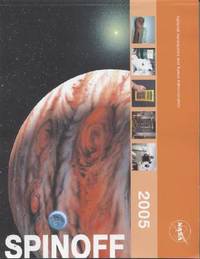
200586140Washington DC: National Aeronautics and Space Administration NASA Center for AeroSpace Information CASI Publications and Graphics Department 2005. Presumed First Edition First printing of this annual report. Trade paperback. Very good. Lynette Cook Front cover art. The format is approximately 11 inches by 8.5 inches. 167 1 pages. Illustrations most with color. Annual report on technology transfer or "technology twice used" inventions from NASA. Since 1976 Spinoff has profiled technologies that benefit from NASA investment and expertise. These developments have transformed into commercial products and services that are used throughout daily life from your cell phone camera to the memory foam in your mattress. When Congress created NASA it mandated the agency disseminate its innovations as widely possible. To that end the Technology Transfer Program was created in 1964 and it has functioned ever since making it NASA’s longest continuously operated mission. Early publications about NASA inventions made available to the scientific and engineering communities resulted in feedback indicating a broad interest in the private sector in adapting NASA technology for commercial uses. As products began to emerge NASA began preparing annual reports on these successes to present at congressional budget hearings. Spinoff has been published in a four-color editionand it has been released every year since 1976. All together since its first edition NASA has shared the stories of more 2000 products and services that began as or have benefited from NASA technology. In addition to the general public NASA sends copies of Spinoff to politicians representatives at the United Nations economic decision makers company CEOs academics scientists engineers professionals in technology transfer the news media and many others. The early black-and-white Technology Utilization Program Reports published in 1973 and ‘74 generated so much public interest that NASA decided to turn them into an attractive publication for a general audience. NASA SPINOFF now features dozens of success stories annually online and in its print publication demonstrating the wider benefits of America’s investment in its space program. The 2005 edition highlights Partnership Benefits in Health and Medicine Transportation Public Safety Consumer/Home/Recreations Environment and Resources Management; Computer Technology and Industrial Productivity/Manufacturing Technology. National Aeronautics and Space Administration, NASA Center for AeroSpace Information (CASI), Publications and Graphics Departmen paperback
0160841917.Gpaperback. Good. Access codes and supplements are not guaranteed with used items. May be an ex-library book. paperback
ANAIS-0160664624United States Government Printing. paperback. Good. 0x0x0. Buy with confidence. Excellent Customer Service & Return policy. United States Government Printing paperback
0160814235New. Brand new and still unused unknown
B9781288911134Paperback / softback. New. paperback
1982765255PN. New. 1982. Soft Cover. Date is original print. This is a reprint edition. . PN paperback
23112235like new. unknown
1505399378.Gpaperback. Good. Access codes and supplements are not guaranteed with used items. May be an ex-library book. paperback
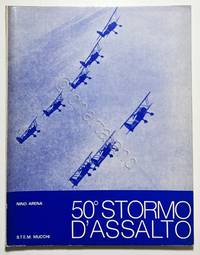
125387Stato Maggiore Aeronautica - N. Arena - 50° Stormo d'Assalto - ed. 1979 - Testo in lingua italiana. Pagine 233 con illustrazioni. - Copertina morbida. - Condizioni molto buone con piccoli segni del tempo. unknown
127630Stato Maggiore Aeronautica - I Reparti dell'Aeronautica Militare Italiana: Cenni storici - ed. 1973 - Testo in lingua italiana. Pagine 272 con tavole illustrate. - Copertina rigida. - Condizioni molto buone. unknown
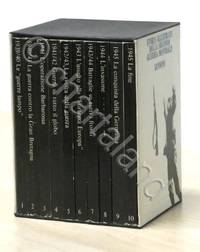
131223Storia illustrata della Seconda Guerra Mondiale - ed. 1969 Sansoni - Opera completa in 10 volumi - 1: 1939-40 : le guerre lampo - 2: 1940-41 : la guerra contro la Gran Bretagna - 3: 1941 : l'operazione Barbarossa - 4: 1941-42 : guerra su tutto il globo - 5: 1942-43 : la svolta della guerra - 6: 1943 : l'assalto alla fortezza Europa - 7: 1943-44 : battaglie su tutti i fronti - 8: 1944 : l'invasione - 9: 1945: la conquista della Germania - 10: 1945: la fine - Pag. 191; 192; 191; 192; 191; 191; 191; 192; 190; 192. Con moltissime illustrazioni. - Copertina morbida - Testo in italiano. - Buone condizioni generali. Con cofanetto. unknown