486 résultats
196267236Maxwell Air Force Base Alabama: United States AIr University Aerospace Studies Institute 1962. Presumed first edition/first printing. Wraps. Good. Pencil erasure residue on t-p. Errata sheet stapled to t-p verso. Cover has some wear and soiling. iii 264 p. Includes: diagrams maps bibliography. Footnotes. Fold-out organizational charts. Author continues: "Concepts Division." This is an underrecognized but critically seminal work produced at the time the United States involvement in the Vietnam War was ramping up. It was an early analysis of the role of air power in insurgency/guerrilla warfare situations. As a product of the Aerospace Studies Institute of the Air University it was available to a broad range of field grade officiers to senior USAF leadership. This study was concerned with those aspects of guerrilla operations during the Second World War that related to the use of airpower ot either support guerrilla or counterguerrilla roles during the 1940-1945 time period. It examples the application of air poser by analyzing guerrilla campaigns. The study identified areas of effective applicaiton of air power as well as those where air power was not as effective as desired. AIr Supply was a signifcant element in the application of air power. Additionally specific aircraft characteristics were relevant and in some cases determinant with respect to the selection and application of specific air tactics. United States, AIr University, Aerospace Studies Institute paperback
Features. Grumman X-29A; Cook Island Hopping; "Mallet Blow"; Blackburn's Buccaneer - 1; Captured Argentine aircraft in the UK; Slingsby T67M Firefly; Schneider Trophy 1929; Air Malawi; Blackburn's Buccaneer - 2; R. Norwegian A.F.; Starfighter Twilight; 'Ocean Safari 85'; German Cargo Services; Where have all the Tridents gone?; ARV Super 2; Chinese 'Coke' with a western flavour; 'Frogfoot'; Back to Barbados; R.A.F. Finningley; Orions provide ASW network around the world; Coat of many colours; Aeronautical Research in WWI; South African DC-3 Anniversary; Republic of Singapore A.F.; EAP - Britain's fighter demonstrator; Bell AH-1W SuperCobra; First TriStar K.1 for No. 216 Squadron; Final Top-up with No. 57 Squadron; Zeppelin-Staaken E.4/20; Sun'n Fun; R.A.F. Fighter Command 50 years on; British Caledonian Airways - part 1; Electronic Warfare - part 1; R. Moroccan A.F.; Hanover Report; Tiger Club Air Show; Outback Medic; British Caledonian Airways - part 2; What to see at Farnborough; R.A.F. Support Helicopters; British Aerospace 146; British Caledonian Airways - part 3; Lynx Speed Record; British Aerospace ATP; Chile's Air Force; Sea Harrier Training; Freighters at Birmingham; Tactical Fighter Meet '86; Eastern Air Lines - part 1; Farnborough postscript; Beverleys in Aden; Visit to China; R.A.F. Support Helicopters; EW Training in the R.A.F.; Oshkosh Highlights; Eastern Air Lines - part 2; Westland Lysander; Index laid in. Clean and unmarked with moderate external wear. A quality copy. Book
19722081502112501363A5 Revised new edition Volume 1-5 First edition Volume 6-8 Boxed Publishing Co. Ltd. 1972. Soft Cover. Fine. Number of books: 1 A5 Revised new edition [Volume 1-5] First edition [Volume 6-8] Boxed Publishing Co., Ltd. paperback
196409958US: Aerospace Research Laboratory Office of Aerospace Research U.S. Air Force 1964. First Edition. Paperback. Fair/No dust jacket. 10.7 x 8.4 x 0.8 inches. Paperback publication. The covers and title page have organization stamps number marked near the spine and the previous owner's name. The covers have some edge wear and tear and a few creases. The spine is creased. The binding is tight. The interior pages are clean and unmarked. Electronic delivery tracking will be issued free of charge. ARL 64-34 Aerospace Research Laboratory, Office of Aerospace Research, U.S. Air Force paperback
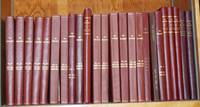
1970216453Washington DC: The International Association of Machinists and Aerospace Workers 1970. Hardcover. Twenty four professionally bound volumes of the newspaper a complete run up to Feb. 1970. Large folios 11.5x19.25 inches all bound in maroon or brick red buckram with spine titles the newsprint is evenly browned without any chipping and still flexible some issues have mailing labels no other flaws. Illustrated. A very large and heavy set international shipping will be expensive. The International Association of Machinists and Aerospace Workers hardcover
1970216453Washington DC: The International Association of Machinists and Aerospace Workers 1970. Hardcover. Twenty four professionally bound volumes of the newspaper a complete run up to Feb. 1970. Large folios 11.5x19.25 inches all bound in maroon or brick red buckram with spine titles the newsprint is evenly browned without any chipping and still flexible some issues have mailing labels no other flaws. Illustrated. A very large and heavy set international shipping will be expensive. The International Association of Machinists and Aerospace Workers hardcover books
MASTER316194ILONDON: AEROSPACE PUBLISHING. VG IN WRAPS. 43 VOLUME SET. FAINT WEAR IN OCCASIONAL SPOTS. Pages: 6880. . TRADE PAPERBACK. ALL PAGES CLEAN BINDINGS TIGHT. 160 PAGES EACH ISSUE. WILL SHIP IN SEVERAL BOXES. . AEROSPACE PUBLISHING paperback
In -folio, pp. IV, 84, tavv. 174. Straordinario repertorio iconografico. Legatura originale in mezza pelle con titolo impresso in oro al dorso e illustrazione ai piatti, tagli in oro, cofanetto. Esemplare perfetto.
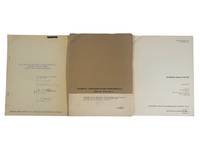
1965223311965. Douglas Missile and Space Systems Division and McDonnell Douglas internal technical reports issued between 1965 and 1974 document the engineering infrastructure required for missile testing data acquisition and systems reliability during the Cold War. Produced for internal training and operational use these materials establish the technical foundations of missile deployment including environmental protection telemetry standardization and automated validation processes as missile systems increased in complexity during and after the Apollo era. The archive supports research into aerospace engineering defense industry practices and the integration of computing and instrumentation within missile systems development.<br /> <br /> Douglas Missile and Space Systems Division; McDonnell Douglas Astronautics Company. Electrical Grounding and Lightning Protection Systems Design Recommendations. Santa Monica CA: Douglas Missile and Space Systems Division October 1965; Telemetry Instrumentation Fundamentals. Santa Monica or Huntington Beach CA: Douglas Missile and Space Systems Division n.d. late 1960s to early 1970s; Patzold F.W. Automated Missile Testing. Huntington Beach CA: McDonnell Douglas Astronautics Company February 1974. Three technical reports totaling approximately 105 pages illustrated with photographs and technical schematics in original paper wraps. The grounding report by W.F. White outlines protection systems for missile facilities addressing "earth resistivity" lightning protection and grounding requirements for launch pads blockhouses and associated infrastructure. Telemetry Instrumentation Fundamentals provides a structured introduction to data acquisition systems stating that "telemetry must expand with the increased complexity of R & D" and detailing standards such as IRIG for coordinating data across missile platforms including Atlas Thor and Delta. Patzold's Automated Missile Testing paper presented at the American Society for Quality Control's 28th Annual Technical Conference describes a "production test system. for an advanced missile guidance system" incorporating software controlled testing environments vibration and hydraulic test stations and computer based evaluation systems to improve reliability and defect detection.<br /> <br /> These materials were produced during a period when missile systems required increasingly sophisticated support infrastructure including standardized telemetry for real time data transmission and automated testing systems to ensure performance reliability prior to deployment. The emphasis on lightning protection and grounding reflects the vulnerability of launch installations and sensitive electronic systems while the shift toward automation in the 1970s demonstrates the growing role of computer control in aerospace manufacturing and testing. Together the reports document the evolution from manually intensive engineering practices to integrated systematized approaches to missile validation within the defense industry. Light edge wear and curling to covers with minor interior smudging; text remains clear and fully legible; overall very good condition. unknown
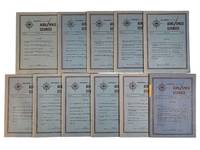
1959223131959. Journal of the Aerospace Sciences 1959 documents foundational research in American aerospace engineering during the early Cold War space race. Published the year after the establishment of NASA and amid intensified U.S. efforts to match Soviet rocket achievements following the 1957 launch of Sputnik these issues contain contemporary technical studies on hypersonic aerodynamics missile stability spacecraft propulsion and planetary trajectory design. Articles by scientists and engineers working at leading research institutions and government laboratories record the theoretical groundwork that would shape the next decade of American spaceflight including early analytical work on Mars trajectories reentry materials and competing propulsion systems for interplanetary travel.<br /> <br /> Journal of the Aerospace Sciences. Volume 26 numbers 1 2 4 5 6 7 8 9 10 11 and 12. New York: Institute of the Aeronautical Sciences 1959. Eleven issues from the journal's 1959 volume lacking only the March issue. The periodical served as the principal research forum of the Institute of the Aeronautical Sciences the professional organization that later became the American Institute of Aeronautics and Astronautics. Together these figures represent a cohort of scientists who would define American spaceflight theory and practice in the decade to come.Archive consists of 11 printed volumes in original wrappers approx. 50-80 pages per issue totaling over 800 pages.<br /> <br /> This archive includes:<br /> <br /> Volume 26 No. 1 January 1959: Features research on turbulent skin-friction drag at supersonic speeds jet nozzle structures nonlinear flutter problems and B-47 gust response. Includes Frank E. Goddard Jr. T.C. Adamson Jr. S.P. Shen.<br /> <br /> Vol. 26 No. 2 February 1959: Contains work on spiked bodies at hypersonic speeds reentry missile stability and panel flutter. Contributors include Seymour M. Bogdonoff E.V. Laitone and Frederick L. Ryder.<br /> <br /> Vol. 26 No. 4 April 1959: Publishes the Twenty-Second Wright Brothers Lecture by Maurice Roy of ONERA France. Other articles include thermal stresses hypersonic shock tunnels and boundary-layer transition.<br /> <br /> Vol. 26 No. 5 May 1959: Focuses on heat transfer at hypersonic speeds lift-drag ratios at supersonic speeds low-thrust spacecraft flight mechanics and chemically reacting boundary layers. Authors include A.J. Hanawalt Clinton E. Brown and Daniel E. Rosner.<br /> <br /> Vol. 26 No. 6 June 1959: Includes Hans Bethe's paper on the ablation of glassy materials structural matrix analysis and free-molecule flow dynamics.<br /> <br /> Vol. 26 No. 7 July 1959: Features M.A. Biot on thermomechanical reciprocity airplane turbulence responses and reentry motion. Also includes research on fatigue stress and laminar dissociated airflows.<br /> <br /> Vol. 26 No. 8 August 1959: Discusses transonic wing/body aerodynamics supersonic plate divergence mercury plasma tunnels and propellant burning models. Includes Hans U. Eckert.<br /> <br /> Vol. 26 No. 9 September 1959: Opens with Richard H. Battin's landmark article on planetary reconnaissance trajectories from MIT along with contributions on missile drag optimization rocket flight variational problems and real-gas flows.<br /> <br /> Vol. 26 No. 10 October 1959: Features George Paul Sutton's comprehensive comparison of interplanetary propulsion systems addressing ion rockets nuclear heating and solar sails. Also includes optimal aircraft climb paths and spherical cap snapping.<br /> <br /> Vol. 26 No. 11 November 1959: Includes studies on flutter energy equations jet-flap compressors porous-wall cooling and actuator disc dynamics in turbomachinery.<br /> <br /> Vol. 26 No. 12 December 1959: Closes the year with work on thermal buckling subsonic turbulence reattachment zoom climb optimization and hypersonic similitude. Contributors include Carl Gazley Jr. Wallace D. Hayes and George Gerard.<br /> <br /> In 1959 the Journal of the Aerospace Sciences served as the official scientific platform for cutting-edge American aerospace research marking the transition from aeronautical to astronautical engineering. That year saw sustained focus on hypersonics ballistic missile trajectories spacecraft propulsion and heat transfer under extreme atmospheric conditions as the U.S. sought to stabilize its strategic position after the 1957 Sputnik crisis and ahead of the 1960 Mercury program. Research in these volumes was underwritten by military contracts NASA collaboration established in 1958 and Cold War exigencies. Light foxing to several wrappers particularly July issue; some edge wear and surface abrasions. Two issues show sticker residue at spine or lower edge. Interiors uniformly clean bindings firm and covers largely bright and intact. Overall very good condition. The studies record the technical environment that produced early American satellite programs and later lunar navigation systems linking university laboratories defense contractors and federal research agencies. unknown
17086Aerospace Archive of eight scarce courses and technical reports relating to Jet Propulsion and Aero-Elasticity published between 1945 and 1950 a key period in the development of these fields. Included material was published by the California Institute of Technology Massachusetts Institute of Technology the US Air Force and Boeing Aircraft Company. These documents all belonged to Joseph Kelley Jr. who served in the Air Force during WWII as Director of the Structural Design Unit at the Wright Air Development Center in Dayton OH. This collection of reports demonstrates the high-level of importance that the US military placed upon the growing field of aerodynamics and jet propulsion; in the waning days of W.W.II and the early days of the Cold War Space Race this information was more crucial and critical than ever. All have ownership signature Kelly; few minor annotations in pencil. All in very good condition. <br/><br/>During WWII jet engine technology was of utmost importance for the US military as Nazi scientists had developed advanced fighter planes and bombers with jet technology; after World War II ended understanding and harnessing jet power was essential both for aviation and in early space exploration. As such jet technology was fiercely important cutting-edge top secret military information. The very rare 1945 course book on "Jet Propulsion" is even marked "Confidential" throughout; on the front cover though "Confidential" has been crossed out in pencil. This documents is published by California Institute of Technology Caltech home of NASA's Jet Propulsion Laboratory JPL. JPL was funded in by the U.S. Army's Ordnance Corps beginning in 1944 and the lab would eventually involve technologies for space flight secure communications spacecraft navigation and control and planetary exploration. By 1945 when this report was published JPL had a staff of almost 300 and the group had begun to launch test vehicles from White Sands New Mexico to an altitude of 40 miles 60 kilometers monitoring their performance by radio and war surplus radar equipment. Interestingly two of the lectures were taught by JPL co-founder Hsue-Shen Tsien Qian Xuesen who contributed to the Manhattan Project; later under the pressure of deportation for suspicions of association with Communists he returned to China where he made important contributions to China's missile and space program. <br/><br/>"High Speed Aerodynamic Lecture Series" 1948 features the research and writing of Dr. Bernhard H. Goethert a German scientist who developed German Nazi jets during WWII. Goethert came to the US via Operation Paperclip a secret US intelligence program in which more than 1600 German scientists engineers and technicians were brought to the US after WWII to work for the federal government. As Cold War tensions increased after the end of WWII both the United States and the Soviet Union were eager to work with German scientists who could help develop advanced engines in the early years of the Space Race. <br/><br/>After WWII MIT emerged as the nation's largest nonindustrial defense contractor and almost all major research in MIT's Department of Aeronautics was performed for the military. Four reports in our archive come from MIT's Aeroelastic and Structures Research Laboratory which led the design of aircraft structures for high-speed flight virtually creating the modern specialty of aeroelasticity. These documents evaluate wing loads elasticity and the effects of different forces or stressors on the aircraft. The Boeing Company was an essential WWII-era producer of military aircraft but after 1945 the company returned to the business of transporting goods and passengers. During World War II Boeing and its partners worked together to produce a staggering 98965 aircraft including the famed B-17 Flying Fortress. The momentum from the war effort served to launch the company's tremendous postwar advances in aerospace technology as seen in this 1948 report which examines how to best stabilize planes caught in a gust of wind. <br/><br/><br/>The following reports are included in the archive: <br/><br/>1 California Institute of Technology. "Jet Propulsion: A Course Given for Officers of the United States Army and Navy by the Staff of the Guggenheim Aeronautical Laboratory California Institute of Technology." Section I. Pasadena CA: California Institute of Technology 1945. Original paper wraps. 11.25 x 9 in. 492 pages. Table of contents lists lectures on topics such as: "Principles of Aerotherodynamics" "Chemistry of Combustion" "The Solid Propellant Rocket" and "The Liquid Propellant Rockets." Numerous technical diagrams graphs and illustrations throughout including some large fold-outs. Marked "Confidential" throughout with some pencil annotations by the owner. Copy number 20 of an unknown limited run. Very rare with 0 copies listed in any institutional or university collections per OCLC Worldcat.<br/><br/>2 Massachusetts Institute of Technology. "Report On An Investigation Of Stresses In Aircraft Structures Under Dynamic Loading." January 21 1949. Report by R.L. Bisplinghoff G. Isakson T.H.H. Pian H.I. Flomenhoft and T.F. O'Brien. Quarto. Original blue covers. Spiral bound. 377 pages Filled with diagrams mathematical equations and illustrations throughout. Chapters on: Basic mathematical Approach to the Problem of Determining transient Stresses in Unrestrained Elastic Structures Characteristics of the principal Oscillations of the Aircraft Structure and The Landing Problem The Gust Problem and The Gun Blast Problem. Only 3 copies listed in institutional or university collections in the United States per OCLC Worldcat.<br/><br/>3 Massachusetts Institute of Technology. "Report On Gust Loads On Rigid And Elastic Airplanes." August 15 1949. Report by: R.L. Bisplinghoff G. Isakson and T.F. O'Brien. Quarto. Original blue wraps. Spiral bound. 112 pages. Filled with diagrams mathematical equations and illustrations. Includes chapters on "The Rigid Airplane in Incompressible Flow" and "Gust Loads at Supersonic Speeds" among others. Authors notably thank 3 women who worked as computers for the project in the Acknowledgement section. Per OCLC Worldcat only 1 copy of this report at MIT Libraries is held by any institutional or university collection.<br/><br/>4 Massachusetts Institute of Technology. "A Two-Dimensional Study Of The Impact Of Wedges On a Water Surface for the Bureau of Aeronautics." March 20 1950. Report by R.L. Bisplinghoff and C.S. Doherty. Original blue wraps. Spiral bound. 115 pages. Filled with diagrams mathematical equations and illustrations. Per OCLC Worldcat only 1 copy of this report at MIT Libraries is held by any institutional or university collection.<br/><br/>5 Massachusetts Institute of Technology. "The Prediction Of Stresses In A Structure Under An Arbitrary Dynamic Loading. Technical Report for Contract N5 ori-07833 to Office of Naval Research." July 15 1949. Report by T.H.H. Pian and J.N. Siddall. Quarto. Original blue wraps. Spiral bound. 32 pages. Filled with diagrams mathematical equations and illustrations. "An experimental method of predicting the stress at any point in a complete elastic structure under an arbitrary dynamic loading is described." Only 3 copies of this report is listed in any institutional collection per OCLC Worldcat.<br/><br/>6 United States Air Force Air Material Command. "AF Technical Report 5706. Prediction Of Wing Loads Due To Gusts Including Aero-Elastic Effects. Part I. Formulation of the Method." A.T.I. No. 24322. Dayton OH: United States Air Force Air Material Command 21 July 1947. Quarto. Original paper wrappers staplebound. 90 pages. Filled with scientific mathematical equations and diagrams. No copies of this document listed in any institutional or university collections as per OCLC Worldcat.<br/><br/>7 Dr. Bernard H. Goethert. "High Speed Aerodynamic Lecture Series / Part I. Experimental Facts On High Speed Aerodynamics And Brief Comparison With Theory." Given at Air Force Institute of Technology Wright-Patterson Air Force Base Dayton OH. Winter Quarter 1948. Quarto. Original paper wraps stablebound. 76 pages. Filled with 117 illustrations listed in Index. Goethert was a German aeronautics scientist who developed Nazi jets during World War II; he later became chief scientist for the Air Force Systems Command near Washington. From the Foreword: "This series of eight lectures delivered during the period from 16 February 1948 until 5 March 1948 .was intended to provide a demonstrative picture of the characteristic of high-speed aerodynamics." Lectures topics on Continuity Law from Compressible Fluids and Some Applications; Shock Waves and Propagation of Pressure Disturbances; Pressure Distribution Lift and Center of Pressure on Airfoils; Drag of Airfoil Section sand Flow Separation Due to Shock Wave Formation; Supersonic Flow Around Sharp Corners and Characteristics of Airfoils at Supersonic Speeds; Wave Reflection in Supersonic Flow; Interaction Between Shock Waves and Boundary Layer; and Longitudinal Stability and Trim of Airplanes. <br/><br/>8 Boeing Aircraft Company. "Document No. D-9065. Stability Equations For An Airplane In A Gradient Gust." Dated 3-30-48. Quarto. Original report cover. Screw bound. 35 pages. 14 pages are mimeographed from a handwritten manuscript on blueprint paper including several hand-drawn diagrams and scientific formulas. Sections on "Stability Equations Neglection Unsteady Lift" "Stability Equations Including Unsteady Lift" and "Other Unsteady Lift Methods." Rare internal document from Boeing with No known copies of this document is listed in any institutional or university collections per OCLC Worldcat. unknown books