486 résultats
1963720713PN. New. 1963. Soft Cover. Date is original print. This is a reprint edition. . PN paperback
1991241595PN. New. 1991. Soft Cover. Date is original print. This is a reprint edition . PN paperback
1998261109Detroit: UAW-CIO 1998. Paperback. 152p. wraps 4x8 inches four page "Amendments to Article 16 initiation fees and dues" laid in very good condition. UAW-CIO paperback books
1998243785Detroit: UAW-CIO 1998. Paperback. 224p. paperback very good. Also included is a worn copy of the 1995 constitution. UAW-CIO paperback books
196488339Beale Air Force Base CA: United States Air Force 456th Strategic Aerospace Wing SAC Headquarters c1964. Presumed to be one of only a few multiple copies produced for distribution. Two sheets with printing on three sides only. Good. Format is approximately 8 inches by 10.5 inches with THREE holes punched in the left side. This document contains 2 sheets/four pages with text printed on the first three sides. This typed/mimeographed document shows some wear and soiling. This was included in a group of materials associated with the 456th Strategic Aerospace Wing SAC This type of operational communication within the SAC organization rarely survives. NAV/RN is written at the top of the front side. It is assumed that the author was Lt. Colonel USAF was Chief of the Bomb/Nav Branch located at Beale Air Force Base in California. The 456th Bombardment Wing is an inactive United States Air Force unit. It was last assigned to the 14th Air Division of Strategic Air Command at Beale Air Force Base California where it was inactivated on 30 September 1975. The wing was redesignated the 456th Strategic Aerospace Wing and was activated at Beale Air Force Base California in February 1963. It flew Boeing B-52 Stratofortress bombers and Boeing KC-135 Stratotanker air refueling aircraft and also commanded a HGM-25A Titan I squadron until 1965. Although it operated no intercontinental ballistic missiles after then it was not until July 1972 that the wing was redesignated the 456th Bombardment Wing. The wing was inactivated in September 1975 and its personnel equipment and mission transferred to the 17th Bombardment Wing and moved to Beale on paper from Wright-Patterson Air Force Base Ohio. This document has sections on A. CONSIDERATIONS FOR PLANNING; B. FLIGHT TECHNIQUES; C. EMERGENCY PROCEDURES; and D. OPERATIONAL ERRORS NOTED BY SAC GAM TEAM. This document addresses situations that allow the missile to 'break the Tone' and an error induced by the Flight Control Power Switch being "OFF" during programming. Also discussed was Star lock-on Astro-Tracker difficulties including simultaneously use of the SLEW and STEP switches. The Emergency procedures were largely concerned with engine failures. The SAC GAM team noted concerns with guidance system alignment in flight data recording especially by missile operators in the use of SAC Form 650 and Radar Navigators should place greater emphasis on accurate completing of SAC Form 284. The North American Aviation AGM-28 Hound Dog was a supersonic turbojet-propelled nuclear armed air-launched cruise missile developed in 1959 for the United States Air Force. It was primarily designed to be capable of attacking Soviet ground-based air defense sites prior to a potential air attack by B-52 Stratofortress long range bombers during the Cold War. The Hound Dog was first given the designation B-77 then redesignated GAM-77 and finally AGM-28. The Hound Dog continued to be deployed for a total of 15 years until its replacement by newer missiles including the AGM-69 SRAM and then the AGM-86 ALCM. United States Air Force, 456th Strategic Aerospace Wing (SAC), Headquarters unknown
20001327488PN. New. 2000. Soft Cover. Date is original print. This is a reprint edition . PN paperback
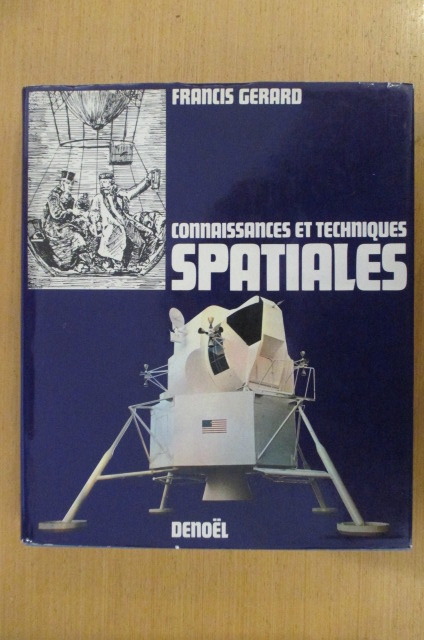
8vo., First Edition thus, with plates, illustrations and diagrams in the text, mild tape marks on endpapers; blue cloth, upper and backstrip lettered in silver, a near fine copy. An unspecified (but evidently small) number of copies were bound specially for British Aerospace. VERY SCARCE.
ESP030C431971 / 328 pages. Relié avec jaquette. Editions Denoël
1975749572PN. New. 1975. Soft Cover. Date is original print. This is a reprint edition. . PN paperback
0791808424.Gpaperback. Good. Access codes and supplements are not guaranteed with used items. May be an ex-library book. paperback
1973747487PN. New. 1973. Soft Cover. Date is original print. This is a reprint edition. . PN paperback
1991ZB652003Amer Society of Mechanical 1991. 159 pp. paperback ex library else text clean & binding tight. - If you are reading this this item is actually physically in our stock and ready for shipment once ordered. We are not bookjackers. Buyer is responsible for any additional duties taxes or fees required by recipient's country. Photos available upon request. Amer Society of Mechanical paperback
1977754657PN. New. 1977. Soft Cover. Date is original print. This is a reprint edition. . PN paperback
1979758543PN. New. 1979. Soft Cover. Date is original print. This is a reprint edition. . PN paperback
1979758545PN. New. 1979. Soft Cover. Date is original print. This is a reprint edition. . PN paperback
1979758544PN. New. 1979. Soft Cover. Date is original print. This is a reprint edition. . PN paperback
1979758542PN. New. 1979. Soft Cover. Date is original print. This is a reprint edition. . PN paperback
1963718428PN. New. 1963. Soft Cover. Date is original print. This is a reprint edition. . PN paperback
1963718431PN. New. 1963. Soft Cover. Date is original print. This is a reprint edition. . PN paperback
19631340904PN. New. 1963. Soft Cover. md . PN paperback
Z1-C-089-00808Used - Good. Hardcover. Ships from UK in 48 hours or less usually same day. Your purchase helps support Sri Lankan Children's Charity 'The Rainbow Centre'. Ex-library so some stamps and wear but in good overall condition. 100% money back guarantee. We are a world class secondhand bookstore based in Hertfordshire United Kingdom and specialize in high quality textbooks across an enormous variety of subjects. We aim to provide a vast range of textbooks rare and collectible books at a great price. Our donations to The Rainbow Centre have helped provide an education and a safe haven to hundreds of children who live in appalling conditions. We provide a 100% money back guarantee and are dedicated to providing our customers with the highest standards of service in the bookselling industry. hardcover
1962716468PN. New. 1962. Soft Cover. Date is original print. This is a reprint edition. . PN paperback
1972745618PN. New. 1972. Soft Cover. Date is original print. This is a reprint edition. . PN paperback
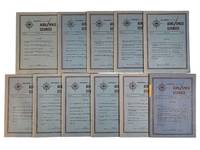
1959223131959. Journal of the Aerospace Sciences 1959 documents foundational research in American aerospace engineering during the early Cold War space race. Published the year after the establishment of NASA and amid intensified U.S. efforts to match Soviet rocket achievements following the 1957 launch of Sputnik these issues contain contemporary technical studies on hypersonic aerodynamics missile stability spacecraft propulsion and planetary trajectory design. Articles by scientists and engineers working at leading research institutions and government laboratories record the theoretical groundwork that would shape the next decade of American spaceflight including early analytical work on Mars trajectories reentry materials and competing propulsion systems for interplanetary travel.<br /> <br /> Journal of the Aerospace Sciences. Volume 26 numbers 1 2 4 5 6 7 8 9 10 11 and 12. New York: Institute of the Aeronautical Sciences 1959. Eleven issues from the journal's 1959 volume lacking only the March issue. The periodical served as the principal research forum of the Institute of the Aeronautical Sciences the professional organization that later became the American Institute of Aeronautics and Astronautics. Together these figures represent a cohort of scientists who would define American spaceflight theory and practice in the decade to come.Archive consists of 11 printed volumes in original wrappers approx. 50-80 pages per issue totaling over 800 pages.<br /> <br /> This archive includes:<br /> <br /> Volume 26 No. 1 January 1959: Features research on turbulent skin-friction drag at supersonic speeds jet nozzle structures nonlinear flutter problems and B-47 gust response. Includes Frank E. Goddard Jr. T.C. Adamson Jr. S.P. Shen.<br /> <br /> Vol. 26 No. 2 February 1959: Contains work on spiked bodies at hypersonic speeds reentry missile stability and panel flutter. Contributors include Seymour M. Bogdonoff E.V. Laitone and Frederick L. Ryder.<br /> <br /> Vol. 26 No. 4 April 1959: Publishes the Twenty-Second Wright Brothers Lecture by Maurice Roy of ONERA France. Other articles include thermal stresses hypersonic shock tunnels and boundary-layer transition.<br /> <br /> Vol. 26 No. 5 May 1959: Focuses on heat transfer at hypersonic speeds lift-drag ratios at supersonic speeds low-thrust spacecraft flight mechanics and chemically reacting boundary layers. Authors include A.J. Hanawalt Clinton E. Brown and Daniel E. Rosner.<br /> <br /> Vol. 26 No. 6 June 1959: Includes Hans Bethe's paper on the ablation of glassy materials structural matrix analysis and free-molecule flow dynamics.<br /> <br /> Vol. 26 No. 7 July 1959: Features M.A. Biot on thermomechanical reciprocity airplane turbulence responses and reentry motion. Also includes research on fatigue stress and laminar dissociated airflows.<br /> <br /> Vol. 26 No. 8 August 1959: Discusses transonic wing/body aerodynamics supersonic plate divergence mercury plasma tunnels and propellant burning models. Includes Hans U. Eckert.<br /> <br /> Vol. 26 No. 9 September 1959: Opens with Richard H. Battin's landmark article on planetary reconnaissance trajectories from MIT along with contributions on missile drag optimization rocket flight variational problems and real-gas flows.<br /> <br /> Vol. 26 No. 10 October 1959: Features George Paul Sutton's comprehensive comparison of interplanetary propulsion systems addressing ion rockets nuclear heating and solar sails. Also includes optimal aircraft climb paths and spherical cap snapping.<br /> <br /> Vol. 26 No. 11 November 1959: Includes studies on flutter energy equations jet-flap compressors porous-wall cooling and actuator disc dynamics in turbomachinery.<br /> <br /> Vol. 26 No. 12 December 1959: Closes the year with work on thermal buckling subsonic turbulence reattachment zoom climb optimization and hypersonic similitude. Contributors include Carl Gazley Jr. Wallace D. Hayes and George Gerard.<br /> <br /> In 1959 the Journal of the Aerospace Sciences served as the official scientific platform for cutting-edge American aerospace research marking the transition from aeronautical to astronautical engineering. That year saw sustained focus on hypersonics ballistic missile trajectories spacecraft propulsion and heat transfer under extreme atmospheric conditions as the U.S. sought to stabilize its strategic position after the 1957 Sputnik crisis and ahead of the 1960 Mercury program. Research in these volumes was underwritten by military contracts NASA collaboration established in 1958 and Cold War exigencies. Light foxing to several wrappers particularly July issue; some edge wear and surface abrasions. Two issues show sticker residue at spine or lower edge. Interiors uniformly clean bindings firm and covers largely bright and intact. Overall very good condition. The studies record the technical environment that produced early American satellite programs and later lunar navigation systems linking university laboratories defense contractors and federal research agencies. unknown
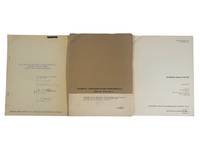
1965223311965. Douglas Missile and Space Systems Division and McDonnell Douglas internal technical reports issued between 1965 and 1974 document the engineering infrastructure required for missile testing data acquisition and systems reliability during the Cold War. Produced for internal training and operational use these materials establish the technical foundations of missile deployment including environmental protection telemetry standardization and automated validation processes as missile systems increased in complexity during and after the Apollo era. The archive supports research into aerospace engineering defense industry practices and the integration of computing and instrumentation within missile systems development.<br /> <br /> Douglas Missile and Space Systems Division; McDonnell Douglas Astronautics Company. Electrical Grounding and Lightning Protection Systems Design Recommendations. Santa Monica CA: Douglas Missile and Space Systems Division October 1965; Telemetry Instrumentation Fundamentals. Santa Monica or Huntington Beach CA: Douglas Missile and Space Systems Division n.d. late 1960s to early 1970s; Patzold F.W. Automated Missile Testing. Huntington Beach CA: McDonnell Douglas Astronautics Company February 1974. Three technical reports totaling approximately 105 pages illustrated with photographs and technical schematics in original paper wraps. The grounding report by W.F. White outlines protection systems for missile facilities addressing "earth resistivity" lightning protection and grounding requirements for launch pads blockhouses and associated infrastructure. Telemetry Instrumentation Fundamentals provides a structured introduction to data acquisition systems stating that "telemetry must expand with the increased complexity of R & D" and detailing standards such as IRIG for coordinating data across missile platforms including Atlas Thor and Delta. Patzold's Automated Missile Testing paper presented at the American Society for Quality Control's 28th Annual Technical Conference describes a "production test system. for an advanced missile guidance system" incorporating software controlled testing environments vibration and hydraulic test stations and computer based evaluation systems to improve reliability and defect detection.<br /> <br /> These materials were produced during a period when missile systems required increasingly sophisticated support infrastructure including standardized telemetry for real time data transmission and automated testing systems to ensure performance reliability prior to deployment. The emphasis on lightning protection and grounding reflects the vulnerability of launch installations and sensitive electronic systems while the shift toward automation in the 1970s demonstrates the growing role of computer control in aerospace manufacturing and testing. Together the reports document the evolution from manually intensive engineering practices to integrated systematized approaches to missile validation within the defense industry. Light edge wear and curling to covers with minor interior smudging; text remains clear and fully legible; overall very good condition. unknown