174 résultats
92110001Edo 1750 Suharaya Mohei. Large folding map 170 x 200 cm. old mended worming rebackedpastel colors Japanese reprint of a map printed in Henan in 1679 folds down to be 21.5 x 25.5 cm. woodblock printed hand color. V E R Y R A R E ! . . AN EXCEPTIONALLY RARE WALL-SIZE MAP OF CHINA . . EXECTED BY A SHAOLIN ZEN MASTER The Shaolin Xi Monastery/Temple is a Chán Zen Buddhist temple at Song Shan near Zheng Zhou City Henan Province in Dengfeng China. It was led by Venerable abbot Shi Yongxìn. founded in the 5th century the monastery has been famous for centuries its association with Chinese martial arts and particularly with Shaolin Kung Fu. It is also a Mahayana Buddhist monastery perhaps best known to the Western world. . The Shaolin Monastery and its famed Pagoda Forest were inscribed as a UNESCO World Heritage Site in 2010 as part of the Historic Monuments of Dengfeng. Extracted from Wikipedia. . A RARE EDITION: Reprinted and published in Japan by Katsuragawa Hosan in 1750 reproduced from the Chinese original of Kangxi 27 1679. The original Chinese edition has been exceptionally obscure and impossible to come by for over the last two-hundred years and is believed now to be lost to posterity. . PRINTING TECHNIQUE AND THE PAPER: The work is woodblock printed by hand on hand-made Washi paper then hand-colored in delicate pastels. . CHINESE VIEW OF ANCIENT CHINA: This grand scale work covers a very large space and is quite handsome suitable for framing and display. The map shows a full view of all of China from the Great Wall in the North Shanghai the East coast down to the oceans in the South and Hainan Island and the coasts along he Eastern shores. This is a spectacular work showing each province in pastel colors with outlines large numbers of place names rivers & the major waterways mountains named and located. By and large inspired to show all of the known lands considered a part of China delineating the country and its exterior boundaries. . Japan and other islands are not shown but boxes with notes in Chinese as to their existence and location are well documented. The lower portion has text discussing the population of the various provinces and other notes. Areas beyond the traditional lines of China i.e.: North of the Great Wall and to . RARITY OF THE MAP AND ITS MAKERS: This grand-scale and truly spectacular work is virtually never found on the market. The Shaolin Monastery monks were the original founders of the celebrated and now famous Kung-fu martial art school located in Henan province. The priests were legendary and the most feared for their martial art prowess. They were also covert with their powerful political force in China. . SHAOLIN SI TEMPLE/MONASTERY LEGENDARY CUSTOMS: Priests who passed the highest level of Kung-fu martial art were invited to participate in a recognition ceremony. They were allowed to self-brand themselves by picking up a red-hot iron brazier that had long temple dragon decorations on the sides. The branding was accomplished by clamping the brazier between their forearms until the dragon image was branded on them. These brazier dragons are identical to the long dragon found at the top of this historic map. Another ancient practices used was the Jieba. It is an ancient ceremony where nine marks are burned onto the head with sticks of incense. In 2007 the Chinese government partially lifted the 300-year ban of the Jieba allowing the the mentally and physically prepared to participate in the ancient tradition. Incense or moxa was used on top of the shaved head and burned in a ceremony of dedication to the Shaolin Si temple/monastery by the most skilled of martial artists. WHY THE DRAGON SYMBOL WAS USED BY SHAOLIN MONKS: The top of the map show the dragon as a symbol of the Shaolin Si. In China the dragon is the first of twelve zodiac animals and is the most powerful of all and represents the ultimate and greatest of all powers known. It is also the one and only legendary animal in the zodiac the rest are actual animals. Because this map was conceived of carved and printed at the Shaolin Xi monastery or temple by these very priests they put the most powerful symbol at the top a dragon. The symbolic meaning indicated that China was superior to all other nations. It was also a private pun by the Shaolin priests indicating for all to see and know that the Shaolin temple and its priests were above all others. Additionally it reminded and indicated that the Shaolin priest were the most powerful martial artists and covert political force in all China. . RARITY: The original Chinese edition has been exceptionally obscure and impossible to come by for over the last two-hundred years and is believed now to be lost to posterity. Shaolin Si temple/monastery imprints are very R A R E ! Few references or examples exist of their woodblock printed works. This edition was a copy of the original re-carved by the Japanese and reissued. Not only is this map of great interest to Chan Zen Buddhists Shaolin Kung-fu collectors martial artists and historians but to students of Chinese cartography collectors and museums. . CONDITION: The map has been professionally re-backed in its distant past due to the large amount of old worming. It is now solid and stable. Because of the rarity of this work a complete map found in any condition would be now considered exceptionally R A R E ! Please review images posted to our website to observe the restored condition. . THE COVERS: The map has been rebound in non-original paper covers perhaps about 100 years ago. It is contained in a brown cloth Chuan Chitsu folding slipcase with ivory clasps cloth a bit faded one edge a bit worn else clean & solid. . THE SCANS: While we have made efforts to take good digital photographs and scans of our copy due to the exceptionally large size of the map these photos are not of the highest quality. We therefore are additionally using copies of this map from the Oda reference book illustrations as samples of what the map is like. Please note the following digital images are from Oda: cover.jpg illus08.jpg & illus12.jpg the balance are from our digital camera. . Any client who purchases this map may be interested in the Japanese text found in Oda. Upon request we are happy to provide a copy of his entry. . BIBLIOGRAPHY: G. Beans: A LIST OF JAPANESE MAPS OF THE TOKUGAWA ERA Supplement A on p.14 as #1750.1 with confirmation date of 1750. Beans gives this the title: "THE BEST COLLECTION OF ANCIENT AND MODERN WORKS CONCERNING THE HISTORICAL EVENTS THROUGHOUT THE DYNASTIES BY THE MONASTERY OF SHAO-LIN." T. Oda: THE WORLD IN JAPANESE MAPS UNTIL THE MID-19TH CENTURY p.52-53 item #24 for 2 excellent color examples. Oda shows the Japanese title: REKIDAI JISEKI ZU: HISTORICAL MAP OF CHINA reproduced from the Chinese original of 1679 by Katsuragawa Hosan 1750. Beautifully reproduced here in full color. Meir Shahar: The Xiaolin Monastery: History Religion and the Chinese Martial Arts. Wikipedia: http://en.wikipedia.org/wiki/Shaolin_Monastery Color scans of this and most items are posted to our web site. . hardcover books
25054401China n.d. ca. 1927-1928. Brown simulated alligator cloth covers 37 x 27.5 cm. black pages spine ribbon-tied ca. 400 b.w. photos corner mounted images very good sharp and clear images NOT fadedsolidnicely done. V E R Y R A R E ! . . SUPERB PHOTO ALBUM OF THE CHINESE CIVIL WAR: . . Beginning of The Communist Party led led by Mao Tse-tung . . V.S. the Kuomintang KMT or Chinese Nationalist Party . Led by Chiang Kai Shek. . The United States Supported the KMT. In this album we see how the KMT soldiers hosted the American Army in China using their trains and military bases throughout China. This unusual album contains 400 original b. w. photographs & and is an historic photographic record of American military deployment showing Dough-boys in China probably from the U.S. Army's 2nd. Battalion 15th. infantry per the flag and insignia found on a group formation photograph. A minority are with written captions by and large taken by the person who made the album also enhanced with a small percent of professional Chinese photos some of which have in-negative captions. There are ca. 3 or so photos missing else completely filling 32 pages or 64 sides one on the inside back cover. The inside of the front cover has five attractive period color luggage type adverts from various hotels: Hotel Lankershim & Coast Line Military & Naval Hotel San Francisco Cal; The Court Hotel Tientsin North China; Grand Hotel des Wagons Litz; Astor House Hotel Ltd. Tientsin. The album begins with photos of a Chinese playing a Pi-pa snake skin banjo then there are three other photos: first two show a Chinese military camouflage train engine from which a Yank soldier in his campaign hat descends and a long train of cars with a large howitzer mounted upon one last shows French troops at parade rest with their rifles and white gloves and crested helmets with anchors naval or marines with others in the background with some officers. The next two pages show Chinese coolies swing a basket from the creek top water a field a mother suckling her baby with her family at the farm a large water tower in the wet slums and a group of Doughboys at attention in formation they wear boots leggings chrome World War I type dress helmets a rifle back pack with bayonet cartridge pouch belts with green wool hip-length jackets. The opposite page shows another view of the Chinese military train a pair of large mounted guns on an armored train car. To the right is a Chinese officer pointing to a large pierced hole in the train with a foreign engineer peering out from the small window. The train sports the Republic of China flag with a Chinese military unit flag painted on the side. Another view shows a group of abandoned Chinese coffins that went to the dogs; a group of soldiers in garrison caps at attention with fixed bayonets as the officers salute someone near the person taking the photo some Chinese officers also present. Next 2 pages show Chinese on a wheel barrow some Japanese women by a pond in Kimono and a group of British troops from their colonial Empire: blacks Indians white trumpeter Chinese and others with musical instruments all wear white cork-type pith helmets. A group of Japanese officers mugging for the camera. Photos of the railhead and large number of Chinese troops with rifles and kit at the railway station some on march carrying their flags others in open box cars with touring cars that are on the move another of camouflaged armored train cars one shows a number of foreign soldiers looking out of a train car window some are with tiny embossed stamp at right corner: "Mei Lee Tien Tsin." The album continues with a mixture of images of civilian Chinese Chinese military their trains moving air planes weapons war refugees in tents military views of barbed wire fortifications trenches machine gunners Russian soldiers Chinese officers Chinese air force funerals rickshaw pullers camel trains captured & wounded prisoners foreign soldiers at their sand-bagged posts. Photos of the great wall magnificent Chinese architectural monuments buildings and pagodas religious icons coffins more coffins mortars & Chinese junks and a plethora of others. The American Consulate General's compound in Tientsin American military band welcoming the newly arrived replacement troops. A large photo group shot of the American officers seated for a memorial photograph with their Battalion flag proudly posted on the wall where they pose source of our citation at the top of the unit name; two buglers are at each outside position the commander is ram-rod straight and taller than all others seated in the front & center; he and only two others on his sides wear full leather knee boots probably indicating the highest ranking officers; others are in boots & leggings. Photos of Doughboys aboard a ship showing the Naval officers with one stunning photo of an American high officer with his Japanese & Chinese counter parts posing for the camera. And a photo of the "Mail Boat Gazun Panama" and a few others of Panama giving credence to the fact that some of these soldiers came from the American East coast via Panama to San Francisco then on to China. Nice photo of semi-nude Panamanian family men women children. Doughboys at target practice photos of Chinese poverty coolies pulling great loads and street vendors. More showing Chinese life style street life horse & bullock carts and yet more caskets left in the open unburied and abandoned train cars full of horses Chinese troops smoke rising from a burning city another with "Tian jin" written in Chinese catholic church more parading of American soldiers within the Tientsin American Consulate parade grounds trooping of the colors. And a nice photo of the "U.S. Army Transport Thomas" Chinese junk &c. A U.S. soldier in a necktie his rifle at fixed bayonet at parade-rest before the Consulate General compound with sand bags inside a photo of a U.S. soldier with his Colt-45 on his hip with canteen looking at some communications connections another photo of two mini U.S. tanks and a very long bridge over the water. Photo of the Tientsin downtown with a Sikh Indian policeman directing traffic. Next page shows a public Chinese street execution: the guilty on his knees with the executioner ready to swing a very large sword and another headless corpse is before him the Tientsin YMCA compound opposite which is likely the inside of the American Consulate offices showing very ancient typewriters and three women staff and one other female Navy person. They all mug for the camera with a good number of U.S. Army or Marine officers behind three desks. Chinese hauling "magnum gold" brand ammunition on hand- trucks a U.S. Army band performing before the Consulate's office. At this point we find a few photos with penned captions: "One of China's Department Stores it shows a bird vendor; Peanut Gambler a mountain of P-nuts; Chinese Shimboo photo of the office and maker of the album and his Chinese officer friend ; "A Chinese Taxi" shows him in a Rickshaw "Me and the boy friend 11/3/28" shows a tiny goat cart carrying a child's coffin with a Chinese man. This penned date gives substantial proof of the date range of the entire album which was placed about the center of the whole work. The next page shows two more penned captions: "Chinese cavalry" and "Note mud house and fence" shows two Chinese officers on horse-back and a very very poor house with very starved animals. The next shows six Chinese undercover men two each holding a Chinese being readied for execution; and a very grizzly photo of a Chinese officer actually executing a Chinese man with his pistol who is seated on a rock: the photo captures the action as the shot blows away the mans brains. Behind the execution scene is a crowd of American soldiers in campaign hats and Chinese military officers who are witness to the event. More views of Chinese street life vendors pullers haulers & horse carts religious icons and a stunning Chinese roofed gate more Chinese troops on the move via train with a very horrible view of a large number of dead Chinese in the muddy filthy waters by a bridge. Homeless Chinese at a "soup kitchen" war refugees hauling their belongings house boat street barbers a group of 7 photos by the ocean. They show American soldiers at leisure looking at Chinese fishermen nets naked fishermen hauling in a net of fish to the beach a burning waterfront village the jetty where several large American transport ships are at anchor and a great assembly of Yankee soldiers on the beach with duffel bags and their gear at the railhead. The last photo shows a great number of various whisky bottles lined up for display. More photos show a coffin maker large coffin basket seller and "chow" sellers on the street. A military formation of 100's of either Scottish or Irish soldiers with fixed bayonets marching down the main street before the "RNC Electricity Dept." below which is a very long line of British soldiers on one side of the street opposite from a good number of American soldiers who are on the side of the street a British Union Jack flies over a castle-like structure this is clearly some kind of grand military parade. More photos of the Great Wall the military parade and army chaplains with an Australia flag flying over another castle tower. Chinese river scene with large numbers of native boats in a canal a beggar's camp with straw -mat tents a canal crossing ferry for people a photo of a U.S. officer stand on top a wooden coffin for a closer look. More poverty-stricken Chinese haulers fortune tellers graves tethered horses log sawyers rice haulers electric trolley with English and Chinese language sign on the roof panorama post card of Shanghai's Bund. The album now shifts to photos of the Peking area. Shows the Ming tombs and the camel-lined road; military train the Americans were transported by that train a large bivouac and tent city where the U. S. military troops camped some Chinese "house boys" proudly holding the American troop's unit flag. More photos of two U.S. soldiers posing near Chinese coffins in a wet ditch. A group of very young Chinese boys posed near the railroad; one is so poor that he has no clothes at all and is in nude. A large group of Nationalist Chinese soldiers marching along a street one classic photo of a single American soldier on guard standing at attention as stands vigil on a barbed-wire barrier his rifle at fixed bayonet. A group of five Chinese young "ladies" who pose for the camera who seemed NOT to be bewildered by the photographer they look like "Sing-song girls" hookers who entertained the U.S. troops. Chinese Buddhist priests in white robes with shaved heads a great gate to Peking Shanghai harbor views shanty huts captured Chinese criminal or traitor guarded by Chinese soldiers train car full of rifles more Chinese soldiers on trains marching in formation on the road. And a good photo of several American officers: one with a whip posing for the camera in garrison hat. Chinese bivouac and American soldiers with bullet and pouches for ammo with rifles at parade rest. More barbed-wire barricades Chinese & British soldiers armored train-mounted gun. More Chinese prisoners traitors being executed heads hoisted on power poles in baskets as a form of public warning and display for other would-be traitors. An American tent bivouac camp at the train yard two more public exec executions by beheading at the moment of loosing one's head an executed dead man lying in the street. Photos of Peking's Forbidden City a Chinese hung to death from a tree a Yank soldier in overalls carries a Chinese bamboo "yoke" with two baskets and smokes a pipe while Chinese look on and laugh. Two photos of lines of Rickshaws waiting for passengers. One comic photo with negative caption: "Find the Chinaman;" it shows two American soldiers sitting among Chinese. Nice shot of the Summer Palace Peking and a U.S. soldier riding in a Rickshaw. The very last photo inside the back cover shows the whole battalion dressed up wearing their chrome helmets standing at attention in formation for a classic and most historic memorial photograph. Their commanding officer is front and center; all have their rifles ammo belts and very polished boots with back packs. They could be standing in the Tientsin American Consulate compound grounds. Followed by a few other photos of Chinese a Chinese soldier et al. This work shows the typical things seen in China during this period of political and military chaos. The feuding war lords and political parties at war; the landing of American military to protect American diplomatic interests. Support & assistance given to the Americans and other foreign military groups by the Nationalist Chinese army. The desperate situation of the tragic Chinese people caught in the grips of upheaval and the summary punishment of traitors in a public display of the swift and ruthless law of China. A riveting and most compelling true record of a U.S. military officer's sojourn to and deployment in China. THE PHOTOGRAPHER AND THE SIZE OF PHOTOGRAPHS: This is not a professional group of photographs but there a very small amount which were obviously purchased by the maker of the album and inserted. The vast majority are his personal photographs these again are obvious to anyone who looks at the album. This is an excellent example of private work of an unknown American Army officer stationed in China during a very chaotic period. He was interested in recording for posterity his experiences and the sights that he saw while on duty. We thank him for giving us privy to this slice of American and Chinese military history. SIZE OF THE PHOTOGRAPHS: The size varies considerably sizes in cm.: the smallest are 8 x 5 most are 14 x 9 3 larger photos 24.5 x 18 and the last 30 x 10. CONDITION OF THE PHOTOGRAPHS: These are original period photos they are all very clear sharp images no fading and in excellent condition. They have been corner mounted. RARITY: Photographic albums of this period in China are NOT commonly found; one made by an American Army officer stationed in China at this time is exceptionally unusual and RARE ! This is a charming primary source with a large number of clean & sharp images taken by an actual participant in this historic period of China. The officer and photographer of these photographs shared for posterity his keen insight and view of these events. We thank him for giving us privy to this slice of American & Chinese military history. . hardcover books
1891BB009<p> CHINA: Propaganda against Western Missionaries<br /></p><p>The Cause of the Riots in the Yangtse Valley. A "Complete Picture Gallery" by CHOU HAN. Hankow China 1891. With 32 full=page woodblock plates printed in color. Oblong 4to original printed wrappers sewn spine soiling minor repairs.</p><p>The author Chou Han is described by the translator Griffith John 1831-1912 as 'a gentleman of high official rank Taotai in Hunan' and was part of an orchestrated propaganda campaign aimed at discouraging Western Christian missionaries from working and traveling in China. This volume was perhaps his most significant and horrific attack on western culture managing a "reptile press" in Hunan creating unrest and distrust amongst the Chinese people see John's "A Voice from China" 1907 p. 220. Chou Han himself is probably represented in plates IX XIII XXVI and XXIX; the images are virulently anti-foreigner and specifically anti-Christian. John translated and circulated the present work to draw attention to the British authorities of the problems faced by missionaries in Asia. </p><p>Very Rare. ONLY 3 COPIES CAN BE TRACED AT AUCTION IN THE PAST 40 YEARS ABPC & RBH. </p><br /> paperback books
698117 of 36 folding black & white woodcut plates each with fine contemporary hand-coloring. Printed in red & black zhu mo tao yin ben. 51; 50 folding leaves. Two vols. 8vo 265 x 166 mm. modern brown wrappers new stitching. Beijing: Wu ying dian the Imperial Printing House Preface dated 1711 Afterword dated 1712 completed 1713. First edition Chinese issue of this famous and beautifully illustrated book ordered by and overseen by Kangxi 1654-1722 Emperor of China. It was printed in 400 copies on superior paper 200 in Manchu and 200 in Chinese. The Chinese edition is quite remarkable for having been printed in both black and red ink zhu mo tao yin ben an invention from the Yuan Dynasty requiring two runs through the press. The book is a collection of poems written about 36 remarkable sites which include gardens landscapes and buildings at the emperor's summer palace a mountain estate in Rehe now Chengde Hebei; it is today a UNESCO World Heritage Site. For each poem a magnificent folding woodcut plate is provided depicting the associated site. While our copy has 17 of the 36 folding plates they have been beautifully hand-colored at what appears to be an early date and have large margins at the bottom. The difference between the black & white plates and those hand-colored is remarkable and dramatic. In each case the plates - which are extremely fragile - have been expertly backed with new paper margins strengthened and reinserted into the volumes on stubs. The plates clearly come from another copy. On several of the plates there is some small loss of image. Our copy has plates 2 3 7 8 9 11 14 15 16 19 21 24 25 27 29 32 and 35 as established by Whiteman see below. The result is a perfect match of poetry and landscape painting with strong literary and artistic characteristics. Kangxi's own Preface dated 1711 is followed by the impressions in red of his two seals: Ti yuan zhu ren his style name used on his seals and Wan ji yu xia "Brief leisure". This work "offers a virtual tour framed by images and the emperor's own poetry the garden placed in the palms of one's hands. Created in parallel painted which no longer survives woodblock printed our first edition and copperplate engraved versions the album's multiple iterations resonated with each other and with the park itself."-Stephen H. Whiteman Where Dragon Veins Meet. The Kangxi Emperor and His Estate at Rehe 2020 p. 6-& see the entirety of this wonderful and beautiful book especially pp. 151-88. The scenes of the imperial gardens and landscapes offered in this book allowed unprecedented access to the private life of the emperor. In 1702 Kangxi ordered the construction of the palace and landscaping of the considerable parklands at Rehe in order to support his annual tours north amongst the court's Inner Mongolian allies. The palace served as a second capital at which Kangxi resided from late spring to early autumn. When in residence the emperor oversaw garden tours banquets and entertainments all of which celebrated his rule. In 1711 Emperor Kangxi conceived of a project to celebrate his 60th birthday and 50th year of his reign. He selected 36 major scenic sites within the extensive property and gardens surrounding the summer palace. One poem for each site was written with the emperor's involvement and one painting of each site was created by the court artist Shen Yu b. 1649. The writings and accompanying illustrations were meant to demonstrate the harmony between heaven and humankind through natural landscapes and related architecture. They also served as propaganda: this represents the first time imperial spaces were depicted during the Kangxi court. The collection of poems was annotated by Kui Xu Li Tingyi and others upon the imperial order and prefaced by Emperor Kangxi himself in 1711. Two of the court's most talented woodblock artists Zhu Gui ca. 1644-1717 and Mei Yufeng active ca. 1696-1713 were engaged to prepare the woodblocks from Shen Yu's designs. "Whether derived from or simply correlated to the unique album now lost the woodblock-printed book functions as a surrogate for the paintings. It imitates the album's arrangement and mode of engagement with the landscape pairing image and text in an intimately scaled format. The style of the images evokes Wang Yuanqi but also and more significant the emperor's most important artist thereby marking the book as a work of the court's highest echelon of cultural production and an object clearly commissioned and owned by the emperor. "Kangxi was intimately involved in the minutiae of the book's production from the selection of a specific type of high-quality paper to reviewing and editing the printing proofs to inspecting samples of the finished work. He was kept closely informed about the progress of the project including difficulties in curing the datewood blocks Zhu Gui and Mei Yufeng used as well as the need for more artisans given the scale and intricacy of the work. The order for four hundred copies two hundred in Chinese and another two hundred in Manchu came directly from the throne. In comparison to other contemporary projects with print runs of one thousand or more this number suggests that the emperor had a clear sense of the exclusive audience he intended to reach. "There is no record of the deadline against which the block-cutters printers and binders all labored. Given the timing of the project and the flurry of reports around printing and binding that appear from the intercalary fifth through the seventh months of 1713 however it seems most likely that the volumes were meant as gifts for the emperor's sixtieth birthday celebrations that year. The scale and lavishness of production accords with this hypothesis as four hundred copies indicated intended distribution among a relatively small circle of imperial clansmen steppe elites senior officials and others close to the throne."-ibid. pp. 182-83. Shortly thereafter in the years 1712-14 another edition was produced with engravings instead of woodcuts. It was overseen by the Jesuit Matteo Ripa and two Qing artists. In fine and fresh condition. Minor worming to text leaves but not the plates. Preserved in a chitsu. unknown books
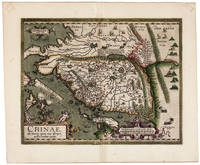
1606602014 3/8 x 18 3/8 inches. Fine original hand color; slight split at centerfold fine condition. <br /><br /><p>A brilliant example in rich original hand color of the rare and only English language edition of the earliest printed folio-size western map specifically of China and "the first to show the Great Wall"Nebenzahl. "This map remained the standard type for the interior of China for over sixty years" Tooley. Although 2 pocket-sized English language editions of an abbreviated version of Ortelius' <i>Theatrum</i> entitled <i>Epitome</i> were published previously in 1601 and 1603 with brief texts in English the English text in the present edition runs to 2 large folio pages printed on the back of the map giving an extensive description of China drawn from recent publications of observations by European travelers to the area particularly Jesuits. With its three lushly designed cartouches and many illustrations of indigenous shelters modes of transportation i.e. the famous wind wagons and animals this is one of Ortelius's richest engravings and among his rarest. </p><p>Nebenzahl <i>Mapping the Silk Road and Beyond </i>4.6; van der Krogt 8410:31:051; Tooley <i>Maps and Mapmakers</i> p. 106 pl. 78 p. 108; Walter <i>Japan: A Cartographic Vision</i> 11F p. 186.</p> books
1873312749Shanghai: Printed at The "North China Herald" Office 1873. First edition. Presentation copy inscribed from the author to Douglas Jones on first blank. Title-page printed preface and text with holograph manuscript by Jones on the Index and Game Register. Pp. vii 116 Diary & Game Register accomplished in ink 4 pages unused; 1-50. 1 vols. 4to 10-1/8 x 8 inches; 257 x 203 mm. Contemporary full brown roan upper cover titled in gilt. Spine neatly rebacked notes on front endsheets. Quarter black morocco slipcase and cloth chemises. First edition. Presentation copy inscribed from the author to Douglas Jones on first blank. Title-page printed preface and text with holograph manuscript by Jones on the Index and Game Register. Pp. vii 116 Diary & Game Register accomplished in ink 4 pages unused; 1-50. 1 vols. 4to 10-1/8 x 8 inches; 257 x 203 mm. "The immense tracts of country available for purposes of sport and well stocked with game the entire absence of game laws and the friendly disposition of the natives combine to render Keang-soo and the adjoining provinces a very Paradise for sportsmen ." Groom from the Preface. <br/><br/>Early work on hunting in China with a partly printed dairy and "Register of Game Bagged" here accomplished with an extensive and detailed manuscript of expeditions from 1878 to 1892 recounting trips on the Merlin and other boats after deer waterfowl and other game listing participants names of dogs and game bags. The manuscript is followed by the printed text with notes on boats guns and kit "The Medicine Chest" cookery and chapters on various types of game pheasant snipe wild pig and a printed Vocabulary with Chinese/English translations and phonetic transcriptions.<br/><br/>Among the hunting companions of Jones in the 1885 season was Bell-Irving author of Diary of the Ewo Party 1890. Both Jones and Bell-Irving are quoted frequently in Wade's With Boat and Gun in the Yangtze Valley 2nd ed. 1910.<br/><br/>Some interesting ephemera has been preserved including printed Chinese broadside shooting permits for Jones for the years 1884 and 1885 a shooting permit for Hong Kong and the New Territories 1894; fivee sketch maps of Kiang Su Le Yang and Kashing; four small photographs of Hong Kong mounted on the verso of a Victorian photographic portrait of Douglas Jones; a manuscript translations of Chinese verse by one of Jones' companions and four autograph letters on sporting topics or introductions and requests to assist Jones in his up country trips; and a stray sheet of printed letterhead of the Union Insurance Society of Canton Shanghai where Jones was Secretary.<br/><br/>A UNIQUE AND SUBSTANTIAL RECORD OF SPORT IN CHINA. Czech Asia p. 93. Not in OCLC Printed at The "North China Herald" Office unknown books
1890312761London: Printed at the Army-Navy Cooperative Society Limited 1890. 3Â mounted albumen photographs of the shooting party with their trophies head- and tailpieces. xii 170 pp. 1 vols. 8vo 7-3/4 x 5 -3/8 inches; 196 x 137 mm. Contemporary full black morocco over stiff card covers ruled in silver upper cover with text in blindstamp edges silvered decorative endpapers. Finely rebacked to style; edges rubbed. Black morocco backed slipcase and chemise. 3Â mounted albumen photographs of the shooting party with their trophies head- and tailpieces. xii 170 pp. 1 vols. 8vo 7-3/4 x 5 -3/8 inches; 196 x 137 mm. Presentation Copy. A signed presentation copy from the author John Bell-Irving to Douglas Jones. <br/>Bell-Irving was a Scottish businessman and partner in the Hong Kong trading firm Jardine Matheson and a director of the Hong Kong Electric Company. Jones was Secretary of the Union Insurance Society of Canton of Shanghai. <br/>"The greatest pleasure in up-country shooting trips"Â Bell-Irving claims "is the idea of perfect freedom far removed from business cares and beyond the reach of letters and telegrams." Succinct account of many hunting trips after pheasant waterfowl deer and other game with observations on weather and conditions and game bag. Bell-Irving and Jones are quoted frequently in Wade's With Boat and Gun in the Yangtze Valley 2nd ed. 1910.<br/><br/>A SUSTANTIAL ACCOUNT OF SPORT ALONG THE YANGTZE OVER THREE DECADES.<br/><br/>EXCEEDINGLY RARE. OCLC 42241800 Princeton Printed at the Army-Navy Cooperative Society Limited unknown books
1788314738Paris: chez l'auteur . et chez Ponce 1788. First editions. Vol 1: Title 24 plates and 24 leaves of text; vol 2: title dedication 24 plates and 24 leaves of text. 4to. Contemporary green morocco with gilt Greek key borders pink silk endpapers a.e.g. Corners rubbed spine a touch browned marginal foxing in first volume and to a few leaves in second. First editions. Vol 1: Title 24 plates and 24 leaves of text; vol 2: title dedication 24 plates and 24 leaves of text. 4to. First editions beautifully and fully engraved. The first volume is on the life of Confucius the second details notable events in the reigns of various Chinese emperors. The plates were made after a series of drawings by the Jesuit missionary Joseph Marie Amiot. Cohen-De Ricci 479; Lust 729 1133. Provenance: Francis John Hughes bookplate chez l'auteur ... et chez Ponce unknown books
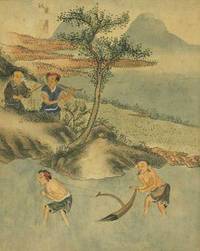
218778China Ca. first half of 19th century. 34 scenes on paper each featuring several figures in traditional dress disporting themselves amid landscapes and in a few instances houses all done by the same artist. Each picture is a separate scene; subjects include fishing visiting boating farming wrestling courting harvesting rice and hunting--a particularly effective image shows a tiger hunt and several scenes include wild and domestic animals. 1 vols. Images measure 8-3/4 x 7 inches plus margins bringing the overall page size to 11 x 8 inches. The mounted leaves are linked in the Oriental accordion fashion and contained within two substantial wood covers. Fine condition. 34 scenes on paper each featuring several figures in traditional dress disporting themselves amid landscapes and in a few instances houses all done by the same artist. Each picture is a separate scene; subjects include fishing visiting boating farming wrestling courting harvesting rice and hunting--a particularly effective image shows a tiger hunt and several scenes include wild and domestic animals. 1 vols. Images measure 8-3/4 x 7 inches plus margins bringing the overall page size to 11 x 8 inches. Album of 34 Original Chinese Watercolors. A very interesting and engaging collection of genre scenes. The trees rocks and landscapes are particularly well rendered and the figures are full of life. The pictures in many such albums often follow a sequence of events going on a journey etc.; this one gains by having a variety of unconnected events and individuals and the whole production is a delight to behold. unknown books
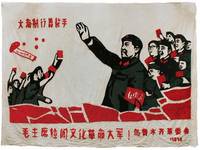
196716838Urumqi XinJiang Uyghur Autonomous Region: Cultural Revolution Committee of Urumqi / Xinjiang Army Divisioni 1967/8. Two extraordinary hand-crafted parade banners ca. 110" x 84" 9 feet x 7 feet one slightly smaller. Each entirely composed of hook-work with colored yarns on white muslin backing. Slight age-toning and soil; a few threads loose but no significant losses; Near Fine condition overall. Folded and stored in original velvet draw-string carrying bags as found. Both banners bear the inscription "Chairman Mao Reviewing the Great Army of the Cultural Revolution" and depict the August 1966 mass rally at Tiananmen Gate where more than 10 million Red Guards from all over China converged to express their solidarity with Mao and his second-in-command Lin Biao. Additional text on the lower banner reads "Long Live Chairman Mao for ten thousand years" and "Sailing in the ocean requires a helmsman" -- both quotes from Lin Biao. The agencies responsible for the banners are identified in lower right of each: "Cultural Revolution Committee of Xinjiang Army Division 1968" upper banner and "Cultural Revolution Committee of Urumqi 1967" lower. <br/><br/>The presence of Biao the figure to the right of Mao holding the Little Red Book in the top banner is of particular interest. Biao compiler of The Quotations of Chairman Mao popularly known as the "Little Red Book" and coiner of the phrase "Maoism" was probably more responsible than any other figure for creating the cult of personality around Mao particularly at the time of the Cultural Revolution. He quickly ascended Party ranks and was widely seen as Mao's obvious successor. But in 1971 Biao was exposed in the process of an apparent coup attempt the details of the event have never been made public. He died in an airplane crash attempting to leave China and from this point forward was officially condemned as a traitor by the Communist Party; any record of his achievements on behalf of the Revolution was expunged from the official record and any positive image of Biao would have been confiscated and destroyed as a matter of course -- suggesting either that these banners left China prior to 1971 or that they remained out of sight until some later date. The second possibility is plausible given whence the banners issued - both were created by Red Guard branches in the Xinjiang Uyghur Autonomous Region an extremely remote province in China's northwest corner and for many years the center of a militant independence movement for Uyghur and other Turkic minorities. In any case the precise manner in which these banners left China will likely never be known; they surfaced at a New England antiques show in 2011. Cultural Revolution Committee of Urumqi / Xinjiang Army Divisioni unknown books
1936318267N.p. China 1936. illustrated from photographs. 50 pp. 1 vols. Square 12mo. Green cloth titled in gilt. Very good plus minor wear and soiling to cloth. Chinese bookseller's ticket at back. illustrated from photographs. 50 pp. 1 vols. Square 12mo. Only known copy. Only known copy of this engaging account of the month-long cruise of the Lark in the Woosung mudflats in November and December 1935. The party comprised four sportsmen Len Biggs the chronicler Bob Biggs Bob Whitmore and Dick Martin and a crew of four and their bag was more than 200 birds shot and retrieved chiefly duck and teal. The party travelled on the motor cruiser Lark with a sailing sampan Victor and converted lifeboat Marion in tow. The book takes the form of a diary with notes on expenses and other practical aspects of organizing the outing. Biggs acknowledges H.T. Wade's With Boat and Gun in the Yangtze Valley 1895; 2nd ed. 1910: "Although the enormous flocks of geese swan and duck that used to be a really wonderful sight seem to have decreased in numbers considerably there are still ideal spots for the wildfowler to shoot from still so many bird ." <br/>The typesetting and paper points to a local Chinese production and a handful of typographical errors are lightly corrected in pencil.<br/>RARE and interesting. Not in OCLC unknown books
1940008960Tientsin China: Reprinted in China 1940. Four volumes bound in blue/grey cloth Good the cloth worn and soiled one hinge each in Vols. I and II and both in Vol. IV broken the bindings still holding well. Faint damping bottom edges Vol. III. Interiors clean and unmarked. Prior owner name stamp of Richard W. Powell noted University of Hawaii anthropologist. From the collection of noted East Asian scholar Ruth Meserve her business card for The Mongolian Society which she served as Secretary laid in. The 1940 Chinese reprint of the original 1834 first edition SCARCE in either edition. The first serious study of Genghis Khan. Three folding genealogical charts one in Vol.I and two in Vol. IV; large 1824 folding map of Asia in the13thcentury in pocket at rear of Vol. IV. The charts and the map are Fine. A sturdy and usable set of this important history. . Reprint. Cloth. Good/No Jacket. Small 8vo - over 7¾" - 9¾" Tall. Reprinted in China Hardcover books
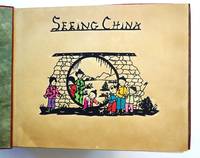
006911Chefoo China: Women's Bible School American Presbyterian Mission No Date circa 1930. Near Fine pages with light toning. Oblong folio 10" x 13 3/4". Bound in beautiful red pictorial embossed silk over limp boards string-tied 28 pp of cut-out illustrations in black and white many with colorful silk inlays with tissue guards publisher's 1 page explanatory leaf laid in also an original 6 1/2" x 10 1/2" cut-out with colorful silk inlays and string hanger readt-to-hang laid in. Cut-out chapter headings are Travel and Transportation Customs and Habits Chinese Birth-Year Cycle latest date 1935 Occupations The Eight Immortals Myths and Legends Chinese Recipes Chinese Children Chinese Junks and The Magician. Well over 100 cut-outs in all including the bonus laid in cut-out and SCARCE THUS. First Edition. String Tied. Near Fine/No Jacket As Issued. Oblong Folio . Women's Bible School, American Presbyterian Mission Paperback books
1940006910Helsinki Finland: Suomalais-Ugrilainen Seura 1940. Two volumes in original dustjackets. Both volumes are Fine Vol.I dustjacket Very Good 1 1/2" triangular chip bottom edge at spine tears at spine folds and 2 tears horizontally at spine Vol. II jacket Near Fine small chips bottom edge of spine. List of donors laid in. One folding plate map index 15 folding maps at rear Vol. II. Numerous black and white photographs in text. A classic scholarly text ''In the spring of 1906 I received orders from the Russian General Staff to undertake a journey from Russian Turkestan through Chinese Turkestan and Western China and the provinces of Kan Su Shensi and Shansi to Peiping as the final goal. The object of this expedition was to study the conditions in the interior of Northern China collect statistical materials and perform various tasks of a military nature'' Preface. Mannerheim also collected archaeological and ethnographic materials and manuscripts and studied little-known peoples and tribes in Norther China. Mannerheim later became the 6th President of Finland after serving as Commander-in-Chief of the Finnish armed forces during WWII. . First Edition. Cloth. Fine/Very Good. Folio - over 12" - 15" tall. Suomalais-Ugrilainen Seura Hardcover books
19184224Shanghai: Presbyterian Mission Press 1918. First edition. Near Fine. Quarter cloth over pictorial drab boards. Early ownership signature to upper front board and some faint soiling mostly to spine and edges. Textblock firm and square measuring 210 x 130mm. Internally a surprisingly fresh copy collating complete with adverts to front and rear: 12 138 16. Introducing a range of "native products" to Americans living in the region the cookery reflects a growing need for nutritious recipes and supply chain substitutions in wartime. The sole copy on the market OCLC reports only 7 copies.<br/><br/>The only Chinese-published cookbook "to deal only with native products and recipes that could be made from them." In their preface to this new cookery the committee for the Women's Auxiliary explains in clear terms what sets their cookery apart. "This book was definitely war product. It was prepared with two ideas in view: that of utilizing local products as substitutes for the home imported foodstuffs and secondly that of reducing the cost of living. It was different from all other cook books that had been published in China for foreigners' use in that it dealt only with native products and recipes that could be made from them." While some recipes are titles in English only the compilers included Cantonese translations wherever possible in addition to including a glossary at the rear called Hints for the Housekeeper as well as a List of Terms Necessary in Food Preparation which both provide translations and pronunciations for Cantonese words related to food and household cleaning products. During and after WWI Shanghai had become a space of rich and problematic interactions between cultures. In addition to rising Western military forces its reputation as the "Paris of the East" drove in American and British tourists while later large residential areas were being built in the north due to war concessions. Opium smuggling prostitution and a spreading wealth gap caused friction. The Women's Auxiliary composed of intelligent and educated members with a cultural appreciation for these fluctuations as well as for the culture into which they had migrated sought to use the kitchen as a positive space for the exchange of food language and ideas. Near Fine. Presbyterian Mission Press unknown books
1879VBF09CHINA<br /><br /><i><b>PANORAMA OF PEKING</b> during the Celebrations of the Sixtieth Anniversary of the Emperor Kang-He's birthday</i>.<br /><br />Shanghai: Tien-Shin-Chai 1879.<br /><br />Profusely illustrated throughout with 292 pages lithographed with images mostly captioned below in English script and on the side<br /><br />Small 8vo measures: 6 1/8 x 3 3/4 inches 155 x 96 mm original gilt pictorial purple silk wrappers front cover dulled.<br /><br />First edition thus.<br /><br />With 6 page Introduction in English explaining that the festivities being described date back to the western calendar year 1721. Six pages of text as introduction in English at the front and in Chinese at the back.<br /><br /><br /> Tien-Shin-Chai, paperback books
1799254690Paris: Chez F. Buisson Imprimeur-Librair rue Hautefeuille no. 20 1799. Seconde édition augmentée d'un Précis de l'Histoire de la Chine par le traducteur et du Voyage en Chine et en tartare de J. C. Huttner traduit de l'allemand par le même Traducteur. Vol.1 : with half-title portrait frontispiece of Macartney clxxxiv 311 pp. Plates 1-6. VOLUME II : half-title 408 pp. Plates 7-13. VOLUME 3 : Half title 414 2 Catalogue "Voyages" de la librairie chez Buisson pp. Plates 14-27. VOLUME 4 : half-title 380 pp. Plates 28-35. VOLUME. 5 : half-title. 350 pp 1 plate 36 and 2 folding maps Plates 37 & 38. 5 vols. 8vo. Nineteenth century brown boards red paper labels some rubbing else Very Good. Seconde édition augmentée d'un Précis de l'Histoire de la Chine par le traducteur et du Voyage en Chine et en tartare de J. C. Huttner traduit de l'allemand par le même Traducteur. Vol.1 : with half-title portrait frontispiece of Macartney clxxxiv 311 pp. Plates 1-6. VOLUME II : half-title 408 pp. Plates 7-13. VOLUME 3 : Half title 414 2 Catalogue "Voyages" de la librairie chez Buisson pp. Plates 14-27. VOLUME 4 : half-title 380 pp. Plates 28-35. VOLUME. 5 : half-title. 350 pp 1 plate 36 and 2 folding maps Plates 37 & 38. 5 vols. 8vo. Cordier Biblioteca Sinica IV 2385 Chez F. Buisson, Imprimeur-Librair, rue Hautefeuille, no. 20 unknown books
1974006070No Place: China Painting Association 1974. Both volumes Near Fine small marginal stains first 3 pages of No. 1. . First Edition. Pictorial Printed Wrappers. Near Fine/No Jacket As Issued. Elephant Folio - over 15" - 23" tall. China Painting Association Paperback books
1933709351933. Macau: Imprensa Nacional 1933. Macau: Imprensa Nacional 1933. Rare 1933 Digest of Laws Regulating Macau's Sex Trade Macau. China. Prostitution. Regulamento das Meretrizes Aprovado pelo Portaria Provincial No. 1:093 De 7 de Abril de 1933. Macau: Imprensa Nacional 1933. 22 pp. Text in Portuguese and Chinese. Stitched pamphlet in printed paper wrappers. Some edgewear a few chips and minor tears to wrappers early annotations to front wrapper light toning to interior. $950. Only edition located. Laws governing prostitution in the Portuguese colony of Macau 1557-1999 were first enacted in the mid-nineteenth century. By the 1930s the government administered the trade directly through the Regulamento das Meretrizes. No copies located on OCLC. unknown books
1932304062Shanghai: North-Daily News & Herald Ltd 1932. Sole edition. Cartographic endpapers 138 photographic illustrations and 12 cartoons. 48 pp. Oblong 4to. Publisher's cloth backed boards a little dusty some minor edgewear. Very good. Sole edition. Cartographic endpapers 138 photographic illustrations and 12 cartoons. 48 pp. Oblong 4to. "This album of views of the Sino-Japanese conflict at Shanghai consists principally of views taken in the field by Chinese Japanese and British photographers. Generally speaking few restrictions were placed on the free movement of accredited photographers during the operations and in this sense it is a unique record of modern war at close quarters."<br/><br/>This volume serves as a sort of companion volume to the work Sino-Japanese Disturbances published in Shanghai in the same year. Both works commemorate the First Battle of Shanghai which was the culmination of events beginning with the Mukden Incident the previous year. North-Daily News & Herald, Ltd unknown books
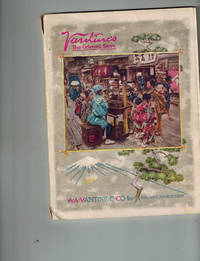
1916007165New York: A.A. Vantine & Co. Inc. 1916. A RARE catalogue and in lovely condition of the major importer of Oriental goods into America from 1866 to 1921. Very Good Plus in original full color pictorial wrappers 120 pp. plus 2 order pages at rear pre-addressed envelope tipped at page 106. numerous black and white and color photographs throughout small tears at spine ends small spot rear wrapper else Near Fine. In 1916 Vantine's was located at Fifth Avenue and 39th Street. Clothing furniture housewares fabric toys and other merchandise imported from China and Japan are described in the catalogue and merchandise from Vantine's has been avidly collected over the years. Worldcat locates no copies of the 1916 edition. . First Edition. Pictorial Printed Wrappers. Very Good Plus/No Jacket As Issued. 8vo - over 7¾" - 9¾" tall. A.A. Vantine & Co., Inc. Paperback books
1833301618London: John Murray 1833. First edition. iv 258 pp. Recently rebound quarter calf over green cloth spine gilt retaining contemporary upper board text clean and bright. First edition. iv 258 pp. FROM THE CANTON READING ROOMS. A copy from the Canton Reading Rooms the library of the 13 factories at Canton China which existed until the factories were destroyed during the Second Opium War. <br/><br/>With bookplate of the Newburyport Public Library stating that the book was: "Presented by Hon. Caleb Cushing." Caleb Cushing first U.S. Minister to China who probably acquired or was given this book when he was in China negotiating the Treaty of Wangxia in 1844. John Murray unknown books
WALTER-FILM000433No binding. Very Good. Fine Art Print Vintage original set of eighteen 18 13 x 10 "" 33 x 27 cm. lobby cards China. Jimbo Shen Xiangling Tong; dir: Tieli Xie; China Film Distribution and Exhibition Corporation. A classic of the Chinese Cultural Revolution -- a revolutionary ballet film with a very strong dose of propaganda intertwined with its storyline produced at the Beijing Film Studio and performed by members of the Peking Opera Troupe of Shanghai sic. A famous and probably equally infamous cultural relic of Mao's Cultural Revolution -- and needless to say an extremely rare one. This original set of Chinese lobby cards were printed for export to other countries. Slight scattered creasing ABOUT FINE. unknown books
41407Shanghai: Secretary of State for Foreign Affairs. Two 8vo volumes variously paginated About 300 pp each Text in English and Chinese. <br /><br />Taxes criminal matters including murder property law sanitation harbor and pilotage regulations quarantines insurance and much more including such minutia as regulations for Russian-0Chinese settlements. Two volumes solidly bound in gray library buckram with leather spine labels. Ex-libris City of New York Association of the Bar library. Very good condition. Secretary of State for Foreign Affairs hardcover books
190841275London.: The China Inland Mission. 1908. Color lithographed maps xii index map plus 22 single and double page maps 16pp 13 1/2 x 9 1/2 inches gilt lettered red cloth covered boards hardbound. The Index Map of China has a stain with a small piece of paper adhered to it from the facing page which is the Alphabetical List of Protestant Missions with resultant damage to that page; neat marginal notes to the Index Map only; the first several sheets of the atlas are beginning to split along the lower gutter from the tight binding. The binding is worn with splits to the tail of the spine and marking to the front cover. The maps with the exception of the Index Map are clean and bright. Very attractive color maps covering the whole of the Chinese Empire including maps of Tibet and Mongolia. This is the first edition of this important atlas of China: "in view of the fact that 1907 would be the Centenary of Protestant Missionary effort in China it was decided by the China Inland Mission toward the close of 1905 to publish a new Atlas of the Chinese Empire this Atlas to be accompanied by a book giving a geographical historical and missionary survey of each province and dependency of that Empire. It was hoped that these companion volumes would be ready for the Centenary Conference which was to take place in Shanghai during the spring of 1907. Through unexpected delays it was however found impossible without serious loss to the Atlas to have the maps ready in time so the book entitled The Chinese Empire was published first. The Atlas which is now sent forth to the public has taken about two and a half years to prepare and is in every respect an entirely new work." The atlas includes maps of Tibet Manchuria and Mongolia. The maps of the provinces are on the scale of 1:3000000 and of the great dependencies on the scale of 1:7500000. . The China Inland Mission. hardcover books