25 729 résultats
biblio19<p>Published in c. 1941 in Tientsin China. A photo commemorative album for <strong>B.M.I.C.C.N. </strong>Bataillon Mixte d'Infanterie Coloniale de Chine du Nord . Inscribed and signed by someone as showed. Printed photos all the album describing every aspect of the <strong>B.M.I.C.C.N. Captions in French.</strong></p><p><strong>Extremely rare. No OCLC/worldcat record. No record in any Library or in Google etc. Extremely probably the only one in the world considering the Japanese's occupying the </strong>French Concession at almost the same time of the printing time of this book<strong>.</strong></p><p>Because there is pictures limit for each item I list the other supplement pictures of this <strong>B.M.I.C.C.N. </strong>book in the following link:</p><p>https://www.biblio.com/book/other-supplement-pictures-bmiccn-photo-commemorative/d/1042741439</p> TIENTSIN paperback
73<p>Notice: this is the supplement pictures of B.M.I.C.C.N. in my store which I list here again for supplements because of the limited pictures number for each item at Biblio. <br />Size: 32cm X 22cm,there are 44 pages copper papers except covers of them 10 pages are in blank. <br />The book was published in Tientsin Press probabaly privately printing because of no pagination and some pages are in blank. so the "Tientsin 1940-1941" on cover probably is for publishing place but not for the troops in Tientsin for there are also images of the regiment in Peking Tongkou Shanhaiguan ChingHuangDao etc places.<br />The B.M.I.C.C.N. forces disappeared from China thereafter when Japanese take over Tientsin concessions. You can neglect the reflect light which I took.</p> TIENTSIN Press paperback
186166<p>Original rubbing for the Stele of Second Opium War Arrow War in China during 1856-1860. Stele erected in 1861 in Canton Guangzhou City in GuangTong Province in China.</p><p>Very big size on a whole thick rice paper 152cm X 98cm The original stone had been demolished long long ago. This rubbing is the only one found in the world. Folded a few wears at edges. Both text and pictures were fine copied and undamaged but had some folds.</p><p>Rubbing is an ancient Chinese method to copy text and pictures on stone or on bronze wares by hand.</p>
148967<p>Rare. Size: 147x80 cm. Original rubbing on thin paper maybe Bible paper because of its very fine quality. was attached to thick paper to make a hanging scroll. Some wear on the thick paper but very good on the thin rubbing paper. There are two red stamps on middle-right of the scroll which probably is the stamps of former owners. <br /><br />This stele in 1489 is the first document found and also a very important document to describe the history of Judaism and Jewish people in China. Its contents are in three sections; one explains the origin and history of Judaism another describes the rituals and worship of Chinese Jews around the time of the stele construction and the last tells that there were 70 surnames families of the Kaifeng Jewish community several surnames being the officers of Chinese Emperor a Zhao surname among them being a past imperial audience. The Zhao surname was also the surname of the emperors of Song Dynasty(AD 960--AD 1279) in China and can only be bestowed by emperors exclusively therefore a great honor to be bestowed the Zhao surname by the emperors of Song Dynasty Ususally only to persons with great contribution to emperors.<br /><br />This rubbing was made c. 1800s. This rubbing should be more clear and more integrate than its present stele because the stele was moved to museum so as to be protected till the end of 1970s. Many surnames characters on the stele were dig out by their surnames family for fear of implications during the wars conflicts and political movements.<br /><br /><br /><br /></p>
1136136 folding black & white woodcut plates. 88 folding leaves. Two debtelin in one vol. 8vo 265 x 166 mm. pink wrappers orig. block-printed title-slip on yellow silk on upper cover early stitching. Beijing: Wuying dian æ¦è‹±æ®¿ Postscript dated 1712.<br /> <BR> <BR> First edition of the Kangxi Emperor’s r. 1661-1722 poetic cycle for the 36 scenic sights within the Rehe summer estate each accompanied by a stunning double-page woodcut illustration. Printed under the emperor’s direct supervision on superior paper and using woodblocks carved by two of the finest artisans in the palace workshop this celebrated album had an initial print run of only 400 copies 200 in Manchu our copy and 200 in Chinese. As Stephen H. Whiteman writes in Where Dragon Veins Meet: The Kangxi Emperor and His Estate at Rehe 2020 these exclusive royal albums were most likely gifts from the Kangxi Emperor to “a relatively small circle of imperial clansmen steppe elites senior officials and others close to the throne†on the occasion of his 60th birthday in 1713 and their presentation was meant to “generate a particular bond of loyalty between the emperor and those he favored with this rare gift†pp. 183 224.<br /> <BR> <BR> First constructed in 1703 and enlarged over the next century the Rehe summer estate located beyond the Great Wall in present-day Chengde about 175 kilometers northeast of Beijing played an important role throughout the Qing empire’s political history. It is today a UNESCO World Heritage Site. When the Kangxi Emperor ordered its initial construction in 1702 after half a century of expansionary war the summer estate was to become “the most substantial in a network of traveling palaces Ch. xinggong 行宮 that supported his annual tours north among the court’s Inner Mongolian allies.†But its significance quickly expanded. The Mountain Estate to Escape the Heat as the site would eventually be named effectively served as a secondary capital the emperor residing there from late spring through early autumn each year over the last decade of his life. <br /> <BR> <BR> “Yet it was also decidedly not the capital. Freed from the architectonic constraints of the Forbidden City Kangxi employed imperial parks and gardens as alternative spaces of rulership. Like his almost exact contemporaries in Europe and South Asia Aurangzeb r. 1658-1707 Louis XIV r. 1643-1715 and Peter the Great r. 1682-1725 Kangxi made designed landscapes central to his performance of authority…Kangxi’s Mountain Estate was substantially a site of rituals of intimacy and exchange that performed a temporary elision of social difference between emperor and subject: roaming in the gardens banqueting entertainments and gift givingâ€â€“ibid. pp. 4-5.<br /> <BR> <BR> “In 1711 the Kangxi emperor formally initiated a project that sought to interweave the physical and sensory experiences of the Mountain Estate with his ideology of rulership and personal biography. Imperial Poems on the Mountain Estate to Escape the Heat presented the thirty-six scenes of the park-palace through a combination of imperially composed texts and images created by artists of the court. Produced almost simultaneously in three different mediums the work was part of a coordinated multifaceted effort to articulate a vision of Qing imperial rule through the links between landscape technology and the emperor himselfâ€â€“ibid. 151.<br /> <BR> <BR> Our edition is the first to contain woodcuts; it was the second of many installments of the album — including a later one with copperplate engravings made by the Italian missionary Matteo Ripa 1682-1746 — and the earliest that survives. It opens with the emperor’s “Record of the Mountain Estate†Ma. Han-i araha alin-i tokso de halhÅ«n be jailaha gi bithe dated Kangxi 50 1711 followed by the impressions in red of his personal seals: Ti yuan zhu ren 體元主人 and Wan ji yu xia è¬å¹¾é¤˜æš‡; the latter which means “a brief leisure†was reserved for the emperor’s own calligraphic and literary works. The emperor briefly introduces each of the 36 scenic poems in prose as if guiding the reader through a personal tour of the summer estate. The fold-out woodcut illustrations drawn by the court artist Shen Yu 沈崳 b. 1649 and carved by the artisans Zhu Gui æœ±åœ ca. 1644-1717 and Mei Yufeng 梅裕鳳 fl. ca. 1696-1713 follow each poem. The album concludes with the Postscript signed by four palace officials who supervised its production dated Kangxi 51 1712.<br /> <BR> <BR> “Whether derived from or simply correlated to the unique album now lost the woodblock-printed book functions as a surrogate for the paintings. It imitates the album’s arrangement and mode of engagement with the landscape pairing image and text in an intimately scaled format. The style of the images evokes Wang Yuanqi but also and more significant the emperor’s most important artist thereby marking the book as a work of the court’s highest echelon of cultural production and an object clearly commissioned and owned by the emperor…<br /> <BR> <BR> “Kangxi was intimately involved in the minutiae of the book’s production from the selection of a specific type of high-quality paper to reviewing and editing the printing proofs to inspecting samples of the finished work. He was kept closely informed about the progress of the project including difficulties in curing the datewood blocks Zhu Gui and Mei Yufeng used as well as the need for more artisans given the scale and intricacy of the work. The order for four hundred copies two hundred in Chinese and another two hundred in Manchu came directly from the throne. In comparison to other contemporary projects with print runs of one thousand or more this number suggests that the emperor had a clear sense of the exclusive audience he intended to reach.â€â€“ibid. pp. 182-83.<br /> <BR> <BR> A monument of artistic production under imperial patronage the album of 36 sites has been the topic of extensive scholarly research. Comparing the woodcut edition to earlier traditions of royal literature and garden illustration in China the art historian Ma Yazhen 馬雅貞 of National Tsinghua University points out that many aspects of this album were unprecedented. For example she observes that the album is likely the first use of a fold-out illustration in a Chinese book — a detail that has long been overlooked. The wide fields of vision printed without frames the absence of persons within the buildings and corridors and the visual presentation of imperial poetry alongside official commentaries are only some of the album’s many fascinating features that being unusual and sometimes unprecedented continue to generate new scholarly interpretation and debate.<br /> <BR> <BR> Interest in the album has only grown in recent decades following the publication of court archives that shed light on the process of its production. We know now for example that the Kangxi Emperor personally specified the layout choice of paper number of copies and even the thickness of brushstrokes of the Manchu issue and that its printing was carried out in batches in the year 1713 rather than 1712 date of Postscript. Some of the idiosyncrasies of the Manchu issue which survives less well than its Chinese counterpart nevertheless remain under-explored by researchers who have generally focused on the Chinese-language editions of the album. We find little scholarly discussion for example on the emperor’s choice to exclude from the Manchu issue the extensive commentaries for his poetry compiled by palace officials a decision that surely gave the album a different — perhaps more personal than belletristic — tone of voice a voice reserved exclusively for its Manchu-speaking recipients.<br /> <BR> <BR> As mentioned above the Manchu issue has survived less well than the Chinese issue. Of the Manchu issue we locate copies at BnF Columbia LC SBBerlin Cambridge Harvard and SOAS in WorldCat.<br /> <BR> <BR> In fine and fresh condition preserved in yellow silk-covered folder and slipcase. The plates are fine and clean. The fold in each plate has been very carefully strengthened on the verso. A few minor marginal tears and paper flaws. Several other minor and skillful repairs.<br /> <BR> <BR> ⧠Philippe Forêt Mapping Chengde: the Qing Landscape Enterprise University of Hawai‘i Press 2000; 馬雅貞 “皇苑圖繪的新典範:康熙《御製é¿æš‘山莊詩》的製作åŠå…¶æ„義†故宮å¸è¡“å£åˆŠ 32 No. 2 2014 pp. 39-80. <br /> <br> <br> James A. Millward et al. eds. New Qing Imperial History: the Making of Inner Asian Empire at Qing Chengde Routledge 2004. <br /> <br> <br> Stephen H. Whiteman “Creating the Kangxi Landscape: Bishu shanzhuang and the Mediation of Qing Imperial Identity†PhD dissertation Stanford 2011; idem. Where Dragon Veins Meet: The Kangxi Emperor and His Estate at Rehe University of Washington Press 2020. unknown
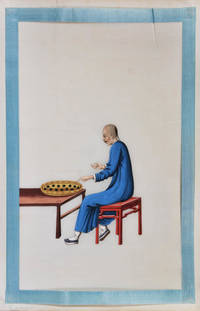
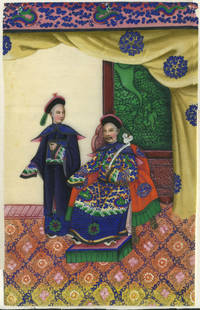
180026715Canton 1800. Large 4to. 15 x 12 1/2 inches. 141 watercolours on thin paper nearly all captioned in ink in Chinese in the lower right corner each tipped to a sheet of wove paper. Mid-nineteenth century citron half morocco over marbled paper covered boards spine with raised bands in six compartments lettered in gilt in the second compartment the others with a repeat decoration in gilt marbled edges<br/> <br/> Provenance: Annie Pearson Viscountess Cowdray née Cass 1860-1932 Dunecht House Aberdeenshire.<br/> <br/> An extraordinary album of early Chinese export watercolours of the highest quality.<br/> <br/> Beginning in the late 18th century centred on the treaty port of Canton there existed a thriving trade in ethnographical watercolours executed by local Chinese artists and sold to the western merchants and travellers. The best known result of this trade is William Mason's Costume of China first published in London in 1800 which is illustrated with 60 hand-coloured aquatints adapted from a series of original watercolours by Pu-Qua of Canton. It was common for the local artists including Pu-Qua to work from a set series of models. The present album includes a number of compositions that are from the same set of models as those used by Pu-Qua but they include more detail and more of the trade-associated paraphernalia than are shown in the images as published in Mason's work. This suggests that they were not copied from Mason but were after another more detailed source or were unique compositions by the artist based on a similar series of models. Importantly these watercolours are of a uniformly higher quality than usually encountered and represent not only a wide array of occupations but also members of the highest echelon of Chinese society. The detailing on the costumes worn by these members of the royal court is breathtaking with copious use of gilt. Later collections of Chinese export watercolours were routinely executed on less expensive pith paper whereas the present watercolours are on high quality tissue and are larger in size than those typically encountered. The album represents an earlier more prestigious style of export watercolour paintings specifically meant for wealthy Europeans. These are Chinese watercolours of the highest quality designed and executed to the highest standards. The album was once owned by Annie Pearson Viscountess Cowdray Steward of Colchester and wife of Lord Weetman Dickinson Pearson 1st Viscount Cowdray.<br/> <br/> Cf. Crossman The China Trade Princeton: 1972; cf. Clunas Chinese Export Watercolours London: 1984. unknown
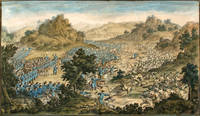
17751691811775. QIANLONG EMPEROR OF CHINA 1736-1796. Suite of four engravings depicting the conquests of the Qianlong Emperor. From the suite of sixteen engraved plates. Printed in Paris under the direction of Charles-Nicholas Cochin. Broadsheets image size: 515 x 890 mm. Preserved in the contemporary French green paper mounts with black ink outline borders. Professionally framed. With the original French printed labels describing the individual engravings affixed to back of frames. Paris 1769-1774. These four contemporary hand-coloured engravings represent individual scenes from the exceedingly rare series of sixteen engravings commissioned by the Qianlong Emperor to commemorate the victory of his 1755-1760 military campaigns against the Western Mongols. The four plates are: I. "General Fou Te Accepts the Surrender of the Ili" showing the triumphal march of the Emperor and his general to Beijing. Drawn by Sichelbart and engraved by B.L. Prévost in 1769 Pirazzoli-t'Serstevens 1; II. "The victory of Khorgos." in the Spring of 1758 against the forces of Amoursana. Drawn by J. D Attiret cut by C. N. Cochin and engraved by J. Ph. Le Bas in 1774. Pirazzoli-t'Serstevens 4; III. "The great victory of the Qurman." on February 3 1759 when the Chinese general Fou-te with only 600 soldiers defeated an army of 5000 Muslims. Drawn by Damasceno and engraved by A. de St. Aubin in 1770. Pirazzoli-t'Serstevens 8. IV. "The Emperor Gives a Victory Banquet to the Officers and Soldiers who have distinguished themselves in battle" at Tseu-kuang-ko the Imperial Palace Gardens Beijing on July 5 1754. Drawn by Castiglione and engraved by J. Ph. le Bas 1770 Pirazzoli-t'Serstevens 16. These large Chinese-French prints are among the most impressive works ever produced by the method of copper engraving. This is the first series of engraved plates to document the conquests of the Qianlong Emperor. They represented an amalgam of Chinese imagery Italian interpretation and Parisian copperplate engraving at its apogee. The drawings were supplied by Jesuit artists attached to the Emperor's court in Beijing. Upon completion they were shipped to France for engraving as the craft was unknown in China. After the Emperor was shown battle prints by the Augsburg artist Georg Philipp Rugendas 1666-1743 he wished to see his military conquests recorded in intaglio prints as well. He therefore ordered his Jesuit court painters Giuseppe Castiglione 1688-1766 called "Lang Shining" Jean Denis Attiret 1702-1768 "Wang Zhicheng" Ignaz Sichelbart 1708-1780 "Ai Qimeng" and Giovanni Damasceno Sallusti i.e. Joannes Damascenus a SS. Concepcione d. 1781 later bishop of Beijing called "An Deyi" to prepare sketches for the prints which they did in 1764 and 1765. Four of the drawings had been completed by the time of Castiglione's death when the decision was made to send the work to France via the ships of the Compagnie des Indes. According to the Emperor's decree no expense was to be spared. The first four drawings reached Paris in the autumn of 1766 and the remaining twelve in July 1767. The Marquis de Marigny director of the Academie Royale de Peinture et Sculpture decreed that the work should be carried out under the supervision of Charles-Nicholas Cochin 'fils' 1715-1790. As the French paper manufacturers did not have paper of the desired proportions the paper-merchant Prudhomme was ordered to make it to custom; the new size was called Grand Louvois. The copperplates were imported from England. Cochin chose Beauvais for the actual printing of the sheets on the grounds that he was "the only one who can be completely trusted both regarding his talents as well as his honesty which is well-known." The work proceeded slowly; standards of the highest quality were called for and some of the pictures especially the one by Sallusti needed careful editing. The original order was for 100 copies of each print but by 1768 this figure was increased to 200 copies so that at least 100 would survive the journey back to China ! -- however several authorities claim that many copies were lost at sea. In any event the final delivery was not shipped until 1775 occasioned in part by the difficulty the printers had producing a uniform series of prints from drawings by different artists. Three of the initial drawings were made by Attiret six by Damasceno one by Sichelbart and at least two by Castiglione; the remaining are unsigned but have been attributed to Castiglione by C. & M. Beurdeley and others. The engravers were L.J. Masquelier 1 J. Aliamet 2 J. Ph. Le Bas 5 A. St.-Aubin 2 F.D. Née 1 B.L. Prevost 2 P.P. Choffard 2 and N. de Launay 1. The Emperor's instructions stated that all the impressions were to be sent to him along with the original copper plates. However there is plentiful evidence that prints were pulled for the King of France and influential persons in Paris as well. Most of the surviving sets and individual prints appear to belong to this surreptitious group. The above series is not only a landmark in the history of Chinese and European art but also testifies to the direct artistic cooperation between China and Europe in the eighteenth century. It has been a common misconception that China was only interested in itself and detested the foreigners -- here the Emperor himself proved the contrary. VERY RARE IMPRESSIONS WITH CONTEMPORARY FRENCH HAND-COLOURING. The complete set of sixteen black and white engravings or a few individual prints from this set have come onto the market for sale only rarely. We can locate no other examples of any of the prints with contemporary colouring having been for sale or in public or private collections. PROVENANCE: Robert Barnwell Roosevelt 1829-1906 the uncle of Theodore Roosevelt and great-uncle of Eleanor Roosevelt. He was an early conservationist and worked for the protection of waterways. Roosevelt served in Congress and was later appointed to a diplomatic post in the Netherlands. He is credited with influencing his nephew Theodore Roosevelt to become a conservationist. With the ownership label "R.B. Roosevelt/ 26 East 20th Street/ New York" attached to the verso on one print. Cohen-De Ricci 1012-1013. Cordier Bibliotheca Sinica 641-642. Fünf Jahrhunderte Buchillustration 141. Brunet V 1178. P. Pelliot "Les conquêtes de l'empereur de la Chine" T'oung Pao ed. H. Cordier & P. Pelliot vol 20 1921 pp. 183-274. Michèle Pirazzoli t'Serstevens Gravures de conquêtes de l'Empereur de la Chine Kien-Long au Musée Guimet 1969. Hartmut Walravens "The Introduction of Copper-Engraving into China" 62nd IFLA General Conference August 25-31 1996. unknown
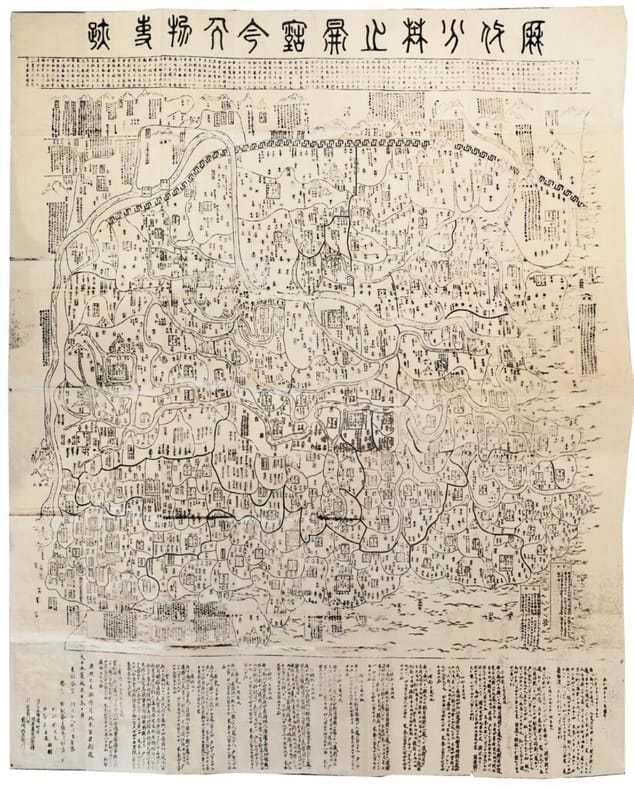
92110001Edo 1750 Suharaya Mohei. Large folding map 170 x 200 cm. old mended worming rebackedpastel colors Japanese reprint of a map printed in Henan in 1679 folds down to be 21.5 x 25.5 cm. woodblock printed hand color. V E R Y R A R E ! . . AN EXCEPTIONALLY RARE WALL-SIZE MAP OF CHINA . . EXECTED BY A SHAOLIN ZEN MASTER The Shaolin Xi Monastery/Temple is a Chán Zen Buddhist temple at Song Shan near Zheng Zhou City Henan Province in Dengfeng China. It was led by Venerable abbot Shi Yongxìn. founded in the 5th century the monastery has been famous for centuries its association with Chinese martial arts and particularly with Shaolin Kung Fu. It is also a Mahayana Buddhist monastery perhaps best known to the Western world. . The Shaolin Monastery and its famed Pagoda Forest were inscribed as a UNESCO World Heritage Site in 2010 as part of the Historic Monuments of Dengfeng. Extracted from Wikipedia. . A RARE EDITION: Reprinted and published in Japan by Katsuragawa Hosan in 1750 reproduced from the Chinese original of Kangxi 27 1679. The original Chinese edition has been exceptionally obscure and impossible to come by for over the last two-hundred years and is believed now to be lost to posterity. . PRINTING TECHNIQUE AND THE PAPER: The work is woodblock printed by hand on hand-made Washi paper then hand-colored in delicate pastels. . CHINESE VIEW OF ANCIENT CHINA: This grand scale work covers a very large space and is quite handsome suitable for framing and display. The map shows a full view of all of China from the Great Wall in the North Shanghai the East coast down to the oceans in the South and Hainan Island and the coasts along he Eastern shores. This is a spectacular work showing each province in pastel colors with outlines large numbers of place names rivers & the major waterways mountains named and located. By and large inspired to show all of the known lands considered a part of China delineating the country and its exterior boundaries. . Japan and other islands are not shown but boxes with notes in Chinese as to their existence and location are well documented. The lower portion has text discussing the population of the various provinces and other notes. Areas beyond the traditional lines of China i.e.: North of the Great Wall and to . RARITY OF THE MAP AND ITS MAKERS: This grand-scale and truly spectacular work is virtually never found on the market. The Shaolin Monastery monks were the original founders of the celebrated and now famous Kung-fu martial art school located in Henan province. The priests were legendary and the most feared for their martial art prowess. They were also covert with their powerful political force in China. . SHAOLIN SI TEMPLE/MONASTERY LEGENDARY CUSTOMS: Priests who passed the highest level of Kung-fu martial art were invited to participate in a recognition ceremony. They were allowed to self-brand themselves by picking up a red-hot iron brazier that had long temple dragon decorations on the sides. The branding was accomplished by clamping the brazier between their forearms until the dragon image was branded on them. These brazier dragons are identical to the long dragon found at the top of this historic map. Another ancient practices used was the Jieba. It is an ancient ceremony where nine marks are burned onto the head with sticks of incense. In 2007 the Chinese government partially lifted the 300-year ban of the Jieba allowing the the mentally and physically prepared to participate in the ancient tradition. Incense or moxa was used on top of the shaved head and burned in a ceremony of dedication to the Shaolin Si temple/monastery by the most skilled of martial artists. WHY THE DRAGON SYMBOL WAS USED BY SHAOLIN MONKS: The top of the map show the dragon as a symbol of the Shaolin Si. In China the dragon is the first of twelve zodiac animals and is the most powerful of all and represents the ultimate and greatest of all powers known. It is also the one and only legendary animal in the zodiac the rest are actual animals. Because this map was conceived of carved and printed at the Shaolin Xi monastery or temple by these very priests they put the most powerful symbol at the top a dragon. The symbolic meaning indicated that China was superior to all other nations. It was also a private pun by the Shaolin priests indicating for all to see and know that the Shaolin temple and its priests were above all others. Additionally it reminded and indicated that the Shaolin priest were the most powerful martial artists and covert political force in all China. . RARITY: The original Chinese edition has been exceptionally obscure and impossible to come by for over the last two-hundred years and is believed now to be lost to posterity. Shaolin Si temple/monastery imprints are very R A R E ! Few references or examples exist of their woodblock printed works. This edition was a copy of the original re-carved by the Japanese and reissued. Not only is this map of great interest to Chan Zen Buddhists Shaolin Kung-fu collectors martial artists and historians but to students of Chinese cartography collectors and museums. . CONDITION: The map has been professionally re-backed in its distant past due to the large amount of old worming. It is now solid and stable. Because of the rarity of this work a complete map found in any condition would be now considered exceptionally R A R E ! Please review images posted to our website to observe the restored condition. . THE COVERS: The map has been rebound in non-original paper covers perhaps about 100 years ago. It is contained in a brown cloth Chuan Chitsu folding slipcase with ivory clasps cloth a bit faded one edge a bit worn else clean & solid. . THE SCANS: While we have made efforts to take good digital photographs and scans of our copy due to the exceptionally large size of the map these photos are not of the highest quality. We therefore are additionally using copies of this map from the Oda reference book illustrations as samples of what the map is like. Please note the following digital images are from Oda: cover.jpg illus08.jpg & illus12.jpg the balance are from our digital camera. . Any client who purchases this map may be interested in the Japanese text found in Oda. Upon request we are happy to provide a copy of his entry. . BIBLIOGRAPHY: G. Beans: A LIST OF JAPANESE MAPS OF THE TOKUGAWA ERA Supplement A on p.14 as #1750.1 with confirmation date of 1750. Beans gives this the title: "THE BEST COLLECTION OF ANCIENT AND MODERN WORKS CONCERNING THE HISTORICAL EVENTS THROUGHOUT THE DYNASTIES BY THE MONASTERY OF SHAO-LIN." T. Oda: THE WORLD IN JAPANESE MAPS UNTIL THE MID-19TH CENTURY p.52-53 item #24 for 2 excellent color examples. Oda shows the Japanese title: REKIDAI JISEKI ZU: HISTORICAL MAP OF CHINA reproduced from the Chinese original of 1679 by Katsuragawa Hosan 1750. Beautifully reproduced here in full color. Meir Shahar: The Xiaolin Monastery: History Religion and the Chinese Martial Arts. Wikipedia: cans of this and most items are posted to our web site. unknown
92110001Edo 1750 Suharaya Mohei. Large folding map 170 x 200 cm. old mended worming rebackedpastel colors Japanese reprint of a map printed in Henan in 1679 folds down to be 21.5 x 25.5 cm. woodblock printed hand color. V E R Y R A R E ! . . AN EXCEPTIONALLY RARE WALL-SIZE MAP OF CHINA . . EXECTED BY A SHAOLIN ZEN MASTER The Shaolin Xi Monastery/Temple is a Chán Zen Buddhist temple at Song Shan near Zheng Zhou City Henan Province in Dengfeng China. It was led by Venerable abbot Shi Yongxìn. founded in the 5th century the monastery has been famous for centuries its association with Chinese martial arts and particularly with Shaolin Kung Fu. It is also a Mahayana Buddhist monastery perhaps best known to the Western world. . The Shaolin Monastery and its famed Pagoda Forest were inscribed as a UNESCO World Heritage Site in 2010 as part of the Historic Monuments of Dengfeng. Extracted from Wikipedia. . A RARE EDITION: Reprinted and published in Japan by Katsuragawa Hosan in 1750 reproduced from the Chinese original of Kangxi 27 1679. The original Chinese edition has been exceptionally obscure and impossible to come by for over the last two-hundred years and is believed now to be lost to posterity. . PRINTING TECHNIQUE AND THE PAPER: The work is woodblock printed by hand on hand-made Washi paper then hand-colored in delicate pastels. . CHINESE VIEW OF ANCIENT CHINA: This grand scale work covers a very large space and is quite handsome suitable for framing and display. The map shows a full view of all of China from the Great Wall in the North Shanghai the East coast down to the oceans in the South and Hainan Island and the coasts along he Eastern shores. This is a spectacular work showing each province in pastel colors with outlines large numbers of place names rivers & the major waterways mountains named and located. By and large inspired to show all of the known lands considered a part of China delineating the country and its exterior boundaries. . Japan and other islands are not shown but boxes with notes in Chinese as to their existence and location are well documented. The lower portion has text discussing the population of the various provinces and other notes. Areas beyond the traditional lines of China i.e.: North of the Great Wall and to . RARITY OF THE MAP AND ITS MAKERS: This grand-scale and truly spectacular work is virtually never found on the market. The Shaolin Monastery monks were the original founders of the celebrated and now famous Kung-fu martial art school located in Henan province. The priests were legendary and the most feared for their martial art prowess. They were also covert with their powerful political force in China. . SHAOLIN SI TEMPLE/MONASTERY LEGENDARY CUSTOMS: Priests who passed the highest level of Kung-fu martial art were invited to participate in a recognition ceremony. They were allowed to self-brand themselves by picking up a red-hot iron brazier that had long temple dragon decorations on the sides. The branding was accomplished by clamping the brazier between their forearms until the dragon image was branded on them. These brazier dragons are identical to the long dragon found at the top of this historic map. Another ancient practices used was the Jieba. It is an ancient ceremony where nine marks are burned onto the head with sticks of incense. In 2007 the Chinese government partially lifted the 300-year ban of the Jieba allowing the the mentally and physically prepared to participate in the ancient tradition. Incense or moxa was used on top of the shaved head and burned in a ceremony of dedication to the Shaolin Si temple/monastery by the most skilled of martial artists. WHY THE DRAGON SYMBOL WAS USED BY SHAOLIN MONKS: The top of the map show the dragon as a symbol of the Shaolin Si. In China the dragon is the first of twelve zodiac animals and is the most powerful of all and represents the ultimate and greatest of all powers known. It is also the one and only legendary animal in the zodiac the rest are actual animals. Because this map was conceived of carved and printed at the Shaolin Xi monastery or temple by these very priests they put the most powerful symbol at the top a dragon. The symbolic meaning indicated that China was superior to all other nations. It was also a private pun by the Shaolin priests indicating for all to see and know that the Shaolin temple and its priests were above all others. Additionally it reminded and indicated that the Shaolin priest were the most powerful martial artists and covert political force in all China. . RARITY: The original Chinese edition has been exceptionally obscure and impossible to come by for over the last two-hundred years and is believed now to be lost to posterity. Shaolin Si temple/monastery imprints are very R A R E ! Few references or examples exist of their woodblock printed works. This edition was a copy of the original re-carved by the Japanese and reissued. Not only is this map of great interest to Chan Zen Buddhists Shaolin Kung-fu collectors martial artists and historians but to students of Chinese cartography collectors and museums. . CONDITION: The map has been professionally re-backed in its distant past due to the large amount of old worming. It is now solid and stable. Because of the rarity of this work a complete map found in any condition would be now considered exceptionally R A R E ! Please review images posted to our website to observe the restored condition. . THE COVERS: The map has been rebound in non-original paper covers perhaps about 100 years ago. It is contained in a brown cloth Chuan Chitsu folding slipcase with ivory clasps cloth a bit faded one edge a bit worn else clean & solid. . THE SCANS: While we have made efforts to take good digital photographs and scans of our copy due to the exceptionally large size of the map these photos are not of the highest quality. We therefore are additionally using copies of this map from the Oda reference book illustrations as samples of what the map is like. Please note the following digital images are from Oda: cover.jpg illus08.jpg & illus12.jpg the balance are from our digital camera. . Any client who purchases this map may be interested in the Japanese text found in Oda. Upon request we are happy to provide a copy of his entry. . BIBLIOGRAPHY: G. Beans: A LIST OF JAPANESE MAPS OF THE TOKUGAWA ERA Supplement A on p.14 as #1750.1 with confirmation date of 1750. Beans gives this the title: "THE BEST COLLECTION OF ANCIENT AND MODERN WORKS CONCERNING THE HISTORICAL EVENTS THROUGHOUT THE DYNASTIES BY THE MONASTERY OF SHAO-LIN." T. Oda: THE WORLD IN JAPANESE MAPS UNTIL THE MID-19TH CENTURY p.52-53 item #24 for 2 excellent color examples. Oda shows the Japanese title: REKIDAI JISEKI ZU: HISTORICAL MAP OF CHINA reproduced from the Chinese original of 1679 by Katsuragawa Hosan 1750. Beautifully reproduced here in full color. Meir Shahar: The Xiaolin Monastery: History Religion and the Chinese Martial Arts. Wikipedia: http://en.wikipedia.org/wiki/Shaolin_Monastery Color scans of this and most items are posted to our web site. . hardcover books
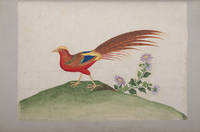
107536Circa 1800. . Watercolour album; folio 55 x 37.5 cm; 64 watercolour illustrations heightened in white featuring tradesmen 23 flowers 17 and bird and flower 24 subjects on pith paper sheet size: approx. 41 x 31.5 cm each laid down on thick grey paper tissue guards endpapers watermarked 'B E & S 1815'; an exceptional green morocco binding by George Mullen of Dublin with his ticket the panels elaborately tooled in gilt and blind in a Celtic Cross design spine gilt in six compartments all edges gilt inside dentelles gilt endpapers with gilt vine borders minor rubbing to joints and extremities internally clean throughout.<br /> A remarkable collection of sixty-four fine large-format Chinese watercolours with subjects depicting tradesmen flowers and images combining both birds and flowers in an exceptional green morocco binding elaborately tooled in gilt and blind with a Celtic Cross design by the Irish bookbinder George Mullen. <br /><br />Designed for the export market the watercolours offer a fascinating glimpse into Chinese cultural life during the Imperial Qing Dynasty. Trades and occupations depicted include wok mender fortune teller fishmonger tailor woman and monkey performer tobacco cutter meat vendor clog maker silk spinner puppet show metal worker lantern maker medicine vendor rice grinder umbrella maker toy maker grocer and embroiderer. <br /><br />Similar paintings by the Canton Guangzhou artist Pu-Qúa fl.1780-1810 formed the basis of the 60 engravings illustrating George Henry Mason's The Costume of China published in 1804 and John Dadley produced stipple engravings after Pu-Qúa's originals which were published by William Miller in 1799. The remainder of the album is given over to the flora and avian fauna of the far east including Chinese golden pheasants framed within a naturalistic setting blossom-headed parakeets woodcocks varieties of orchid rose and jasmine. <br /><br />In an exceptional green morocco binding by George Mullen fl.1800-1850 who was one of the most pre-eminent booksellers publishers and binders operating in Ireland at the turn of the nineteenth century. From his Dublin studio he experimented with a variety of styles using gilt and blind tooling to great effect on morocco russia and calf. Records show he ran a business of considerable size counting the Marquess of Sligo among his clients. His work is identifiable here by his ticket which is neatly pasted to the upper left corner of the front free endpaper verso. Later he was joined in business by his son George and John and Thomas Mullen are also listed as Dublin bookbinders in the directories of the time. <br /> Circa 1800]. unknown
191754<p>Very rare first edition. Bible for the Lisu nationality who are a minority living in a southwestern mountain area in China. This book is of very interesting because Lisu has only oral language but not written language. This Lisu written language was invented and designed by the missionary writer of this book for the nationality by combining both oriental and western languages. However this written language disappear after Chinese Communist Government got power in 1949 when they began to spread Chinese Characters in the area.</p><p>Title from verso t.p. Has also a Chinese title page as shown because it is published in Shanghai China.<br /></p><p>136 pages ; 20 cm. A little wear on covers near fine in total. </p><p><br /></p> Shanghai : British and Foreign Bible Society, 1917. paperback
LCS-18417Cette carte murale de la Chine est extrêmement rare. Elle fut exécutée par un maître zen de Shaolin. Datée : 寛延庚午, Kanen, année du cheval = Kanen 3, 1750. Édité par l'érudit de la dynastie Qing Lu Yunhan, 呂君翰, publié par Suwaraya Mohei, 須原屋茂兵, à Edo. Couverture originale en papier bleu, conservée dans un étui à décor floral [21 x 30,5 cm]. 181,5 x 168,5 cm
90438Various places 1764-1914. . Collection of 15 titles in 18 vols.<br /> Extensive collection of Russian works focusing mostly on Northern China and Mongolia including important and rare travel trade and exploration accounts.<br /> <br />Assembled by Angus Ivan Ward us consul in China and Russia during troubled times and ambassador in Afghanistan.<br /><br />Ward 1893-1969 served in the U.S. Army during World War I and then became U.S. Vice Consul in Mukden China in 1926; then in Tientsin in 1927-29 and again in 1932. He was sent to Moscow in 1938 and served as U.S. Consul General in Vladivostok during WWII in 1943. Before becoming U.S. Ambassador in Afghanistan in 1952-56 he was back in Mukden as Consul in 1948 where he became the subject of the Ward Incident 1948-49. During the final years of the Chinese Civil War Ward and the consulate staff were imprisoned and held under house arrest by Mao Zedong's People's Liberation Army for almost a year creating a diplomatic rift with the United States.<br /><br />Ward's collection is remarkable for its wide range comprising 150 years of Russian approach to China and their neighbouring region Mongolia before the Russian revolution. Including important as well as lesser works most in first editions and all rarely found on the market the collection not only presents an excellent panorama of Russian exploration of the region but also allows a rare understanding of the commercial and diplomatic relations between these two giant states. It is completed by scholarly works on local languages and cultures.<br /><br />Although Russian envoys and merchants were visiting and residing in Mongolia and China in the 17th century printed accounts of the relations between these countries became available to Russian readers only in the mid 18th century. At first they were Russian translations of works by Chinese authors such as An Account of the Chinese Mission to the Kalmyk Khan on the Volga in 1714 and Their Journey through Russia by Tulishen 16671741 which describes in detail the first official diplomatic mission of China to a European State. This early and important work later published in English by Staunton himself is represented here by a fine example of the first edition in Russian. <br /><br />One of the first Russian scholars of China is the celebrated and prolific monk Iakinf Bichurin 1777-1853. Leader of the 9th Russian Mission to Peking he spent 14 years in China learning the language and exploring the region. His Notes on Mongolia 1828 illustrated with fine hand-coloured plates is the first fundamental study of Mongolia by a Russian sinologist. When Bichurin's mission left Beijing the smooth transition with the new mission was under the control of the diplomat Egor Timkovskiy 1790-1875. His 3-volume Travels through Mongolia to China in the years 1820 and 1821 1824 became the first significant travel account of a Russian to China collecting material on Eastern Turkestan Mongolia Tibet China and Korea.<br />The 1860 Beijing agreement ending the Second Opium War brought a new turn to the Russian exploration of the region. It was the result of Russian diplomatic efforts to facilitate negotiations between China on one side and Britain and France on the other and it allowed the establishment of a permanent Russian diplomatic presence in Beijing. The negotiations and Russia's role are described in detail in Baron Buksgevden's Russian China 1902.<br /><br />The last quarter of the 19th century was the most fruitful period for Russian exploration and the Ward collection includes some of the most important accounts published at that time. Due to an extension of the Great Game to the East many scientific Russian expeditions to Tibet and China were subsidized by the Russian Imperial Geographical Society with often a hidden agenda focusing on mapping the region and gathering intelligence data. <br /><br />An excellent example is given by Mikhail Pevtsov 1843-1902 a Russian army officer and student of Nikolay Przhevalskiy. His Account of a Travel around Mongolia and Northern Provinces of Continental China 1883 mapped unknown parts of Mongolia and Inner China which he discovered during his 1878-79 exploration. Similarly a generation later another military Vasiliy Novitskiy published an account on central Mongolia 1911 accompanied by fifteen accurate and detailed maps of the region. <br /><br />One of the most famous Russian explorers of the region is Grigoriy Potanin 1835-1920 who conducted eight expeditions to Mongolia Tibet and China with some of them lasting up to two years. The present collection includes his rare and fundamental 2-volume study of Central Mongolia and the Eastern border of China published in 1893 to which Ward added a scarce volume of articles by Alexandra Potanina 1843-93 Potanin's wife and the first woman to be accepted as a member of the Russian Geographical Society. <br /><br />A diplomat himself Ward extended his interest to the economic and diplomatic relations between Russia China and Mongolia. Exploration missions were indeed often useful to trade missions organized by the largest Russian trading companies trying to find new routes to the East and to understand the legal and economic aspects of trading in the region. Fascinating accounts were published including for example an Expedition to China in 1874-75 by Yu. Sosnovskiy 1883 Notes the Russian-Mongolian Trade by M. Bogolepov 1911 and Moscow Trade Mission to Mongolia by V. Popov 1912.<br /><br />Ward was a bibliophile and took great care of his purchases. All books are in excellent fresh condition and except the very rare Timkovskiy they are all complete with maps and illustrations. They have been bound in the mid 20th century in a uniform dark burgundy or brown colour in full cloth or in a quality half calf for the most important works except a couple of books such as the Tulishen which is in contemporary Russian half calf. During the binding work the maps were usually professionally laid on linen and carefully stored at the back of each volume in a pocket specially made. Most of the books bear Angus Ward's bookplate on the upper pastedown; some have supplementary earlier provenances.<br />The full collection comprises the following titles. A detailed description of each with notes is available on request.<br /><br />1. - - . TULIEN Larion Kalinovich ROSSOKHIN translator Gerhard Friedrich MILLER publisher. <br /> 1714 . ' '. An Account of the Chinese Mission to the Kalmyk Khan Ayuk on the Volga in 1714 and their Journey through Russia. Published in 'Monthly Essays on Scientific Affairs'. Imper. Akad. Nauk Skt. Peterburg 1764.<br /><br />A lovely fresh example of this early account of the Chinese mission to the Kalmyk Khanate - the first Russian edition of the first diplomatic mission to China to a European state according to the sinologist Mikhail Kapitsa. In the beginning of the 18th century the Kalmyk khanate situated in the South-East of the Russian Empire enjoyed autonomy in managing its domestic and foreign affairs. Ayuka Khan had a considerable authority both within the khanate and abroad and the Russian government relied on his military support to protect the borders of the Empire and make allies with the Asian states. The Tulien's mission was pre-approved by Peter the Great and aimed at forming a military union against the Dzungar Khanate. <br /><br />Originally published in Beijing in 1723 in Chinese and Manchurian this account became known in Europe thanks to the French translation issued in 1729. In 1732 a scientist of a German origin based in Saint Petersburg and the publisher of the "Ezhemesiachnye sochineniya" "Monthly essays" Gerard Miller issued his German translation of the account. Miller however didn't fully trust the accuracy of the French text on which he based his German translation; he wished to use a Russian translation based directly on the Chinese or Manchurian original. Miller's goal was achieved when he discovered a Russian translation of the travel account done by Larion Rossokhin a knowledgeable translator from Chinese and Manchurian and a resident at the Imperial Academy of Sciences. He resided in China for many years and had a chance to work with the original Manchurian text. Before passing away in 1761 Rossokhin left all his documents and translations to the Academy of Sciences including the unpublished translation of the Tulien's work which Miller tracked down. For clarity Miller supplied his own notes and comments in addition to those of Rossokhin.<br /><br />Description and Bibliographical references: July 1764: title 96 pp.; August 1764: title 99192 pp.; September 1764: title 195-288 pp.; October 1764: title 291-384 pp.; November 1764: title 387-480 pp.; December 1764: title 481-576 pp. An account of the Chinese mission: pp. 3-48; 99-150; 195-234; 291-353; 387-427; missing upper fly leaf and small part of title page with no loss of text light spotting throughout. Contemporary half calf over marbled boards two red calf labels to spines; corners slightly bumped. <br /><br />2. TIMKOVSKIY EGOR. 1820 1821 Travels through Mongolia to China in the years 1820 and 1821. Tip. meditsinskogo dep. Ministerstva vnutrennikh del Sankt Peterburg 1824. <br /><br />First edition very rare. For several decades after its publication this account remained the most comprehensive and reliable source of information about the region and was subsequently translated into English German and French. In 1820 Egor Timkovskiy 1790-1785 writer diplomat and a Privy Councillor was entrusted to accompany a new Russian mission to Beijing led by Archimandrite Petr Kamenskiy. On the way back to Russia he was to ensure a safe return of the 9th mission headed by Iakinf Bichurin who spent 12 years fulfilling his duties in Beijing. Timkovskiy set off from Kiakhta in August 1820 and returned a year later having stayed in Beijing for 9 months. He used this time to explore geography history and culture of the region and subsequently published his findings in 1824 upon the Imperial order. <br />The first volume of his work follows the caravan route between Kiakhta and Beijing; the second one provides an overview of China Eastern Turkistan Tibet and Korea; and the third one is dedicated entirely to the description of history geography religion as well as political and economical organization of Mongolia. <br /><br />3 vols 8vo 22.3 x 14.5 cm. Half-title engr. title letterpress title XVIII 388 pp. with 1 folding plan and a map laid on linen and inserted in pocket at rear ; Half-title frontispiece letterpress title 8pp. 409 pp. with 2 facsimile 1 plate and a folding plan plan laid on linen and inserted in pocket at rear; Title 6 433 2 37 4pp. with 3 plates; lacking pp. 159-160 frontispiece and a plate in vol 3 small light marginal waterstain to some ll. in vol. 1 and 2 title and p. IX in vol. 1 with neat marginal repair not affecting text. Later half calf over maroon cloth gilt lettering to upper covers and spine exlibris of Ward to upper pastedowns. <br /><br />Provenance: Nikolay Kolchin owner's inscription to half-title in vol. II Rayskiy's library at the theologival seminary of Tambov ink stamp to title of vol. II.<br /><br />3. FAR EAST BICHURIN Monakh Iakinf. Notes on Mongolia. Skt. Peterburg 1828.<br /><br />A lovely fresh copy of a rare book illustrated with hand-coloured plates by one of the major Russian scholars on China. Bichurin 1777-1853 was named in 1805 leader of the 9th Russian Mission to Peking and head of the Sretenskiy monastery in this town. During his 14-year stay he learnt Chinese compiled his own dictionary and prepared other scholar works for later publication. The first volume of the present work gives an account of the journey and the second volume a detailed examination of the geographical and political condition of the Mongols and their life and customs.<br /><br />2 vols in one 8vo 20.5 x 13.2 cm. xii 231pp. with 5 hand-coloured lithographed plates; vi 339 pp. folding engraved map with hand-coloured outlines laid on linen and inserted in pocket at rear; occasional marginal notes in pencil. Later half calf over maroon cloth boards gilt lettering to upper cover and spine ex libris of Ward to upper pastedown.<br />Obolyaninov 1027. <br /><br />4. . ORLOV A. - Mongolian-Buryat grammar. Gladysheva Kazan 1878.<br /><br />8vo 25 x 16 cm. Title X 265 VI pp; light marginal waterstain to several pages at rear traces of removed label on title. Later calf over maroon cloth boards gilt lettering to upper cover and spine ex libris of Ward to upper pastedown. <br /><br />5. PEVTSOV M.V. . Account of the Travel around Mongolia and the Northern Provinces of the Inner China. Omsk 1883.<br /><br />First edition of this travel account describing unknown parts of Mongolia and inner China. Mikhail Pevtsov 1843-1902 a young Russian army officer devoted traveler and student of Nikolay Przhevalskiy went with a caravan of merchants from Bijsk to Kalgan and back through the Southern Altai Mongolia and Gobi Desert thoroughly mapping the territory of altogether about four thousand kilometers. His detailed account covers the region's terrain rivers lakes brief history of its settlements; and characterizes local trade and animal productions. The large folding map of Mongolia clearly delineates the main geographical points of the territory between Irkutsk in the north Peking in the south and Lake Zaysan modern Kazakhstan in the west.<br /><br />A 20-pp. extract was published earlier in Izvestija Imperatorskogo Russkogo Geograficheskogo Obschesctva 1880 Vol 16. issue 5 pp. 435-457.<br /><br />Provenance: E.I. Yakushkin important historian and ethnographer with a library of about 15000 volumes 1826-1905 stamps to wrapper and title; Library of Shanyavskiy University Moscow stamps to wrapper and title.<br /><br />Title 2 IV 354 2 pp. with folding map of Mongolia laid on linen and inserted in pocket at rear; library stamps to title and upper wrapper. Later maroon cloth gilt lettering to spine original wrappers bound in ex libris of Ward to upper pastedown. Cf. for Yakushkin: Ivask IIp. 96.<br /><br />6. SOSNOVSKIY Y.A. 1874-75 . Expedition to China in the years 1874-75. Ivanov Moskva 1883. <br /><br />An account compiled by the Ukrainian born Colonel Sosnovskiy 1842-1895 who headed the 1874-75 expedition to China aimed at finding new land routes to Chinese trade markets. Among other tasks set by the Russian government the expedition was to evaluate opportunities for expanding trade with China find most favourable locations for Russian consulates and fabrics and also collect intelligence information on the Dungan revolt taking place in the Eastern regions of the country. The expedition resulted in establishing a new route to China which was 1600 versts shorter than the one used before. <br />In the mid 1870s still weakened after Russo-Japanese war the Russian Empire concentrated its geopolitical interests in Asia. Its activity in Central Asia and attempts to create spheres of influence in Tibet and China brought Russia on the brick of war with England which was itself aiming to dominate in the region. Both countries were actively conducting military intelligence in China considering it a possible future war arena. At that point Russian Empire sent multiple missions to Mongolia China and Tibet with most of them being headed by officers of the General headquarters. Sosnovskiy headed two such expeditions. <br />His account of the 1874-75 mission first appeared in the Izvestia Russkogo Imperatorskogo Obshchestva 1876 vol 12 issues 1 2 3 5 6 with the offered example being the first edition in the book form. <br /><br />Title V 894 II pp. with large folding map of China laid on linen and inserted in pocket at rear; lacking pp. 141-2 instead bound duplicate of pp. 189-190 ink stamp and inventory number to title light occasional spotting. Later maroon cloth gilt lettering to upper cover and spine ex libris of Ward to upper pastedown.<br /><br />7. POTANIN Grigoriy Nikolaevich. - Tangut-Tibetan border of China and Central Mongolia. Skt. Peterburg Suvorin 1893.<br /><br />An account of the two years expedition led by the famous Russian explorer and scientist Potanin 1835 - 1920 to the territories on the border of China and Tibet. Apart from Potanin himself the expedition of 1884-6 included his wife ethnographer Alexandra topographer A. Skassi and zoologist M. Berezovskiy. The group travelled from Beijing through two northern Chinese provinces to arrive in Gansu in 1884. Having spent a year researching the territories on the Eastern border of Tibet they travelled back to Russia in 1886 through Nanshan district and Central Mongolia. This work presents richly illustrated material collected during the expedition including geography ethnography and zoology of the region.<br /><br />2 vols 4to 29 x 22.5 cm. Title XVIII 657 XVIII 2 pp. with 42 photogravures and 3 maps incl. 2 large folding laid on linen and inserted in pocket at rear; Frontispiece title XII 437 XIX pp. Later half calf over maroon cloth gilt lettering to upper cover and spine ex libris of Ward to upper pastedowns; very slightly rubbed. <br /><br />8. DEKEN Constant de. A Travers l'Asie. Polleunis et Ceuterick Bruxelles 1894. <br /><br />8vo 22.6 x 16.4 cm. XI including title 367 pp. with 30 plates and 1 folding map; some light occasional spotting. Contemporary brown cloth gilt lettering to spine; traces of a removed label on upper pastedown.<br /><br />9. POTANINA A.V. : . Travels around Eastren Siberia Mongolia Tibet and China: collection of articles. Moskva Gerbek 1895.<br /><br />A posthumous publication of the complete collection of articles including the unpublished ones by Potanina 1843 - 1893 a famous explorer of Asia and the first women to be accepted as a member of the Russian Geographical Society. Along with her husband Grigoriy Potanin who made a very significant contribution to the research of Central Asia she took part in four expeditions to the region researching ethnography geography and economy of Mongolia Tibet and Inner China. <br /><br />8vo 24.5 x 17 cm. Frontispiece title 4 XLII 296 pp. 5 lithographed plates incl. 3 in colour. Later maroon cloth gilt lettering to spine and upper cover ex libris of Ward to upper pastedown; extremities of spine slightly rubbed. <br /><br />10. . BUKSGEVDEN Baron A. : 1860 . Russian China: notes on the diplomatic relations between Russia and China The Convention of Peking of 1860. Noviy Kray Port Artur 1902.<br /><br />The publication of this work was triggered by the events in China in 1900 when the massive rebellion against foreign intervention in Chinese provinces resulted in extensive violent attacks on foreigners official missions and Christian monuments. To protect their interests German American British and Russian forces advanced on Beijing and put an end to the rebellion which was supported by the Chinese government. <br /><br />The author found the developments of 1900 to have direct connection to the ones that took place 40 years before when at the culmination of the Second Opium War the British and French troops entered the Forbidden City in Beijing. Reflecting on these events Baron Buksgevden describes the diplomatic efforts of the Russian representative Ignatiev in 1860 to facilitate the negotiations between China on one side and Britain and France on the other and their successful outcome for the Russian Empire. <br /><br />The editor was planning to continue the work with description of the events of 1900 in China but the second part was never published. <br /><br />Small 4to 21.5 x 15.5 cm. Title 2 II 2 III 239 pp. Later maroon cloth binding gilt lettering to spine ex libris of Ward to upper pastedown.<br /><br /><br />11. TSYBIKOV G.Ts. - - : Guide to the stages of the Path to Awakening. Vostochniy institut Vladivostok 1910 1913.<br /><br />The first translation into a European language of the first part of this important text on Indian Buddhism in a scholar edition with text in Mongolian and in Russian with many linguistic notes. The 'Guide to the stages of the Path to Awakening' is the main work of the great Tibetan religious leader Tsongkhapa 1357-1419 which outlines the ideas of Buddhism in the form of a guide and describes the stages of the path of spiritual development up to the achievement of full awakening. <br /><br />Tsybikov 1873-1930 an explorer ethnographer and orientalist was one of the first foreigners to travel in Tibet where he secretly conducted research and recorded his journey in photographs. During his travels he obtained Mongolian texts of Lam-Rim from which he wrote a translation into Russian. According to Tsybikov only the first part of Tsongkhapa's work was available in Mongolian at that time.<br /><br />Two issues bound in 1 vol. 8vo 22.8 x 16.3 cm. 8 pp. incl. title XLVIII 312 pp. 2; 10 pp. incl. title XLI 294 II pp. Later half calf over maroon cloth gilt lettering to upper cover and spine ex libris of Ward to upper pastedown; spine very slightly rubbed. <br /><br />12. . . . BOGOLEPOV M.I. and M.N. SOBOLEV. - Notes on the Russian-Mongolian Trade. Sibirskoe tov. pechatnogo dela Tomsk 1911.<br /><br />An account of the expedition organized by Tomsk Society of the Siberia Research independently of the Moscow Trade Mission that was initiated in 1910. The expedition was subsidized by the three largest companies trading with Mongolia and aimed at researching all aspects of the Mongolian trade system including its legal and economic aspects.<br /><br />8vo 26.6 x 18 cm. Title VII 498 2 pp. with 20 photoengravings on 10 plates and 1 folding map pasted on linen and inserted in pocket at rear. Later maroon cloth gilt lettering to spine ex libris of Ward to upper pastedown. <br /><br />13. NOVITSKIY V.F. - - - 1906 Travels around Mongolia in 1906. Voenneya tipografiya Skt.Peterburg 1911. <br /><br />After the end of the Russo-Japanese war the Russian troops in Manchuria where Colonel Novitskiy served where awaiting relocation that was not promising to take place soon. Therefore it was not difficult for Novitskiy to receive a permission to explore the neighbouring Mongolia in the meantime. During his expedition which was partly sponsored by the Imperial Geographical Society Novitskiy meticulously recorded his geographical and meteorological observations as well as specimens of flora and fauna that he encountered. The account also greatly benefits from the enclosed fifteen accurate maps of the region and expedition routes compiled by Novitskiy. <br /><br />Large 8vo 27.7 x 17.6 cm. IV including title 400 pp. with 15 folding maps all pasted on linen and inserted in pocket at rear; traces of old tape to inner margin of several leaves small marginal loss to the general map of expedition route in Mongolia. Later maroon cloth gilt lettering to spine and upper cover ex libris of Ward to upper pastedown; extremities of spine slightly rubbed. <br /><br />14. . . . POPOV V.L. and others. Mo Moscow Trade Mission to Mongolia. Riabushinskiy Moskva 1912.<br /><br />An account compiled by the participants of the trade mission initiated at the meeting of the Russian industrialists and entrepreneurs in 1910. The expedition was headed by the colonel Popov and included representatives of the biggest trade companies such as V. Shkarin K. Koliadov I. Morozov and others. In Mongolia the group studied stock raising production of fur local banking and trade systems as well as the country's geographical political and administrative characteristics. <br /><br />Large 8vo 27 x 18.8 cm.Title 2 353 pp. with 35 photoengr. and lith. plates and folding map pasted on linen. Later maroon cloth gilt lettering to upper cover and spine ex libris of Ward to upper pastedown. <br /><br />15. RUDNEV A.D. - : 1 2 3 Khori-Buryat dialect: issues 1 2 and 3. Petrograd 1913 1914. <br /><br />8vo. 10 pp incl. title CXX; title 128 2 pp.; title 135 2pp. 4 pp. advert. Later maroon cloth gilt lettering to upper cover and spine ex libris of Ward to upper pastedown original upper wrappers of three issues bound in extremities of spine slightly rubbed. <br /><br />Provenance: Library of the Oriental Institute stamps to upper wrapper and titles.<br /> [Various places, 1764-1914]. hardcover
20162081502111903976Gaku en 2016. Soft Cover. Fine. The book is in fine condition. Gaku en paperback
2081502111902635Shanghai Jiao Tong University Publishing House N.A. Soft Cover. Fine. The book is in fine condition. Shanghai Jiao Tong University Publishing House paperback
86939Early nineteenth century. . Album 24.5 x 13.5 cm; 70 watercolours on paper many heightened with gold MS inscriptions to each watercolour MS title in Traditional Chinese to endpaper ownership inscription in pen to pastedown; orange endpapers cloth boards cover detached ff coming detached from spine housed in a modern green calf-backed solander box spine lettered in gilt.<br /> A fine collection of Qing dynasty watercolours depicting deities and immortals from Chinese folk religion incorporating elements from Confucianism Buddhism and Taoism. Each image caption in manuscript in Traditional Chinese.<br /> Early nineteenth century]. hardcover
100987c.1830 . 4to album 33 x 26 cml; 24 gouaches on pith paper each one 30.5 x 20.4 cm all mounted on paper and framed with a pale blue silk fabric border; bookplate 3 plates with small tears approx 2 cm length at margins; bound in contemporary patterned decorated silk boards some pencilling on front pastedown ; overall an attractive copy. <br /> An excellent example of rare Chinese album on pith paper on tea cultivation depicting each process in detail. <br /><br />Pith seems not to have been adopted for painting until about 1820. Some European museums claim that their paintings on pith often erroneously called 'rice paper' or 'mulberry pith' come from the end of the eighteenth century but there do not seem to be any dateable examples that are so early. There is a record of the Kaiser Franz of Austria buying some albums from an English Consul-General Watts in 1826. We know of an Italian Count who visited Canton in 1828 and had over 350 paintings on pith in his baggage when he died in Ambon two years later. In the British Library there is a scrap-book containing six pith paintings and a journal entry by a serving British officer who sent them home from India in 1829. These examples and contemporary accounts by visitors to Canton suggest that there was a flourishing trade in pith paintings by the early 1830s.<br /><br />Pith presumably came into use for painting to satisfy the increasing demand for small inexpensive and easily transported souvenirs following the massive growth in the China Trade in the first quarter of the nineteenth century. Paintings in oils on board and canvas were costly and difficult to carry home. Earlier and more prestigious export water-colours had often been on a larger scale and painted on fine Chinese paper or on paper imported from Europe. The albums of pith paintings and later the little glass-fronted boxes were inexpensive light easy to pack and gave the pictures some protection on the long voyage home. Because many were sold in albums and hence protected from the light they retain their bright colours to this day.<br /><br />Pith comes from the central column of spongy cellular tissue in the stem of a small tree called Tetrapanax Papyrifera native to south-west China. It has had a variety of uses some going back many centuries. At the imperial court both men and women wore coloured flowers made from pith in their hair. For use in painting it is cut by hand with a knife into thin sheets from short lengths of the spongy tissue. Cutting is highly skilled and the constraints of the process mean that the finished sheets for painting seldom if ever measure more than about 30 by 20 cm. The sheets are dried trimmed and used for painting without any further processing.<br /><br />Because of the nature of pith and its cellular structure the gouache used by the Chinese sat on the surface and produced a bright and even sparkling effect. Very fine detail could be achieved but pith did not lend itself to the flat wash of colour favoured for European watercolours. <br /><br />Carl Crossman in his book The Decorative Arts of the China Trade originally published under the title The China Trade gives an excellent list of export painters with a note of those known to have painted on pith. These include Tingqua Sunqua and Youqua. From 1757 until 1842 Canton was the only Chinese port open to trade with the west and it is no surprise that of the eight studios identified by Crossman as producing works on pith six were in Canton. <br /><br />It seems that the 1830s and 1840s may have been the heyday of pith painting. The international trading bases the waterfront 'factories' on the 'Hongs' in Canton where they were produced were partially burnt during the First Opium War 1839-41 and totally destroyed in a fire of 1856. The foreign trading companies then moved to Honan and subsequently put up splendid new offices on reclaimed land at Shamian Island a little up river. As the result of the Treaty of Nanking in 1842 additional Chinese ports were opened up for foreign trade and Hong Kong was established as a major trading centre. <br /><br />By 1860 references to China in the Illustrated London News plentiful three years earlier were few and far between. That is not to say that painting on pith ceased. Nicholas the second was given paintings on pith when he visited Canton in 1891 and the last Emperor is said to have sent him a gift which included pith paintings in 1907 though these could have been examples of much earlier work. <br /><br />There are collections of paintings on pith in the Ashmolean the British Museum the Fitzwilliam the Hermitage the Peabody/Essex Museum in Massachusetts and the Hong Kong Museum of Art. However because paintings on pith are not in general regarded as fine art they are usually to be found in ethnographic or specialised collections.<br /> [c.1830] hardcover
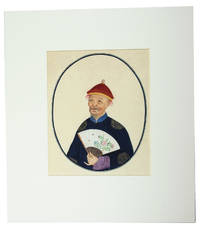
1800J76F1EWPWNYUChina 1800. In a modern gold-tooled dark green morocco clam shell box in contemporary style. Collection of 17 Chinese watercolours on Asian paper with chain lines including 3 of birds seated on a branch 3 of ensembles of fruit and flowers and 5 of fishes all ca. 30 x 37 .5 cm; 2 further watercolours each showing 2 branches of flowers and trees in a drawn oval border ca. 39 x 30 cm; and 4 watercolours of Chinese people posing with objects ca. 25 x 21 cm. Thirteen detailed Chinese watercolours of birds fruits flowers plants and fishes together with four portraits of Chinese people posing with a pipe lute flower and a handheld fan. The drawings in this album show the mixture of the Chinese and European styles that was popular in the market for export paintings in the first half of the 19th century: a combination of the Chinese approach to rendering with European aesthetics concerning light shadow and realism. As traditional in these paintings large areas of flat colour have been subtly shaded with very thin lines to draw the veins of the leaves fins of the fish and feathers of the birds. The production of these export paintings began earnestly in the 1820s and reached its height in the 1830s and 1840s especially after China's defeat in the First Opium War 1839-1842 opened the country to foreign trade. Photography was introduced in China in the 1840s and the market for export paintings declined after 1860.By the end of the 18th century Chinese painters in Hong Kong and Canton started producing paintings and drawings for European buyers. Although they were made for artistic and decorative purposes many European naturalists began collecting drawings to study Chinese plants and species. Most of the plants and animals would simply not survive the journey to Europe whereas dried specimens did not preserve the colour or shape of the flower. Most of the export paintings were ensembles of flowers and animals placed on a background. Imagination was more important than copying nature and the realistically painted flowers could have different colours or even be a composition of elements from different species. For that reason serious naturalists commissioned Chinese artists to paint according to the standards of European scientific illustration. With a few tiny spots and minor smudges but otherwise in very good condition. unknown
25054401China n.d. ca. 1927-1928. Brown simulated alligator cloth covers 37 x 27.5 cm. black pages spine ribbon-tied ca. 400 b.w. photos corner mounted images very good sharp and clear images NOT fadedsolidnicely done. V E R Y R A R E ! . . SUPERB PHOTO ALBUM OF THE CHINESE CIVIL WAR: . . Beginning of The Communist Party led led by Mao Tse-tung . . V.S. the Kuomintang KMT or Chinese Nationalist Party . Led by Chiang Kai Shek. . The United States Supported the KMT. In this album we see how the KMT soldiers hosted the American Army in China using their trains and military bases throughout China. This unusual album contains 400 original b. w. photographs & and is an historic photographic record of American military deployment showing Dough-boys in China probably from the U.S. Army's 2nd. Battalion 15th. infantry per the flag and insignia found on a group formation photograph. A minority are with written captions by and large taken by the person who made the album also enhanced with a small percent of professional Chinese photos some of which have in-negative captions. There are ca. 3 or so photos missing else completely filling 32 pages or 64 sides one on the inside back cover. The inside of the front cover has five attractive period color luggage type adverts from various hotels: Hotel Lankershim & Coast Line Military & Naval Hotel San Francisco Cal; The Court Hotel Tientsin North China; Grand Hotel des Wagons Litz; Astor House Hotel Ltd. Tientsin. The album begins with photos of a Chinese playing a Pi-pa snake skin banjo then there are three other photos: first two show a Chinese military camouflage train engine from which a Yank soldier in his campaign hat descends and a long train of cars with a large howitzer mounted upon one last shows French troops at parade rest with their rifles and white gloves and crested helmets with anchors naval or marines with others in the background with some officers. The next two pages show Chinese coolies swing a basket from the creek top water a field a mother suckling her baby with her family at the farm a large water tower in the wet slums and a group of Doughboys at attention in formation they wear boots leggings chrome World War I type dress helmets a rifle back pack with bayonet cartridge pouch belts with green wool hip-length jackets. The opposite page shows another view of the Chinese military train a pair of large mounted guns on an armored train car. To the right is a Chinese officer pointing to a large pierced hole in the train with a foreign engineer peering out from the small window. The train sports the Republic of China flag with a Chinese military unit flag painted on the side. Another view shows a group of abandoned Chinese coffins that went to the dogs; a group of soldiers in garrison caps at attention with fixed bayonets as the officers salute someone near the person taking the photo some Chinese officers also present. Next 2 pages show Chinese on a wheel barrow some Japanese women by a pond in Kimono and a group of British troops from their colonial Empire: blacks Indians white trumpeter Chinese and others with musical instruments all wear white cork-type pith helmets. A group of Japanese officers mugging for the camera. Photos of the railhead and large number of Chinese troops with rifles and kit at the railway station some on march carrying their flags others in open box cars with touring cars that are on the move another of camouflaged armored train cars one shows a number of foreign soldiers looking out of a train car window some are with tiny embossed stamp at right corner: "Mei Lee Tien Tsin." The album continues with a mixture of images of civilian Chinese Chinese military their trains moving air planes weapons war refugees in tents military views of barbed wire fortifications trenches machine gunners Russian soldiers Chinese officers Chinese air force funerals rickshaw pullers camel trains captured & wounded prisoners foreign soldiers at their sand-bagged posts. Photos of the great wall magnificent Chinese architectural monuments buildings and pagodas religious icons coffins more coffins mortars & Chinese junks and a plethora of others. The American Consulate General's compound in Tientsin American military band welcoming the newly arrived replacement troops. A large photo group shot of the American officers seated for a memorial photograph with their Battalion flag proudly posted on the wall where they pose source of our citation at the top of the unit name; two buglers are at each outside position the commander is ram-rod straight and taller than all others seated in the front & center; he and only two others on his sides wear full leather knee boots probably indicating the highest ranking officers; others are in boots & leggings. Photos of Doughboys aboard a ship showing the Naval officers with one stunning photo of an American high officer with his Japanese & Chinese counter parts posing for the camera. And a photo of the "Mail Boat Gazun Panama" and a few others of Panama giving credence to the fact that some of these soldiers came from the American East coast via Panama to San Francisco then on to China. Nice photo of semi-nude Panamanian family men women children. Doughboys at target practice photos of Chinese poverty coolies pulling great loads and street vendors. More showing Chinese life style street life horse & bullock carts and yet more caskets left in the open unburied and abandoned train cars full of horses Chinese troops smoke rising from a burning city another with "Tian jin" written in Chinese catholic church more parading of American soldiers within the Tientsin American Consulate parade grounds trooping of the colors. And a nice photo of the "U.S. Army Transport Thomas" Chinese junk &c. A U.S. soldier in a necktie his rifle at fixed bayonet at parade-rest before the Consulate General compound with sand bags inside a photo of a U.S. soldier with his Colt-45 on his hip with canteen looking at some communications connections another photo of two mini U.S. tanks and a very long bridge over the water. Photo of the Tientsin downtown with a Sikh Indian policeman directing traffic. Next page shows a public Chinese street execution: the guilty on his knees with the executioner ready to swing a very large sword and another headless corpse is before him the Tientsin YMCA compound opposite which is likely the inside of the American Consulate offices showing very ancient typewriters and three women staff and one other female Navy person. They all mug for the camera with a good number of U.S. Army or Marine officers behind three desks. Chinese hauling "magnum gold" brand ammunition on hand- trucks a U.S. Army band performing before the Consulate's office. At this point we find a few photos with penned captions: "One of China's Department Stores it shows a bird vendor; Peanut Gambler a mountain of P-nuts; Chinese Shimboo photo of the office and maker of the album and his Chinese officer friend ; "A Chinese Taxi" shows him in a Rickshaw "Me and the boy friend 11/3/28" shows a tiny goat cart carrying a child's coffin with a Chinese man. This penned date gives substantial proof of the date range of the entire album which was placed about the center of the whole work. The next page shows two more penned captions: "Chinese cavalry" and "Note mud house and fence" shows two Chinese officers on horse-back and a very very poor house with very starved animals. The next shows six Chinese undercover men two each holding a Chinese being readied for execution; and a very grizzly photo of a Chinese officer actually executing a Chinese man with his pistol who is seated on a rock: the photo captures the action as the shot blows away the mans brains. Behind the execution scene is a crowd of American soldiers in campaign hats and Chinese military officers who are witness to the event. More views of Chinese street life vendors pullers haulers & horse carts religious icons and a stunning Chinese roofed gate more Chinese troops on the move via train with a very horrible view of a large number of dead Chinese in the muddy filthy waters by a bridge. Homeless Chinese at a "soup kitchen" war refugees hauling their belongings house boat street barbers a group of 7 photos by the ocean. They show American soldiers at leisure looking at Chinese fishermen nets naked fishermen hauling in a net of fish to the beach a burning waterfront village the jetty where several large American transport ships are at anchor and a great assembly of Yankee soldiers on the beach with duffel bags and their gear at the railhead. The last photo shows a great number of various whisky bottles lined up for display. More photos show a coffin maker large coffin basket seller and "chow" sellers on the street. A military formation of 100's of either Scottish or Irish soldiers with fixed bayonets marching down the main street before the "RNC Electricity Dept." below which is a very long line of British soldiers on one side of the street opposite from a good number of American soldiers who are on the side of the street a British Union Jack flies over a castle-like structure this is clearly some kind of grand military parade. More photos of the Great Wall the military parade and army chaplains with an Australia flag flying over another castle tower. Chinese river scene with large numbers of native boats in a canal a beggar's camp with straw -mat tents a canal crossing ferry for people a photo of a U.S. officer stand on top a wooden coffin for a closer look. More poverty-stricken Chinese haulers fortune tellers graves tethered horses log sawyers rice haulers electric trolley with English and Chinese language sign on the roof panorama post card of Shanghai's Bund. The album now shifts to photos of the Peking area. Shows the Ming tombs and the camel-lined road; military train the Americans were transported by that train a large bivouac and tent city where the U. S. military troops camped some Chinese "house boys" proudly holding the American troop's unit flag. More photos of two U.S. soldiers posing near Chinese coffins in a wet ditch. A group of very young Chinese boys posed near the railroad; one is so poor that he has no clothes at all and is in nude. A large group of Nationalist Chinese soldiers marching along a street one classic photo of a single American soldier on guard standing at attention as stands vigil on a barbed-wire barrier his rifle at fixed bayonet. A group of five Chinese young "ladies" who pose for the camera who seemed NOT to be bewildered by the photographer they look like "Sing-song girls" hookers who entertained the U.S. troops. Chinese Buddhist priests in white robes with shaved heads a great gate to Peking Shanghai harbor views shanty huts captured Chinese criminal or traitor guarded by Chinese soldiers train car full of rifles more Chinese soldiers on trains marching in formation on the road. And a good photo of several American officers: one with a whip posing for the camera in garrison hat. Chinese bivouac and American soldiers with bullet and pouches for ammo with rifles at parade rest. More barbed-wire barricades Chinese & British soldiers armored train-mounted gun. More Chinese prisoners traitors being executed heads hoisted on power poles in baskets as a form of public warning and display for other would-be traitors. An American tent bivouac camp at the train yard two more public exec executions by beheading at the moment of loosing one's head an executed dead man lying in the street. Photos of Peking's Forbidden City a Chinese hung to death from a tree a Yank soldier in overalls carries a Chinese bamboo "yoke" with two baskets and smokes a pipe while Chinese look on and laugh. Two photos of lines of Rickshaws waiting for passengers. One comic photo with negative caption: "Find the Chinaman;" it shows two American soldiers sitting among Chinese. Nice shot of the Summer Palace Peking and a U.S. soldier riding in a Rickshaw. The very last photo inside the back cover shows the whole battalion dressed up wearing their chrome helmets standing at attention in formation for a classic and most historic memorial photograph. Their commanding officer is front and center; all have their rifles ammo belts and very polished boots with back packs. They could be standing in the Tientsin American Consulate compound grounds. Followed by a few other photos of Chinese a Chinese soldier et al. This work shows the typical things seen in China during this period of political and military chaos. The feuding war lords and political parties at war; the landing of American military to protect American diplomatic interests. Support & assistance given to the Americans and other foreign military groups by the Nationalist Chinese army. The desperate situation of the tragic Chinese people caught in the grips of upheaval and the summary punishment of traitors in a public display of the swift and ruthless law of China. A riveting and most compelling true record of a U.S. military officer's sojourn to and deployment in China. THE PHOTOGRAPHER AND THE SIZE OF PHOTOGRAPHS: This is not a professional group of photographs but there a very small amount which were obviously purchased by the maker of the album and inserted. The vast majority are his personal photographs these again are obvious to anyone who looks at the album. This is an excellent example of private work of an unknown American Army officer stationed in China during a very chaotic period. He was interested in recording for posterity his experiences and the sights that he saw while on duty. We thank him for giving us privy to this slice of American and Chinese military history. SIZE OF THE PHOTOGRAPHS: The size varies considerably sizes in cm.: the smallest are 8 x 5 most are 14 x 9 3 larger photos 24.5 x 18 and the last 30 x 10. CONDITION OF THE PHOTOGRAPHS: These are original period photos they are all very clear sharp images no fading and in excellent condition. They have been corner mounted. RARITY: Photographic albums of this period in China are NOT commonly found; one made by an American Army officer stationed in China at this time is exceptionally unusual and RARE ! This is a charming primary source with a large number of clean & sharp images taken by an actual participant in this historic period of China. The officer and photographer of these photographs shared for posterity his keen insight and view of these events. We thank him for giving us privy to this slice of American & Chinese military history. . unknown
25054401China n.d. ca. 1927-1928. Brown simulated alligator cloth covers 37 x 27.5 cm. black pages spine ribbon-tied ca. 400 b.w. photos corner mounted images very good sharp and clear images NOT fadedsolidnicely done. V E R Y R A R E ! . . SUPERB PHOTO ALBUM OF THE CHINESE CIVIL WAR: . . Beginning of The Communist Party led led by Mao Tse-tung . . V.S. the Kuomintang KMT or Chinese Nationalist Party . Led by Chiang Kai Shek. . The United States Supported the KMT. In this album we see how the KMT soldiers hosted the American Army in China using their trains and military bases throughout China. This unusual album contains 400 original b. w. photographs & and is an historic photographic record of American military deployment showing Dough-boys in China probably from the U.S. Army's 2nd. Battalion 15th. infantry per the flag and insignia found on a group formation photograph. A minority are with written captions by and large taken by the person who made the album also enhanced with a small percent of professional Chinese photos some of which have in-negative captions. There are ca. 3 or so photos missing else completely filling 32 pages or 64 sides one on the inside back cover. The inside of the front cover has five attractive period color luggage type adverts from various hotels: Hotel Lankershim & Coast Line Military & Naval Hotel San Francisco Cal; The Court Hotel Tientsin North China; Grand Hotel des Wagons Litz; Astor House Hotel Ltd. Tientsin. The album begins with photos of a Chinese playing a Pi-pa snake skin banjo then there are three other photos: first two show a Chinese military camouflage train engine from which a Yank soldier in his campaign hat descends and a long train of cars with a large howitzer mounted upon one last shows French troops at parade rest with their rifles and white gloves and crested helmets with anchors naval or marines with others in the background with some officers. The next two pages show Chinese coolies swing a basket from the creek top water a field a mother suckling her baby with her family at the farm a large water tower in the wet slums and a group of Doughboys at attention in formation they wear boots leggings chrome World War I type dress helmets a rifle back pack with bayonet cartridge pouch belts with green wool hip-length jackets. The opposite page shows another view of the Chinese military train a pair of large mounted guns on an armored train car. To the right is a Chinese officer pointing to a large pierced hole in the train with a foreign engineer peering out from the small window. The train sports the Republic of China flag with a Chinese military unit flag painted on the side. Another view shows a group of abandoned Chinese coffins that went to the dogs; a group of soldiers in garrison caps at attention with fixed bayonets as the officers salute someone near the person taking the photo some Chinese officers also present. Next 2 pages show Chinese on a wheel barrow some Japanese women by a pond in Kimono and a group of British troops from their colonial Empire: blacks Indians white trumpeter Chinese and others with musical instruments all wear white cork-type pith helmets. A group of Japanese officers mugging for the camera. Photos of the railhead and large number of Chinese troops with rifles and kit at the railway station some on march carrying their flags others in open box cars with touring cars that are on the move another of camouflaged armored train cars one shows a number of foreign soldiers looking out of a train car window some are with tiny embossed stamp at right corner: "Mei Lee Tien Tsin." The album continues with a mixture of images of civilian Chinese Chinese military their trains moving air planes weapons war refugees in tents military views of barbed wire fortifications trenches machine gunners Russian soldiers Chinese officers Chinese air force funerals rickshaw pullers camel trains captured & wounded prisoners foreign soldiers at their sand-bagged posts. Photos of the great wall magnificent Chinese architectural monuments buildings and pagodas religious icons coffins more coffins mortars & Chinese junks and a plethora of others. The American Consulate General's compound in Tientsin American military band welcoming the newly arrived replacement troops. A large photo group shot of the American officers seated for a memorial photograph with their Battalion flag proudly posted on the wall where they pose source of our citation at the top of the unit name; two buglers are at each outside position the commander is ram-rod straight and taller than all others seated in the front & center; he and only two others on his sides wear full leather knee boots probably indicating the highest ranking officers; others are in boots & leggings. Photos of Doughboys aboard a ship showing the Naval officers with one stunning photo of an American high officer with his Japanese & Chinese counter parts posing for the camera. And a photo of the "Mail Boat Gazun Panama" and a few others of Panama giving credence to the fact that some of these soldiers came from the American East coast via Panama to San Francisco then on to China. Nice photo of semi-nude Panamanian family men women children. Doughboys at target practice photos of Chinese poverty coolies pulling great loads and street vendors. More showing Chinese life style street life horse & bullock carts and yet more caskets left in the open unburied and abandoned train cars full of horses Chinese troops smoke rising from a burning city another with "Tian jin" written in Chinese catholic church more parading of American soldiers within the Tientsin American Consulate parade grounds trooping of the colors. And a nice photo of the "U.S. Army Transport Thomas" Chinese junk &c. A U.S. soldier in a necktie his rifle at fixed bayonet at parade-rest before the Consulate General compound with sand bags inside a photo of a U.S. soldier with his Colt-45 on his hip with canteen looking at some communications connections another photo of two mini U.S. tanks and a very long bridge over the water. Photo of the Tientsin downtown with a Sikh Indian policeman directing traffic. Next page shows a public Chinese street execution: the guilty on his knees with the executioner ready to swing a very large sword and another headless corpse is before him the Tientsin YMCA compound opposite which is likely the inside of the American Consulate offices showing very ancient typewriters and three women staff and one other female Navy person. They all mug for the camera with a good number of U.S. Army or Marine officers behind three desks. Chinese hauling "magnum gold" brand ammunition on hand- trucks a U.S. Army band performing before the Consulate's office. At this point we find a few photos with penned captions: "One of China's Department Stores it shows a bird vendor; Peanut Gambler a mountain of P-nuts; Chinese Shimboo photo of the office and maker of the album and his Chinese officer friend ; "A Chinese Taxi" shows him in a Rickshaw "Me and the boy friend 11/3/28" shows a tiny goat cart carrying a child's coffin with a Chinese man. This penned date gives substantial proof of the date range of the entire album which was placed about the center of the whole work. The next page shows two more penned captions: "Chinese cavalry" and "Note mud house and fence" shows two Chinese officers on horse-back and a very very poor house with very starved animals. The next shows six Chinese undercover men two each holding a Chinese being readied for execution; and a very grizzly photo of a Chinese officer actually executing a Chinese man with his pistol who is seated on a rock: the photo captures the action as the shot blows away the mans brains. Behind the execution scene is a crowd of American soldiers in campaign hats and Chinese military officers who are witness to the event. More views of Chinese street life vendors pullers haulers & horse carts religious icons and a stunning Chinese roofed gate more Chinese troops on the move via train with a very horrible view of a large number of dead Chinese in the muddy filthy waters by a bridge. Homeless Chinese at a "soup kitchen" war refugees hauling their belongings house boat street barbers a group of 7 photos by the ocean. They show American soldiers at leisure looking at Chinese fishermen nets naked fishermen hauling in a net of fish to the beach a burning waterfront village the jetty where several large American transport ships are at anchor and a great assembly of Yankee soldiers on the beach with duffel bags and their gear at the railhead. The last photo shows a great number of various whisky bottles lined up for display. More photos show a coffin maker large coffin basket seller and "chow" sellers on the street. A military formation of 100's of either Scottish or Irish soldiers with fixed bayonets marching down the main street before the "RNC Electricity Dept." below which is a very long line of British soldiers on one side of the street opposite from a good number of American soldiers who are on the side of the street a British Union Jack flies over a castle-like structure this is clearly some kind of grand military parade. More photos of the Great Wall the military parade and army chaplains with an Australia flag flying over another castle tower. Chinese river scene with large numbers of native boats in a canal a beggar's camp with straw -mat tents a canal crossing ferry for people a photo of a U.S. officer stand on top a wooden coffin for a closer look. More poverty-stricken Chinese haulers fortune tellers graves tethered horses log sawyers rice haulers electric trolley with English and Chinese language sign on the roof panorama post card of Shanghai's Bund. The album now shifts to photos of the Peking area. Shows the Ming tombs and the camel-lined road; military train the Americans were transported by that train a large bivouac and tent city where the U. S. military troops camped some Chinese "house boys" proudly holding the American troop's unit flag. More photos of two U.S. soldiers posing near Chinese coffins in a wet ditch. A group of very young Chinese boys posed near the railroad; one is so poor that he has no clothes at all and is in nude. A large group of Nationalist Chinese soldiers marching along a street one classic photo of a single American soldier on guard standing at attention as stands vigil on a barbed-wire barrier his rifle at fixed bayonet. A group of five Chinese young "ladies" who pose for the camera who seemed NOT to be bewildered by the photographer they look like "Sing-song girls" hookers who entertained the U.S. troops. Chinese Buddhist priests in white robes with shaved heads a great gate to Peking Shanghai harbor views shanty huts captured Chinese criminal or traitor guarded by Chinese soldiers train car full of rifles more Chinese soldiers on trains marching in formation on the road. And a good photo of several American officers: one with a whip posing for the camera in garrison hat. Chinese bivouac and American soldiers with bullet and pouches for ammo with rifles at parade rest. More barbed-wire barricades Chinese & British soldiers armored train-mounted gun. More Chinese prisoners traitors being executed heads hoisted on power poles in baskets as a form of public warning and display for other would-be traitors. An American tent bivouac camp at the train yard two more public exec executions by beheading at the moment of loosing one's head an executed dead man lying in the street. Photos of Peking's Forbidden City a Chinese hung to death from a tree a Yank soldier in overalls carries a Chinese bamboo "yoke" with two baskets and smokes a pipe while Chinese look on and laugh. Two photos of lines of Rickshaws waiting for passengers. One comic photo with negative caption: "Find the Chinaman;" it shows two American soldiers sitting among Chinese. Nice shot of the Summer Palace Peking and a U.S. soldier riding in a Rickshaw. The very last photo inside the back cover shows the whole battalion dressed up wearing their chrome helmets standing at attention in formation for a classic and most historic memorial photograph. Their commanding officer is front and center; all have their rifles ammo belts and very polished boots with back packs. They could be standing in the Tientsin American Consulate compound grounds. Followed by a few other photos of Chinese a Chinese soldier et al. This work shows the typical things seen in China during this period of political and military chaos. The feuding war lords and political parties at war; the landing of American military to protect American diplomatic interests. Support & assistance given to the Americans and other foreign military groups by the Nationalist Chinese army. The desperate situation of the tragic Chinese people caught in the grips of upheaval and the summary punishment of traitors in a public display of the swift and ruthless law of China. A riveting and most compelling true record of a U.S. military officer's sojourn to and deployment in China. THE PHOTOGRAPHER AND THE SIZE OF PHOTOGRAPHS: This is not a professional group of photographs but there a very small amount which were obviously purchased by the maker of the album and inserted. The vast majority are his personal photographs these again are obvious to anyone who looks at the album. This is an excellent example of private work of an unknown American Army officer stationed in China during a very chaotic period. He was interested in recording for posterity his experiences and the sights that he saw while on duty. We thank him for giving us privy to this slice of American and Chinese military history. SIZE OF THE PHOTOGRAPHS: The size varies considerably sizes in cm.: the smallest are 8 x 5 most are 14 x 9 3 larger photos 24.5 x 18 and the last 30 x 10. CONDITION OF THE PHOTOGRAPHS: These are original period photos they are all very clear sharp images no fading and in excellent condition. They have been corner mounted. RARITY: Photographic albums of this period in China are NOT commonly found; one made by an American Army officer stationed in China at this time is exceptionally unusual and RARE ! This is a charming primary source with a large number of clean & sharp images taken by an actual participant in this historic period of China. The officer and photographer of these photographs shared for posterity his keen insight and view of these events. We thank him for giving us privy to this slice of American & Chinese military history. . hardcover books
187027200China 1870. Fine. A splendid series of pith paintings from the Doheny collection. The watercolor and gouache paintings are splendidly preserved displayed and housed. The bookplates of Carrie Estelle Doheny and Edward Laurence Doheny are mounted on acid free board which sits atop the images and the totality fits snugly into the box. <br /> <br /> The images are in the traditional format in this case illustrating nine subjects - <br /> Royal Procession 6 images; Birds 11 images; Ships & Barges 5 ; Tea Cultivation 7; Punishments 11; Butterflies & Flowers 2 ; Butterflies & Insects 8; Court life 5; Flowers Camellias etc. 9. Each is protected in an archival paper sleeve 13 x 8.25 inches and numbered in pencil on the wrapper. Images 33 x 21 cm. <br /> <br /> The stability of these images is greatly enhanced by their conservation. Each pith image has been backed on acid free tissue supporting the pith which is quite fragile. The vast majority of the images are complete and undamaged. A minority have small marginal cracks or small corners missing. A couple have slight browning. Each image is preserved in a numbered acid-free folder and the whole is housed in a custom brown and black leather solander box numbered XI on the front board. <br /> <br /> Pith paintings are notoriously fragile. Crossman states "The other paper commonly used for watercolors and gouaches after 1800 was pith. The pith paper is a very fragile medium to work on and many of those watercolors which have survived are cracked and broken. Crossman "The China Trade" pp 95-97.<br /> <br /> A splendid collection. unknown
LCS-18330Magnifique album composé d'une suite de 28 gouaches sur papier de riz d’une remarquable finesse d’exécution. Canton, fin XIXe siècle. Album in-4 oblong de 28 feuillets ornés de gouaches peintes sur papier de riz, petites fentes à 5 peintures dont 2 avec atteinte aux peintures. Percaline noire ornée à froid, titre «album» en lettres dorées au centre du plat supérieur, tranches dorées. Reliure de l'époque. 210 x 308 mm.
CBF23<p>Canton end of the nineteenth century. </p><p>Oblong 4to album 210 x 308 mm of 28 leaves illustrated with painted gouaches on rice paper small tears in 5 paintings 2 of which touching the paintings. Blind-stamped decorated black buckram title "album" gilt-stamped in the center of the front cover gilt edges. <i>Contemporary binding.</i></p><p><b>Magnificent album containing a set of 28 large Chinese gouaches painted on rice paper in fresh colors</b> each framed in gold paper. </p><p><b>Among these 28 gouaches 11 are dedicated to the sumptuous ceremony organized in honor of the 70th birthday of the Chinese general Guo Ziyi in 767.</b></p><p>Guo Ziyi born in 697 died July 9 781 also posthumously called Prince ZhÅngwÇ” of Fényáng æ±¾é™½å¿ æ¦çŽ‹ was a Tang Dynasty general who ended the An Lushan Revolt one of the greatest civil wars in history which took place from December 16 755 to February 17 763 and participated in expeditions against the Uyghur Khaganate and the Tibetan Empire. </p><p>He is seen as one of the most powerful generals of the Tang dynasty. After his death he is immortalized in Chinese mythology as the God of fortune and happiness guì shòu kÇŽo.</p><p>To celebrate the 70th birthday of this very powerful general a lavish ceremony was organized.</p><p>More than 3 000 guests were gathered for the occasion.</p><p>The paintings represent thus:</p><p>- a large bouquet</p><p>- 3 scenes of processions with musicians</p><p>- porters supporting the very luxurious palanquin of the general</p><p>- porters carrying a palanquin containing gifts for the general hat and shoes</p><p>- porters with a palanquin containing the crown of the general's wife as well as a belt symbol of power</p><p>- 2 scenes of lantern bearers</p><p>- porters bring a piece of furniture supporting a representation of the general and his family. The general surmounts the scene; a dragon is represented under him. At the bottom we see again the general with his 7 sons on the left</p><p>- The porters of the next scene carry a Chinese tower. At the foot of the tower the general is again shown with his seven sons</p><p>- the next scene shows the porters with a large hanging stretched on a horizontal pole. We find on this hanging the symbol of happiness</p><p>- 7 scenes of fight</p><p>- 6 scenes of punishments .</p><p><b>A rare and precious copy of remarkable finesse of execution preserved in its original binding.</b></p><p><br /></p><p><u>Français</u></p><p>Canton fin XIXe siècle. </p><p>Album in-4 oblong de 28 feuillets ornés de gouaches peintes sur papier de riz petites fentes à 5 peintures dont 2 avec atteinte aux peintures. Percaline noire ornée à froid titre " album " en lettres dorées au centre du plat supérieur tranches dorées. <i>Reliure de l'époque.</i></p><p>210 x 308 mm.</p><p><b>Magnifique album comportant une suite de 28 grandes gouaches chinoises peintes sur papier de riz en coloris très frais chacune avec en encadrement de papier doré. </b></p><p><b>Parmi ces 28 gouaches 11 sont consacrées à la somptueuse cérémonie organisée en l'honneur des 70 ans du général chinois Guo Ziyi en 767.</b></p>Guo Ziyi né en 697 décédé le 9 juillet 781 également appelé à titre posthume Prince ZhÅngwÇ” de Fényáng æ±¾é™½å¿ æ¦çŽ‹ est un général de la dynastie Tang qui mit fin à la révolte d'An Lushan l'une des plus grandes guerres civiles de l'histoire qui eut lieu du 16 décembre 755 au 17 février 763 et participe à des expéditions contre le khaganat ouïghour et l'empire tibétain.<br /><br />Il est vu comme l'un des plus puissants généraux de la dynastie Tang. Après sa mort il est immortalisé dans la mythologie chinoise en tant que Dieu de la fortune et du bonheur <i>guì shòu kÇŽo</i>. <p>Pour célébrer les 70 ans de ce général très puissant une cérémonie fastueuse fut organisée.</p><p>Plus de 3 000 invités furent réunis pour l'occasion.</p><p>Les peintures représentent ainsi :</p><p>- un grand bouquet</p><p>- 3 scènes de cortèges avec des musiciens</p><p>- des porteurs qui soutiennent le palanquin très luxueux du général</p><p>- des porteurs portent un palanquin contenant des présents pour le général chapeau et chaussures</p><p>- des porteurs avec un palanquin contenant la couronne de l'épouse du général ainsi qu'une ceinture symbole de pouvoir</p><p>- 2 scènes de porteurs de lanternes</p><p>- des porteurs apportent un meuble soutenant une représentation du général et de sa famille. Le général surmonte la scène un dragon est représenté sous lui. En bas on voit à nouveau le général avec ses 7 fils à gauche</p><p>- les porteurs de la scène suivante portent une tour chinoise. Au pied de la tour le génral est à nouveau représenté avec ses 7 fils</p><p>- la scène suivante montre des porteurs munis d'une grande tenture tendue sur un mat horizontal. On trouve sur cette tenture le symbole du bonheur</p><p>- 7 scènes de lutte</p><p>- 6 scènes de châtiments …</p><p><b>Rare et précieux exemplaire d'une remarquable finesse d'exécution conservé dans sa reliure de l'époque.</b> </p> hardcover
1913150453Berlin, Dietrich Reimer (Ernst Vohsen), 1913. VII, 17 S., 75 Lichtdrucktafeln, davon 40 in Farbe, mit je einem Vorblatt mit Titel und beschreibendem Text, (bei Tafel 5 sind Titel und Text in die Abbildung integriert), lose in HLwd.-Mappe. Gr.-Fol., 60 x 50 cm, OHPgt.-Mappe mit goldgeprägtem Rückentitel, Deckel erneuert.
1891BB009<p> CHINA: Propaganda against Western Missionaries<br /></p><p>The Cause of the Riots in the Yangtse Valley. A "Complete Picture Gallery" by CHOU HAN. Hankow China 1891. With 32 full=page woodblock plates printed in color. Oblong 4to original printed wrappers sewn spine soiling minor repairs.</p><p>The author Chou Han is described by the translator Griffith John 1831-1912 as 'a gentleman of high official rank Taotai in Hunan' and was part of an orchestrated propaganda campaign aimed at discouraging Western Christian missionaries from working and traveling in China. This volume was perhaps his most significant and horrific attack on western culture managing a "reptile press" in Hunan creating unrest and distrust amongst the Chinese people see John's "A Voice from China" 1907 p. 220. Chou Han himself is probably represented in plates IX XIII XXVI and XXIX; the images are virulently anti-foreigner and specifically anti-Christian. John translated and circulated the present work to draw attention to the British authorities of the problems faced by missionaries in Asia. </p><p>Very Rare. ONLY 3 COPIES CAN BE TRACED AT AUCTION IN THE PAST 40 YEARS ABPC & RBH. </p><br /> paperback books