Philippines; Bureau of EducationBiblio.com
821 résultats
1528488075.Ghardcover. Good. Access codes and supplements are not guaranteed with used items. May be an ex-library book. hardcover
B9781019761595Hardback. New. hardcover
DADAX1344741509Arkose Press 2015-10-17. hardcover. New. 6.14x1.50x9.21. Buy with confidence. Excellent Customer Service & Return policy. Arkose Press hardcover
A9781344741507Hardback. New. hardcover
B9781013969584Hardback. New. hardcover
1247898288.Gpaperback. Good. Access codes and supplements are not guaranteed with used items. May be an ex-library book. paperback
1247882454.Gpaperback. Good. Access codes and supplements are not guaranteed with used items. May be an ex-library book. paperback
1247895882.Gpaperback. Good. Access codes and supplements are not guaranteed with used items. May be an ex-library book. paperback
1247911586.Gpaperback. Good. Access codes and supplements are not guaranteed with used items. May be an ex-library book. paperback
B9781020446719Hardback. New. hardcover
B9781020886898Hardback. New. hardcover
0266158994.Ghardcover. Good. Access codes and supplements are not guaranteed with used items. May be an ex-library book. hardcover
0266100015.Gpaperback. Good. Access codes and supplements are not guaranteed with used items. May be an ex-library book. paperback
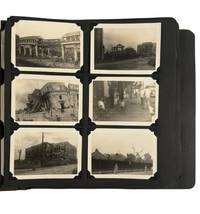
1945212431945. World War II Philippines photo album 1940s documenting United States Army Forces Far East activity and civilian conditions in Luzon during Japanese occupation and subsequent military operations. The album records military presence infrastructure damage and daily life among Filipino civilians providing visual evidence of the Pacific Theater at a critical stage of conflict. The material captures both organized military environments and surrounding local landscapes situating the campaign within its geographic and social context.<br /> <br /> Album comprises 48 silver gelatin photographs each measuring approximately 3" x 4.25" mounted on 8 loose black album pages within faux brown leather covers measuring approximately 10.5" x 12". The photographs depict a range of wartime and civilian scenes including damaged buildings rural and urban environments and Filipino civilians engaged in daily activity. Several images show U.S. soldiers stationed at an encampment with rows of tents including one photograph of a Filipino man possibly affiliated with the Philippine Scouts posed in front of a tent. Additional photographs depict large U.S. naval vessels alongside smaller wooden boats occupied by Filipino men and women approaching or departing from these ships. Other images capture natural landscapes including volcanic terrain and cloud formations above Luzon. The sequence of photographs reflects both military occupation and local life with visual emphasis on interaction between American forces and Filipino civilians.<br /> <br /> Created during the prolonged conflict in the Philippines where American and Filipino forces resisted Japanese occupation from 1941 to 1945 these photographs provide a record of conditions during one of the most significant campaigns in the Pacific Theater. The images reflect both the presence of U.S. military operations and the lived environment of the island during wartime. Album pages are loose within covers; photographs remain clean and well-preserved with minimal wear; overall very good condition. This album offers a concentrated visual record of wartime Luzon and the intersection of military and civilian experience. unknown
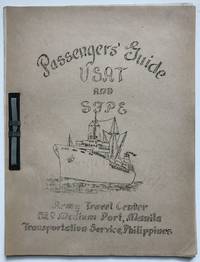
1947475Manila 1947. Very good. 24pp. Quarto. Original printed wrappers bound with folding metal fasteners. Small original photo laid in. A fascinating mimeograph guide published by the U.S. Army in the Philippines to assist soldiers and civilian personnel that were being transported back to the United States or to other posts overseas at the end of World War II. The transports all travelled from Manila to Fort Mason in San Francisco or the Oakland Army Base. The guide is quite detailed and like military manuals everywhere sought to foresee all contingencies from detailed information about the types of vessels used as transports their safety procedures American customs allowances and other procedures at the American ports of entry to very specific advice about how to tip ship stewards and advice on dealing with seasickness "far more a disease of the mind than of the body". The final pages contain several forms required for re-entry and a small section listing the "responsibilities" of military personnel on board the transports. With a small photo of a Filipino band watching a transport departing Manila harbor dated June 13 1947 on the verso. Not in OCLC. unknown books
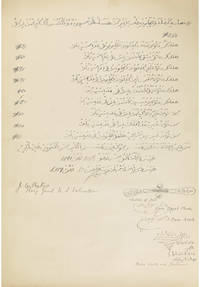
189924064<p><b>PHILIPPINES.</b>Facsimile of original treaty ceding sovereignty of the Archipelago of Jolo to the United States. Jolo Province of Sulu Philippines August 20 1899. Bound in 20th century cloth comprising a large three-page lithographed facsimile of the manuscript treaty written in the Tausug language and signed in print by the Sultan of Jolo and Brig. General John C. Bates 16½ x 12 in. With a small format copy of the document in English the first leaf mimeographed the final leaf lithographed with facsimile signatures. </p><p><b><br /></b></p><p><b>Historical Background</b></p><p>The Sultanate of Sulu began in the early 15th century and once included the northeastern side of Borneo and many islands to the northeast including the island of Jolo. By the late 19th century it had been reduced to a string of islands under Spanish occupation rule. The Treaty of Paris that ended the Spanish-American War transferred control of the Philippines including the Sulu to the United States. The sultanate was home to several ethnic groups including the Moro and Tausug.</p><p>On August 20 1899 the United States signed this treaty with Sultan Hadji Mohammed Jamalul Kiram II and several of his tribal chiefs. The "Bates Treaty" after General John C. Bates recognized U.S. sovereignty over the whole archipelago of Jolo. The U.S. agreed to protect the sultan and his subjects and not to sell any island in the archipelago to any other nation without the sultan's consent. The treaty promised religious freedom especially for the Muslim Moros and free trade with the Philippines. It prohibited piracy and the introduction of war material. The most controversial article recognized slavery but allowed any slave to purchase his or her freedom by paying "the usual market value" to the master. Finally the treaty promised monthly payments to the Sultan and his chiefs totaling 730 Mexican dollars per month approx. $365.</p><p>This treaty theoretically removed the Sultanate of Sulu from participation in the Philippine American War 1899-1902. Some Americans criticized the treaty for granting too much autonomy to the Sultan and for allowing slavery to continue. Over the next five years political conditions deteriorated and there were revolts in several areas even threatening Jolo City where U.S. authorities were stationed.</p><p>In March 1904 the United States abrogated the treaty unilaterally per Secretary of War William Howard Taft's telegram to Gov. General Luke E. Wright 1846-1922: "By order of the President you are hereby directed to notify the sultan of Sulu and the dattos who signed the so-called Bates treaty of August 20 1899 which was a modus vivendi and mere executive agreement that in view of the failure on the part of the sultan … to discharge the duties and fulfill the conditions imposed upon them by said agreement they have forfeited all rights to the annuities therein stipulated to be paid to them and all other considerations… they are subject to the laws enacted therein under the sovereignty of the United States."</p><p>Although the Philippine-American War officially ended in July 1902 with the dissolution of the First Philippine Republic resistance continued for several more years especially in remote areas and the islands occupied by the Moro people. In June 1913 American troops under General John "Black Jack" Pershing 1860-1948 attacked a group of fighters atop Mount Bagsak on the island of Jolo. At the Battle of Bud Bagsak the Americans destroyed the Moro resistance and killed its leader Datu Amil.</p><p>In the text of the treaty there was a critical "translation error." The Treaty in the Tausug version discussed "The support aid and protection of the Jolo Island and Archipelago" but the word "sovereignty" was not used. The English-language version noted that "The sovereignty of the United States over the whole Archipelago of Jolo and its dependencies is declared and acknowledged." In 1946 the English text provided justification for America's decision to incorporate the Sulu Archipelago into the Philippine state.</p><p><b>Sultan Hadji Mohammed Jamalul Kiram II</b> 1868-1936 was a member of the Muslim royal house that ruled the Sulu archipelago from the 15th to the 20th centuries. Proclaimed sultan when his older brother died in 1884 it took ten years to consolidate his authority. In 1912 he took a world tour and visited President William Howard Taft at the White House in Washington D.C. He surrendered his political powers to the United States government in 1915 but retained cultural and religious authority. He died leaving seven daughters but no male heir. His younger brother made an ineffectual claim to the abolished sultanate.</p><p><b>John C. Bates</b> 1842-1919 was born in Missouri the son of Abraham Lincoln's Attorney General Edward Bates and educated at Washington University in St. Louis. During the Civil War John C. Bates served as an aide to General George G. Meade. He served in the Indian Wars of the late nineteenth century and rose to the rank of colonel. In 1898 he received promotion to brigadier general and commanded in the Spanish-American War. He also commanded a division of volunteers in the Philippines during the early stages of the Philippine-American War. He later served as the Chief of Staff of the U.S. Army for several months before his retirement in 1906. He was the last Army Chief of Staff to have served in the American Civil War.</p><p><b>Condition</b></p><p>Dust soiling stains margins strengthened.</p> books
193988381Manilla: Bureau of Printing 1939. Paperback. Good. 334p. Softcover in original wrapper. 24 cm. Light library markings Department of the Interior on front cover. Some wrinkling of cover and text. Cover edges slightly wrinkled and and spotted. Some dog-earing. <br/><br/> Bureau of Printing paperback books
17641400London: J. Dodsley 1764. Scare first edition of this document relating to the British occupation of Manila during the Anglo-Spanish War of 1762-3 and an interesting case of international law. In September of 1762 under the command of Draper and Cornish a British fleet of 13 ships containing over 6000 men attacked Manila and following a difficult landing quickly dispatched the Spanish garrison which they outnumbered 10 to 1.They entered the city on October 5 and part of the terms of capitulation was that Spain would pay the British an indemnity of 4 million pesos roughly a million pounds for not pillaging the city. The British evacuated in 1764 when hostilities ceased and Draper enjoyed the highly unusual privilege of presenting the standards of Spain taken in Manila to his alma mater Kings College Cambridge. But the Spanish did not honor this gentlemans agreement claiming that Draper dealt with an unauthorized agent that he himself broke the terms of the agreement etc. In order to press his claim which amounted to £25000 he published the present tract to pressure his government to collect. The tract contains a brief letter to the British Secretary of State outlining his grievance; a bilingual summary in English and French of the Spanish ambassadors grounds for not complying with the terms of the agreement; extracts from the treaty; a refutation by Draper of the claim that he dealt with an unauthorized agent; and an English language treaty signed by the original parties in Manila. But with hostilities over and their attention occupied by other foreign adventures chief among them America the British were in no position to insist and the suit was eventually abandoned.Griffin Bibliography of the Philippines p. 125; Dictionary of National Biography compact ed. I.573. 8vo. 43 pp. Bound in blue wrappers and housed in protective buckram case with title gilt on spine. Minor foxing in margins of final leaves but otherwise absolutely mint. J. Dodsley hardcover books
196223324Manila 1962. Hardcover. Very Good. 2 vols. now bound in 1. Each provincial report separately numbered. Blue cloth. 28cm. Modest cover wear. No Jacket. <br/><br/> hardcover books
195185206Manila: Bureau of Printing 1951. Paperback. Good. frontis 2 folding maps 258p. Blue wrapper. 25cm. Ends of backstrip chipped. <br/><br/> Bureau of Printing paperback books
197485209Manila 1974. Paperback. Good. maps xxviii 491p. Softcover in original wrapper. 30cm. Backstrip wrinkled some chipping At head of title: Final Report. Vol. I. 67 Final Provincial Reports were scheduled to be published. <br/><br/> paperback books
197485211Manila 1974. Paperback. Good. maps xxiv 589p. Softcover in original wrapper. 30cm. Light stain on fore-edge. Name "whited-out" on front cover. At head of title: Final Report. Vol. I. <br/><br/> paperback books
197485210Manila 1974. Paperback. Very Good. maps xxvii 516p. Softcover in original wrapper. 30cm. Corner wrinkled. At head of title: Final Report. Vol. I. <br/><br/> paperback books
189957494New York: The Macmillan Company London: Macmillan & co. Ltd 1899. Early edition first printed the year before. Illustrated with plates and folding map. 529 pp. 1 vols. 8vo. Original tan cloth some minor darkening to spine else fine with the armorial bookplate of Van Nest on endpaper. Early edition first printed the year before. Illustrated with plates and folding map. 529 pp. 1 vols. 8vo. The Macmillan Company, London: Macmillan & co., Ltd unknown books