PhilippinesABAA
31 résultats
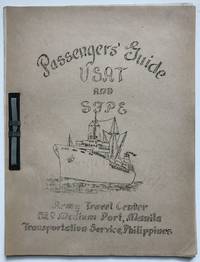
1947475Manila 1947. Very good. 24pp. Quarto. Original printed wrappers bound with folding metal fasteners. Small original photo laid in. A fascinating mimeograph guide published by the U.S. Army in the Philippines to assist soldiers and civilian personnel that were being transported back to the United States or to other posts overseas at the end of World War II. The transports all travelled from Manila to Fort Mason in San Francisco or the Oakland Army Base. The guide is quite detailed and like military manuals everywhere sought to foresee all contingencies from detailed information about the types of vessels used as transports their safety procedures American customs allowances and other procedures at the American ports of entry to very specific advice about how to tip ship stewards and advice on dealing with seasickness "far more a disease of the mind than of the body". The final pages contain several forms required for re-entry and a small section listing the "responsibilities" of military personnel on board the transports. With a small photo of a Filipino band watching a transport departing Manila harbor dated June 13 1947 on the verso. Not in OCLC. unknown books
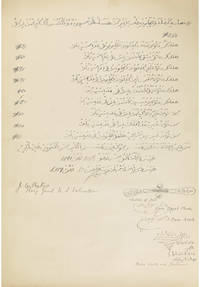
189924064<p><b>PHILIPPINES.</b>Facsimile of original treaty ceding sovereignty of the Archipelago of Jolo to the United States. Jolo Province of Sulu Philippines August 20 1899. Bound in 20th century cloth comprising a large three-page lithographed facsimile of the manuscript treaty written in the Tausug language and signed in print by the Sultan of Jolo and Brig. General John C. Bates 16½ x 12 in. With a small format copy of the document in English the first leaf mimeographed the final leaf lithographed with facsimile signatures. </p><p><b><br /></b></p><p><b>Historical Background</b></p><p>The Sultanate of Sulu began in the early 15th century and once included the northeastern side of Borneo and many islands to the northeast including the island of Jolo. By the late 19th century it had been reduced to a string of islands under Spanish occupation rule. The Treaty of Paris that ended the Spanish-American War transferred control of the Philippines including the Sulu to the United States. The sultanate was home to several ethnic groups including the Moro and Tausug.</p><p>On August 20 1899 the United States signed this treaty with Sultan Hadji Mohammed Jamalul Kiram II and several of his tribal chiefs. The "Bates Treaty" after General John C. Bates recognized U.S. sovereignty over the whole archipelago of Jolo. The U.S. agreed to protect the sultan and his subjects and not to sell any island in the archipelago to any other nation without the sultan's consent. The treaty promised religious freedom especially for the Muslim Moros and free trade with the Philippines. It prohibited piracy and the introduction of war material. The most controversial article recognized slavery but allowed any slave to purchase his or her freedom by paying "the usual market value" to the master. Finally the treaty promised monthly payments to the Sultan and his chiefs totaling 730 Mexican dollars per month approx. $365.</p><p>This treaty theoretically removed the Sultanate of Sulu from participation in the Philippine American War 1899-1902. Some Americans criticized the treaty for granting too much autonomy to the Sultan and for allowing slavery to continue. Over the next five years political conditions deteriorated and there were revolts in several areas even threatening Jolo City where U.S. authorities were stationed.</p><p>In March 1904 the United States abrogated the treaty unilaterally per Secretary of War William Howard Taft's telegram to Gov. General Luke E. Wright 1846-1922: "By order of the President you are hereby directed to notify the sultan of Sulu and the dattos who signed the so-called Bates treaty of August 20 1899 which was a modus vivendi and mere executive agreement that in view of the failure on the part of the sultan … to discharge the duties and fulfill the conditions imposed upon them by said agreement they have forfeited all rights to the annuities therein stipulated to be paid to them and all other considerations… they are subject to the laws enacted therein under the sovereignty of the United States."</p><p>Although the Philippine-American War officially ended in July 1902 with the dissolution of the First Philippine Republic resistance continued for several more years especially in remote areas and the islands occupied by the Moro people. In June 1913 American troops under General John "Black Jack" Pershing 1860-1948 attacked a group of fighters atop Mount Bagsak on the island of Jolo. At the Battle of Bud Bagsak the Americans destroyed the Moro resistance and killed its leader Datu Amil.</p><p>In the text of the treaty there was a critical "translation error." The Treaty in the Tausug version discussed "The support aid and protection of the Jolo Island and Archipelago" but the word "sovereignty" was not used. The English-language version noted that "The sovereignty of the United States over the whole Archipelago of Jolo and its dependencies is declared and acknowledged." In 1946 the English text provided justification for America's decision to incorporate the Sulu Archipelago into the Philippine state.</p><p><b>Sultan Hadji Mohammed Jamalul Kiram II</b> 1868-1936 was a member of the Muslim royal house that ruled the Sulu archipelago from the 15th to the 20th centuries. Proclaimed sultan when his older brother died in 1884 it took ten years to consolidate his authority. In 1912 he took a world tour and visited President William Howard Taft at the White House in Washington D.C. He surrendered his political powers to the United States government in 1915 but retained cultural and religious authority. He died leaving seven daughters but no male heir. His younger brother made an ineffectual claim to the abolished sultanate.</p><p><b>John C. Bates</b> 1842-1919 was born in Missouri the son of Abraham Lincoln's Attorney General Edward Bates and educated at Washington University in St. Louis. During the Civil War John C. Bates served as an aide to General George G. Meade. He served in the Indian Wars of the late nineteenth century and rose to the rank of colonel. In 1898 he received promotion to brigadier general and commanded in the Spanish-American War. He also commanded a division of volunteers in the Philippines during the early stages of the Philippine-American War. He later served as the Chief of Staff of the U.S. Army for several months before his retirement in 1906. He was the last Army Chief of Staff to have served in the American Civil War.</p><p><b>Condition</b></p><p>Dust soiling stains margins strengthened.</p> books
16743Women of the United States for the Women of the Philippines. Petition. Cambridge Massachusetts 1899. Standard legal 8.5" X14.5" inches. Light toning down the middle and very slight creasing on bottom right edge. Slight tear on the third original fold but very good condition overall with neat handsome print displaying a variety of fonts. A moving entreaty from the women of the U.S. to protest American imperialism. This petition calls upon "every American citizen woman no less than man" to "earnestly protest against the war of conquest into which our country has been plunged in the Philippines Islands." Price. The women circling this petition addressed to President William McKinley were working in support of the Anti -Imperialist League which included such well-known members as steel magnate Andrew Carnegie former president Grover Cleveland and writer Mark Twain." "We do not intend to free but to subjugate the people of the Philippines" Twain wrote " and I am opposed to have the eagle put its talons on any other land." As this petition testifies however women's monetary donations labor networks and reputations were integral to the Anti- Imperialist League's activities. down to "Miss F.L. Abbot" the circler of this document. The petition includes a slot for name city or town and state proving that the "Dear Madam" addressed at the top was one of any number of women across the nation working to "cease at once this war of "criminal aggression" against brave people fighting for their independence as our forefathers fought for theirs and ours." Very rare with no copies of this broadside in any institution or library as per OCLC Worldcat. unknown books
196389861Manila: National Museum 1963. Paperback. Very Good. illustrations most are rather grainy 34 2p. Softcover in original wrapper. 26cm. Some wrinkling on front cover. Bookplate "Ella Samonte". <br/><br/> National Museum paperback books
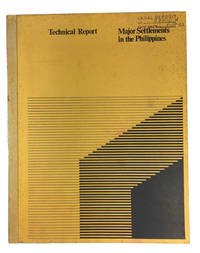
197590050Quezon City: Task Force on Human Settlements Developments Academy of the Philippines 1975. Paperback. Good. illustrations 166p. Softcover in original wrapper. 28 cm. Text printed on one side. Some cover foxing/spotting. Modest staining along fore-edge. Institutional stamp on cover and title-page. Contents sound. <br/><br/> Task Force on Human Settlements, Developments Academy of the Philippines paperback books
194044229Manila 1940. Letters housed in a file folder attached at top with two prong paper fastener. Age-toning & staining. Fastener rusted. Folder front cover chipped & detached. A VG cache. 52 leaves most with typescript to recto only. ~ 10-1/2" x 8-1/8" <br/><br/>A cache of 40 typed letters and TLs exchanged between the Office of the President of the Philippines and various officers of the U.S. High Commissioner of the Philippines many on official letterhead and some marked "confidential." The letters ordered chronologically chart the negotiations defense concerns and sometimes uneasy power sharing between the two administrations in regards to the rules and regulations governing aerial photography of the islands. Issues discussed include the advisability of allowing aerial photography by outside entities the feasiblity of specifying no-fly zones for aerial photography without interferring with commercial flights enforcement efforts and the powers afforded the two administrations. The majority of the letters expressing the Commonwealth's position are from and signed by Jorge B. Vargas then serving as Executive Secretary to President Manuel Quezon. Later Vargas administered Manila as an open city during the Japanese occupation in 1942 and served in the puppet government of the Second Philippine Republic; following the war he chaired the National Planning Committee served on the board of regents of the University of the Philippines and became the first Filipino on the International Olympic Committee. In 1960 he was awarded the Legion of Honor by the Republic of the Philippines. Signed letters from the U.S. High Commission include several from Major General R. L. Holbrook as well as Colonel/Acting Chief of Staff E. H. DeArmond. From the first letter dated May 25 1937: "under the present prohibitive measures regarding aerial photography embodied in Proclamation No. 485 of the Governor-General dated August 12 1932 and in the Bureau of Aeronautics rules and regulations it is believed that the granting of permission to aviation companies particularly to an aerial photographic company to take pictures will be exceedingly difficult and complicated. This office is studying the advisability of altering the present rules and regulations." Jorge B. Vargas Secretary to the President. From November 12 1938: "So long as the Philippine Islands remain United States territory the United States is responsible for their defense and that responsibility at least so far as land operations are concerned devolves upon the Commanding General . . . . To say that the Department Commander is supreme in time of war or grave emergency but that in time of peace his responsibilities are limited to administrative control over United States military personnel and United States military reservations and that in peace time he should not interest himself in control or prevention of activities which may have the gravest consequences in time of war or public emergency is manifestly contradictory." Edward H. DeArmond Colonel FS G.S.C. Acting Chief of Staff. From October 26 1939: "I have the honor to inform you that in an investigation conducted by proper authorities of this Government Mr. B. A. Glover airplane pilot in the emply of Elizalde & Co. was found guilty of violation of the provisions of Proclamation No. 364 of the President of the Philippines in view of which he was suspended as transport pilot for a period of one month from October 18 to November 17 1939 inclusive and warned that repetition of a similar offense in the future will be subject of a more drastic action." Jorge B. Vargas Secretary to the President. An interesting cache of material documenting activities of the transitional government of the Philippines just prior to the outbreak of WWII. unknown books