Philippines Bureau of EducationBiblio.com
Philippine Normal School Manila P. I
0331844958.Ghardcover. Good. Access codes and supplements are not guaranteed with used items. May be an ex-library book. hardcover

Bonita · États-Unis64,26 $US≈ 54,37 €
439 résultats
1940cffdswertty<p>vgd rare relic of u s occupation of philippines 1899 1945</p> macmillan hardcover
0331844958.Ghardcover. Good. Access codes and supplements are not guaranteed with used items. May be an ex-library book. hardcover
199736622Makati City: Bookmark 1997. soft cover. VG. Very good condition with light shelf wear and creasing to covers./No Jacket. Illustrated with photographs and maps in colour and black and white. 23 cm. Bookmark paperback
75-8122Manila: Department of Foreign Affairs Republic of the Philippines 2010. Fo. Hard Cover Red Cloth Gold embossed Titling ca. 230 pp. B&W and Color Plates. Very Good with Scuffing. Dust Jacket is Very good with CreasingOversize Book May require extra Shipping Charges Manila: Department of Foreign Affairs, Republic of the Philippines, 2010 hardcover
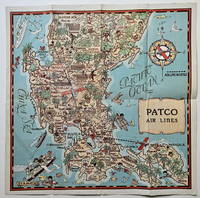
19363828<p>A wonderfully colorful map of a portion of the Philippines from the very early days of aviation in the country. PATCO the Philippine Aerial Taxi Company was organized in 1930 primarily to fly workers in the gold mining centers of Baguio and Paracale to and from Manila. With the fading of the mining boom in the late 1930s PATCO's fortunes waned; it ceased operations in 1940 and its franchise was assumed by the newly created Philippine Air Line in 1941.</p><p>The map was drawn by D.B. Santos. The cartoon-like illustrations portray a country rich in natural resources and agricultural hunting and fishing activities including a man spearing a shark from an outrigger canoe. The illustrations are very reminiscent of the style of Ruth Taylor White who coincidentally visited the Philippines in 1930 and produced <em>A Cartograph of the Major Philippine Islands. "The Riviera of the Orient."</em> in that year.</p><p>A delightful and uncommon pictorial map.</p><p><strong>Condition:</strong> Printed color map. Folded as issued with a bit of extraneous creasing. Wear at some fold lines including short separations in the blank margins. Very small fold intersection breaks in two spots. Overall good.</p><p>ICN 7816.</p> PATCO Air Lines
2021AME_9781774076798Society Publishing 2021. UNKNOWN. Hardcover. New/New. Society Publishing hardcover
2021DBS-9781774076798Society Publishing 2021. 1st. Hardcover. New. Society Publishing hardcover
2021DBS-9781774076798Society Publishing 2021. 1st. Hardcover. New. Society Publishing hardcover
5518853092.Gpaperback. Good. Access codes and supplements are not guaranteed with used items. May be an ex-library book. paperback
G9718528334I5N00Distributed by Premium Book Store. Unknown. Acceptable. Readable copy. Pages may have considerable notes/highlighting. ~ ThriftBooks: Read More Spend Less.Dust jacket quality is not guaranteed. Distributed by Premium Book Store unknown
2021AME_9781774077115ARCLER PRESS 2021. UNKNOWN. Hardcover. New/New. ARCLER PRESS hardcover
2021DBS-9781774077115ARCLER PRESS 2021. 1ST. Hardcover. New. ARCLER PRESS hardcover
2021DBS-9781774077115ARCLER PRESS 2021. 1ST. Hardcover. New. ARCLER PRESS hardcover
2020DBS-9781774071960Delve 2020. 1ST. Hardcover. New. Delve hardcover
2020DBS-9781774071960Delve 2020. 1ST. Hardcover. New. Delve hardcover
2020AME_9781774073148Society Publishing 2020. UNKNOWN. Soft Cover. New/New. Society Publishing paperback
2020DBS-9781774073148Society Publishing 2020. 1st. Soft Cover. New. Society Publishing paperback
2020DBS-9781774073148Society Publishing 2020. 1st. Soft Cover. New. Society Publishing paperback
2021AME_9781774076651Society Publishing 2021. UNKNOWN. Hardcover. New/New. Society Publishing hardcover
2021DBS-9781774076651Society Publishing 2021. 1st. Hardcover. New. Society Publishing hardcover
2021DBS-9781774076651Society Publishing 2021. 1st. Hardcover. New. Society Publishing hardcover
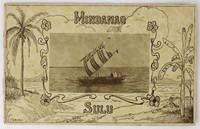
19055045Manila: Sugar News Press 1905. Very good. 22pp. Photographically illustrated. Oblong quarto. Original pictorial wrappers stapled. Moderate dust-soiling and edge wear. Light even toning to text. An early and seemingly-unrecorded promotional touting the people and scenery in Mindanao and Sulu in the southern Philippines in the first decade of the 20th century. The work opens with a Foreword detailing the positive aspects of Mindanao particularly its principal city described here as the "Metropolis of Mindanao and Sulu" with "a population of more than thirty thousand a mixture of Moros or Mohammedan Filipinos Christian Filipinos Chinese Japanese and Europeans." Following the Foreword the remainder of the work is mostly comprised of thirty-four duotone photographs printed mostly two per page but occasionally with from one to five per page. The photographs feature numerous scenic and street views in and around Zamboanga including various "Moro houses" and about fifteen portraits of indigenous Filipinos such as a "Moro woman weaving materials for head-turbans and sarongs" a view inside a "weaving school" "Yakan Moros on the island of Basilan" "Muhammad Jamallul Sultan of Sulu" "Joloano Warriors" "Moro Kulintang" and their musical instruments Bogobo and Cotabato warriors "Bajaos - the sea gypsies of Sulu" and "Bogobo musicians."<br /> <br /> The final two pages of the work are taken up with two poems -- the first is a traditional Filipino poem entitled "No Te Vayas" noted as "Zamboanga's 'Auld Lang Syne" and one titled simply "Zamboanga" by Susan Hart Dyer. The front cover is decorated with a central photograph of an indigenous sailing vessel surrounded by an illustrated beach scene signed at bottom left "Jh. Mendoza." The inside front cover contains an illustration of the Philippine Islands from Batanes down to Sulu. We could locate no other copies of the work by title and imprint information in OCLC. Sugar News Press unknown
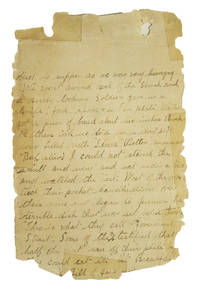
1902311327np 1902. 5-67 manuscript pages on the rectos of unbound sheets. 8 x 5 inches. Lacking the first 4 leaves and an indeterminate number at end several leaves quite worn each crudely taped or pasted to modern paper and then crudely cropped at the top edge without loss of text. 5-67 manuscript pages on the rectos of unbound sheets. 8 x 5 inches. This account consists of pages five to sixty-seven of what appears to be a diary or copied letters of an unnamed soldier in the 21st United States Infantry. The author who may have been a corporal remains unidentified by name. The account begins in August 1898 at Camp Hobson Lithia Springs GA; in September he is transferred to Plattsburgh NY rejoining the bulk of his regiment which had suffered heavy losses in Cuba. <br /> <br /> The Philippine-American war ran from February 1899 to July 1902 and was regarded as a continuation of a war for independence by the Philippines and as an insurrection by the United States of America. This account spans the duration of it providing rich detail on topics ranging from food to the war-ravaged environment and American-Philippino interactions both on and off the battlefield. <br /> <br /> An epic train ride across the country and then a boat from San Francisco brought the 21st US Infantry to Manila on 11 May 1899 in the fourth month of the conflict. The author mentions shipboard conditions an engine breaking down and comments "We caught 4 sharks in our trip. The largest was 12 feet long and took the whole crowd to land him aboard. the men used the bones for rings and pen holders and in fact every thing you could think."<br /> <br /> Their first combat was the capture of an insurgent outpost at Guadaloupa Ridge on 9 June 1899 where they "joined General Lauter's Flying Column . with eight chinamen to carry our rations."<br /> <br /> The description of this combat and its aftermath pages 33-41 is the most dramatic passage in the memoir. The writer was sent with another soldier to gather up some supplies that had been left behind but they were separated from the regiment with no food or water. They made a makeshift fort from some old haversacks and brush when they were unable to return to the trenches that night. The author describes scavenging after battle as follows: "About 10:00 oclock there was several chinamen came looking around and picking up what-ever they seen. They came to close to us to suit me and we shot 4 and the rest ran away."<br /> <br /> Going out in search of water at about four in the morning despite ongoing fire the author found several dead and mortally wounded soldiers from a black regiment including a graphic description of one man who had been shot at close range and had a hole the size of a fist in his belly and was covered in blood. Of the only survivor the author says: "Found one poor cuss shot through the hip. He could not move. I gave him some hard tack and he gave me water then I went back to our haversacks." Another disoriented soldier whom the author names as H. McBain was found wandering without most of his clothing brandishing a bottle of wine and an axe. <br /> <br /> After waiting until the 11th for a reclamation detail the author and his companion crawled through the brush for a mile to San Peter McCarty and eventually rejoined their regiment at Los Penes where their captain threatened to have them court-martialed for losing their haversacks. <br /> <br /> Later while hospitalized the author was befriended by Señora Edna Luna cousin of an insurgent general who took him out riding daily: "She was stuck on me and that is no lie. I think I ought to go back and hook up with her as she has all that is required. She is hansome & plenty of money" page 45. <br /> <br /> The author -- first too ill to be moved then put in a wheel chair and with trouble with his vision -- was transferred back to the States on 15 May 1900 page 48 by way of Nagasaki May 21 1900 and Yokohama arrived in San Francisco on June 9 1900 then was sent to recover at Hot Springs Arkansas concluding in Vancouver Barracks Washington circa July 1901. <br /> <br /> Some of the pages are torn and some text is lost at the bottom edges due to wear but the handwriting is clear and the voice of the author shines through. This narrative though it took place before World War One reads more akin to a Vietnam War narrative than a Civil War diary in tone and disregard for authority and the morality of war. unknown
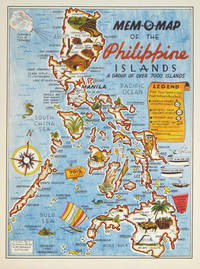
1945204557U.S.A.: Mem-O-Map Co. 1945. Colour pictographic / pictorial map 32.1 x 23.8 cms; 35.4 x 26.6 cms sheet very good condition. Rare pictorial map published in 1945 by John G. Drury aTechnical Officer who served with the 214th Ordnance Battalion to mark the end of World War II as souvenirs for the military. Military personnel could fill in banners "came in on good ship." and "departed on good ship." their name organisation and "Line of Advance or movement" blank in this example. Pictographs mark various memorable spots and wildlife including larger-than-life insects. A "Terrible Tillie Typhoon" looms over the coast at Luzon. <br>Drury published a series of five maps: Philippines and Okinawa in 1945; Japan and Korea Oahu and Europe in 1946. They are all scarce. “These almost whimsical maps are designed to support the creation of personalised geographies. At a time when digital mapping is beginning to experiment with the creation of personalised content that would render the same map in different ways for different users Mem-O-Maps demonstrate the principle in action." Kenneth Field ICA Commission on Map Design. . Mem-O-Map Co. unknown
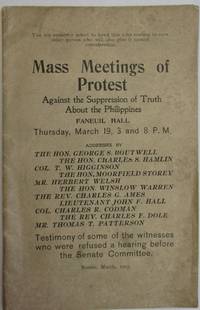
190337755Boston 1903. Original printed wrappers with wrapper title as issued and original staples. At head of title: "You are earnestly asked to hand this after reading to some other person who will also give it careful consideration." Rear wrapper repeats the first sentence of the title. 56 pages. Wrappers lightly dusted else Fine.<br /> <br /> An anti-imperialist protest against American efforts to "to conquer a foreign nation and to impose our sway upon it against its will. We are departing from the principles upon which our government is founded and which we have always held to be self-evident truths."<br /> The Philippine conflict was a guerilla war of unbridled brutality instigated by the American decision to become a Pacific power. unknown