TAVERNIER (Jean-Baptiste)Livre Rare Book
38 résultats
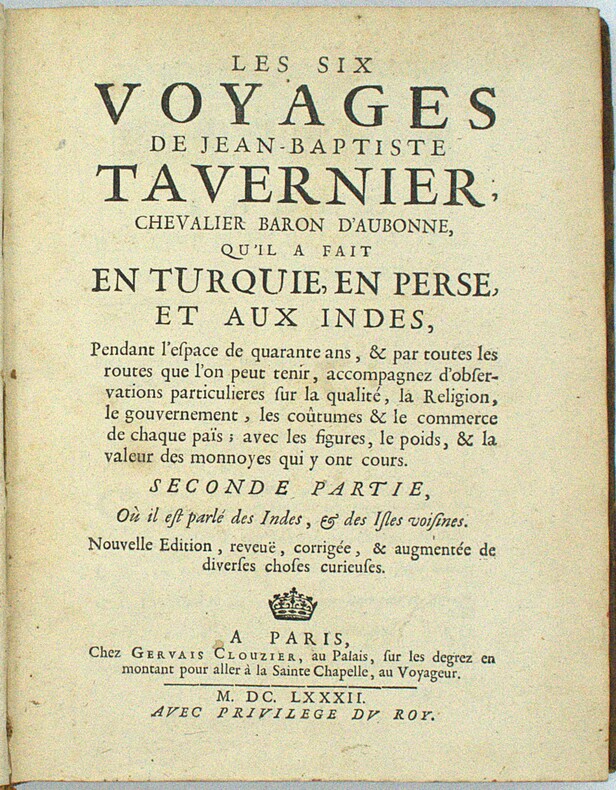
1680PHO-1964Paris, chez Gervais Clouzier, 1682-1680, 3 volumes in-4 (246x195mm), 14ff.-636pp., 4ff.-481pp., 8ff.-72pp.-1f.-156pp.-1f.-96pp.-4ff.-1f.-178pp., Illustration : Tome 1 ; 7 planches (6 dépliantes) sur 8, Tome 2 ; 26 planches dont 15 de monnaies, 5 de pierres et 4 gravures dans le texte, Tome 3 ; 2 grandes cartes (Japon, 79x56cm et Tunquin, 56x41cm) et 8 planches dépliantes. Basane époque, dos à nerfs avec titre et tomaison, frottements, griffures et épidermures, Tome 1 ; accroc au plat, coiffe sup. absente, 2 coins usés, rousseurs, mouillure en coin puis en marge, planches avec déchirures sans manque, page 431 déchirée avec manque. Tome 2 ; fente au dos et charnière, coins usés, rousseurs et brunissures, 1 planche déchirée sans manque. Tome 3 ; coins usés, coiffes arasées, carte du Japon volante, déchirure carte du Tunquin, carte du Japon légèrement oxydée, petites rousseurs.
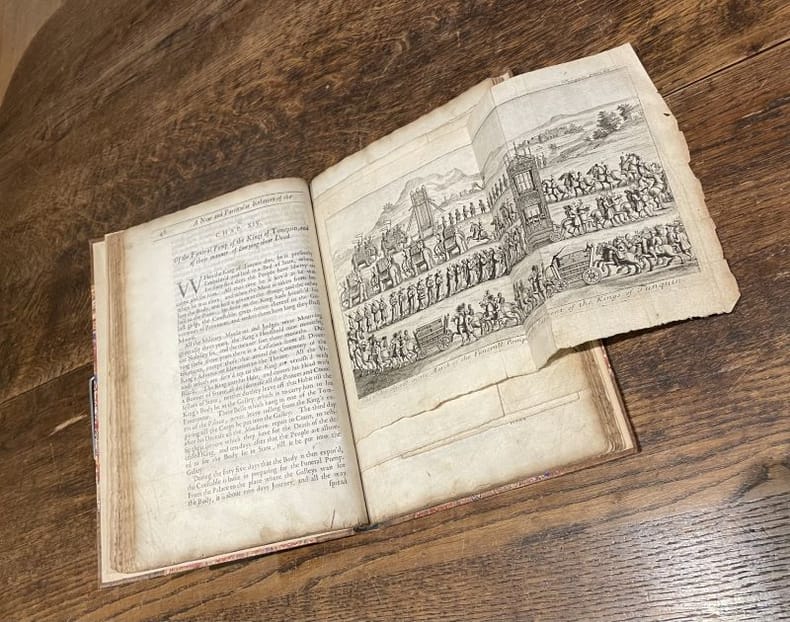
168082460Londres Printed by A. Godbid and J. Playford, for Moses Pitt at the Angel in S. Paul's Churchyard 1680 1 vol. relié in-4, demi-veau jaspé à coins, dos à nerfs encadrés de filets dorés, pièce de titre maroquin rouge, plats de papier peigné, non rogné, 1 f. + titre + 10 ff. (avertissement, dédicace, préface, table)+14-[4]-15-46-[4]-47-87+66 pp. Édition originale anglaise (l'originale française parut chez Clouzier l'année précédente) qui contient une description du Tonkin, dérivée des observations du frère de l'auteur, une description du Japon, recueillie auprès de négociants, et une violente attaque contre les agents de la Compagnie néerlandaise des Indes orientales. La première partie, consacrée au royaume du Tunquin (Tonkin), est illustrée de 8 planches gravées dépliantes oblongues. Mais il manque la planche réunissant les cartes du Japon et du Tonkin. Initiales gravées sur bois et ornements en tête de chapitres. Notes manuscrites sur la première page muette (deux citations poétiques en anglais dont une d'Alexander Pope : "If to her share some female errors fall, Look on her face and you'll forget them all") et ex-libris manuscrit au bas de la page d'avertissement "Franceis Stephens book 1721". Cet ouvrage très rare est conservé dans une bonne reliure du début du XXe siècle, mais présente deux restaurations grossières (au premier feuillet de la préface et à la dernière gravure collée qui ne se déplie plus), quelques déchirures sans manque (notamment sur trois des gravures), quelques rousseurs et tâches.
168082460Londres Printed by A. Godbid and J. Playford, for Moses Pitt at the Angel in S. Paul's Churchyard 1680 1 vol. relié in-4, demi-veau jaspé à coins, dos à nerfs encadrés de filets dorés, pièce de titre maroquin rouge, plats de papier peigné, non rogné, 1 f. + titre + 10 ff. (avertissement, dédicace, préface, table)+14-[4]-15-46-[4]-47-87+66 pp. Édition originale anglaise (l'originale française parut chez Clouzier l'année précédente) qui contient une description du Tonkin, dérivée des observations du frère de l'auteur, une description du Japon, recueillie auprès de négociants, et une violente attaque contre les agents de la Compagnie néerlandaise des Indes orientales. La première partie, consacrée au royaume du Tunquin (Tonkin), est illustrée de 8 planches gravées dépliantes oblongues. Mais il manque la planche réunissant les cartes du Japon et du Tonkin. Initiales gravées sur bois et ornements en tête de chapitres. Notes manuscrites sur la première page muette (deux citations poétiques en anglais dont une d'Alexander Pope : "If to her share some female errors fall, Look on her face and you'll forget them all") et ex-libris manuscrit au bas de la page d'avertissement "Franceis Stephens book 1721". Cet ouvrage très rare est conservé dans une bonne reliure du début du XXe siècle, mais présente deux restaurations grossières (au premier feuillet de la préface et à la dernière gravure collée qui ne se déplie plus), quelques déchirures sans manque (notamment sur trois des gravures), quelques rousseurs et tâches.
1676PHO-1352A Paris, Chez Gervais Clouzier, 1676-79, 2 volume in-4 (sur 3),30pp.- 698pp.-8pp.-2ff.,8 ff., 72 pp., 1 f., 156 pp.,2 ff., 96 pp. , 1 f., 178 pp., tome 1 ,illustré de 6 planches (7) et tome 3 ; 12 cartes et planches (complet), relié plein veau époque , dos à nerfs ornés avec titre et tomaison , tranches mouchetées , coins , coiffes et coupes usés , début de fente, manque de matière , tome 1 plus petit avec quelques rousseurs , plan d’Erevan coupé court , déchirures aux plis ,réparation carte du Tunquin , manque le tome 2.
168010841Amsterdam Jacob de Meurs 1680 -in-folio plein-veau 2 parties reliées en un volume, reliure plein veau havane (binding full calfskin) in-folio (359 x 240mm), dos à nerfs (spine with raised bands) décoré or (gilt decoration) filets or (gilt line) et filets à froid (blind-stamping line decoration), entre-nerfs à compartiments or à fleuron central dans un encadrement d'un filet or et un filet perlé or avec rinceaux aux angles, titre frappé or (gilt title), pièce de titre sur fond rouge-foncé (label of title) avec filet or (label of title with gilt line), coiffes anciennement restaurées mais proprement (head and tail of the spine restored), dos frotté avec manques de dorure, plats décorés à froid (cover blind-stamping) d'un double filet à froid en encadrement, angles et charnières anciennement restaurées (corners and joints renovated), toutes tranches lisses (all edges smoothes), orné d'un Titre frontispice gravé (with 1 engraved frontispiece) papier restauré en marge + une gravure en bas de la page de titre + 25 gravures hors-texte (full page engraving) en noir sur 26 (manque la gravure page 222/223 "le temple de Dayro" dont j'ai mis une photocopie à la place) et 70 gravures in-texte en noir + lettrines et fronts de chapitres gravés sur bois en noir (engraved initials and head-pieces), la gravure : "Le Chateau d'Osacca" qui devait se trouver initialement page 220/221 à été reliée page 120/121 avec la gravure du "palais de Dayro à Miaco", autre erreur : le relieur à inséré la gravure : " Entrée des Ambassadeurs à Mia" page 138/139 alors qu'il aurait du la placer page 138/139 de la 2ème partie ou c'était sa place, présence d'une tache brune claire n'empéchant a aucun moment la compréhension du texte de la page 63 à la page 70 sur une surface de 3 centimètres carrés environ, réparation ancienne du bas de la page 79/80 une partie du texte de la page 80 est manuscrit à l'encre brune, quelques reparations anciennes en bas de page n'atteignant pas le texte ou au dos de certaines gravures mais n'atteignant jamais la gravure, très rares et légères rousseurs (rares and lights redness marks), (4 p. de préface + 227 + 8 pages de tables + un page blanche) + (146 + 6 pages de tables) Pages avec Approbation & Privilège du Roy, 1680 Amsterdam Jacob de Meurs Editeur,
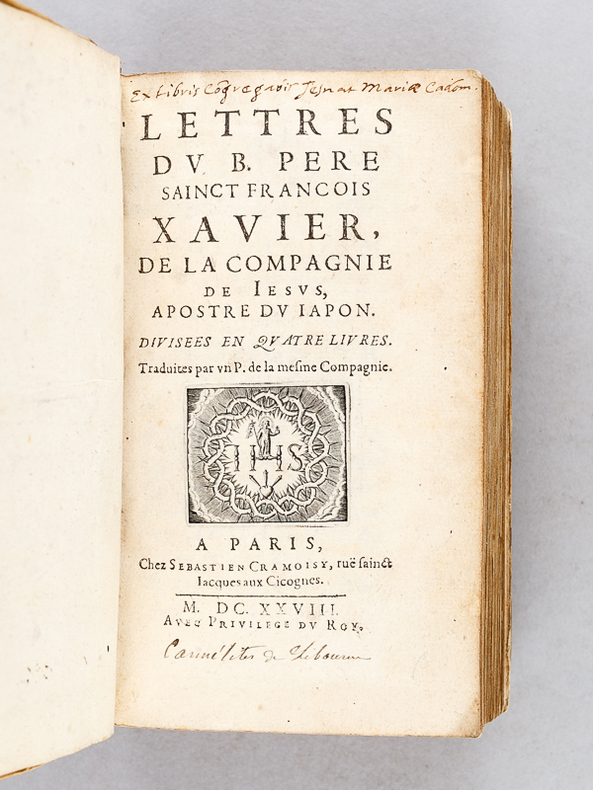
162855012Traduites par un P. de la mesme Compagnie, 1 vol. fort in-8 reliure de l'époque plein vélin blanc à lacets, Chez Sebastien Cramoisy, Paris, 1628, 20 ff., 907 pp., 11 ff. n. ch.. Rappel du titre complet : Lettres du B. Père Sainct François Xavier, de la Compagnie de Iesus, Apostre du Iapon [ Lettres du B. Père Saint François Xavier de la Compagnie de Jésus, Apostre du Japon ] [ Edition originale de la traduction française - First edition of the french translation]
167864619Amsterdam, Jacob van Meurs u. Joannes, van Someren, 1678. Fol. Mit illustr. Kupfertitel, Drucktitel in Rot u. Schwarz m. Druckermarke, einer doppelblattgr. Kupferkarte u. 19 doppelblattgr. Kupfertafeln. Mod. Ldr. m. Rückenverg. u. goldgepr. Rückenschild.
1663PHO-2278A Paris, chez Jacques Langlois, 1663-1666 3 parties en 1 volumes in-folio (38x25cm). Veau tacheté époque, dos à nerfs ornés avec pièce de titre en maroquin et tomaison, tranches jaspées rouges. Réparations au dos et coins, mouillure, quelques rousseurs, réparation au titre, renforcement à la carte. Complet de ses relations de voyage selon Brunet & Camus
16920184951692 - 1779. First Edition. Wraps. Wrappers with some soiling and slight loss. Contents Fine bright and fresh. A string-tied manuscript 7-3/4" x 10-1/2" of Japanese Flower Arrangements Kadou author unknown from the middle of the Edo era 1692-1779 consisting of 32 leaves with no text and a total of 63 lovely hand-colored drawings one per page of flower arrangements. <br/><br/> paperback
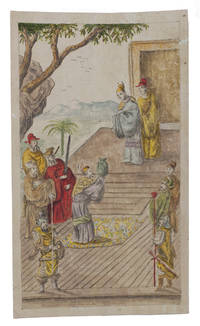
1670E9PF9I9C81WOChina 1670. A series of 8 Chinese drawings ca. 24 x 14.5 cm: 5 coloured 1 also highlighted in gold showing scenes from a Chinese novel many military or diplomatic plus a Chinese watercolour drawing and a Japanese woodblock print. A series of 8 pen and ink drawings 5 coloured 1 also highlighted in gold drawn from Chinese books possibly the 14th-century Sanguo yanyi or Romance of the Three Kingdoms. All mounted on European paper 6 on 3 different patterns of decorated paper. The paper of the drawings ranges from 23.5 x 14 cm to 24 x 15 cm. They show the following outdoor and indoor scenes:1 2 warriors on horseback one of whom has just beheaded the other and carries his head away the beheaded warrior has not yet fallen from his horse while his superior watches on horseback with 2 attendants.2 a man standing with a spear in the prow of a boat while 2 men and a woman sit at a tea table in the boat which flies a flag and pennant.3 5 people on 2 boats one flying a flag and pennant.4 4 soldiers bringing a woman to a dignitary at his house.5 a delegation visiting a dignitary.6 2 men playing go with 4 attendants and a guard.7 a dignitary at a writing table with attendants and visitors.8 a seated dignitary with 6 standing figures 1 with a document at a table.In the backing paper of number 7 one can make out an Amsterdam coat of arms watermark. It is difficult to see clearly but seems to follow the general style of Laurentius 71-95 1662-1675. The 3 patterns of decorated backing paper show: a flower pattern printed in gold on green; 2 patterns with more abstract decorations in a diamond pattern printed in gold on white.With this series we include a watercolour drawing and a woodblock print:9 watercolour drawing of irises along a stream with hills in the background 17 x 22.5 cm.10 rectangular woodblock print of a Samurai at a tea ceremony 14 x 10 cm possibly derived from a Japanese book.Some edges of the drawings a little frayed but otherwise in very good condition. unknown
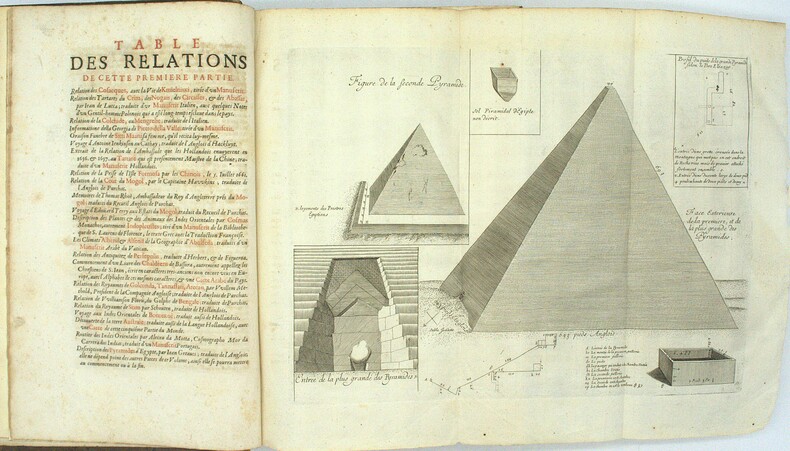
1696PHO-1981Paris, Thomas Moette, 1696 ; 5 parties en 2 vol. in-folio (37x23,5cm), veau marbré, dos à nerfs richement orné de motifs dorés avec tomaison et pièce de titre grenat, quelques frottements, charnières fendillées, manque au dos, coins usés, coiffes absentes, 8 feuillets détachés, rousseurs, qlqs feuillets brunis. L’illustration comporte de nombreuses gravures et illustrations dans et hors texte, 6 cartes dont la carte de l’Indostan, de la Colchide, du Japon (qui regarde l’Amérique), carte de la route du voyage de Canton à Péking, carte de l’Éthiopie, carte de l'Éthiopie ["Entrée de quelques ports…"]. Il manque la Carte de Bassorah, les 2 planches de caractères Chaldéens, la carte de l’Australie, la carte des côtes d’Arabie et d’Asie, la carte des Costes de Sierlionne, la carte des Philippines et Chine, la carte de Chine
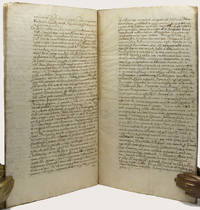
162134518Lisbon and Hangzhou China: Manuscripts ca.1623 and 1621. Very Rare A Similar Manuscript Exists in Brussels. We know of no others. The Latin text of both letters is written in a neat uniform cursive hand in brown. Folio leaves 33 x 20.5 cm The transcripts bound in 18th Century stiff blue wrappers the blank paste-downs and endpapers are late 18th century most likely the third quarter between 1745/1753 and 1776 since they contain a clear "lion/vryheit/pro patria" watermark with a crowned GR countermark which resembles Heawood 3148 3149 and 3154. The paper used for the manuscript contains a faint double-headed eagle watermark and it has been reinforced in the gutters. A very pleasing survival very well preserved edges slightly mellowed the wrappers show some signs of wear. VERY RARE MANUSCRIPT TRANSCRIPTS. Chrysostomus Johann Gall 1586-1643 was a German Jesuit and scholar. He left Ingolstadt Germany to teach astronomy mathematics and navigation in Lisbon fro 1620to 1627 before leaving to work in the Jesuit missions in India. The Colégio de Santo Antŕo benefitted from the arrival of many foreign mathematicians and other scholars as Lisbon serves as a gateway for all missionaries departing for Asia. The original letter by Gall was written in Lisbon September 1623 and concerns a newspaper style description of various events including details of the perseution of Christians in Japan particularly the execution of large numbers of the Christian community in Nagasaki in 1622.<br> The second letter in the present work is especially interesting as the original was written by Johannes Terentius also known as Johannes Schreck an Deng Yuhan Hanpo 1576-1630. Terentius was a prominent Jesuit scholar specialized in natural science and mathematics. Before joining the Jesuits as a novice1611 he already enjoyed a grea reputation in Germany as a scholar. In 1621 Terentius left for China to join the Jesuit mission. The original letter by Terentius was written in Hangzhou China on 30 August 1621 to the rector of teh Jesuit College in Munich Jakob Keller 1568-1631. He discusses his journey to China which he started in 1618 his intentions to participate in the planned calendar reform in China and his impressions of the city of Hangzhou which he reached in 1621 Terentius wrote several works on european medicine mathematics and technology in Chinese and together with Johann Adam Schall von Bell and G. Roho introduced European tigonometry and European astronomical instruments to China. In 1629 he began to reform the calendar which J.A. Schall von Bell ocmpleted after Terentius' early death a year later.<br><br>Backer & Sommervogel VII col. 1929-F<br> Manuscripts unknown
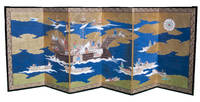
1700ABC_49540Japan 1700. 104 x 272 cm each illustrated panel: ca. 90.5 x 44.5 cm. Ink watercolours gold paint and gold leaf on paper. The image is surrounded by a frame of silk brocade a narrow frame in burgundy and gold and a wider frame in yellow gold and black with a clear floral pattern; together the frame is 5 cm wide the whole is mounted on six roiro black lacquered wood panels with gilt metal fittings on the outer corners of the outer panels. The panels are backed with decorative paper. A remarkable example of a Nanban byobu literal translation: Southern Barbarian screen a type of Japanese folding screen byobu depicting the arrival of Europeans especially the Portuguese in Japan during the late 16th- and early 17th centuries. It shows the vast expanse of the Portuguese seaborne empire. From their possessions along the coast of the Indian subcontinent and their lease of Macau individual Portuguese reached Japan in 1542 and were followed by traders and missionaries the most famous being Francis Xavier. Nanban art provides a unique glimpse into a period of significant cultural exchange and the Japanese perspective on the arrival of the Portuguese in their islands. While inspired by the arrival of and trade with the Portuguese in Japan before the enforcement of the isolationist foreign policy commonly known as Sakoku by the Japanese Tokugawa shogunate from 1633/1639 onwards it remained a popular subject to depict on these folding screens and in other artworks during the Edo period and beyond. The image on the present folding screen shows a large four-masted ship probably approaching the port of Nagasaki. Crew members both Portuguese and people from Portuguese possessions in the Indian subcontinent are seen furling the sails and performing remarkable acrobatic feats in the ship's rigging. The artist emphasises the balloon-like bagginess of their bombacha trousers typically associated with the Portuguese and other Europeans but focuses also on distinctive details such as heavy gold necklaces facial hair hats capes frilly white handkerchiefs and ruffled collars. The foreigners are depicted as being exotic but not scary or very "other" they are depicted as being different while still simply being human. The decoration and colours of the flags flown at the top of each mast are reminiscent of Christian symbols the Cross of Christ and Portugal's colours green and red. Cargo and passengers are offloaded into small boats that pull alongside the ship the top right corner shows a 12-point wind rose including a depiction of the globe. The whole scene is enschrouded in gold clouds.After the Sengoku period a period of practically consecutive and almost continuous civil wars and social upheavals in the 15th- and 16th centuries Japan entered a more peaceful and prosperous period. Folding screens such as the present example were used to divide larger homes and generally show of the growing wealth and prosperity of the warrior and merchant classes. The screens are finely executed in detail and using vibrant colours and copious amounts of gold paint and/or gold leaf. Thematically the painting here continues a tradition of now-lost screens of Chinese trade ships that were in vogue during the 15th- and 16th centuries at the peak of the Sino-Japanese tribute missions that brought entourages numbering in the thousands from the Ming court. The precise subject of these paintings had since shifted from Chinese trade ships to Chinese- or more general Southeast Asian-style ships carrying European including men from the European possessions in Africa and Asia crews. The scene illustrates the dynamic convergence of Eastern and Western cultures through trade around 1600. Portuguese traders first arrived in Japan in 1543 and by 1570 they had established the Bay of Nagasaki as a strategic hub for their commercial operations which were largely unregulated. They generated significant profits by exchanging Chinese silk for Japanese silver although some European goods were also part of the trade. The Portuguese carracks massive three-decked vessels weighing up to 1600 tons captivated local observers with their impressive scale unfamiliar crews and exotic cargo.Alongside these traders Jesuit missionaries sought to spread Christianity finding particular success in Kyushu where many local daimyo converted. However a Christian-led rebellion in 1638 alarmed the Tokugawa authorities raising fears of European colonial interference. As a result the Portuguese were expelled in 1639. When a Portuguese delegation attempted to restore diplomatic relations the following year all sixty members were executed. In 1640 the shogunate instituted a policy of national seclusion restricting foreign contact to limited trade with Chinese merchants a small number of Dutch traders and occasional Korean envoys. By 1650 Christianity was outlawed and any missionary work was punishable by death. The present screen is a slightly later example and the focus of the scene lies mostly on trade and the ship's crew itself and not directly on any Christian identity of the foreigners arriving on Japanese shores.This screen belongs to approximately ninety surviving Nanban screens ranking second only to capital city scenes in popularity among Japanese patrons. The earliest examples date to the 1590s and their continued production throughout the Edo period demonstrates the lasting impact of the Portuguese encounter on Japanese culture.Some minor flaking of the gold paint/gold leaf barely any soiling the decorative paper back of the work shows some traces of wear and use. The image remains clear and the colours vibrant. Overall in very good condition. This exceptional screen offers collectors an important historical document that captures both Portuguese maritime exploration and the Jesuit mission to Japan-a unique period of cultural exchange between East and West. unknown