[MANUSCRIPT - FLAGS - JAPAN].Biblio.com
462 résultats
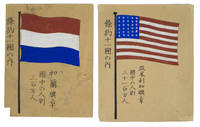
1893ABC_46387Japan 1893. 19th-century wrappers of thick handmade Japanese paper reinforced with straps of paper containing Japanese characters and blue and red stamps; with the title of ad 1 in Japanese characters on the front wrapper. Collection of drawings of 131 flags banners etc. on separate leaves of varying sizes most of them coloured. 131; 10 ll. Ad 1: Very interesting collection of drawings of 131 flags code and signal flags banners standards crests etc. made in late 19th-century Japan most of them coloured in red blue white black yellow and some decorated with gold and/or silver paint. Many with mottos and captions in Japanese characters. The collection can be divided into 8 subcategories. 1 34 flags on black poles of European and other powers. 2 17 rectangular Samurai banners on a pole with a horizontal pole at the top mostly in red and white. 3 28 pennants and banners of various shapes mostly on crested poles and some of them decorated or partly decorated with gold and/or silver paint. 4 27 Japanese military Samurai flags and banners in red and white some with Japanese characters including the flag of the imperial Japanese army: the red sun with the red sunrays. 5 11 Japanese military flags and banners in blue black and white. 6 4 unfinished and uncoloured sketches of Japanese military flags and banners. 7 3 symbolic banners with mottos in Japanese characters. 8 7 unfinished but partly coloured in sketches of flags banners and pennants.Ad 2: 10 folded leaves of Japanese so-called rice-paper mostly containing decorative flower designs one with fans and another with traditional Japanese dolls. All are executed with a brush and black paint two of the flower designs are executed in black red and green paint.With Japanese characters in pencil and/or black and blue ink as well as red owners stamps on the inside of the wrapper. Wrapper slightly browned with some minor signs of wear some margins slightly frayed some leaves with minor stains or browning. unknown
189532714Ca. 1895 / 96. Format fast 4°. (Original) Halbleder. [5 Warenabbildungen]
186034745Edo 1860. Two woodblock-printed Kawaraban broadsides on Japanese paper each 9 x 11 5/8 inches. Two late Edo Kawaraban broadsides recording foreign people objects coinage dress and material culture at the moment of Japan's accelerated contact with Europe and America.<br/> <br/> These two Kawaraban belong to the popular printed culture that developed around Japan's encounter with foreign powers in the 1850s and early 1860s. Produced for circulation beyond official channels such broadsides translated diplomatic and commercial contact into a form legible to a broad Japanese readership combining image caption anecdote and report. Their interest lies in the way they classify the foreign world through visible particulars: clothing physiognomy tools coins flags animals weapons and curiosities. The first broadside is arranged in four compartments under a title describing Western products and curiosities. It includes figures identified as foreign visitors or crewmen among them an English captain and a Black sailor together with a Dutch-style optical instrument and a draped clay or stone figure possibly a classical statue. The second broadside combines a portrait of a captain's wife with her dog a depiction of a foreign flag and examples of foreign coins shown obverse and reverse including Russian coinage and coins dated 1843 and 1854. Here the focus is less on a single event than on the material signs by which foreign nations could be distinguished. The woman's dress the dog the flag and the coins are presented as objects of information and curiosity evidence of a public appetite for visual knowledge about the peoples then appearing in Japanese ports. Together the broadsides show how Kawaraban helped mediate the experience of opening Japan to foreign trade and diplomacy. Their compact format and direct visual language made them effective vehicles for reporting and interpreting the unfamiliar preserving a popular Japanese response to the presence of Westerners at a moment of rapid political and cultural change. unknown
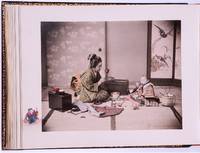
1892019217@1892. Hardcover. Photographs are Fine and bright with tissue guards. Both boxes in nice shape. The front cover of the album with a horizontal crack about 3 inches from the bottom and extending across most of the cover doing little to detract from the lovely decorative scene. Overall a beautiful example uncommon in such nice condition. Oblong Folio 14" x 10-1/2" with a black morocco leather spine with gilt designs and exquisite black enamel painted and onlaid covers. Containing 50 hand-colored 10-1/4" x 7-3/4" albumen photographs laid down onto heavy cardboard pages titled in the negative in English and with small color drawings of figures in the margins of each page. Images include cityscapes landmarks and scenes of daily life and rituals in mid-to-late Meiji period Japan. Places shown include Tokyo Kyoto Yokohama Nagoya Enoshima the shrines of Nikko and two views of Mt. Fuji. Occupational scenes include women spinning cotton men striking wheat a rice plantation men transporting rice bales on horseback a samurai a Shinto priest Shinto pilgrims a "blind shampooer" a pottery shop a shoe shop a grocery a cloth store "reading at home" "gathering the cocoons" "playing at ball" and more. Albums such as this were sold to overseas visitors to Japan ca 1880s- early 1900s who would choose their favorite scenes from the photography studio's stock and whether to pay extra for hand-coloring fine binding and artistic covers. We have offered a handful of examples over the years and this is easily the finest in content with more occupational and daily life scenes as opposed to the standard landmarks as well as special touches such as the small hand-painted characters in the margins of each page and also in the finest condition. Housed in a clamshell box with decorative cloth covers and likely the original tin container used for shipment to America. <br/><br/> hardcover
187464884Berlin, R. Wagner, (1871-1874). Imp.-Fol. (62 x 53 cm). Mit 34 chromolithogr. Farbtafeln v. R. Steinbock (27) u. W. Loeillot (7) nach Eduard Hildebrandt, vom Verlag auf Untersatzkartons montiert. Zus. m. dem letzten Orig.-Lieferungsumschlag lose in schwarz- u. goldgepr. illustr. OLwd.-Mappe.
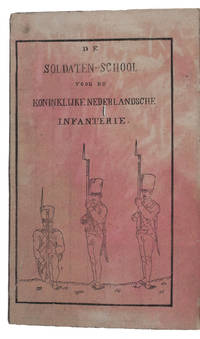
18568CFB37BBNOWBcopy imprint: The Hague & Amsterdam 1856. 8vo. Gebroeders van Cleef Contemporary Japanese brown paper covers side stitched and oversewn through 4 holes near the head and near the foot and 2 holes between them. In a modern Japanese gold brocade cloth chitsu folding case with 2 bone fastenings and a brown paper label. Printed from woodblocks on Japanese paper in the traditional Japanese manner on the outside of double leaves with the fold at the fore-edge. With woodcut Japanese text on the half title and last leaf. With an illustrated title-page printed on paper which has been dyed red facing the half-title showing three soldiers. 15 179 6 pp. Very rare first and only Japanese edition of a Dutch military manual being a concise guidebook for the military school originally intended for the Royal Dutch Infantry. It discusses various topics for the beginning foot soldier for example the order of rank within the army the education of soldiers and higher ranks such as officers how a soldier should stand and march and of course how to carry load and fire a rifle and the many different ways to do so. It therefore presents the basics for a trainee soldier and was commonly used at the Dutch military schools.The present manual is a beautiful example of the many Dutch military science books that were imported to and distributed throughout Japan during the Bakumatsu 1853-1867 the final years of the Edo period when the Tokogawa shogunata ended and the Meiji government was restored. Earlier Dutch editions were printed in 1826 1831 and 1833 by the brothers Van Cleef in The Hague and Amsterdam. The present edition is of great importance to illustrate the Dutch-Japanese exchange of military science but also of the utmost rarity. WorldCat records only 1 copy of the present edition in the library of Leiden University.Binding only very slightly worn a few wormholes without loss of text the last leaf with Japanese text slightly stained red colour of the illustrated title-page a little faded but overall still in good condition. Rare Japanese edition in the original Dutch language of a military manual preserved in a Japanese gold brocade folding case.l WorldCat 1 copy; not in Alt Japan Kat.; Cordier Nipponalia. hardcover
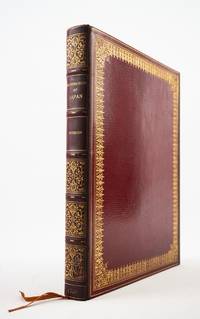
1822ST20877London: Printed for R. Ackermann 1822. First English Edition. 300 x 235 mm. 11 3/4 x 9 1/2". xvi 325 1 pp.Translated by Frederic Shoberl. <br/> Imposing contemporary crimson straight-grain morocco gilt covers with filigree frame with densely massed scrolling fleurons raised bands spine gilt in compartments with radiating viny scrolls surrounded by leaves and annular dots marbled endleaves all edges gilt. WITH 13 HAND-COLORED PLATES in etching and aquatint many after Japanese artworks one folding. Bookplate removed from front flyleaf. Bookseller's ticket of J. L. Thompson & Co Kobe Japan on front pastedown. Abbey Travel 557; Tooley 489; Martin Hardie "English Coloured Books" pp. 113-14. See also E. F. Strange "Japanese Illustration" pp. xxiii-xxiv. Spine and fore-edge of upper board slightly darkened a few minute flakes to lowest spine compartment but the binding extremely well preserved with very lustrous boards. Final 10 leaves slightly creased one repaired marginal tear but still A FINE COPY INTERNALLY exceptionally bright smooth and entirely fresh and clean.<br/> <br/> This generously proportioned production illustrated with 13 vibrant colored plates is a rare European account of Japan during the period in which the country was "closed" to the west offered here in its first English edition. Originally published in French in 1820 "Illustrations of Japan" is comprised of a history and description of the Tokugawa shogunate which Titsingh had translated from the Japanese plus Titsingh's own observations on the language customs and ceremonies of the Japanese people. The present English edition is accompanied by plates in etching and aquatint enhanced with hand coloring. Our author Dutch diplomat Isaac Titsingh 1745-1812 spent 14 years in Nagasaki for the Dutch East India company and between 1779-84 he served as trade director-cum-ambassador travelling to Edo now Tokyo for audiences with the shogun and other high officials in the shogunate. Unlike most of his Western contemporaries Titsingh was open-minded and curious about the people he encountered engaging with their art and culture; in fact art historian and Victoria & Albert Museum keeper Edward F. Strange tells us that Titsingh is the earliest known European collector of Japanese prints of which a number appear in the present volume. Our publisher Rudolph Ackermann 1764-1834 made his living issuing sumptuously illustrated books such as the present volume and was an early adopter of color aquatint and lithography technologies; Hardie writes that he was "the great presiding genius before whose magic wand so many pictorial books sprang into existence." In very attractive period morocco this is a particularly appealing copy of the work free of the foxing and offsetting that often plague copies of this and other large-format color illustrated books. Printed for R. Ackermann unknown
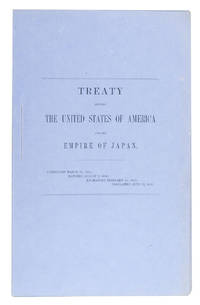
1855876DLLAMJKGSWashington D.C. 1855. Folio. Original printed self-wrappers stitched. Signed in type by Franklin Pierce as President and by W. L. Marcy as Secretary of State. 5 1 blank pp. Second recorded copy of the Kanagawa Treaty of Friendship resulting in the opening of Japan to trade with the West. The American expection to open Japan was undertaken at the suggestion of its leader Commodore Matthew Calbraith Perry 1794-1858. ''The key document caried by Perry to Japan was a letter to the Emperor from President Fillmore in which the President requested Japan to open relations cooperate in the development of trade assist distressed whalers and provide bunkering and supplies for ships on the California to China run. The Treaty of Friendship 1854 negotiated by Perry provided for 'perfect permanent and universal piece' and it contained assurances that the Japanese would meet the demands of the United States for safe haven and acces to naval supplies. Two ports Shimoda and Hakodate were to be openened for this purpose and Americans using them were to be allowed to exhange gold and silver for goods 'under regulations for this purpose' and were not to be subject to restrictions on movement as stringent as those applied to the Dutch and Chinese. The treaty does not include provisions for the development of normal foreign trade'' Howe but it did provide for the stationing of American consuls in Japan of which the first was Townshend Harris 1804-1878 an avid student of Engelbert Kaempfer who played an important part in the early economic education of Japanese leadership and among others was the negotiator of the Treaty of Shimoda in 1857 which granted the Americans extraterritorial rights. Fine copy. Extremely rare document concerning the opening of Japan to trade with the West and an important Americanum as well.l Howe The origins of Japanese trade supremacy London 1999 pp. 73-74; WorldCat and RLIN 1 copy in Harvard; not in Cordier Japonica; the Library of Congress; Nipponalia; NUC; Sabin. unknown