795 résultats
1856WRCAM55468N.p. but probably Tokyo 1856. Ink and watercolor on twenty-five linen- mounted rice paper panels joined into a scroll measuring approximately 10 1/2 inches x 29 1/2 feet. Mounted on a wooden roller with silk tie housed in a custom balsa wood box. Intermittent creasing fairly regular small chips to bottom edge sometimes costing a bit of the image area. Very good. An incredible informative and beautifully rendered "Black Ship Scroll" giving a thirty- foot long visual account of the visit of Commodore Perry's U.S. naval squadron to Shimoda in the wake of the signing of the Treaty of Kanagawa. It is an awe-inspiring artifact of a momentous event in American and Japanese history and a brilliant work of art. <br> <br> Perry's 1854 arrival in the remote port of Shimoda aroused great curiosity and was recorded both by anonymous artisans as well as real artists the latter being the case for the present scroll. One of Perry's interpreters S. Wells Williams reported seeing similar scrolls depicting the naval visit just a few weeks after they anchored. He wrote in his account of the visit: "A pictorial representation of our squadron and description annexed and an account of the war between England and China were seen today by officers." Williams goes on the remark that it was forbidden to sell these scrolls to Americans and in fact being a non- trading closed society Japanese officials discouraged personal purchases of any kind by U.S. personnel. <br> <br> Evident in the present scroll is the Japanese fascination with American military technology. Perry's official account made note of the Japanese being insatiably inquisitive when invited on board: "When visiting the ship the mandarins and their attendants were never at rest: but went about peering into every nook and corner peeping into the muzzles of the guns.They were not contented to merely observing with their eyes but were constantly taking out their writing materials their mulberry bark paper." <br> <br> The present scroll depicts the deck and equipment details of one of Perry's frigate steamers as well as handsome harbor scenes of the numerous ships at anchor including a moonlight view brilliantly-colored American flags flying from the masts of the ships undulating coastlines maps of the locations of Perry's ships the narrative of their travel from Edo Bay a portrait of Commodore Perry and two of his interpreters and an account of naval gun salutes and the burial of a sailor with a rendering of his tombstone. Also shown is a small American military band large portraits of several of Perry's ships a detail of an American landing party departing one of the imposing Black Ships and much more. On the whole the expert illustrations give not only the details of Perry his men ships and their armaments but a sense of the level to which the American squadron impressed the Japanese. Accomplished by an artist that would almost certainly have had firsthand knowledge of the visit of the American squadron it is a far more artistically-polished memorial of Perry's extraordinary visit than many of the more folk-art type scrolls that make up the majority of surviving examples. <br> <br> Perry's sudden arrival near the entrance to Tokyo Bay at Uraga on July 8 1853 with two sloops and two paddle-steamer battleships carrying letters and gifts to deliver to the Emperor threw the Japanese authorities into a tailspin. The reports went back to the Emperor who immediately took ill presumably fearing an invasion. For several days there was a stand-off the smaller Japanese vessels amassing around the American vessels one of which had ninety-two cannons. Local warlord families took up arms all around the Bay and made promises of men for the defense of Edo. For five days the stand-off continued and Perry stayed in his cabin and let it be known he had a letter from President Fillmore to deliver to the Emperor and only the Emperor or his emissary could receive it. The Japanese first threatened him then tried to bribe him to leave and go to Nagasaki to complete his mission. Perry stood firm and ignored the Japanese demands. <br> <br> Perry sent out smaller boats to start surveying the area and the Japanese stood aside wondering if the cannon would strike them. On July 14 a hastily erected tent was put up on the shore of the bay and two sons of the Emperor Princes Ido and Toda came down by Imperial barge from Edo and sat in the tent to receive the letters. Perry arrived with his troops his marching band playing flags flying. He formally delivered the letters and said he would be back in a year for an answer to the President's call for a trade treaty with Japan protection for shipwrecked sailors and the establishment of refueling stations for American ships in the Western Pacific. The Japanese asked Perry to leave quickly but he stayed anchored for a further three days then spent some time doing surveys of other parts of Edo Bay returning via Okinawa to winter at the American station in Hong Kong. <br> <br> Perry returned the following February with a larger flotilla strengthened by newly- completed battleship steamers sent out from the United States. The second meeting took place at Yokohama from February to June 1854 where Perry insisted that negotiations begin and at that time there was an exchange of diplomatic gifts. A provisional treaty was signed in 1854 but the full trading treaty was not completed until 1858 after Townsend Harris came to Japan as U.S. Consul and set about finalizing the negotiations. <br> <br> Perry's return in 1854 with a much more substantial force provoked the same curiosity and trepidation among the Japanese populace as his first visit if not more so and it is this second visit that is captured in the present scroll. The Americans arrived by steam frigates the "black ships of evil men" as well as under sail with their canons and howitzers conspicuous. This second visit to Edo Bay was a purposeful display of the United States' superior military force to impress an essentially feudal society - all the better for Perry to encourage the signing of a treaty allowing American whalers to use the islands as a resupply outpost of America's burgeoning economic empire and Pacific expansion. <br> <br> Following the signing of the Treaty of Kanagawa on March 31 1854 Perry visited the two ports named as open to American ships Shimoda and Hakodate. Americans were also allowed to travel inland from these ports to a proscribed distance of seven ri approximately seventeen miles. Officers were allowed onshore and the manners appearance and customs of the Americans were of nearly insatiable interest to the inhabitants of these remote fishing villages. This was the first interaction common Japanese citizens had with Westerners. <br> <br> The present scroll descends from the Perry family specifically Calbraith Perry Rodgers famed aviator and Commodore Matthew Calbraith Perry's great-grandnephew. The scroll is accompanied by a later typed transcription of an 1858 account of Commodore Perry's life by R.S. Rodgers. <br> <br> One of the more impressive examples of a Black Ship Scroll documenting Perry's second interaction with the Japanese rulers and people executed by an accomplished Japanese artist and descended through the Perry family. unknown books
1853WRCAM52129Uraga Bay Japan 1853. Pen and ink manuscript scroll on thick mulberry paper in Japanese 10 1/2 x 125 inches. Mounted on a wooden roller and with a small contemporary cloth extension panel to the scroll cotton tie. Manuscript backed on thick paper a few worm holes at upper margin of the final panel occasional brown stain at upper margins of first few panels a few tiny holes some old creases. Very good. A Japanese manuscript depiction showing the parade of Commodore Matthew Perry and his forces on the shore at Uraga Bay to visit the Japanese Princes on July 14 1853. An important piece of American naval and diplomatic history and a rare survival of a Japanese "Black Ship" Scroll for the 1853 arrival of Perry this is one of only a handful to have survived. <br> <br> Perry's sudden arrival near the entrance to Tokyo Bay at Uraga on July 8 1853 with two sloops and two paddle-steamer battleships carrying letters and gifts to deliver to the Emperor threw the Japanese authorities into a tailspin. The reports went back to the Emperor who immediately took ill presumably fearing an invasion. For several days there was a stand-off the smaller Japanese vessels amassing around the American vessels one of which had ninety-two cannons. Local warlord families took up arms all around the Bay and made promises of men for the defense of Edo. For five days the stand-off continued and Perry stayed in his cabin and let it be known he had a letter from President Fillmore to deliver to the Emperor and only the Emperor or his emissary could receive it. The Japanese first threatened him then tried to bribe him to leave and go to Nagasaki to complete his mission. Perry stood firm and ignored the Japanese demands. <br> <br> Perry sent out smaller boats to start surveying the area and the Japanese stood aside wondering if the cannon would strike them. On July 14 a hastily erected tent was put up on the shore of the bay and two sons of the Emperor Princes Ido and Toda came down by Imperial barge from Edo and sat in the tent to receive the letters. Perry arrived with his troops his marching band playing the Stars and Stripes flags flying. He formally delivered the letters and said he would be back in a year for an answer to the President's call for a trade treaty with Japan protection for shipwrecked sailors and the establishment of refueling stations for American ships in the Western Pacific. The Japanese asked him to leave quickly but he stayed anchored for a further three days then spent some time doing surveys of other parts of Edo Bay returning via Okinawa to winter at the American station in Hong Kong. He returned the following February with a larger flotilla strengthened by newly- completed battleship steamers sent out from the States. The second meeting took place at Yokohama from February to June 1854 where Perry insisted that negotiations begin and at that time there was an exchange of diplomatic gifts. A provisional treaty was signed in 1854 but the full trading treaty was not completed until 1858 after Townsend Harris came to Japan as U.S. Consul and set about finalizing the negotiations. <br> <br> The artist of this piece certainly documented the action well. It begins with a panel showing an American officer and three soldiers from the ship continues with eight sketches of hats seven instruments of the band and a naval sword two small barges that brought the crew and troops to the shore a detailed annotated sketch of the flagship Susquehanna followed by the procession of the 300 Americans from the shore to the receiving tents the Stars and Stripes waving and including the band and a similar sketch of the Japanese procession with clan banners a sketch of the receiving area with a parade ground and two tents and a final view of Uraga Bay with the four American ships at anchor and the landing place on the shoreline. <br> <br> While the census for the scrolls and scroll fragments depicting Perry's second arrival in 1854 number at least twenty in institutional hands for the 1853 arrival of Perry we locate only one - a ten-foot watercolor scroll in the British Museum for which this is either a precursor or a contemporary near- copy. A close comparison with the British Museum scroll has yet to be accomplished but there are textual differences in some of the captions and it appears from the sketchy monochrome nature and uncolored state of this scroll that it is more likely a provisional sketch done from observation by a Japanese artist who attended the event rather than a contemporary finished scroll. It is likely that after the meeting with Perry the warlord attendees would have been presented with a finished watercolor scroll. This scroll may well be the original provisional version of that finished sketch. <br> <br> An extraordinarily rare and important "Black Ship" Japanese scroll. hardcover books
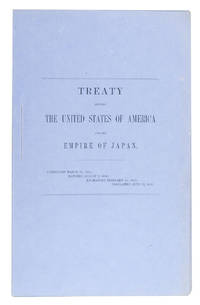
1855876DLLAMJKGSWashington D.C. 1855. Folio. Original printed self-wrappers stitched. Signed in type by Franklin Pierce as President and by W. L. Marcy as Secretary of State. 5 1 blank pp. Second recorded copy of the Kanagawa Treaty of Friendship resulting in the opening of Japan to trade with the West. The American expection to open Japan was undertaken at the suggestion of its leader Commodore Matthew Calbraith Perry 1794-1858. ''The key document caried by Perry to Japan was a letter to the Emperor from President Fillmore in which the President requested Japan to open relations cooperate in the development of trade assist distressed whalers and provide bunkering and supplies for ships on the California to China run. The Treaty of Friendship 1854 negotiated by Perry provided for 'perfect permanent and universal piece' and it contained assurances that the Japanese would meet the demands of the United States for safe haven and acces to naval supplies. Two ports Shimoda and Hakodate were to be openened for this purpose and Americans using them were to be allowed to exhange gold and silver for goods 'under regulations for this purpose' and were not to be subject to restrictions on movement as stringent as those applied to the Dutch and Chinese. The treaty does not include provisions for the development of normal foreign trade'' Howe but it did provide for the stationing of American consuls in Japan of which the first was Townshend Harris 1804-1878 an avid student of Engelbert Kaempfer who played an important part in the early economic education of Japanese leadership and among others was the negotiator of the Treaty of Shimoda in 1857 which granted the Americans extraterritorial rights. Fine copy. Extremely rare document concerning the opening of Japan to trade with the West and an important Americanum as well.l Howe The origins of Japanese trade supremacy London 1999 pp. 73-74; WorldCat and RLIN 1 copy in Harvard; not in Cordier Japonica; the Library of Congress; Nipponalia; NUC; Sabin. unknown
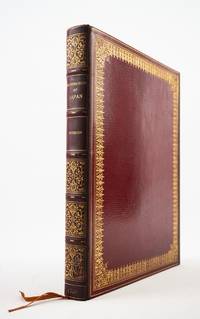
1822ST20877London: Printed for R. Ackermann 1822. First English Edition. 300 x 235 mm. 11 3/4 x 9 1/2". xvi 325 1 pp.Translated by Frederic Shoberl. <br/> Imposing contemporary crimson straight-grain morocco gilt covers with filigree frame with densely massed scrolling fleurons raised bands spine gilt in compartments with radiating viny scrolls surrounded by leaves and annular dots marbled endleaves all edges gilt. WITH 13 HAND-COLORED PLATES in etching and aquatint many after Japanese artworks one folding. Bookplate removed from front flyleaf. Bookseller's ticket of J. L. Thompson & Co Kobe Japan on front pastedown. Abbey Travel 557; Tooley 489; Martin Hardie "English Coloured Books" pp. 113-14. See also E. F. Strange "Japanese Illustration" pp. xxiii-xxiv. Spine and fore-edge of upper board slightly darkened a few minute flakes to lowest spine compartment but the binding extremely well preserved with very lustrous boards. Final 10 leaves slightly creased one repaired marginal tear but still A FINE COPY INTERNALLY exceptionally bright smooth and entirely fresh and clean.<br/> <br/> This generously proportioned production illustrated with 13 vibrant colored plates is a rare European account of Japan during the period in which the country was "closed" to the west offered here in its first English edition. Originally published in French in 1820 "Illustrations of Japan" is comprised of a history and description of the Tokugawa shogunate which Titsingh had translated from the Japanese plus Titsingh's own observations on the language customs and ceremonies of the Japanese people. The present English edition is accompanied by plates in etching and aquatint enhanced with hand coloring. Our author Dutch diplomat Isaac Titsingh 1745-1812 spent 14 years in Nagasaki for the Dutch East India company and between 1779-84 he served as trade director-cum-ambassador travelling to Edo now Tokyo for audiences with the shogun and other high officials in the shogunate. Unlike most of his Western contemporaries Titsingh was open-minded and curious about the people he encountered engaging with their art and culture; in fact art historian and Victoria & Albert Museum keeper Edward F. Strange tells us that Titsingh is the earliest known European collector of Japanese prints of which a number appear in the present volume. Our publisher Rudolph Ackermann 1764-1834 made his living issuing sumptuously illustrated books such as the present volume and was an early adopter of color aquatint and lithography technologies; Hardie writes that he was "the great presiding genius before whose magic wand so many pictorial books sprang into existence." In very attractive period morocco this is a particularly appealing copy of the work free of the foxing and offsetting that often plague copies of this and other large-format color illustrated books. Printed for R. Ackermann unknown
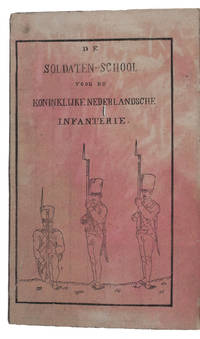
18568CFB37BBNOWBcopy imprint: The Hague & Amsterdam 1856. 8vo. Gebroeders van Cleef Contemporary Japanese brown paper covers side stitched and oversewn through 4 holes near the head and near the foot and 2 holes between them. In a modern Japanese gold brocade cloth chitsu folding case with 2 bone fastenings and a brown paper label. Printed from woodblocks on Japanese paper in the traditional Japanese manner on the outside of double leaves with the fold at the fore-edge. With woodcut Japanese text on the half title and last leaf. With an illustrated title-page printed on paper which has been dyed red facing the half-title showing three soldiers. 15 179 6 pp. Very rare first and only Japanese edition of a Dutch military manual being a concise guidebook for the military school originally intended for the Royal Dutch Infantry. It discusses various topics for the beginning foot soldier for example the order of rank within the army the education of soldiers and higher ranks such as officers how a soldier should stand and march and of course how to carry load and fire a rifle and the many different ways to do so. It therefore presents the basics for a trainee soldier and was commonly used at the Dutch military schools.The present manual is a beautiful example of the many Dutch military science books that were imported to and distributed throughout Japan during the Bakumatsu 1853-1867 the final years of the Edo period when the Tokogawa shogunata ended and the Meiji government was restored. Earlier Dutch editions were printed in 1826 1831 and 1833 by the brothers Van Cleef in The Hague and Amsterdam. The present edition is of great importance to illustrate the Dutch-Japanese exchange of military science but also of the utmost rarity. WorldCat records only 1 copy of the present edition in the library of Leiden University.Binding only very slightly worn a few wormholes without loss of text the last leaf with Japanese text slightly stained red colour of the illustrated title-page a little faded but overall still in good condition. Rare Japanese edition in the original Dutch language of a military manual preserved in a Japanese gold brocade folding case.l WorldCat 1 copy; not in Alt Japan Kat.; Cordier Nipponalia. hardcover
187464884Berlin, R. Wagner, (1871-1874). Imp.-Fol. (62 x 53 cm). Mit 34 chromolithogr. Farbtafeln v. R. Steinbock (27) u. W. Loeillot (7) nach Eduard Hildebrandt, vom Verlag auf Untersatzkartons montiert. Zus. m. dem letzten Orig.-Lieferungsumschlag lose in schwarz- u. goldgepr. illustr. OLwd.-Mappe.
1853WRCAM53554Edo 1853. 31; 31; 61pp. plus a loose sheet. Original paper wrappers stitched. Contemporary manuscript annotations in red ink in one volume. Scattered worming heavy in places. Some dampstaining and dust soiling. About very good. Three fascinating Japanese manuscript accounts of the arrival of Commodore Perry to Japan in 1853. Then first URAGA KUROTONE NI KANSARU or "The Black Ship Arriving in Uraga" comprises the official government report of events when Perry steamed into Uraga Bay. This volume contains contemporary edits to the text in red ink. The second account of Perry's arrival EDO URAGA BIKOKU FUNE TORAI IKKEN or "Arrival of the Ships at Uraga" contains a double-page manuscript sketch of the coastline of Uraga Bay together with the disposition of Perry's ships. The final volume consists of a third manuscript entitled GASSHUKKO SHOKAN WAGE UTSUSHI a copy of the report on the Perry arrival prepared by Abe Masahiro Chief Senior Councillor in the Toguwara Shogunate which includes translations of the letters from Fillmore and Perry delivered by Perry on July 8 1853. Also with a single manuscript sheet that provides a description of Perry's ship. <br> <br> Vital contemporary manuscript accounts of this monumental transformation in Japanese foreign relations from significant Japanese participants in events. unknown books
1859WRCAM55020Japan 1859. 354pp. including twelve full-page or double- page ink and watercolor wash illustrations. Contemporary Japanese wrappers string-tied paper label completed in manuscript on front cover. Noticeable wear and rubbing to the binding newer string. Uneven worming throughout mostly unobtrusive. About very good. In a half morocco and cloth clamshell box spine gilt with raised bands. Large bound collection of contemporary manuscript papers documents and drawings relating to Commodore Perry and the Black Ships entering Edo Bay in July 1853. The text is comprised of accounts of the event and transcriptions of official letters from President Millard Fillmore Secretary of State Edward Everett and Commodore Perry to the Japanese Emperor. Illustrations include two double-hemispheric world maps a map showing the course of the Black Ship squadron Edo Bay and the landing of the ships Perry's marines marching sketches of large cannons aboard Perry's ships and diagrams and fortifications protecting the Japanese people from foreign invasion. <br> <br> In 1852 Perry was appointed head of a naval expedition charged with inducing the Japanese government to establish diplomatic relations with the United States. The expedition involved two visits to Japan. On his first Perry arrived at Edo Bay on July 8 1853. After a brief standoff and show of force he was able to land the following week and deliver a letter from President Fillmore with the U.S. demands with the promise he would return the following year for a reply. On February 13 1854 Perry returned with a total of ten vessels and 1600 men. After another standoff and three weeks of negotiation Perry signed the Convention of Kanagawa at the end of March 1854 which opened the ports of Shimoda and Hakodate to American ships provided for care of shipwrecked sailors and the establishment of an American consulate in Shimoda. "The most important result however was that the visit contributed to the collapse of the feudal regime and to the modernization of Japan" - Hill. <br> <br> Altogether a very comprehensive manuscript archive of this important occasion that helped open Japan to world commerce and culture. HILL 1332 ref. hardcover books
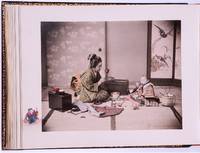
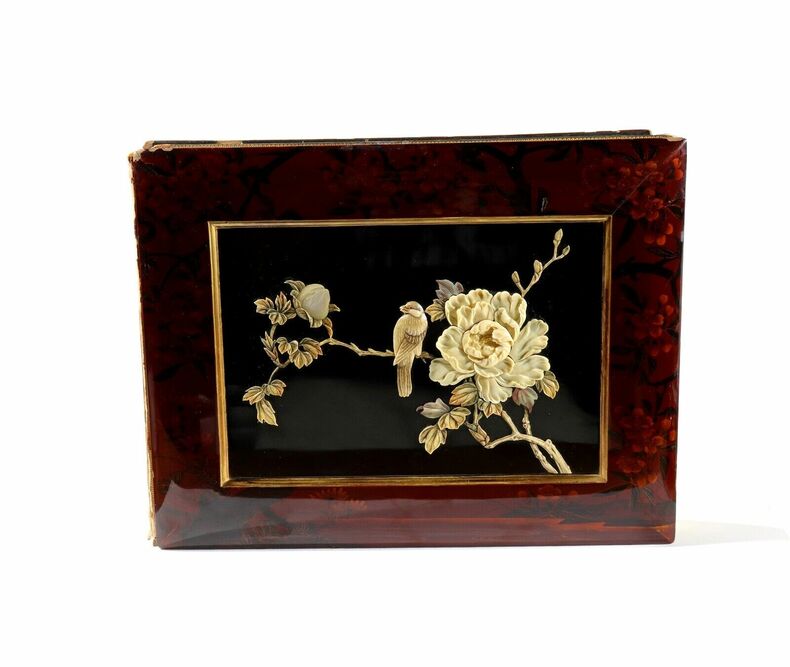
1892019217@1892. Hardcover. Photographs are Fine and bright with tissue guards. Both boxes in nice shape. The front cover of the album with a horizontal crack about 3 inches from the bottom and extending across most of the cover doing little to detract from the lovely decorative scene. Overall a beautiful example uncommon in such nice condition. Oblong Folio 14" x 10-1/2" with a black morocco leather spine with gilt designs and exquisite black enamel painted and onlaid covers. Containing 50 hand-colored 10-1/4" x 7-3/4" albumen photographs laid down onto heavy cardboard pages titled in the negative in English and with small color drawings of figures in the margins of each page. Images include cityscapes landmarks and scenes of daily life and rituals in mid-to-late Meiji period Japan. Places shown include Tokyo Kyoto Yokohama Nagoya Enoshima the shrines of Nikko and two views of Mt. Fuji. Occupational scenes include women spinning cotton men striking wheat a rice plantation men transporting rice bales on horseback a samurai a Shinto priest Shinto pilgrims a "blind shampooer" a pottery shop a shoe shop a grocery a cloth store "reading at home" "gathering the cocoons" "playing at ball" and more. Albums such as this were sold to overseas visitors to Japan ca 1880s- early 1900s who would choose their favorite scenes from the photography studio's stock and whether to pay extra for hand-coloring fine binding and artistic covers. We have offered a handful of examples over the years and this is easily the finest in content with more occupational and daily life scenes as opposed to the standard landmarks as well as special touches such as the small hand-painted characters in the margins of each page and also in the finest condition. Housed in a clamshell box with decorative cloth covers and likely the original tin container used for shipment to America. <br/><br/> hardcover
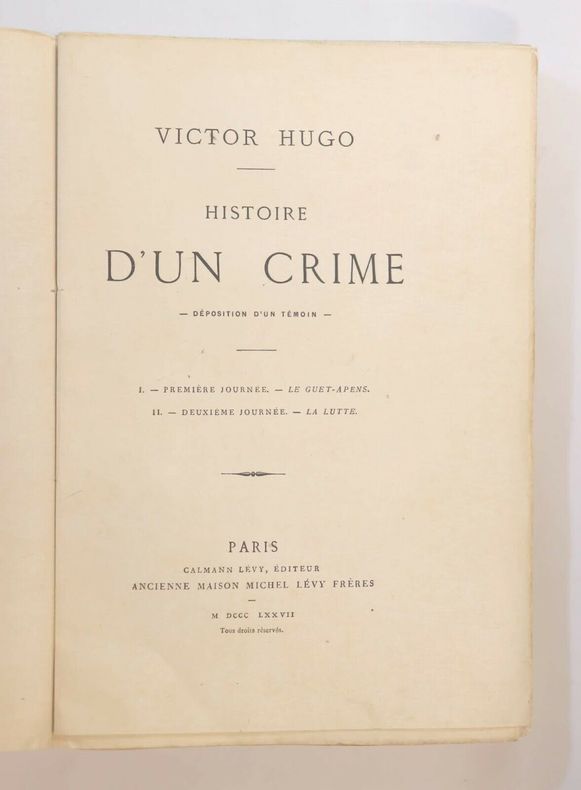
1877AMO-4306Histoire d'un Crime. Déposition d'un témoin. I. Première journée. - Le Guet-apens. II. Deuxième journée. - La Lutte. Histoire d'un Crime. Déposition d'un témoin. III. Troisième journée. - Le Massacre. IV. Quatrième journée. - La Victoire. V. Conclusion. - La Chute. Paris, Calmann Lévy, Ancienne Maison Michel Lévy frères, 1877-1878 [imprimerie Albert Quantin] 2 volumes in-8 (23,5 x 16 cm environ) de 323 et 337 pages, exemplaire débroché (en feuilles), non rogné. Exemplaire à relier. Les plats de couverture saumon seront fournis (manques sur les bords dont un manque avec petit manque de texte à l'adresse du libraire pour le deuxième volume). Premier volume frais avec quelques pâles rousseurs éparses (cahiers non coupés). Deuxième volume frais (cahiers non coupés). Fonds de cahiers nettoyés, prêts à être cousus. Collationné complet. Edition originale des deux volumes. Celui-ci, 1 des 10 rarissimes exemplaires sur Japon (il porte le numéro 10 au composteur). Seul le premier volume est numéroté (ce qui est normal). Le tirage de luxe de cet ouvrage a été de 10 ex. sur Japon, 20 ex. sur Chine et 40 ex. sur Hollande (Cf. Clouzot, Guide du Bibliophile français, XIXe siècle, p. 151). "Rappel des circonstances de l'écriture d'Histoire d'un crime, écrit au lendemain du coup d'État de Louis-Napoléon Bonaparte le 2 décembre 1851, et publié 25 ans plus tard, en 1877, au lendemain de la crise du 16 mai. Histoire d'un crime est la reconstitution, heure par heure, des événements qui se sont déroulés pendant les quatre jours qu'il a fallu au coup d'état pour réussir (du 2 au 5 décembre), quatre jours au cours desquels les députés de la Montagne ont tenté d'organiser une résistance armée dans les faubourgs. - nuit du 1er au 2 décembre : l'organisation du coup d'état /Le guet apens/ - 3 décembre : les barricades ; la mort de Baudin faubourg St Antoine /La Lutte / - 4 décembre ; les barricades se multiplient, et sont pratiquement toutes abattues en fin de journée /Le massacre/ - 5-6 décembre : fin du combat, recul, solitude, dernière séance du comité de résistance /La victoire / Le 11 décembre, Hugo part en exil vers Bruxelles ; le 14, il commence la rédaction d'Histoire d'un crime, et s'y consacre activement pendant quelques mois. Le 11 janvier 1852, il écrit à sa femme "Ce sera de l'histoire, et on croira lire du roman". Le livre avance, mais Hugo écrit qu'il "ne voit pas encore urgence à l'achever". Avril : il écrit sans cesse, et l'on s'attend à la parution imminente de son "Coup d'État du 2 décembre". En mai, sans expliquer pourquoi, il interrompt la rédaction, et se consacre à celle de son pamphlet contre "Napoléon le Petit", publié en août 1852. Pourquoi cette soudaine interruption ? D'après les lettres écrites à Adèle, il semble avoir succombé sous une avalanche de documents qui lui parvenaient, et l'obligeaient à refaire sans cesse des retouches. D'autre part, beaucoup d'ouvrages sur le coup d'état paraissent à cette époque (8 entre 52 et 53). Hugo renonce donc à achever Histoire d'un crime ; qu'il ressortira de ces tiroir 25 ans plus tard, en 1877. Le 16 mai 1877, le Maréchal Mac Mahon, président de la République, contraint le président du Conseil Jules Simon à démissionner; ses adversaires parlent de 1/2 coup d'état. Mac Mahon imposera ensuite le duc de Broglie à la présidence du Conseil, et demandera la dissolution de la chambre des députés. Dès le 26 mai, Hugo commence à mettre en ordre son manuscrit de l'histoire du 2 décembre, se remet au travail, et donne les premiers chapitres à son imprimeur le 5 septembre. Très sensible aux coïncidences de l'histoire, Hugo a donc profité de l'opportunité que lui offrait le contexte politique de 1877 pour ressortir son vieux manuscrit et le publier...deux semaines avant les élections législatives d'octobre 1877. C'est d'ailleurs grâce à ce contexte que le livre obtient un si grand retentissement. Les ventes sont excellentes, les éditions sont écoulées sitôt sorties des presses ; plus de 100 000 exemplaires vendus en 15 jours. Le premier volume d'Histoire d'un crime parait le 1er octobre 1877 ; dans Le Rappel daté du 3 octobre, on peut lire: "Histoire d'un crime a été mis en vente hier matin et à dix heures il n'en restait plus un seul exemplaire chez l'éditeur Calmann Lévy. En moins de deux heures, tout avait été enlevé. Bien que le tirage fût à un nombre considérable d'exemplaires, le chiffre des demandes envoyées par lettres ou par dépêches dépassait ce nombre de plus du double." Dans Le Temps du 7 octobre, on peut lire : "Ce matin a paru l'édition à deux francs du livre de Victor Hugo, l'Histoire d'un crime. Plus de 50 000 exemplaires étaient déjà enlevés avant midi." Ce chiffre est peut-être un peu au-dessus de la réalité, du moins si l'on se fie à celui indiqué par Victor Hugo : "On a mis en vente hier l'édition à deux francs de l'Histoire d'un crime. On en a vendu 22 000 avant midi." Le succès de l'ouvrage s'amplifie de jour en jour, peut-être en partie grâce à la presse qui multiplie les articles. Le 11 octobre, Hugo rapporte dans ses Carnets l'état des ventes: "Calmann Lévy me dit que l'Histoire d'un crime se vend à 10 000 exemplaires par jour. Il y a 70 000 exemplaires vendus à cette heure. Le tirage ne peut suffire. On n'a plus le temps de satiner le papier." Le second volume de l'Histoire d'un crime, dont la publication était initialement prévue pour la date symbolique du 2 décembre 1877, n'est disponible que le 14 mars 1878. Dans son numéro du 11 mars, Le Rappel en annonce la parution : "Le second volume de l'Histoire d'un crime, dont la publication a été retardée par les incidents de la politique, paraîtra jeudi prochain 14 mars. L'édition grand in-8° sera seule mise en vente jeudi. Les nécessités d'un tirage tout à fait exceptionnel n'ont pas permis de publier ce jour là l'édition in-18° à deux francs. L'édition populaire paraîtra le mardi 19 mars." Le 20 mars, Le Rappel signale la sortie de l'édition à deux francs du tome II, et fait un bilan de la vente du premier volume : "Aujourd'hui mardi, en vente, dans toutes les librairies, l'édition à deux francs du tome second de l'Histoire d'un crime. Le tome premier a été vendu, dans cette édition in-16°, à 165 000 exemplaires, divisés en 110 éditions, à 1 500 exemplaires par édition. Pour épargner aux acheteurs l'inconvénient d'avoir lu deux volumes dans des éditions différentes, le tome second ne portera pas d'indication d'édition. Le premier tirage du tome second a été fait à 100 000 exemplaires qui étaient retenus d'avance par les libraires de Paris et des départements. Mais l'imprimerie Quantin ne discontinue pas le tirage, pour qu'il n'y ait pas interruption dans la vente." Comme le premier, le second volume d'Histoire d'un crime connaît un immense succès, dont la presse se fait largement l'écho." (extrait de Laurence Oliviéri : La réception dans la presse de Histoire d'un crime. Compte rendu de la communication au Groupe Hugo en mai 1987). L'importance de cet ouvrage politique ainsi que la diffusion extraordinaire des volumes entre octobre 1887 et mars 1878 ne fait que renforcer l'intérêt exceptionnel qu'on doit porter religieusement à ces deux volumes tirés à 10 exemplaires sur papier du Japon. Nous avons préféré laisser le choix de la reliure à exécuter à l'amateur qui fera l'acquisition de ces deux volumes. Plein papier ? Plein maroquin ? Il faut un habit de luxe à ces précieux exemplaires. Pour information, une fine reliure plein papier façon époque (fin XIXe s.) coûtera environ 300/400 euros pour les 2 volumes. Une fine reliure demi-maroquin à coins coûtera environ 1.200/1.500 euros pour les 2 volumes. Enfin une fine reliure plein maroquin avec emboîtage coûtera environ 3.000/4.000 euros. La valeur de cet exemplaire une fois reliée avec luxe (plein maroquin) peut être estimée à 8.000/10.000 euros. Le prix que nous proposons tient compte du fait que les deux volumes sont proposés en feuilles, à relier. "Ce livre est plus qu'actuel ; il est urgent. Je le publie. V. H. Paris, 1er octobre 1877." Exceptionnel exemplaire à relier du plus rare tirage pour ce titre, complet des deux volumes sur le même papier de tête (10 ex. Japon).
186034745Edo 1860. Two woodblock-printed Kawaraban broadsides on Japanese paper each 9 x 11 5/8 inches. Two late Edo Kawaraban broadsides recording foreign people objects coinage dress and material culture at the moment of Japan's accelerated contact with Europe and America.<br/> <br/> These two Kawaraban belong to the popular printed culture that developed around Japan's encounter with foreign powers in the 1850s and early 1860s. Produced for circulation beyond official channels such broadsides translated diplomatic and commercial contact into a form legible to a broad Japanese readership combining image caption anecdote and report. Their interest lies in the way they classify the foreign world through visible particulars: clothing physiognomy tools coins flags animals weapons and curiosities. The first broadside is arranged in four compartments under a title describing Western products and curiosities. It includes figures identified as foreign visitors or crewmen among them an English captain and a Black sailor together with a Dutch-style optical instrument and a draped clay or stone figure possibly a classical statue. The second broadside combines a portrait of a captain's wife with her dog a depiction of a foreign flag and examples of foreign coins shown obverse and reverse including Russian coinage and coins dated 1843 and 1854. Here the focus is less on a single event than on the material signs by which foreign nations could be distinguished. The woman's dress the dog the flag and the coins are presented as objects of information and curiosity evidence of a public appetite for visual knowledge about the peoples then appearing in Japanese ports. Together the broadsides show how Kawaraban helped mediate the experience of opening Japan to foreign trade and diplomacy. Their compact format and direct visual language made them effective vehicles for reporting and interpreting the unfamiliar preserving a popular Japanese response to the presence of Westerners at a moment of rapid political and cultural change. unknown
189532714Ca. 1895 / 96. Format fast 4°. (Original) Halbleder. [5 Warenabbildungen]
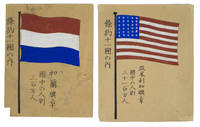
1893ABC_46387Japan 1893. 19th-century wrappers of thick handmade Japanese paper reinforced with straps of paper containing Japanese characters and blue and red stamps; with the title of ad 1 in Japanese characters on the front wrapper. Collection of drawings of 131 flags banners etc. on separate leaves of varying sizes most of them coloured. 131; 10 ll. Ad 1: Very interesting collection of drawings of 131 flags code and signal flags banners standards crests etc. made in late 19th-century Japan most of them coloured in red blue white black yellow and some decorated with gold and/or silver paint. Many with mottos and captions in Japanese characters. The collection can be divided into 8 subcategories. 1 34 flags on black poles of European and other powers. 2 17 rectangular Samurai banners on a pole with a horizontal pole at the top mostly in red and white. 3 28 pennants and banners of various shapes mostly on crested poles and some of them decorated or partly decorated with gold and/or silver paint. 4 27 Japanese military Samurai flags and banners in red and white some with Japanese characters including the flag of the imperial Japanese army: the red sun with the red sunrays. 5 11 Japanese military flags and banners in blue black and white. 6 4 unfinished and uncoloured sketches of Japanese military flags and banners. 7 3 symbolic banners with mottos in Japanese characters. 8 7 unfinished but partly coloured in sketches of flags banners and pennants.Ad 2: 10 folded leaves of Japanese so-called rice-paper mostly containing decorative flower designs one with fans and another with traditional Japanese dolls. All are executed with a brush and black paint two of the flower designs are executed in black red and green paint.With Japanese characters in pencil and/or black and blue ink as well as red owners stamps on the inside of the wrapper. Wrapper slightly browned with some minor signs of wear some margins slightly frayed some leaves with minor stains or browning. unknown
1890AMO-4520[Japon, Yokohama ?, vers 1890] Très beau spécimen en grand format (36 x 27 cm environ pour l'album et 26,5 x 20,5 cm pour les tirages). Complet. Très bel album très bien conservé malgré quelques chocs sur quelques bords et le dos de l'album manquant (bande de cuir), parfaitement solide et très décoratif. Très belle esthétique d'ensemble, superbe décor sur le premier plat (rare aussi beau et fin). Intérieur d'une grande fraîcheur. Beau coloris au pinceau à la main.
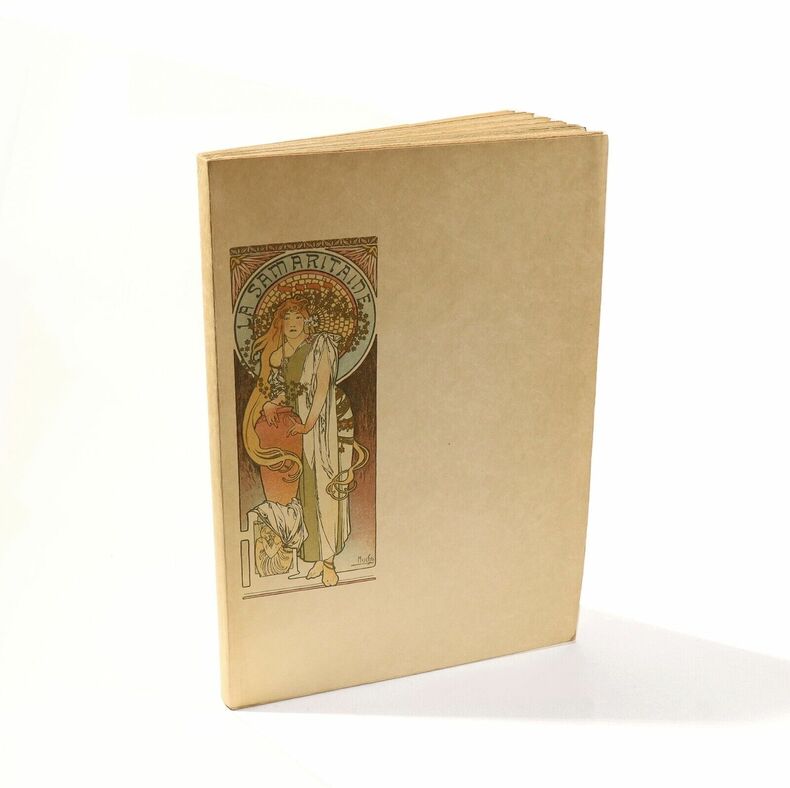
1897AMO-4526Paris, Librairie Charpentier et Fasquelle, 1897 1 volume in-4 (27,2 x 19 cm) broché de (6)-120 pages. Couverture illustrée d'une lithographie par Mucha (réduction de l'affiche originale de la pièce) tirée par l'imprimerie F. Champenois. Parfait exemplaire non coupé, jamais lu, très peu manipulé. Léger empoussiérage de la tranche inférieure. Exemplaire en grande partie non coupé. Edition originale. Un des rares 25 exemplaires imprimés sur papier du Japon avec double état de la couverture (également imprimée sur Japon) dont un premier état avant la lettre (également imprimé sur Japon).
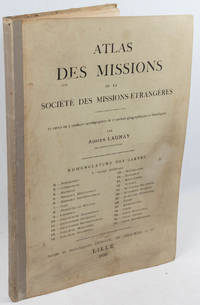
1890219322Lille.: Société de Saint Augustin. 1890. Large thumb-indexed atlas 27 full page colour maps with accompanying text 53 x 38 cms; original paper covered boards a little stained and abraded front hinge tender but sound a few gatherings loosening front free endpaper chipped at the lower corner prelims and thumb tabs soiled but the maps in very good clean condition. Adrien Launay 1853 - 1927 a Catholic priest in the Société des Missions Étrangères was the author of many books on the Society's history and that of many of the individual missions. His atlas now scarce on the market gives maps and a gazzetteer of the Société's missions in Asia. . Société de Saint Augustin. hardcover
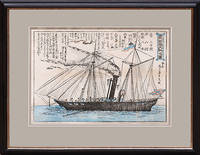
1854103501Nagasaki: c.1854. Wonderful locally-produced image of the Vostok a steamship that took part in Vice-Admiral Euphimy Vasil'evich Putiatin's mission to negotiate trade arrangements with the Tokugawa shogunate which were to result in the signing of the Treaty of Shimoda the first treaty between the Russian and Japanese Empires. Putiatin sailed from Russia in the frigate Pallas and stopped at Portsmouth for refitting before facing the rigours of rounding the Cape of Good Hope and while there he also purchased an "iron-hulled screw steamer the Fearless and renamed it Vostok" Grainger The First Pacific War p.51. The Vostok was captained by Voin Andreevich Rimsky-Korsakov a graduate of the St Petersburg School of Mathematics and Navigational Sciences and elder brother of the famous composer. Various delays meant that Putiatin's squadron arrived shortly after Admiral Perry's similar expedition but the Russian's more measured approach contrasted distinctly with that of the Americans and were to eventually ensure a highly successful outcome. It was recorded that during the squadron's second visit to Nagasaki "just before he left Nakamura Tameya the secretary to the plenipotentiaries a member of the new special committee to introduce steam ships to Japan came to the schooner Vostok with Putiatin and a Japanese artist to have a look at its engine. The artist made a quick sketch. It was the first steam ship to visit Nagasaki harbour and only the third to visit Japan" McOmie The Russians in Nagasaki 1853-54 p.54. The present print was probably based upon the drawings and notes made on that occasion. The captioning includes reference to the squadron's first arrival in August 1853 departure in November their return in January 1854 and departure the following month with no mention of mission's subsequent return in April. The rest of the text is largely given over to technical data; length 30 ken or a shade under 60 metres and width 8 ken 16 metres; two masts; funnel circumference 6 shaku about 2 metres; and a note identifying where the "power comes from to create the steam to turn the propeller which is under the ship". Russia is interestingly described in a manner assuming little knowledge of the world outside Japan: "The country of Russia is to the east of Japan. To west is Tartary and to the south is the Yezo continuing on to the country of Japan. The number of ri approx. 4 km of the land of the large country is east to the west 1000 ri. From the south to north it is more than 1500 ri. Their customs literally customs/manners/looks are similar to those of the Americans But are also unlike them". A fascinating and uncommon commemoration of this world-historically important first contact. Woodblock print with applied colour 354 x 475 mm. Window-mounted in ebonized wood frame with gilt sight-line. Lightly browned and a few minor creases judicious restoration to a few short splits and scrapes but overall very good indeed. unknown
1900235312Japan 1900. 50 hand colored-albumen prints mounted on card. Each print framed by two original watercolor vignettes. Tissue guards. 1 vols. Oblong folio 12-1/2 x 15-1/2 inches; image 8 x 10⁻¹/2/ inches. Lacquered wood covers with hand-painted title in gold; central vignette depicting rickshaw and passenger; floral motif background to front and rear covers. A.e.g. Spine neatly rebacked in leather. Fine. 50 hand colored-albumen prints mounted on card. Each print framed by two original watercolor vignettes. Tissue guards. 1 vols. Oblong folio 12-1/2 x 15-1/2 inches; image 8 x 10⁻¹/2/ inches. Fifty finely pastel hand-colored albumen prints some captioned in English in the negative some with pencil captions. Includes scenes of Koyoto Nara Osaka Kobe and Nagasaki; Japanese junk European steamer a tea house at Tokyo street vendors Kabuki actors including a member of the renowned Danjuro lineage sumo wrestlers dancers and geisha as well as some studio portraits.<br /> <br /> Each image is framed by two original watercolor vignettes a total of 100 unique images mostly depicting scenes of nature. unknown
1900235312Japan 1900. 50 hand colored-albumen prints mounted on card. Each print framed by two original watercolor vignettes. Tissue guards. 1 vols. Oblong folio 12-1/2 x 15-1/2 inches; image 8 x 10⁻¹/2/ inches. Lacquered wood covers with hand-painted title in gold; central vignette depicting rickshaw and passenger; floral motif background to front and rear covers. A.e.g. Spine neatly rebacked in leather. Fine. 50 hand colored-albumen prints mounted on card. Each print framed by two original watercolor vignettes. Tissue guards. 1 vols. Oblong folio 12-1/2 x 15-1/2 inches; image 8 x 10⁻¹/2/ inches. Fifty finely pastel hand-colored albumen prints some captioned in English in the negative some with pencil captions. Includes scenes of Koyoto Nara Osaka Kobe and Nagasaki; Japanese junk European steamer a tea house at Tokyo street vendors Kabuki actors including a member of the renowned Danjuro lineage sumo wrestlers dancers and geisha as well as some studio portraits.<br/><br/>Each image is framed by two original watercolor vignettes a total of 100 unique images mostly depicting scenes of nature. unknown books
1860347451860. Two small broadsides each 9 x 11 3/4 inches. Previously folded. Moderate toning and dust soiling faint foxing at outer margins. Good plus. Japanese news sheet on foreigners.<br/> <br/>Two interesting Japanese Kawaraban woodblock news sheets documenting some of the foreigners who visited Japan's shores in the 1850s as the country opened up to the west. The first sheet is in four sections and titled "Western Products and Strange Things." It contains images of an English Captain a black sailor a microscope of Dutch style and a mummified body wrapped in sheets. The second shows a Captain's wife and her wolfhound dog an American Flag and a depiction of four Russian coins obverse and reverse and two other coins dated 1843 and 1854. unknown books
189714037ABBoston, Millet, 1897. 41 : 32 cm. With ten colour collotype frontispieces, 30 mounted handcoloured albumen photographs, and appproximately 260 halftone reproductions. Original printed silk over boards, bound with silk cord, each volume with different Japanese style floral pattern. 10 volumes.
1870RO40086928Librairie de L. Hachette et Cie. 1870. In-4. Relié demi-cuir. Bon état, Coins frottés, Dos à nerfs, Quelques rousseurs. 424 pages pour le tome I, et 432 pages pour le tome II. Illustrés de nombreuses gravures en noir et blanc dans le texte, et de gravures en noir et blanc sur planches hors texte. Auteur, titre, tomaison et caissons dorés sur le dos. Tranche dorée. Ouvrage de bibliothèque avec code collé sur le dos et petits tampons en page de titre. Mors du tome I fendu sur 5 cm. Dos frottés.. . . . Classification Dewey : 952-Japon et ses îles
1858WRCAM52130AJapan 1858. Five volumes. 58; 58; 54; 58; 58pp. Original stiff textured tan wrappers stitched as issued each with printed paper title label. Some minor shelf wear and dust soiling. Very good. An attractive set of the "Ansei Five-Power Treaties" the formal diplomatic engagements between Japan and the United States United Kingdom France Russia and the Netherlands ending Japan's 250 years of seclusion and opening its ports to worldwide commercial trade so named for their signing in the fifth year of the Ansei era. The first treaty also known as the Harris Treaty was signed by the U.S. on the deck of the USS "Powhatan" in Edo now Tokyo Bay on July 29 1858. It opened the ports of of Shimoda Hakodate Kanagawa and Nagasaki to foreign trade effective July 4 1859 and then Niigata and Hyogo on January 1 1860 and January 1 1863 respectively. In addition to extensive trade and consular provisions the treaty also established the rights of U.S. citizens to reside permanently lease property purchase real estate and construct residences and warehouses; established a system of extraterritoriality whereby U.S. residents were subject only to the laws of their own consular courts and not the Japanese legal system; and established freedom of religious expression and the right to construct churches to serve the needs of U.S. residents within the confines of designated foreign settlements. The treaty followed the Convention of Kanagawa signed under threat of force in 1854 after Commodore Matthew Perry's aggressive visits to the Shogunate in 1853 and 1854. The Convention had granted coaling rights for U.S. ships and allowed for an American consul in Shimoda but Perry left the more important trading negotiations to Townsend Harris New York businessman and eventually the first U.S. Consul General to Japan. <br> <br> Each of the five volumes details the negotiations between Japan and a specific foreign power. These other accords are similar and duly inspired by the U.S. treaty; each nation forced Japan to grant the same "favored nation" provisions they had granted to the U.S. The Dutch already had several treaties with Japan; they were the only Western power to retain trade relations with Japan after the final expulsion of Europeans in 1638 and had been advising and supplying the Japanese navy since 1853. However once the U.S. had sealed its "Treaty of Amity" the Dutch quickly revised theirs to match on August 18 1858; Russia followed on August 19; Lord Elgin signed for Britain on August 26; and Jean-Baptiste Louis Gros commander of the French expedition in China signed for France on October 9 1858. Subsequent Japanese and Chinese scholars refer to these treaties and subsequent agreements as the "unequal treaties" as none of the provisions were ever reciprocated. <br> <br> This set is uncommon. We found only one record for another incomplete set at auction. This is the first time we have handled this title. unknown books
1853WRCAM55689Japan 1853. 14pp. including three double-page woodblock illustrations. Gathered signatures stitched as issued. Mild wear. Near fine. Rare kawaraban newsbook announcing the arrival of Commodore Perry and the Black Ships to Japan in 1853. The work includes three double-page illustrations: a dominating portrait of Perry's flagship; Perry and a contingent of marines marching in procession to a meeting with local dignitaries at Kurihama with two cabin boys carrying boxes presumably official gifts or President Fillmore's letter requesting harmonious commerce; and a map of Edo Bay where the Black Ships entered. Listings of the Samurai and Daimyo Feudal Lords entrusted with the protection of Japan from foreign invasion are found on the final leaves. Such kawaraban - news sheets broadsides or small periodicals - provided the most immediate contemporary news of events in Japan including Commodore Perry's momentous first visit. unknown books
1880023430London circa 1880: J. S. Virtue and Co 1880. First Edition . Hardcover. Very Good . 13" Tall. Engravings on Steel and Wood. Vol 1: X;Vi; 240; Vol 2: Vi 240; Vol 3 Vi 240; Vol 4 Vi 236. Half Morocco Spine And Tips Over Purple Pebbled Cloth; Spines With 5 Bands Six Compartments Gilt Title And Volume Number Ornate Gilt Decorations In Other Four Compartments; Original Yellow Endpapers; All Edges Of Page Block Gilt. The Books Are 13" Tall 10 1/2" Deep And The Four Volumes Are 6 3/4" Wide On The Shelf. Undated But Circa 1880. Front Hinge To Vol Ii Cracked Binding Solid. Original Leather Recently Professionally Conditioned And Refreshed Professional Repairs To A Few Splits At Top/Bottom Of Spine Edges; Gilt Bright; No Names No Marks No Bookplates. Also With An Additional 41 Loose Plates Of Same Size As Those In The BooksPossibly From Another Copy Of This Set Or Perhaps Never Bound. Shipping Weight About 30 Pounds Insurance Required Shipping Requires Additional Charges Depending On Destination. Palestine Refers To The Area Immediately North Of Egypt Along The Mediterranean Coast Inhabited By Countless Peoples And Conquered More Or Less Mercilessly Countless Times By Various Empires From England To Central Asia. The Volumes May Or May Not Include References To This Unrivaled Mix Of Ethnicities Most Of Whom Were Then Living At Pece With Each Other. <br/> <br/> J. S. Virtue and Co hardcover